Energy Dissipation Analysis of Implicit-Explicit Linear Multistep Methods for Gradient Flows Using a Simple Multiplier
Pith reviewed 2026-06-29 16:19 UTC · model grok-4.3
The pith
A non-negative quadratic modification to the energy exists for IMEX linear multistep methods if and only if their generating polynomials are positive on [-1,1].
A machine-rendered reading of the paper's core claim, the machinery that carries it, and where it could break.
Core claim
Testing the scheme with the first-order time difference of the numerical solution as multiplier shows that the associated non-negative quadratic modification can be constructed if and only if the two generating polynomials of the linear multistep method are positive on [-1,1]. Under this positivity the modified energy is proved to decay monotonically for time steps below a bound that depends only on the minimum values attained by the polynomials. The same condition immediately yields energy dissipation for the backward differentiation formula methods of orders one through five and allows the first explicit construction of a sixth-order energy-dissipative IMEX-LMM, while proving that no highe
What carries the argument
The simple multiplier given by the first-order time difference of the numerical solutions, combined with the if-and-only-if positivity condition on the two generating polynomials of the linear multistep method.
If this is right
- Backward differentiation formula methods up to fifth order dissipate the modified energy under a mild step-size restriction determined by the polynomial lower bounds.
- An explicit sixth-order IMEX-LMM can be constructed that satisfies the positivity condition and therefore dissipates the modified energy.
- No IMEX-LMM of order higher than six can dissipate a modified energy when tested with this simple multiplier.
- The time-step restriction needed for decay shrinks as the lower bound of the polynomials approaches zero.
Where Pith is reading between the lines
- Alternative multipliers may be needed to reach orders above six while retaining a comparable modified-energy argument.
- The positivity requirement on the generating polynomials can be used as an a-priori filter when designing new IMEX schemes for gradient flows.
- The same testing strategy might apply to other families of multistep or Runge-Kutta methods for dissipative systems once an analogous multiplier is identified.
Load-bearing premise
The analysis relies on testing the methods with the first-order time difference of the numerical solutions as the multiplier.
What would settle it
An IMEX-LMM whose generating polynomials take a negative value somewhere inside [-1,1] yet still admits a non-negative quadratic modification that produces a strictly decaying modified energy would falsify the necessity part of the positivity condition.
Figures


read the original abstract
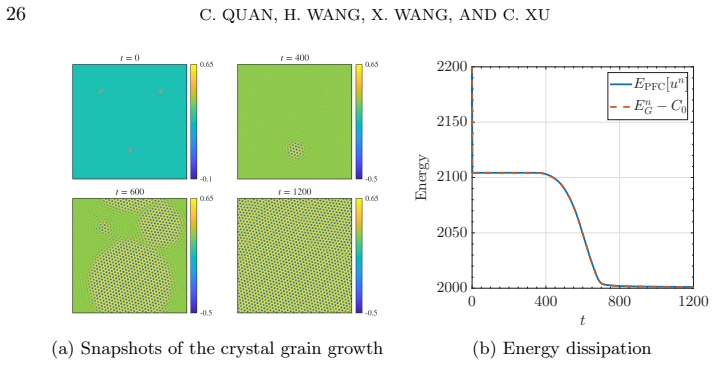
This paper proposes a theoretical framework for establishing the energy dissipation of general implicit-explicit linear multistep methods (IMEX-LMMs) for gradient flows, by constructing a dissipative modified energy consisting of the original energy and a non-negative quadratic modification. We first test IMEX-LMMs with a simple multiplier, the first-order time difference of numerical solutions. Then, it is shown that the associated non-negative quadratic modification can be constructed if and only if two generating polynomials (corresponding to the LMM) are positive on $[-1,1]$. Based on this, the modified energy is proved to decay over time under a mild time-step restriction depending on the lower bounds of the associated generating polynomials. As a consequence, the energy dissipation of the well-known backward differentiation formula methods up to fifth order can be obtained straightforwardly. Furthermore, we construct for the first time (to the best of our knowledge) a sixth-order energy-dissipative IMEX-LMM and also prove the sixth-order barrier of energy-dissipative IMEX-LMMs when testing the simple multiplier. Some numerical experiments are conducted to verify our theoretical results.
Editorial analysis
A structured set of objections, weighed in public.
Referee Report
Summary. The paper develops a framework for proving energy dissipation of implicit-explicit linear multistep methods (IMEX-LMMs) applied to gradient flows. Using the simple multiplier given by the first-order backward difference of the numerical solution, it derives an if-and-only-if condition: a non-negative quadratic modification to the original energy exists precisely when the two generating polynomials of the LMM are positive on [-1,1]. Under this positivity, the modified energy is shown to decay monotonically provided the time step satisfies a mild restriction depending on the lower bounds of those polynomials. The framework recovers energy dissipation for BDF methods through order 5, yields an explicit sixth-order energy-dissipative IMEX-LMM, and establishes a sixth-order barrier that holds specifically when the simple multiplier is employed. Numerical experiments are presented to illustrate the theory.
Significance. If the central derivations hold, the work supplies a systematic, polynomial-based criterion for constructing dissipative modified energies for a broad class of IMEX-LMMs. The if-and-only-if characterization and the explicit time-step restriction tied to polynomial lower bounds are concrete and usable. The recovery of BDF results up to order 5, the new sixth-order construction, and the accompanying barrier for the simple-multiplier case constitute clear advances. The approach is scoped precisely to the chosen multiplier, which limits over-claiming while still delivering practical insight for structure-preserving discretizations of gradient flows.
major comments (2)
- [§4, Theorem 4.1] §4, Theorem 4.1 (the if-and-only-if statement): the necessity direction requires showing that positivity of the generating polynomials on [-1,1] is also required for the quadratic form to be non-negative; the provided sketch appears to establish sufficiency directly from the positivity assumption but leaves the converse argument implicit. Because this equivalence is load-bearing for the subsequent decay proof and the sixth-order barrier, an expanded derivation of necessity would strengthen the claim.
- [§5.2] §5.2, the sixth-order construction: the coefficients of the new IMEX-LMM are stated to satisfy the positivity condition, yet the explicit verification that the associated quadratic modification remains non-negative for all admissible time steps is only summarized. A short table or direct computation of the lower bound would make the construction fully reproducible.
minor comments (2)
- [§2–§3] Notation: the two generating polynomials are introduced with different symbols in §2 and §3; consistent use of a single pair of symbols (e.g., α(ζ) and β(ζ)) throughout would improve readability.
- [§6] Numerical section: the time-step restriction derived from the polynomial lower bounds is not numerically compared against the observed stability thresholds in the experiments; adding this comparison would directly illustrate the sharpness of the theoretical bound.
Simulated Author's Rebuttal
We thank the referee for the positive evaluation and the constructive comments, which will improve the clarity and reproducibility of the manuscript. We address each major point below and will revise accordingly.
read point-by-point responses
-
Referee: [§4, Theorem 4.1] §4, Theorem 4.1 (the if-and-only-if statement): the necessity direction requires showing that positivity of the generating polynomials on [-1,1] is also required for the quadratic form to be non-negative; the provided sketch appears to establish sufficiency directly from the positivity assumption but leaves the converse argument implicit. Because this equivalence is load-bearing for the subsequent decay proof and the sixth-order barrier, an expanded derivation of necessity would strengthen the claim.
Authors: We agree that the necessity direction, while present in the proof of Theorem 4.1 (via contraposition: if either polynomial takes a negative value at some point in [-1,1], a suitable choice of the discrete solution sequence renders the quadratic form negative), can be made more explicit. In the revised manuscript we will insert an additional lemma that isolates the necessity argument, with explicit test sequences and direct computation of the quadratic form, before combining it with the sufficiency direction already given. revision: yes
-
Referee: [§5.2] §5.2, the sixth-order construction: the coefficients of the new IMEX-LMM are stated to satisfy the positivity condition, yet the explicit verification that the associated quadratic modification remains non-negative for all admissible time steps is only summarized. A short table or direct computation of the lower bound would make the construction fully reproducible.
Authors: We accept the suggestion. The revised §5.2 will contain a short table that lists (i) the coefficients of the new sixth-order IMEX-LMM, (ii) the numerically computed infima of the two generating polynomials on [-1,1], and (iii) the resulting explicit time-step restriction. This will make the verification of non-negativity of the quadratic modification fully reproducible. revision: yes
Circularity Check
No significant circularity detected
full rationale
The paper derives the if-and-only-if positivity condition on the two generating polynomials directly from testing the IMEX-LMM with the simple first-order multiplier (the time difference of solutions), then proves modified energy decay from that condition under a time-step restriction tied to the polynomials' lower bounds. This chain is self-contained in the stated hypotheses and does not reduce any central claim to a fitted parameter, self-definition, or load-bearing self-citation; the sixth-order construction and barrier are likewise scoped explicitly to the simple multiplier. No steps match the enumerated circularity patterns.
Axiom & Free-Parameter Ledger
axioms (1)
- domain assumption The non-negative quadratic modification exists precisely when the two generating polynomials are positive on [-1,1]
Reference graph
Works this paper leans on
-
[1]
Akrivis , Stability of implicit-explicit backward difference formul as for nonlinear parabolic equations, SIAM J
G. Akrivis , Stability of implicit-explicit backward difference formul as for nonlinear parabolic equations, SIAM J. Numer. Anal., 53 (2015), pp. 464–484
2015
-
[2]
Akrivis , Stability properties of implicit-explicit multistep meth ods for a class of nonlinear parabolic equations, Math
G. Akrivis , Stability properties of implicit-explicit multistep meth ods for a class of nonlinear parabolic equations, Math. Comp., 85 (2016), pp. 2217–2229
2016
-
[3]
Akrivis, M
G. Akrivis, M. Chen, and F. Yu , The weighted and shifted seven-step BDF method for parabolic equations, IMA J. Numer. Anal., 45 (2025), pp. 3207–3234
2025
-
[4]
Akrivis, M
G. Akrivis, M. Chen, F. Yu, and Z. Zhou , The energy technique for the six-step BDF method , SIAM J. Numer. Anal., 59 (2021), pp. 2449–2472
2021
-
[5]
Akrivis and F
G. Akrivis and F. Karakatsani , Modified implicit-explicit BDF methods for nonlinear par- abolic equations, BIT, 43 (2003), pp. 467–483
2003
-
[6]
Akrivis and C
G. Akrivis and C. Lubich , Fully implicit, linearly implicit and implicit-explicit b ackward dif- ference formulae for quasi-linear parabolic equations , Numer. Math., 131 (2015), pp. 713– 735
2015
-
[7]
U. M. Ascher, S. J. Ruuth, and B. T. R. Wetton , Implicit-explicit methods for time- dependent partial differential equations , SIAM J. Numer. Anal., 32 (1995), pp. 797–823
1995
-
[8]
Baiocchi and M
C. Baiocchi and M. Crouzeix , On the equivalence of A-stability and G-stability , Applied Numerical Mathematics, 5 (1989), pp. 19–22
1989
-
[9]
Boyd and L
S. Boyd and L. V andenberghe , Convex optimization , Cambridge University Press, 2004
2004
-
[10]
Brezis , Functional analysis, Sobolev spaces and partial differenti al equations, Universitext, Springer, New York, 2011
H. Brezis , Functional analysis, Sobolev spaces and partial differenti al equations, Universitext, Springer, New York, 2011
2011
-
[11]
Chen and J
L. Chen and J. Shen , Applications of semi-implicit Fourier-spectral method to phase field equations, Comput. Phys. Commun., 108 (1998), pp. 147–158
1998
-
[12]
Dahlquist , Convergence and stability in the numerical integration of o rdinary differen- tial equations , Math
G. Dahlquist , Convergence and stability in the numerical integration of o rdinary differen- tial equations , Math. Scand., 4 (1956), pp. 33–53, https://doi.org/10.71 46/math.scand. a-10454
1956
-
[13]
G. G. Dahlquist , Stability questions for some numerical methods for ordinar y differential equations, in Proc. Sympos. Appl. Math., Vol. XV, Amer. Math. Soc., Pro vidence, RI, 1963, pp. 147–158
1963
-
[14]
G. G. Dahlquist , G-stability is equivalent to A-stability, BIT, 18 (1978), pp. 384–401
1978
-
[15]
Daubechies , Ten lectures on wavelets , vol
I. Daubechies , Ten lectures on wavelets , vol. 61 of CBMS-NSF Regional Conference Series in Applied Mathematics, Society for Industrial and Applied Ma thematics (SIAM), Philadel- phia, PA, 1992
1992
-
[16]
T. A. Driscoll, N. Hale, and L. N. Trefethen , Chebfun guide , 2014
2014
-
[17]
Frank, W
J. Frank, W. Hundsdorfer, and J. G. Verwer , On the stability of implicit-explicit linear multistep methods, Appl. Numer. Math., 25 (1997), pp. 193–205, https://doi.o rg/10.1016/ S0168-9274(97)00059-7
1997
-
[18]
Z. Fu, J. Shen, and J. Yang , Higher-order energy-decreasing exponential time differen cing Runge-Kutta methods for gradient flows , Sci. China Math., 68 (2025), pp. 1727–1746, https://doi.org/10.1007/s11425-024-2337-3
-
[19]
Z. Fu, T. Tang, and J. Yang , Energy diminishing implicit-explicit Runge-Kutta method s for gradient flows , Math. Comp., 93 (2024), pp. 2745–2767, https://doi.org/1 0.1090/mcom/ 3950
2024
-
[20]
Z. Fu and J. Yang , Energy-decreasing exponential time differencing Runge-Ku tta methods for phase-field models , J. Comput. Phys., 454 (2022), pp. Paper No. 110943, 11, http s://doi. org/10.1016/j.jcp.2022.110943
-
[21]
Gong and J
Y. Gong and J. Zhao , Energy-stable Runge-Kutta schemes for gradient flow models using the energy quadratization approach , Appl. Math. Lett., 94 (2019), pp. 224–231
2019
-
[22]
Hairer and G
E. Hairer and G. W anner , Solving ordinary differential equations. II , vol. 14 of Springer Series in Computational Mathematics, Springer-Verlag, Be rlin, revised ed., 2010. Stiff and differential-algebraic problems
2010
-
[23]
Y. Hao, Q. Huang, and C. W ang , A third order BDF energy stable linear scheme for the no-slope-selection thin film model , Commun. Comput. Phys., 29 (2021), pp. 905–929
2021
-
[24]
Huang and J
F. Huang and J. Shen , On a new class of BDF and IMEX schemes for parabolic type equa- tions, SIAM J. Numer. Anal., 62 (2024), pp. 1609–1637
2024
-
[25]
F. Huang and J. Shen , Stability and error analysis of a new class of higher-order c onsistent splitting schemes for the Navier-Stokes equations , Math. Comp., (2025), https://doi.org/ 10.1090/mcom/4132
-
[26]
D. Li, C. Quan, and J. Xu , Stability and convergence of Strang splitting. Part I: Scal ar Allen- Cahn equation , J. Comput. Phys., 458 (2022), pp. Paper No. 111087, 20, http s://doi.org/ 10.1016/j.jcp.2022.111087. 28 C. QUAN, H. W ANG, X. W ANG, AND C. XU
- [27]
-
[28]
Q. Y. Li and J. D. Xie , A linear multistep method for solving stiff ordinary differen tial equa- tions, J. Tsinghua Univ., 31 (1991), pp. 1–11
1991
-
[29]
X. Li, Z. Qiao, and C. W ang, Convergence analysis for a stabilized linear semi-implici t numer- ical scheme for the nonlocal Cahn-Hilliard equation , Math. Comp., 90 (2021), pp. 171–188
2021
-
[30]
X. Li, Z. Qiao, C. W ang, and N. Zheng , Global-in-time energy stability analysis for a second- order accurate exponential time differencing Runge-Kutta s cheme for the phase field crystal equation, Math. Comp., 95 (2026), pp. 803–831, https://doi.org/10. 1090/mcom/4067
2026
-
[31]
Liao and Y
H.-l. Liao and Y. Kang , L2 norm error estimates of BDF methods up to fifth-order for the phase field crystal model , IMA J. Numer. Anal., 44 (2024), pp. 2138–2164
2024
-
[32]
H.-L. Liao, T. Tang, and T. Zhou , A new discrete energy technique for multi-step backward difference formulas , CSIAM Trans. Appl. Math., 3 (2022), pp. 318–334
2022
- [33]
-
[34]
Lubich, D
C. Lubich, D. Mansour, and C. Venkataraman , Backward difference time discretization of parabolic differential equations on evolving surfaces , IMA J. Numer. Anal., 33 (2013), pp. 1365–1385
2013
-
[35]
Nevanlinna and F
O. Nevanlinna and F. Odeh , Multiplier techniques for linear multistep methods , Numer. Funct. Anal. Optim., 3 (1981), pp. 377–423
1981
-
[36]
R. R. Rosales, B. Seibold, D. Shirokoff, and D. Zhou , Unconditional stability for multistep ImEx schemes: theory , SIAM J. Numer. Anal., 55 (2017), pp. 2336–2360
2017
-
[37]
Seibold, D
B. Seibold, D. Shirokoff, and D. Zhou , Unconditional stability for multistep ImEx schemes: practice, J. Comput. Phys., 376 (2019), pp. 295–321
2019
-
[38]
J. Shen, T. Tang, and L.-L. W ang , Spectral methods: algorithms, analysis and applications , vol. 41, Springer Science & Business Media, 2011
2011
-
[39]
Shen and X
J. Shen and X. Yang , Numerical approximations of Allen-Cahn and Cahn-Hilliard equations, Discrete Contin. Dyn. Syst., 28 (2010), pp. 1669–1691
2010
-
[40]
, fft: Fast Fourier Transform , The MathW orks Inc., Natick, Massachu- setts, United States, 2026, https://www.mathworks.com/h elp/matlab/ref/fft.html
The MathWorks Inc. , fft: Fast Fourier Transform , The MathW orks Inc., Natick, Massachu- setts, United States, 2026, https://www.mathworks.com/h elp/matlab/ref/fft.html. MAT- LAB Documentation, accessed May 12, 2026
2026
-
[41]
Thom ´ee, Galerkin finite element methods for parabolic problems , vol
V. Thom ´ee, Galerkin finite element methods for parabolic problems , vol. 25 of Springer Series in Computational Mathematics, Springer-Verlag, Berlin, s econd ed., 2006
2006
-
[42]
L. N. Trefethen , Approximation theory and approximation practice , Society for Industrial and Applied Mathematics (SIAM), Philadelphia, PA, extende d ed., 2020
2020
-
[43]
Xu and T
C. Xu and T. Tang , Stability analysis of large time-stepping methods for epit axial growth models, SIAM J. Numer. Anal., 44 (2006), pp. 1759–1779
2006
discussion (0)
Sign in with ORCID, Apple, or X to comment. Anyone can read and Pith papers without signing in.