MSCGC-KAN: Multi-scale Causal Graph Convolution and Kolmogorov-Arnold Feature Mapping for EEG Emotion Recognition
Pith reviewed 2026-06-29 18:19 UTC · model grok-4.3
The pith
A task head with multi-scale causal graph convolution and Kolmogorov-Arnold mapping improves fine-tuning of pre-trained EEG models for emotion recognition.
A machine-rendered reading of the paper's core claim, the machinery that carries it, and where it could break.
Core claim
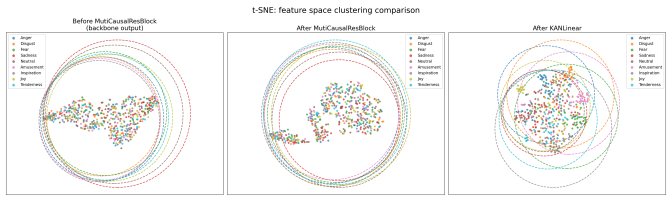
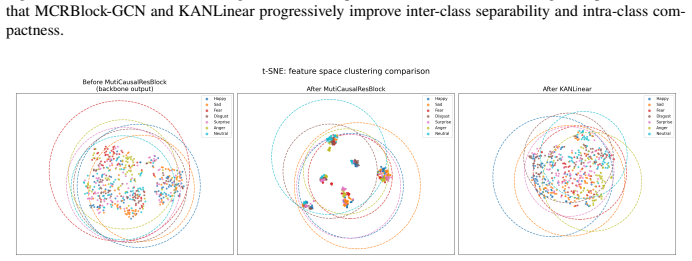
Built on a pre-trained CBraMod backbone, MSCGC-KAN introduces a structured task head composed of multi-scale causal graph convolution and Kolmogorov-Arnold feature mapping. This design jointly strengthens multi-scale temporal modeling, learnable inter-channel connectivity modeling, and nonlinear discriminative mapping within a compact task-specific head. The method preserves the representation advantage of the foundation model while making the classifier more sensitive to emotion-related spatiotemporal patterns, resulting in balanced accuracy of 60.66% on FACED and 33.27% on SEED-VII, with gains of 5.91 and 2.03 percentage points over the linear baseline.
What carries the argument
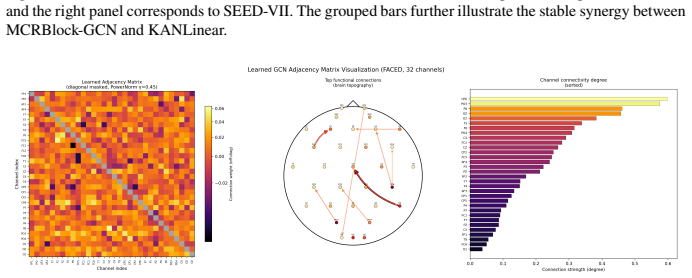
MSCGC-KAN task head, which uses multi-scale causal graph convolution to model temporal dynamics and inter-channel relations, followed by Kolmogorov-Arnold networks to perform nonlinear feature mapping.
If this is right
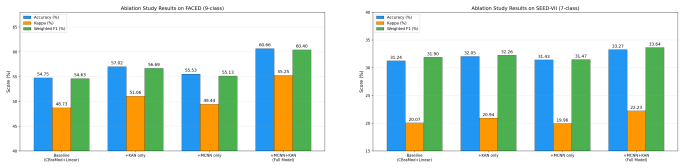
- The method reaches 60.66% balanced accuracy, 0.5525 Cohen's Kappa, and 60.40% weighted F1 on FACED.
- It reaches 33.27% balanced accuracy, 0.2223 Cohen's Kappa, and 33.64% weighted F1 on SEED-VII.
- Balanced accuracy improves by 5.91 percentage points on FACED and 2.03 percentage points on SEED-VII over the CBraMod+Linear baseline.
- Structured task-head design provides an effective route to better emotion recognition performance during fine-tuning of pre-trained EEG models.
Where Pith is reading between the lines
- The same head architecture could be attached to other pre-trained EEG backbones to test whether the gains depend on the specific CBraMod representations.
- The multi-scale causal graph and KAN combination might transfer to other EEG classification tasks such as motor imagery or sleep staging.
- Ablation studies that isolate the contribution of each scale in the graph convolution could clarify which temporal resolutions drive the observed improvements.
Load-bearing premise
The measured accuracy gains arise specifically because the multi-scale causal graph convolution and Kolmogorov-Arnold components resolve the three listed limitations in fine-tuning rather than from other experimental choices.
What would settle it
Re-running the fine-tuning experiments on the same datasets and backbone but replacing the proposed head with an alternative nonlinear head that lacks the graph convolution component and observing no comparable gains in balanced accuracy would falsify the central claim.
Figures




read the original abstract
Electroencephalogram (EEG)-based emotion recognition is an important affective computing task, and recent EEG foundation models provide useful generic representations for downstream adaptation. However, under the fine-tuning setting, three limitations remain prominent: insufficient modeling of multi-scale emotional dynamics, inadequate exploitation of inter-channel functional connectivity, and the limited expressive power of simple linear classification heads. To address these issues, this paper proposes a new EEG emotion recognition method, termed MSCGC-KAN, which introduces a structured task head composed of multi-scale causal graph convolution and Kolmogorov--Arnold feature mapping. Built on a pre-trained CBraMod backbone, MSCGC-KAN enhances downstream adaptation by jointly strengthening multi-scale temporal modeling, learnable inter-channel connectivity modeling, and nonlinear discriminative mapping within a compact task-specific head. This design preserves the representation advantage of the foundation model while making the classifier more sensitive to emotion-related spatiotemporal patterns. Extensive experiments are conducted on the public FACED and SEED-VII datasets. The proposed method achieves a balanced accuracy of 60.66\%, a Cohen's Kappa of 0.5525, and a weighted F1-score of 60.40\% on FACED, and obtains 33.27\%, 0.2223, and 33.64\%, respectively, on SEED-VII. Compared with the CBraMod+Linear baseline, the balanced accuracy is improved by 5.91 and 2.03 percentage points on the two datasets, respectively. These results indicate that structured task-head design is an effective way to improve EEG emotion recognition when fine-tuning pre-trained EEG models.
Editorial analysis
A structured set of objections, weighed in public.
Referee Report
Summary. The manuscript proposes MSCGC-KAN, a structured task head for fine-tuning the pre-trained CBraMod EEG foundation model on emotion recognition. The head combines multi-scale causal graph convolution (for temporal dynamics and learnable inter-channel connectivity) with Kolmogorov-Arnold feature mapping (for nonlinear classification). On the FACED and SEED-VII datasets the method reports balanced accuracies of 60.66% and 33.27%, respectively, corresponding to gains of 5.91 and 2.03 percentage points over the CBraMod+Linear baseline.
Significance. If the reported gains can be isolated to the proposed components, the work would demonstrate that compact, domain-structured task heads can meaningfully improve adaptation of EEG foundation models while preserving the backbone's representations. This would be a practical contribution to affective computing pipelines that rely on pre-trained models.
major comments (1)
- [Abstract] Abstract (results paragraph): The central claim attributes the 5.91 pp and 2.03 pp balanced-accuracy improvements specifically to the multi-scale causal graph convolution, learnable inter-channel connectivity modeling, and KAN components. However, the manuscript supplies only the end-to-end comparison against the linear baseline; no ablation studies that remove or replace individual modules, no matched-capacity controls, no optimizer/training-protocol details, and no statistical significance tests on the deltas are referenced. This prevents verification that the observed lifts arise from the claimed mechanisms rather than other experimental factors.
Simulated Author's Rebuttal
We thank the referee for the constructive feedback. We address the major comment on the attribution of performance gains point by point below.
read point-by-point responses
-
Referee: [Abstract] Abstract (results paragraph): The central claim attributes the 5.91 pp and 2.03 pp balanced-accuracy improvements specifically to the multi-scale causal graph convolution, learnable inter-channel connectivity modeling, and KAN components. However, the manuscript supplies only the end-to-end comparison against the linear baseline; no ablation studies that remove or replace individual modules, no matched-capacity controls, no optimizer/training-protocol details, and no statistical significance tests on the deltas are referenced. This prevents verification that the observed lifts arise from the claimed mechanisms rather than other experimental factors.
Authors: We agree that the current version reports only the end-to-end comparison and does not include the requested controls. In the revised manuscript we will add (i) ablation variants that successively remove the multi-scale causal graph convolution, the learnable inter-channel connectivity, and the KAN mapping, (ii) matched-capacity MLP and linear baselines trained under identical protocols, (iii) explicit optimizer, learning-rate schedule, and training-hyperparameter details, and (iv) statistical significance tests (paired t-test or Wilcoxon signed-rank) on the reported deltas. These additions will allow direct verification that the observed gains are attributable to the proposed components. revision: yes
Circularity Check
No circularity: empirical performance claims rest on external dataset comparisons, not self-referential definitions or fitted inputs
full rationale
The paper reports balanced-accuracy gains of 5.91 pp and 2.03 pp on FACED and SEED-VII relative to a CBraMod+Linear baseline. These are presented as experimental outcomes from fine-tuning a pre-trained backbone with an added task head; no equations, parameter-fitting steps, or derivations are supplied in the abstract that would allow any reported metric to reduce to its own inputs by construction. No self-citations, uniqueness theorems, or ansatzes are invoked. The central claim therefore remains an ordinary empirical comparison whose validity can be checked against the stated datasets and protocols, satisfying the self-contained criterion.
Axiom & Free-Parameter Ledger
Reference graph
Works this paper leans on
-
[1]
G.Assuncao,B.Patrao,M.Castelo-Branco,P.Menezes,Anoverviewofemotion in artificial intelligence, IEEE Trans. Artif. Intell. 3 (6) (2022) 867–886
2022
-
[2]
Zhang, Y
T. Zhang, Y. Zong, W. Zheng, et al., Cross-database micro-expression recogni- tion: a benchmark, IEEE Trans. Knowl. Data Eng. 34 (2) (2022) 544–559
2022
-
[3]
Y. Lei, S. Yang, X. Wang, L. Xie, MsEmoTTS: Multi-scale emotion transfer, prediction,andcontrolforemotionalspeechsynthesis,IEEE/ACMTrans.Audio Speech Lang. Process. 30 (2022) 853–864
2022
-
[4]
Zhang, X
T. Zhang, X. Gong, C. L. P. Chen, BMT-Net: Broad multitask transformer network for sentiment analysis, IEEE Trans. Cybern. 52 (7) (2022) 6232–6243
2022
-
[5]
Q.She,X.Shi,F.Fang,Y.Ma,Y.Zhang,Cross-subjectEEGemotionrecognition using multi-source domain manifold feature selection, Comput. Biol. Med. 159 (2023) 106860.doi:10.1016/j.compbiomed.2023.106860
-
[6]
W.-L.Zheng,J.-Y.Zhu,B.-L.Lu,Identifyingstablepatternsovertimeforemotion recognition from EEG, IEEE Trans. Affect. Comput. 10 (3) (2019) 417–429
2019
-
[7]
Samal, M
P. Samal, M. F. Hashmi, Role of machine learning and deep learning techniques in EEG-based BCI emotion recognition system: a review, Artificial Intelligence Review 57 (50) (2024). 31
2024
-
[8]
Y. Ding, S. Zhang, C. Tang, C. Guan, MASA-TCN: Multi-anchor space-aware temporalconvolutionalneuralnetworksforcontinuousanddiscreteEEGemotion recognition, IEEE J. Biomed. Health Inform. 28 (7) (2024) 3953–3964.doi: 10.1109/JBHI.2024.3392564
-
[9]
D. Li, B. Chai, Z. Wang, H. Yang, W. Du, EEG emotion recognition based on 3-d feature representation and dilated fully convolutional networks, IEEE Trans. Cogn.Dev.Syst.13(4)(2021)885–897.doi:10.1109/TCDS.2021.3051465
-
[10]
Z.Cheng,X.Bu,Q.Wang,T.Yang,J.Tu,EEG-basedemotionrecognitionusing multi-scale dynamic CNN and gated transformer, Scientific Reports 14 (2024) 31319
2024
-
[11]
Z. Jia, Y. Lin, J. Cai, et al., SST-EmotionNet: Spatial-spectral-temporal based attention 3D dense network for EEG emotion recognition, in: Proc. ACM Int. Conf. Multimedia, 2020
2020
-
[12]
W. Tao, C. Li, R. Song, et al., EEG-based emotion recognition via channel-wise attentionandselfattention,IEEETrans.Affect.Comput.14(1)(2023)382–393
2023
-
[13]
R. Liu, Y. Chao, X. Ma, X. Sha, L. Sun, S. Li, S. Chang, ERTNet: an inter- pretabletransformer-basedframeworkforEEGemotionrecognition,Frontiersin Neuroscience 18 (2024) 1320645
2024
-
[14]
G.Zhang,M.Yu,Y.-J.Liu,G.Zhao,D.Zhang,W.Zheng,SparseDGCNN:Rec- ognizing emotion from multichannel EEG signals, IEEE Trans. Affect. Comput. 14 (1) (2023) 537–548.doi:10.1109/TAFFC.2021.3051332
-
[15]
Zhong, D
P. Zhong, D. Wang, C. Miao, EEG-based emotion recognition using regularized graph neural networks, IEEE Trans. Affect. Comput. 13 (3) (2022) 1290–1301
2022
-
[16]
T. Song, W. Zheng, P. Song, Z. Cui, EEG emotion recognition using dynamical 32 graphconvolutionalneuralnetworks,IEEETrans.Affect.Comput.11(3)(2020) 532–541
2020
-
[17]
W. Chen, Y. Liao, R. Dai, Y. Dong, L. Huang, EEG-based emotion recogni- tion using graph convolutional neural network with dual attention mechanism, Frontiers in Computational Neuroscience 18 (2024) 1416494
2024
-
[18]
R.Li,X.Yang,J.Lou,J.Zhang,Atemporal-spectralgraphconvolutionalneural network model for EEG emotion recognition within and across subjects, Brain Informatics 11 (30) (2024)
2024
-
[19]
K. Shen, Q. She, X. Yang, Y. Gao, Y. Fan, Dynamic sparse directed graph convolutional network with attention mechanisms for EEG emotion recognition, Neurocomputing 658 (2025) 131749
2025
-
[20]
J. Wang, S. Zhao, Z. Luo, Y. Zhou, H. Jiang, S. Li, T. Li, G. Pan, CBraMod: A criss-cross brain foundation model for EEG decoding, in: Proc. ICLR, 2025
2025
-
[21]
C. Yang, D. Westover, Q. Sun, et al., BIOT: Biosignal transformer for cross-data learning in the wild, in: Proc. NeurIPS, 2023
2023
-
[22]
ICLR, 2024
W.Jiang,L.Zhao,B.Lu,Largebrainmodelforlearninggenericrepresentations with tremendous EEG data in BCI, in: Proc. ICLR, 2024
2024
- [23]
-
[24]
WaveNet: A Generative Model for Raw Audio
A. van den Oord, et al., WaveNet: A generative model for raw audio, arXiv:1609.03499 (2016)
work page internal anchor Pith review Pith/arXiv arXiv 2016
-
[25]
CVPR, 2015, pp
C.Szegedy,W.Liu,Y.Jia,etal.,Goingdeeperwithconvolutions,in: Proc.IEEE Conf. CVPR, 2015, pp. 1–9. 33
2015
-
[26]
A. N. Kolmogorov, On the representation of continuous functions of many vari- ables by superposition of continuous functions of one variable and addition, Dokl. Akad. Nauk SSSR 114 (1957) 953–956
1957
-
[27]
Z. Liu, Y. Wang, S. Vaidya, et al., KAN: Kolmogorov-Arnold Networks, arXiv:2404.19756 (2024)
work page internal anchor Pith review Pith/arXiv arXiv 2024
-
[28]
J.Chen,X.Wang,C.Huang,etal.,Alargefiner-grainedaffectivecomputingEEG dataset, Scientific Data 10 (2023) 740.doi:10.1038/s41597-023-02650-w
- [29]
-
[30]
I.Loshchilov,F.Hutter,Decoupledweightdecayregularization,in: Proc.ICLR, 2019
2019
-
[31]
V. J. Lawhern, A. J. Solon, N. R. Waytowich, S. M. Gordon, C. P. Hung, B. J. Lance,EEGNet: AcompactconvolutionalneuralnetworkforEEG-basedbrain– computer interfaces, Journal of Neural Engineering 15 (5) (2018) 056013
2018
-
[32]
Y. Song, Q. Zheng, B. Liu, X. Gao, EEG conformer: Convolutional transformer for EEG decoding and visualization, IEEE Trans. Neural Syst. Rehabil. Eng. 31 (2023) 710–719.doi:10.1109/TNSRE.2022.3230250
-
[33]
J. Jing, W. Ge, S. Hong, M. B. Fernandes, Z. Lin, C. Yang, S. An, A. F. Struck, A. Herlopian, I. Karakis, et al., Development of expert-level classification of seizures and rhythmic and periodic patterns during EEG interpretation, Neurol- ogy 100 (17) (2023) e1750–e1762.doi:10.1212/WNL.0000000000207127
-
[34]
W. Y. Peh, Y. Yao, J. Dauwels, Transformer convolutional neural networks for 34 automated artifact detection in scalp EEG, in: Proc. 44th Annu. Int. Conf. IEEE Eng. Med. Biol. Soc., 2022, pp. 3599–3602
2022
-
[35]
H. Li, M. Ding, R. Zhang, C. Xiu, Motor imagery EEG classification algorithm basedonCNN-LSTMfeaturefusionnetwork,BiomedicalSignalProcessingand Control 72 (2022) 103342
2022
- [36]
- [37]
- [38]
- [39]
-
[40]
Y.E.Ouahidi,J.Lys,P.Thoelke,N.Farrugia,B.Pasdeloup,V.Gripon,K.Jerbi, G. Lioi, REVE: A foundation model for EEG–adapting to any setup with large- scale pretraining on 25,000 subjects, arXiv:2510.21585 (2025)
-
[41]
C.Cheng,W.Liu,L.Feng,Z.Jia,Emotionrecognitionusinghierarchicalspatial– temporal learning transformer from regional to global brain, Neural Networks 179 (2024) 106624
2024
-
[42]
P.Vuilleumier,G.Pourtois,Distributedandinteractivebrainmechanismsduring emotion face perception: evidence from functional neuroimaging, Neuropsy- chologia 45 (1) (2007) 174–194. 35
2007
-
[43]
J. A. Russell, A circumplex model of affect, Journal of Personality and Social Psychology 39 (6) (1980) 1161–1178. Appendix A. Supplementary Interpretability Visualizations This appendix provides the SEED-VII interpretability visualizations that comple- menttherepresentativeFACEDvisualizationsinSectionIII.Thesefiguresareincluded as supplementary material ...
1980
discussion (0)
Sign in with ORCID, Apple, or X to comment. Anyone can read and Pith papers without signing in.