Design principles for optoelectronic light-scattering reservoir computing at the edge of chaos
Pith reviewed 2026-06-29 16:13 UTC · model grok-4.3
The pith
Three control axes in a light-scattering reservoir reach optima at the edge of chaos for sequential inference.
A machine-rendered reading of the paper's core claim, the machinery that carries it, and where it could break.
Core claim
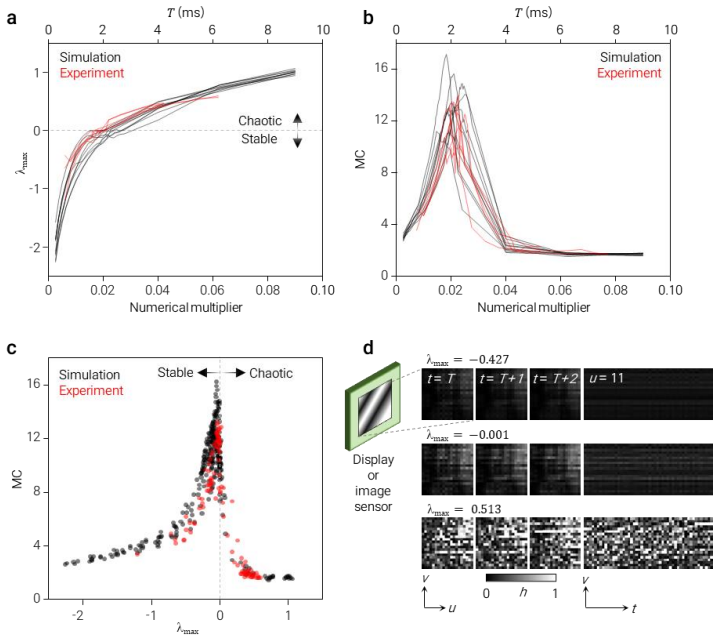
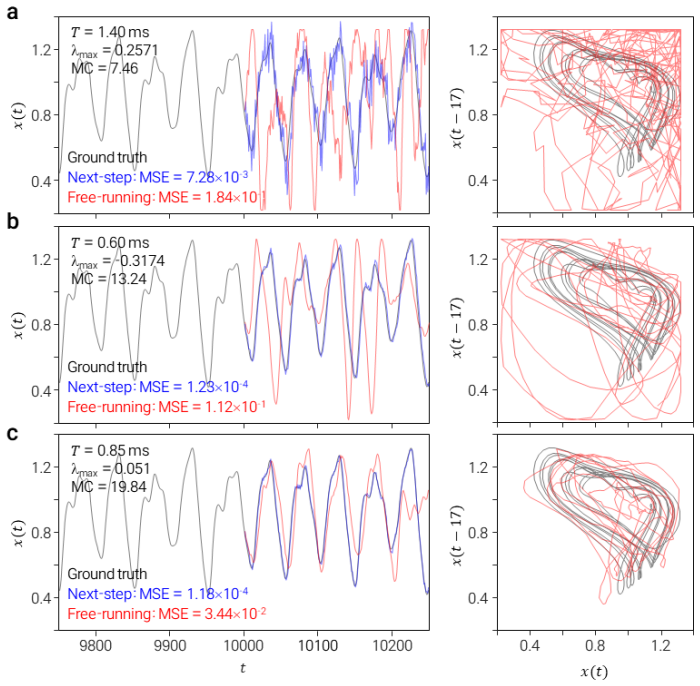
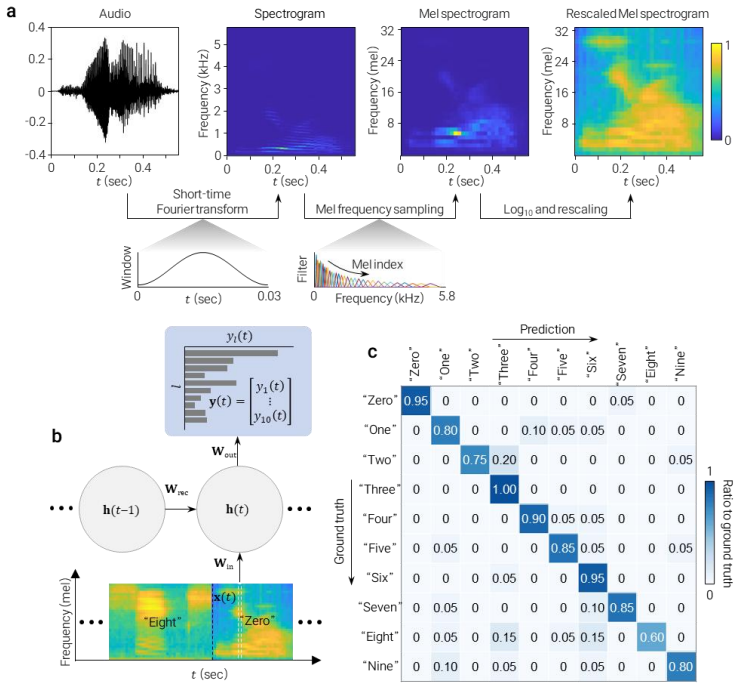
By varying the three physical control axes the study identifies a quantitative optimum where memory capacity peaks at a near-zero maximal Lyapunov exponent. Operating at this point the reservoir supports stable free-running Mackey-Glass time-series prediction and achieves 84.5 percent blind classification accuracy on the 10-class Speech Commands benchmark. The design principles are stated in substrate-specific units yet rest on substrate-independent notions of criticality and balanced coupling.
What carries the argument
Three physical control axes—reservoir dynamics, input-reservoir coupling, and reservoir interconnectivity—whose joint optimum places the system at the edge of chaos and produces the reported performance.
If this is right
- Stable Mackey-Glass prediction occurs in free-running mode at the three-axis optimum.
- 84.5 percent blind accuracy is reached on the 10-class Speech Commands benchmark.
- The memory-capacity peak is reproduced quantitatively by numerical simulation.
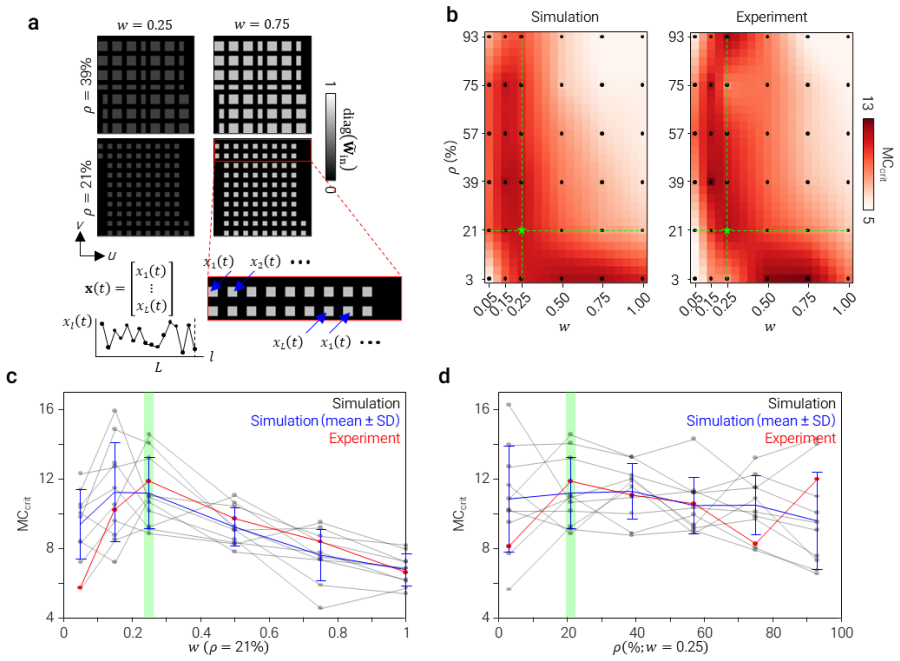
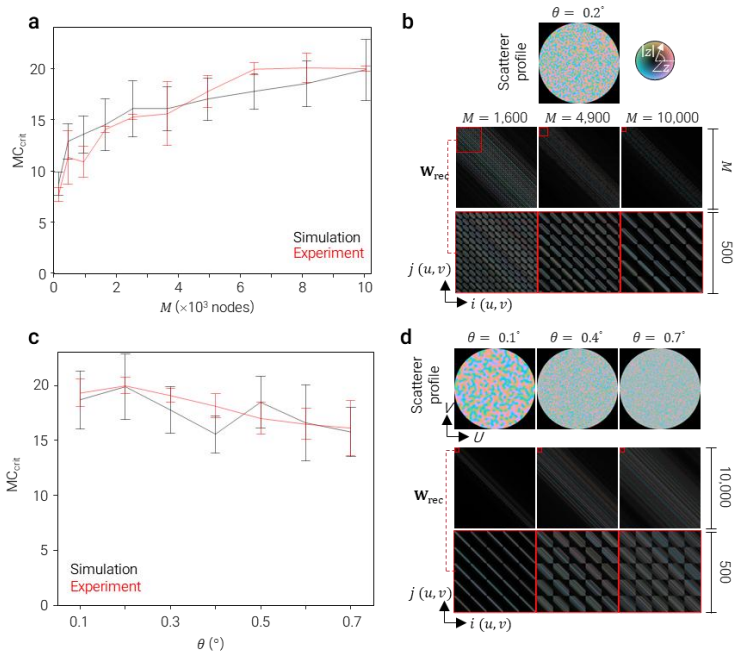
- Input coupling shows a density-magnitude trade-off and interconnectivity shows an intermediate optimum.
Where Pith is reading between the lines
- The same three-axis mapping could be applied to other reconfigurable photonic substrates to test whether the edge-of-chaos location remains optimal.
- The density-magnitude trade-off in coupling strength may set practical limits on input-signal scaling in free-space optical reservoirs.
- An intermediate interconnectivity optimum may turn out to be a general rule for balancing memory and nonlinearity across physical reservoir types.
Load-bearing premise
The memory-capacity peak at near-zero Lyapunov exponent is what causes the benchmark performance rather than merely correlating with it.
What would settle it
Fix the input-coupling and interconnectivity axes at their reported optima, deliberately shift the maximal Lyapunov exponent away from zero, and check whether prediction error rises or classification accuracy falls below 84.5 percent.
Figures

read the original abstract
Physical reservoir computing offers an energy-efficient route to sequential cognitive inference by outsourcing nonlinear temporal mixing to hardware substrates with rich intrinsic dynamics, with free-space light-scattering systems particularly attractive for their parallelism and reconfigurability-yet practical design principles linking hardware control variables to computational performance have remained unestablished. Here, we establish such principles by systematically mapping three physical control axes of a reconfigurable optoelectronic light-scattering reservoir-reservoir dynamics, input-reservoir coupling, and reservoir interconnectivity-and identifying a quantitative optimum along each axis. Within this design landscape, we observe a memory-capacity peak that coincides with near-zero maximal Lyapunov exponent and is quantitatively reproduced in numerical simulation, extending edge-of-chaos confirmations previously reported in ion-gating and spin-wave reservoirs into the photonic substrate. The two remaining axes exhibit a density-magnitude trade-off in input coupling and an intermediate optimum in reservoir interconnectivity. Operating at the resulting three-axis optimum, the reservoir achieves stable Mackey-Glass chaotic time-series prediction in free-running mode and 84.5% blind classification accuracy on the 10-class Speech Commands spoken-digit benchmark; the principles, stated in substrate-specific units yet rooted in substrate-independent concepts of criticality and balanced coupling, provide a transferable framework for reconfigurable optical reservoir hardware.
Editorial analysis
A structured set of objections, weighed in public.
Referee Report
Summary. The paper claims to establish practical design principles for a reconfigurable optoelectronic light-scattering reservoir by systematically mapping three physical control axes (reservoir dynamics via maximal Lyapunov exponent, input-reservoir coupling, and reservoir interconnectivity). It reports a memory-capacity peak coinciding with near-zero maximal Lyapunov exponent that is quantitatively reproduced in simulation, plus stable free-running Mackey-Glass prediction and 84.5% blind accuracy on the 10-class Speech Commands benchmark when operating at the identified three-axis optimum. The principles are presented as substrate-specific yet rooted in substrate-independent notions of criticality and balanced coupling.
Significance. If the reported optima and performance metrics hold under the stated conditions, the work supplies concrete, transferable design rules for photonic reservoir hardware that extend prior edge-of-chaos observations from other physical substrates. The quantitative experimental-simulation match on the memory-capacity peak and the free-running chaotic prediction constitute clear strengths.
major comments (1)
- [Abstract] Abstract: the central claim that performance occurs at the 'resulting three-axis optimum' and that the work 'extends edge-of-chaos confirmations' rests on the untested assumption that the near-zero Lyapunov-exponent condition contributes causally rather than coinciding incidentally with the optima identified on the input-coupling and interconnectivity axes. No direct comparison is described that isolates the contribution of the dynamics axis (e.g., performance when the other two axes are optimized while the Lyapunov exponent is held away from zero).
Simulated Author's Rebuttal
We thank the referee for the detailed and constructive report. The single major comment is addressed point-by-point below.
read point-by-point responses
-
Referee: [Abstract] Abstract: the central claim that performance occurs at the 'resulting three-axis optimum' and that the work 'extends edge-of-chaos confirmations' rests on the untested assumption that the near-zero Lyapunov-exponent condition contributes causally rather than coinciding incidentally with the optima identified on the input-coupling and interconnectivity axes. No direct comparison is described that isolates the contribution of the dynamics axis (e.g., performance when the other two axes are optimized while the Lyapunov exponent is held away from zero).
Authors: We agree that the manuscript does not contain a controlled isolation experiment in which input-coupling and interconnectivity are held at their identified optima while the maximal Lyapunov exponent is deliberately moved away from zero. The evidence presented consists of (i) an independent sweep of the dynamics axis that locates a memory-capacity peak at near-zero MLE, quantitatively reproduced in simulation, and (ii) the joint performance obtained when all three axes are set to their individually mapped optima. This constitutes a correlation rather than a direct causal isolation. We will therefore revise the abstract (and the corresponding discussion paragraph) to replace language implying causality with language that reports the observed coincidence and the resulting performance metrics. revision: partial
Circularity Check
No circularity: derivation chain maps control axes to observed optima without reduction to inputs by construction
full rationale
The paper systematically varies three hardware axes (reservoir dynamics, input coupling, interconnectivity), reports a memory-capacity peak coinciding with near-zero Lyapunov exponent (reproduced in simulation), and states performance at the resulting optimum. No equations, fitted-parameter renamings, or self-citation chains are exhibited that define the claimed optima or performance metrics in terms of themselves. The edge-of-chaos extension cites prior work on other substrates without the present authors' prior results serving as the sole justification for the photonic case. The central claims remain independent of the reported metrics and are not forced by definition or statistical fitting of the target quantities.
Axiom & Free-Parameter Ledger
Reference graph
Works this paper leans on
-
[1]
Brown, B
T. Brown, B. Mann, N. Ryder, M. Subbiah, J. D. Kaplan, P. Dhariwal, A. Neelakantan, P. Shyam, G. Sastry, A. Askell, S. Agarwal, A. Herbert-Voss, G. Krueger, T. Henighan, R. Child, A. Ramesh, D. Ziegler, J. Wu, C. Winter, C. Hesse, M. Chen, E. Sigler, M. Litwin, S. Gray, B. Chess, J. Clark, C. Berner, S. McCandlish, A. Radford, I. Sutskever, D. Amodei, in ...
2020
-
[2]
Strubell, A
E. Strubell, A. Ganesh, A. McCallum, in Proceedings of the 57th Annual Meeting of the Association for Computational Linguistics, Association For Computational Linguistics, Florence, Italy, 2019, pp. 3645–3650
2019
-
[3]
Carbon Emissions and Large Neural Network Training
D. Patterson, J. Gonzalez, Q. Le, C. Liang, L.-M. Munguia, D. Rothchild, D. So, M. Texier, J. Dean, 2021, DOI 10.48550/arXiv.2104.10350
work page internal anchor Pith review Pith/arXiv arXiv doi:10.48550/arxiv.2104.10350 2021
-
[4]
M. C. Mackey, L. Glass, Science 1977, 197, 287
1977
-
[5]
G. Chen, C. Parada, G. Heigold, in 2014 IEEE International Conference on Acoustics, Speech and Signal Processing (ICASSP), IEEE, Florence, Italy, 2014, pp. 4087–4091
2014
-
[6]
Speech Commands: A Dataset for Limited-Vocabulary Speech Recognition
P. Warden, 2018, DOI 10.48550/ARXIV.1804.03209
work page internal anchor Pith review Pith/arXiv arXiv doi:10.48550/arxiv.1804.03209 2018
-
[7]
M. Yan, C. Huang, P. Bienstman, P. Tino, W. Lin, J. Sun, Nat Commun 2024, 15, 2056
2024
-
[8]
Wetzstein, A
G. Wetzstein, A. Ozcan, S. Gigan, S. Fan, D. Englund, M. Soljačić, C. Denz, D. A. B. Miller, D. Psaltis, Nature 2020, 588, 39
2020
-
[9]
Nishioka, T
D. Nishioka, T. Tsuchiya, W. Namiki, M. Takayanagi, M. Imura, Y. Koide, T. Higuchi, K. Terabe, Sci. Adv. 2022, 8, eade1156
2022
-
[10]
Nishimura, D
M. Nishimura, D. Nishioka, W. Namiki, S. Hikasa, R. Iguchi, K. Terabe, T. Tsuchiya, Jpn. J. Appl. Phys. 2026, 65, 080903
2026
-
[11]
Loeffler, R
A. Loeffler, R. Zhu, J. Hochstetter, M. Li, K. Fu, A. Diaz-Alvarez, T. Nakayama, J. M. Shine, Z. Kuncic, Front. Neurosci. 2020, 14, 184
2020
-
[12]
Larger, M
L. Larger, M. C. Soriano, D. Brunner, L. Appeltant, J. M. Gutierrez, L. Pesquera, C. R. Mirasso, I. Fischer, Opt. Express 2012, 20, 3241
2012
-
[13]
Brunner, M
D. Brunner, M. C. Soriano, C. R. Mirasso, I. Fischer, Nat Commun 2013, 4, 1364
2013
-
[14]
Vandoorne, P
K. Vandoorne, P. Mechet, T. Van Vaerenbergh, M. Fiers, G. Morthier, D. Verstraeten, B. Schrauwen, J. Dambre, P. Bienstman, Nat Commun 2014, 5, 3541
2014
-
[15]
D. Wang, Y. Nie, G. Hu, H. K. Tsang, C. Huang, Nat Commun 2024, 15, 10841
2024
-
[16]
J. Dong, S. Gigan, F. Krzakala, G. Wainrib, in 2018 IEEE Statistical Signal Processing Workshop (SSP), IEEE, Freiburg, 2018, pp. 448–452
2018
-
[17]
J. Dong, M. Rafayelyan, F. Krzakala, S. Gigan, IEEE J. Select. Topics Quantum Electron. 2020, 26, 1
2020
-
[18]
Rafayelyan, J
M. Rafayelyan, J. Dong, Y. Tan, F. Krzakala, S. Gigan, Phys. Rev. X 2020, 10, 041037
2020
-
[19]
Jaeger, Bonn, Germany: German national research center for information technology gmd technical report 2001, 148
H. Jaeger, Bonn, Germany: German national research center for information technology gmd technical report 2001, 148
2001
-
[20]
Maass, T
W. Maass, T. Natschläger, H. Markram, Neural Computation 2002, 14, 2531
2002
-
[21]
Lukoševičius, in Neural Networks: Tricks of the Trade (Eds.: G
M. Lukoševičius, in Neural Networks: Tricks of the Trade (Eds.: G. Montavon, G. B. Orr, K.-R. Müller), Springer Berlin Heidelberg, Berlin, Heidelberg, 2012, pp. 659–686
2012
-
[22]
C. G. Langton, Physica D: Nonlinear Phenomena 1990, 42, 12
1990
-
[23]
Boedecker, O
J. Boedecker, O. Obst, J. T. Lizier, N. M. Mayer, M. Asada, Theory Biosci. 2012, 131, 205
2012
-
[24]
Bertschinger, T
N. Bertschinger, T. Natschläger, Neural Computation 2004, 16, 1413
2004
-
[25]
S. M. Popoff, G. Lerosey, M. Fink, A. C. Boccara, S. Gigan, New J. Phys. 2011, 13, 123021
2011
-
[26]
H. Yu, T. R. Hillman, W. Choi, J. O. Lee, M. S. Feld, R. R. Dasari, Y. Park, Phys. Rev. Lett. 2013, 111, 153902
2013
-
[27]
J. Yoon, K. Lee, J. Park, Y. Park, Opt. Express 2015, 23, 10158
2015
-
[28]
X. Lin, Y. Rivenson, N. T. Yardimci, M. Veli, Y. Luo, M. Jarrahi, A. Ozcan, Science 2018, 361, 1004
2018
-
[29]
J. Hu, D. Mengu, D. C. Tzarouchis, B. Edwards, N. Engheta, A. Ozcan, Nat Commun 2024, 15, 1525
2024
-
[30]
Çarpınlıoğlu, U
B. Çarpınlıoğlu, U. Teğin, Commun Phys 2025, 8, 349
2025
-
[31]
H. Wang, J. Hu, Y. Baek, K. Tsuchiyama, M. Joly, Q. Liu, S. Gigan, Light Sci Appl 2025, 14, 245
2025
-
[32]
Sunada, A
S. Sunada, A. Uchida, Sci Rep 2019, 9, 19078
2019
-
[33]
H. Cao, R. Chriki, S. Bittner, A. A. Friesem, N. Davidson, Nat Rev Phys 2019, 1, 156
2019
-
[34]
Eliezer, S
Y. Eliezer, S. Mahler, A. A. Friesem, H. Cao, N. Davidson, Phys. Rev. Lett. 2022, 128, 143901
2022
-
[35]
Teğin, M
U. Teğin, M. Yıldırım, İ. Oğuz, C. Moser, D. Psaltis, Nat Comput Sci 2021, 1, 542
2021
-
[36]
R. Zhu, J. Hochstetter, A. Loeffler, A. Diaz-Alvarez, T. Nakayama, J. T. Lizier, Z. Kuncic, Sci Rep 2021, 11, 13047
2021
-
[37]
Loeffler, A
A. Loeffler, A. Diaz-Alvarez, R. Zhu, N. Ganesh, J. M. Shine, T. Nakayama, Z. Kuncic, Sci. Adv. 2023, 9, eadg3289
2023
-
[38]
Mühlnickel, J
L. Mühlnickel, J. A. Jaurigue, L. C. Jaurigue, K. Lüdge, Commun Phys 2024, 7, 370
2024
-
[39]
W., Saxton, W
Gerchberg, R. W., Saxton, W. O, Optik 1972, 35
1972
-
[40]
A. Wolf, J. B. Swift, H. L. Swinney, J. A. Vastano, Physica D: Nonlinear Phenomena 1985, 16, 285
1985
-
[41]
Jaeger, Short Term Memory in Echo State Networks, Fraunhofer-Gesellschaft, 2001
H. Jaeger, Short Term Memory in Echo State Networks, Fraunhofer-Gesellschaft, 2001
2001
discussion (0)
Sign in with ORCID, Apple, or X to comment. Anyone can read and Pith papers without signing in.