REVIEW 1 major objections 1 minor
Beyond Questions: Evaluating LLM's Knowledge Expression
T0 review · 1 major / 1 minor · reviewed 2026-06-29 · grok-4.3
Pith's one-line read Open knowledge evaluation measures what LLMs naturally express rather than testing only on preset questions.
desk verdict Paper introduces open elicitation for LLM knowledge eval via BeQu benchmark but the representativeness of open prompts remains lightly tested. read the letter →
The pith
A machine-rendered reading of the paper's core claim, the machinery that carries it, and where it could break.
The reading
What carries the argument
Open knowledge evaluation paradigm, which elicits model statements via open-ended prompts about entities and verifies them against reference corpora.
What would settle it
A study showing that models correctly answer many more facts in direct questions than they volunteer unprompted in open descriptions of the same entities would indicate the open method under-samples knowledge.
Extended reading notes
Core claim
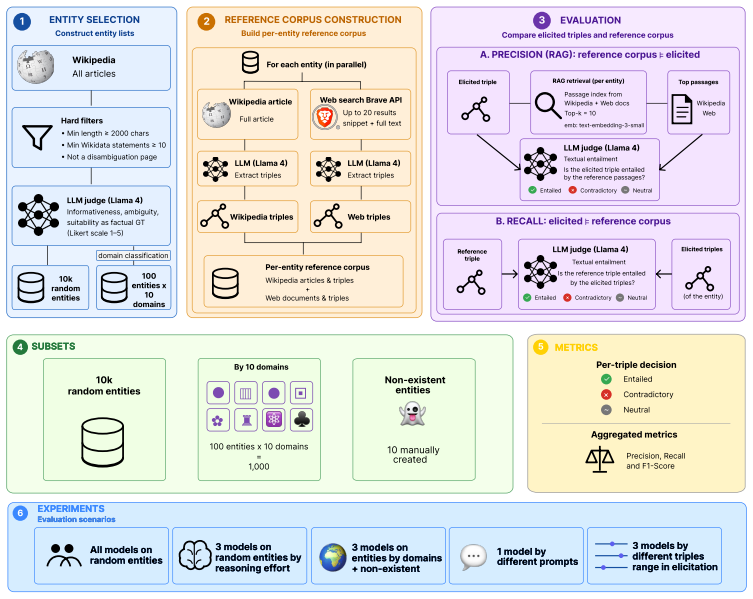
The paper establishes that evaluating LLMs by their responses to open-ended elicitation prompts, rather than predefined questions, provides a characterization of the knowledge models naturally express, implemented via the BeQu benchmark of 10,000 entities paired with reference corpora for statement verification.
Load-bearing premise
Responses to open-ended prompts provide a representative and unbiased sample of a model's parametric knowledge rather than being shaped by prompt phrasing or generation biases.
Editorial extensions
If this is right
- Larger models express more knowledge when responding to open elicitation prompts.
- Increased reasoning effort changes the volume and accuracy of knowledge that surfaces.
- Different prompt formats alter which knowledge gets expressed by the model.
- Knowledge expression patterns vary across different domains.
- The BeQu benchmark supports systematic comparison of these effects across many models.
Reading between the lines
- The method could help surface training data gaps by identifying topics where models remain silent in open responses.
- It might complement traditional benchmarks to give a fuller view of model capabilities.
- Future tests could check whether models hold knowledge they consistently fail to volunteer without specific prompting.
Signed reviews
Editorial analysis
A structured set of objections, weighed in public.
Referee Report
Summary. The paper claims that existing LLM knowledge benchmarks suffer from availability bias because they rely on predefined questions selected by benchmark designers. It proposes a new 'open knowledge evaluation' paradigm that instead evaluates the knowledge models naturally express in response to open-ended elicitation prompts (e.g., 'Tell me everything you know about M.L. King'). The paradigm is instantiated with the BeQu benchmark, which consists of 10,000 entities paired with reference corpora for statement verification. The authors evaluate a range of LLMs and analyze the effects of reasoning effort, model scale, prompt format, and knowledge domain, with data and leaderboard made available.
Significance. If the central assumption holds, this work offers a meaningful shift in how parametric knowledge in LLMs is assessed, potentially providing a more unbiased characterization by focusing on what models choose to surface rather than what designers query. The scale of the BeQu benchmark (10,000 entities) and the public release of data and leaderboard are positive for reproducibility and further research. The analysis of multiple factors (scale, prompt format, etc.) adds to its potential impact if the method's validity is established.
major comments (1)
- [Abstract, paragraph 2] Abstract, paragraph 2: The core claim that open-ended prompts allow characterization of knowledge models 'naturally express' is load-bearing but rests on the untested assumption that such responses are representative of parametric knowledge rather than shaped by prompt phrasing or generation biases. The paper reports analyzing prompt format effects, but this does not rule out systematic suppression of entire classes of facts (e.g., low-probability or negative statements), as highlighted in the stress-test note. A concrete test or discussion of this completeness is needed to support the paradigm shift.
minor comments (1)
- [Abstract] Abstract: The abstract mentions 'a broad range of language models' but does not specify which models or scales are evaluated; this detail would help readers assess the scope.
Simulated Author's Rebuttal
We thank the referee for the detailed review and the opportunity to clarify the scope and limitations of the open knowledge evaluation paradigm. We address the single major comment below.
read point-by-point responses
-
Referee: [Abstract, paragraph 2] Abstract, paragraph 2: The core claim that open-ended prompts allow characterization of knowledge models 'naturally express' is load-bearing but rests on the untested assumption that such responses are representative of parametric knowledge rather than shaped by prompt phrasing or generation biases. The paper reports analyzing prompt format effects, but this does not rule out systematic suppression of entire classes of facts (e.g., low-probability or negative statements), as highlighted in the stress-test note. A concrete test or discussion of this completeness is needed to support the paradigm shift.
Authors: We acknowledge that prompt-format experiments alone do not fully establish completeness with respect to suppressed fact classes. The manuscript already notes generation biases in the stress-test discussion, but we agree a more explicit treatment is warranted. We will expand the Limitations section with a dedicated paragraph on potential systematic omissions (low-probability facts, negative statements, etc.) and outline concrete follow-up tests (e.g., targeted probing for withheld knowledge categories) that future work could perform. This addition will temper the paradigm-shift language while preserving the core contribution of shifting from designer-chosen queries to model-elicited statements. revision: yes
Circularity Check
No circularity: methodological contribution with independent benchmark
full rationale
The paper introduces open knowledge evaluation as a new paradigm contrasting with question-based benchmarks, instantiated via the BeQu dataset of 10,000 entities with reference corpora for verification. No equations, fitted parameters, predictions, or derivations are present. Claims rest on empirical evaluation of models under varied conditions (scale, prompt format, domain) against external references, not on self-referential fits or self-citation chains. The central assumption about representativeness of open-ended prompts is a methodological choice open to external testing, not a reduction by construction.
Assumptions & free parameters
assumptions (2)
- domain assumption LLMs store parametric knowledge that can be elicited via natural language prompts
- domain assumption Reference corpora provide ground-truth statements suitable for verifying model outputs
Cite this review
Pith. "Pith review of Beyond Questions: Evaluating LLM's Knowledge Expression." pith.science (2026). https://pith.science/paper/WCJ4DPWF
@misc{pith2026260526937,
  author       = {Pith},
  title        = {Pith review of: Beyond Questions: Evaluating LLM's Knowledge Expression},
  year         = {2026},
  howpublished = {\url{https://pith.science/paper/WCJ4DPWF}},
  note         = {Machine review of arXiv:2605.26937}
}
read the original abstract
Parametric knowledge in large language models (LLMs) is a cornerstone of their success, yet remains poorly understood. Existing knowledge benchmarks typically rely on predefined questions (e.g., "What is the birth date of M.L. King?"), evaluating only knowledge that benchmark designers explicitly choose to query, a problematic availability bias. In this paper, we introduce open knowledge evaluation, a new paradigm for LLM knowledge expression benchmarking. Instead of asking narrow questions, it evaluates models on the knowledge they choose to surface in response to open-ended elicitation prompts (e.g., "Tell me everything you know about M.L. King"). This shifts the focus from predefined answer retrieval toward characterizing the knowledge models naturally express. We instantiate this paradigm with BeQu (Beyond Questions), a benchmark of 10,000 entities paired with reference corpora for statement verification. Using BeQu, we evaluate a broad range of language models and analyze the effects of reasoning effort, model scale, prompt format, and knowledge domain. Data and leaderboard are available on this work's GitHub repository and at the benchmark's website.
Figures


Figures from the paper (7 more)


Reviewed June 29, 2026 · model on record in the stance chip above.
Discussion (0). Continue with ORCID to comment.