Advances in polyconvex anisotropic hyperelasticity
Pith reviewed 2026-07-01 15:55 UTC · model grok-4.3
The pith
A new polyconvex PANN model for anisotropic hyperelasticity is built from triclinic invariants symmetrized over finite symmetry groups to satisfy all mechanical conditions automatically.
A machine-rendered reading of the paper's core claim, the machinery that carries it, and where it could break.
Core claim
We propose a new polyconvex PANN constitutive model for anisotropic hyperelasticity based on triclinic invariants and group symmetrization. For finite symmetry groups, this model fulfills all common mechanical constitutive conditions a priori. We derive a new integrity basis for a tetragonal symmetry group and a new functional basis for a cubic symmetry group; to the best of our knowledge, these are the first polyconvex integrity or functional bases for symmetry groups characterized by structural tensors of order higher than two.
What carries the argument
Group symmetrization applied to triclinic invariants, which generates complete polyconvex integrity and functional bases for finite symmetry groups such as tetragonal and cubic.
If this is right
- The resulting models fulfill all common mechanical constitutive conditions a priori for any finite symmetry group.
- A new integrity basis is obtained for tetragonal symmetry.
- A new functional basis is obtained for cubic symmetry.
- The bases are the first polyconvex ones known for symmetry groups whose structural tensors have order higher than two.
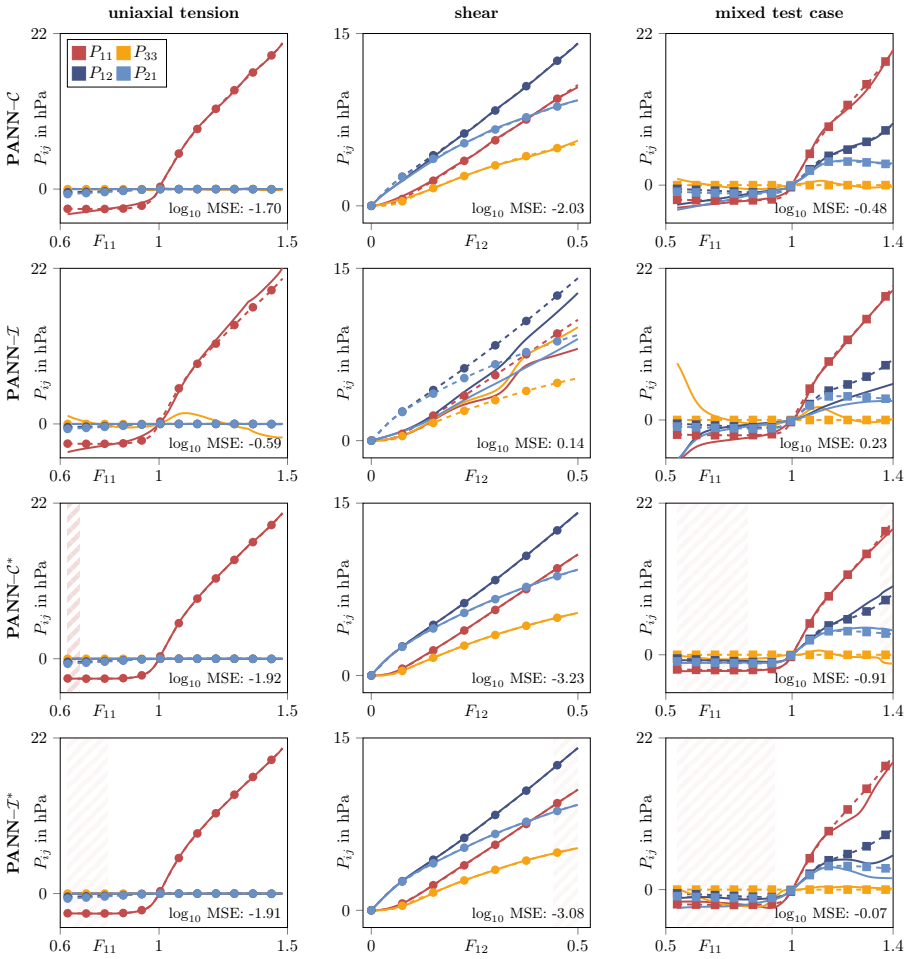
- The models are benchmarked against highly nonlinear homogenization data of cubic metamaterials.
Where Pith is reading between the lines
- The symmetrization technique could be applied to additional finite symmetry groups not treated in the paper.
- Models constructed this way may simplify the calibration of material parameters from experimental data by automatically enforcing physical constraints.
- The same invariant construction might be combined with other neural-network architectures or with models that include inelastic effects.
- Implementation in finite-element codes would allow direct use of the new bases for engineering simulations of metamaterials.
Load-bearing premise
The group symmetrization procedure applied to triclinic invariants produces a complete set of polyconvex invariants that fully characterize the response for the target finite symmetry groups without missing terms or introducing non-polyconvex contributions.
What would settle it
A concrete counterexample in which the symmetrized invariants for a cubic material produce a stress response that deviates from the expected cubic symmetry under a chosen deformation gradient, or that violates polyconvexity for some admissible strain.
Figures



read the original abstract
A key challenge in material theory is the formulation of models that satisfy all common mechanical constitutive conditions while retaining sufficient flexibility. In this context, several important modeling aspects remain unresolved for polyconvex anisotropic hyperelasticity. We address some of these challenges and apply our results for physics-augmented neural network (PANN) constitutive modeling. The main contributions of this paper are as follows: (1) We propose a new polyconvex PANN constitutive model for anisotropic hyperelasticity based on triclinic invariants and group symmetrization. For finite symmetry groups, this model fulfills all common mechanical constitutive conditions a priori. (2) We propose a group symmetrization-based method for the construction of polyconvex invariants for finite symmetry groups. Based on this, we derive a new integrity basis for a tetragonal symmetry group and a new functional basis for a cubic symmetry group. To the best of our knowledge, these are the first polyconvex integrity or functional bases for symmetry groups characterized by structural tensors of order higher than two. (3) We provide an extensive introduction to the construction of polyconvex integrity and functional bases, which form the basis of polyconvex invariant-based constitutive models. We discuss polyconvex bases for triclinic, isotropic, transversely isotropic, monoclinic, rhombic, tetragonal, and cubic symmetry groups. (4) We benchmark the polyconvex PANN constitutive models with highly nonlinear homogenization data of cubic metamaterials.
Editorial analysis
A structured set of objections, weighed in public.
Referee Report
Summary. The paper proposes a polyconvex physics-augmented neural network (PANN) constitutive model for anisotropic hyperelasticity constructed from triclinic invariants via group symmetrization. It asserts that this yields models satisfying all common mechanical constitutive conditions a priori for finite symmetry groups; derives a new polyconvex integrity basis for a tetragonal group and a new functional basis for a cubic group (claimed to be the first such for symmetries involving structural tensors of order higher than two); surveys polyconvex bases across triclinic through cubic symmetries; and benchmarks the resulting PANN models against highly nonlinear homogenization data for cubic metamaterials.
Significance. If the symmetrized bases are both complete and polyconvex, the work supplies a systematic route to a priori polyconvex anisotropic models for symmetries beyond those treatable by low-order structural tensors, directly addressing a recognized gap in invariant-based hyperelasticity. The explicit tetragonal integrity basis and cubic functional basis, together with the PANN implementation and homogenization benchmarks, would constitute a concrete advance usable in metamaterial design and finite-element simulation.
major comments (3)
- [tetragonal integrity basis derivation] Section deriving the tetragonal integrity basis (around the group-symmetrization procedure): completeness is asserted but no explicit algebraic argument or enumeration is given showing that every invariant of the tetragonal group can be expressed as a function of the symmetrized triclinic set; without this verification the claim that the construction supplies a complete integrity basis (and therefore the first polyconvex one for higher-order structural tensors) is not secured.
- [cubic functional basis derivation] Section on group symmetrization applied to the cubic case: preservation of polyconvexity under symmetrization is stated but not demonstrated for structural tensors of order greater than two; an explicit check (e.g., via the definition of polyconvexity or a counter-example exclusion) is required because the central modeling claim rests on the resulting invariants remaining polyconvex.
- [benchmarking against homogenization data] Benchmarking section (cubic metamaterial homogenization data): the data-exclusion rules, training/validation split, and hyperparameter selection procedure are not reported in sufficient detail to allow independent reproduction or to rule out post-hoc selection effects on the reported fits.
minor comments (2)
- [group symmetrization method] Notation for the symmetrized invariants is introduced without a compact tabular summary relating original triclinic invariants to their symmetrized counterparts; a table would improve readability.
- [introduction to polyconvex bases] Several citations to prior polyconvexity literature appear only in the introduction; cross-references to the specific equations or theorems used in the derivations would strengthen the survey section.
Simulated Author's Rebuttal
We thank the referee for their thorough and constructive review. The comments identify important points that will strengthen the manuscript. We respond to each major comment below and will incorporate revisions accordingly.
read point-by-point responses
-
Referee: [tetragonal integrity basis derivation] Section deriving the tetragonal integrity basis (around the group-symmetrization procedure): completeness is asserted but no explicit algebraic argument or enumeration is given showing that every invariant of the tetragonal group can be expressed as a function of the symmetrized triclinic set; without this verification the claim that the construction supplies a complete integrity basis (and therefore the first polyconvex one for higher-order structural tensors) is not secured.
Authors: We agree that an explicit algebraic verification of completeness is required to fully secure the claim. In the revised manuscript we will add a dedicated subsection that provides the algebraic argument and enumeration, demonstrating that every invariant of the tetragonal group is generated by the symmetrized triclinic set under the group action. revision: yes
-
Referee: [cubic functional basis derivation] Section on group symmetrization applied to the cubic case: preservation of polyconvexity under symmetrization is stated but not demonstrated for structural tensors of order greater than two; an explicit check (e.g., via the definition of polyconvexity or a counter-example exclusion) is required because the central modeling claim rests on the resulting invariants remaining polyconvex.
Authors: We acknowledge that an explicit demonstration is needed. The revised manuscript will include a direct verification that polyconvexity is preserved under symmetrization for higher-order structural tensors, based on the definition of polyconvexity and the properties of the symmetrization operator applied to the original polyconvex invariants. revision: yes
-
Referee: [benchmarking against homogenization data] Benchmarking section (cubic metamaterial homogenization data): the data-exclusion rules, training/validation split, and hyperparameter selection procedure are not reported in sufficient detail to allow independent reproduction or to rule out post-hoc selection effects on the reported fits.
Authors: We agree that the current description lacks sufficient detail for reproducibility. In the revision we will expand the benchmarking section to report the precise data-exclusion rules, the training/validation split ratios and selection method, and the full hyperparameter selection procedure, including any cross-validation steps used. revision: yes
Circularity Check
No circularity: derivation of polyconvex bases rests on explicit group symmetrization construction, not reduction to inputs by definition.
full rationale
The paper's central contribution is the explicit proposal of a group symmetrization procedure applied to triclinic invariants to generate new integrity and functional bases for tetragonal and cubic groups, presented as fulfilling polyconvexity and completeness a priori via the method itself. No quoted step reduces a claimed prediction or completeness result to a fitted parameter, self-citation chain, or definitional renaming; the construction is algebraic and benchmarked against external homogenization data. This is the normal case of a self-contained theoretical derivation without load-bearing circular steps.
Axiom & Free-Parameter Ledger
free parameters (1)
- PANN network weights and biases
axioms (2)
- domain assumption Polyconvexity of the strain-energy function guarantees material stability and existence of minimizers for boundary-value problems in finite elasticity.
- ad hoc to paper Group symmetrization of triclinic invariants yields polyconvex invariants that form a complete basis for the target finite symmetry groups.
Reference graph
Works this paper leans on
-
[1]
Discovery of hyperelastic constitutive laws from experimental data with EUCLID
Abbasi, A., M. Ricci, P. Carrara, M. Flaschel, S. Kumar, S. Marfia and L. De Lorenzis (2026). “Discovery of hyperelastic constitutive laws from experimental data with EUCLID”. In:Exp. Mech.doi:10.1007/s11340-026-01290-6. Aggarwal, C. C. (2018).Neural Networks and Deep Learning. 1st ed. Springer International Publishing. Aldakheel, F., E. S. Elsayed, Y. He...
-
[2]
PMLR, pp. 146–155. arXiv:1609.07152. As’ad, F., P. Avery and C. Farhat (2022). “A mechanics-informed artificial neural network approach in data-driven consti- tutive modeling”. In:Int. J. Numer. Methods Eng.123.12, pp. 2738–2759.doi:10.1002/nme.6957. As’ad, F. and C. Farhat (2023). “A mechanics-informed deep learning framework for data-driven nonlinear vi...
work page internal anchor Pith review Pith/arXiv arXiv doi:10.1002/nme.6957 2022
-
[3]
London: Pitman, pp. 187–241. Ball, J. M. (2002). “Some open problems in elasticity”. In:Geometry, Mechanics, and Dynamics. Ed. by P. Newton, P. Holmes and A. Weinstein. New York: Springer-Verlag, pp. 3–59.doi:10.1007/0-387-21791-6_1. Bertoldi, K. and M. Gei (2011). “Instabilities in multilayered soft dielectrics”. In:J. Mech. Phys. Solids59 (1), pp. 18–42...
discussion (0)
Sign in with ORCID, Apple, or X to comment. Anyone can read and Pith papers without signing in.