ReasonOps: A Unified Operational Paradigm for Trustworthy Verified LLM Reasoning
Pith reviewed 2026-06-29 14:55 UTC · model grok-4.3
The pith
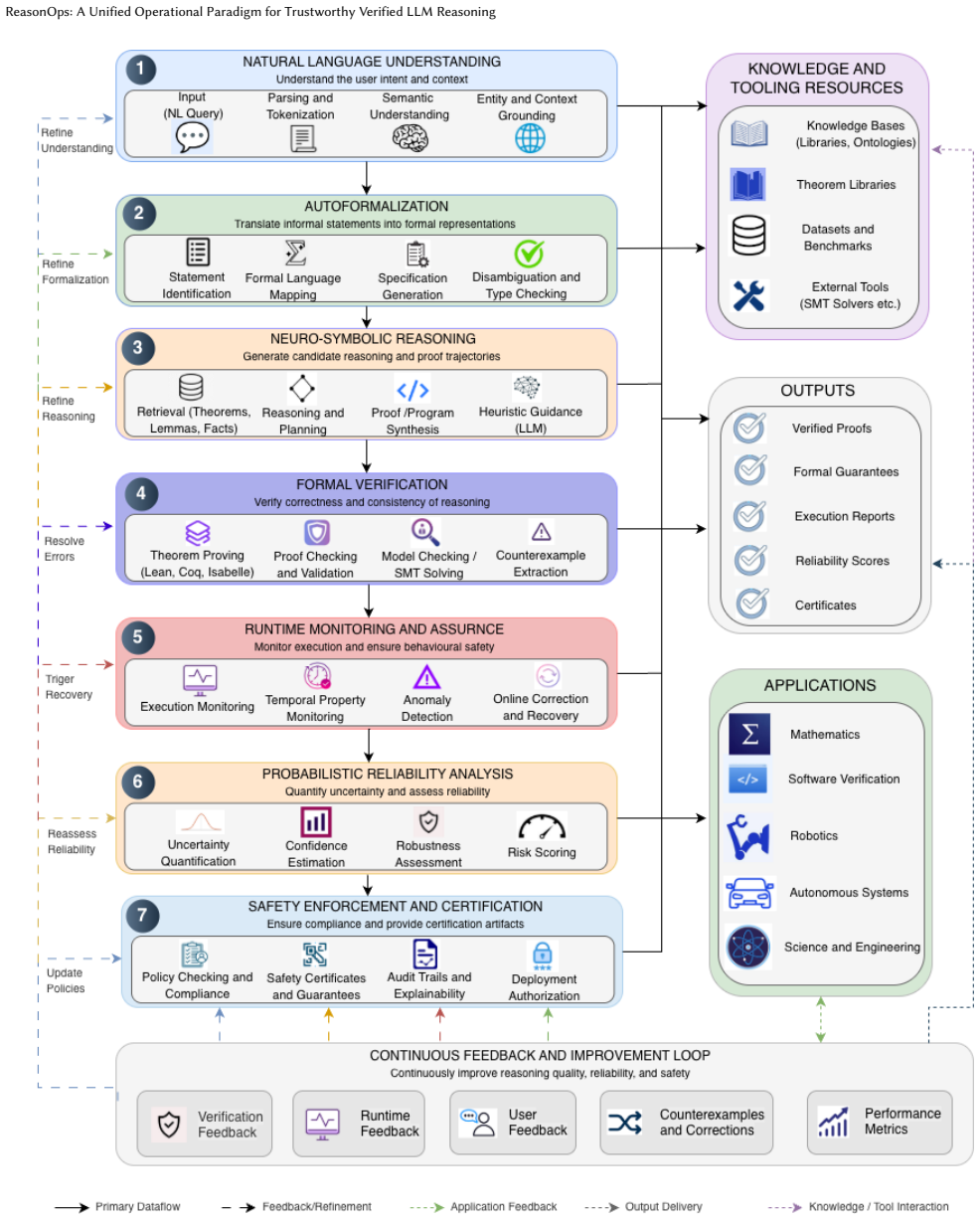
ReasonOps treats LLM reasoning as a continuously monitored operational lifecycle that integrates semantic interpretation, autoformalization, symbolic reasoning, theorem proving, runtime assurance, probabilistic reliability estimation, and a
A machine-rendered reading of the paper's core claim, the machinery that carries it, and where it could break.
Core claim
ReasonOps is a unified operational paradigm that treats reasoning as a continuously monitored, verifiable, reliability-aware operational process rather than an isolated inference task; it integrates semantic interpretation, autoformalization, symbolic reasoning, theorem proving, runtime assurance, probabilistic reliability estimation, and adaptive correction into a single reasoning lifecycle and presents an architecture whose workflow is shown on an autonomous braking system analysis.
What carries the argument
The ReasonOps unified reasoning lifecycle that folds semantic interpretation through adaptive correction into one monitored operational process.
If this is right
- Reasoning systems gain continuous monitoring and adaptive correction loops.
- Probabilistic reliability estimates become part of every reasoning output.
- Runtime assurance techniques apply directly to LLM-generated formal steps.
- Fragmented communities in formal verification and trustworthy AI share a common operational framework.
- Safety-critical autonomous AI systems obtain a candidate infrastructure for verified reasoning.
Where Pith is reading between the lines
- The same lifecycle structure could be tested on non-reasoning tasks such as code generation or planning.
- New quantitative benchmarks would be needed to measure whether the integrated reliability estimates actually correlate with fewer errors.
- Adoption would likely require standardized interfaces between the semantic, symbolic, and probabilistic layers.
- If the approach scales, it suggests shifting evaluation of AI systems from single-task accuracy to lifecycle-level reliability metrics.
Load-bearing premise
That integrating those listed components into a single lifecycle will remove hidden inconsistencies and deliver reliability guarantees rather than introduce new failure modes.
What would settle it
A concrete ReasonOps implementation that still generates unsupported theorem applications or unresolved logical inconsistencies when applied to a formal analysis of an autonomous braking system.
Figures
read the original abstract
Large Language Models (LLMs) have transformed artificial intelligence from primarily generative systems into increasingly capable reasoning agents. Recent advances in theorem proving, autoformalization, symbolic reasoning, and tool-augmented language models demonstrate substantial progress toward machine-assisted formal reasoning. However, current reasoning systems still suffer from hidden logical inconsistencies, hallucinated symbolic transitions, unsupported theorem applications, and limited reliability guarantees. Existing approaches remain fragmented across formal verification, runtime assurance, neuro-symbolic reasoning and trustworthy Artificial Intelligence (AI) research communities. This paper introduces ReasonOps, a unified operational paradigm for trustworthy verified reasoning systems. Inspired by operational ecosystems such as DevOps and MLOps, ReasonOps treats reasoning as a continuously monitored, verifiable, reliability-aware operational process rather than an isolated inference task. The proposed paradigm integrates semantic interpretation, autoformalization, symbolic reasoning, theorem proving, runtime assurance, probabilistic reliability estimation, and adaptive correction into a unified reasoning lifecycle. The paper further presents the ReasonOps architecture, demonstrates its workflow using an autonomous braking system analysis example, and discusses its potential role in future safety-critical autonomous AI systems. We argue that operational reasoning paradigms such as ReasonOps may become foundational infrastructure for next-generation trustworthy AI ecosystems.
Editorial analysis
A structured set of objections, weighed in public.
Referee Report
Summary. The paper claims that current LLM reasoning systems suffer from hidden logical inconsistencies, hallucinated symbolic transitions, unsupported theorem applications, and limited reliability guarantees due to fragmentation across formal verification, runtime assurance, neuro-symbolic reasoning, and trustworthy AI communities. It introduces ReasonOps, a unified operational paradigm inspired by DevOps and MLOps that treats reasoning as a continuously monitored, verifiable, reliability-aware lifecycle integrating semantic interpretation, autoformalization, symbolic reasoning, theorem proving, runtime assurance, probabilistic reliability estimation, and adaptive correction. The manuscript presents the ReasonOps architecture, demonstrates the workflow via an autonomous braking system analysis example, and argues that such operational paradigms may become foundational infrastructure for next-generation trustworthy AI ecosystems.
Significance. If the proposed integration can be shown to deliver trustworthiness guarantees without new failure modes, ReasonOps could provide a significant unifying framework bridging disparate research communities and guiding the design of safety-critical autonomous reasoning systems.
major comments (3)
- [Abstract] Abstract and introduction: the central claim that integrating the listed components into a unified lifecycle resolves hidden logical inconsistencies, hallucinated symbolic transitions, unsupported theorem applications, and limited reliability guarantees is unsupported by any formal semantics, state-transition model, invariants, or empirical validation; the asserted benefits are defined circularly in terms of the paradigm itself.
- [ReasonOps Architecture] ReasonOps architecture section: no formal model of the operational lifecycle (e.g., state transitions, monitoring invariants, or detection mechanisms for invalid symbolic steps) is supplied to substantiate how the integration prevents the listed failure modes.
- [Autonomous Braking System Analysis Example] Autonomous braking system analysis example: the workflow is described at a high level with no error analysis, quantitative reliability estimates, comparative measurements against existing fragmented systems, or demonstration that the components address the claimed problems.
minor comments (1)
- The manuscript would benefit from explicit references to concrete prior results in each integrated component (e.g., specific autoformalization or theorem-proving systems) to clarify the unification contribution.
Simulated Author's Rebuttal
We thank the referee for the constructive and detailed review. The manuscript presents ReasonOps as a conceptual paradigm proposal to unify reasoning techniques, rather than a formal or empirical study. We address each major comment below.
read point-by-point responses
-
Referee: [Abstract] Abstract and introduction: the central claim that integrating the listed components into a unified lifecycle resolves hidden logical inconsistencies, hallucinated symbolic transitions, unsupported theorem applications, and limited reliability guarantees is unsupported by any formal semantics, state-transition model, invariants, or empirical validation; the asserted benefits are defined circularly in terms of the paradigm itself.
Authors: The paper is a position paper proposing a new operational paradigm inspired by DevOps/MLOps, motivated by the fragmentation across communities. The claims describe potential benefits of integration rather than demonstrated resolutions. We agree the abstract and introduction can be revised to explicitly frame these as posited advantages of the unified lifecycle to guide future research, avoiding any implication of current formal proof. revision: partial
-
Referee: [ReasonOps Architecture] ReasonOps architecture section: no formal model of the operational lifecycle (e.g., state transitions, monitoring invariants, or detection mechanisms for invalid symbolic steps) is supplied to substantiate how the integration prevents the listed failure modes.
Authors: The architecture section outlines the components and lifecycle at a conceptual level to introduce the paradigm. A formal state-transition model with invariants is not provided because the contribution focuses on unification rather than formalization. We can add discussion of potential formalization directions in revision but note that developing the full model exceeds the scope of this initial manuscript. revision: partial
-
Referee: [Autonomous Braking System Analysis Example] Autonomous braking system analysis example: the workflow is described at a high level with no error analysis, quantitative reliability estimates, comparative measurements against existing fragmented systems, or demonstration that the components address the claimed problems.
Authors: The example illustrates the high-level workflow in a safety-critical domain. We acknowledge it lacks quantitative estimates or detailed error analysis, as the paper does not include implementation or evaluation. In a revision we can expand the narrative to more explicitly link components to specific failure modes, though full comparative measurements would require separate empirical work. revision: partial
Circularity Check
No significant circularity in derivation chain
full rationale
The manuscript proposes ReasonOps as a new operational paradigm integrating multiple components into a unified lifecycle for trustworthy reasoning. It presents an architecture and demonstrates it with an example but does not advance any mathematical derivation, fitted prediction, or first-principles result that reduces to its own inputs by construction. The argument for its potential foundational role is presented as a forward-looking discussion rather than a forced outcome from prior definitions or self-citations. The paper is self-contained as an architectural proposal without load-bearing self-referential reductions.
Axiom & Free-Parameter Ledger
axioms (2)
- domain assumption Current reasoning systems suffer from hidden logical inconsistencies, hallucinated symbolic transitions, unsupported theorem applications, and limited reliability guarantees.
- ad hoc to paper Integrating semantic interpretation, autoformalization, symbolic reasoning, theorem proving, runtime assurance, probabilistic reliability estimation, and adaptive correction into a unified operational lifecycle will produce trustworthy verified reasoning.
invented entities (1)
-
ReasonOps
no independent evidence
Reference graph
Works this paper leans on
-
[1]
Zhangir Azerbayev, Hailey Schoelkopf, Keiran Paster, Marco Dos Santos, Stephen McAleer, Albert Q Jiang, Jia Deng, Stella Biderman, and Sean Welleck
-
[2]
Llemma: An Open Language Model for Mathematics.arXiv preprint arXiv:2310.10631(2023)
work page internal anchor Pith review Pith/arXiv arXiv 2023
-
[3]
Artur d’Avila Garcez and Luis C Lamb. 2023. Neurosymbolic AI: The 3rd Wave. Artificial Intelligence Review56, 11 (2023), 12387–12406
2023
-
[4]
Martin Leucker and Christian Schallhart. 2009. A Brief Account of Runtime Verification.The Journal of Logic and Algebraic Programming78, 5 (2009), 293– 303
2009
-
[5]
Stanislas Polu and Ilya Sutskever. 2020. Generative Language Modeling for Auto- mated Theorem Proving.arXiv preprint arXiv:2009.03393(2020)
work page internal anchor Pith review Pith/arXiv arXiv 2020
-
[6]
Stuart Russell. 2022. Human-Compatible Artificial Intelligence.Human-like machine intelligence1 (2022), 3–22
2022
-
[7]
Yuhuai Wu, Albert Qiaochu Jiang, Wenda Li, Markus Rabe, Charles Staats, Mateja Jamnik, and Christian Szegedy. 2022. Autoformalization with Large Language Models.Advances in neural information processing systems35 (2022), 32353–32368
2022
-
[8]
Kaiyu Yang, Aidan Swope, Alex Gu, Rahul Chalamala, Peiyang Song, Shixing Yu, Saad Godil, Ryan J Prenger, and Animashree Anandkumar. 2023. Leandojo: Theorem Proving with Retrieval-Augmented Language Models.Advances in Neural Information Processing Systems36 (2023), 21573–21612
2023
-
[9]
Kunhao Zheng, Jesse Michael Han, and Stanislas Polu. 2022. Minif2f: A Cross- System Benchmark for Formal Olympiad-Level Mathematics.URL https://arxiv. org/abs/2109.00110(2022)
work page internal anchor Pith review Pith/arXiv arXiv 2022
discussion (0)
Sign in with ORCID, Apple, or X to comment. Anyone can read and Pith papers without signing in.