BatteryMFormer: Multi-level Learning for Battery Degradation Trajectory Forecasting
Pith reviewed 2026-06-29 17:45 UTC · model grok-4.3
The pith
BatteryMFormer forecasts full battery degradation trajectories from early data by explicitly modeling multi-level aging patterns and SOC-localized variations.
A machine-rendered reading of the paper's core claim, the machinery that carries it, and where it could break.
Core claim
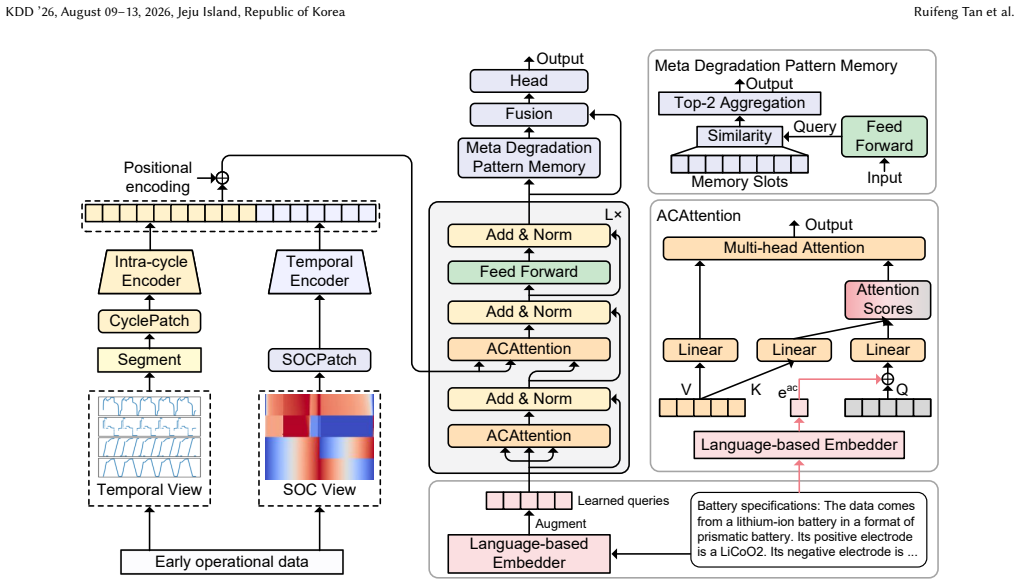
BatteryMFormer is a multi-level Transformer for early BDTF that integrates an aging-condition-aware decoder injecting priors via informed queries and attention, a meta degradation pattern memory that learns and retrieves trajectory prototypes, and a dual-view encoder jointly capturing temporal dynamics and SOC-localized variations from voltage-current time series, thereby addressing the multi-level structure and localized profile changes that existing methods overlook.
What carries the argument
BatteryMFormer architecture, which adds aging-condition-informed queries and attention, meta degradation pattern memory retrieval, and dual-view encoding of temporal and SOC-specific signals to a Transformer backbone.
If this is right
- Early trajectory forecasts become reliable enough to inform manufacturing adjustments and usage optimization before full degradation occurs.
- Shared patterns across batteries allow the model to generalize when new units enter the same aging condition.
- Focusing on specific SOC intervals reduces error accumulation in long-horizon forecasts.
- Prototype retrieval from the meta memory supports consistent predictions even when early data are sparse.
- The same design yields gains on multiple battery domains, suggesting transferability within the field.
Where Pith is reading between the lines
- The dual-view encoder idea could be tested on other sensor streams where certain operating regimes drive most of the signal change.
- If the meta memory proves central, replacing it with learned prototypes from physics-based simulations might reduce the need for large labeled datasets.
- Extending the aging-condition queries to include temperature or load history would be a direct next step if those variables show similar clustering.
- Real-time deployment logs from fielded packs could serve as a falsification test for whether the learned prototypes remain stable outside laboratory conditions.
Load-bearing premise
The two data characteristics of multi-level structure and SOC-localized variations are the main reasons prior methods fall short, and the three added components directly close that gap.
What would settle it
An ablation study on the four battery domains in which removing the aging-condition-aware decoder, the meta memory, or the dual-view encoder individually brings performance back to the level of the strongest baseline.
Figures



read the original abstract
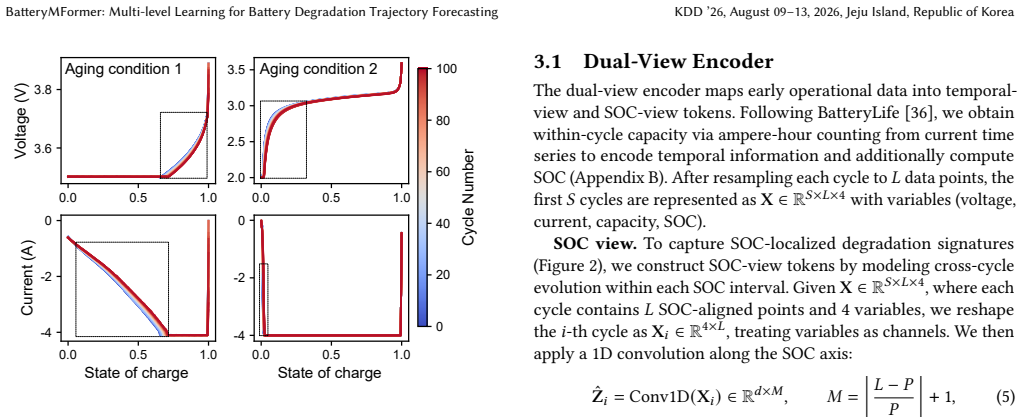
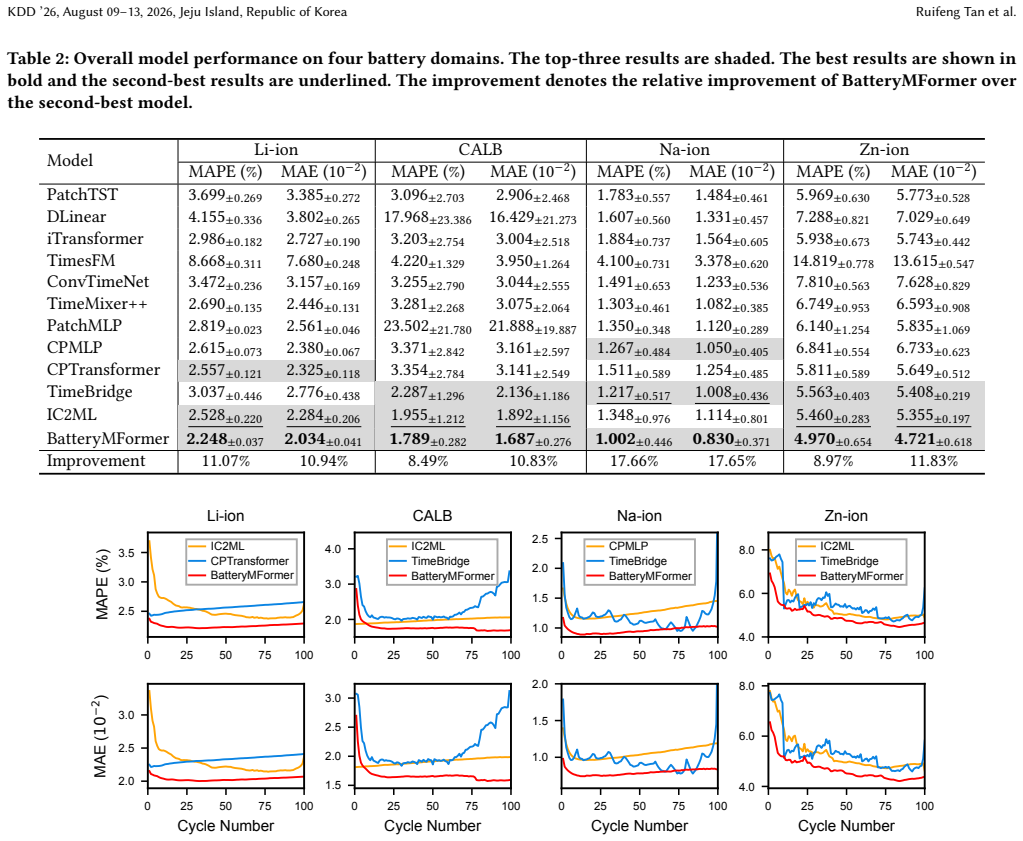
Early battery degradation trajectory forecasting (BDTF), which predicts the full-life state-of-health trajectory from early operational data, is critical for battery optimization, manufacturing, and deployment. Battery degradation data exhibit two key characteristics. First, degradation data present a multi-level structure, including regularities shared within aging conditions and trajectory patterns shared across batteries. Second, degradation-related variations in voltage-current profiles are often localized to specific state of charge (SOC) intervals. Existing approaches often fail to explicitly model these characteristics. To bridge this gap, we propose BatteryMFormer, a multi-level Transformer for early BDTF. BatteryMFormer integrates (1) an aging-condition-aware decoder that injects aging-condition priors via aging-condition-informed queries and aging-condition-aware attention, (2) a meta degradation pattern memory that learns and retrieves trajectory prototypes to guide long-horizon forecasting, and (3) a dual-view encoder that jointly captures temporal dynamics and SOC-localized variations from voltage and current time series. Extensive experiments on four battery domains show that BatteryMFormer consistently outperforms state-of-the-art baselines, marking a significant step toward reliable BDTF. Our code is available at https://github.com/Ruifeng-Tan/BatteryMFormer.
Editorial analysis
A structured set of objections, weighed in public.
Referee Report
Summary. The paper proposes BatteryMFormer, a multi-level Transformer for early battery degradation trajectory forecasting (BDTF). It identifies two key data characteristics—multi-level structure (regularities within aging conditions and shared trajectory patterns across batteries) and SOC-localized variations in voltage-current profiles—and introduces three components to address them: an aging-condition-aware decoder (using aging-condition-informed queries and attention), a meta degradation pattern memory (for learning and retrieving trajectory prototypes), and a dual-view encoder (capturing temporal dynamics and SOC-localized variations). The central claim is that experiments on four battery domains show consistent outperformance over state-of-the-art baselines, advancing reliable BDTF.
Significance. If the claimed outperformance holds with rigorous validation, the work could advance BDTF by explicitly targeting multi-level and SOC-specific data traits that prior methods overlook, with potential benefits for battery optimization and deployment. Code availability supports reproducibility, which strengthens the contribution if the experiments are detailed and falsifiable.
major comments (2)
- [Abstract] Abstract: The central claim that BatteryMFormer 'consistently outperforms state-of-the-art baselines' is presented without any quantitative results, specific baseline names, error metrics, error bars, or validation protocol, making the claim unverifiable from the provided evidence and load-bearing for the significance statement.
- [Abstract] Abstract: The manuscript asserts that the two data characteristics (multi-level structure and SOC-localized variations) are the primary reasons existing methods underperform and that the three proposed modules directly remedy this, but supplies no targeted evidence such as baseline failure-mode analysis, attention visualizations confirming SOC localization, or ablations isolating each module's contribution to those traits rather than generic gains; this causal link is load-bearing for the 'significant step' conclusion.
Simulated Author's Rebuttal
We thank the referee for highlighting issues with the abstract's claims. We will revise the abstract to include quantitative highlights and adjust the causal language to better align with the evidence presented in the full manuscript. Point-by-point responses follow.
read point-by-point responses
-
Referee: [Abstract] Abstract: The central claim that BatteryMFormer 'consistently outperforms state-of-the-art baselines' is presented without any quantitative results, specific baseline names, error metrics, error bars, or validation protocol, making the claim unverifiable from the provided evidence and load-bearing for the significance statement.
Authors: We agree the abstract claim would be stronger with concrete numbers. In revision we will insert key quantitative results (e.g., average RMSE reduction of X% over baselines Y and Z across the four domains, with 5-run standard deviations) and a one-sentence validation protocol note, while staying within length limits. Full tables and protocols remain in Sections 4.1–4.2. revision: yes
-
Referee: [Abstract] Abstract: The manuscript asserts that the two data characteristics (multi-level structure and SOC-localized variations) are the primary reasons existing methods underperform and that the three proposed modules directly remedy this, but supplies no targeted evidence such as baseline failure-mode analysis, attention visualizations confirming SOC localization, or ablations isolating each module's contribution to those traits rather than generic gains; this causal link is load-bearing for the 'significant step' conclusion.
Authors: The manuscript already contains module ablations (Section 4.3) and attention visualizations aligned with SOC intervals (Figure 5). We did not include dedicated baseline failure-mode analysis. We will revise the abstract to state that the modules are designed to address the identified characteristics and that experiments demonstrate consistent gains, rather than asserting they are the 'primary reasons' for prior underperformance. This removes the stronger causal claim while preserving the motivation. revision: partial
Circularity Check
No significant circularity; claims rest on empirical validation
full rationale
The paper proposes an architecture motivated by two observed data traits and validates performance via experiments on four external battery datasets. No equations, derivations, or predictions appear that reduce by construction to fitted inputs or self-citations. The central claim (outperformance) is supported by baseline comparisons rather than any self-definitional loop, uniqueness theorem, or ansatz smuggled via prior work. This is the standard non-circular case for an applied ML architecture paper.
Axiom & Free-Parameter Ledger
Reference graph
Works this paper leans on
-
[1]
2024.BatteryArchive.org.https://batteryarchive.org/index.html
2024
-
[2]
Peter M Attia, Alexander Bills, Ferran Brosa Planella, Philipp Dechent, Goncalo Dos Reis, Matthieu Dubarry, Paul Gasper, Richard Gilchrist, Samuel Greenbank, David Howey, et al . 2022. “Knees” in lithium-ion battery aging trajectories. Journal of The Electrochemical Society169, 6 (2022), 060517
2022
-
[3]
Peter M Attia, Aditya Grover, Norman Jin, Kristen A Severson, Todor M Markov, Yang-Hung Liao, Michael H Chen, Bryan Cheong, Nicholas Perkins, Zi Yang, et al. 2020. Closed-loop optimization of fast-charging protocols for batteries with machine learning.Nature578, 7795 (2020), 397–402
2020
-
[4]
Jimmy Lei Ba, Jamie Ryan Kiros, and Geoffrey E. Hinton. 2016. Layer Normaliza- tion. arXiv:1607.06450 [stat.ML] https://arxiv.org/abs/1607.06450
work page internal anchor Pith review Pith/arXiv arXiv 2016
-
[5]
Christoph R. Birkl, Matthew R. Roberts, Euan McTurk, Peter G. Bruce, and David A. Howey. 2017. Degradation diagnostics for lithium ion cells.Journal of Power Sources341 (2017), 373–386. doi:10.1016/j.jpowsour.2016.12.011
-
[6]
Mingyue Cheng, Jiqian Yang, Tingyue Pan, Qi Liu, Zhi Li, and Shijin Wang. 2025. ConvTimeNet: A Deep Hierarchical Fully Convolutional Model for Multivariate Time Series Analysis. InCompanion Proceedings of the ACM on Web Conference 2025(Sydney NSW, Australia)(WWW ’25). Association for Computing Machinery, New York, NY, USA, 171–180. doi:10.1145/3701716.3715214
-
[7]
Rose, Huada Lian, Alexis Geslin, Steven B
Xiao Cui, Stephen Dongmin Kang, Sunny Wang, Justin A. Rose, Huada Lian, Alexis Geslin, Steven B. Torrisi, Martin Z. Bazant, Shijing Sun, and William C. KDD ’26, August 09–13, 2026, Jeju Island, Republic of Korea Ruifeng Tan et al. Chueh. 2024. Data-driven analysis of battery formation reveals the role of electrode utilization in extending cycle life.Joule...
-
[8]
Abhimanyu Das, Weihao Kong, Rajat Sen, and Yichen Zhou. 2024. A decoder-only foundation model for time-series forecasting. InProceedings of the 41st Interna- tional Conference on Machine Learning(Vienna, Austria)(ICML’24). JMLR.org, Article 404, 20 pages
2024
-
[9]
Arnaud Devie, George Baure, and Matthieu Dubarry. 2018. Intrinsic Variability in the Degradation of a Batch of Commercial 18650 Lithium-Ion Cells.Energies 11, 5 (2018). doi:10.3390/en11051031
-
[10]
Jakob Fleischmann, Mikael Hanicke, Evan Horetsky, Dina Ibrahim, Sören Jautelat, Martin Linder, Patrick Schaufuss, Lukas Torscht, and Alexandre van de Rijt. 2023. Battery 2030: Resilient, sustainable, and circular.McKinsey & Company16 (2023), 2023
2023
-
[11]
Wei He, Nicholas Williard, Michael Osterman, and Michael Pecht. 2011. Prognos- tics of lithium-ion batteries based on Dempster–Shafer theory and the Bayesian Monte Carlo method.Journal of Power Sources196, 23 (2011), 10314–10321. doi:10.1016/j.jpowsour.2011.08.040
-
[12]
Dan Hendrycks and Kevin Gimpel. 2016. Gaussian error linear units (gelus). arXiv preprint arXiv:1606.08415(2016)
work page internal anchor Pith review Pith/arXiv arXiv 2016
-
[13]
Boles, and Jean-Marie Tarascon
Jiaqiang Huang, Steven T. Boles, and Jean-Marie Tarascon. 2022. Sensing as the key to battery lifetime and sustainability.Nature Sustainability5, 3 (2022), 194 –
2022
-
[14]
http://dx.doi.org/10.1038/s41893-022-00859-y
-
[15]
Xinghao Huang, Chen Liang, Shengyu Tao, Yunhong Che, Ningyu Bian, Jiale Zhang, Runhua Wang, Yuqi Zhang, Bizhong Xia, and Xuan Zhang. 2026. IC2ML: Unified battery state-of-health, degradation trajectory and remaining useful life prediction via intra-cycle and inter-cycle enhanced machine learning.Journal of Power Sources666 (2026), 239148. doi:10.1016/j.jp...
-
[16]
Yaodi Huang, Pengcheng Zhang, Jiahuan Lu, Rui Xiong, and Zhongmin Cai. 2024. A transferable long-term lithium-ion battery aging trajectory prediction model considering internal resistance and capacity regeneration phenomenon.Applied Energy360 (2024), 122825. doi:10.1016/j.apenergy.2024.122825
-
[17]
Jeevarajan, and Partha P
Daniel Juarez-Robles, Saad Azam, Judith A. Jeevarajan, and Partha P. Mukherjee
-
[18]
Degradation-Safety Analytics in Lithium-Ion Cells and Modules: Part III. Aging and Safety of Pouch Format Cells.Journal of The Electrochemical Society 168, 11 (nov 2021), 110501. doi:10.1149/1945-7111/ac30af
-
[19]
Daniel Juarez-Robles, Judith A Jeevarajan, and Partha P Mukherjee. 2020. Degradation-safety analytics in lithium-ion cells: Part I. Aging under charge/discharge cycling.Journal of The Electrochemical Society167, 16 (2020), 160510
2020
-
[20]
Minsoo Kim, Inwoo Kim, Jisub Kim, and Jang Wook Choi. 2023. Lifetime Predic- tion of Lithium Ion Batteries by Using the Heterogeneity of Graphite Anodes.ACS Energy Letters8, 7 (2023), 2946 – 2953. http://dx.doi.org/10.1021/acsenergylett. 3c00695
-
[21]
Jinwen Li, Zhongwei Deng, Yunhong Che, Yi Xie, Xiaosong Hu, and Remus Teodorescu. 2024. Degradation Pattern Recognition and Features Extrapolation for Battery Capacity Trajectory Prediction.IEEE Transactions on Transportation Electrification10, 3 (2024), 7565–7579. doi:10.1109/TTE.2023.3336618
-
[22]
Juren Li, Yang Yang, Hanchen Su, Jiayu Liu, Youmin Chen, Jianfeng Zhang, and Lujia Pan. 2025. LiPM: Foundation Model for Lithium-Ion Battery Analysis. In Proceedings of the 31st ACM SIGKDD Conference on Knowledge Discovery and Data Mining V.2(Toronto ON, Canada)(KDD ’25). Association for Computing Machinery, New York, NY, USA, 1412–1423. doi:10.1145/37118...
-
[23]
Tingkai Li, Zihao Zhou, Adam Thelen, David A. Howey, and Chao Hu. 2024. Predicting battery lifetime under varying usage conditions from early aging data. Cell Reports Physical Science5, 4 (2024), 101891. doi:10.1016/j.xcrp.2024.101891
-
[24]
Weihan Li, Neil Sengupta, Philipp Dechent, David Howey, Anuradha Annaswamy, and Dirk Uwe Sauer. 2021. One-shot battery degradation trajectory prediction with deep learning.Journal of Power Sources506 (2021), 230024. doi:10.1016/j. jpowsour.2021.230024
work page doi:10.1016/j 2021
-
[25]
Weihan Li, Haotian Zhang, Bruis van Vlijmen, Philipp Dechent, and Dirk Uwe Sauer. 2022. Forecasting battery capacity and power degradation with multi-task learning.Energy Storage Materials53 (2022), 453–466. doi:10.1016/j.ensm.2022. 09.013
-
[26]
Peiyuan Liu, Beiliang Wu, Yifan Hu, Naiqi Li, Tao Dai, Jigang Bao, and Shu-Tao Xia. 2025. TimeBridge: Non-Stationarity Matters for Long-term Time Series Forecasting.International Conference on Machine Learning(2025)
2025
-
[27]
Qingqiang Liu, Zhiqing Shang, Shixiang Lu, Yuanhong Liu, Yuchao Liu, and Sheng Yu. 2025. Physics-guided TL-LSTM network for early-stage degradation trajectory prediction of lithium-ion batteries.Journal of Energy Storage106 (2025), 114736. doi:10.1016/j.est.2024.114736
-
[28]
Yong Liu, Tengge Hu, Haoran Zhang, Haixu Wu, Shiyu Wang, Lintao Ma, and Mingsheng Long. 2024. iTransformer: Inverted Transformers Are Effective for Time Series Forecasting. InThe Twelfth International Conference on Learning Representations, ICLR 2024, Vienna, Austria, May 7-11, 2024. OpenReview.net, Vienna, Austria, 1–25. https://openreview.net/forum?id=J...
2024
-
[29]
Guijun Ma, Songpei Xu, Benben Jiang, Cheng Cheng, Xin Yang, Yue Shen, Tao Yang, Yunhui Huang, Han Ding, and Ye Yuan. 2022. Real-time personalized health status prediction of lithium-ion batteries using deep transfer learning.Energy and Environmental Science15, 10 (2022), 4083 – 4094. http://dx.doi.org/10.1039/ d2ee01676a
2022
-
[30]
Jinhao Meng, Lei Cai, Shengxiang Yang, Junxin Li, Feifan Zhou, Jichang Peng, and Zhengxiang Song. 2024. An Empirical-Informed Model for the Early Degra- dation Trajectory Prediction of Lithium-ion Battery.IEEE Transactions on Energy Conversion39, 4 (2024), 2299–2311. doi:10.1109/TEC.2024.3385093
-
[31]
Peyman Mohtat, Suhak Lee, Jason B Siegel, and Anna G Stefanopoulou. 2021. Reversible and irreversible expansion of lithium-ion batteries under a wide range of stress factors.Journal of The Electrochemical Society168, 10 (2021), 100520
2021
-
[32]
Nguyen, Phanwadee Sinthong, and Jayant Kalagnanam
Yuqi Nie, Nam H. Nguyen, Phanwadee Sinthong, and Jayant Kalagnanam. 2023. A Time Series is Worth 64 Words: Long-term Forecasting with Transformers. InThe Eleventh International Conference on Learning Representations, ICLR 2023, Kigali, Rwanda, May 1-5, 2023. OpenReview.net, Kigali, Rwanda, 1–24. https: //openreview.net/forum?id=Jbdc0vTOcol
2023
-
[33]
Barkholtz, Armando Fresquez, Daniel L
Yuliya Preger, Heather M. Barkholtz, Armando Fresquez, Daniel L. Campbell, Benjamin W. Juba, Jessica Romàn-Kustas, Summer R. Ferreira, and Babu Cha- lamala. 2020. Degradation of Commercial Lithium-Ion Cells as a Function of Chemistry and Cycling Conditions.Journal of The Electrochemical Society167, 12 (sep 2020), 120532. doi:10.1149/1945-7111/abae37
-
[34]
Lee, Dominik Linzner, Kathrin Michel, Leon Merker, Balazs B
Fuzhan Rahmanian, Robert M. Lee, Dominik Linzner, Kathrin Michel, Leon Merker, Balazs B. Berkes, Leah Nuss, and Helge Soren Stein. 2024. Attention towards chemistry agnostic and explainable battery lifetime prediction.npj Computational Materials10, 1 (2024). http://dx.doi.org/10.1038/s41524-024- 01286-7
-
[35]
Severson, Peter M
Kristen A. Severson, Peter M. Attia, Norman Jin, Nicholas Perkins, Benben Jiang, Zi Yang, Michael H. Chen, Muratahan Aykol, Patrick K. Herring, Dimitrios Fraggedakis, Martin Z. Bazant, Stephen J. Harris, William C. Chueh, and Richard D. Braatz. 2019. Data-driven prediction of battery cycle life before capacity degra- dation.Nature Energy4, 5 (2019), 383 – 391
2019
-
[36]
Quanyong Shen, Jian Li, Jiahao Nie, Zhengyi Bao, and Chenhan Wang. 2025. A Lightweight Multiscale Signal Learning Framework for Predicting Battery Degradation Trajectory.IEEE Sensors Journal25, 24 (2025), 44801 – 44812. http: //dx.doi.org/10.1109/JSEN.2025.3625630
-
[37]
Ruifeng Tan, Weixiang Hong, Jia Li, Jiaqiang Huang, and Tong-Yi Zhang. 2025. Pretrained Battery Transformer (PBT): A battery life prediction foundation model. arXiv preprint arXiv:2512.16334(2025)
work page internal anchor Pith review Pith/arXiv arXiv 2025
-
[38]
Ruifeng Tan, Weixiang Hong, Jiayue Tang, Xibin Lu, Ruijun Ma, Xiang Zheng, Jia Li, Jiaqiang Huang, and Tong-Yi Zhang. 2025. BatteryLife: A Comprehensive Dataset and Benchmark for Battery Life Prediction. InProceedings of the 31st ACM SIGKDD Conference on Knowledge Discovery and Data Mining V.2(Toronto ON, Canada)(KDD ’25). Association for Computing Machin...
-
[39]
Ruifeng Tan, Xibin Lu, Minhao Cheng, Jia Li, Jiaqiang Huang, and Tong-Yi Zhang
-
[40]
Forecasting battery degradation trajectory under domain shift with domain generalization.Energy Storage Materials72 (2024), 103725. doi:10.1016/j.ensm. 2024.103725
- [41]
-
[42]
Peiwang Tang and Weitai Zhang. 2025. Unlocking the Power of Patch: Patch- Based MLP for Long-Term Time Series Forecasting.Proceedings of the AAAI Conference on Artificial Intelligence39, 12 (Apr. 2025), 12640–12648. doi:10.1609/ aaai.v39i12.33378
2025
-
[43]
Shengyu Tao, Haizhou Liu, Chongbo Sun, Haocheng Ji, Guanjun Ji, Zhiyuan Han, Runhua Gao, Jun Ma, Ruifei Ma, Yuou Chen, et al . 2023. Collaborative and privacy-preserving retired battery sorting for profitable direct recycling via federated machine learning.Nature Communications14, 1 (2023), 8032
2023
-
[44]
Shengyu Tao, Mengtian Zhang, Zixi Zhao, Haoyang Li, Ruifei Ma, Yunhong Che, Xin Sun, Lin Su, Chongbo Sun, Xiangyu Chen, Heng Chang, Shiji Zhou, Zepeng Li, Hanyang Lin, Yaojun Liu, Wenjun Yu, Zhongling Xu, Han Hao, Scott Moura, Xuan Zhang, Yang Li, Xiaosong Hu, and Guangmin Zhou. 2025. Non- destructive degradation pattern decoupling for early battery traje...
-
[45]
Gomez, Lukasz Kaiser, and Illia Polosukhin
Ashish Vaswani, Noam Shazeer, Niki Parmar, Jakob Uszkoreit, Llion Jones, Aidan N. Gomez, Lukasz Kaiser, and Illia Polosukhin. 2017. Attention is all you need, In Advances in Neural Information Processing Systems.Advances in Neural Information Processing Systems2017-December, 5999 – 6009
2017
-
[46]
Fujin Wang, Zhi Zhai, Zhibin Zhao, Yi Di, and Xuefeng Chen. 2024. Physics- informed neural network for lithium-ion battery degradation stable modeling and prognosis.Nature Communications15, 1 (2024), 4332. https://doi.org/10. 1038/s41467-024-48779-z
2024
-
[47]
Shiyu Wang, Jiawei Li, Xiaoming Shi, Zhou Ye, Baichuan Mo, Wenze Lin, Sheng- tong Ju, Zhixuan Chu, and Ming Jin. 2025. TIMEMIXER++: A GENERAL TIME SERIES PATTERN MACHINE FOR UNIVERSAL PREDICTIVE ANALYSIS.13th International Conference on Learning Representations, ICLR 2025, 1662 – 1698. BatteryMFormer: Multi-level Learning for Battery Degradation Trajector...
2025
-
[48]
Attia, Valentin Sulzer, Suhak Lee, Greg Less, and Anna Stefanopoulou
Andrew Weng, Peyman Mohtat, Peter M. Attia, Valentin Sulzer, Suhak Lee, Greg Less, and Anna Stefanopoulou. 2021. Predicting the impact of formation protocols on battery lifetime immediately after manufacturing.Joule5, 11 (2021), 2971 –
2021
-
[49]
http://dx.doi.org/10.1016/j.joule.2021.09.015
-
[50]
Jason Weston, Sumit Chopra, and Antoine Bordes. 2015. Memory Networks. arXiv:1410.3916 [cs.AI] https://arxiv.org/abs/1410.3916
work page internal anchor Pith review Pith/arXiv arXiv 2015
-
[51]
Ma, Kwok-Leung Tsui, and Michael Pecht
Yinjiao Xing, Eden W.M. Ma, Kwok-Leung Tsui, and Michael Pecht. 2013. An ensemble model for predicting the remaining useful performance of lithium-ion batteries.Microelectronics Reliability53, 6 (2013), 811 – 820. http://dx.doi.org/10. 1016/j.microrel.2012.12.003
2013
- [52]
-
[53]
Ailing Zeng, Muxi Chen, Lei Zhang, and Qiang Xu. 2023. Are Transformers Effective for Time Series Forecasting?. InThirty-Seventh AAAI Conference on Artificial Intelligence, AAAI 2023, Thirty-Fifth Conference on Innovative Applica- tions of Artificial Intelligence, IAAI 2023, Thirteenth Symposium on Educational Advances in Artificial Intelligence, EAAI 202...
-
[54]
Han Zhang, Xiaofan Gui, Shun Zheng, Ziheng Lu, Yuqi Li, and Jiang Bian. 2023. BATTERYML: AN OPEN-SOURCE PLATFORM FOR MACHINE LEARNING ON BATTERY DEGRADATION. (2023). http://dx.doi.org/10.48550/arXiv.2310.14714
-
[55]
Han Zhang, Yuqi Li, Shun Zheng, Ziheng Lu, Xiaofan Gui, Wei Xu, and Jiang Bian. 2025. Battery lifetime prediction across diverse ageing conditions with inter-cell deep learning.Nature Machine Intelligence7, 2 (FEB 2025), 270–277. doi:10.1038/s42256-024-00972-x
-
[56]
Jiawen Zhang, Shun Zheng, Wei Cao, Jiang Bian, and Jia Li. 2023. Warpformer: A Multi-scale Modeling Approach for Irregular Clinical Time Series. InProceedings of the 29th ACM SIGKDD Conference on Knowledge Discovery and Data Mining (Long Beach, CA, USA)(KDD ’23). Association for Computing Machinery, New York, NY, USA, 3273–3285. doi:10.1145/3580305.3599543
-
[57]
Taolue Zhang, Ruifeng Tan, Pinxi Zhu, Tong-Yi Zhang, and Jiaqiang Huang. 2025. Unlocking Ultrafast Diagnosis of Retired Batteries via Interpretable Machine Learning and Optical Fiber Sensors.ACS Energy Letters10 (2025), 862–871
2025
-
[58]
Yanzhao Zhang, Mingxin Li, Dingkun Long, Xin Zhang, Huan Lin, Baosong Yang, Pengjun Xie, An Yang, Dayiheng Liu, Junyang Lin, Fei Huang, and Jingren Zhou
-
[59]
Qwen3 Embedding: Advancing Text Embedding and Reranking Through Foundation Models.arXiv preprint arXiv:2506.05176(2025)
work page internal anchor Pith review Pith/arXiv arXiv 2025
-
[60]
Haoyuan Zheng, Shaobin Yang, Weihua Xue, Shouzhen Xiao, Ding Shen, Wei Dong, and Xu Zhang. 2026. Self-discharge estimation for lithium-ion batteries based on formation data in production.Engineering Applications of Artificial Intelligence169 (2026), 114180. doi:10.1016/j.engappai.2026.114180
-
[61]
Haoyi Zhou, Shanghang Zhang, Jieqi Peng, Shuai Zhang, Jianxin Li, Hui Xiong, and Wancai Zhang. 2021. Informer: Beyond Efficient Transformer for Long Se- quence Time-Series Forecasting.Proceedings of the AAAI Conference on Artificial Intelligence35, 12 (May 2021), 11106–11115. doi:10.1609/aaai.v35i12.17325
-
[62]
Jiangong Zhu, Yixiu Wang, Yuan Huang, R Bhushan Gopaluni, Yankai Cao, Michael Heere, Martin J Mühlbauer, Liuda Mereacre, Haifeng Dai, Xinhua Liu, et al. 2022. Data-driven capacity estimation of commercial lithium-ion batteries from voltage relaxation.Nature communications13, 1 (2022), 2261. A End-of-life Definition We define end-of-life𝑡eol as the first c...
2022
discussion (0)
Sign in with ORCID, Apple, or X to comment. Anyone can read and Pith papers without signing in.