Quantum criticality and factorization in a constrained Rydberg spin chain
Pith reviewed 2026-06-29 15:26 UTC · model grok-4.3
The pith
An exact ground-state factorization line exists inside the antiferromagnetic phase of a constrained Rydberg spin chain.
A machine-rendered reading of the paper's core claim, the machinery that carries it, and where it could break.
Core claim
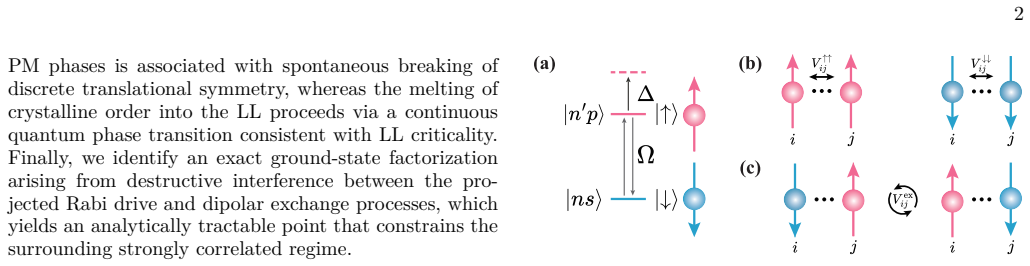
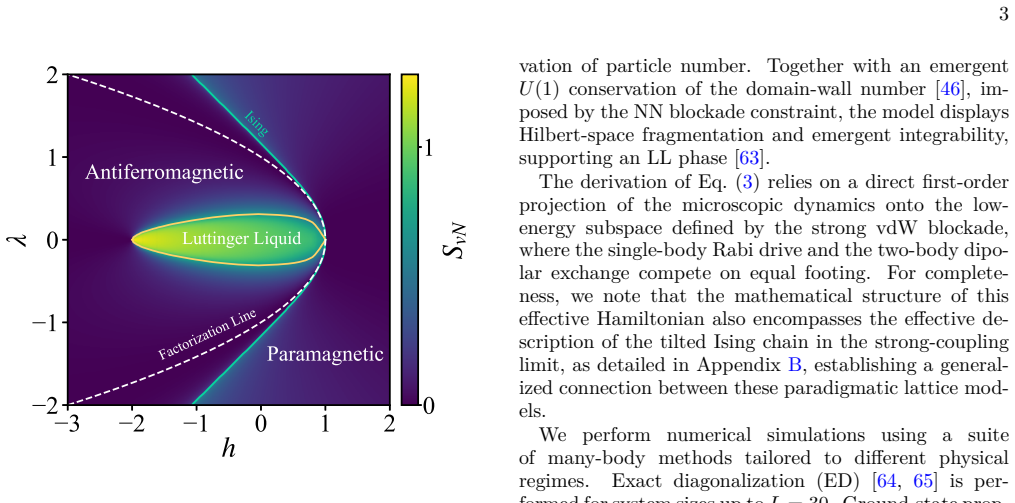
Projecting the driven Rydberg system onto the blockade-constrained Hilbert space produces an effective model in which local Rabi flips compete with nonlocal exchange. Exact diagonalization, DMRG, and variational uniform MPS calculations locate the phase boundaries and the two distinct routes that destroy antiferromagnetic order. Within the ordered region an exact factorization line is found on which the many-body ground state factors into a product of local states and therefore carries identically zero entanglement.
What carries the argument
The exact ground-state factorization line inside the antiferromagnetic phase, on which the wave function is a simple product state with vanishing entanglement.
If this is right
- The factorization line supplies an analytically solvable, zero-entanglement reference state inside the ordered phase.
- Experiments on programmable Rydberg arrays can tune to this line to benchmark entanglement measurements.
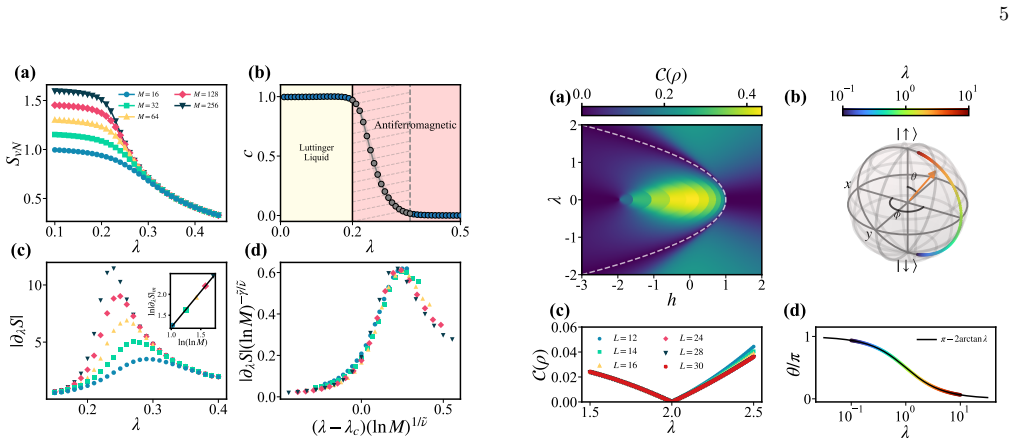
- The Luttinger-liquid to antiferromagnet transition at weak driving is continuous and can be diagnosed by entanglement scaling.
- The strong-driving destruction of order occurs through a standard Ising critical point.
Where Pith is reading between the lines
- The factorization line may allow exact calculation of certain correlation functions throughout the ordered phase by continuity.
- Similar product-state lines could be searched for in other constrained Rydberg or lattice-gauge models.
- The line provides a natural starting point for perturbative expansions around the ordered phase.
Load-bearing premise
Projecting the Rydberg Hamiltonian onto the blockade-constrained subspace produces an effective model whose low-energy physics matches the original array.
What would settle it
Direct computation of the bipartite entanglement entropy on the reported factorization line that remains exactly zero for chain lengths larger than those already checked.
Figures
read the original abstract
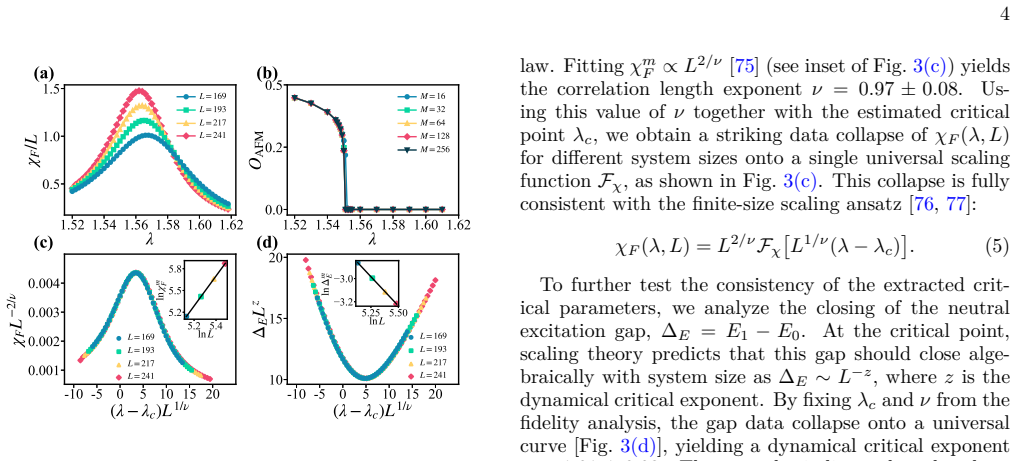
We investigate the zero-temperature phase diagram of a one-dimensional constrained quantum spin chain realized in coherently driven Rydberg-atom arrays with competing local Rabi driving and dipole-dipole exchange interactions. Projecting onto the blockade-constrained Hilbert space yields an effective model in which local and nonlocal quantum fluctuations compete on equal footing. Combining exact diagonalization, the density-matrix renormalization group, and variational uniform matrix-product-state calculations, we establish a complete phase diagram comprising a Luttinger liquid, an antiferromagnetic ordered phase, and a polarized paramagnet. We identify two distinct mechanisms for the destruction of antiferromagnetic order: a conventional Ising transition at strong driving and a continuous quantum melting into the Luttinger liquid at weak driving, characterized using entanglement-based diagnostics and finite-entanglement scaling. In addition, we uncover an exact ground-state factorization line embedded within the ordered phase, providing an analytically tractable zero-entanglement reference point for experiments with programmable Rydberg quantum simulators.
Editorial analysis
A structured set of objections, weighed in public.
Referee Report
Summary. The paper studies the zero-temperature phase diagram of a one-dimensional Rydberg-atom chain with blockade constraint, Rabi driving, and dipole-dipole interactions. Projecting to the constrained Hilbert space produces an effective model whose ground states are mapped via exact diagonalization, DMRG, and VUMPS. The resulting diagram contains a Luttinger liquid, an antiferromagnetic phase, and a polarized paramagnet. Two distinct mechanisms destroy antiferromagnetic order (Ising transition at strong drive, continuous melting into the Luttinger liquid at weak drive). An exact factorization line is identified inside the ordered phase on which a product state is an eigenstate of the effective Hamiltonian.
Significance. The exact factorization line supplies an analytically tractable, zero-entanglement reference state inside an ordered phase, directly relevant to programmable Rydberg simulators. The combination of three independent numerical methods and entanglement-based diagnostics for the two distinct transitions strengthens the phase-diagram claim. If the factorization construction is rigorously verified, the work supplies a concrete, falsifiable benchmark for constrained spin models.
minor comments (3)
- The abstract states that the factorization line is 'embedded within the ordered phase' but does not specify the section or equation that proves the product state is an exact eigenstate of the projected Hamiltonian; a dedicated subsection or appendix deriving this property would improve traceability.
- Finite-entanglement scaling is invoked to characterize the continuous melting transition, yet no explicit scaling collapse or central-charge extraction is referenced in the provided abstract; adding a brief statement of the extracted exponent or c value would clarify the diagnostic.
- Notation for the effective Hamiltonian after blockade projection is introduced without an equation number in the abstract; cross-referencing the projected operator to the original Rydberg Hamiltonian would aid readers.
Simulated Author's Rebuttal
We thank the referee for the positive evaluation of our work and the recommendation to accept the manuscript. The report accurately captures the key elements of the phase diagram, the two distinct mechanisms for destroying antiferromagnetic order, and the significance of the exact factorization line.
Circularity Check
No significant circularity identified
full rationale
The derivation chain rests on standard numerical techniques (exact diagonalization, DMRG, VUMPS) to determine phase boundaries together with a direct analytical verification that a specific product state satisfies the eigenvalue equation of the projected Hamiltonian along an interior line of the antiferromagnetic phase. This exact-eigenstate construction is falsifiable from the model definition itself and does not reduce to any fitted parameter, self-citation chain, or redefinition of input quantities. No quoted step in the abstract or described methods exhibits self-definitional closure, fitted-input renaming, or load-bearing uniqueness imported from prior author work.
Axiom & Free-Parameter Ledger
axioms (1)
- domain assumption Projecting onto the blockade-constrained Hilbert space yields an effective model in which local and nonlocal quantum fluctuations compete on equal footing.
Reference graph
Works this paper leans on
-
[1]
Weimer, M
H. Weimer, M. Müller, I. Lesanovsky, P. Zoller, and H. P. Büchler, A rydberg quantum simulator, Nat. Phys. 6, 382 (2010)
2010
-
[2]
Mukherjee, J
R. Mukherjee, J. Millen, R. Nath, M. P. A. Jones, and T. Pohl, Many-body physics with alkaline-earth rydberg lattices, J. Phys. B: At. Mol. Opt. Phys. 44, 184010 (2011)
2011
-
[3]
R. Löw, H. Weimer, J. Nipper, J. B. Balewski, 10 B. Butscher, H. P. Büchler, and T. Pfau, An experimen- tal and theoretical guide to strongly interacting rydberg gases, J. Phys. B: At. Mol. Opt. Phys. 45, 113001 (2012)
2012
-
[4]
Bernien, S
H. Bernien, S. Schwartz, A. Keesling, H. Levine, A. Om- ran, H. Pichler, S. Choi, A. S. Zibrov, M. Endres, M. Greiner, V. Vuletić, and M. D. Lukin, Probing many- body dynamics on a 51-atom quantum simulator, Nature 551, 579 (2017)
2017
-
[5]
Henriet, L
L. Henriet, L. Beguin, A. Signoles, T. Lahaye, A. Browaeys, G.-O. Reymond, and C. Jurczak, Quantum computing with neutral atoms, Quantum 4, 327 (2020)
2020
-
[6]
Morgado and S
M. Morgado and S. Whitlock, Quantum simulation and computing with rydberg-interacting qubits, A VS Quan- tum Sci. 3, 23501 (2021)
2021
-
[7]
W. S. Bakr, J. I. Gillen, A. Peng, S. Fölling, and M. Greiner, A quantum gas microscope for detecting sin- gle atoms in a Hubbard-regime optical lattice, Nature 462, 74 (2009)
2009
-
[8]
Saffman, T
M. Saffman, T. G. Walker, and K. Mølmer, Quantum information with rydberg atoms, Rev. Mod. Phys. 82, 2313 (2010)
2010
-
[9]
J. F. Sherson, C. Weitenberg, M. Endres, M. Cheneau, I. Bloch, and S. Kuhr, Single-atom-resolved fluorescence imaging of an atomic mott insulator, Nature 467, 68 (2010)
2010
-
[10]
Labuhn, D
H. Labuhn, D. Barredo, S. Ravets, S. De Léséleuc, T. Macrì, T. Lahaye, and A. Browaeys, Tunable two- dimensional arrays of single rydberg atoms for realizing quantum ising models, Nature 534, 667 (2016)
2016
-
[11]
W. J. Eckner, N. Darkwah Oppong, A. Cao, A. W. Young, W. R. Milner, J. M. Robinson, J. Ye, and A. M. Kaufman, Realizing spin squeezing with Rydberg inter- actions in an optical clock, Nature 621, 734 (2023)
2023
-
[12]
Endres, H
M. Endres, H. Bernien, A. Keesling, H. Levine, E. R. Anschuetz, A. Krajenbrink, C. Senko, V. Vuletic, M. Greiner, and M. D. Lukin, Atom-by-atom assembly of defect-free one-dimensional cold atom arrays, Science 354, 1024 (2016)
2016
-
[13]
Ebadi, T
S. Ebadi, T. T. Wang, H. Levine, A. Keesling, G. Se- meghini, A. Omran, D. Bluvstein, R. Samajdar, H. Pich- ler, W. W. Ho, S. Choi, S. Sachdev, M. Greiner, V. Vuletić, and M. D. Lukin, Quantum phases of matter on a 256-atom programmable quantum simulator, Nature 595, 227 (2021)
2021
-
[14]
Scholl, M
P. Scholl, M. Schuler, H. J. Williams, A. A. Eberharter, D. Barredo, K.-N. Schymik, V. Lienhard, L.-P. Henry, T. C. Lang, T. Lahaye, A. M. Läuchli, and A. Browaeys, Quantum simulation of 2D antiferromagnets with hun- dreds of rydberg atoms, Nature 595, 233 (2021)
2021
-
[15]
A. Celi, B. Vermersch, O. Viyuela, H. Pichler, M. D. Lukin, and P. Zoller, Emerging Two-Dimensional Gauge Theories in Rydberg Configurable Arrays, Phys. Rev. X 10, 021057 (2020)
2020
-
[16]
Cheng and H
Y. Cheng and H. Zhai, Emergent u(1) lattice gauge the- ory in rydberg atom arrays, Nature Reviews Physics 6, 566 (2024)
2024
-
[17]
C. J. Turner, Weak ergodicity breaking from quantum many-body scars, Nat. Phys. 14, 745 (2018)
2018
-
[18]
C. J. Turner, A. A. Michailidis, D. A. Abanin, M. Serbyn, and Z. Papić, Quantum scarred eigenstates in a rydberg atom chain: Entanglement, breakdown of thermalization, and stability to perturbations, Phys. Rev. B 98, 155134 (2018)
2018
-
[19]
Schecter and T
M. Schecter and T. Iadecola, Weak ergodicity breaking and quantum many-body scars in spin-1 X Y magnets, Phys. Rev. Lett. 123, 147201 (2019)
2019
-
[20]
A. J. A. James, R. M. Konik, and N. J. Robinson, Non- thermal states arising from confinement in one and two dimensions, Phys. Rev. Lett. 122, 130603 (2019)
2019
-
[21]
Serbyn, D
M. Serbyn, D. A. Abanin, and Z. Papić, Quantum many- body scars and weak breaking of ergodicity, Nat. Phys. 17, 675 (2021)
2021
-
[22]
Moudgalya, B
S. Moudgalya, B. A. Bernevig, and N. Regnault, Quan- tum many-body scars and hilbert space fragmentation: A review of exact results, Rep. Prog. Phys. 85, 86501 (2022)
2022
-
[23]
Iadecola and M
T. Iadecola and M. Schecter, Quantum many-body scar states with emergent kinetic constraints and finite- entanglement revivals, Phys. Rev. B 101, 24306 (2020)
2020
-
[24]
G.-X. Su, H. Sun, A. Hudomal, J.-Y. Desaules, Z.-Y. Zhou, B. Yang, J. C. Halimeh, Z.-S. Yuan, Z. Papić, and J.-W. Pan, Observation of many-body scarring in a bose- hubbard quantum simulator, Phys. Rev. Res. 5, 23010 (2023)
2023
-
[25]
Maxwell, D
D. Maxwell, D. J. Szwer, D. Paredes-Barato, H. Busche, J. D. Pritchard, A. Gauguet, K. J. Weatherill, M. P. A. Jones, and C. S. Adams, Storage and Control of Optical Photons Using Rydberg Polaritons, Phys. Rev. Lett. 110, 103001 (2013)
2013
-
[26]
R. C. Teixeira, C. Hermann-A vigliano, T. L. Nguyen, T. Cantat-Moltrecht, J. M. Raimond, S. Haroche, S. Gleyzes, and M. Brune, Microwaves Probe Dipole Blockade and van der Waals Forces in a Cold Rydberg Gas, Phys. Rev. Lett. 115, 013001 (2015)
2015
-
[27]
S. Baur, D. Tiarks, G. Rempe, and S. Dürr, Single- Photon Switch Based on Rydberg Blockade, Phys. Rev. Lett. 112, 073901 (2014)
2014
-
[28]
Bettelli, D
S. Bettelli, D. Maxwell, T. Fernholz, C. S. Adams, I. Lesanovsky, and C. Ates, Exciton dynamics in emer- gent rydberg lattices, Phys. Rev. A 88, 43436 (2013)
2013
-
[29]
Tiarks, S
D. Tiarks, S. Baur, K. Schneider, S. Dürr, and G. Rempe, Single-photon transistor using a förster resonance, Phys. Rev. Lett. 113, 53602 (2014)
2014
-
[30]
Gorniaczyk, C
H. Gorniaczyk, C. Tresp, J. Schmidt, H. Fedder, and S. Hofferberth, Single-Photon Transistor Mediated by Interstate Rydberg Interactions, Phys. Rev. Lett. 113, 053601 (2014)
2014
-
[31]
D. P. Fahey, T. J. Carroll, and M. W. Noel, Imaging the dipole-dipole energy exchange between ultracold rubid- ium rydberg atoms, Phys. Rev. A 91, 062702 (2015)
2015
-
[32]
S. D. Huber and H. P. Büchler, Dipole-Interaction- Mediated Laser Cooling of Polar Molecules to Ultracold Temperatures, Phys. Rev. Lett. 108, 193006 (2012)
2012
-
[33]
B. Zhao, A. W. Glaetzle, G. Pupillo, and P. Zoller, Atomic rydberg reservoirs for polar molecules, Phys. Rev. Lett. 108, 193007 (2012)
2012
-
[34]
Barredo, H
D. Barredo, H. Labuhn, S. Ravets, T. Lahaye, A. Browaeys, and C. S. Adams, Coherent Excitation Transfer in a Spin Chain of Three Rydberg Atoms, Phys. Rev. Lett. 114, 113002 (2015)
2015
-
[35]
Browaeys, D
A. Browaeys, D. Barredo, and T. Lahaye, Experimen- tal investigations of dipole–dipole interactions between a few rydberg atoms, J. Phys. B: At. Mol. Opt. Phys. 49, 152001 (2016)
2016
-
[36]
Abumwis, M
G. Abumwis, M. T. Eiles, and A. Eisfeld, Extended co- herently delocalized states in a frozen rydberg gas, Phys. Rev. Lett. 124, 193401 (2020)
2020
-
[37]
Browaeys and T
A. Browaeys and T. Lahaye, Many-body physics with 11 individually controlled rydberg atoms, Nat. Phys. 16, 132 (2020)
2020
-
[38]
Zeybek, R
Z. Zeybek, R. Mukherjee, and P. Schmelcher, Quantum phases from competing van der waals and dipole-dipole interactions of rydberg atoms, Phys. Rev. Lett. 131, 203003 (2023)
2023
-
[39]
Günter, H
G. Günter, H. Schempp, M. Robert-de-Saint-Vincent, V. Gavryusev, S. Helmrich, C. S. Hofmann, S. Whitlock, and M. Weidemüller, Observing the Dynamics of Dipole- Mediated Energy Transport by Interaction-Enhanced Imaging, Science 342, 954 (2013)
2013
-
[40]
Bornet, G
G. Bornet, G. Emperauger, C. Chen, B. Ye, M. Block, M. Bintz, J. A. Boyd, D. Barredo, T. Comparin, F. Mezzacapo, T. Roscilde, T. Lahaye, N. Y. Yao, and A. Browaeys, Scalable spin squeezing in a dipolar Ryd- berg atom array, Nature 621, 728 (2023)
2023
-
[41]
C. Chen, G. Bornet, M. Bintz, G. Emperauger, L. Leclerc, V. S. Liu, P. Scholl, D. Barredo, J. Hauschild, S. Chatterjee, M. Schuler, A. M. Läuchli, M. P. Zale- tel, T. Lahaye, N. Y. Yao, and A. Browaeys, Continuous symmetry breaking in a two-dimensional Rydberg array, Nature 616, 691 (2023)
2023
-
[42]
Homeier, S
L. Homeier, S. Hollerith, S. Geier, N.-C. Chiu, A. Browaeys, and L. Pollet, Supersolidity in rydberg tweezer arrays, Phys. Rev. A 111, L011305 (2025)
2025
-
[43]
Sun and Z
R. Sun and Z. Wang, Ground state manipulation of atomic waveguide by a giant atom, Phys. Scr. 100, 15121 (2025)
2025
-
[44]
Scholl, H
P. Scholl, H. J. Williams, G. Bornet, F. Wallner, D. Barredo, L. Henriet, A. Signoles, C. Hainaut, T. Franz, S. Geier, A. Tebben, A. Salzinger, G. Zürn, T. Lahaye, M. Weidemüller, and A. Browaeys, Microwave engineering of programmable X X Z hamiltonians in ar- rays of rydberg atoms, PRX Quantum 3, 20303 (2022)
2022
-
[45]
Zeybek, P
Z. Zeybek, P. Schmelcher, and R. Mukherjee, Formation of rydberg crystals induced by quantum melting in one dimension, Phys. Rev. Res. 7, L012009 (2025)
2025
-
[46]
Bastianello, U
A. Bastianello, U. Borla, and S. Moroz, Fragmentation and emergent integrable transport in the weakly tilted ising chain, Phys. Rev. Lett. 128, 196601 (2022)
2022
-
[47]
Katsura, C
H. Katsura, C. Matsui, C. Paletta, and B. Pozsgay, Weak ergodicity breaking with isolated integrable sec- tors, Phys. Rev. Res. 7, 023099 (2025)
2025
-
[48]
De Léséleuc, V
S. De Léséleuc, V. Lienhard, P. Scholl, D. Barredo, S. Weber, N. Lang, H. P. Büchler, T. Lahaye, and A. Browaeys, Observation of a symmetry-protected topo- logical phase of interacting bosons with rydberg atoms, Science 365, 775 (2019)
2019
-
[49]
Reinhard, T
A. Reinhard, T. C. Liebisch, B. Knuffman, and G. Raithel, Level shifts of rubidium rydberg states due to binary interactions, Phys. Rev. A 75, 032712 (2007)
2007
-
[50]
T. G. Walker and M. Saffman, Consequences of zeeman degeneracy for the van der waals blockade between ryd- berg atoms, Phys. Rev. A 77, 032723 (2008)
2008
-
[51]
de Léséleuc, S
S. de Léséleuc, S. Weber, V. Lienhard, D. Barredo, H. P. Büchler, T. Lahaye, and A. Browaeys, Accurate mapping of multilevel rydberg atoms on interacting spin- 1/2 par- ticles for the quantum simulation of ising models, Phys. Rev. Lett. 120, 113602 (2018)
2018
-
[52]
Šibalić, J
N. Šibalić, J. Pritchard, C. Adams, and K. Weatherill, Arc: An open-source library for calculating properties of alkali rydberg atoms, Computer Physics Communica- tions 220, 319 (2017)
2017
-
[53]
Fendley, K
P. Fendley, K. Sengupta, and S. Sachdev, Competing density-wave orders in a one-dimensional hard-boson model, Phys. Rev. B 69, 75106 (2004)
2004
-
[54]
Khemani, C
V. Khemani, C. R. Laumann, and A. Chandran, Sig- natures of integrability in the dynamics of rydberg- blockaded chains, Phys. Rev. B 99, 161101 (2019)
2019
-
[55]
Bluvstein, A
D. Bluvstein, A. Omran, H. Levine, A. Keesling, G. Se- meghini, S. Ebadi, T. T. Wang, A. A. Michailidis, N. Maskara, W. W. Ho, S. Choi, M. Serbyn, M. Greiner, V. Vuletić, and M. D. Lukin, Controlling quantum many- body dynamics in driven rydberg atom arrays, Science 371, 1355 (2021)
2021
-
[56]
Zhang, Y.-N
W.-Y. Zhang, Y.-N. Wang, D. Liu, J. Ren, J. Li, N. Wu, A. M. Oleś, and W.-L. You, Quantum many-body scars in spin-1 kitaev chain with uniaxial single-ion anisotropy, Phys. Rev. B 108, 104411 (2023)
2023
-
[57]
Cheng, S
Y. Cheng, S. Liu, W. Zheng, P. Zhang, and H. Zhai, Tunable confinement-deconfinement transition in an ultracold-atom quantum simulator, PRX Quantum 3, 40317 (2022)
2022
-
[58]
Zhang, M.-Y
W.-Y. Zhang, M.-Y. Mao, Q.-M. Hu, X. Zhao, G. Sun, and W.-L. You, Yang-lee edge singularity and quantum criticality in non-hermitian PXP model, Phys. Rev. B 112, 155135 (2025)
2025
-
[59]
F. C. Alcaraz and R. Z. Bariev, An exactly solvable con- strained XXZ chain, in Statistical Physics on the Eve of the 21st Century , edited by M. T. Batchelor and L. T. Wille (World Scientific, Singapore, 1999) pp. 412–423, see also arXiv:cond-mat/9904042
work page internal anchor Pith review Pith/arXiv arXiv 1999
-
[60]
Zadnik and M
L. Zadnik and M. Fagotti, The folded spin-1/2 XXZ model: I. Diagonalisation, jamming, and ground state properties, Scipost Phys. Core 4, 10 (2021)
2021
-
[61]
Zadnik, K
L. Zadnik, K. Bidzhiev, and M. Fagotti, The folded spin- 1/2 XXZ model: II. Thermodynamics and hydrodynam- ics with a minimal set of charges, Scipost Phys. 10, 99 (2021)
2021
-
[62]
Pozsgay, T
B. Pozsgay, T. Gombor, A. Hutsalyuk, Y. Jiang, L. Pristyák, and E. Vernier, Integrable spin chain with hilbert space fragmentation and solvable real-time dy- namics, Phys. Rev. E 104, 44106 (2021)
2021
-
[63]
Stable Luttinger liquids and emergent $U(1)$ symmetry in constrained quantum chains
R. Verresen, A. Vishwanath, and F. Pollmann, Stable luttinger liquids and emergent U (1) symmetry in con- strained quantum chains (2019), arXiv:1903.09179 [cond- mat]
work page internal anchor Pith review Pith/arXiv arXiv 2019
-
[64]
A. W. Sandvik, A. A vella, and F. Mancini, Computa- tional studies of quantum spin systems, in AIP Confer- ence Proceedings (AIP, 2010)
2010
-
[65]
Weinberg and M
P. Weinberg and M. Bukov, QuSpin: a Python package for dynamics and exact diagonalisation of quantum many body systems part I: spin chains, SciPost Phys. 2, 003 (2017)
2017
-
[66]
S. R. White, Density matrix formulation for quantum renormalization groups, Phys. Rev. Lett. 69, 2863 (1992)
1992
-
[67]
S. R. White, Density-matrix algorithms for quantum renormalization groups, Phys. Rev. B 48, 10345 (1993)
1993
-
[68]
Schollwöck, The density-matrix renormalization group, Rev
U. Schollwöck, The density-matrix renormalization group, Rev. Mod. Phys. 77, 259 (2005)
2005
-
[69]
Schollwöck, The density-matrix renormalization group in the age of matrix product states, Ann
U. Schollwöck, The density-matrix renormalization group in the age of matrix product states, Ann. Phys. 326, 96 (2011)
2011
-
[70]
Fishman, S
M. Fishman, S. White, and E. Stoudenmire, The ITensor software library for tensor network calculations, SciPost Phys. Codebases , 4 (2022)
2022
-
[71]
Zauner-Stauber, L
V. Zauner-Stauber, L. Vanderstraeten, M. T. Fishman, F. Verstraete, and J. Haegeman, Variational optimization 12 algorithms for uniform matrix product states, Phys. Rev. B 97, 45145 (2018)
2018
-
[72]
You, Y.-W
W.-L. You, Y.-W. Li, and S.-J. Gu, Fidelity, dynamic structure factor, and susceptibility in critical phenomena, Phys. Rev. E 76, 22101 (2007)
2007
-
[73]
S. Chen, L. Wang, Y. Hao, and Y. Wang, Intrinsic re- lation between ground-state fidelity and the characteri- zation of a quantum phase transition, Phys. Rev. A 77, 032111 (2008)
2008
-
[74]
X.-J. Yu, S. Yang, J.-B. Xu, and L. Xu, Fidelity susceptibility as a diagnostic of the commensurate- incommensurate transition: A revisit of the pro- grammable rydberg chain, Phys. Rev. B 106, 165124 (2022)
2022
-
[75]
Schwandt, F
D. Schwandt, F. Alet, and S. Capponi, Quantum monte carlo simulations of fidelity at magnetic quantum phase transitions, Phys. Rev. Lett. 103, 170501 (2009)
2009
-
[76]
Gu, H.-M
S.-J. Gu, H.-M. Kwok, W.-Q. Ning, and H.-Q. Lin, Fi- delity susceptibility, scaling, and universality in quantum critical phenomena, Phys. Rev. B 77, 245109 (2008)
2008
-
[77]
A. F. Albuquerque, F. Alet, C. Sire, and S. Capponi, Quantum critical scaling of fidelity susceptibility, Phys. Rev. B 81, 064418 (2010)
2010
-
[78]
M. Rader and A. M. Läuchli, Floating phases in one-dimensional rydberg ising chains (2019), arXiv:1908.02068 [cond-mat.quant-gas]
-
[79]
Zhang, S
J. Zhang, S. H. Cantú, F. Liu, A. Bylinskii, B. Braver- man, F. Huber, J. Amato-Grill, A. Lukin, N. Gemelke, A. Keesling, S.-T. Wang, Y. Meurice, and S.-W. Tsai, Probing quantum floating phases in rydberg atom arrays, Nat. Commun. 16, 712 (2025)
2025
-
[80]
Soto-Garcia and N
J. Soto-Garcia and N. Chepiga, Numerical investigation of quantum phases and phase transitions in a two-leg ladder of rydberg atoms, Phys. Rev. Res. 7, 13215 (2025)
2025
discussion (0)
Sign in with ORCID, Apple, or X to comment. Anyone can read and Pith papers without signing in.