A Fast Method to Compute Scalar Induced Gravitational Waves on a Lattice with Primordial Non-Gaussianities
Pith reviewed 2026-06-29 15:34 UTC · model grok-4.3
The pith
Recasting Fourier integrals as convolutions allows fast lattice computation of non-Gaussian scalar induced gravitational waves.
A machine-rendered reading of the paper's core claim, the machinery that carries it, and where it could break.
Core claim
Solving the wave equation semi-analytically produces Fourier integrals that cannot be evaluated directly; these integrals are recast as a sum of about fifty convolutions, each computed efficiently by FFT methods, so that the gravitational-wave power spectrum can be measured from the lattice realization and thereby include fully non-perturbative non-Gaussian effects.
What carries the argument
The representation of the wave-equation Fourier integrals as a sum of about fifty convolutions, each evaluated by FFT on the lattice.
If this is right
- Arbitrary primordial non-Gaussian statistics can be included in SIGW spectrum calculations.
- The computation finishes in seconds on modest GPU hardware.
- The measured spectrum stays within ten percent of the expected result under the tested conditions.
- A public implementation is provided for repeated use on different initial conditions.
Where Pith is reading between the lines
- The same convolution reduction could be applied to backgrounds with equations of state other than w = 1/3.
- Specific inflationary models that predict particular non-Gaussian shapes could be confronted directly with the lattice output.
- The method supplies a practical route to test whether non-Gaussian corrections alter the amplitude or shape of the SIGW spectrum at observable frequencies.
Load-bearing premise
The semi-analytic wave-equation solutions remain accurate enough when their Fourier integrals are rewritten as convolutions.
What would settle it
Compute the spectrum for a simple non-Gaussian distribution where the original integrals can be evaluated by direct numerical quadrature and check whether the lattice result agrees within ten percent.
Figures



read the original abstract
Scalar Induced Gravitational Waves (SIGW) are generated at second order in perturbation theory and to achieve observational relevance, inflationary dynamics must evade the standard slow-roll scenario at small scales, generating large curvature perturbations following strongly non-Gaussian statistics. We propose a method to efficiently compute the SIGW spectrum including arbitrary non-Gaussianities. First, we solve the wave equation adopting semi-analytic methods; this results in an expression involving integrals in Fourier space which are impossible to solve directly on a lattice. We overcome this bottleneck by recasting these integrals as a sum of about 50 convolutions, each of which can be computed efficiently with FFT methods. Finally, the power spectrum is measured directly from the lattice realization. We implement this in FLAN-SIGW, a GPU-accelerated code capable of computing fully non-perturbative, non-Gaussian SIGW spectra in seconds with an error within 10% with modest computational resources. The code is made public at https://github.com/giovannipiccoli99/FLAN-SIGW. In this first implementation, in order to assess the performance of the method, we adopt a standard radiation-dominated background with $w = 1/3$.
Editorial analysis
A structured set of objections, weighed in public.
Referee Report
Summary. The paper proposes an efficient lattice-based method to compute scalar-induced gravitational wave (SIGW) spectra that incorporate arbitrary primordial non-Gaussianities. It solves the wave equation semi-analytically to obtain Fourier-space integrals, recasts those integrals as a sum of approximately 50 convolutions that can be evaluated via FFTs, and measures the resulting power spectrum directly from the lattice realization. The approach is implemented in the open-source GPU-accelerated FLAN-SIGW code, which is reported to produce results in seconds with an error within 10% for a radiation-dominated background (w=1/3).
Significance. If validated, the method would enable rapid, non-perturbative calculations of SIGW spectra for general non-Gaussian primordial curvature perturbations, which is relevant for connecting small-scale inflationary dynamics to potential observational signals. The public release of the code is a clear positive.
major comments (2)
- [method section describing the integral-to-convolution recasting (likely §3)] The central accuracy claim rests on recasting the semi-analytic Fourier integrals exactly as a finite sum of ~50 convolutions. The manuscript must supply the explicit decomposition (including any truncation), a derivation of the error bound, and direct numerical cross-checks against brute-force integration or known analytic limits for non-Gaussian cases; without these, the <10% error statement for arbitrary non-Gaussianities remains unverified and load-bearing for the efficiency-accuracy tradeoff.
- [§2 (wave-equation solution) and abstract] The abstract states that the results are 'fully non-perturbative' while simultaneously relying on semi-analytic solutions of the wave equation. The text should clarify precisely which aspects are treated non-perturbatively versus which retain perturbative or background assumptions, and demonstrate that the semi-analytic step does not reintroduce uncontrolled errors when non-Gaussianities are strong.
minor comments (2)
- [abstract and code-description section] The abstract mentions 'modest computational resources' but provides no concrete benchmarks (grid size, GPU model, wall-clock time, memory footprint); these should be added for reproducibility.
- [early theory section] Notation for the primordial non-Gaussianity (e.g., how the bispectrum or higher correlators enter the source term) should be defined explicitly before the convolution step.
Simulated Author's Rebuttal
We thank the referee for the constructive and detailed report. We address the two major comments below and will revise the manuscript accordingly to improve clarity and provide the requested supporting material.
read point-by-point responses
-
Referee: [method section describing the integral-to-convolution recasting (likely §3)] The central accuracy claim rests on recasting the semi-analytic Fourier integrals exactly as a finite sum of ~50 convolutions. The manuscript must supply the explicit decomposition (including any truncation), a derivation of the error bound, and direct numerical cross-checks against brute-force integration or known analytic limits for non-Gaussian cases; without these, the <10% error statement for arbitrary non-Gaussianities remains unverified and load-bearing for the efficiency-accuracy tradeoff.
Authors: We agree that the explicit decomposition, truncation details, error bound derivation, and numerical validation are necessary to substantiate the accuracy claim. In the revised version we will expand §3 to include the complete algebraic decomposition of the Fourier integrals into the finite sum of convolutions, the precise truncation criterion employed, and a derivation of the resulting error bound. We will also add direct numerical benchmarks comparing the FFT-based results against brute-force quadrature for representative non-Gaussian templates (including analytic limits where available) to confirm the reported ~10% accuracy level. revision: yes
-
Referee: [§2 (wave-equation solution) and abstract] The abstract states that the results are 'fully non-perturbative' while simultaneously relying on semi-analytic solutions of the wave equation. The text should clarify precisely which aspects are treated non-perturbatively versus which retain perturbative or background assumptions, and demonstrate that the semi-analytic step does not reintroduce uncontrolled errors when non-Gaussianities are strong.
Authors: The phrase 'fully non-perturbative' is intended to indicate that the primordial curvature perturbations are treated without any perturbative expansion in the non-Gaussian parameters; the lattice realization incorporates the complete non-Gaussian statistics. The wave equation itself is solved under the standard fixed-background approximation (radiation-dominated, w=1/3) that is common to all SIGW calculations. The semi-analytic Green's function is exact for that background and does not depend on the amplitude or shape of the non-Gaussianities. In the revision we will (i) rephrase the abstract and §2 to make this distinction explicit, (ii) add a short paragraph demonstrating that the semi-analytic step remains controlled for arbitrarily strong non-Gaussianities because the source term is evaluated exactly on the lattice, and (iii) note that the only background assumption is the fixed equation-of-state parameter, which is stated in the abstract. revision: yes
Circularity Check
Numerical method for SIGW spectra exhibits no circularity
full rationale
The paper describes a computational procedure: semi-analytic solution of the wave equation yields Fourier integrals that are exactly recast as a finite sum of convolutions evaluable via FFT on a lattice, followed by direct power-spectrum measurement. This is an algorithmic equivalence and implementation detail rather than a theoretical derivation in which a prediction is forced by its own inputs or by self-citation. No fitted parameters are introduced, no uniqueness theorems are invoked, and no load-bearing claim reduces to a prior result by the same authors. The stated 10% error bound is an empirical performance claim for the chosen radiation-dominated background, not a self-referential prediction. The derivation chain is therefore self-contained.
Axiom & Free-Parameter Ledger
axioms (1)
- domain assumption Standard radiation-dominated background with equation-of-state parameter w = 1/3
Forward citations
Cited by 1 Pith paper
-
Matching second-order classical and 1-loop quantum tensor power spectra in de Sitter spacetime
Classical part of 1-loop tensor power spectrum in de Sitter is IR divergent but cancels with vacuum part, enabling non-perturbative renormalization to extract unaffected physical information.
Reference graph
Works this paper leans on
-
[1]
Ap = 0 simply leads toϱ= 1, which corresponds to a uniform discretization of theu−grid
We start by considering the (yet un-normalized) den- sity of points to be uniform plus a bump centered over a pivotal point of interestu p: ϱ(u) = dn du = 1 +A p exp − (u−u p)2 2σ2p ; (59) written in terms of an amplitudeA p controlling the enhancement in density of sampling points around the pivot, and the relative width of said enhancement,σ p. Ap = 0 s...
-
[2]
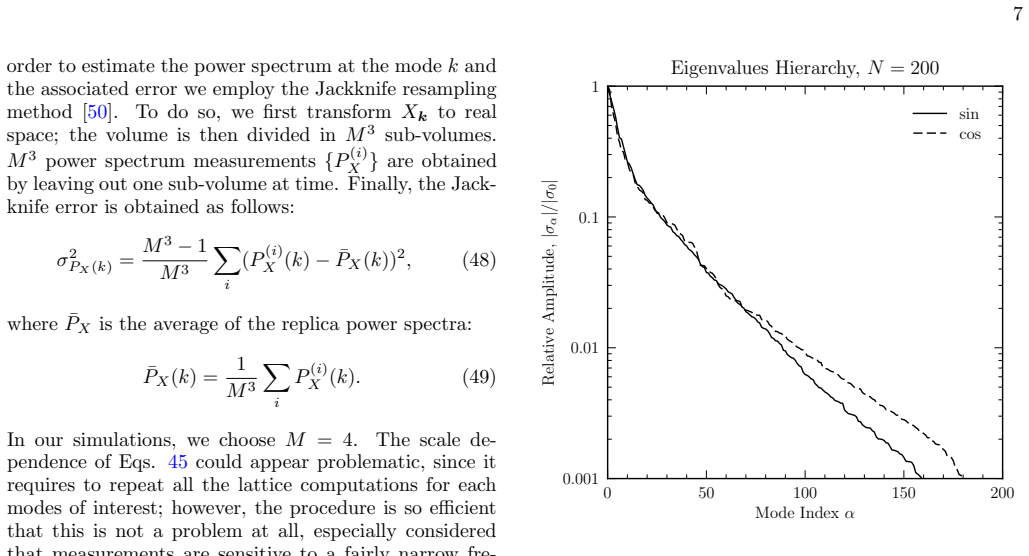
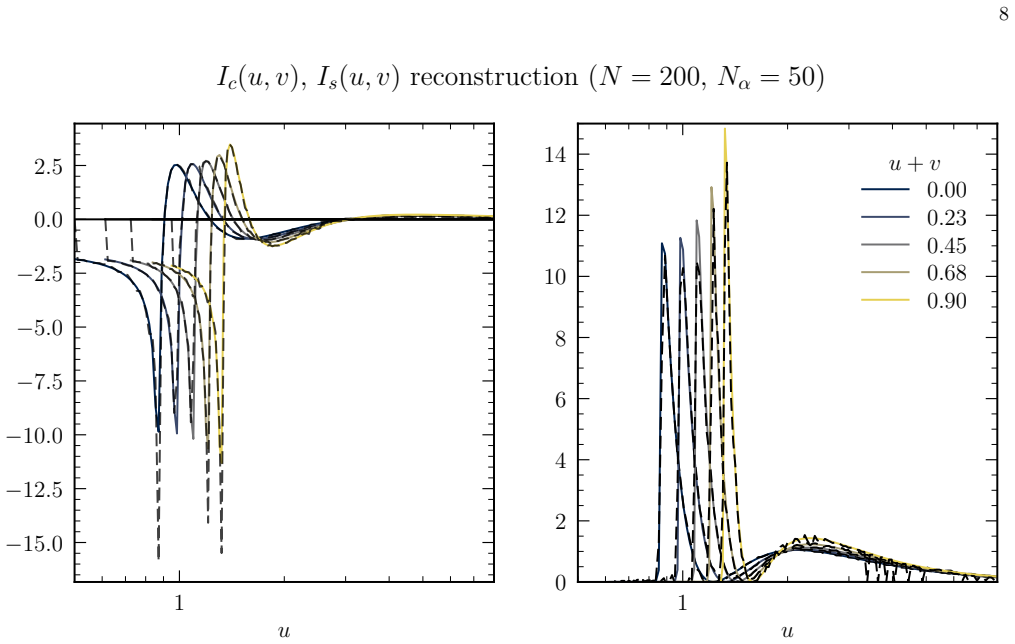
All the lattice computations are performed decomposing each kernelN modes = 100, usingN α = 50 in the reconstruction step
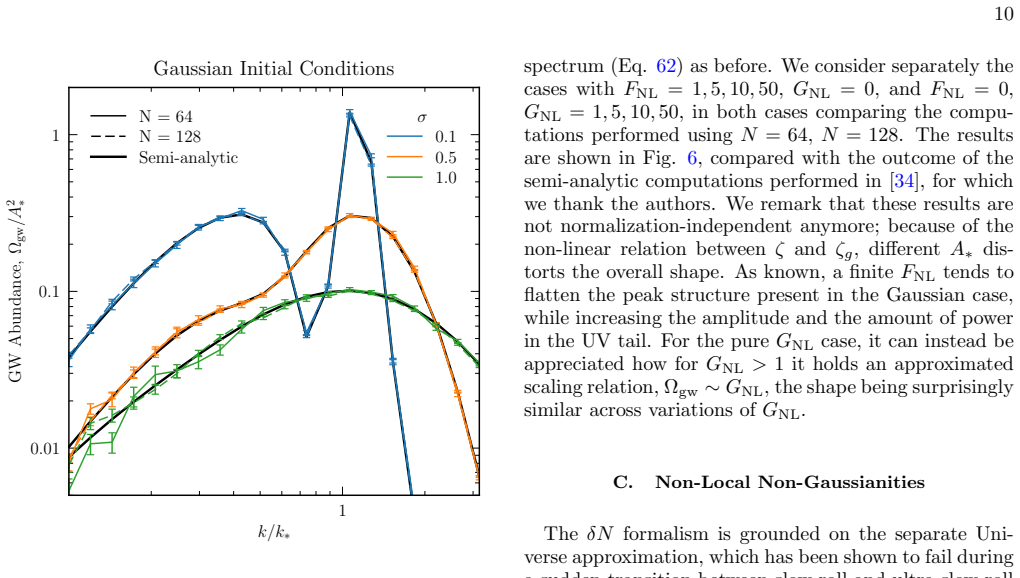
is omitted for clarity. All the lattice computations are performed decomposing each kernelN modes = 100, usingN α = 50 in the reconstruction step. A. Gaussian Initial Conditions As a first test, we consider the case where Φ i,k is a Gaussian field, to be able to compare the outcome of the numerical simulation with a relatively simple semi- analytic expres...
-
[3]
A. H. Guth, Phys. Rev. D23, 347 (1981)
1981
-
[4]
A. A. Starobinsky, Phys. Lett. B91, 99 (1980)
1980
-
[5]
V. F. Mukhanov and G. V. Chibisov, JETP Lett.33, 532 (1981)
1981
-
[6]
The Atacama Cosmology Telescope: DR6 Constraints on Extended Cosmological Models
E. Calabreseet al.(Atacama Cosmology Telescope), JCAP11, 063 (2025), arXiv:2503.14454 [astro-ph.CO]
work page internal anchor Pith review Pith/arXiv arXiv 2025
-
[7]
Tomita, Prog
K. Tomita, Prog. Theor. Phys.37, 831 (1967)
1967
-
[8]
Matarrese, O
S. Matarrese, O. Pantano, and D. Saez, Phys. Rev. D 13 47, 1311 (1993)
1993
-
[9]
General Relativistic Dynamics of Irrotational Dust: Cosmological Implications
S. Matarrese, O. Pantano, and D. Saez, Phys. Rev. Lett. 72, 320 (1994), arXiv:astro-ph/9310036
work page internal anchor Pith review Pith/arXiv arXiv 1994
-
[10]
Relativistic second-order perturbations of the Einstein-de Sitter Universe
S. Matarrese, S. Mollerach, and M. Bruni, Phys. Rev. D 58, 043504 (1998), arXiv:astro-ph/9707278
work page internal anchor Pith review Pith/arXiv arXiv 1998
-
[11]
K. N. Ananda, C. Clarkson, and D. Wands, Phys. Rev. D75, 123518 (2007), arXiv:gr-qc/0612013
work page internal anchor Pith review Pith/arXiv arXiv 2007
-
[12]
D. Baumann, K. Ichiki, P. J. Steinhardt, and K. Taka- hashi, Phys. Rev. D76, 084019 (2007), arXiv:hep- th/0703290
-
[13]
Domenech, Universe7, 398 (2021), arXiv:2109.02581
G. Domenech, Universe7, 398 (2021), arXiv:2109.02581
-
[14]
M. Tristramet al., Astron. Astrophys.647, A128 (2021), arXiv:2010.01139 [astro-ph.CO]
-
[15]
J. Chluba, A. L. Erickcek, and I. Ben-Dayan, Astrophys. J.758, 76 (2012), arXiv:1203.2681 [astro-ph.CO]
work page internal anchor Pith review Pith/arXiv arXiv 2012
-
[16]
Shedding light on the small-scale crisis with CMB spectral distortions
T. Nakama, J. Chluba, and M. Kamionkowski, Phys. Rev. D95, 121302 (2017), arXiv:1703.10559 [astro- ph.CO]
work page internal anchor Pith review Pith/arXiv arXiv 2017
-
[17]
Science with CMB spectral distortions
J. Chluba, in49th Rencontres de Moriond on Cosmology (2014) pp. 327–334, arXiv:1405.6938 [astro-ph.CO]
work page internal anchor Pith review Pith/arXiv arXiv 2014
-
[18]
Silk damping at a redshift of a billion: a new limit on small-scale adiabatic perturbations
D. Jeong, J. Pradler, J. Chluba, and M. Kamionkowski, Phys. Rev. Lett.113, 061301 (2014), arXiv:1403.3697 [astro-ph.CO]
work page internal anchor Pith review Pith/arXiv arXiv 2014
-
[19]
Probing small-scale non-Gaussianity from anisotropies in acoustic reheating
A. Naruko, A. Ota, and M. Yamaguchi, JCAP05, 049 (2015), arXiv:1503.03722 [astro-ph.CO]
work page internal anchor Pith review Pith/arXiv arXiv 2015
-
[20]
Revisiting constraints on small scale perturbations from big-bang nucleosynthesis
K. Inomata, M. Kawasaki, and Y. Tada, Phys. Rev. D 94, 043527 (2016), arXiv:1605.04646 [astro-ph.CO]
work page internal anchor Pith review Pith/arXiv arXiv 2016
-
[21]
Nakama, T
T. Nakama, T. Suyama, and J. Yokoyama, Phys. Rev. Lett.113, 061302 (2014)
2014
-
[22]
Probing the small-scale primordial power spectrum via relic neutrinos and acoustic reheating
G. Piccoli, S. Vagnozzi, and J. Silk, (2026), arXiv:2605.11956 [hep-ph]
work page internal anchor Pith review Pith/arXiv arXiv 2026
-
[23]
Secondary isocurvature perturbations from acoustic reheating
A. Ota and M. Yamaguchi, JCAP06, 022 (2018), arXiv:1705.05196 [astro-ph.CO]
work page internal anchor Pith review Pith/arXiv arXiv 2018
-
[24]
A. S. Josan, A. M. Green, and K. A. Malik, Phys. Rev. D79, 103520 (2009), arXiv:0903.3184 [astro-ph.CO]
work page internal anchor Pith review Pith/arXiv arXiv 2009
-
[25]
Improved constraints on the primordial power spectrum at small scales from ultracompact minihalos
T. Bringmann, P. Scott, and Y. Akrami, Phys. Rev. D 85, 125027 (2012), arXiv:1110.2484 [astro-ph.CO]
work page internal anchor Pith review Pith/arXiv arXiv 2012
-
[26]
Ultra slow-roll inflation demystified
K. Dimopoulos, Phys. Lett. B775, 262 (2017), arXiv:1707.05644 [hep-ph]
work page internal anchor Pith review Pith/arXiv arXiv 2017
-
[27]
The NANOGrav 15-year Data Set: Search for Signals from New Physics
A. Afzalet al.(NANOGrav), Astrophys. J. Lett. 951, L11 (2023), [Erratum: Astrophys.J.Lett. 971, L27 (2024), Erratum: Astrophys.J. 971, L27 (2024)], arXiv:2306.16219 [astro-ph.HE]
work page internal anchor Pith review Pith/arXiv arXiv 2023
-
[28]
Antoniadiset al.(EPTA, InPTA), Astron
J. Antoniadiset al.(EPTA, InPTA), Astron. Astrophys. 685, A94 (2024), arXiv:2306.16227 [astro-ph.CO]
- [29]
- [30]
-
[31]
C. Cecchini, G. Franciolini, and M. Pieroni, Phys. Rev. D111, 123536 (2025), arXiv:2503.10805 [astro-ph.CO]
-
[32]
Auclairet al.(LISA Cosmology Working Group), Living Rev
P. Auclairet al.(LISA Cosmology Working Group), Living Rev. Rel.26, 5 (2023), arXiv:2204.05434 [astro- ph.CO]
- [33]
-
[34]
G. C. Wick, Phys. Rev.80, 268 (1950)
1950
-
[35]
R.-g. Cai, S. Pi, and M. Sasaki, Phys. Rev. Lett.122, 201101 (2019), arXiv:1810.11000 [astro-ph.CO]
work page internal anchor Pith review Pith/arXiv arXiv 2019
- [36]
- [37]
-
[38]
X.-X. Zeng, Z. Ning, R.-G. Cai, and S.-J. Wang, (2025), arXiv:2508.10812 [astro-ph.CO]
work page internal anchor Pith review Pith/arXiv arXiv 2025
-
[39]
Lattice simulations of scalar-induced gravitational waves from inflation
A. Caravano, G. Franciolini, and S. Renaux-Petel, (2026), arXiv:2604.03628 [astro-ph.CO]
work page internal anchor Pith review Pith/arXiv arXiv 2026
- [40]
-
[41]
Zeng, JCAP03, 065 (2026), arXiv:2510.02106 [astro-ph.CO]
X.-X. Zeng, JCAP03, 065 (2026), arXiv:2510.02106 [astro-ph.CO]
- [42]
-
[43]
Dodelson and F
S. Dodelson and F. Schmidt,Modern Cosmology(Aca- demic Press, 2020)
2020
-
[44]
V. F. Mukhanov,Physical Foundations of Cosmology (Cambridge University Press, Oxford, 2005)
2005
-
[45]
E. A. Coddington and N. Levinson,Theory of Ordi- nary Differential Equations(McGraw-Hill Book Com- pany, New York, 1955)
1955
-
[46]
G. Franciolini, D. Racco, and F. Rompineve, Phys. Rev. Lett.132, 081001 (2024), [Erratum: Phys.Rev.Lett. 133, 189901 (2024)], arXiv:2306.17136 [astro-ph.CO]
-
[47]
A. Escriv` a, R. Inui, Y. Tada, and C.-M. Yoo, Phys. Rev. D111, 023528 (2025), arXiv:2404.12591 [astro-ph.CO]
- [48]
- [49]
-
[50]
K. Kohri and T. Terada, Phys. Rev. D97, 123532 (2018), arXiv:1804.08577
work page internal anchor Pith review Pith/arXiv arXiv 2018
-
[51]
Fast fourier transform (fft),
J. W. Cooley, “Fast fourier transform (fft),” inEncyclo- pedia of Computer Science(John Wiley and Sons Ltd., GBR, 2003) p. 695–698
2003
-
[52]
Efron,The Jackknife, the Bootstrap and Other Resam- pling Plans(Society for Industrial and Applied Mathe- matics, Philadelphia, PA, 1982)
B. Efron,The Jackknife, the Bootstrap and Other Resam- pling Plans(Society for Industrial and Applied Mathe- matics, Philadelphia, PA, 1982)
1982
-
[53]
J. W. Gibbs, Nature59, 200 (1898)
-
[54]
PyTorch: An Imperative Style, High-Performance Deep Learning Library
A. Paszke, S. Gross, F. Massa, A. Lerer, J. Bradbury, G. Chanan, T. Killeen, Z. Lin, N. Gimelshein, L. Antiga, A. Desmaison, A. K¨ opf, E. Yang, Z. DeVito, M. Rai- son, A. Tejani, S. Chilamkurthy, B. Steiner, L. Fang, J. Bai, and S. Chintala, “Pytorch: An imperative style, high-performance deep learning library,” (2019), arXiv:1912.01703 [cs.LG]
work page internal anchor Pith review Pith/arXiv arXiv 2019
- [55]
- [56]
-
[57]
J. D. Hunter, Computing in Science & Engineering9, 90 (2007)
2007
-
[58]
Astrojacobli/smplotlib: v0.0.9,
Jiaxuan Li, “Astrojacobli/smplotlib: v0.0.9,” (2023)
2023
discussion (0)
Sign in with ORCID, Apple, or X to comment. Anyone can read and Pith papers without signing in.