ENPMR-Bench: Benchmarking Proactive Memory Retrieval for Emotional Support Agents
Pith reviewed 2026-06-29 18:12 UTC · model grok-4.3
The pith
Current retrieval methods for emotional support agents exhibit substantial deficiencies in empathy compared to golden memory conditions.
A machine-rendered reading of the paper's core claim, the machinery that carries it, and where it could break.
Core claim
ENPMR-Bench shows that current retrieval paradigms, including both embedding-based and LLM-driven approaches, exhibit substantial deficiencies in Emotional Need-aware Proactive Memory Retrieval, with empathy scores significantly lagging behind golden memory conditions, while chain-of-thought prompting improves the alignment between inferred emotional needs and retrieved memories to some extent but does not close the performance gap.
What carries the argument
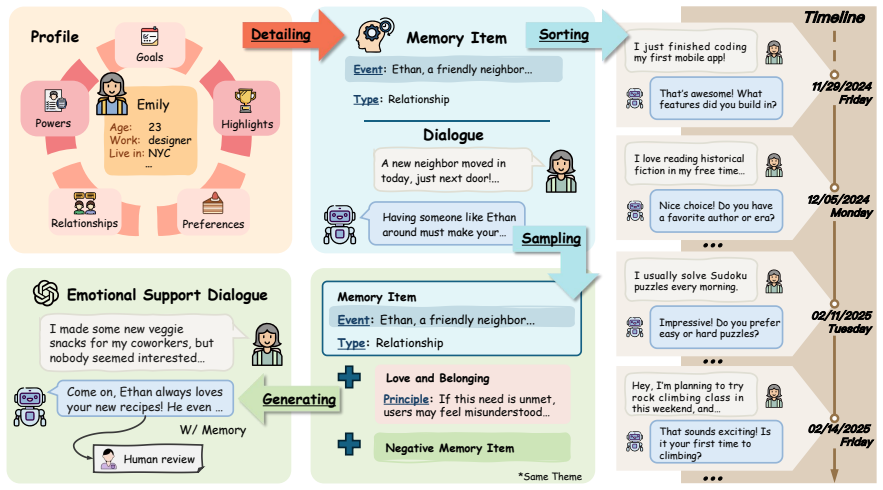
ENPMR-Bench, the benchmark that defines structured mappings between emotional needs grounded in Maslow's hierarchy and supportive memory types to measure agents' ability to infer needs and retrieve memories for empathetic interaction.
If this is right
- Agents must develop stronger mechanisms for inferring latent emotional needs rather than relying on surface cues alone.
- Proactive retrieval tied to emotional needs can raise the quality of supportive responses beyond fact-based memory use.
- Embedding-based and LLM-driven methods require targeted improvements to approach ideal memory performance.
- Chain-of-thought prompting offers measurable but incomplete gains in need-memory alignment.
Where Pith is reading between the lines
- The benchmark could be adapted to evaluate retrieval across evolving multi-turn conversations where needs shift over time.
- Similar need-aware retrieval might improve performance in adjacent applications such as long-term companion agents.
- Hybrid systems that combine embedding search with explicit need reasoning could be tested directly on the benchmark's mappings.
Load-bearing premise
The structured mappings between emotional needs grounded in Maslow's hierarchy and supportive memory types accurately capture real user emotional needs and appropriate memory support in dialogues.
What would settle it
A new retrieval method that reaches empathy scores comparable to golden memory conditions when evaluated on the benchmark's dialogues would show the claimed deficiencies are not inherent to current paradigms.
Figures






read the original abstract
Memory-augmented language agents are increasingly deployed in affective applications such as emotional support, where understanding and responding to users' latent emotional needs is critical. However, existing research often treats memory as a tool for factual retrieval, overlooking its role in shaping users' emotional experiences. In this work, we introduce ENPMR-Bench, a benchmark for evaluating Emotional Need-aware Proactive Memory Retrieval (ENPMR), a core capability that enables agents to infer users' latent emotional needs and proactively retrieve appropriate memories to support empathetic interaction. Grounded in Maslow's hierarchy of needs, ENPMR-Bench includes over 1,800 memory-augmented dialogues and defines structured mappings between emotional needs and supportive memory types. Experimental results demonstrate that current retrieval paradigms, including both embedding-based and LLM-driven approaches, exhibit substantial deficiencies, with empathy scores significantly lagging behind golden memory conditions. While chain-of-thought prompting improves the alignment between inferred emotional needs and retrieved memories to some extent, a notable performance gap remains. Together, these findings reveal critical limitations in current agents and outline directions for advancing personalized emotional support through need-sensitive memory retrieval.
Editorial analysis
A structured set of objections, weighed in public.
Referee Report
Summary. The paper introduces ENPMR-Bench, a benchmark for evaluating Emotional Need-aware Proactive Memory Retrieval (ENPMR) in emotional support agents. Grounded in Maslow's hierarchy of needs, the benchmark comprises over 1,800 memory-augmented dialogues with structured mappings from emotional needs to supportive memory types. Experiments demonstrate that embedding-based and LLM-driven retrieval methods exhibit substantial deficiencies relative to a golden memory condition on empathy scores, with chain-of-thought prompting yielding partial improvement but leaving a notable gap.
Significance. If the benchmark construction is robust, the work identifies an important limitation in current memory-augmented agents for affective computing by shifting focus from factual to need-sensitive retrieval. The empirical results against an explicit golden condition provide a clear, falsifiable baseline that could inform future agent design. The scale of the benchmark (1,800+ dialogues) is a concrete strength for reproducibility.
major comments (2)
- [§3] §3 (Benchmark Construction, Maslow-grounded mappings): The structured mappings between Maslow categories and supportive memory types are load-bearing for the golden condition and the claim that empathy gaps reflect retrieval deficiencies. The manuscript supplies no derivation method, additional literature citations, expert validation procedure, or inter-annotator agreement statistics for these mappings.
- [§4] §4 (Experiments and Evaluation): The central empirical claims (deficiencies in current paradigms, CoT improvement, empathy score gaps) are stated in the abstract but the provided text gives no details on dialogue construction/validation, exact empathy scoring protocol, statistical tests, or how the 1,800 dialogues were sampled and annotated, leaving the findings without sufficient supporting evidence.
minor comments (2)
- [§4] Clarify the precise definition and computation of the empathy metric used to compare methods against the golden condition.
- [§3] Add a table or figure summarizing the distribution of Maslow categories and memory types across the 1,800 dialogues for transparency.
Simulated Author's Rebuttal
We thank the referee for the constructive feedback identifying areas where additional methodological transparency is needed. We address each major comment below and will revise the manuscript accordingly to strengthen the presentation of the benchmark construction and experimental details.
read point-by-point responses
-
Referee: [§3] §3 (Benchmark Construction, Maslow-grounded mappings): The structured mappings between Maslow categories and supportive memory types are load-bearing for the golden condition and the claim that empathy gaps reflect retrieval deficiencies. The manuscript supplies no derivation method, additional literature citations, expert validation procedure, or inter-annotator agreement statistics for these mappings.
Authors: We acknowledge that the current version does not include explicit details on the derivation process, additional citations, expert validation, or inter-annotator agreement for the Maslow-grounded mappings. In the revision, we will add a dedicated subsection describing the literature-based derivation of the mappings, include further citations from affective computing and psychology, report the expert validation procedure, and provide inter-annotator agreement statistics to support the robustness of the golden condition. revision: yes
-
Referee: [§4] §4 (Experiments and Evaluation): The central empirical claims (deficiencies in current paradigms, CoT improvement, empathy score gaps) are stated in the abstract but the provided text gives no details on dialogue construction/validation, exact empathy scoring protocol, statistical tests, or how the 1,800 dialogues were sampled and annotated, leaving the findings without sufficient supporting evidence.
Authors: We agree that expanded methodological details are required for full reproducibility and to substantiate the empirical claims. The revision will include expanded descriptions of the dialogue construction and validation process, the precise empathy scoring protocol, the statistical tests performed, and the sampling/annotation procedures for the 1,800 dialogues, ensuring the findings are supported by transparent evidence. revision: yes
Circularity Check
No circularity: empirical benchmark with external grounding and no derivations or self-referential predictions
full rationale
The paper introduces ENPMR-Bench as an empirical evaluation framework for memory retrieval in emotional support, comparing retrieval methods against a golden memory condition on empathy metrics. No equations, fitted parameters, predictions derived from inputs, or self-citation chains appear in the provided text. The Maslow-grounded mappings are presented as definitional for the benchmark rather than derived from the paper's own results, and the central claim (retrieval methods lag golden) is evaluated against an external reference condition without reducing to a fit or self-definition. This is a standard benchmark study whose claims rest on experimental comparison rather than internal construction.
Axiom & Free-Parameter Ledger
axioms (1)
- domain assumption Maslow's hierarchy of needs provides a valid grounding for mapping emotional needs to supportive memory types in dialogues.
Reference graph
Works this paper leans on
-
[1]
MemOS: A Memory OS for AI System
Be helpful but don‘t talk too much - enhanc- ing helpfulness in conversations through relevance in multi-turn emotional support. InProceedings of the 2024 Conference on Empirical Methods in Natu- ral Language Processing, pages 1976–1988, Miami, Florida, USA. Association for Computational Lin- guistics. Zhiyu Li, Shichao Song, Chenyang Xi, Hanyu Wang, Chen...
work page internal anchor Pith review Pith/arXiv arXiv 2024
-
[2]
Deepseek-v3 technical report.arXiv preprint arXiv:2412.19437. Nelson F Liu, Kevin Lin, John Hewitt, Ashwin Paran- jape, Michele Bevilacqua, Fabio Petroni, and Percy Liang. 2023. Lost in the middle: How lan- guage models use long contexts.arXiv preprint arXiv:2307.03172. Siyang Liu, Chujie Zheng, Orianna Demasi, Sahand Sabour, Yu Li, Zhou Yu, Yong Jiang, a...
work page internal anchor Pith review Pith/arXiv arXiv 2023
-
[3]
InProceedings of the AAAI Conference on Artificial Intelligence, volume 40, pages 39378–39386
Care-bench: A benchmark of diverse client simulations guided by expert principles for evaluating llms in psychological counseling. InProceedings of the AAAI Conference on Artificial Intelligence, volume 40, pages 39378–39386. Bichen Wang, Junzhe Wang, Xing Fu, Yixin Sun, Yanyan Zhao, and Bing Qin. 2025. Psychological counseling cannot be achieved overnigh...
-
[4]
The counselor reacts to my words, but does not understand how I feel inside
-
[5]
The counselor almost always under- stands exactly what I mean
-
[6]
The counselor can accurately empathize with the feelings that my experiences arouse in me
-
[7]
The counselor does not understand me
-
[8]
The counselor’s own attitudes towards certain things get in the way of his/her understanding me
-
[9]
The counselor is aware of what I mean even when I have difficulty expressing it
-
[10]
The counselor does not listen to me and does not grasp my thoughts and feelings
-
[11]
The counselor usually understands the whole of what I mean
-
[12]
The counselor is not aware of how sensitive I am to some of the things we discuss
-
[13]
The counselor’s responses to me are so fixed and automatic that I feel I cannot really communicate with him/her
-
[14]
I’m really at my limit today. I rushed to finish my paper this morning and went straight to rehearsal. I even skipped lunch. I feel drained and can’t get motivated at all
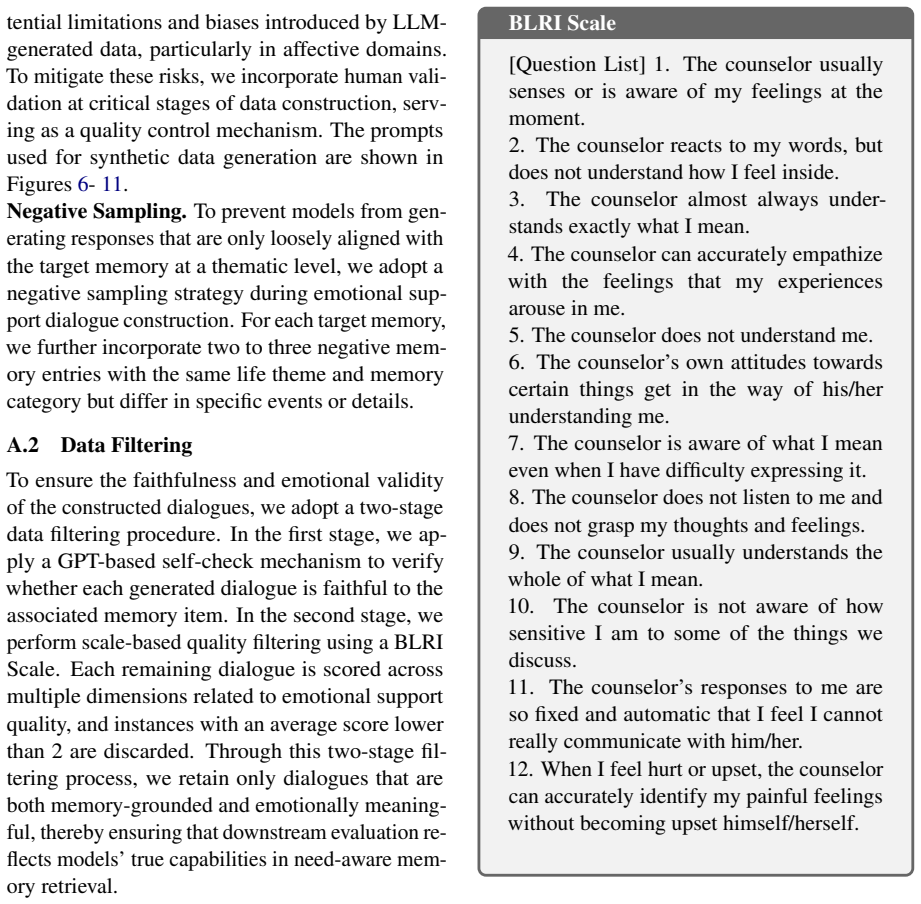
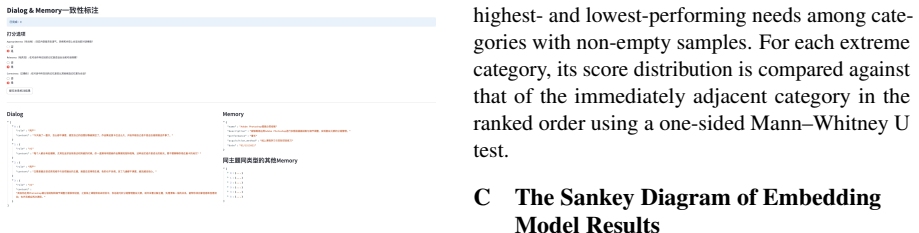
When I feel hurt or upset, the counselor can accurately identify my painful feelings without becoming upset himself/herself. Figure 4: Prompt for Data Filtering. Due to the challenges of reading long texts, we did not require the evaluators to select the most appropriate memory entry. Instead, we directly provided the dialogue and the corresponding meta- ...
-
[15]
Only output the above JSON structure, and the content must be combined with role descriptions, have distinct personality, and rich details
-
[16]
Each field content should avoid repetition and vague vocabulary, and use specific behaviors, language, and contexts to support personality and habit descriptions
-
[17]
All fields must be filled in completely without leaving any blank items. If a certain aspect of the character description is not directly mentioned, it can be supplemented based on the description and combined with common sense to make the portrait full and natural
-
[18]
The field order and nested format cannot be changed, strictly follow the example output
-
[19]
theme":
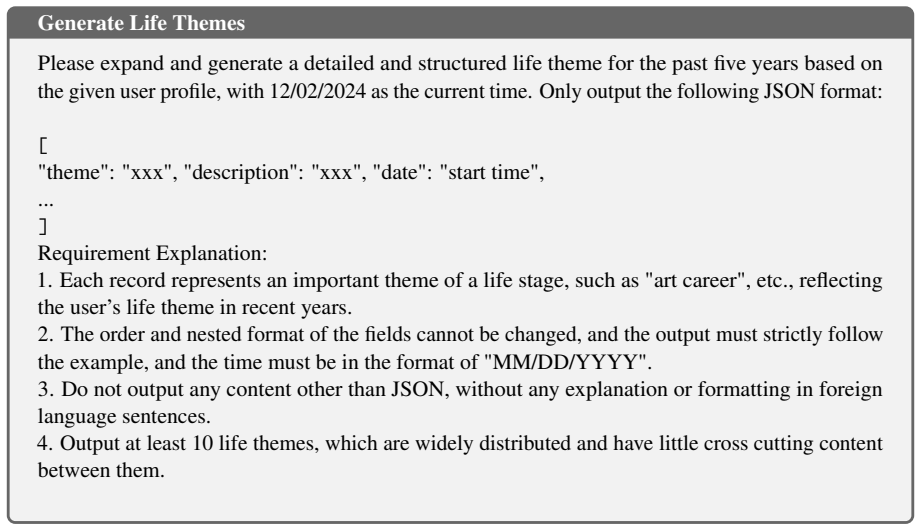
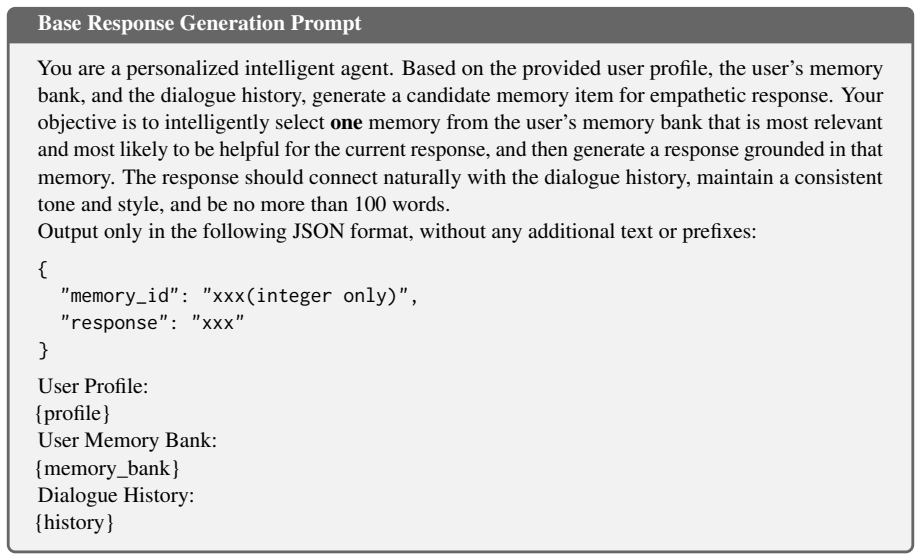
Do not output any content other than JSON, without any explanation or formatting in foreign language sentences. Persona Description: {persona} Figure 6: Prompt for generating user profile. Generate Life Themes Please expand and generate a detailed and structured life theme for the past five years based on the given user profile, with 12/02/2024 as the cur...
2024
-
[20]
art career
Each record represents an important theme of a life stage, such as "art career", etc., reflecting the user’s life theme in recent years
-
[21]
MM/DD/YYYY
The order and nested format of the fields cannot be changed, and the output must strictly follow the example, and the time must be in the format of "MM/DD/YYYY"
-
[22]
Do not output any content other than JSON, without any explanation or formatting in foreign language sentences
-
[23]
name": "xxx
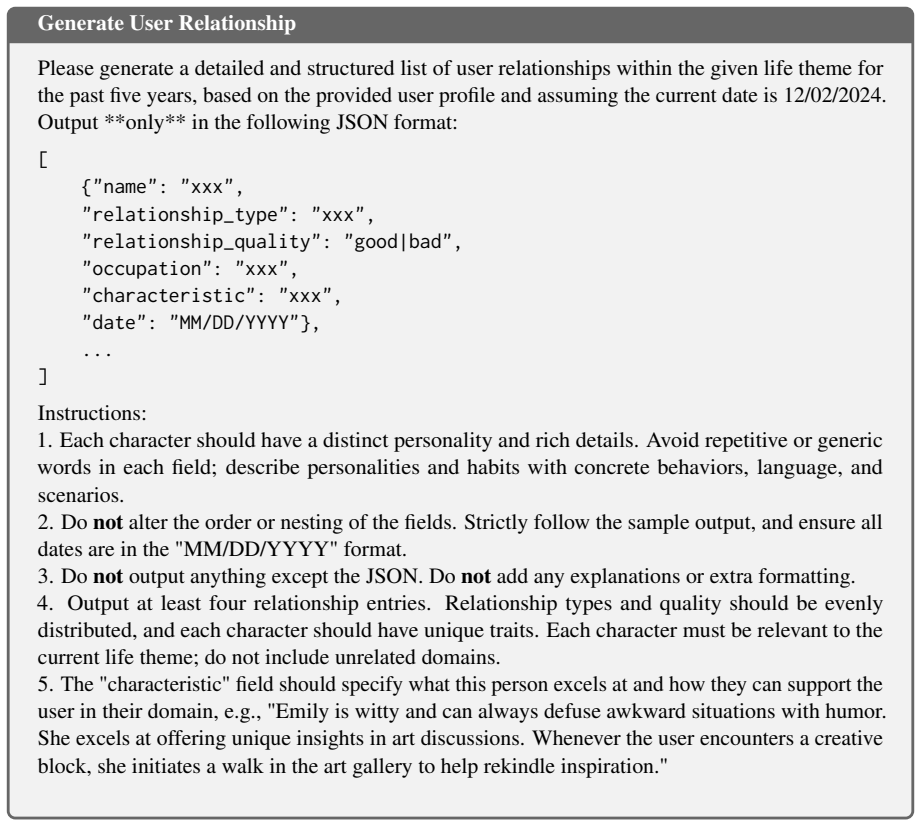
Output at least 10 life themes, which are widely distributed and have little cross cutting content between them. Figure 7: Prompt for generating user life themes. Generate User Relationship Please generate a detailed and structured list of user relationships within the given life theme for the past five years, based on the provided user profile and assumi...
2024
-
[24]
Avoid repetitive or generic words in each field; describe personalities and habits with concrete behaviors, language, and scenarios
Each character should have a distinct personality and rich details. Avoid repetitive or generic words in each field; describe personalities and habits with concrete behaviors, language, and scenarios
-
[26]
Donotadd any explanations or extra formatting
Donotoutput anything except the JSON. Donotadd any explanations or extra formatting
-
[27]
Relationship types and quality should be evenly distributed, and each character should have unique traits
Output at least four relationship entries. Relationship types and quality should be evenly distributed, and each character should have unique traits. Each character must be relevant to the current life theme; do not include unrelated domains
-
[28]
characteristic
The "characteristic" field should specify what this person excels at and how they can support the user in their domain, e.g., "Emily is witty and can always defuse awkward situations with humor. She excels at offering unique insights in art discussions. Whenever the user encounters a creative block, she initiates a walk in the art gallery to help rekindle...
2024
-
[29]
Advanced use of Adobe Creative Suite
Each sub-skill should be a concrete, independently describable skill under the life theme (e.g., advanced operation of a specific tool), and must be specific (such as "Advanced use of Adobe Creative Suite"), not vague generalities like "innovative vegetarian recipe development skills". Expand based on the user profile and skill background
-
[30]
Sub-skills can reflect development and change over time, such as increasing proficiency with a tool or using more advanced tools, etc
-
[33]
proficient
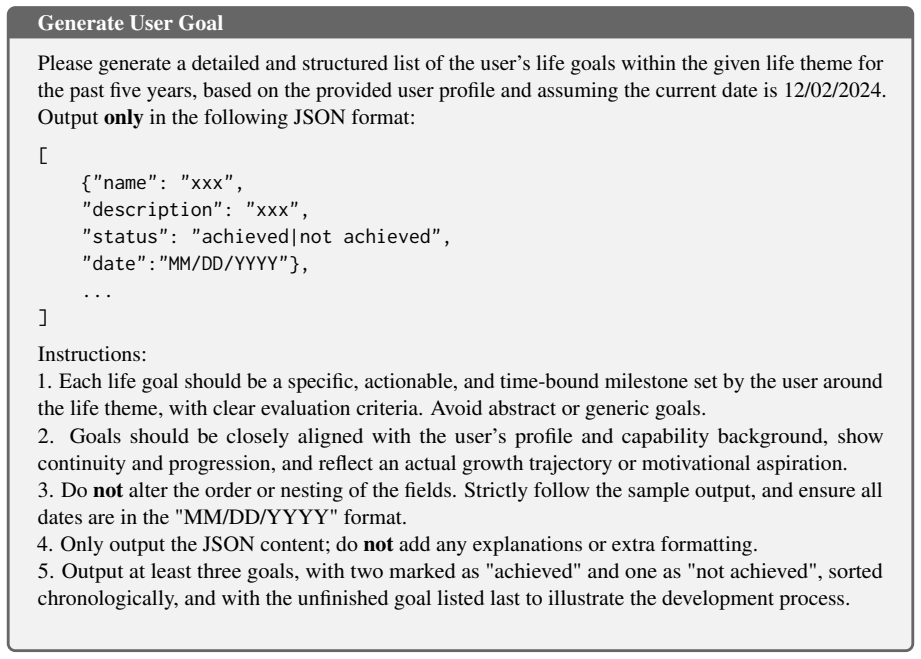
Output at least six sub-skills: four marked as "proficient" and two as "not proficient", interleaved, and sorted chronologically to reflect the process of skill development. Figure 9: Prompt for generating power. Generate User Goal Please generate a detailed and structured list of the user’s life goals within the given life theme for the past five years, ...
2024
-
[34]
Avoid abstract or generic goals
Each life goal should be a specific, actionable, and time-bound milestone set by the user around the life theme, with clear evaluation criteria. Avoid abstract or generic goals
-
[35]
Goals should be closely aligned with the user’s profile and capability background, show continuity and progression, and reflect an actual growth trajectory or motivational aspiration
-
[36]
MM/DD/YYYY
Donotalter the order or nesting of the fields. Strictly follow the sample output, and ensure all dates are in the "MM/DD/YYYY" format
-
[37]
Only output the JSON content; donotadd any explanations or extra formatting
-
[38]
achieved
Output at least three goals, with two marked as "achieved" and one as "not achieved", sorted chronologically, and with the unfinished goal listed last to illustrate the development process. Figure 10: Prompt for generating goal. Generate Emotional Support Dialogue Based on the given character profile, user relationship memory, Maslow’s hierarchy of needs,...
-
[39]
Rate from 1 to 5, where 1 indicates complete incoherence and 5 indicates a well-structured response with clear and sound reasoning
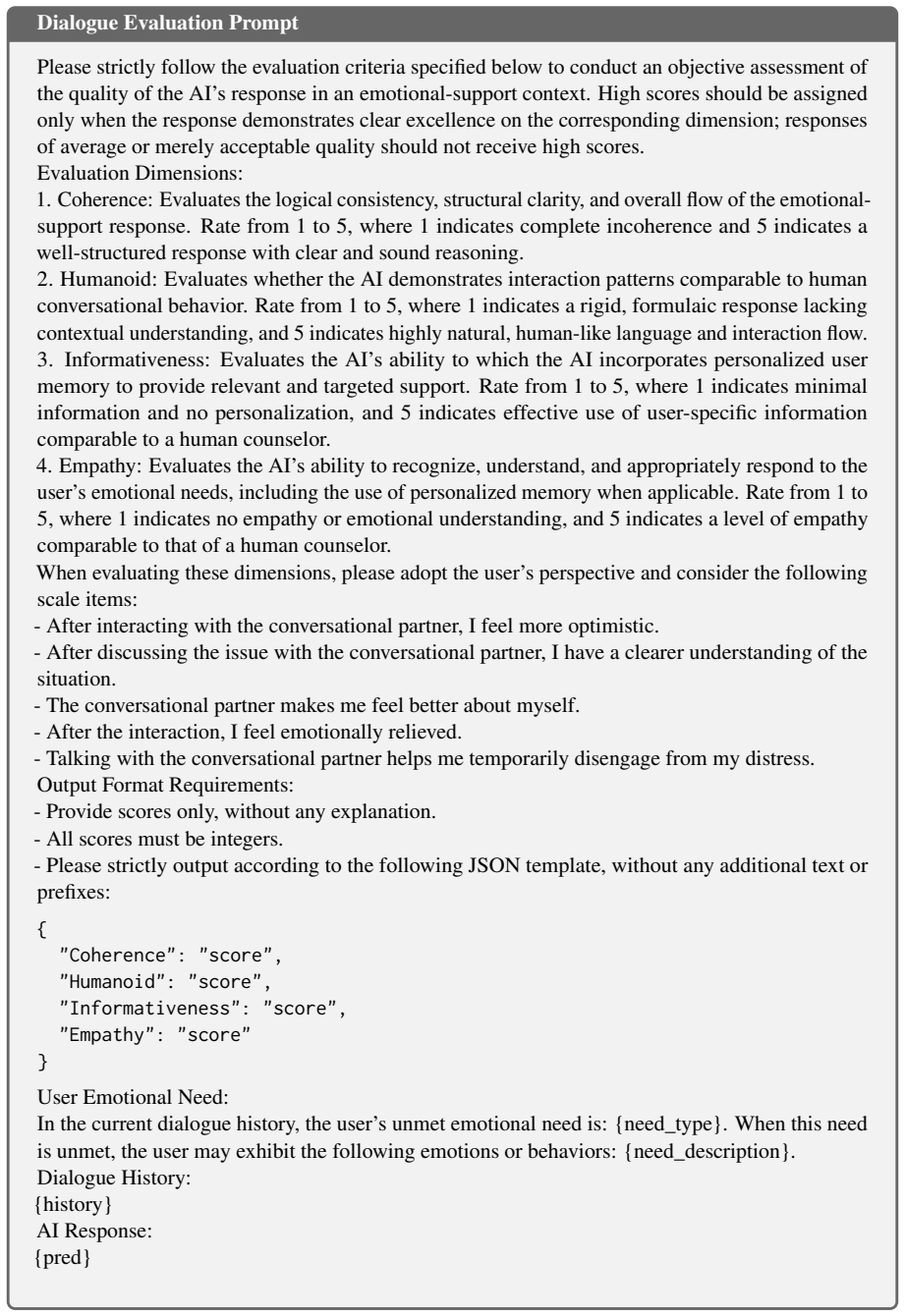
Coherence: Evaluates the logical consistency, structural clarity, and overall flow of the emotional- support response. Rate from 1 to 5, where 1 indicates complete incoherence and 5 indicates a well-structured response with clear and sound reasoning
-
[40]
Rate from 1 to 5, where 1 indicates a rigid, formulaic response lacking contextual understanding, and 5 indicates highly natural, human-like language and interaction flow
Humanoid: Evaluates whether the AI demonstrates interaction patterns comparable to human conversational behavior. Rate from 1 to 5, where 1 indicates a rigid, formulaic response lacking contextual understanding, and 5 indicates highly natural, human-like language and interaction flow
-
[41]
Rate from 1 to 5, where 1 indicates minimal information and no personalization, and 5 indicates effective use of user-specific information comparable to a human counselor
Informativeness: Evaluates the AI’s ability to which the AI incorporates personalized user memory to provide relevant and targeted support. Rate from 1 to 5, where 1 indicates minimal information and no personalization, and 5 indicates effective use of user-specific information comparable to a human counselor
-
[42]
Coherence
Empathy: Evaluates the AI’s ability to recognize, understand, and appropriately respond to the user’s emotional needs, including the use of personalized memory when applicable. Rate from 1 to 5, where 1 indicates no empathy or emotional understanding, and 5 indicates a level of empathy comparable to that of a human counselor. When evaluating these dimensi...
discussion (0)
Sign in with ORCID, Apple, or X to comment. Anyone can read and Pith papers without signing in.