Strong-lensing degeneracies of black holes embedded in self-interacting scalar field dark matter halos
Pith reviewed 2026-06-29 15:41 UTC · model grok-4.3
The pith
Black holes embedded in self-interacting scalar field dark matter halos produce strong-lensing observables that differ from the pure Schwarzschild case by at most one part in a thousand.
A machine-rendered reading of the paper's core claim, the machinery that carries it, and where it could break.
Core claim
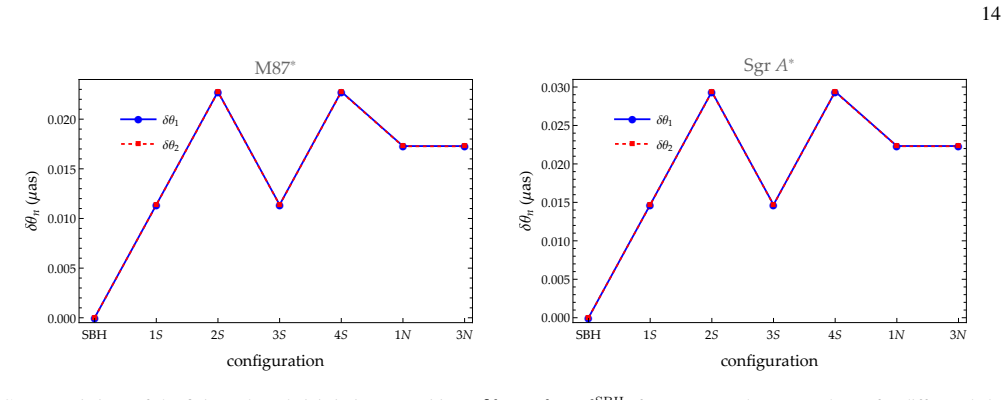
The spacetime geometries of black holes embedded in self-interacting scalar field dark matter halos, reconstructed numerically via the Einstein cluster formalism, yield photon spheres and critical impact parameters that differ from the Schwarzschild metric by O(10^{-3}) or smaller. Consequently, strong-lensing observables including relativistic Einstein rings, image separations, magnifications, and especially time delays between relativistic images exhibit small but systematic deviations, with time delays providing the clearest amplification for supermassive black holes such as M87* and Sgr A*.
What carries the argument
Numerical reconstruction of the spacetime metric through the Einstein cluster formalism, which determines the effective potential for photon trajectories in the combined black hole and halo system.
If this is right
- Relativistic image positions, separations, and magnifications remain within 0.1 percent of their Schwarzschild values for all examined halo configurations.
- Time delays between relativistic images display the largest relative corrections and scale with black hole mass, becoming more detectable for objects like M87*.
- NFW-type halos produce deviations of comparable magnitude to the self-interacting scalar field models.
- Standard strong-lensing observables stay highly robust against the presence of these dark matter distributions around the black hole.
Where Pith is reading between the lines
- High-precision timing observations could distinguish among dark matter halo models around black holes where positional and magnification data cannot.
- Existing Event Horizon Telescope imaging of M87* and Sgr A* is unlikely to resolve the reported halo-induced shifts.
- The same numerical reconstruction approach could be applied to other dark matter density profiles to identify which halo properties most influence time-delay signals.
Load-bearing premise
The spacetime geometry for black holes embedded in self-interacting scalar field dark matter halos can be accurately reconstructed numerically through the Einstein cluster formalism, allowing reliable computation of photon trajectories and lensing observables.
What would settle it
A precision measurement of the time delay between the first two relativistic images of M87* that lies outside the narrow range predicted by the halo models (differing from the Schwarzschild value by more than a few parts in 10^3) would falsify the claim of strong observational degeneracy at the reported level.
Figures




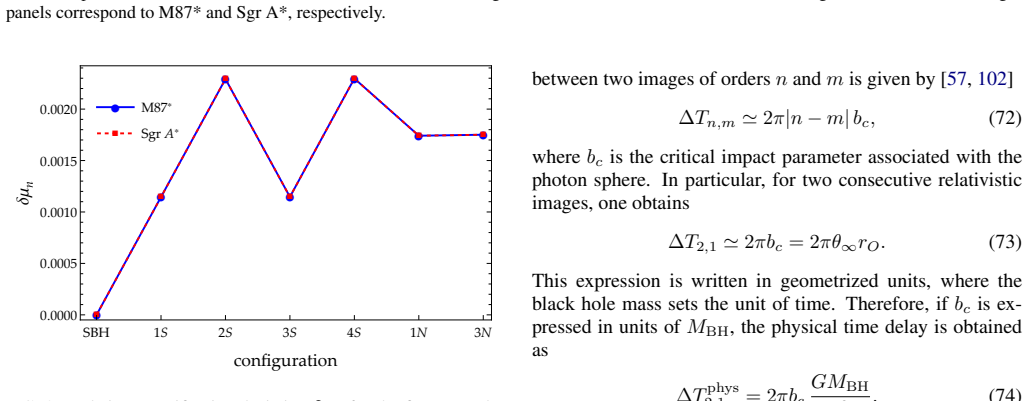

read the original abstract
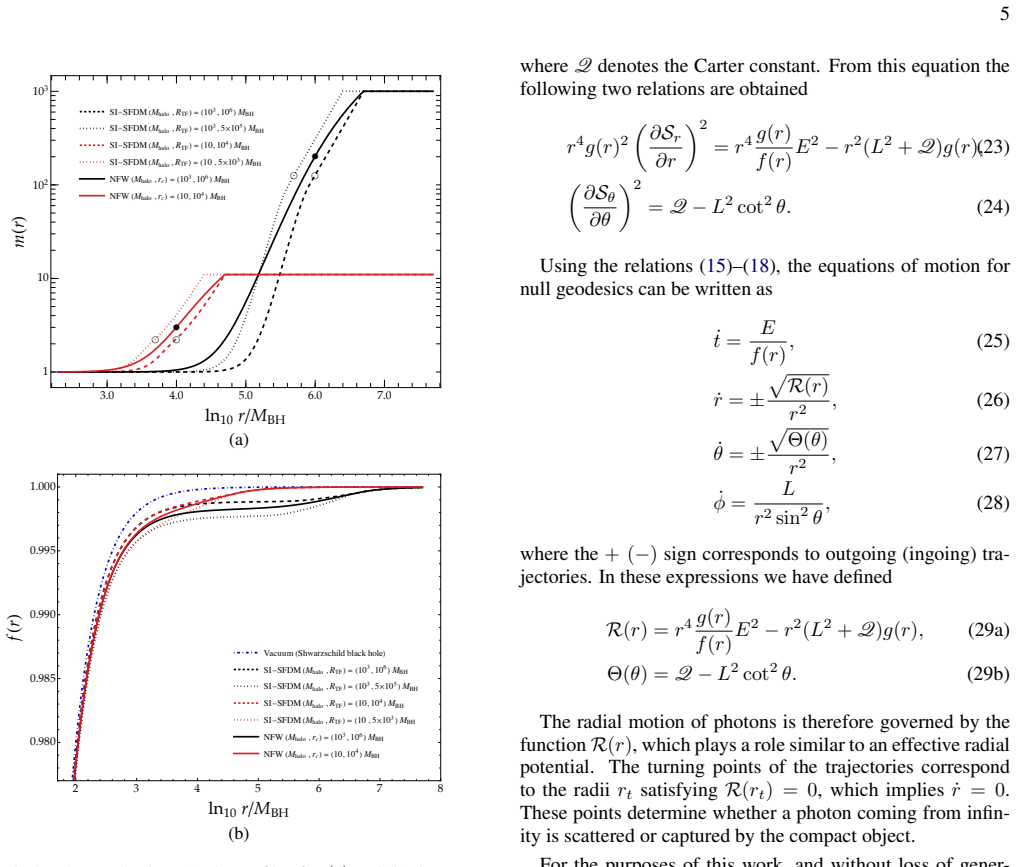
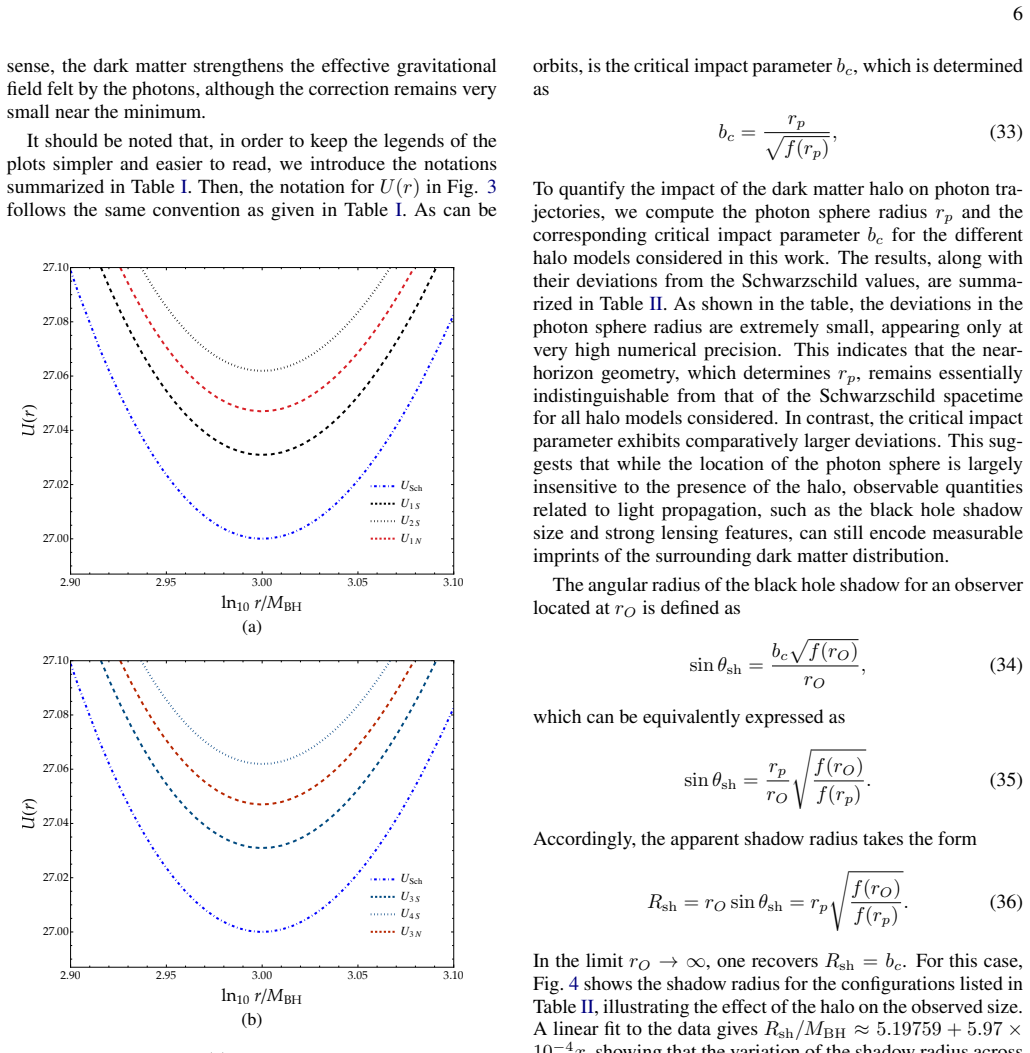
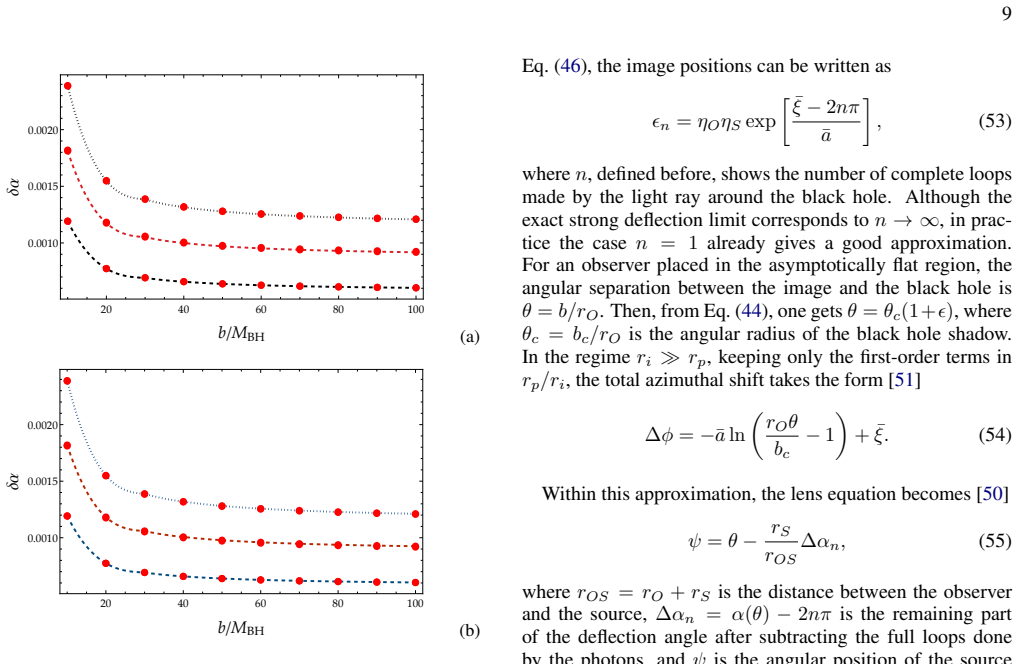
In this paper, we explore the strong gravitational lensing properties of black holes embedded in self-interacting scalar field dark matter halos, together with NFW-type configurations for comparison. The corresponding spacetime geometry is reconstructed numerically through the Einstein cluster formalism, allowing us to study how the surrounding dark matter distribution affects the propagation of photons near the black hole. We first analyze the effective function governing photon trajectories and calculate the corresponding photon sphere radius and critical impact parameter. We then investigate different strong-lensing observables, including relativistic Einstein rings, finite-order image positions, image separations, magnifications, and time delays, with particular attention to the supermassive black holes M87* and Sgr A*. Our results show that the considered halo configurations produce only small deviations with respect to the Schwarzschild case, typically at the level of $\mathcal{O}(10^{-3})$ or smaller, leading to a strong observational degeneracy among the models. Nevertheless, small but systematic differences remain present, especially in the time delay between relativistic images, which provides the clearest amplification of the halo-induced corrections for very massive black holes. These results suggest that, although standard strong-lensing observables remain highly robust against the considered halo environments, time-domain signatures may offer a more promising way to probe the effect of dark matter surrounding black holes.
Editorial analysis
A structured set of objections, weighed in public.
Referee Report
Summary. The manuscript numerically reconstructs the spacetime metric for black holes embedded in self-interacting scalar field dark matter halos (and NFW profiles for comparison) via the Einstein cluster formalism. It computes the effective potential for photon trajectories, the photon-sphere radius, critical impact parameter, and strong-lensing observables including relativistic Einstein rings, finite-order image positions, separations, magnifications, and time delays, with explicit application to M87* and Sgr A*. The central claim is that halo-induced deviations from the Schwarzschild case remain at the level of O(10^{-3}) or smaller for most observables, producing strong observational degeneracy, while time delays between relativistic images exhibit systematic differences that are amplified for very massive black holes.
Significance. If the numerical results hold, the work establishes that standard strong-lensing observables are robust against the considered dark-matter halo environments, while identifying time delays as a potentially more sensitive probe. The numerical reconstruction approach via the Einstein cluster formalism is a positive feature, enabling study of metrics without closed-form solutions and yielding falsifiable predictions for time-domain signatures around M87* and Sgr A*.
major comments (1)
- [Numerical reconstruction (abstract and methods)] The section on numerical reconstruction of the metric (invoked in the abstract and used to obtain all reported observables) provides no details on the integrator, step-size control, convergence tests against the Schwarzschild limit or known halo solutions, or residual error estimates on the photon-sphere radius, critical impact parameter, or integrated time-delay quantities. This validation is load-bearing for the central claim, as the reported O(10^{-3}) deviations and systematic time-delay differences cannot be distinguished from numerical artifacts without such checks.
Simulated Author's Rebuttal
Dear Editor, We thank the referee for their careful and constructive review of our manuscript. The single major comment identifies a genuine omission in the presentation of our numerical methods. We address it below and will revise the manuscript accordingly to strengthen the validation of our results.
read point-by-point responses
-
Referee: [Numerical reconstruction (abstract and methods)] The section on numerical reconstruction of the metric (invoked in the abstract and used to obtain all reported observables) provides no details on the integrator, step-size control, convergence tests against the Schwarzschild limit or known halo solutions, or residual error estimates on the photon-sphere radius, critical impact parameter, or integrated time-delay quantities. This validation is load-bearing for the central claim, as the reported O(10^{-3}) deviations and systematic time-delay differences cannot be distinguished from numerical artifacts without such checks.
Authors: We agree that the current manuscript does not provide sufficient documentation of the numerical reconstruction procedure. In the revised version we will add a dedicated subsection in the methods that specifies: the integrator employed and its implementation; the step-size control and convergence criteria; explicit convergence tests recovering the Schwarzschild limit to machine precision and, where analytic halo solutions exist, matching those profiles; and quantitative residual error bounds on the photon-sphere radius, critical impact parameter, and integrated time-delay observables. These additions will demonstrate that the reported O(10^{-3}) deviations and the systematic time-delay differences are not numerical artifacts. revision: yes
Circularity Check
No circularity: metric reconstruction and observable computation are independent
full rationale
The paper takes external density profiles as input, reconstructs the metric numerically via the Einstein cluster formalism (integrating the Einstein equations for the given halo), and then computes photon trajectories and lensing observables directly from the resulting geometry. No step fits parameters to the output observables and renames them as predictions, invokes self-citations for uniqueness theorems, or defines quantities in terms of each other. The reported O(10^{-3}) deviations are direct numerical outputs rather than tautological re-expressions of the inputs, rendering the derivation chain self-contained.
Axiom & Free-Parameter Ledger
axioms (1)
- domain assumption The Einstein cluster formalism can be applied to numerically reconstruct the spacetime geometry of a black hole embedded in a self-interacting scalar field dark matter halo.
Reference graph
Works this paper leans on
-
[1]
Über das gravitationsfeld eines massen- punktes nach der einsteinschen theorie,
K. Schwarzschild, “Über das gravitationsfeld eines massen- punktes nach der einsteinschen theorie,”Sitzungsberichte der Königlich Preußischen Akademie der Wissenschaften (Berlin), pp. 189–196, Jan. 1916
1916
-
[2]
Gravitational field of a spinning mass as an exam- ple of algebraically special metrics,
R. P. Kerr, “Gravitational field of a spinning mass as an exam- ple of algebraically special metrics,”Physical Review Letters, vol. 11, pp. 237–238, 1963
1963
-
[3]
Chandrasekhar,The mathematical theory of black holes
S. Chandrasekhar,The mathematical theory of black holes. Oxford classic texts in the physical sciences, Oxford: Oxford Univ. Press, 2002
2002
-
[4]
C. W. Misner, K. S. Thorne, and J. A. Wheeler,Gravitation. Princeton University Press, 2017
2017
-
[5]
The Confrontation between General Relativity and Experiment,
C. M. Will, “The Confrontation between General Relativity and Experiment,”Living Rev. Rel., vol. 17, p. 4, 2014
2014
-
[6]
Rotational prop- erties of 21 sc galaxies with a large range of luminosities and radii, from ngc 4605/r = 4 kpc to ugc 2885/r = 122 kpc,
V . C. Rubin, W. K. Ford, and N. Thonnard, “Rotational prop- erties of 21 sc galaxies with a large range of luminosities and radii, from ngc 4605/r = 4 kpc to ugc 2885/r = 122 kpc,”As- trophysical Journal, vol. 238, pp. 471–487, 1980
1980
-
[7]
Particle dark matter: Evi- dence, candidates and constraints,
G. Bertone, D. Hooper, and J. Silk, “Particle dark matter: Evi- dence, candidates and constraints,”Physics Reports, vol. 405, pp. 279–390, 2005
2005
-
[8]
Planck 2018 results. VI. Cosmological parameters,
N. Aghanimet al., “Planck 2018 results. VI. Cosmological parameters,”Astron. Astrophys., vol. 641, p. A6, 2020
2018
-
[9]
Small-scale chal- lenges to theΛCDM paradigm,
J. S. Bullock and M. Boylan-Kolchin, “Small-scale chal- lenges to theΛCDM paradigm,”Ann. Rev. Astron. Astrophys., vol. 55, pp. 343–387, 2017
2017
-
[10]
The structure of cold dark matter halos,
J. F. Navarro, C. S. Frenk, and S. D. M. White, “The structure of cold dark matter halos,”Astrophysical Journal, vol. 462, pp. 563–575, 1996
1996
-
[11]
f(R) actions, cosmic accel- eration and local tests of gravity,
I. Navarro and K. V . Acoleyen, “f(R) actions, cosmic accel- eration and local tests of gravity,”Journal of Cosmology and Astroparticle Physics, vol. 2007, p. 022, feb 2007
2007
-
[12]
The core-cusp problem,
W. J. G. de Blok, “The core-cusp problem,”Adv. Astron., vol. 2010, p. 789293, 2010
2010
-
[13]
Observational evidence for self-interacting cold dark matter,
D. N. Spergel and P. J. Steinhardt, “Observational evidence for self-interacting cold dark matter,”Phys. Rev. Lett., vol. 84, pp. 3760–3763, 2000
2000
-
[14]
Fuzzy cold dark matter: The wave properties of ultralight particles,
W. Hu, R. Barkana, and A. Gruzinov, “Fuzzy cold dark matter: The wave properties of ultralight particles,”Phys. Rev. Lett., vol. 85, pp. 1158–1161, 2000
2000
-
[15]
Cosmic structure as the quantum interference of a coherent dark wave,
H.-Y . Schive, T. Chiueh, and T. Broadhurst, “Cosmic structure as the quantum interference of a coherent dark wave,”Nature Phys., vol. 10, pp. 496–499, 2014
2014
-
[16]
Ultralight scalars as cosmological dark matter,
L. Hui, J. P. Ostriker, S. Tremaine, and E. Witten, “Ultralight scalars as cosmological dark matter,”Phys. Rev. D, vol. 95, no. 4, p. 043541, 2017
2017
-
[17]
Dark matter self-interactions and small scale structure,
S. Tulin and H.-B. Yu, “Dark matter self-interactions and small scale structure,”Phys. Rept., vol. 730, pp. 1–57, 2018
2018
-
[18]
Ultralight Repulsive Dark Matter and BEC,
J. Fan, “Ultralight Repulsive Dark Matter and BEC,”Phys. Dark Univ., vol. 14, pp. 84–94, 2016
2016
-
[19]
Further analysis of a cos- mological model with quintessence and scalar dark matter,
T. Matos and L. A. Ureña López, “Further analysis of a cos- mological model with quintessence and scalar dark matter,” Phys. Rev. D, vol. 63, p. 063506, 2001
2001
-
[20]
Flat central density profile and constant dark matter surface density in galaxies from scalar field dark matter,
V . H. Robles and T. Matos, “Flat central density profile and constant dark matter surface density in galaxies from scalar field dark matter,”Mon. Not. Roy. Astron. Soc., vol. 422, pp. 282–289, 2012
2012
-
[21]
Brief review on scalar field dark matter models,
L. A. Ureña López, “Brief review on scalar field dark matter models,”Front. Astron. Space Sci., vol. 6, p. 47, 2019
2019
-
[22]
Dark matter annihilation at the galac- tic center,
P. Gondolo and J. Silk, “Dark matter annihilation at the galac- tic center,”Phys. Rev. Lett., vol. 83, pp. 1719–1722, 1999
1999
-
[23]
Dark matter dis- tributions around massive black holes: A general relativistic analysis,
L. Sadeghian, F. Ferrer, and C. M. Will, “Dark matter dis- tributions around massive black holes: A general relativistic analysis,”Phys. Rev. D, vol. 88, no. 6, p. 063522, 2013
2013
-
[24]
Gravitational waves as a probe of dark matter minispikes,
K. Eda, Y . Itoh, S. Kuroyanagi, and J. Silk, “Gravitational waves as a probe of dark matter minispikes,”Phys. Rev. Lett., vol. 110, no. 22, p. 221101, 2013
2013
-
[25]
New probe of dark matter properties: gravitational waves from an intermediate mass black hole embedded in a dark matter minispike,
K. Eda, Y . Itoh, S. Kuroyanagi, and J. Silk, “New probe of dark matter properties: gravitational waves from an intermediate mass black hole embedded in a dark matter minispike,”Phys. Rev. D, vol. 91, no. 4, p. 044045, 2015
2015
-
[26]
Dynamical constraints on a dark matter spike at the Galactic centre from stellar orbits,
T. Lacroix, “Dynamical constraints on a dark matter spike at the Galactic centre from stellar orbits,”Astron. Astrophys., vol. 619, p. A46, 2018
2018
-
[27]
Dark-matter dynamical fric- tion versus gravitational-wave emission in the evolution of compact-star binaries,
L. G. Gómez and J. A. Rueda, “Dark-matter dynamical fric- tion versus gravitational-wave emission in the evolution of compact-star binaries,”Phys. Rev. D, vol. 96, no. 6, p. 063001, 2017
2017
-
[28]
Gravitational waves as a probe of dark matter minispikes,
K. Eda, Y . Itoh, S. Kuroyanagi, and J. Silk, “Gravitational waves as a probe of dark matter minispikes,”Phys. Rev. D, vol. 92, no. 6, p. 064016, 2015
2015
-
[29]
Critical behavior of AdS black holes surrounded by dark fluid with Chaplygin-like equation of state,
X.-Q. Li, H.-P. Yan, L.-L. Xing, and S.-W. Zhou, “Critical behavior of AdS black holes surrounded by dark fluid with Chaplygin-like equation of state,”Phys. Rev. D, vol. 107, no. 10, p. 104055, 2023
2023
-
[30]
Quintessence and black holes,
V . V . Kiselev, “Quintessence and black holes,”Classical and Quantum Gravity, vol. 20, pp. 1187–1197, Mar. 2003
2003
-
[31]
G. Mustafa, S. K. Maurya, A. Ditta, S. Ray, and F. Atamuro- tov, “Circular orbits and accretion disk around AdS black holes surrounded by dark fluid with Chaplygin-like equation of state,”arXiv e-prints, p. arXiv:2311.13839, Nov. 2023
-
[32]
D. Arora, M. Yasir, H. Chaudhary, F. Javed, G. Mustafa, X. Tiecheng, and F. Atamurotov, “Joule-Thomson expansion and tidal force effects of AdS black holes surrounded by Chap- lygin dark fluid,”arXiv e-prints, p. arXiv:2312.16224, Dec. 2023
-
[33]
Black hole immersed dark matter halo,
Z. Xu, X. Gong, and S.-N. Zhang, “Black hole immersed dark matter halo,”Physical Review D, vol. 101, p. 024029, Jan. 2020. 18
2020
-
[34]
Shadow of a black hole surrounded by dark matter,
R. Konoplya, “Shadow of a black hole surrounded by dark matter,”Physics Letters B, vol. 795, pp. 1–6, Aug. 2019
2019
-
[35]
Shadows of Sgr A* black hole surrounded by superfluid dark matter halo,
K. Jusufi, M. Jamil, and T. Zhu, “Shadows of Sgr A* black hole surrounded by superfluid dark matter halo,”The Euro- pean Physical Journal C, vol. 80, p. 354, May 2020
2020
-
[36]
Shadow of a spinning black hole in an expanding universe,
P.-C. Li, M. Guo, and B. Chen, “Shadow of a spinning black hole in an expanding universe,”Physical Review D, vol. 101, p. 084041, Apr. 2020
2020
-
[37]
Dark matter effect on the weak deflection angle by black holes at the center of Milky Way and M87 galaxies,
R. C. Pantig and A. Övgün, “Dark matter effect on the weak deflection angle by black holes at the center of Milky Way and M87 galaxies,”The European Physical Journal C, vol. 82, p. 391, May 2022
2022
-
[38]
Dehnen halo effect on a black hole in an ultra-faint dwarf galaxy,
R. C. Pantig and A. Övgün, “Dehnen halo effect on a black hole in an ultra-faint dwarf galaxy,”Journal of Cosmology and Astroparticle Physics, vol. 2022, p. 056, Aug. 2022
2022
-
[39]
Black Hole in Quantum Wave Dark Matter,
R. C. Pantig and A. Övgün, “Black Hole in Quantum Wave Dark Matter,”F ortschritte der Physik, vol. 71, p. 2200164, Jan. 2023
2023
-
[40]
Apparent and emergent dark matter around a Schwarzschild black hole,
R. C. Pantig, “Apparent and emergent dark matter around a Schwarzschild black hole,”Physics of the Dark Universe, vol. 45, p. 101550, July 2024
2024
-
[41]
Deflection Angle of Photons through Dark Matter by Black Holes and Wormholes Using Gauss–Bonnet Theo- rem,
A. Övgün, “Deflection Angle of Photons through Dark Matter by Black Holes and Wormholes Using Gauss–Bonnet Theo- rem,”Universe, vol. 5, no. 5, p. 115, 2019
2019
-
[42]
Light deflection by Damour-Solodukhin worm- holes and Gauss-Bonnet theorem,
A. Övgün, “Light deflection by Damour-Solodukhin worm- holes and Gauss-Bonnet theorem,”Phys. Rev. D, vol. 98, no. 4, p. 044033, 2018
2018
-
[43]
Shadow cast of noncommutative black holes in Rastall gravity,
A. Övgün, I. Sakallı, J. Saavedra, and C. Leiva, “Shadow cast of noncommutative black holes in Rastall gravity,”Mod. Phys. Lett. A, vol. 35, no. 20, p. 2050163, 2020
2020
-
[44]
Testing generalized Ein- stein–Cartan–Kibble–Sciama gravity using weak deflection angle and shadow cast,
A. Övgün and I. Sakallı, “Testing generalized Ein- stein–Cartan–Kibble–Sciama gravity using weak deflection angle and shadow cast,”Class. Quant. Grav., vol. 37, no. 22, p. 225003, 2020
2020
-
[45]
Black hole with confining electric potential in scalar-tensor description of regularized 4-dimensional Einstein-Gauss-Bonnet gravity,
A. Övgün, “Black hole with confining electric potential in scalar-tensor description of regularized 4-dimensional Einstein-Gauss-Bonnet gravity,”Phys. Lett. B, vol. 820, p. 136517, 2021
2021
-
[46]
Constraints via the Event Horizon Telescope for Black Hole Solutions with Dark Matter under the Generalized Uncertainty Principle Min- imal Length Scale Effect,
A. Övgün, L. J. F. Sese, and R. C. Pantig, “Constraints via the Event Horizon Telescope for Black Hole Solutions with Dark Matter under the Generalized Uncertainty Principle Min- imal Length Scale Effect,”Annalen der Physik, vol. 536, p. 2300390, Apr. 2024
2024
-
[47]
Black hole surrounded by the pseudo-isothermal dark matter halo,
Y . Yang, D. Liu, A. Övgün, G. Lambiase, and Z.-W. Long, “Black hole surrounded by the pseudo-isothermal dark matter halo,”Eur . Phys. J. C, vol. 84, p. 63, 2024
2024
-
[48]
The gravity field of a particle,
C. Darwin, “The gravity field of a particle,”Proceedings of the Royal Society of London. Series A. Mathematical and Physical Sciences, vol. 249, pp. 180–194, Jan. 1959
1959
-
[49]
Schwarzschild black hole lensing,
K. S. Virbhadra and G. F. R. Ellis, “Schwarzschild black hole lensing,”Phys. Rev. D, vol. 62, p. 084003, Sep 2000
2000
-
[50]
Strong Field Limit of Black Hole Gravitational Lensing,
V . Bozza, S. Capozziello, G. Iovane, and G. Scarpetta, “Strong Field Limit of Black Hole Gravitational Lensing,”General Relativity and Gravitation, vol. 33, pp. 1535–1548, Sept. 2001
2001
-
[51]
Gravitational lensing in the strong field limit,
V . Bozza, “Gravitational lensing in the strong field limit,” Phys. Rev. D, vol. 66, p. 103001, Nov 2002
2002
-
[52]
Gravitational lensing by black holes,
V . Bozza, “Gravitational lensing by black holes,”General Rel- ativity and Gravitation, vol. 42, pp. 2269–2300, 2010
2010
-
[53]
Strong deflection limit of black hole gravitational lensing with arbitrary source distances,
V . Bozza and G. Scarpetta, “Strong deflection limit of black hole gravitational lensing with arbitrary source distances,” Physical Review D, vol. 76, p. 083008, Oct. 2007
2007
-
[54]
Strong deflection limit of black hole gravitational lensing with arbitrary source distances,
V . Bozza and G. Scarpetta, “Strong deflection limit of black hole gravitational lensing with arbitrary source distances,” Physical Review D, vol. 76, p. 083008, 2007
2007
-
[55]
Calculating black hole shad- ows: Review of analytical studies,
V . Perlick and O. Y . Tsupko, “Calculating black hole shad- ows: Review of analytical studies,”Physics Reports, vol. 947, pp. 1–39, 2022
2022
-
[57]
Time delay in black hole gravita- tional lensing as a distance estimator,
V . Bozza and L. Mancini, “Time delay in black hole gravita- tional lensing as a distance estimator,”General Relativity and Gravitation, vol. 36, pp. 435–450, 2004
2004
-
[58]
Time Delay in Black Hole Gravi- tational Lensing as a Distance Estimator,
V . Bozza and L. Mancini, “Time Delay in Black Hole Gravi- tational Lensing as a Distance Estimator,”General Relativity and Gravitation, vol. 36, pp. 435–450, Feb. 2004
2004
-
[59]
Analytical study of higher-order ring images of the accretion disk around a black hole,
G. S. Bisnovatyi-Kogan and O. Y . Tsupko, “Analytical study of higher-order ring images of the accretion disk around a black hole,”Physical Review D, vol. 105, p. 064040, Mar. 2022
2022
-
[60]
Shape of higher-order images of equatorial emission rings around a Schwarzschild black hole: Analytical description with polar curves,
O. Y . Tsupko, “Shape of higher-order images of equatorial emission rings around a Schwarzschild black hole: Analytical description with polar curves,”Physical Review D, vol. 106, p. 064033, Sept. 2022
2022
-
[61]
Constraining spher- ically symmetric metrics by the gap between photon rings,
F. Aratore, O. Y . Tsupko, and V . Perlick, “Constraining spher- ically symmetric metrics by the gap between photon rings,” Physical Review D, vol. 109, p. 124057, June 2024
2024
-
[62]
First M87 Event Horizon Telescope Results. IV . Imag- ing the Central Supermassive Black Hole,
[The Event Horizon Telescope Collaboration], K. Akiyama, et al., “First M87 Event Horizon Telescope Results. IV . Imag- ing the Central Supermassive Black Hole,”Astrophys. J. Lett., vol. 875, no. 1, p. L4, 2019
2019
-
[63]
First Sagittarius A ∗ Event Horizon Telescope results. I. The shadow of the supermassive black hole in the center of the Milky Way.,
[The Event Horizon Telescope Collaboration], K. Akiyama, et al., “First Sagittarius A ∗ Event Horizon Telescope results. I. The shadow of the supermassive black hole in the center of the Milky Way.,”Astrophys. J. Lett., vol. 930, no. 2, p. L12, 2022
2022
-
[64]
First M87 Event Horizon Telescope Results. IV. Imag- ing the Central Supermassive Black Hole,
[The Event Horizon Telescope Collaboration], K. Akiyama, et al., “First M87 Event Horizon Telescope Results. IV. Imag- ing the Central Supermassive Black Hole,”The Astrophysical Journal Letters, vol. 875, p. L4, Apr. 2019
2019
-
[65]
First Sagittarius A* Event Horizon Telescope Results. VI. Testing the Black Hole Metric,
[The Event Horizon Telescope Collaboration], K. Akiyama, et al., “First Sagittarius A* Event Horizon Telescope Results. VI. Testing the Black Hole Metric,”The Astrophysical Journal Letters, vol. 930, p. L17, May 2022
2022
-
[66]
Testing general relativity with the event horizon telescope,
D. Psaltis, “Testing general relativity with the event horizon telescope,”Gen. Relativ. Gravit., vol. 51, p. 137, Oct 2019
2019
-
[67]
Black Hole Shadows, Photon Rings, and Lensing Rings,
S. E. Gralla, D. E. Holz, and R. M. Wald, “Black Hole Shadows, Photon Rings, and Lensing Rings,”Phys. Rev. D, vol. 100, no. 2, p. 024018, 2019
2019
-
[68]
Black hole shad- ows, photon rings, and lensing rings,
S. E. Gralla, D. E. Holz, and R. M. Wald, “Black hole shad- ows, photon rings, and lensing rings,”Phys. Rev. D, vol. 100, p. 024018, Jul 2019
2019
-
[69]
Universal interferometric signatures of a black hole’s photon ring,
M. D. Johnsonet al., “Universal interferometric signatures of a black hole’s photon ring,”Science Advances, vol. 6, p. eaaz1310, Mar. 2020
2020
-
[70]
Horizon-scale tests of gravity theories and fundamental physics from the Event Horizon Telescope im- age of Sagittarius A,
S. Vagnozziet al., “Horizon-scale tests of gravity theories and fundamental physics from the Event Horizon Telescope im- age of Sagittarius A,”Class. Quant. Grav., vol. 40, no. 16, p. 165007, 2023
2023
-
[71]
Note on Fundamental Physics Tests from Black Hole Imaging: Comment on “Hunting for Extra Dimensions in the Shadow of Sagittarius A*
S. Vagnozzi and L. Visinelli, “Note on Fundamental Physics Tests from Black Hole Imaging: Comment on “Hunting for Extra Dimensions in the Shadow of Sagittarius A*”,”Res. Notes AAS, vol. 6, no. 5, p. 106, 2022
2022
-
[72]
Horizon-scale tests of gravity theories and fun- 19 damental physics from the Event Horizon Telescope image of Sagittarius A*,
S. Vagnozzi, R. Roy, Y .-D. Tsai, L. Visinelli, M. Afrin, A. Allahyari, P. Bambhaniya, D. Dey, S. G. Ghosh, P. S. Joshi, K. Jusufi, M. Khodadi, R. K. Walia, A. Övgün, and C. Bambi, “Horizon-scale tests of gravity theories and fun- 19 damental physics from the Event Horizon Telescope image of Sagittarius A*,”Classical and Quantum Gravity, vol. 40, p. 16500...
2023
-
[73]
Shadow of rotating non-Kerr black hole,
F. Atamurotov, A. Abdujabbarov, and B. Ahmedov, “Shadow of rotating non-Kerr black hole,”Phys. Rev. D, vol. 88, no. 6, p. 064004, 2013
2013
-
[74]
Optical properties of black hole in the presence of plasma: shadow,
F. Atamurotov and B. Ahmedov, “Optical properties of black hole in the presence of plasma: shadow,”Phys. Rev. D, vol. 92, p. 084005, 2015
2015
-
[75]
Influ- ence of a plasma on the shadow of a spherically symmetric black hole,
V . Perlick, O. Y . Tsupko, and G. S. Bisnovatyi-Kogan, “Influ- ence of a plasma on the shadow of a spherically symmetric black hole,”Phys. Rev. D, vol. 92, no. 10, p. 104031, 2015
2015
-
[76]
Black hole shadow in an expanding universe with a cosmological constant,
V . Perlick, O. Y . Tsupko, and G. S. Bisnovatyi-Kogan, “Black hole shadow in an expanding universe with a cosmological constant,”Phys. Rev., vol. D97, p. 104062, May 2018
2018
-
[77]
Shad- ows of black holes with dark matter halo,
S. V . Xavier, H. C. Lima Junior, and L. C. Crispino, “Shad- ows of black holes with dark matter halo,”Physical Review D, vol. 107, p. 064040, Mar. 2023
2023
-
[78]
Perturbative Effects of Dark Matter Environments on Black Hole Shadows,
G. Gomez, “Perturbative Effects of Dark Matter Environments on Black Hole Shadows,” 3 2026
2026
-
[79]
Black holes sur- rounded by generic dark matter profiles: Appearance and gravitational-wave emission,
E. Figueiredo, A. Maselli, and V . Cardoso, “Black holes sur- rounded by generic dark matter profiles: Appearance and gravitational-wave emission,”Phys. Rev. D, vol. 107, no. 10, p. 104033, 2023
2023
-
[80]
Constraining self-interacting scalar field dark matter from the black hole shadow of the Event Horizon Telescope,
G. Gómez and P. Valageas, “Constraining self-interacting scalar field dark matter from the black hole shadow of the Event Horizon Telescope,”Phys. Rev. D, vol. 109, no. 10, p. 103038, 2024
2024
-
[81]
Strong lensing by fermionic dark matter in galax- ies,
L. G. Gómez, C. R. Argüelles, V . Perlick, J. A. Rueda, and R. Ruffini, “Strong lensing by fermionic dark matter in galax- ies,”Phys. Rev. D, vol. 94, no. 12, p. 123004, 2016
2016
discussion (0)
Sign in with ORCID, Apple, or X to comment. Anyone can read and Pith papers without signing in.