The Memory Scaling of Reverse-Mode Differentiation in Particle Accelerator Simulations with Space Charge
Pith reviewed 2026-06-29 14:15 UTC · model grok-4.3
The pith
Reverse-mode differentiation memory in accelerator simulations scales linearly with macroparticles and space charge kicks.
A machine-rendered reading of the paper's core claim, the machinery that carries it, and where it could break.
Core claim
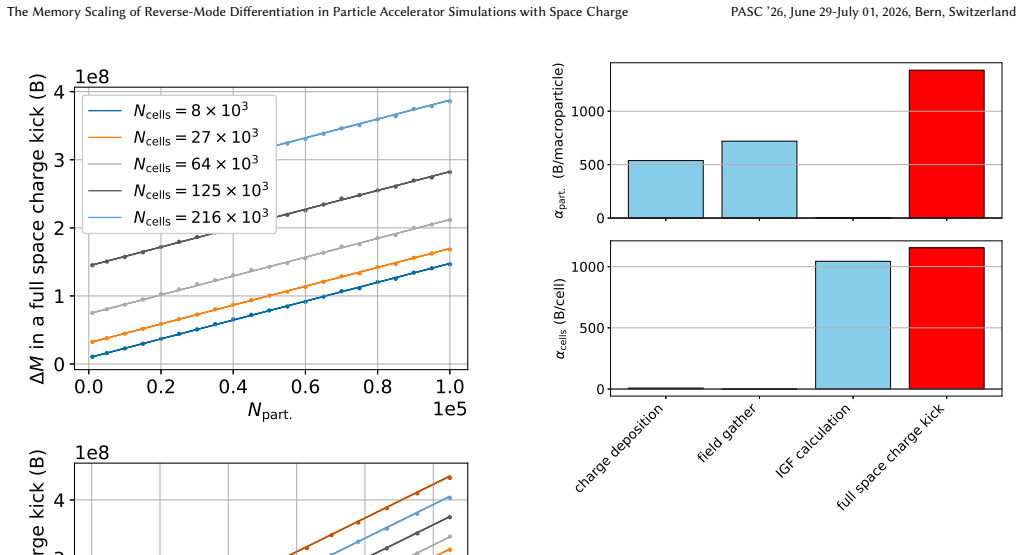
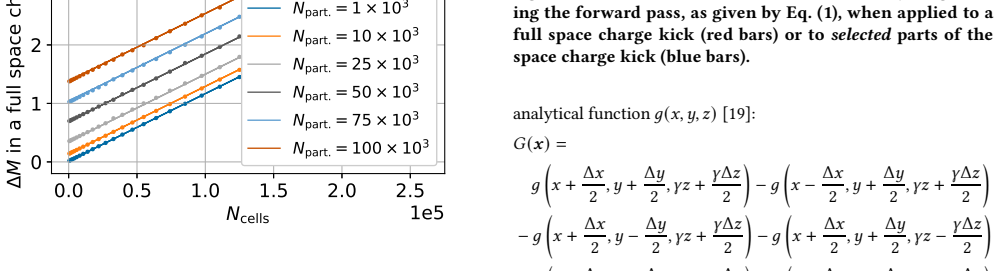
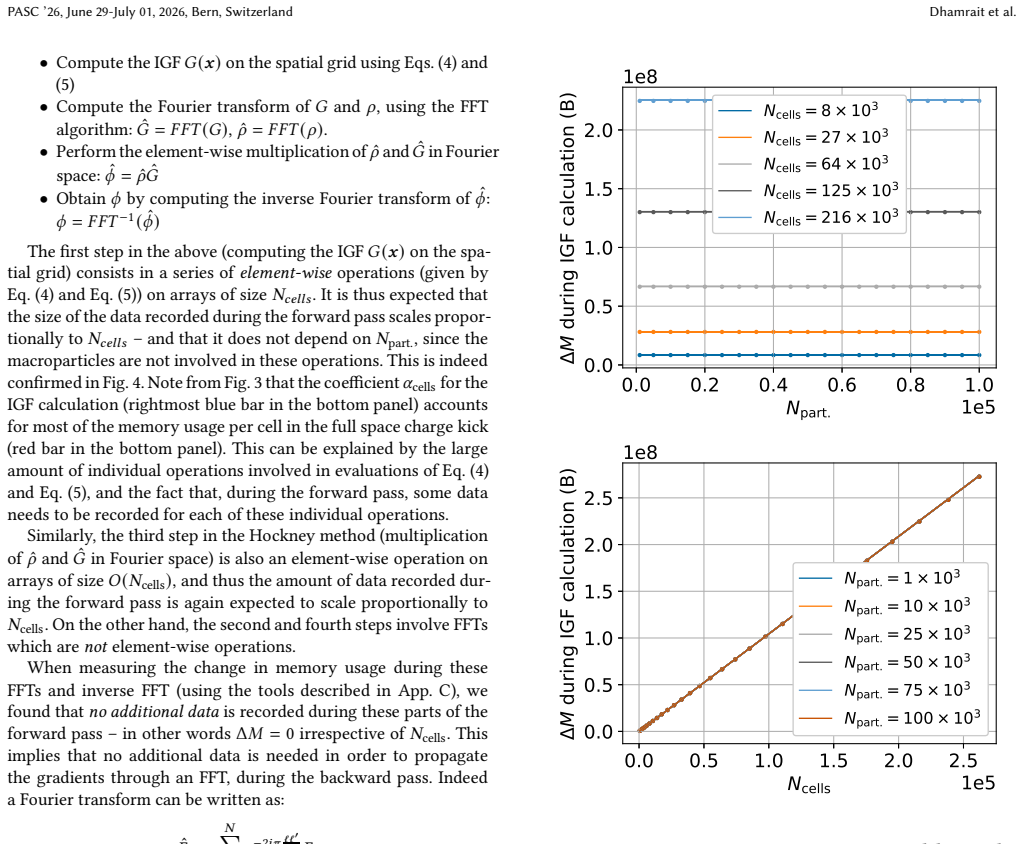
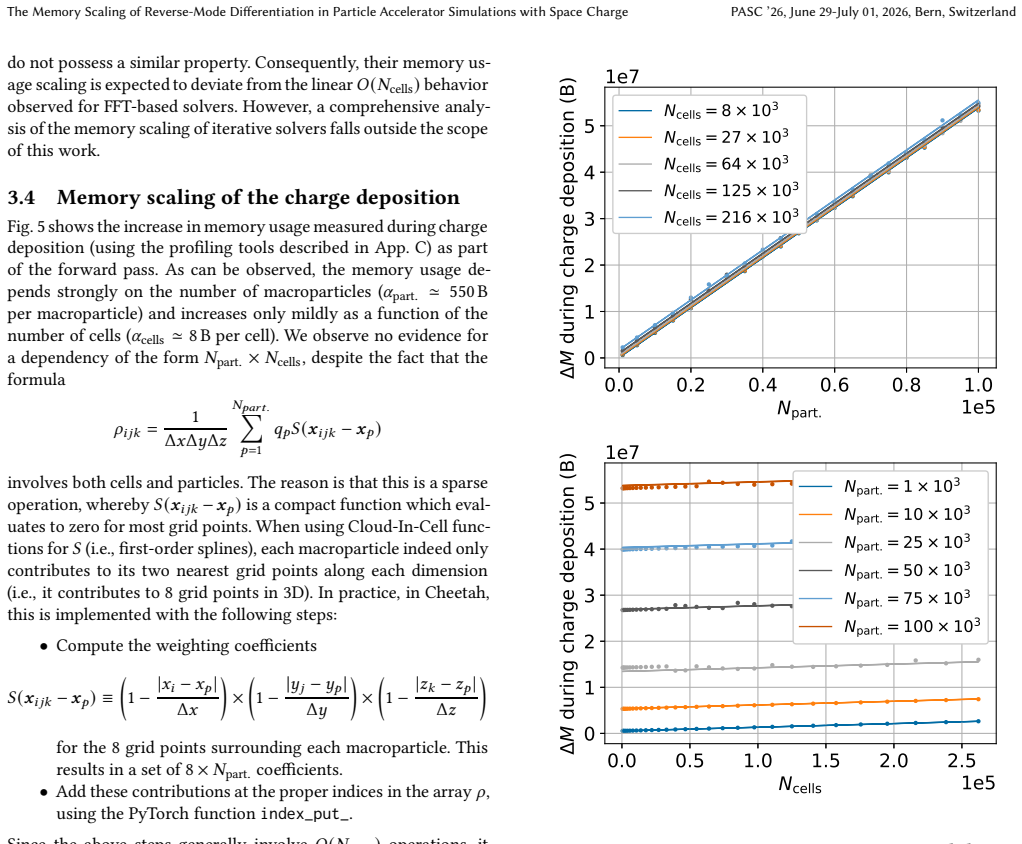
The memory usage for reverse-mode differentiation grows linearly with the number of macroparticles and cells, and that it is proportional to the number of space charge kicks involved in the simulation. This general scaling can be used to evaluate whether a given differentiable simulation is feasible given hardware memory constraints.
What carries the argument
The PyTorch-based implementation of space charge kicks in Cheetah, which builds a computational graph for reverse-mode automatic differentiation.
If this is right
- Memory requirements can be predicted from the number of macroparticles, cells, and space charge kicks before running the simulation.
- Simulations become more feasible on limited hardware when fewer space charge kicks are used.
- Differentiable modeling of accelerators with space charge is practical provided the linear growth stays within memory limits.
Where Pith is reading between the lines
- Other implementations of differentiable space charge might exhibit the same linear scaling if they use similar reverse-mode methods.
- Techniques like gradient checkpointing could further reduce memory use in long simulations.
- The result highlights a trade-off between simulation accuracy from more macroparticles and available memory.
Load-bearing premise
The linear scaling measured in this particular Cheetah implementation using PyTorch represents the general behavior for reverse-mode differentiation with space charge.
What would settle it
Implementing space charge in a different differentiable particle simulation framework and measuring whether memory usage follows the same linear dependence on macroparticles and kicks.
Figures



read the original abstract
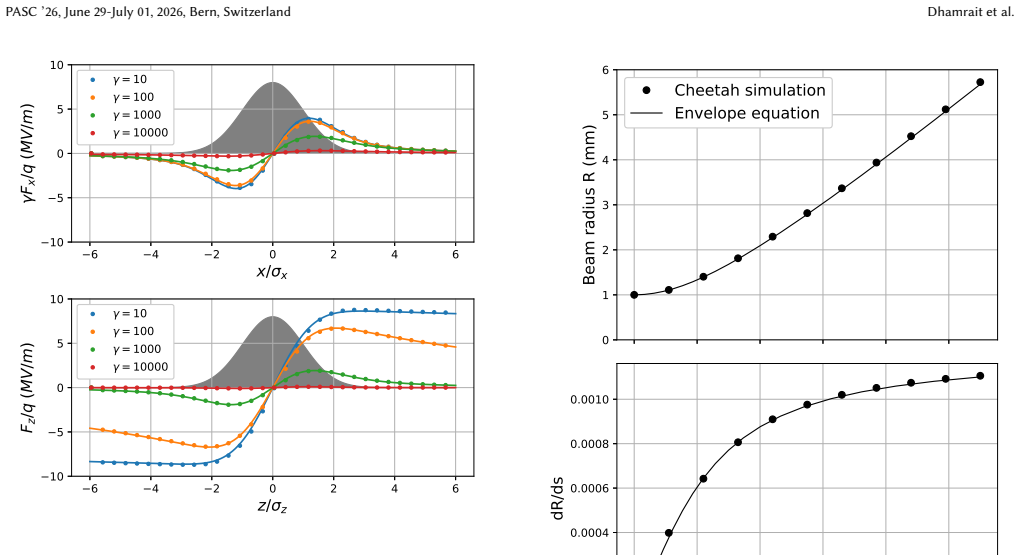
The recent development of differentiable simulation codes for particle accelerators has enabled gradient-based workflows that promise finer control and more realistic modeling of accelerator facilities. However, when using reverse-mode automatic differentiation, the memory usage continuously increases during the simulation, and can potentially exceed the available hardware memory -- especially when costly space charge computation is included. To study the memory requirements for differentiable simulations, we have implemented space charge in Cheetah, a PyTorch-based beam tracking code that supports reverse-mode differentiation. We find that the memory usage for reverse-mode differentiation grows linearly with the number of macroparticles and cells, and that it is proportional to the number of space charge kicks involved in the simulation. This general scaling can be used to evaluate whether a given differentiable simulation is feasible given hardware memory constraints.
Editorial analysis
A structured set of objections, weighed in public.
Referee Report
Summary. The manuscript implements space charge in the Cheetah PyTorch-based differentiable beam tracking code and reports empirical measurements showing that reverse-mode automatic differentiation memory usage grows linearly with the number of macroparticles and grid cells and is proportional to the number of space charge kicks performed during the simulation. This scaling is presented as a practical guideline for assessing hardware feasibility of such simulations.
Significance. If the reported linear scaling is robust and not implementation-specific, the result supplies a concrete, directly measured rule of thumb that accelerator physicists can use to decide whether a planned differentiable simulation with space charge will fit in available GPU memory. The empirical character of the claim (rather than a fitted or derived expression) is a strength when the measurement protocol is fully documented.
major comments (2)
- [Abstract] Abstract and results sections: the central claim of linear scaling is stated without any description of the test cases, number of macroparticles/cells ranges, number of independent runs, error bars, or controls that would rule out artifacts from Cheetah's specific data structures or PyTorch autograd tape construction. This information is load-bearing for judging whether the observed linearity is general.
- [Results] The manuscript supplies no theoretical accounting of tape size (particle-to-grid deposition, field solve, grid-to-particle interpolation) and no cross-framework or cross-solver comparisons. Without these, the claim that the scaling is 'general' and can be used to evaluate 'a given differentiable simulation' remains specific to the Cheetah/PyTorch implementation and cannot yet be treated as implementation-independent.
Simulated Author's Rebuttal
We thank the referee for their constructive comments. We address each major comment below, indicating where revisions will be made to strengthen the documentation of our empirical results while clarifying the scope of the claims.
read point-by-point responses
-
Referee: [Abstract] Abstract and results sections: the central claim of linear scaling is stated without any description of the test cases, number of macroparticles/cells ranges, number of independent runs, error bars, or controls that would rule out artifacts from Cheetah's specific data structures or PyTorch autograd tape construction. This information is load-bearing for judging whether the observed linearity is general.
Authors: We agree that additional details on the experimental protocol are required for readers to evaluate the robustness of the reported linearity. In the revised manuscript we will expand the Results section (and update the abstract accordingly) to describe the test cases, the specific ranges of macroparticles and grid cells examined, the number of independent runs, any error bars or statistical measures, and the controls used to check for implementation-specific artifacts in Cheetah or PyTorch autograd. revision: yes
-
Referee: [Results] The manuscript supplies no theoretical accounting of tape size (particle-to-grid deposition, field solve, grid-to-particle interpolation) and no cross-framework or cross-solver comparisons. Without these, the claim that the scaling is 'general' and can be used to evaluate 'a given differentiable simulation' remains specific to the Cheetah/PyTorch implementation and cannot yet be treated as implementation-independent.
Authors: The work is an empirical study of memory scaling inside the Cheetah/PyTorch implementation; we will revise the abstract and discussion to make this scope explicit rather than using the term 'general' without qualification. We will also add a concise paragraph explaining why linear scaling with macroparticles, cells, and kicks is expected from the structure of reverse-mode differentiation applied to standard particle-in-cell operations. A full theoretical derivation of tape size or cross-framework comparisons lie outside the present study and would require new analysis not performed here. revision: partial
- A theoretical accounting of tape size for particle-to-grid deposition, field solve, and grid-to-particle interpolation together with cross-framework or cross-solver comparisons.
Circularity Check
No circularity: empirical measurement, not a derivation
full rationale
The paper implements space charge in Cheetah (a PyTorch code) and reports direct measurements of memory usage during reverse-mode differentiation. The central claim is an observed linear scaling with macroparticles, cells, and space-charge kicks. No equations, fitted parameters, or self-citations are used to derive the scaling; it is presented as a measurement result. The derivation chain is therefore self-contained and does not reduce to its own inputs by construction. This is the expected honest outcome for an empirical scaling study.
Axiom & Free-Parameter Ledger
Reference graph
Works this paper leans on
-
[1]
C. K. Birdsall and A. B. Langdon. 2004. Plasma Physics via Computer Simulation . CRC Press. doi:10.1201/9781315275048
-
[2]
Martinez, Connie Xu, Kathryn R
Tobias Boltz, Jose L. Martinez, Connie Xu, Kathryn R. L. B aker, Zihan Zhu, Jenny Morgan, Ryan Roussel, Daniel Ratner, Brahim Mustapha , and Auralee L. Edelen. 2025. Leveraging prior mean models for faster Bayes ian optimiza- tion of particle accelerators. Scientific Reports 15, 1 (10 April 2025), 12232. doi:10.1038/s41598-025-95297-z
-
[3]
Kyle Cranmer, Johann Brehmer, and Gilles Louppe. 2020. T he frontier of simulation-based inference. Proceedings of the National Academy of Sciences 117, 48 (2020), 30055–30062. arXiv:https://www.pnas.org/doi/pdf/10.1073/pnas.1912789117 doi:10.1073/pnas.1912789117
-
[4]
Gauge r, Christian Glaser, Atılım G
Tommaso Dorigo, Andrea Giammanco, Pietro Vischia, Max A ehle, Mateusz Bawaj, Alexey Boldyrev, Pablo de Castro Manzano, Denis Derk ach, Julien Donini, Auralee Edelen, Federica Fanzago, Nicolas R. Gauge r, Christian Glaser, Atılım G. Baydin, Lukas Heinrich, Ralf Keidel, Jan Kieseler , Claudius Krause, Maxime Lagrange, Max Lamparth, Lukas Layer, Gernot Maier...
-
[5]
Jeff Eldred, Valeri Lebedev, Kiyomi Seiya, and Vladimir S hiltsev. 2021. Beam intensity effects in Fermilab Booster synchrotron. Phys. Rev. Accel. Beams 24 (Apr 2021), 044001. Issue 4. doi:10.1103/PhysRevAccelBea ms.24.044001
-
[6]
Juan Pablo Gonzalez-Aguilera, Young-Kee Kim, Ryan Rous sel, Auralee Edelen, and Christopher Mayes. 2023. Towards fully differentiable accelerator modeling. JACoW IPAC2023 (2023), WEPA065. doi:10.18429/JACoW-IPAC2023-WEPA065
-
[7]
Andreas Griewank and Andrea Walther. 2008. Evaluating Deriva- tives (second ed.). Society for Industrial and Applied Mathemat- ics. arXiv:https://epubs.siam.org/doi/pdf/10.1137/1. 9780898717761 doi:10.1137/1.9780898717761
work page doi:10.1137/1 2008
-
[8]
R. W. Hockney and J. W. Eastwood. 1988. Computer simulation using particles . Bristol: Hilger, 1988
1988
-
[9]
Austin Hoover and Jonathan C. Wong. 2024. High-dimensio nal maximum- entropy phase space tomography using normalizing flows. Phys. Rev. Res. 6 (Aug 2024), 033163. Issue 3. doi:10.1103/PhysRevResearch.6.0 33163
-
[10]
Jan Kaiser, Chenran Xu, Annika Eichler, and Andrea Sant amaria Garcia. 2024. Bridging the gap between machine learning and particle acce lerator physics with high-speed, differentiable simulations. Phys. Rev. Accel. Beams 27 (May 2024), 054601. Issue 5. doi:10.1103/PhysRevAccelBeams.2 7.054601
-
[11]
Kuklev, M
N. Kuklev, M. Wallbank, N. Banerjee, J. Jarvis, and A. Romanov. 2025. End-to-end differentiable digital twin for the IOTA/FAST facility. (20 25)
2025
-
[12]
Christopher Mayes, Robert Ryne, and David Sagan. 2018. 3D Space Charge in Bmad. In 9th International Particle Accelerator Conference . doi:10.18429/JACoW-IPAC2018-THPAK085
-
[13]
C.E. Mitchell, M. Garten, A. Huebl, R. Lehe, J. Qiang, R. T. Sandberg, and J.-L. Vay. 2024. ImpactX Modeling of Benchmark Tests for Space Cha rge Validation. In Proc. 68th Adv. Beam Dyn. Workshop High-Intensity High-Brig htness Hadron Beams (HB’23) (ICFA Advanced Beam Dynamics Workshop on High-Intensity and High-Brightness Hadron Beams, 68) . JACoW Publis...
-
[14]
PyTorch Contributors. 2024. torch.utils.checkpoint . https://docs.pytorch.org/docs/stable/checkpoint.html. Accessed: 2024
2024
-
[15]
Ji Qiang. 2018. Three-dimensional envelope instabili ty in periodic focus- ing channels. Phys. Rev. Accel. Beams 21 (Mar 2018), 034201. Issue 3. doi:10.1103/PhysRevAccelBeams.21.034201
-
[16]
Ji Qiang. 2023. Differentiable self-consistent space- charge simulation for ac- celerator design. Phys. Rev. Accel. Beams 26 (Feb 2023), 024601. Issue 2. doi:10.1103/PhysRevAccelBeams.26.024601
- [17]
-
[18]
Ryne, and Cecile Limbor g-Deprey
Ji Qiang, Steve Lidia, Robert D. Ryne, and Cecile Limbor g-Deprey. 2006. Three-dimensional quasistatic model for high brightness b eam dynamics simulation. Phys. Rev. ST Accel. Beams 9 (Apr 2006), 044204. Issue 4. doi:10.1103/PhysRevSTAB.9.044204
-
[19]
Ji Qiang, Chad Mitchell, Remi Lehe, and Arianna Forment i. 2024. Implementa- tion of the Integrated Green’s Function Method for 3D Poisso n’s Equation in a Large Aspect Ratio Computational Domain. Journal of Software Engineering and Applications 17, 9 (2024), 740–749
2024
- [20]
-
[21]
M. Reiser. 2008. Theory and Design of Charged Particle Beams . John Wiley & Sons, Ltd
2008
-
[22]
Tunable, flexible, and efficient optimization of control pulses for practical qubits,
R. Roussel, A. Edelen, C. Mayes, D. Ratner, J. P. Gonzalez-Aguilera, S. Kim, E. Wis- niewski, and J. Power. 2023. Phase Space Reconstruction from Accelerator Beam Measurements Using Neural Networks and Differentiable Simulations. Phys. Rev. Lett. 130 (Apr 2023), 145001. Issue 14. doi:10.1103/PhysRevLett .130.145001
-
[23]
Ryan Roussel, Juan Pablo Gonzalez-Aguilera, Eric Wisn iewski, Alexander Ody, Wanming Liu, John Power, Young-Kee Kim, and Auralee Edelen. 2024. Efficient six-dimensional phase space reconstructions from experim ental measurements using generative machine learning. Phys. Rev. Accel. Beams27 (Sep 2024), 094601. Issue 9. doi:10.1103/PhysRevAccelBeams.27.094601
-
[24]
J.-L. Vay. 2008. Simulation of beams or plasmas crossin g at relativistic velocity. Physics of Plasmas 15, 5 (02 2008), 056701. doi:10.1063/1.2837054
-
[25]
J. Wan, H. Alamprese, C. Ratcliff, J. Qiang, and Y. Hao. 20 25. JuTrack: a Ju- lia package for auto-differentiable accelerator modeling a nd particle tracking. Comp. Phys. Comm. 309 (2025), 109497
2025
-
[26]
Eric Wong. 2017. pytorch_fft: A PyTorch wrapper for CUDA FFTs. https://github.com/locuslab/pytorch_fft. Apache-2.0 Li cense
2017
-
[27]
Takaaki Yasui, Susumu Igarashi, Yoichi Sato, Tadashi K oseki, and Kazuhito Ohmi. 2020. Transverse emittance growth caused by space-ch arge-induced resonance. Phys. Rev. Accel. Beams 23 (Jun 2020), 061001. Issue 6. doi:10.1103/PhysRevAccelBeams.23.061001
-
[28]
T. Zolkin, A. Burov, and B. Pandey. 2018. Transverse mod e-coupling instabil- ity and space charge. Phys. Rev. Accel. Beams 21 (Oct 2018), 104201. Issue 10. doi:10.1103/PhysRevAccelBeams.21.104201
discussion (0)
Sign in with ORCID, Apple, or X to comment. Anyone can read and Pith papers without signing in.