Neural Quantum Spectral Operator Learning for Solving Partial Differential Equations
Pith reviewed 2026-06-30 22:33 UTC · model grok-4.3
The pith
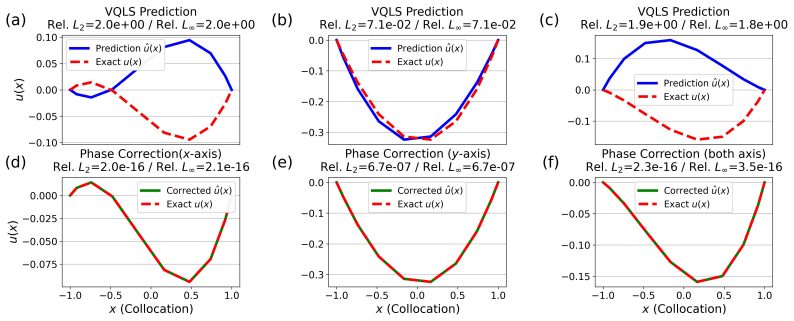
NVQLS resolves sign ambiguity in variational quantum linear solvers and adds neural embeddings to enable unsupervised operator learning for parametric PDEs.
A machine-rendered reading of the paper's core claim, the machinery that carries it, and where it could break.
Core claim
NVQLS is the first hybrid quantum-classical operator learning method that uses the Legendre-Galerkin weak formulation together with a sign-resolved variational quantum linear solver and a neural embedding scheme; the combination lets the framework map varying PDE inputs into quantum circuit parameters and produce accurate surrogate solutions for 1D and 2D parametric problems under diverse boundary conditions.
What carries the argument
The neural embedding scheme, which maps forcing functions and PDE coefficients into parameterized quantum circuit representations while the sign-resolved VQLS supplies the linear solve step inside the Legendre-Galerkin formulation.
If this is right
- A single trained NVQLS model can process multiple different forcings and coefficients at inference time without retraining.
- The method offers a route to unsupervised quantum-enhanced operator learning that avoids generating large classical training datasets.
- Theoretical complexity advantages appear once efficient state-preparation oracles are available for the embedded inputs.
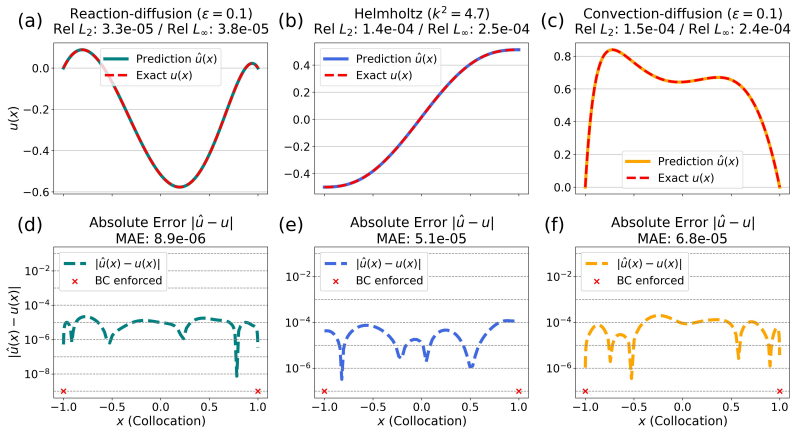
- The framework extends to both 1D and 2D problems with various boundary conditions while staying within the variational quantum linear solver setting.
Where Pith is reading between the lines
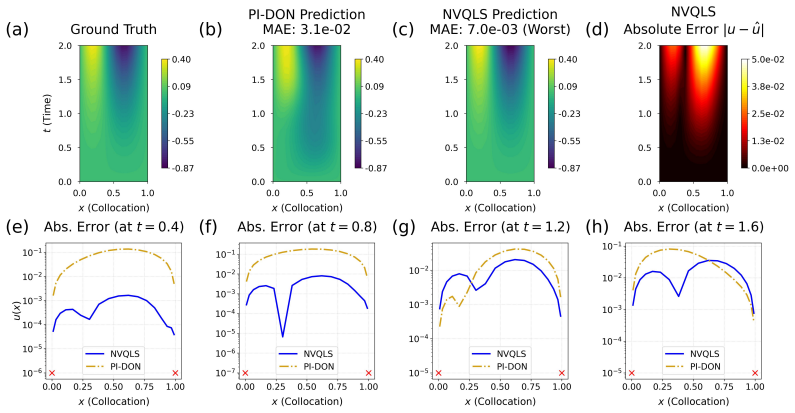
- If the neural embedding generalizes beyond the tested 1D/2D cases, the same architecture could be applied to time-dependent or nonlinear parametric PDEs by extending the weak-form discretization.
- The sign-resolution technique may transfer to other variational quantum algorithms that minimize energies over signed solution spaces.
- Scaling to higher-dimensional PDEs would require checking whether the quantum circuit depth remains practical under realistic hardware noise.
Load-bearing premise
The neural embedding successfully encodes different forcings and coefficients into quantum circuits without adding errors large enough to break the operator learning, and the sign fix in VQLS actually prevents incorrect solution representations for the PDEs tested.
What would settle it
Run NVQLS and the classical baseline on the same family of 2D parametric Poisson equations, measure L2 error on held-out coefficient/forcing pairs, and check whether the quantum method's error remains lower when the sign ambiguity is deliberately left unresolved.
Figures





read the original abstract
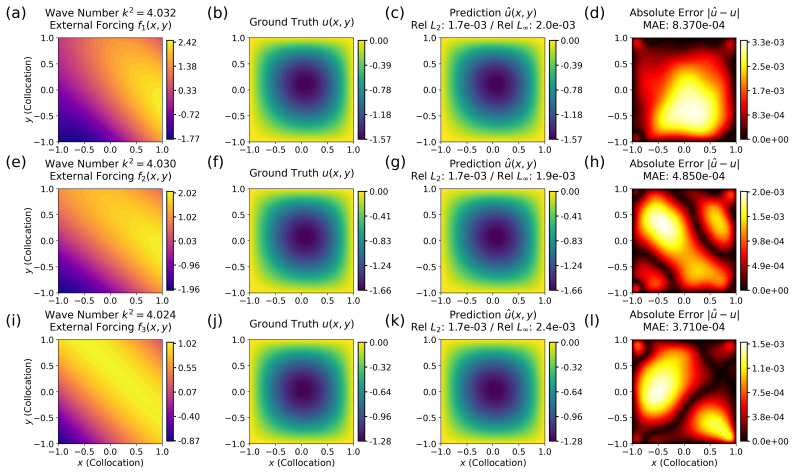
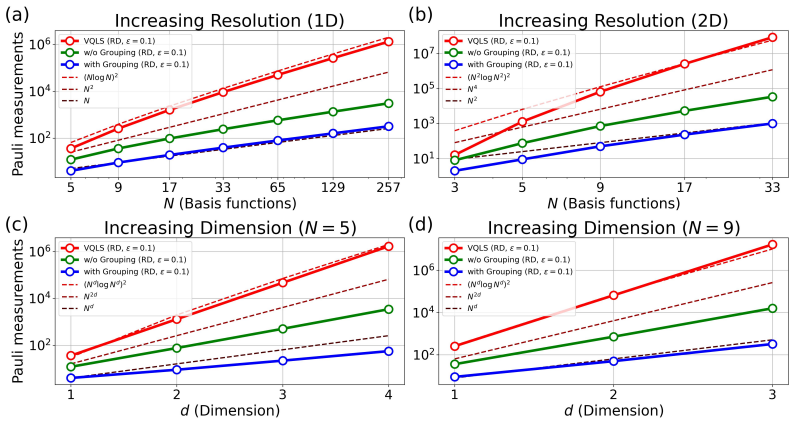
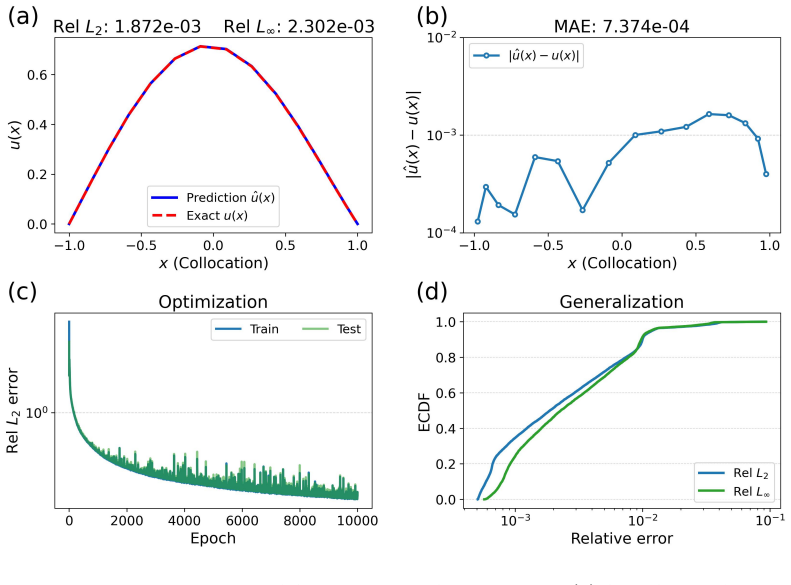
Partial differential equations (PDEs) are central to modeling physical and engineering systems, but repeatedly solving parametric PDEs remains computationally expensive. Operator learning enables fast surrogate inference, yet typically requires large input-output paired datasets generated by costly high-fidelity PDE solvers. Unsupervised operator learning frameworks alleviate data dependency but remain hindered by computational bottlenecks. To address this, we propose Neural Variational Quantum Linear Solver (NVQLS), the first hybrid quantum-classical operator learning framework leveraging the Legendre--Galerkin weak formulation. We critically resolve the sign ambiguity in VQLS energy minimization, preventing erroneous solution representations. Additionally, we introduce a neural embedding, a novel encoding scheme to map varying forcings and PDE coefficients into parameterized quantum circuit representations. These structural innovations provide theoretical computational complexity advantages under efficient state preparation schemes, while achieving superior accuracy compared to a representative classical baseline. Validations on 1D and 2D parametric PDEs under diverse boundary conditions demonstrate NVQLS's capability to simultaneously process varying inputs, offering a scalable unsupervised approach to quantum-enhanced operator learning.
Editorial analysis
A structured set of objections, weighed in public.
Referee Report
Summary. The manuscript proposes Neural Variational Quantum Linear Solver (NVQLS), presented as the first hybrid quantum-classical operator learning framework for parametric PDEs. It combines the Legendre-Galerkin weak formulation with a variational quantum linear solver (VQLS), resolves sign ambiguity in the VQLS energy minimization, introduces a neural embedding to encode varying forcings and PDE coefficients into parameterized quantum circuits, and claims both superior accuracy over a classical baseline and theoretical computational complexity advantages (conditioned on efficient state preparation) demonstrated on 1D and 2D test problems under diverse boundary conditions.
Significance. If the accuracy results and complexity claims hold after verification, the work would introduce a novel unsupervised quantum-classical route to operator learning that reduces reliance on paired high-fidelity data. The sign-ambiguity resolution and neural embedding constitute concrete technical contributions. However, the significance is limited by the absence of explicit quantitative validation details and by the central dependence on unverified efficient state preparation for the embedding, which is a known hard problem in the worst case.
major comments (2)
- [Abstract] Abstract: the claim of 'theoretical computational complexity advantages under efficient state preparation schemes' is load-bearing for the paper's positioning as a quantum-enhanced method, yet the neural embedding is not accompanied by any cost analysis, circuit-depth bounds, or verification that the output states admit sub-exponential preparation; general state preparation is #P-hard, so the advantage is conditional and currently unsupported.
- [Validation sections] Validation sections (referenced in abstract as 1D/2D experiments): the abstract asserts 'superior accuracy' and 'demonstrate NVQLS's capability' but supplies no error metrics, convergence rates, comparison tables, or statistical details; without these, the accuracy claim cannot be evaluated and is not yet load-bearing evidence.
minor comments (2)
- Notation for the neural embedding and the resolved sign-ambiguity term should be introduced with explicit equations rather than descriptive prose only.
- [Abstract] The classical baseline used for the accuracy comparison is not named in the abstract; it should be identified early.
Simulated Author's Rebuttal
We thank the referee for their detailed review and constructive comments. We address each major comment below, providing clarifications and indicating revisions where appropriate.
read point-by-point responses
-
Referee: [Abstract] Abstract: the claim of 'theoretical computational complexity advantages under efficient state preparation schemes' is load-bearing for the paper's positioning as a quantum-enhanced method, yet the neural embedding is not accompanied by any cost analysis, circuit-depth bounds, or verification that the output states admit sub-exponential preparation; general state preparation is #P-hard, so the advantage is conditional and currently unsupported.
Authors: The manuscript explicitly conditions the complexity advantages on efficient state preparation schemes, as stated in the abstract and throughout the text. The neural embedding is presented as a structural innovation that maps varying inputs to parameterized circuits in a manner compatible with such schemes. We agree that general state preparation is hard and do not claim unconditional advantage; the contribution is the hybrid framework under the stated assumption, consistent with standard practice in quantum algorithm papers. We will expand the discussion section with explicit assumptions and references to state-preparation literature in the revision. revision: partial
-
Referee: [Validation sections] Validation sections (referenced in abstract as 1D/2D experiments): the abstract asserts 'superior accuracy' and 'demonstrate NVQLS's capability' but supplies no error metrics, convergence rates, comparison tables, or statistical details; without these, the accuracy claim cannot be evaluated and is not yet load-bearing evidence.
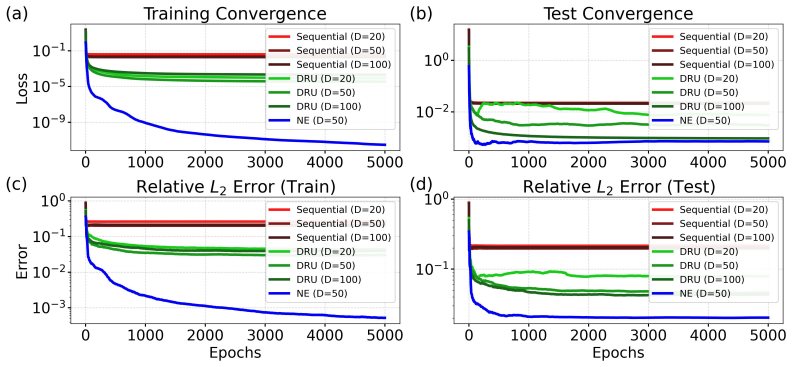
Authors: The manuscript body contains validation sections reporting quantitative results for the 1D and 2D parametric PDE test cases, including direct comparisons against a classical baseline that demonstrate superior accuracy under the tested boundary conditions. The abstract provides only a high-level summary, as is conventional. To strengthen visibility of the evidence, we will insert a consolidated error-metrics table and convergence details into the main text during revision. revision: yes
- The central dependence on efficient state preparation for the neural embedding, which is a known hard problem in the worst case and remains unverified in general.
Circularity Check
No significant circularity; framework derivation is self-contained
full rationale
The paper proposes NVQLS as a novel hybrid framework combining Legendre-Galerkin weak form, sign ambiguity resolution in VQLS, and a neural embedding scheme. Claims of theoretical complexity advantages are explicitly conditioned on external 'efficient state preparation schemes' rather than derived by construction from the method itself. No self-definitional reductions, fitted inputs renamed as predictions, or load-bearing self-citations appear in the abstract or described claims. The derivation introduces new components without reducing the central results to reparameterizations of the inputs.
Axiom & Free-Parameter Ledger
axioms (2)
- domain assumption Legendre-Galerkin weak formulation applies to the target parametric PDEs
- domain assumption VQLS energy minimization can be made reliable by resolving sign ambiguity
invented entities (2)
-
NVQLS framework
no independent evidence
-
neural embedding
no independent evidence
Reference graph
Works this paper leans on
-
[1]
Deep learning using rectified linear units (relu), 2019
Abien Fred Agarap. Deep learning using rectified linear units (relu), 2019
2019
-
[2]
Performance study of variational quantum algorithms for solving the poisson equation on a quantum computer
Mazen Ali and Matthias Kabel. Performance study of variational quantum algorithms for solving the poisson equation on a quantum computer. Physical Review Applied , 20 (1):014054, 2023
2023
-
[3]
Ville Bergholm, Josh Izaac, Maria Schuld, Christian Gogolin, M. Sohaib Alam, Shahnawaz Ahmed, Juan Miguel Arrazola, Carsten Blank, Alain Delgado, Soran Jahangiri, Keri McK- iernan, Johannes Jakob Meyer, Zeyue Niu, Antal Száva, and Nathan Killoran. Penny- lane: Automatic differentiation of hybrid quantum-classical computations. arXiv preprint arXiv:1811.04...
work page internal anchor Pith review Pith/arXiv arXiv 2020
-
[4]
Jax: composable transformations of python+ numpy programs
James Bradbury, Roy Frostig, Peter Hawkins, Matthew James Johnson, Chris Leary, Dougal Maclaurin, George Necula, Adam Paszke, Jake VanderPlas, Skye Wanderman-Milne, et al. Jax: composable transformations of python+ numpy programs. 2018
2018
-
[5]
Variational quantum linear solver
Carlos Bravo-Prieto, Ryan LaRose, Marco Cerezo, Yigit Subasi, Lukasz Cincio, and Patrick J Coles. Variational quantum linear solver. arXiv preprint arXiv:1909.05820 , 2019
-
[6]
Variational quantum linear solver
Carlos Bravo-Prieto, Ryan LaRose, Marco Cerezo, Yigit Subasi, Lukasz Cincio, and Patrick J Coles. Variational quantum linear solver. Quantum, 7:1188, 2023
2023
-
[7]
Burden and J
Richard L. Burden and J. Douglas Faires. Numerical Analysis . The Prindle, Weber and Schmidt Series in Mathematics. PWS-Kent Publishing Company, Boston, fourth edition, 1989
1989
-
[8]
Childs and Jin-Peng Liu
Andrew M. Childs and Jin-Peng Liu. Quantum spectral methods for differential equations. Communications in Mathematical Physics , 375 (2):1427–1457, 2020
2020
-
[9]
Physics-informed deep inverse operator networks for solving pde inverse problems, 2025
Sung Woong Cho and Hwijae Son. Physics-informed deep inverse operator networks for solving pde inverse problems, 2025
2025
-
[10]
Spectral operator learning for parametric pdes without data reliance
Junho Choi, Taehyun Yun, Namjung Kim, and Youngjoon Hong. Spectral operator learning for parametric pdes without data reliance. Computer Methods in Applied Mechanics and Engineering, 420:116678, 2024
2024
-
[11]
Efficient variational quantum linear solver for structured sparse matrices
Abeynaya Gnanasekaran and Amit Surana. Efficient variational quantum linear solver for structured sparse matrices. In 2024 IEEE International Conference on Quantum Computing and Engineering (QCE), volume 1, pages 199–210. IEEE, 2024
2024
-
[12]
Physics-informed neural networks with domain decomposition for the incompressible navier–stokes equations
Linyan Gu, Shanlin Qin, Lei Xu, and Ronglian Chen. Physics-informed neural networks with domain decomposition for the incompressible navier–stokes equations. Physics of Fluids , 36(2):021914, 02 2024
2024
-
[13]
Ib-uq: Information bottleneck based uncertainty quantification for neural function regression and neural operator learning, 2023
Ling Guo, Hao Wu, Wenwen Zhou, Yan Wang, and Tao Zhou. Ib-uq: Information bottleneck based uncertainty quantification for neural function regression and neural operator learning, 2023
2023
-
[14]
Multiwavelet-based operator learning for dif- ferential equations
Gaurav Gupta, Xiongye Xiao, and Paul Bogdan. Multiwavelet-based operator learning for dif- ferential equations. In Proceedings of the 35th International Conference on Neural Information Processing Systems, NIPS ’21, Red Hook, NY, USA, 2021. Curran Associates Inc
2021
-
[15]
Harrow, A vinatan Hassidim, and Seth Lloyd
Aram W. Harrow, A vinatan Hassidim, and Seth Lloyd. Quantum algorithm for linear systems of equations. Phys. Rev. Lett. , 103:150502, Oct 2009
2009
-
[16]
Gaussian Error Linear Units (GELUs)
Dan Hendrycks and Kevin Gimpel. Gaussian error linear units (gelus). arXiv preprint arXiv:1606.08415, 2016
work page internal anchor Pith review Pith/arXiv arXiv 2016
- [17]
-
[18]
Tackling the curse of dimensionality with physics-informed neural networks
Zheyuan Hu, Khemraj Shukla, George Em Karniadakis, and Kenji Kawaguchi. Tackling the curse of dimensionality with physics-informed neural networks. Neural Networks , 176:106369, 2024
2024
-
[19]
Quantum fourier networks for solving parametric pdes
Nishant Jain, Jonas Landman, Natansh Mathur, and Iordanis Kerenidis. Quantum fourier networks for solving parametric pdes. Quantum Science and Technology , 9 (3):035026, 2024. 10
2024
-
[20]
Kharazmi, Z
E. Kharazmi, Z. Zhang, and G. E. Karniadakis. Variational physics-informed neural networks for solving partial differential equations, 2019
2019
-
[21]
Adam: A Method for Stochastic Optimization
Diederik P Kingma and Jimmy Ba. Adam: A method for stochastic optimization. arXiv preprint arXiv:1412.6980 , 2017
work page internal anchor Pith review Pith/arXiv arXiv 2017
-
[22]
Abueidda, Nahil A
Seid Koric, Asha Viswantah, Diab W. Abueidda, Nahil A. Sobh, and Kamran Khan. Deep learning operator network for plastic deformation with variable loads and material properties. Engineering with Computers , 40 (2):917–929, 2024
2024
-
[23]
Neural operator: learning maps between function spaces with applications to pdes
Nikola Kovachki, Zongyi Li, Burigede Liu, Kamyar Azizzadenesheli, Kaushik Bhattacharya, Andrew Stuart, and Anima Anandkumar. Neural operator: learning maps between function spaces with applications to pdes. J. Mach. Learn. Res. , 24 (1), January 2023
2023
-
[24]
Paine, and Vincent E
Oleksandr Kyriienko, Annie E. Paine, and Vincent E. Elfving. Solving nonlinear differential equations with differentiable quantum circuits. Phys. Rev. A , 103:052416, May 2021
2021
-
[25]
Spectral coefficient learning via operator networks for inverse problems of parametric partial differential equations
Myeong-Su Lee, Taehyun Yun, Youngjoon Hong, and Namjung Kim. Spectral coefficient learning via operator networks for inverse problems of parametric partial differential equations. Engineering Applications of Artificial Intelligence , 166:113665, 2026
2026
-
[26]
Fourier Neural Operator for Parametric Partial Differential Equations
Zongyi Li, Nikola B. Kovachki, Kamyar Azizzadenesheli, Burigede Liu, Kaushik Bhattacharya, Andrew M. Stuart, and Anima Anandkumar. Fourier neural operator for parametric partial differential equations. arXiv preprint arXiv:2010.08895 , 2020
work page internal anchor Pith review Pith/arXiv arXiv 2010
-
[27]
Kovachki, David Jin, Haoxuan Chen, Burigede Liu, Kam- yar Azizzadenesheli, and Anima Anandkumar
Zongyi Li, Hongkai Zheng, Nikola B. Kovachki, David Jin, Haoxuan Chen, Burigede Liu, Kam- yar Azizzadenesheli, and Anima Anandkumar. Physics-informed neural operator for learning partial differential equations. arXiv preprint arXiv:2111.03794 , 2021
-
[28]
Liu and Jorge Nocedal
Dong C. Liu and Jorge Nocedal. On the limited memory bfgs method for large scale optimiza- tion. Mathematical Programming, 45:503–528, 1989
1989
-
[29]
Variational quantum algorithm for the poisson equation
Hai-Ling Liu, Yu-Sen Wu, Lin-Chun Wan, Shi-Jie Pan, Su-Juan Qin, Fei Gao, and Qiao- Yan Wen. Variational quantum algorithm for the poisson equation. Physical Review A , 104(2):022418, 2021
2021
-
[30]
Application of a variational hybrid quantum-classical algorithm to heat conduction equation and analysis of time complexity
YY Liu, Zhen Chen, Chang Shu, Siou Chye Chew, Boo Cheong Khoo, Xiang Zhao, and YD Cui. Application of a variational hybrid quantum-classical algorithm to heat conduction equation and analysis of time complexity. Physics of Fluids , 34 (11), 2022
2022
-
[31]
Learning nonlinear operators via deeponet based on the universal approximation theorem of operators
Lu Lu, Pengzhan Jin, Guofei Pang, Zhongqiang Zhang, and George Em Karniadakis. Learning nonlinear operators via deeponet based on the universal approximation theorem of operators. Nature machine intelligence , 3 (3):218–229, 2021
2021
-
[32]
Menon and Ameya D
Sidharth S. Menon and Ameya D. Jagtap. Anant-net: Breaking the curse of dimensionality with scalable and interpretable neural surrogate for high-dimensional pdes. Computer Methods in Applied Mechanics and Engineering , 447:118403, 2025
2025
-
[33]
Mauro E. S. Morales, Lirandë Pira, Philipp Schleich, Kelvin Koor, Pedro C. S. Costa, Dong An, Alán Aspuru-Guzik, Lin Lin, Patrick Rebentrost, and Dominic W. Berry. Quantum linear system solvers: A survey of algorithms and applications, 2025
2025
-
[34]
Deep-learning-based quantum algorithms for solving nonlinear partial differential equations
Lukas Mouton, Florentin Reiter, Ying Chen, and Patrick Rebentrost. Deep-learning-based quantum algorithms for solving nonlinear partial differential equations. Phys. Rev. A , 110:022612, Aug 2024
2024
-
[35]
Variational quantum linear solver with a dynamic ansatz
Hrushikesh Patil, Yulun Wang, and Predrag S Krstić. Variational quantum linear solver with a dynamic ansatz. Physical Review A , 105 (1):012423, 2022
2022
-
[36]
A comparison of various classical optimizers for a variational quantum linear solver
Aidan Pellow-Jarman, Ilya Sinayskiy, Anban Pillay, and Francesco Petruccione. A comparison of various classical optimizers for a variational quantum linear solver. Quantum Information Processing, 20 (6):202, 2021
2021
-
[37]
Near term algorithms for linear systems of equations
Aidan Pellow-Jarman, Ilya Sinayskiy, Anban Pillay, and Francesco Petruccione. Near term algorithms for linear systems of equations. Quantum Information Processing , 22 (6):258, 2023
2023
-
[38]
Rudy, Steven L
Samuel H. Rudy, Steven L. Brunton, Joshua L. Proctor, and J. Nathan Kutz. Data-driven discovery of partial differential equations. Science Advances, 3 (4):e1602614, 2017. 11
2017
-
[39]
Hybrid quantum physics-informed neural networks for simulating com- putational fluid dynamics in complex shapes
Alexandr Sedykh, Maninadh Podapaka, Asel Sagingalieva, Karan Pinto, Markus Pflitsch, and Alexey Melnikov. Hybrid quantum physics-informed neural networks for simulating com- putational fluid dynamics in complex shapes. Machine Learning: Science and Technology , 5(2):025045, may 2024
2024
-
[40]
Spectral Methods: Algorithms, Analysis and Applica- tions, volume 41 of Springer Series in Computational Mathematics
Jie Shen, Tao Tang, and Li-Lian Wang. Spectral Methods: Algorithms, Analysis and Applica- tions, volume 41 of Springer Series in Computational Mathematics . Springer Berlin, Heidelberg, 1 edition, 2011
2011
-
[41]
Variational quantum framework for partial differ- ential equation constrained optimization
Amit Surana and Abeynaya Gnanasekaran. Variational quantum framework for partial differ- ential equation constrained optimization. ACM Transactions on Quantum Computing , 2024
2024
-
[42]
Quantum physics-informed neural networks
Corey Trahan, Mark Loveland, and Samuel Dent. Quantum physics-informed neural networks. Entropy, 26 (8), 2024
2024
-
[43]
A variational quan- tum linear solver application to discrete finite-element methods
Corey Jason Trahan, Mark Loveland, Noah Davis, and Elizabeth Ellison. A variational quan- tum linear solver application to discrete finite-element methods. Entropy, 25 (4), 2023
2023
-
[44]
Trefethen
Lloyd N. Trefethen. Spectral Methods in MATLAB . Society for Industrial and Applied Math- ematics, 2000
2000
-
[45]
An em- pirical analysis on the effectiveness of the variational quantum linear solver
Gloria Turati, Alessia Marruzzo, Maurizio Ferrari Dacrema, and Paolo Cremonesi. An em- pirical analysis on the effectiveness of the variational quantum linear solver. arXiv preprint arXiv:2409.06339, 2024
-
[46]
Learning the solution operator of para- metric partial differential equations with physics-informed deeponets
Sifan Wang, Hanwen Wang, and Paris Perdikaris. Learning the solution operator of para- metric partial differential equations with physics-informed deeponets. Science Advances , 7(40):eabi8605, 2021
2021
-
[47]
Understanding the difficulty of solving cauchy problems with pinns
Tao Wang, Bo Zhao, Sicun Gao, and Rose Yu. Understanding the difficulty of solving cauchy problems with pinns. In Alessandro Abate, Mark Cannon, Kostas Margellos, and Antonis Papachristodoulou, editors, Proceedings of the 6th Annual Learning for Dynamics & Control Conference, volume 242 of Proceedings of Machine Learning Research, pages 453–465. PMLR, 15–1...
2024
-
[48]
Solving high- dimensional partial differential equations using tensor neural network and a posteriori error estimators
Yifan Wang, Zhongshuo Lin, Yangfei Liao, Haochen Liu, and Hehu Xie. Solving high- dimensional partial differential equations using tensor neural network and a posteriori error estimators. J. Sci. Comput. , 101 (3), November 2024
2024
-
[49]
Quantum deeponet: Neural operators accelerated by quantum computing
Pengpeng Xiao, Muqing Zheng, Anran Jiao, Xiu Yang, and Lu Lu. Quantum deeponet: Neural operators accelerated by quantum computing. Quantum, 9:1761, 2025
2025
-
[50]
Analyses of internal structures and defects in materials using physics-informed neural networks
Enrui Zhang, Ming Dao, George Em Karniadakis, and Subra Suresh. Analyses of internal structures and defects in materials using physics-informed neural networks. Science Advances, 8(7):eabk0644, 2022
2022
-
[51]
A graph-structured, physics-informed deeponet neural network for complex structural analysis
Guangya Zhang, Tie Xu, Jinli Xu, and Hu Wang. A graph-structured, physics-informed deeponet neural network for complex structural analysis. Machine Learning and Knowledge Extraction, 7 (4), 2025
2025
-
[52]
Psaros, and George E
Zongren Zou, Xuhui Meng, Apostolos F. Psaros, and George E. Karniadakis. Neuraluq: A com- prehensive library for uncertainty quantification in neural differential equations and operators. SIAM Review , 66 (1):161–190, 2024. 12 A Nomenclature Table 2: Notations and Descriptions Notation Description n Number of qubits N Number of basis functions d Dimension...
2024
discussion (0)
Sign in with ORCID, Apple, or X to comment. Anyone can read and Pith papers without signing in.