Balancing Fidelity and Diversity in Diffusion Models via Symmetric Attention Decomposition: Hopfield Perspective
Pith reviewed 2026-06-29 19:57 UTC · model grok-4.3
The pith
Decomposing the pre-softmax attention matrix into symmetric and skew-symmetric parts links Hopfield stability to the fidelity-diversity trade-off in diffusion models and supplies a circulation knob for control.
A machine-rendered reading of the paper's core claim, the machinery that carries it, and where it could break.
Core claim
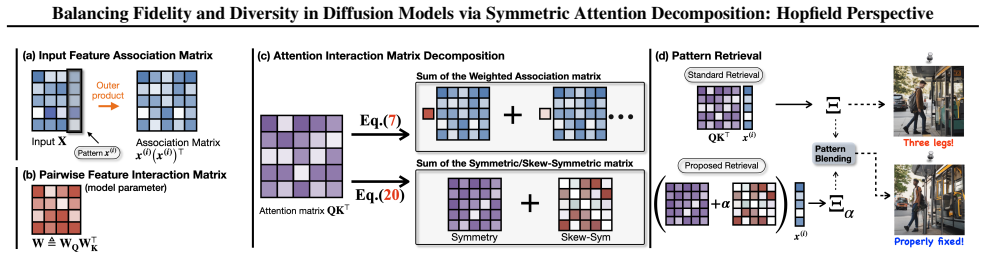
By viewing QK^T as encoding associations, its symmetric decomposition governs the energy minima that determine stable feature retrieval during sampling; the derived stability indices exhibit direct relations to measured fidelity and diversity scores, while skew-symmetric adjustments serve as a tunable parameter for shifting the operating point on the trade-off curve.
What carries the argument
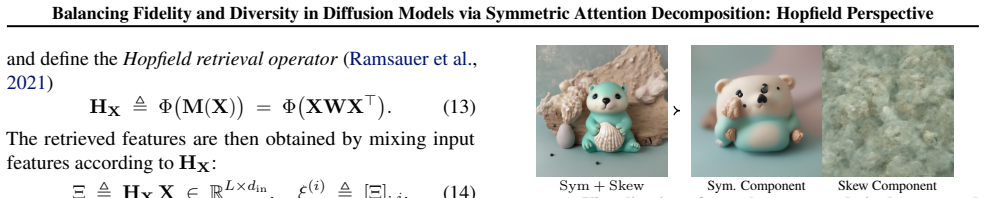
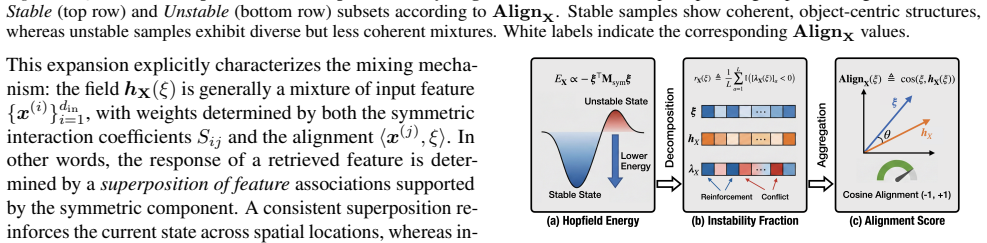
Symmetric-skew decomposition of the pre-softmax attention matrix, inducing a Hopfield energy landscape whose stability measures quantify retrieved feature robustness.
If this is right
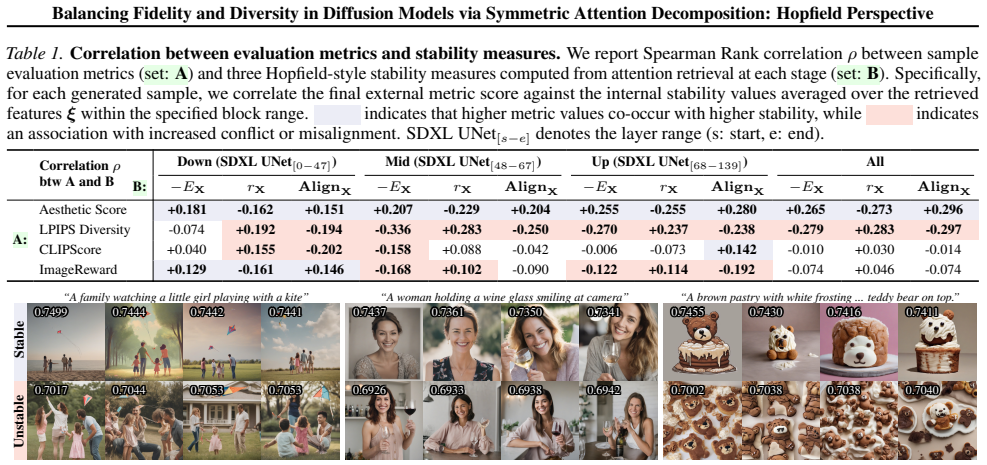
- Correlations appear between the stability measures and observed fidelity-diversity metrics across generated samples.
- Adjusting the skew-symmetric circulation term provides direct control over the trade-off without retraining the model.
- Energy landscape interpretation explains why certain attention patterns lead to mode collapse or excessive diversity in outputs.
Where Pith is reading between the lines
- Similar decomposition might apply to other attention-based generative models beyond diffusion.
- Stability measures could serve as training-time regularizers to target specific fidelity-diversity points.
- If the energy minima correspond to data modes, this links attention dynamics to data manifold geometry.
Load-bearing premise
The symmetric component of the attention matrix creates an energy function whose local minima align with the stable features that diffusion sampling retrieves, making the stability numbers causally predictive of output quality.
What would settle it
An experiment that computes the proposed stability measures on attention matrices from many generated samples and finds no statistical correlation with their individual fidelity or diversity scores would falsify the link.
Figures

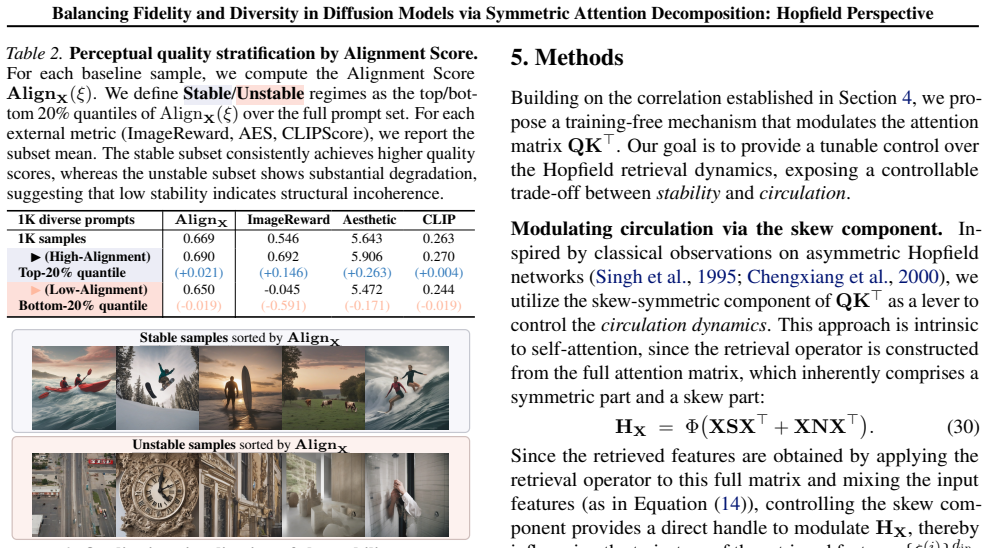
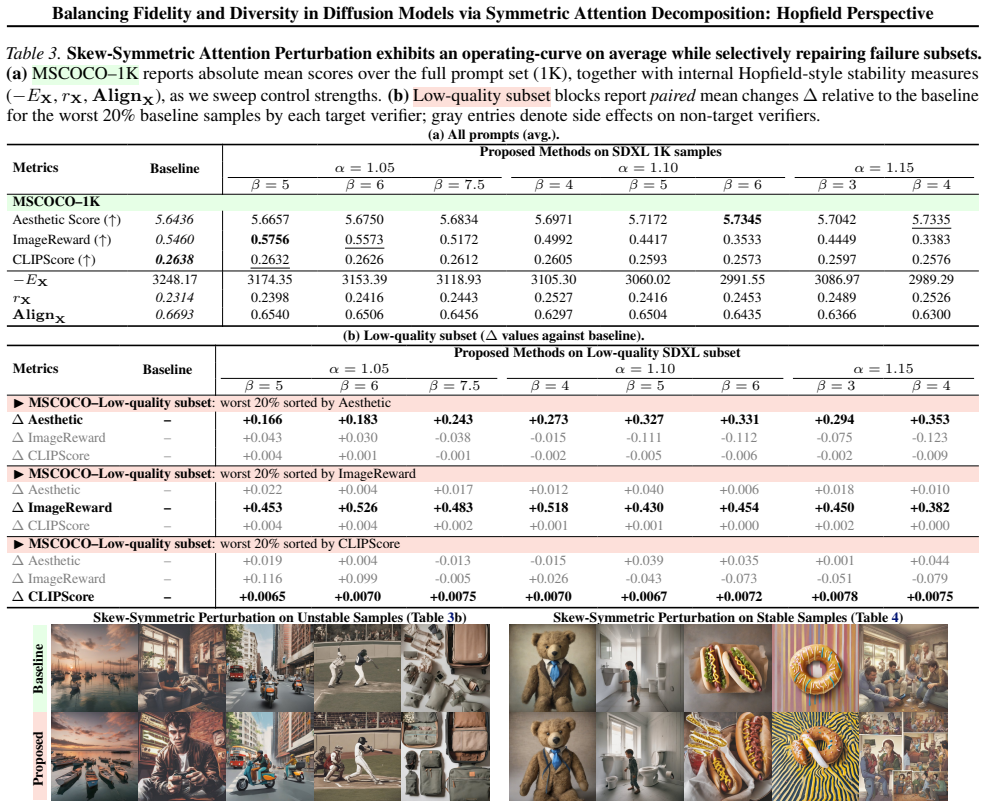
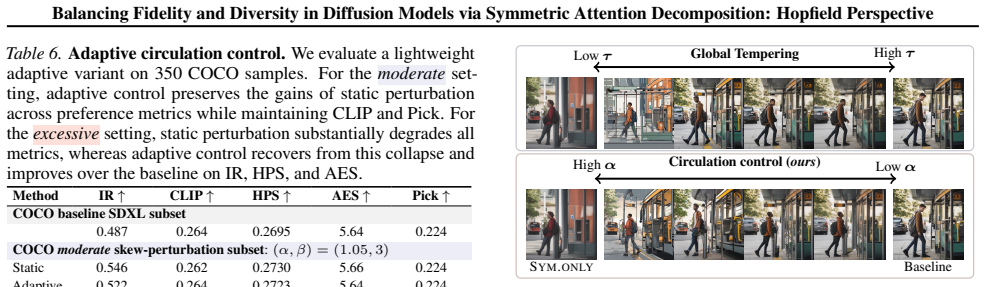


read the original abstract
We characterize the pre-softmax attention matrix $\mathbf{QK^\top}$ in transformers as an associative memory matrix encoding pairwise associations between input features. By decomposing this matrix into its symmetric and skew-symmetric parts, we interpret the symmetric component as governing the structure of the energy landscape, and the skew-symmetric component as driving circulation on that landscape. Leveraging the energy formulation induced by the symmetric component, we derive Hopfield-style stability measures that quantify the stability of retrieved features. We observe meaningful correlations between Hopfield-style stability measures and the fidelity-diversity trade-offs in generation. Finally, we propose a controllable knob to modulate this trade-off by modifying the circulation of the underlying dynamics. Code is available at our GitHub (https://github.com/hyeon-cho/Attention-Symmetric-Decomposition).
Editorial analysis
A structured set of objections, weighed in public.
Referee Report
Summary. The paper decomposes the pre-softmax attention matrix QK^T in transformers into symmetric and skew-symmetric parts, interpreting the symmetric component as defining an energy landscape (Hopfield-style) and the skew-symmetric as driving circulation. From the symmetric part it derives stability measures, reports correlations between these measures and fidelity-diversity trade-offs in diffusion-model generation, and proposes a controllable knob obtained by modulating the circulation term.
Significance. If the claimed causal link between the derived Hopfield stability quantities and generation metrics holds and the circulation knob can be applied without retraining or altering the underlying score function, the work would supply a new, interpretable mechanism for trading off fidelity and diversity that is grounded in associative-memory dynamics rather than ad-hoc sampling adjustments.
major comments (2)
- [Abstract] Abstract (and the central claim): the mapping from the symmetric part S of QK^T to an energy E whose local minima govern stable features retrieved during diffusion sampling is asserted but not derived or experimentally verified. Diffusion trajectories follow the learned reverse SDE/ODE, not gradient descent on E(S); no alignment between argmin E and stabilized points in the sampling chain is shown, undermining the causal interpretation of the reported correlations.
- [Abstract] The proposed circulation-modulation knob is presented as controllable, yet the manuscript provides no ablation confirming that changes to the skew-symmetric component leave the score estimate unchanged while only affecting the claimed energy landscape; this is load-bearing for the claim that the knob balances fidelity and diversity without side effects.
minor comments (1)
- The GitHub link is supplied but no statement is made about whether the released code reproduces the exact stability-measure derivations and correlation tables reported in the paper.
Simulated Author's Rebuttal
We appreciate the referee's insightful comments on the abstract and central claims. Below we provide point-by-point responses, agreeing to revisions that clarify the interpretive framework and add supporting ablations.
read point-by-point responses
-
Referee: [Abstract] Abstract (and the central claim): the mapping from the symmetric part S of QK^T to an energy E whose local minima govern stable features retrieved during diffusion sampling is asserted but not derived or experimentally verified. Diffusion trajectories follow the learned reverse SDE/ODE, not gradient descent on E(S); no alignment between argmin E and stabilized points in the sampling chain is shown, undermining the causal interpretation of the reported correlations.
Authors: Our framework draws an analogy to Hopfield networks, where the symmetric component of the weight matrix defines an energy landscape with local minima corresponding to stable patterns. The stability measures are derived from this symmetric part S and shown to correlate with fidelity-diversity trade-offs observed in diffusion generation. We do not claim or derive that the diffusion sampling trajectory performs gradient descent on this energy E; the reverse SDE is followed as learned. The correlations are empirical observations supporting the utility of these measures. We agree that the causal link is not fully established without alignment verification and will revise the abstract to tone down the language from 'govern' to 'analogous to' and add a discussion on the limitations of the analogy. revision: yes
-
Referee: [Abstract] The proposed circulation-modulation knob is presented as controllable, yet the manuscript provides no ablation confirming that changes to the skew-symmetric component leave the score estimate unchanged while only affecting the claimed energy landscape; this is load-bearing for the claim that the knob balances fidelity and diversity without side effects.
Authors: The knob is designed by modulating the skew-symmetric part while preserving the symmetric part, with the intention that the energy landscape remains the same but circulation changes the dynamics. Since the score function in diffusion models is learned from the full attention, we recognize that an explicit check that the modulated attention does not alter the effective score estimate is missing. We will perform and include an ablation study in the revision that applies the modulation at inference time and verifies that key generation statistics (beyond the target diversity) remain consistent with the unmodulated model, thereby confirming minimal side effects. revision: yes
Circularity Check
No significant circularity detected; derivation remains self-contained
full rationale
The paper decomposes the pre-softmax QK^T matrix into symmetric and skew-symmetric parts, interprets the symmetric component as inducing an energy landscape, derives Hopfield-style stability measures from that formulation, reports empirical correlations with fidelity-diversity metrics, and proposes a circulation-modifying knob. None of these steps reduce by the paper's own equations to a fitted input renamed as prediction, a self-citation chain, or a definitional tautology; the stability quantities and knob follow directly from the decomposition and external observations rather than being forced by construction. The mapping to diffusion sampling dynamics is an interpretive assumption, not a circular reduction.
Axiom & Free-Parameter Ledger
free parameters (1)
- circulation_modulation_scale
axioms (1)
- domain assumption The pre-softmax attention matrix QK^T encodes pairwise associations that can be additively decomposed into symmetric and skew-symmetric components with distinct dynamical roles.
invented entities (1)
-
Hopfield-style stability measure
no independent evidence
Reference graph
Works this paper leans on
-
[1]
URL https://openreview.net/forum? id=hkV9CvCOjH. Amit, D. J., Gutfreund, H., and Sompolinsky, H. Spin- glass models of neural networks.Phys. Rev. A, 32: 1007–1018, Aug 1985. doi: 10.1103/PhysRevA.32
-
[2]
1103/PhysRevA.32.1007
URL https://link.aps.org/doi/10. 1103/PhysRevA.32.1007. Bietti, A., Cabannes, V ., Bouchacourt, D., Jegou, H., and Bottou, L. Birth of a transformer: A memory viewpoint. InThirty-seventh Conference on Neural Information Pro- cessing Systems, 2023. URL https://openreview. net/forum?id=3X2EbBLNsk. Brown, T., Mann, B., Ryder, N., Subbiah, M., Kaplan, J. D., ...
2023
-
[3]
cc/paper_files/paper/2020/file/ 1457c0d6bfcb4967418bfb8ac142f64a-Paper
URL https://proceedings.neurips. cc/paper_files/paper/2020/file/ 1457c0d6bfcb4967418bfb8ac142f64a-Paper. pdf. Chen, X., Liu, N., Zhu, Y ., Feng, F., and Tang, J. EDT: An efficient diffusion transformer framework inspired by human-like sketching. InThe Thirty-eighth Annual Conference on Neural Information Processing Systems,
2020
-
[4]
Boundary-Value Problems with Non-Local Initial Condition for Parabolic Equations with Parameter
URL https://openreview.net/forum? id=MihOCXte41. Chengxiang, Z., Dasgupta, C., and Singh, M. P. Retrieval properties of a hopfield model with random asymmetric interactions.Neural Computation, 12(4):865–880, 2000. doi: 10.1162/089976600300015628. Derrida, B., Gardner, E., and Zippelius, A. An exactly solv- able asymmetric neural network model.Europhysics ...
work page internal anchor Pith review Pith/arXiv arXiv doi:10.1162/089976600300015628 2000
-
[5]
emnlp-main.595/
URL https://aclanthology.org/2021. emnlp-main.595/. Heusel, M., Ramsauer, H., Unterthiner, T., Nessler, B., and Hochreiter, S. Gans trained by a two time-scale update rule converge to a local nash equilibrium. In Guyon, I., Luxburg, U. V ., Bengio, S., Wallach, 10 Balancing Fidelity and Diversity in Diffusion Models via Symmetric Attention Decomposition: ...
2021
-
[6]
cc/paper_files/paper/2017/file/ 8a1d694707eb0fefe65871369074926d-Paper
URL https://proceedings.neurips. cc/paper_files/paper/2017/file/ 8a1d694707eb0fefe65871369074926d-Paper. pdf. Ho, J. and Salimans, T. Classifier-free diffusion guidance. InNeurIPS 2021 Workshop on Deep Generative Models and Downstream Applications, 2021. URL https:// openreview.net/forum?id=qw8AKxfYbI. Ho, J., Jain, A., and Abbeel, P. Denoising diffusion ...
2017
-
[7]
cc/paper_files/paper/2020/file/ 4c5bcfec8584af0d967f1ab10179ca4b-Paper
URL https://proceedings.neurips. cc/paper_files/paper/2020/file/ 4c5bcfec8584af0d967f1ab10179ca4b-Paper. pdf. Hong, S. Smoothed energy guidance: Guiding diffusion models with reduced energy curvature of attention.Ad- vances in Neural Information Processing Systems, 37: 66743–66772, 2024. Hoover, B., Strobelt, H., Krotov, D., Hoffman, J., Kira, Z., and Cha...
-
[8]
Hwang, S., Folli, V ., Lanza, E., Parisi, G., Ruocco, G., and Zamponi, F
URL https://www.pnas.org/doi/abs/ 10.1073/pnas.79.8.2554. Hwang, S., Folli, V ., Lanza, E., Parisi, G., Ruocco, G., and Zamponi, F. On the number of limit cycles in asymmetric neural networks.Journal of Statistical Me- chanics: Theory and Experiment, 2019(5):053402, May
-
[9]
doi: 10.1088/1742-5468/ ab11e3
ISSN 1742-5468. doi: 10.1088/1742-5468/ ab11e3. URL http://dx.doi.org/10.1088/ 1742-5468/ab11e3. Kim, K. and Sim, B. Pladis: Pushing the limits of atten- tion in diffusion models at inference time by leveraging sparsity. InProceedings of the IEEE/CVF International Conference on Computer Vision, pp. 16238–16248, 2025. Krotov, D. and Hopfield, J. J. Dense a...
-
[10]
FLUX.1 Kontext: Flow Matching for In-Context Image Generation and Editing in Latent Space
URL https://proceedings.neurips. cc/paper_files/paper/2016/file/ eaae339c4d89fc102edd9dbdb6a28915-Paper. pdf. Labs, B. F., Batifol, S., Blattmann, A., Boesel, F., Consul, S., Diagne, C., Dockhorn, T., English, J., English, Z., Esser, P., Kulal, S., Lacey, K., Levi, Y ., Li, C., Lorenz, D., M¨uller, J., Podell, D., Rombach, R., Saini, H., Sauer, A., and Sm...
work page internal anchor Pith review Pith/arXiv arXiv doi:10.1016/0025-5564(74)90031-5 2016
-
[11]
org/CorpusID:38591603
URL https://api.semanticscholar. org/CorpusID:38591603. Nichol, A. Q. and Dhariwal, P. Improved denoising dif- fusion probabilistic models. In Meila, M. and Zhang, T. (eds.),Proceedings of the 38th International Confer- ence on Machine Learning, volume 139 ofProceedings of Machine Learning Research, pp. 8162–8171. PMLR, 18–24 Jul 2021. URLhttps://proceedi...
2021
-
[12]
cc/paper_files/paper/2019/file/ bdbca288fee7f92f2bfa9f7012727740-Paper
URL https://proceedings.neurips. cc/paper_files/paper/2019/file/ bdbca288fee7f92f2bfa9f7012727740-Paper. pdf. Peebles, W. and Xie, S. Scalable diffusion models with trans- formers. InProceedings of the IEEE/CVF International Conference on Computer Vision (ICCV), pp. 4195–4205, October 2023. Peretto, P. Collective properties of neural networks: A statistic...
-
[13]
Podell, D., English, Z., Lacey, K., Blattmann, A., Dock- horn, T., M¨uller, J., Penna, J., and Rombach, R
URL https://openreview.net/forum? id=IWZnhP3YgK. Podell, D., English, Z., Lacey, K., Blattmann, A., Dock- horn, T., M¨uller, J., Penna, J., and Rombach, R. SDXL: Improving latent diffusion models for high-resolution image synthesis. InThe Twelfth International Confer- ence on Learning Representations, 2024. URL https: //openreview.net/forum?id=di52zR8xgf....
2024
-
[14]
Rombach, R., Blattmann, A., Lorenz, D., Esser, P., and Ommer, B
URL https://openreview.net/forum? id=tL89RnzIiCd. Rombach, R., Blattmann, A., Lorenz, D., Esser, P., and Ommer, B. High-resolution image synthesis with la- tent diffusion models. InProceedings of the IEEE/CVF Conference on Computer Vision and Pattern Recognition (CVPR), pp. 10684–10695, June 2022. Schuhmann, C., Beaumont, R., Vencu, R., Gordon, C. W., Wig...
-
[15]
cc/paper_files/paper/2019/file/ 3001ef257407d5a371a96dcd947c7d93-Paper
URL https://proceedings.neurips. cc/paper_files/paper/2019/file/ 3001ef257407d5a371a96dcd947c7d93-Paper. pdf. 12 Balancing Fidelity and Diversity in Diffusion Models via Symmetric Attention Decomposition: Hopfield Perspective Song, Y ., Sohl-Dickstein, J., Kingma, D. P., Kumar, A., Ermon, S., and Poole, B. Score-based generative mod- eling through stochas...
2019
-
[16]
LLaMA: Open and Efficient Foundation Language Models
URL https://openreview.net/forum? id=PxTIG12RRHS. Stein, G., Cresswell, J. C., Hosseinzadeh, R., Sui, Y ., Ross, B. L., Villecroze, V ., Liu, Z., Caterini, A. L., Taylor, E., and Loaiza-Ganem, G. Exposing flaws of generative model evaluation metrics and their unfair treatment of diffusion models. InThirty-seventh Conference on Neural Information Processin...
work page internal anchor Pith review Pith/arXiv arXiv 2023
-
[17]
URL https://proceedings.neurips. cc/paper_files/paper/2017/file/ 3f5ee243547dee91fbd053c1c4a845aa-Paper. pdf. von Platen, P., Patil, S., Lozhkov, A., Cuenca, P., Lam- bert, N., Rasul, K., Davaadorj, M., Nair, D., Paul, S., Berman, W., Xu, Y ., Liu, S., and Wolf, T. Diffusers: State-of-the-art diffusion models. https://github. com/huggingface/diffusers, 20...
discussion (0)
Sign in with ORCID, Apple, or X to comment. Anyone can read and Pith papers without signing in.