The strength of Type-C quasi-periodic oscillations in black hole X-ray binaries correlates with the jet inclination
Pith reviewed 2026-06-29 15:28 UTC · model grok-4.3
The pith
Type-C QPO amplitudes in black hole X-ray binaries show a significant linear correlation with jet inclination up to 8 Hz.
A machine-rendered reading of the paper's core claim, the machinery that carries it, and where it could break.
Core claim
Our analysis reveals the presence of a significant linear correlation up to 8 Hz, strengthening the case for a geometrical origin of the QPOs. In addition, for a given QPO frequency, we observe systematically lower amplitudes during the decay of outbursts compared to the rise. Our comparison with the predictions from a precessing hot flow shows that the amplitude of the QPOs can be reproduced by this scenario if the spin-orbit misalignment is at least approximately 10-15 degrees.
What carries the argument
The linear correlation between Type-C QPO amplitude and jet inclination, with jet inclination serving as a proxy for the inclination of the precessing hot flow or accretion disk.
If this is right
- The correlation supports a geometrical origin for Type-C QPOs.
- Any viable QPO model must reproduce the observed amplitude dependence on inclination.
- Precessing hot flow models require a spin-orbit misalignment of at least 10-15 degrees to match the data.
- Amplitudes at fixed frequency are systematically lower on the decay than on the rise of an outburst.
Where Pith is reading between the lines
- If the jet inclination proxy holds, radio jet measurements could be used to forecast expected QPO amplitudes in systems without direct disk inclination constraints.
- The rise-decay difference implies that additional parameters beyond frequency and inclination evolve during an outburst and affect QPO strength.
- Extending the same analysis to higher frequencies or to Type-B QPOs could test whether the geometrical dependence is universal.
Load-bearing premise
Jet inclination measured from radio observations serves as an accurate proxy for the inclination of the accretion disk or precessing hot flow that produces the QPOs.
What would settle it
A new black hole system whose measured Type-C QPO amplitudes at frequencies below 8 Hz fall well off the reported linear trend with jet inclination would falsify the correlation.
Figures




read the original abstract
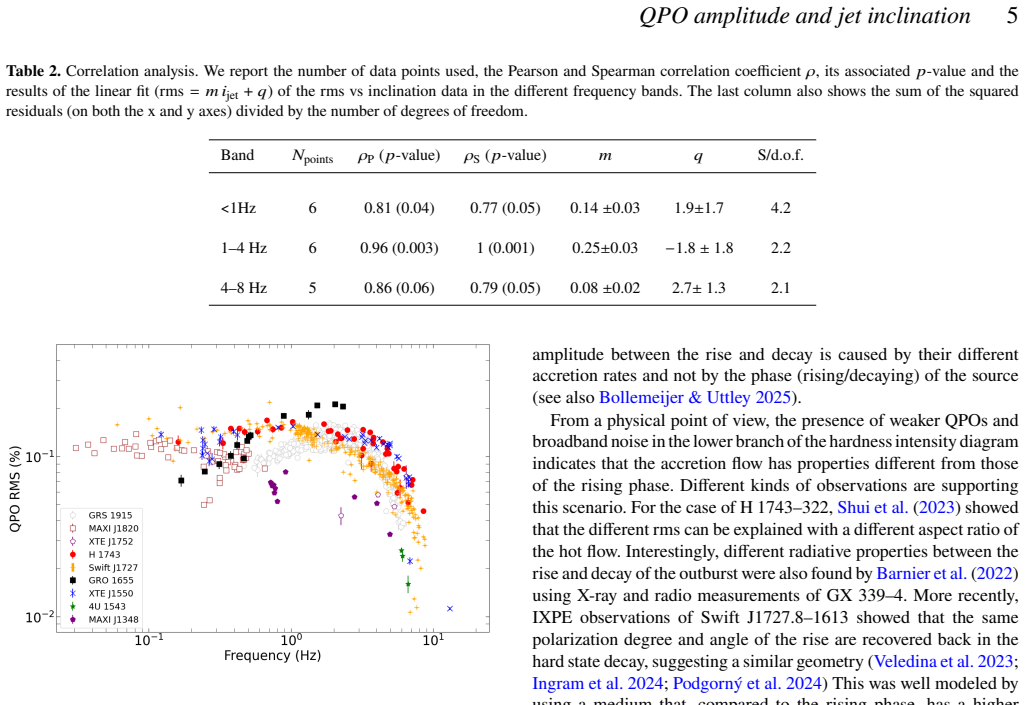
X-ray quasi-periodic oscillations (QPOs) are a characteristic feature of low-mass X-ray binaries (LMXBs). These oscillations have been studied for decades and revealed a rich and complex phenomenology that is still not fully understood. RXTE archival studies have shown that the amplitude of these oscillations differs significantly between black holes (BH) with high or low inclination. Yet, the actual dependence on inclination has never been adequately estimated. Thanks to the improvement of inclination measurements through radio observations and the recent observations by the HXMT satellite, we quantified for the first time the dependence of Type-C QPO amplitudes on the jet inclination of individual BH LMXBs. Our analysis reveals the presence of a significant linear correlation up to 8 Hz, strengthening the case for a ''geometrical'' origin of the QPOs. In addition, for a given QPO frequency, we observe systematically lower amplitudes during the decay of outbursts compared to the rise. This data collection represents a key benchmark for any QPO model. Our comparison with the predictions from a precessing hot flow shows that the amplitude of the QPOs can be reproduced by this scenario if the spin-orbit misalignment is at least $\approx$10-15$^\circ$.
Editorial analysis
A structured set of objections, weighed in public.
Referee Report
Summary. The manuscript analyzes archival RXTE and HXMT observations of Type-C QPOs in black hole LMXBs and reports a significant linear correlation between QPO amplitude and radio jet inclination up to 8 Hz. This is taken as support for a geometrical origin. Amplitudes are systematically lower on outburst decay than rise at fixed frequency. Comparison to a precessing hot flow model indicates that reproducing the observed amplitudes requires a spin-orbit misalignment of at least ≈10–15°.
Significance. If the reported correlation is statistically robust, the work supplies a quantitative observational benchmark that any viable QPO model must satisfy and adds concrete support for geometrical mechanisms over purely intrinsic ones.
major comments (2)
- [Abstract/Results] Abstract and results: the central claim of a 'significant linear correlation' is presented without sample size (number of sources or individual QPO measurements), error treatment, fitting procedure, or any statistical metric (p-value, R², or confidence interval on the slope). These details are load-bearing for assessing whether the correlation is real or driven by small-number statistics or selection effects.
- [Discussion] Discussion: the geometrical interpretation assumes jet inclination (tied to black-hole spin) is a faithful proxy for the line-of-sight inclination of the precessing hot flow or disk that produces the QPO modulation. The manuscript itself states that the precessing-flow model requires a spin-orbit misalignment of ≈10–15°, which means the instantaneous orientation of the precessing structure and the jet axis differ; this mismatch could dilute or bias the observed amplitude-inclination relation, yet no quantitative assessment of the resulting scatter is provided.
minor comments (2)
- Specify how the 8 Hz upper limit was chosen and whether the correlation strength changes when the sample is restricted to frequencies below this cutoff.
- List the individual sources, their adopted jet inclinations, and the number of QPO detections per source to allow independent verification.
Simulated Author's Rebuttal
We thank the referee for their constructive comments, which have helped us improve the clarity and robustness of the manuscript. We address each major comment below and have revised the paper accordingly.
read point-by-point responses
-
Referee: [Abstract/Results] Abstract and results: the central claim of a 'significant linear correlation' is presented without sample size (number of sources or individual QPO measurements), error treatment, fitting procedure, or any statistical metric (p-value, R², or confidence interval on the slope). These details are load-bearing for assessing whether the correlation is real or driven by small-number statistics or selection effects.
Authors: We agree that these details are essential and should be stated explicitly. In the revised manuscript we have added them to both the abstract and the results section: the sample comprises 8 sources and 142 individual Type-C QPO amplitude measurements; errors are treated via Monte Carlo resampling that incorporates both statistical and systematic uncertainties; the fit is performed with orthogonal distance regression; and we now report the p-value, R², and confidence interval on the slope. These additions confirm that the reported correlation is statistically robust. revision: yes
-
Referee: [Discussion] Discussion: the geometrical interpretation assumes jet inclination (tied to black-hole spin) is a faithful proxy for the line-of-sight inclination of the precessing hot flow or disk that produces the QPO modulation. The manuscript itself states that the precessing-flow model requires a spin-orbit misalignment of ≈10–15°, which means the instantaneous orientation of the precessing structure and the jet axis differ; this mismatch could dilute or bias the observed amplitude-inclination relation, yet no quantitative assessment of the resulting scatter is provided.
Authors: This is a fair criticism. The 10–15° misalignment does introduce an additional source of scatter because the jet axis is not identical to the instantaneous orientation of the precessing flow. In the revised discussion we now explicitly address this point, noting that the observed QPO amplitudes are time-averaged over many precession periods and that the jet inclination therefore remains a valid proxy for the mean viewing angle. We have added a qualitative estimate of the extra scatter expected from the misalignment and show that it is consistent with the dispersion seen in the data; a full Monte-Carlo propagation of the misalignment angle is left for future work. revision: partial
Circularity Check
No circularity: empirical correlation extracted from observations
full rationale
The paper's central claim is a measured linear correlation between Type-C QPO amplitudes and jet inclinations, obtained from RXTE archival data, HXMT observations, and radio inclination measurements. No derivation chain, equations, or self-citations are shown that reduce this result to its own inputs by construction; the correlation is presented as a direct data product. The precessing hot flow comparison is a post-hoc consistency check requiring misalignment, not a load-bearing step that defines the correlation. The analysis is self-contained against external benchmarks.
Axiom & Free-Parameter Ledger
free parameters (1)
- slope and intercept of amplitude-inclination linear fit
axioms (1)
- domain assumption Jet inclination from radio observations accurately traces the inclination relevant to the QPO-emitting region
Reference graph
Works this paper leans on
-
[1]
Alabarta K., M \'e ndez M., Garc \' a F., Altamirano D., Zhang Y., Zhang L., Russell D. M., K \"o nig O., 2025, @doi [ ] 10.3847/1538-4357/ada7f9 , https://ui.adsabs.harvard.edu/abs/2025ApJ...980..251A 980, 251
-
[2]
A., Hasinger G., Shaham J., Yancopoulos S., 1992, , https://ui.adsabs.harvard.edu/abs/1992A&A...257..627A 257, 627
Alpar M. A., Hasinger G., Shaham J., Yancopoulos S., 1992, , https://ui.adsabs.harvard.edu/abs/1992A&A...257..627A 257, 627
1992
-
[3]
Barnier S., et al., 2022, @doi [ ] 10.1051/0004-6361/202141182 , https://ui.adsabs.harvard.edu/abs/2022A&A...657A..11B 657, A11
-
[4]
Bellavita C., Garc \' a F., M \'e ndez M., Karpouzas K., 2022, @doi [ ] 10.1093/mnras/stac1922 , https://ui.adsabs.harvard.edu/abs/2022MNRAS.515.2099B 515, 2099
-
[5]
Bellavita C., M \'e ndez M., Garc \' a F., Ma R., K \"o nig O., 2025, @doi [arXiv e-prints] 10.48550/arXiv.2502.12283 , https://ui.adsabs.harvard.edu/abs/2025arXiv250212283B p. arXiv:2502.12283
-
[6]
Belloni T., Klein-Wolt M., M \'e ndez M., van der Klis M., van Paradijs J., 2000, , https://ui.adsabs.harvard.edu/abs/2000A&A...355..271B 355, 271
2000
-
[7]
Belloni T., Psaltis D., van der Klis M., 2002, @doi [ ] 10.1086/340290 , https://ui.adsabs.harvard.edu/#abs/2002ApJ...572..392B 572, 392
-
[8]
Belloni T., Homan J., Casella P., van der Klis M., Nespoli E., Lewin W. H. G., Miller J. M., M \'e ndez M., 2005, @doi [ ] 10.1051/0004-6361:20042457 , https://ui.adsabs.harvard.edu/#abs/2005A&A...440..207B 440, 207
-
[9]
Blandford R. D., K \"o nigl A., 1979, @doi [ ] 10.1086/157262 , https://ui.adsabs.harvard.edu/#abs/1979ApJ...232...34B 232, 34
-
[10]
Boggs P. T., Donaldson J. R., 1989, Technical Report NIST IR 89-4197, Orthogonal Distance Regression, https://nvlpubs.nist.gov/nistpubs/Legacy/IR/nistir89-4197.pdf . National Institute of Standards and Technology, Gaithersburg, MD, @doi 10.6028/NIST.IR.89-4197 , https://nvlpubs.nist.gov/nistpubs/Legacy/IR/nistir89-4197.pdf
-
[11]
Bollemeijer N., Uttley P., 2025, @doi [ ] 10.1093/mnras/staf1238 , https://ui.adsabs.harvard.edu/abs/2025MNRAS.542..350B 542, 350
-
[12]
Bollemeijer N., Uttley P., You B., 2025, @doi [ ] 10.1093/mnras/staf750 , https://ui.adsabs.harvard.edu/abs/2025MNRAS.540.1394B 540, 1394
-
[13]
Bright J. S., et al., 2020, @doi [Nature Astronomy] 10.1038/s41550-020-1023-5 , https://ui.adsabs.harvard.edu/abs/2020NatAs...4..697B 4, 697
-
[14]
Buisson D. J. K., Marcel G., L \'o pez-Barquero V., Motta S. E., Turner S. G. D., Vincentelli F. M., 2025, @doi [arXiv e-prints] 10.48550/arXiv.2502.08718 , https://ui.adsabs.harvard.edu/abs/2025arXiv250208718B p. arXiv:2502.08718
-
[15]
2010, MNRAS, 406, 1379, doi: 10.1111/j.1365-2966.2010.16776.x
Cabanac C., Henri G., Petrucci P.-O., Malzac J., Ferreira J., Belloni T. M., 2010, @doi [ ] 10.1111/j.1365-2966.2010.16340.x , https://ui.adsabs.harvard.edu/abs/2010MNRAS.404..738C 404, 738
-
[16]
Carotenuto F., Tetarenko A. J., Corbel S., 2022, @doi [ ] 10.1093/mnras/stac329 , https://ui.adsabs.harvard.edu/abs/2022MNRAS.511.4826C 511, 4826
-
[17]
Carotenuto F., Fender R., Tetarenko A. J., Corbel S., Zdziarski A. A., Shaik G., Cooper A. J., Di Palma I., 2024, @doi [ ] 10.1093/mnras/stae2049 , https://ui.adsabs.harvard.edu/abs/2024MNRAS.533.4188C 533, 4188
-
[18]
Casella P., Belloni T., Homan J., Stella L., 2004, @doi [ ] 10.1051/0004-6361:20041231 , https://ui.adsabs.harvard.edu/#abs/2004A&A...426..587C 426, 587
-
[19]
Casella P., Belloni T., Stella L., 2005, @doi [ ] 10.1086/431174 , https://ui.adsabs.harvard.edu/#abs/2005ApJ...629..403C 629, 403
-
[20]
Cooper A. J., et al., 2025, @doi [ ] 10.1093/mnras/staf1085 , https://ui.adsabs.harvard.edu/abs/2025MNRAS.541.3518C 541, 3518
-
[21]
P., 2002, @doi [ ] 10.1086/341870 , https://ui.adsabs.harvard.edu/abs/2002ApJ...573L..35C 573, L35
Corbel S., Fender R. P., 2002, @doi [ ] 10.1086/341870 , https://ui.adsabs.harvard.edu/abs/2002ApJ...573L..35C 573, L35
-
[22]
M., Casares J., Mu \ n oz-Darias T., Bauer F
Corral-Santana J. M., Casares J., Mu \ n oz-Darias T., Bauer F. E., Mart \' nez-Pais I. G., Russell D. M., 2016, @doi [ ] 10.1051/0004-6361/201527130 , https://ui.adsabs.harvard.edu/abs/2016A&A...587A..61C 587, A61
-
[23]
A., Ponti G., Migliori G., Belloni T
De Marco B., Zdziarski A. A., Ponti G., Migliori G., Belloni T. M., Segovia Otero A., Dzie ak M. A., Lai E. V., 2021, @doi [ ] 10.1051/0004-6361/202140567 , https://ui.adsabs.harvard.edu/abs/2021A&A...654A..14D 654, A14
-
[24]
Done C., Gierli \'n ski M., Kubota A., 2007, @doi [Astronomy and Astrophysics Review] 10.1007/s00159-007-0006-1 , https://ui.adsabs.harvard.edu/#abs/2007A&ARv..15....1D 15, 1
-
[25]
Fender R. P., Motta S. E., 2025, @doi [Nature Astronomy] 10.1038/s41550-025-02665-w , https://ui.adsabs.harvard.edu/abs/2025NatAs...9.1854F 9, 1854
-
[26]
2004, MNRAS, 350, 1301, doi: 10.1111/j.1365-2966.2004.07713.x
Fender R. P., Belloni T. M., Gallo E., 2004, @doi [ ] 10.1111/j.1365-2966.2004.08384.x , https://ui.adsabs.harvard.edu/#abs/2004MNRAS.355.1105F 355, 1105
-
[27]
Ferreira J., et al., 2022, @doi [ ] 10.1051/0004-6361/202040165 , https://ui.adsabs.harvard.edu/abs/2022A&A...660A..66F 660, A66
-
[28]
Fogantini F. A., Garc \' a F., M \'e ndez M., K \"o nig O., Wilms J., 2025, @doi [ ] 10.1051/0004-6361/202453523 , https://ui.adsabs.harvard.edu/abs/2025A&A...696A.237F 696, A237
-
[29]
Fragile P. C., Blaes O. M., Anninos P., Salmonson J. D., 2007, @doi [ ] 10.1086/521092 , https://ui.adsabs.harvard.edu/abs/2007ApJ...668..417F 668, 417
-
[30]
Fragos T., Tremmel M., Rantsiou E., Belczynski K., 2010, @doi [ ] 10.1088/2041-8205/719/1/L79 , https://ui.adsabs.harvard.edu/abs/2010ApJ...719L..79F 719, L79
-
[31]
Gandhi P., et al., 2010, @doi [ ] 10.1111/j.1365-2966.2010.17083.x , http://adsabs.harvard.edu/abs/2010MNRAS.407.2166G 407, 2166
-
[32]
Gandhi P., et al., 2011, @doi [ ] 10.1088/2041-8205/740/1/L13 , https://ui.adsabs.harvard.edu/#abs/2011ApJ...740L..13G 740, L13
-
[33]
Garc \' a F., M \'e ndez M., Karpouzas K., Belloni T., Zhang L., Altamirano D., 2021, @doi [ ] 10.1093/mnras/staa3944 , https://ui.adsabs.harvard.edu/abs/2021MNRAS.501.3173G 501, 3173
-
[34]
Heil L. M., Uttley P., Klein-Wolt M., 2015, @doi [ ] 10.1093/mnras/stv240 , https://ui.adsabs.harvard.edu/#abs/2015MNRAS.448.3348H 448, 3348
-
[35]
Hjellming R. M., Rupen M. P., 1995, @doi [ ] 10.1038/375464a0 , https://ui.adsabs.harvard.edu/#abs/1995Natur.375..464H 375, 464
-
[36]
2009, MNRAS, 397, 985, doi: 10.1111/j.1365-2966.2009.15007.x
Hynes R. I., Brien K. O., Mullally F., Ashcraft T., 2009, @doi [ ] 10.1111/j.1365-2966.2009.15260.x , https://ui.adsabs.harvard.edu/abs/2009MNRAS.399..281H 399, 281
-
[37]
Ingram A., Done C., 2010, @doi [ ] 10.1111/j.1365-2966.2010.16614.x , https://ui.adsabs.harvard.edu/abs/2010MNRAS.405.2447I 405, 2447
-
[38]
Ingram A., Done C., 2012, @doi [ ] 10.1111/j.1365-2966.2011.19885.x , https://ui.adsabs.harvard.edu/#abs/2012MNRAS.419.2369I 419, 2369
-
[39]
Ingram A. R., Motta S. E., 2019, @doi [ ] 10.1016/j.newar.2020.101524 , https://ui.adsabs.harvard.edu/abs/2019NewAR..8501524I 85, 101524
-
[40]
Ingram A., Done C., Fragile P. C., 2009, @doi [ ] 10.1111/j.1745-3933.2009.00693.x , http://adsabs.harvard.edu/abs/2009MNRAS.397L.101I 397, L101
-
[41]
Ingram A., Maccarone T. J., Poutanen J., Krawczynski H., 2015, @doi [ ] 10.1088/0004-637X/807/1/53 , https://ui.adsabs.harvard.edu/abs/2015ApJ...807...53I 807, 53
-
[42]
Ingram A., van der Klis M., Middleton M., Done C., Altamirano D., Heil L., Uttley P., Axelsson M., 2016, @doi [ ] 10.1093/mnras/stw1245 , https://ui.adsabs.harvard.edu/#abs/2016MNRAS.461.1967I 461, 1967
-
[43]
Ingram A., van der Klis M., Middleton M., Altamirano D., Uttley P., 2017, @doi [ ] 10.1093/mnras/stw2581 , https://ui.adsabs.harvard.edu/abs/2017MNRAS.464.2979I 464, 2979
-
[44]
Ingram A., et al., 2024, @doi [ ] 10.3847/1538-4357/ad3faf , https://ui.adsabs.harvard.edu/abs/2024ApJ...968...76I 968, 76
-
[45]
Kalamkar M., Casella P., Uttley P., O'Brien K., Russell D., Maccarone T., van der Klis M., Vincentelli F., 2016, @doi [ ] 10.1093/mnras/stw1211 , http://adsabs.harvard.edu/abs/2016MNRAS.460.3284K 460, 3284
-
[46]
Kalemci E., Tomsick J. A., Rothschild R. E., Pottschmidt K., Corbel S., Kaaret P., 2006, @doi [ ] 10.1086/499222 , https://ui.adsabs.harvard.edu/abs/2006ApJ...639..340K 639, 340
-
[47]
Karpouzas K., M \'e ndez M., Ribeiro E. M., Altamirano D., Blaes O., Garc \' a F., 2020, @doi [ ] 10.1093/mnras/stz3502 , https://ui.adsabs.harvard.edu/abs/2020MNRAS.492.1399K 492, 1399
-
[48]
K \"o nig O., et al., 2024, @doi [ ] 10.1051/0004-6361/202449333 , https://ui.adsabs.harvard.edu/abs/2024A&A...687A.284K 687, A284
-
[49]
Krawczynski H., et al., 2022, @doi [Science] 10.1126/science.add5399 , https://ui.adsabs.harvard.edu/abs/2022Sci...378..650K 378, 650
-
[50]
Li Z. B., Qu J. L., Song L. M., Ding G. Q., Zhang C. M., 2013, @doi [ ] 10.1093/mnras/sts149 , https://ui.adsabs.harvard.edu/abs/2013MNRAS.428.1704L 428, 1704
-
[51]
Liska M., Hesp C., Tchekhovskoy A., Ingram A., van der Klis M., Markoff S., 2018, @doi [ ] 10.1093/mnrasl/slx174 , http://adsabs.harvard.edu/abs/2018MNRAS.474L..81L 474, L81
-
[52]
Ma R., M \'e ndez M., Garc \' a F., Sai N., Zhang L., Zhang Y., 2023, @doi [ ] 10.1093/mnras/stad2284 , https://ui.adsabs.harvard.edu/abs/2023MNRAS.525..854M 525, 854
-
[53]
Marcel G., Neilsen J., 2021, @doi [ ] 10.3847/1538-4357/abcbf9 , https://ui.adsabs.harvard.edu/abs/2021ApJ...906..106M 906, 106
-
[54]
Mastichiadis A., Petropoulou M., Kylafis N. D., 2022, @doi [ ] 10.1051/0004-6361/202243397 , https://ui.adsabs.harvard.edu/abs/2022A&A...662A.118M 662, A118
-
[55]
Mastroserio G., et al., 2025, @doi [ ] 10.3847/2041-8213/ad9913 , https://ui.adsabs.harvard.edu/abs/2025ApJ...978L..19M 978, L19
-
[56]
Mata S \'a nchez D., Torres M. A. P., Casares J., Mu \ n oz-Darias T., Armas Padilla M., Yanes-Rizo I. V., 2025, @doi [ ] 10.1051/0004-6361/202451960 , https://ui.adsabs.harvard.edu/abs/2025A&A...693A.129M 693, A129
-
[57]
M \'e ndez M., Karpouzas K., Garc \' a F., Zhang L., Zhang Y., Belloni T. M., Altamirano D., 2022, @doi [Nature Astronomy] 10.1038/s41550-022-01617-y , https://ui.adsabs.harvard.edu/abs/2022NatAs...6..577M 6, 577
-
[58]
Miller-Jones J. C. A., et al., 2019, @doi [ ] 10.1038/s41586-019-1152-0 , https://ui.adsabs.harvard.edu/abs/2019Natur.569..374M 569, 374
-
[59]
Miller M. C., Lamb F. K., Psaltis D., 1998, @doi [ ] 10.1086/306408 , https://ui.adsabs.harvard.edu/abs/1998ApJ...508..791M 508, 791
-
[60]
Mirabel I. F., Rodr \' guez L. F., 1994, @doi [ ] 10.1038/371046a0 , https://ui.adsabs.harvard.edu/#abs/1994Natur.371...46M 371, 46
-
[61]
J., Page C
Motch C., Ricketts M. J., Page C. G., Ilovaisky S. A., Chevalier C., 1983, , https://ui.adsabs.harvard.edu/#abs/1983A&A...119..171M 119, 171
1983
-
[62]
Motta S. E., Belloni T. M., Stella L., Mu \ n oz-Darias T., Fender R., 2014a, @doi [ ] 10.1093/mnras/stt2068 , https://ui.adsabs.harvard.edu/abs/2014MNRAS.437.2554M 437, 2554
-
[63]
Motta S. E., Munoz-Darias T., Sanna A., Fender R., Belloni T., Stella L., 2014b, @doi [ ] 10.1093/mnrasl/slt181 , https://ui.adsabs.harvard.edu/abs/2014MNRAS.439L..65M 439, L65
-
[64]
Motta S. E., Casella P., Henze M., Mu \ n oz-Darias T., Sanna A., Fender R., Belloni T., 2015, @doi [ ] 10.1093/mnras/stu2579 , http://adsabs.harvard.edu/abs/2015MNRAS.447.2059M 447, 2059
-
[65]
Motta S. E., Casella P., Fender R. P., 2018, @doi [ ] 10.1093/mnras/sty1440 , https://ui.adsabs.harvard.edu/#abs/2018MNRAS.478.5159M 478, 5159
-
[66]
2010, MNRAS, 406, 1379, doi: 10.1111/j.1365-2966.2010.16776.x
Mu \ n oz-Darias T., Motta S., Belloni T. M., 2011, @doi [ ] 10.1111/j.1365-2966.2010.17476.x , https://ui.adsabs.harvard.edu/abs/2011MNRAS.410..679M 410, 679
-
[67]
Mu \ n oz-Darias T., Coriat M., Plant D. S., Ponti G., Fender R. P., Dunn R. J. H., 2013, @doi [ ] 10.1093/mnras/stt546 , https://ui.adsabs.harvard.edu/abs/2013MNRAS.432.1330M 432, 1330
-
[68]
Nathan E., et al., 2022, @doi [ ] 10.1093/mnras/stab3803 , https://ui.adsabs.harvard.edu/abs/2022MNRAS.511..255N 511, 255
-
[69]
Orosz J. A., Jain R. K., Bailyn C. D., McClintock J. E., Remillard R. A., 1998, @doi [ ] 10.1086/305620 , https://ui.adsabs.harvard.edu/abs/1998ApJ...499..375O 499, 375
-
[70]
Orosz J. A., Steiner J. F., McClintock J. E., Torres M. A. P., Remillard R. A., Bailyn C. D., Miller J. M., 2011, @doi [ ] 10.1088/0004-637X/730/2/75 , https://ui.adsabs.harvard.edu/abs/2011ApJ...730...75O 730, 75
-
[71]
Parra M., Petrucci P.-O., Bianchi S., Gianolli V. E., Ursini F., Ponti G., 2024, @doi [ ] 10.1051/0004-6361/202346920 , https://ui.adsabs.harvard.edu/abs/2024A&A...681A..49P 681, A49
-
[72]
Pe'er A., 2014, @doi [ ] 10.1007/s11214-013-0001-y , https://ui.adsabs.harvard.edu/abs/2014SSRv..183..371P 183, 371
-
[73]
Podgorn \'y J., et al., 2024, @doi [ ] 10.1051/0004-6361/202450566 , https://ui.adsabs.harvard.edu/abs/2024A&A...686L..12P 686, L12
-
[74]
Poutanen J., et al., 2022, @doi [Science] 10.1126/science.abl4679 , https://ui.adsabs.harvard.edu/abs/2022Sci...375..874P 375, 874
-
[75]
Psaltis D., Belloni T., van der Klis M., 1999, @doi [ ] 10.1086/307436 , https://ui.adsabs.harvard.edu/abs/1999ApJ...520..262P 520, 262
-
[76]
Reid M. J., Miller-Jones J. C. A., 2023, @doi [ ] 10.3847/1538-4357/acfe0c , https://ui.adsabs.harvard.edu/abs/2023ApJ...959...85R 959, 85
-
[77]
Reid M. J., McClintock J. E., Steiner J. F., Steeghs D., Remillard R. A., Dhawan V., Narayan R., 2014, @doi [ ] 10.1088/0004-637X/796/1/2 , https://ui.adsabs.harvard.edu/abs/2014ApJ...796....2R 796, 2
-
[78]
Reig P., Kylafis N. D., 2019, @doi [ ] 10.1051/0004-6361/201935070 , https://ui.adsabs.harvard.edu/abs/2019A&A...625A..90R 625, A90
-
[79]
Schnittman J. D., Homan J., Miller J. M., 2006, @doi [ ] 10.1086/500923 , https://ui.adsabs.harvard.edu/abs/2006ApJ...642..420S 642, 420
-
[80]
Shahbaz T., 2003, @doi [ ] 10.1046/j.1365-8711.2003.06258.x , https://ui.adsabs.harvard.edu/abs/2003MNRAS.339.1031S 339, 1031
discussion (0)
Sign in with ORCID, Apple, or X to comment. Anyone can read and Pith papers without signing in.