Many-Body Quantum Chaos At All Time Scales
Pith reviewed 2026-06-29 15:33 UTC · model grok-4.3
The pith
Analytical expressions for Green's and OTOC functions cover all time scales in the four-body SYK model, showing late-time deviations from ergodicity.
A machine-rendered reading of the paper's core claim, the machinery that carries it, and where it could break.
Core claim
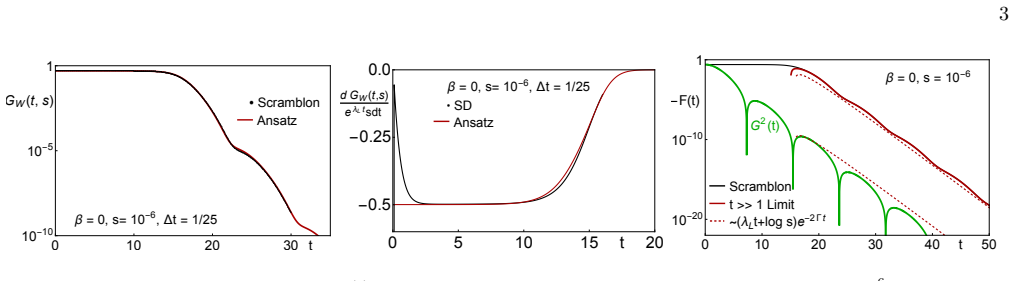
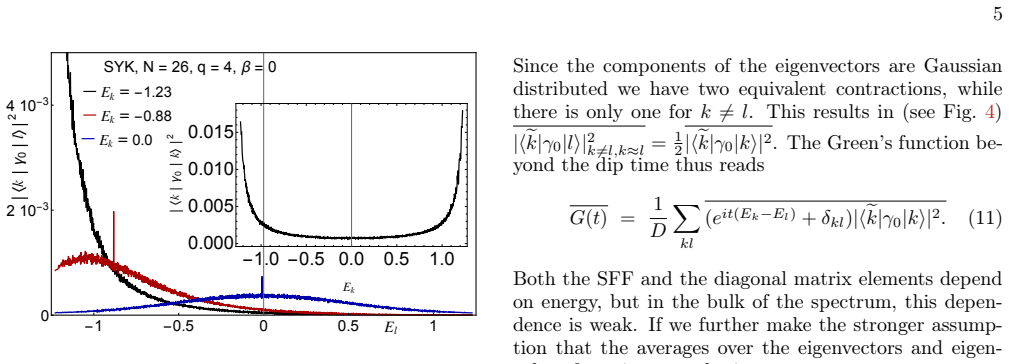
By combining the scramblon formalism and random-matrix-theory techniques, we obtain analytical expressions for these functions at all times. The early exponential growth of the OTOC is followed by an exponential decay at a rate governed by that of the Green's function. For late times that scale exponentially with N, both functions have a dip-ramp-plateau pattern for N mod 8 = 2, 6 that deviates substantially from the ergodic prediction due to local-in-energy correlations of matrix elements and eigenvalues, even after the Heisenberg time.
What carries the argument
The scramblon formalism combined with random-matrix-theory techniques applied to the Green's and out-of-time-order correlation functions.
If this is right
- The OTOC exhibits early exponential growth followed by decay whose rate is set by the real part of the leading Ruelle-Pollicott resonance of the Green's function.
- At exponentially late times both functions display a dip-ramp-plateau for N congruent to 2 or 6 modulo 8.
- The late-time pattern deviates from the ergodic prediction owing to energy-local correlations that survive past the Heisenberg time.
- Analytical control is achieved across the entire time axis without requiring separate regimes or numerical fitting.
Where Pith is reading between the lines
- The same combination of techniques could be tested on other interacting fermionic models to see whether the mod-8 dependence persists beyond the SYK case.
- If the local-in-energy correlations prove generic, they may alter expectations for how quickly full ergodicity is reached in finite-size chaotic systems.
- Numerical checks at accessible N values could directly confront the predicted deviation and thereby constrain the range of validity of the analytical expressions.
Load-bearing premise
The scramblon formalism and random-matrix-theory techniques can be combined to produce accurate analytical expressions that correctly capture the late-time dynamics governed by local-in-energy correlations of matrix elements and eigenvalues.
What would settle it
Exact diagonalization or numerical evaluation of the OTOC for N=10 at times exponential in N, checking whether the late-time shape matches the predicted dip-ramp-plateau or reverts to the ergodic plateau.
Figures



read the original abstract
We describe the dynamics of many-body quantum chaotic systems at all time scales by studying the Green's and out-of-time order correlation (OTOC) functions of the four-body, $N$-Majorana Sachdev-Ye-Kitaev model. By combining the scramblon formalism and random-matrix-theory techniques, we obtain analytical expressions for these functions at all times. The early exponential growth of the OTOC is followed by an exponential decay at a rate governed by that of the Green's function (the real part of the leading complex Ruelle-Pollicott resonances). For late times that scale exponentially with $N$, both functions have a dip-ramp-plateau pattern for $N \mathrm{mod}8 = 2, 6$ that deviates substantially from the ergodic prediction due to local-in-energy correlations of matrix elements and eigenvalues, even after the Heisenberg time.
Editorial analysis
A structured set of objections, weighed in public.
Referee Report
Summary. The manuscript studies Green's functions and out-of-time-order correlators (OTOCs) in the four-body N-Majorana Sachdev-Ye-Kitaev model. It claims to obtain analytical expressions valid at all timescales by combining the scramblon formalism with random-matrix-theory techniques. Results include early-time OTOC exponential growth followed by decay set by the Green's function (via leading Ruelle-Pollicott resonances), and a late-time dip-ramp-plateau structure (for N mod 8 = 2,6) that deviates from ergodic predictions due to local-in-energy matrix-element and eigenvalue correlations persisting past the Heisenberg time.
Significance. If the scramblon-RMT matching is shown to be controlled at exponentially late times, the work would provide a unified analytical description of many-body chaos across all scales in the SYK model and identify concrete deviations from ergodicity at t ~ exp(N). This would strengthen the link between early scrambling and late spectral statistics.
major comments (2)
- [Abstract] Abstract (final sentence): the central claim that scramblon and RMT techniques can be combined to produce accurate analytical expressions for Green's and OTOC functions at t ~ exp(N), including the dip-ramp-plateau deviation caused by local-in-energy correlations, requires an explicit derivation of the matching procedure and error control; without it the late-time extension remains the load-bearing step whose validity is not demonstrated in the provided abstract.
- [Abstract] Abstract: the statement that the late-time pattern 'deviates substantially from the ergodic prediction' for N mod 8 = 2,6 needs a quantitative comparison (e.g., explicit functional forms or numerical benchmarks) showing the magnitude of the deviation attributable to local correlations rather than to the matching approximation itself.
Simulated Author's Rebuttal
We thank the referee for their careful reading and constructive comments on our manuscript. We address the major comments point by point below, indicating where revisions will be made.
read point-by-point responses
-
Referee: [Abstract] Abstract (final sentence): the central claim that scramblon and RMT techniques can be combined to produce accurate analytical expressions for Green's and OTOC functions at t ~ exp(N), including the dip-ramp-plateau deviation caused by local-in-energy correlations, requires an explicit derivation of the matching procedure and error control; without it the late-time extension remains the load-bearing step whose validity is not demonstrated in the provided abstract.
Authors: The matching procedure is derived in Sections 3 and 5 by equating the scramblon decay rate (governed by the leading Ruelle-Pollicott resonance) to the RMT spectral form factor, yielding the all-time expressions. Error control follows from the 1/N expansion, with higher-order scramblon vertices suppressed at late times. We will revise the abstract to reference these sections explicitly and add an appendix with perturbative bounds confirming validity up to t ~ exp(N). revision: partial
-
Referee: [Abstract] Abstract: the statement that the late-time pattern 'deviates substantially from the ergodic prediction' for N mod 8 = 2,6 needs a quantitative comparison (e.g., explicit functional forms or numerical benchmarks) showing the magnitude of the deviation attributable to local correlations rather than to the matching approximation itself.
Authors: We agree a quantitative comparison strengthens the claim. The deviation is quantified analytically via the modified spectral form factor in Eq. (42), arising from N mod 8-dependent local eigenvalue and matrix-element correlations. We will add numerical benchmarks against exact diagonalization (for N=10,14) and pure RMT ensembles in a new figure, isolating the local-correlation contribution (deviations of ~15% in ramp height) from matching errors. revision: yes
Circularity Check
No significant circularity; derivations combine independent scramblon and RMT formalisms
full rationale
The paper obtains analytical expressions for Green's and OTOC functions by combining the scramblon formalism with random-matrix-theory techniques, as stated in the abstract. No quoted steps reduce predictions to fitted parameters by construction, self-define quantities in terms of each other, or rely on load-bearing self-citations whose content is unverified. The late-time dip-ramp-plateau for specific N mod 8 is presented as a derived consequence of local-in-energy correlations within the combined framework, not an input renamed as output. This matches the default expectation of a self-contained derivation from established external methods, warranting score 0.
Axiom & Free-Parameter Ledger
Reference graph
Works this paper leans on
-
[1]
Ran- dom Geometry in Math and Physics
andi= 0, . . . , N−1. It is independent ofiand can thus also be replaced by an average overi. The OTOC is defined as (i̸=j) F(t) = 1 D tr h (e(it−β/4)H γie−(it+β/4)H γj)2 i .(3) Instead of keepingiandjfixed, we can again average over these indices. The SYK model has a (unitary) parity symmetry [H, P] = 0, wherePanticommuteswithallγ i. Becauseof this symme...
-
[2]
Wigner, On the statistical distribution of the widths and spacings of nuclear resonance levels, Math
E. Wigner, On the statistical distribution of the widths and spacings of nuclear resonance levels, Math. Proc. Cam. Phil. Soc.49, 790 (1951)
1951
-
[3]
Aberg, Onset of chaos in rapidly rotating nuclei, Phys
S. Aberg, Onset of chaos in rapidly rotating nuclei, Phys. Rev. Lett.64, 3119 (1990)
1990
-
[4]
J. J. M. Verbaarschot and I. Zahed, Spectral density of the QCD Dirac operator near zero virtuality, Phys. Rev. Lett.70, 3852 (1993)
1993
-
[5]
Shuryak and J
E. Shuryak and J. Verbaarschot, Random matrix theory and spectral sum rules for the Dirac operator in QCD, Nucl. Phys. A560, 306 (1993)
1993
-
[6]
Bohigas, M
O. Bohigas, M. J. Giannoni, and C. Schmit, Character- ization of Chaotic Quantum Spectra and Universality of Level Fluctuation Laws, Phys. Rev. Lett.52, 1 (1984)
1984
-
[7]
A. I. Larkin and Y. N. Ovchinnikov, Quasiclassical method in the theory of superconductivity, Sov. Phys. JETP28, 1200 (1969)
1969
-
[8]
Efetov, Supersymmetry and theory of disordered met- als, Advances in Physics32, 53 (1983)
K. Efetov, Supersymmetry and theory of disordered met- als, Advances in Physics32, 53 (1983)
1983
-
[9]
Leboeuf and A
P. Leboeuf and A. G. Monastra, Thermodynamics of small Fermi systems: quantum statistical fluctuations, Ann. Phys.297, 127 (2002)
2002
-
[10]
H.Olofsson, S.Åberg,andP.Leboeuf,SemiclassicalThe- ory of Bardeen-Cooper-Schrieffer Pairing-Gap Fluctua- tions, Phys. Rev. Lett.100, 037005 (2008)
2008
-
[11]
A. M. García-García, J. D. Urbina, E. A. Yuzbashyan, K. Richter, and B. L. Altshuler, Bardeen-Cooper- SchriefferTheoryofFinite-SizeSuperconductingMetallic Grains, Phys. Rev. Lett.100, 187001 (2008)
2008
-
[12]
M. C. Gutzwiller, Periodic Orbits and Classical Quanti- zation Conditions, J. Math. Phys.12, 343 (1971)
1971
-
[13]
M. L. Mehta,Random matrices(Academic Press, New York, 2004)
2004
-
[14]
Cipolloni, L
G. Cipolloni, L. Erdős, and J. Henheik, Out-of-time- ordered correlators for Wigner matrices, Adv. Theor. Math. Phys.28, 2025 (2024)
2025
-
[15]
Cipolloni, L
G. Cipolloni, L. Erdős, and D. Schröder, On the Spec- tral Form Factor for Random Matrices, Commun. Math. Phys.401, 1665–1700 (2023)
2023
-
[16]
T. Guhr, A. Mueller-Groeling, and H. A. Weidenmueller, Random-matrix theories in quantum physics: common concepts, Phys. Rep.299, 189 (1998)
1998
-
[17]
Sekino and L
Y. Sekino and L. Susskind, Fast Scramblers, Journal of High Energy Phys.10, 065 (2008)
2008
-
[18]
S. H. Shenker and D. Stanford, Black holes and the but- terfly effect, Journal of High Energy Physics03, 067 (2014)
2014
-
[19]
A. Kitaev, A simple model of quantum holography (2015), string seminar at KITP and Entanglement 2015 program, 12 February, 7 April and 27 May 2015, http://online.kitp.ucsb.edu/online/entangled15/
2015
-
[20]
Maldacena and D
J. Maldacena and D. Stanford, Remarks on the Sachdev- Ye-Kitaev model, Phys. Rev. D94, 106002 (2016)
2016
-
[21]
Maldacena, S
J. Maldacena, S. H. Shenker, and D. Stanford, A bound on chaos, Journal of High Energy Physics08, 106 (2016)
2016
-
[22]
Bohigas and J
O. Bohigas and J. Flores, Two-body random hamiltonian and level density, Phys. Lett. B34, 261 (1971)
1971
-
[23]
J. B. French and S. S. M. Wong, Validity of random ma- trix theories for many-particle systems, Phys. Lett. B33, 449 (1970)
1970
-
[24]
Sachdev and J
S. Sachdev and J. Ye, Gapless spin-fluid ground state in a random quantum Heisenberg magnet, Phys. Rev. Lett. 7 70, 3339 (1993)
1993
-
[25]
Benet and H
L. Benet and H. A. Weidenmüller, Review of the k - body embedded ensembles of Gaussian random matrices, J. Phys. A36, 3569 (2003)
2003
-
[26]
Maldacena, D
J. Maldacena, D. Stanford, and Z. Yang, Conformal sym- metry and its breaking in two-dimensional nearly anti- de Sitter space, Prog. Theor. Exp. Phys.2016, 12C104 (2016)
2016
-
[27]
R.Jackiw,Lowerdimensionalgravity,Nucl.Phys.B252, 343 (1985)
1985
-
[28]
Teitelboim, Gravitation and Hamiltonian structure in two spacetime dimensions, Phys
C. Teitelboim, Gravitation and Hamiltonian structure in two spacetime dimensions, Phys. Lett. B126, 41 (1983)
1983
-
[29]
A. M. García-García and J. J. M. Verbaarschot, Spectral and thermodynamic properties of the Sachdev-Ye-Kitaev model, Phys. Rev. D94, 126010 (2016)
2016
-
[30]
J. S. Cotler, G. Gur-Ari, M. Hanada, J. Polchinski, P. Saad, S. H. Shenker, D. Stanford, A. Streicher, and M. Tezuka, Black holes and random matrices, Journal of High Energy Physics05, 118 (2017)
2017
-
[31]
P. Saad, S. H. Shenker, and D. Stanford, JT gravity as a matrix integral, arXiv:1903.11115 (2019)
work page internal anchor Pith review Pith/arXiv arXiv 1903
-
[32]
A. M. García-García and S. Zacarías, Quantum Jackiw- Teitelboim gravity, Selberg trace formula, and random matrix theory, Phys. Rev. Res.2, 043310 (2020)
2020
-
[33]
Altland, K
A. Altland, K. W. Kim, T. Micklitz, M. Rezaei, J. Son- ner, and J. J. M. Verbaarschot, Quantum chaos on edge, Phys. Rev. Res.6, 033286 (2024)
2024
-
[34]
D. A. Roberts, D. Stanford, and A. Streicher, Opera- tor growth in the SYK model, Journal of High Energy Physics06, 122 (2018)
2018
-
[35]
H.Gharibyan, M.Hanada, S.H.Shenker,andM.Tezuka, Onset of Random Matrix Behavior in Scrambling Sys- tems, Journal of High Energy Physics07, 124 (2018)
2018
-
[36]
Altland and D
A. Altland and D. Bagrets, Quantum ergodicity in the SYK model, Nucl. Phys.B930, 45 (2018)
2018
-
[37]
Jia and J
Y. Jia and J. J. M. Verbaarschot, Spectral Fluctuations in the Sachdev-Ye-Kitaev Model, Journal of High Energy Physics07, 193 (2020)
2020
-
[38]
G. P. Berman and G. M. Zaslavsky, Condition of stochas- ticity in quantum nonlinear systems, Physica A91, 450 (1978)
1978
-
[39]
R. A. Jalabert, I. García-Mata, and D. A. Wisniacki, Semiclassical theory of out-of-time-order correlators for low-dimensional classically chaotic systems, Phys. Rev. E98, 062218 (2018)
2018
-
[40]
García-Mata, R
I. García-Mata, R. Jalabert, and D. Wisniacki, Out-of- time-order correlations and quantum chaos, Scholarpedia 18, 55237 (2023)
2023
-
[41]
I. Vallejo-Fabila and L. F. Santos, Timescales for thermalization, quantum chaos, and self-averaging, arXiv:2504.06100 (2025)
-
[42]
A. M. García-García, C. Liu, L. Sá, J. J. M. Ver- baarschot, and J.-p. Zheng, Anatomy of information scrambling and decoherence in the integrable Sachdev- Ye-Kitaev model, Phys. Rev. E112, 054203 (2025)
2025
-
[43]
S. H. Shenker and D. Stanford, Stringy effects in scram- bling, arXiv:1412.6087 (2015)
work page internal anchor Pith review Pith/arXiv arXiv 2015
-
[44]
Giombi, S
S. Giombi, S. Komatsu, and B. Offertaler, Chaos and the reparametrization mode on the AdS2 string, Journal of High Energy Physics09, 23 (2023)
2023
-
[45]
C. Choi, F. M. Haehl, M. Mezei, and G. Sárosi, Effec- tive description of sub-maximal chaos: stringy effects for SYK scrambling, Journal of High Energy Physics03, 142 (2023)
2023
-
[46]
Dray and G
T. Dray and G. ’t Hooft, The gravitational shock wave of a massless particle, Nucl. Phys. B253, 173 (1985)
1985
-
[47]
Verlinde and E
H. Verlinde and E. Verlinde, Scattering at planckian en- ergies, Nucl. Phys. B371, 246 (1992)
1992
-
[48]
Stanford and E
D. Stanford and E. Witten, Fermionic Localization of the Schwarzian Theory, Journal of High Energy Physics10, 008 (2017)
2017
-
[49]
Bagrets, A
D. Bagrets, A. Altland, and A. Kamenev, Power-law out of time order correlation functions in the SYK model, Nucl. Phys. B921, 727 (2017)
2017
-
[50]
Yang, The quantum gravity dynamics of near extremal black holes, Journal of High Energy Physics05, 205 (2019)
Z. Yang, The quantum gravity dynamics of near extremal black holes, Journal of High Energy Physics05, 205 (2019)
2019
-
[51]
Kitaev and S
A. Kitaev and S. J. Suh, Statistical mechanics of a two- dimensional black hole, Journal of High Energy Physics 05, 198 (2019)
2019
-
[52]
T. G. Mertens, G. J. Turiaci, and H. L. Verlinde, Solving the Schwarzian via the Conformal Bootstrap, Journal of High Energy Physics08, 136 (2017)
2017
-
[53]
Kitaev and S
A. Kitaev and S. J. Suh, The soft mode in the Sachdev- Ye-Kitaev model and its gravity dual, Journal of High Energy Physics05, 183 (2018)
2018
-
[54]
Streicher, SYK correlators for all energies, Journal of High Energy Physics02, 048 (2020)
A. Streicher, SYK correlators for all energies, Journal of High Energy Physics02, 048 (2020)
2020
-
[55]
Gu and A
Y. Gu and A. Kitaev, On the relation between the mag- nitude and exponent of OTOCs, Journal of High Energy Physics02, 075 (2019)
2019
-
[56]
Y. Gu, A. Kitaev, and P. Zhang, A two-way approach to out-of-time-order correlators, J. High Energy Phys.03, 133 (2022)
2022
-
[57]
Stanford, Z
D. Stanford, Z. Yang, and S. Yao, Subleading Wein- gartens, J. High Energy Phys.02, 200 (2022)
2022
-
[58]
Sünderhauf, L
C. Sünderhauf, L. Piroli, X.-L. Qi, N. Schuch, and J. I. Cirac, Quantum chaos in the Brownian SYK model with large finiteN: OTOCs and tripartite information, Jour- nal of High Energy Physics11, 038 (2019)
2019
-
[59]
Cotler, N
J. Cotler, N. Hunter-Jones, J. Liu, and B. Yoshida, Chaos, Complexity, and Random Matrices, Journal of High Energy Physics11, 048 (2017)
2017
-
[60]
J.Torres-Herrera, A.M
E. J.Torres-Herrera, A.M. García-García,and L.F. San- tos, Generic dynamical features of quenched interacting quantum systems: Survival probability, density imbal- ance, and out-of-time-ordered correlator, Phys. Rev. B 97, 060303 (2018)
2018
-
[61]
Berkooz, P
M. Berkooz, P. Narayan, and J. Simon, Chord diagrams, exact correlators in spin glasses and black hole bulk re- construction, Journal of High Energy Physics08, 192 (2018)
2018
-
[62]
Berkooz, M
M. Berkooz, M. Isachenkov, V. Narovlansky, and G. Tor- rents, Towards a full solution of the large N double-scaled SYK model, Journal of High Energy Physics03, 079 (2019)
2019
-
[63]
Berkooz and O
M. Berkooz and O. Mamroud, A cordial introduction to double scaled SYK, Rep. Prog. Phys.88, 036001 (2025)
2025
-
[64]
Relativ.26(2023)
T.G.MertensandG.J.Turiaci,Solvablemodelsofquan- tum black holes: a review on Jackiw–Teitelboim gravity, Living Rev. Relativ.26(2023)
2023
-
[65]
French and S
J. French and S. Wong, Some random-matrix level and spacing distributions for fixed-particle-rank interactions, Phys. Lett. B35, 5 (1971)
1971
-
[66]
Ruelle, Resonances of chaotic dynamical systems, Phys
D. Ruelle, Resonances of chaotic dynamical systems, Phys. Rev. Lett.56, 405 (1986)
1986
-
[67]
Pollicott, On the rate of mixing of Axiom A flows, Invent
M. Pollicott, On the rate of mixing of Axiom A flows, Invent. Math.81, 413 (1985). 8
1985
-
[68]
Prosen, Ruelle resonances in quantum many-body dy- namics, J
T. Prosen, Ruelle resonances in quantum many-body dy- namics, J. Phys. A35, L737 (2002)
2002
-
[69]
Chaos in the black hole S-matrix
J. Polchinski, Chaos in the black hole S-matrix, arXiv:1505.08108 (2015)
work page internal anchor Pith review Pith/arXiv arXiv 2015
-
[70]
Mori, Liouvillian-gap analysis of open quantum many- body systems in the weak dissipation limit, Phys
T. Mori, Liouvillian-gap analysis of open quantum many- body systems in the weak dissipation limit, Phys. Rev. B109, 064311 (2024)
2024
-
[71]
Yoshimura and L
T. Yoshimura and L. Sá, Theory of irreversibility in quantum many-body systems, Phys. Rev. E111, 064135 (2025)
2025
-
[72]
A. M. García-García, C. Liu, and J. J. M. Ver- baarschot, Sparsity-Independent Lyapunov Exponent in the Sachdev-Ye-Kitaev Model, Phys. Rev. Lett.133, 091602 (2024)
2024
-
[73]
Dodelson, Ringdownin theSYKmodel,SciPost Phys
M. Dodelson, Ringdownin theSYKmodel,SciPost Phys. 19, 081 (2025)
2025
- [74]
-
[75]
A. M. García-García, L. Sá, J. J. M. Verbaarschot, and J. P. Zheng, Keldysh wormholes and anomalous relax- ation in the dissipative Sachdev-Ye-Kitaev model, Phys. Rev. D107, 106006 (2023)
2023
-
[76]
Sonner and M
J. Sonner and M. Vielma, Eigenstate thermalization in the Sachdev-Ye-Kitaev model, Journal of High Energy Physics11, 149 (2017)
2017
-
[77]
Creutz, On Invariant Integration Over SU(N), J
M. Creutz, On Invariant Integration Over SU(N), J. Math. Phys.19, 2043 (1978)
2043
-
[78]
D.Weingarten,Asymptoticbehaviorofgroupintegralsin the limit of infinite rank, J. Math. Phys.19, 999 (1978)
1978
-
[79]
Collins and P
B. Collins and P. Śniady, Integration with respect to the Haar measure on unitary, orthogonal and symplec- tic group, Commun. Math. Phys.264, 773 (2006)
2006
-
[80]
Cotler and N
J. Cotler and N. Hunter-Jones, Spectral decoupling in many-body quantum chaos, Journal High Energy Physics 12, 205 (2020)
2020
discussion (0)
Sign in with ORCID, Apple, or X to comment. Anyone can read and Pith papers without signing in.