A Semi-Supervised Variational Autoencoder for Generating Neutron Star Equations of State
Pith reviewed 2026-07-01 15:52 UTC · model grok-4.3
The pith
A semi-supervised variational autoencoder reconstructs neutron star equations of state using two supervised observables and one variational latent variable.
A machine-rendered reading of the paper's core claim, the machinery that carries it, and where it could break.
Core claim
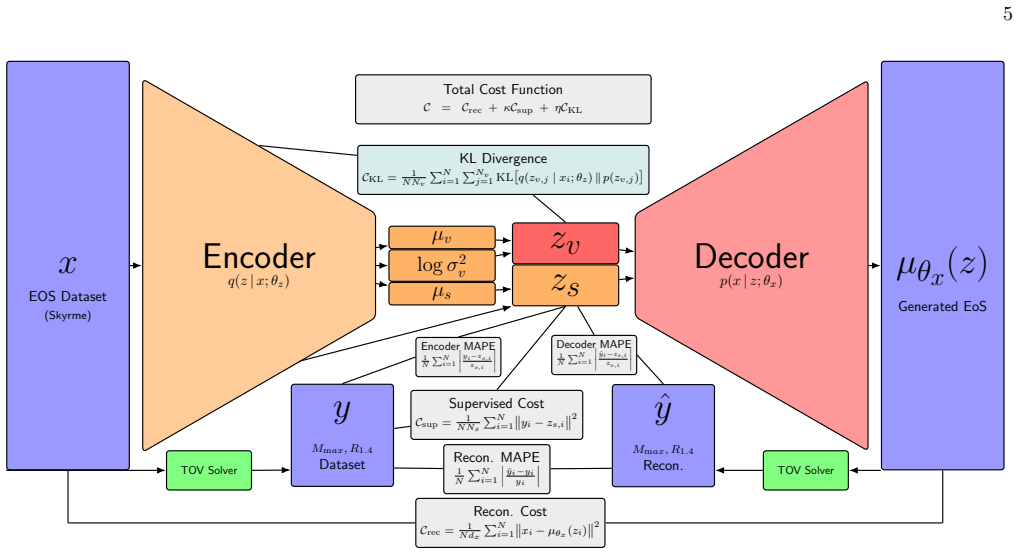
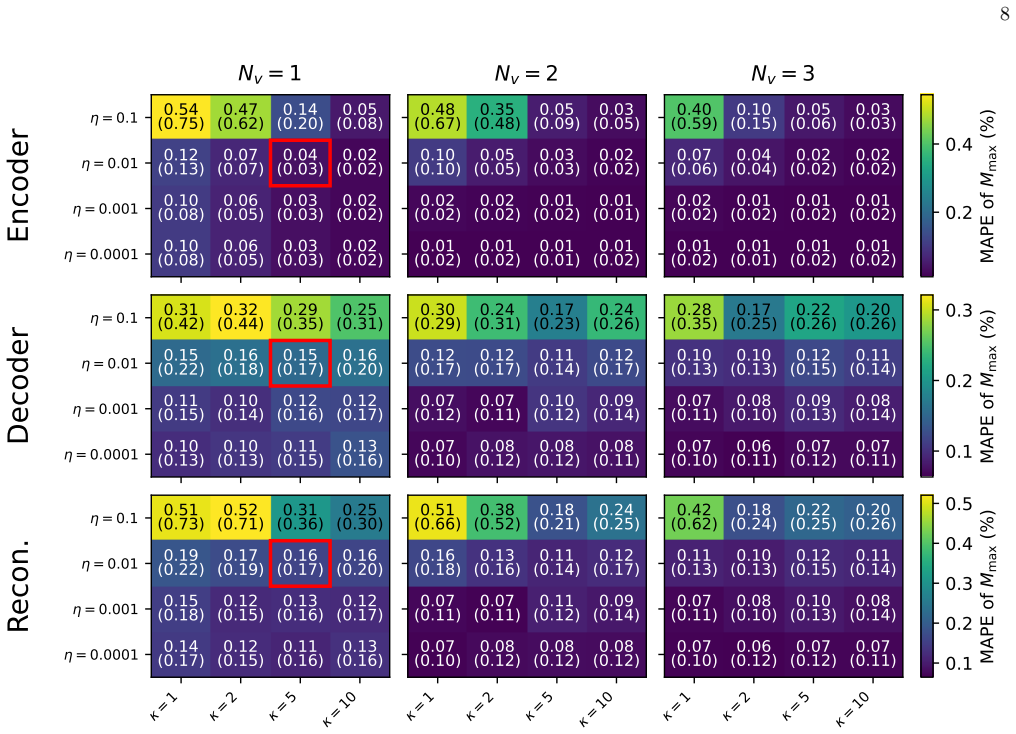
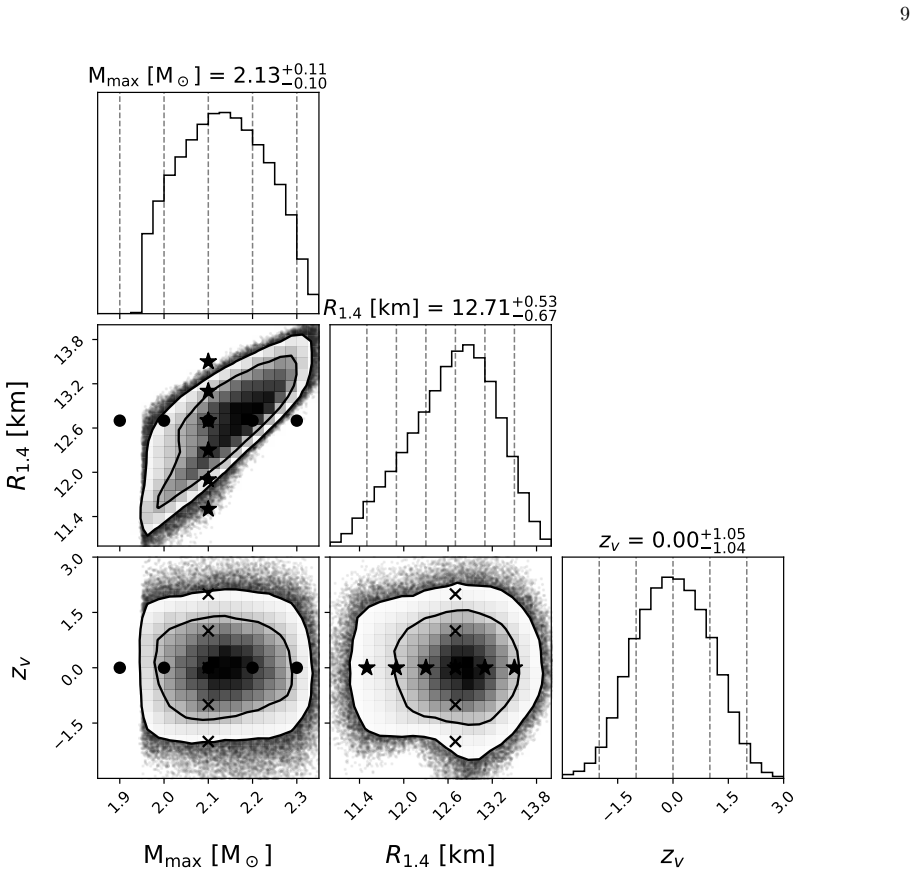
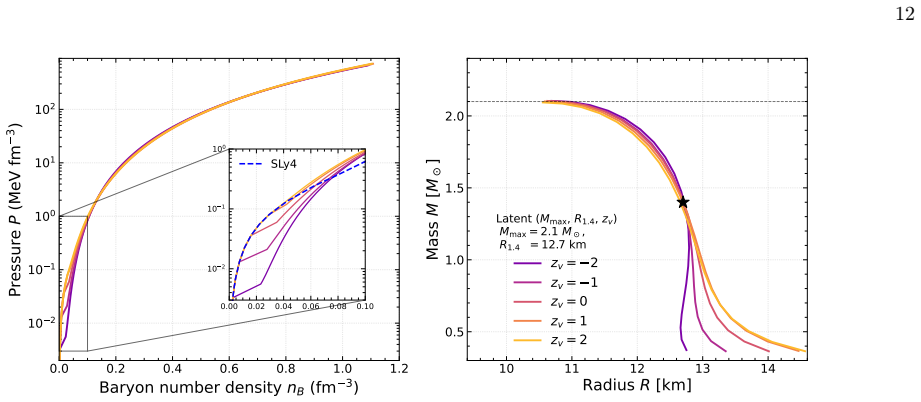
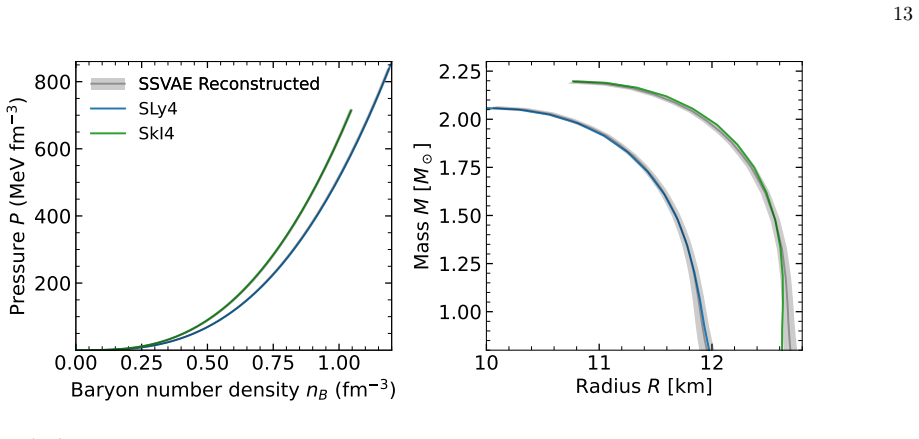
The SSVAE consists of an encoder that maps high-dimensional EOS data into a latent space and a decoder that reconstructs the full EOS from the latent representation. The latent space includes two supervised observables, M_max and R_1.4, together with a single variational latent variable associated mainly with the EOS near the crust-core transition. This setup reconstructs Skyrme EOSs with high fidelity, reproducing M_max and R_1.4 with mean absolute percentage errors within 0.14%. Sampling the latent space generates new EOSs that are causal, thermodynamically stable, and consistent with the imposed constraints.
What carries the argument
The semi-supervised variational autoencoder whose latent space combines two supervised observables with one variational latent variable.
Load-bearing premise
The assumption that one variational latent variable is sufficient to capture all additional EOS features needed for high-fidelity reconstruction and physically valid generation.
What would settle it
Finding that a significant portion of EOSs sampled from the latent space violate causality or thermodynamic stability, or that the reconstruction error for M_max and R_1.4 exceeds 0.14% on new Skyrme models.
Figures

read the original abstract
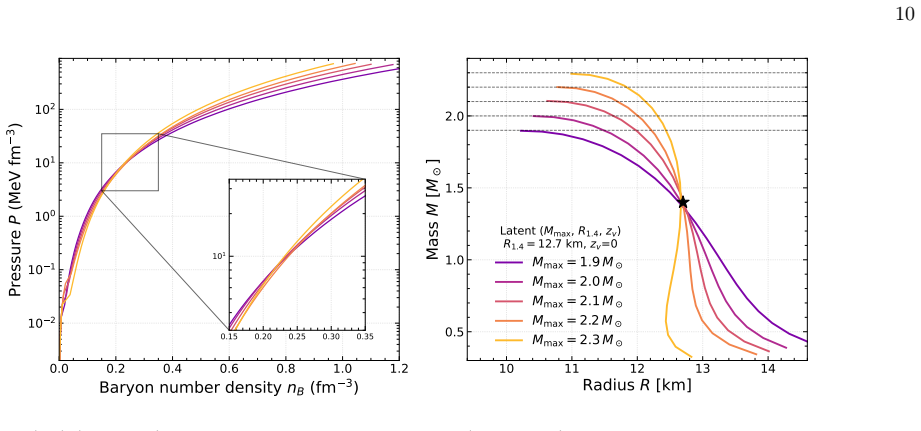
We develop a semi-supervised variational autoencoder (SSVAE) framework to reconstruct and generate neutron star (NS) equations of state (EOS). The SSVAE consists of an encoder network that maps high-dimensional EOS data into a lower-dimensional latent space and a decoder network that reconstructs the full EOS from the latent representation. The latent space includes supervised NS observables derived from the training EOS data, as well as variational latent variables that capture additional EOS features learned automatically. Using a SSVAE trained on a Skyrme EOS dataset, we find that a latent space consisting of two supervised observables, the maximum mass $M_{\max}$ and the canonical radius $R_{1.4}$, together with a single variational latent variable associated mainly with the EOS near the crust-core transition, is sufficient to reconstruct Skyrme EOSs with high fidelity. The decoder reconstructed EOSs reproduce $M_{\max}$ and $R_{1.4}$ with mean absolute percentage errors within $0.14\%$. Sampling the latent space generates new EOSs that are causal, thermodynamically stable, and consistent with imposed constraints on the supervised observables. The framework therefore provides a compact and physically interpretable parameterization of the NS EOS that is well suited for Bayesian inference with multimessenger observations, including pulsar mass-radius measurements and gravitational wave data.
Editorial analysis
A structured set of objections, weighed in public.
Referee Report
Summary. The manuscript develops a semi-supervised variational autoencoder (SSVAE) trained on Skyrme-family neutron star equations of state (EOS). It claims that a three-dimensional latent space consisting of two supervised observables (M_max and R_1.4) plus one automatically learned variational latent variable is sufficient to reconstruct the input EOS with high fidelity (mean absolute percentage error within 0.14% on the supervised observables), while sampled outputs remain causal, thermodynamically stable, and consistent with the imposed constraints; the resulting parameterization is presented as well suited for Bayesian multimessenger inference.
Significance. If the central claims are substantiated, the work supplies a compact, physically interpretable low-dimensional parameterization of the NS EOS that combines supervised observables with data-driven latent features. The SSVAE architecture is credited for automatically identifying a variational variable linked to the crust-core transition without manual feature engineering, which could streamline sampling in Bayesian analyses that incorporate pulsar mass-radius and gravitational-wave constraints.
major comments (3)
- [Abstract] Abstract: the claim that the three-dimensional latent space yields 'high-fidelity' reconstruction with MAPE within 0.14% and is 'well suited for Bayesian inference with multimessenger observations' is load-bearing for the central contribution, yet the abstract supplies no information on dataset size, cross-validation procedure, error propagation, or the concrete mechanism used to enforce causality and thermodynamic stability in the decoder; without these details the reported reconstruction accuracy cannot be evaluated.
- [Abstract] Abstract: the statement that the single variational latent variable is 'associated mainly with the EOS near the crust-core transition' is presented without any supporting analysis (e.g., correlation with density slices, sensitivity tests, or ablation of the latent dimension), which directly underpins the claim that this three-dimensional space is sufficient and interpretable.
- [Abstract] Abstract: because the training corpus consists exclusively of Skyrme EOSs, the assertion that the decoder produces EOSs suitable for multimessenger inference requires explicit discussion of whether the learned mapping can accommodate structures absent from the training distribution (phase transitions, hyperonic softening, etc.); the current text does not address this generalization risk.
minor comments (1)
- The abstract would benefit from a concise statement of the total number of Skyrme EOSs in the training set and the precise definition of the variational latent variable (dimension, prior, etc.).
Simulated Author's Rebuttal
We thank the referee for their constructive comments on our manuscript. We address each major comment point by point below, indicating revisions where the manuscript will be updated.
read point-by-point responses
-
Referee: [Abstract] Abstract: the claim that the three-dimensional latent space yields 'high-fidelity' reconstruction with MAPE within 0.14% and is 'well suited for Bayesian inference with multimessenger observations' is load-bearing for the central contribution, yet the abstract supplies no information on dataset size, cross-validation procedure, error propagation, or the concrete mechanism used to enforce causality and thermodynamic stability in the decoder; without these details the reported reconstruction accuracy cannot be evaluated.
Authors: We agree the abstract is brief and omits key methodological context. The full manuscript details the training dataset, cross-validation approach, error metrics on held-out data, and constraint enforcement (via architecture and loss terms ensuring causality and stability) in the Methods section. In revision we will expand the abstract with a concise reference to dataset scale and cross-validation while retaining the core claims, and ensure the main text explicitly cross-references these elements for the reported MAPE. revision: partial
-
Referee: [Abstract] Abstract: the statement that the single variational latent variable is 'associated mainly with the EOS near the crust-core transition' is presented without any supporting analysis (e.g., correlation with density slices, sensitivity tests, or ablation of the latent dimension), which directly underpins the claim that this three-dimensional space is sufficient and interpretable.
Authors: The association is supported by analysis in the results section, including sensitivity to density regimes. To strengthen the abstract claim we will add a short summary of the supporting correlation and sensitivity tests. We will also incorporate an explicit ablation study on latent dimensionality in the revised manuscript. revision: yes
-
Referee: [Abstract] Abstract: because the training corpus consists exclusively of Skyrme EOSs, the assertion that the decoder produces EOSs suitable for multimessenger inference requires explicit discussion of whether the learned mapping can accommodate structures absent from the training distribution (phase transitions, hyperonic softening, etc.); the current text does not address this generalization risk.
Authors: This is a valid concern. The study is scoped to Skyrme-family EOSs as a controlled demonstration. We will add an explicit limitations paragraph in the Conclusions discussing generalization risks to features outside the training distribution (e.g., phase transitions) and note that broader applicability would require retraining on diverse EOS sets. revision: yes
Circularity Check
No circularity: SSVAE trained on external Skyrme data with independent reconstruction metrics
full rationale
The paper trains a semi-supervised VAE on an external Skyrme-family EOS dataset. The latent space combines two supervised observables (M_max, R_1.4) with one variational variable learned automatically from the data; the decoder reconstructs full EOS tables and the reported MAPE values (≤0.14%) are direct reconstruction errors on the training distribution. Generated samples are validated for causality and thermodynamic stability as post-hoc checks. No equation, claim, or self-citation reduces the output EOS or observables back to the inputs by construction, nor imports uniqueness from prior author work. The framework is a standard application of SSVAE and remains self-contained against the external training corpus.
Axiom & Free-Parameter Ledger
free parameters (1)
- number of variational latent variables =
1
axioms (2)
- domain assumption Skyrme EOS dataset is representative of the EOS features needed for the target application
- domain assumption Sampling the learned latent space produces causal and thermodynamically stable EOS
Reference graph
Works this paper leans on
-
[1]
J. M. Lattimer and M. Prakash. Neutron Star Structure and the Equation of State.The Astrophysical Journal, 550(1):426–442, March 2001. doi:10.1086/319702
-
[2]
Neutron star observations: Prognosis for equation of state constraints
James M Lattimer and Madappa Prakash. Neutron star observations: Prognosis for equation of state constraints. Physics reports, 442(1-6):109–165, 2007
2007
-
[3]
J. M. Lattimer. Neutron Stars and the Nuclear Mat- ter Equation of State.Annual Review of Nuclear and Particle Science, 71:433–464, September 2021. doi: 10.1146/annurev-nucl-102419-124827
-
[4]
Lattimer, Madappa Prakash, Sanjay Reddy, and Tianqi Zhao
Christian Drischler, Sophia Han, James M. Lattimer, Madappa Prakash, Sanjay Reddy, and Tianqi Zhao. Lim- iting masses and radii of neutron stars and their impli- cations.Phys. Rev. C, 103(4):045808, April 2021. doi: 10.1103/PhysRevC.103.045808
-
[5]
Ben Margalit and Brian D. Metzger. Constraining the Maximum Mass of Neutron Stars from Multi-messenger Observations of GW170817.The Astrophysical Journal Letters, 850(2):L19, December 2017. doi:10.3847/2041- 8213/aa991c
-
[6]
Elias R. Most, Lukas R. Weih, Luciano Rezzolla, and Jürgen Schaffner-Bielich. New Constraints on Radii and Tidal Deformabilities of Neutron Stars from GW170817. Phys. Rev. Lett., 120(26):261103, June 2018. doi: 10.1103/PhysRevLett.120.261103
-
[7]
Andreas Bauswein, Sebastian Blacker, Vimal Vijayan, Nikolaos Stergioulas, Katerina Chatziioannou, James A. Clark, Niels-Uwe F. Bastian, David B. Blaschke, Ma- teusz Cierniak, and Tobias Fischer. Equation of State Constraints from the Threshold Binary Mass for Prompt Collapse of Neutron Star Mergers.Phys. Rev. Lett., 125(14):141103, October 2020. doi: 10.1...
-
[8]
Impact of the PSR J 0740 +6620 radius constraint on the properties of high- density matter.Phys
Isaac Legred, Katerina Chatziioannou, Reed Essick, Sophia Han, and Philippe Landry. Impact of the PSR J 0740 +6620 radius constraint on the properties of high- density matter.Phys. Rev. D, 104(6):063003, September
-
[9]
doi:10.1103/PhysRevD.104.063003
-
[10]
Equation of state for neutron stars with speed of sound constraints via bayesian inference.Physical Review D, 112(6):063043, 2025
Xieyuan Dong, Hong Shen, Jinniu Hu, and Ying Zhang. Equation of state for neutron stars with speed of sound constraints via bayesian inference.Physical Review D, 112(6):063043, 2025
2025
-
[11]
Michael Bender, Paul-Henri Heenen, and Paul-Gerhard Reinhard. Self-consistent mean-field models for nuclear structure.Reviews of Modern Physics, 75(1):121–180, January 2003. doi:10.1103/RevModPhys.75.121
-
[12]
Brian D. Serot and John Dirk Walecka. Recent Progress in Quantum Hadrodynamics.International Journal of Modern Physics E, 6(4):515–631, January 1997. doi: 10.1142/S0218301397000299
-
[13]
Mikhail V. Beznogov and Adriana R. Raduta. Bayesian inference of the dense matter equation of state built upon extended Skyrme interactions.Phys. Rev. C, 110(3):035805, September 2024. doi: 10.1103/PhysRevC.110.035805
-
[14]
Chun Huang, Laura Tolos, Constança Providência, and Anna Watts. Constraining a relativistic mean field model using neutron star mass–radius measurements ii: hyper- onic models.Monthly Notices of the Royal Astronomical Society, 536(4):3262–3275, 2025
2025
-
[15]
Lattimer, Akira Ohnishi, and Ev- geni E
Ingo Tews, James M. Lattimer, Akira Ohnishi, and Ev- geni E. Kolomeitsev. Symmetry Parameter Constraints from a Lower Bound on Neutron-matter Energy.Astro- phys. J., 848(2):105, October 2017. doi:10.3847/1538- 4357/aa8db9
-
[16]
Spectral representations of neutron-star equations of state.Phys
Lee Lindblom. Spectral representations of neutron-star equations of state.Phys. Rev. D, 82(10):103011, Novem- ber 2010. doi:10.1103/PhysRevD.82.103011
-
[17]
Jocelyn S. Read, Benjamin D. Lackey, Benjamin J. Owen, and John L. Friedman. Constraints on a phe- nomenologically parametrized neutron-star equation of state.Phys. Rev. D, 79(12):124032, June 2009. doi: 10.1103/PhysRevD.79.124032
-
[18]
On the Sound Speed in Neutron Stars.The As- trophysical Journal Letters, 939(2):L34, November 2022
Sinan Altiparmak, Christian Ecker, and Luciano Rez- zolla. On the Sound Speed in Neutron Stars.The As- trophysical Journal Letters, 939(2):L34, November 2022. doi:10.3847/2041-8213/ac9b2a
-
[19]
Philippe Landry and Reed Essick. Nonparametric in- ference of the neutron star equation of state from grav- itational wave observations.Physics Review D, 99(8): 084049, April 2019. doi:10.1103/PhysRevD.99.084049
-
[20]
Coleman Miller, Jacquelyn Noronha-Hostler, and Nicolas Yunes
Debora Mroczek, M. Coleman Miller, Jacquelyn Noronha-Hostler, and Nicolas Yunes. Searching for phase transitions in neutron stars with modified Gaussian pro- cesses.arXiv e-prints, art. arXiv:2302.07978, February
-
[21]
doi:10.48550/arXiv.2302.07978
-
[22]
D. D. Ofengeim, P. S. Shternin, and T. Piran. Maxi- mal Mass Neutron Star as a Key to Superdense Matter Physics.Astronomy Letters, 49(10):567–574, November
-
[23]
doi:10.1134/S1063773723100055
-
[24]
Core states of neutron stars from anatomizing their scaled structure equations.The Astrophysical Journal, 952(2):147, 2023
Bao-Jun Cai, Bao-An Li, and Zhen Zhang. Core states of neutron stars from anatomizing their scaled structure equations.The Astrophysical Journal, 952(2):147, 2023
2023
-
[25]
Correlations be- tween the neutron star mass–radius relation and the equation of state of dense matter.The Astrophysical Journal, 984(1):30, 2025
Boyang Sun and James M Lattimer. Correlations be- tween the neutron star mass–radius relation and the equation of state of dense matter.The Astrophysical Journal, 984(1):30, 2025
2025
-
[26]
Boyang Sun, Tianqi Zhao, and James M Lattimer. A new bayesian framework with natural priors to con- strain the neutron star equation of state.arXiv preprint arXiv:2601.04294, 2026
-
[27]
Yuki Fujimoto, Kenji Fukushima, and Koichi Murase. Extensive studies of the neutron star equation of state from the deep learning inference with the ob- servational data augmentation.Journal of High Energy Physics, 2021(3):273, March 2021. doi: 10.1007/JHEP03(2021)273
-
[28]
Extracting nuclear matter properties from the neutron star matter equation of state using deep neu- ral networks.Phys
Márcio Ferreira, Valéria Carvalho, and Constança Providência. Extracting nuclear matter properties from the neutron star matter equation of state using deep neu- ral networks.Phys. Rev. D, 106(10):103023, November
-
[29]
doi:10.1103/PhysRevD.106.103023
-
[30]
Shriya Soma, Lingxiao Wang, Shuzhe Shi, Horst Stöcker, and Kai Zhou. Reconstructing the neutron star equation of state from observational data via automatic differen- tiation.Phys. Rev. D, 107(8):083028, April 2023. doi: 10.1103/PhysRevD.107.083028
-
[31]
Giulia Ventagli and Ippocratis D. Saltas. Deep learning inference of the neutron star equation of state.Jour- nal of Cosmology and Astroparticle Physics, 2025(1):073, January 2025. doi:10.1088/1475-7516/2025/01/073. 15
-
[32]
Nonparametric representation of neutron star equation of state using variational autoencoder.The Astrophysi- cal Journal, 950(2):77, 2023
Ming-Zhe Han, Shao-Peng Tang, and Yi-Zhong Fan. Nonparametric representation of neutron star equation of state using variational autoencoder.The Astrophysi- cal Journal, 950(2):77, 2023
2023
-
[33]
Márcio Ferreira and Michał Bejger. Conditional vari- ational autoencoder inference of neutron star equa- tion of state from astrophysical observations.Physics Review D, 111(2):023035, January 2025. doi: 10.1103/PhysRevD.111.023035
-
[34]
D. Vautherin and D. M. Brink. Hartree-Fock Cal- culations with Skyrme’s Interaction. I. Spherical Nu- clei.Phys. Rev. C, 5(3):626–647, March 1972. doi: 10.1103/PhysRevC.5.626
-
[35]
E. Chabanat, P. Bonche, P. Haensel, J. Meyer, and R. Schaeffer. A Skyrme parametrization from subnuclear to neutron star densities.Nuclear Physics A, 627:710– 746, February 1997. doi:10.1016/S0375-9474(97)00596-4
-
[36]
J. D. Walecka. A theory of highly condensed mat- ter.Annals of Physics, 83:491–529, January 1974. doi: 10.1016/0003-4916(74)90208-5
-
[37]
Tianqi Zhao, Zidu Lin, Bharat Kumar, Andrew W. Steiner, and Madappa Prakash. Characteriz- ing the nuclear models informed by PREX and CREX: a view from Bayesian inference.arXiv e-prints, art. arXiv:2406.05267, June 2024. doi: 10.48550/arXiv.2406.05267
-
[38]
C. Ducoin, Ph. Chomaz, and F. Gulminelli. Isospin- dependent clusterization of neutron-star matter.Nu- clear Physics A, 789(1-4):403–425, June 2007. doi: 10.1016/j.nuclphysa.2007.03.006
-
[39]
Locating the inner edge of the neutron star crust us- ing terrestrial nuclear laboratory data.Physical Review C—Nuclear Physics, 79(3):035802, 2009
Jun Xu, Lie-Wen Chen, Bao-An Li, and Hong-Ru Ma. Locating the inner edge of the neutron star crust us- ing terrestrial nuclear laboratory data.Physical Review C—Nuclear Physics, 79(3):035802, 2009
2009
-
[40]
Core-crust transition in neutron stars: Predictivity of density developments
Camille Ducoin, Jérôme Margueron, Constança Providência, and Isaac Vidana. Core-crust transition in neutron stars: Predictivity of density developments. Physical Review C—Nuclear Physics, 83(4):045810, 2011
2011
-
[41]
P. B. Demorest, T. Pennucci, S. M. Ransom, M. S. E. Roberts, and J. W. T. Hessels. A two-solar-mass neutron star measured using Shapiro delay.Nature (London), 467(7319):1081–1083, October 2010. doi: 10.1038/nature09466
-
[42]
John Antoniadis, Paulo C. C. Freire, Norbert Wex, Thomas M. Tauris, Ryan S. Lynch, Marten H. van Kerkwijk, Michael Kramer, Cees Bassa, Vik S. Dhillon, Thomas Driebe, Jason W. T. Hessels, Victoria M. Kaspi, Vladislav I. Kondratiev, Norbert Langer, Thomas R. Marsh, Maura A. McLaughlin, Timothy T. Pennucci, Scott M. Ransom, Ingrid H. Stairs, Joeri van Leeuwe...
-
[43]
H. T. Cromartie, E. Fonseca, S. M. Ransom, P. B. De- morest, Z. Arzoumanian, H. Blumer, P. R. Brook, M. E. DeCesar, T. Dolch, J. A. Ellis, R. D. Ferdman, E. C. Ferrara, N. Garver-Daniels, P. A. Gentile, M. L. Jones, M. T. Lam, D. R. Lorimer, R. S. Lynch, M. A. McLaugh- lin, C. Ng, D. J. Nice, T. T. Pennucci, R. Spiewak, I. H. Stairs, K. Stovall, J. K. Swi...
-
[44]
M. C. Miller, F. K. Lamb, A. J. Dittmann, S. Bogdanov, Z. Arzoumanian, K. C. Gendreau, S. Guillot, W. C. G. Ho, J. M. Lattimer, M. Loewenstein, S. M. Morsink, P. S. Ray, M. T. Wolff, C. L. Baker, T. Cazeau, S. Man- thripragada, C. B. Markwardt, T. Okajima, S. Pollard, I. Cognard, H. T. Cromartie, E. Fonseca, L. Guillemot, M. Kerr, A. Parthasarathy, T. T. ...
-
[45]
Riley, Anna L
Thomas E. Riley, Anna L. Watts, Paul S. Ray, Slavko Bogdanov, Sebastien Guillot, Sharon M. Morsink, Anna V. Bilous, Zaven Arzoumanian, Devarshi Choud- hury, Julia S. Deneva, Keith C. Gendreau, Alice K. Harding, Wynn C. G. Ho, James M. Lattimer, Michael Loewenstein, Renee M. Ludlam, Craig B. Mark- wardt, Takashi Okajima, Chanda Prescod-Weinstein, Ronald A....
-
[46]
doi:10.3847/2041-8213/ac0a81
-
[47]
B. P. Abbott, R. Abbott, T. D. Abbott, F. Acernese, K. Ackley, C. Adams, T. Adams, P. Addesso, R. X. Ad- hikari, V. B. Adya, C. Affeldt, B. Agarwal, M. Agathos, K. Agatsuma, N. Aggarwal, O. D. Aguiar, L. Aiello, A. Ain, P. Ajith, B. Allen, G. Allen, A. Allocca, M. A. Aloy, P. A. Altin, A. Amato, A. Ananyeva, S. B. Ander- son, W. G. Anderson, S. V. Angelov...
-
[48]
B. P. Abbott, R. Abbott, T. D. Abbott, F. Acernese, K. Ackley, C. Adams, T. Adams, P. Addesso, R. X. Ad- hikari, V. B. Adya, C. Affeldt, B. Agarwal, M. Agathos, K. Agatsuma, N. Aggarwal, O. D. Aguiar, L. Aiello, A. Ain, P. Ajith, B. Allen, G. Allen, A. Allocca, M. A. Aloy, P. A. Altin, A. Amato, A. Ananyeva, S. B. Ander- son, W. G. Anderson, S. V. Angelov...
-
[49]
Richard C. Tolman. Static solutions of einstein’s field equations for spheres of fluid.Phys. Rev., 55:364–373, Feb 1939. doi:10.1103/PhysRev.55.364. URLhttps: //link.aps.org/doi/10.1103/PhysRev.55.364
-
[50]
J. R. Oppenheimer and G. M. Volkoff. On massive neutron cores.Phys. Rev., 55:374–381, Feb 1939. doi: 10.1103/PhysRev.55.374. URLhttps://link.aps.org /doi/10.1103/PhysRev.55.374
-
[51]
Linda R. Petzold. Automatic selection of methods for solving stiff and nonstiff systems of ordinary differential equations.SIAM Journal on Scientific and Statistical Computing, 4(1):136–148, 1983. doi:10.1137/0904010
-
[52]
Diederik P. Kingma and Max Welling. An In- troduction to Variational Autoencoders.arXiv e- prints, art. arXiv:1906.02691, June 2019. doi: 10.48550/arXiv.1906.02691
-
[53]
Tutorial on Variational Autoencoders
Carl Doersch. Tutorial on Variational Autoencoders. arXiv e-prints, art. arXiv:1606.05908, June 2016. doi: 10.48550/arXiv.1606.05908
-
[54]
Gaussian Error Linear Units (GELUs)
Dan Hendrycks and Kevin Gimpel. Gaussian error linear units (gelus).arXiv preprint arXiv:1606.08415, 2016
work page internal anchor Pith review Pith/arXiv arXiv 2016
-
[55]
J. M. Lattimer and M. Prakash. The Physics of Neu- tron Stars.Science, 304(5670):536–542, April 2004. doi: 10.1126/science.1090720
-
[56]
Ssvae_eos: Semi-supervised variational autoencoder for neutron star equation of state generation, 2026
Tianqi Zhao, Fanglida Yan, and Alex Ross. Ssvae_eos: Semi-supervised variational autoencoder for neutron star equation of state generation, 2026. URLhttps://gith ub.com/sotzee/SSVAE_EOS. GitHub repository
2026
-
[57]
Indication of sharp and strong phase transitions from nicer observations.The Astrophysical Journal Letters, 974(1):L17, 2024
Zidu Lin and Andrew W Steiner. Indication of sharp and strong phase transitions from nicer observations.The Astrophysical Journal Letters, 974(1):L17, 2024
2024
-
[58]
Luiz L Lopes, Carline Biesdorf, and Débora P Menezes. Modified mit bag models—part i: Thermodynamic con- sistency, stability windows and symmetry group.Physica Scripta, 96(6):065303, March 2021. ISSN 1402-4896. doi: 10.1088/1402-4896/abef34. URLhttp://dx.doi.org/1 0.1088/1402-4896/abef34
-
[59]
Sebastian Blacker, Andreas Bauswein, and Stefan Typel. Exploring thermal effects of the hadron-quark matter transition in neutron star mergers.Physical Review D, 108(6), September 2023. ISSN 2470-0029. doi: 10.1103/physrevd.108.063032. URLhttp://dx.doi.o rg/10.1103/PhysRevD.108.063032
discussion (0)
Sign in with ORCID, Apple, or X to comment. Anyone can read and Pith papers without signing in.