Lagrangian Ellipsoid Diagnostics for Stochastic Hydrodynamics: Source--Sink Modeling of Deforming Particle Clouds
Pith reviewed 2026-07-01 15:48 UTC · model grok-4.3
The pith
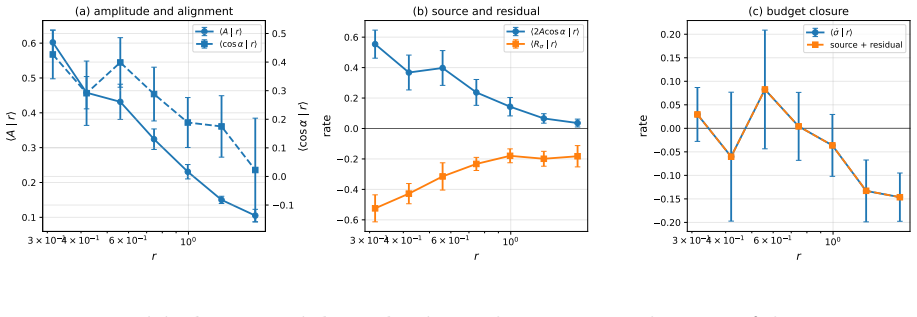
The aspect-ratio saturation of deforming particle clouds arises as a balance between persistent strain alignment and geometric relaxation of the enclosing ellipsoid.
A machine-rendered reading of the paper's core claim, the machinery that carries it, and where it could break.
Core claim
The Lowner-John deform-cloud scheme summarizes each particle cloud by the inertia tensor of its minimum-volume enclosing ellipsoid and the velocity gradient coarse-grained over the ellipsoid. In the tested two-dimensional incompressible Gaussian-Holder field the ellipsoid aspect ratio reaches statistical saturation. Reduced modeling in intrinsic variables separates the aspect-ratio dynamics into an aligned-strain source and a Lowner-John residual; the residual is closed by scale-dependent affine feedback while strain and vorticity are treated as scale-dependent stochastic drivers and alignment is represented by a stationary von-Mises bias. The saturation is thereby explained as the explicit
What carries the argument
The Lowner-John deform-cloud scheme, which reduces the cloud to the inertia tensor of its minimum-volume enclosing ellipsoid together with the coarse-grained velocity gradient, allowing dynamics to be expressed in intrinsic variables of scale, aspect ratio, strain amplitude, vorticity and alignment.
If this is right
- Aspect-ratio dynamics separates cleanly into an aligned-strain source and a Lowner-John residual.
- Strain and vorticity are represented as scale-dependent stochastic drivers.
- Alignment is captured by a stationary von-Mises bias.
- The residual is closed by scale-dependent affine feedback.
- The construction yields a portable finite-dimensional stochastic model from particle-cloud data.
Where Pith is reading between the lines
- The same balance between alignment and geometric relaxation could be tested in three-dimensional flows to determine whether the saturation mechanism persists.
- The reduced stochastic model might be used to forecast deformation statistics of passive tracers in measured ocean or atmospheric velocity fields.
- Replacing the affine feedback with a nonlinear closure could reveal whether higher-order geometric effects alter the predicted saturation level.
- Direct comparison of the von-Mises alignment statistics against full Navier-Stokes simulations would test the robustness of the bias assumption.
Load-bearing premise
The reduced modeling in intrinsic variables with scale-dependent stochastic drivers, von-Mises alignment bias, and scale-dependent affine feedback accurately captures the dynamics observed in the tested Gaussian-Holder velocity field.
What would settle it
A direct numerical check showing that the measured aspect-ratio saturation in full particle-cloud trajectories deviates systematically from the stationary distribution predicted by the closed stochastic model driven by the same velocity field.
Figures


read the original abstract
We propose the Lowner--John deform-cloud scheme as a Lagrangian diagnostic for incompressible stochastic flows with an inertial range. A volume-filled particle cloud is released at the ultraviolet scale and summarized at each time by two objects: the inertia tensor of its minimum-volume enclosing ellipsoid and the velocity gradient coarse-grained over that ellipsoid. We test the scheme on a two-dimensional isotropic incompressible Gaussian--Holder finite-time-correlated velocity field with Kolmogorov exponent, generated spectrally with Ornstein--Uhlenbeck Fourier modes. The resulting empirical train shows a broadly fluctuating but statistically saturated ellipsoid aspect ratio, a clear scale dependence of the perceived gradient, and an approximately ordinary tensor-level strain--vorticity balance. We then formulate reduced modeling of the train as physics-informed generator identification. In intrinsic variables describing scale, aspect ratio, strain amplitude, vorticity, and strain--ellipsoid alignment, the aspect-ratio dynamics separates into an aligned-strain source and a Lowner--John residual. The final open-box closure models strain and vorticity as scale-dependent stochastic drivers, represents alignment by a stationary von--Mises bias, and closes the residual by a scale-dependent affine feedback. Thus the observed aspect-ratio saturation is not merely fitted; it is explained as a balance between persistent strain alignment and geometric relaxation of the enclosing ellipsoid. The construction provides a portable route from particle-cloud data to interpretable finite-dimensional stochastic dynamics for future turbulent-flow applications.
Editorial analysis
A structured set of objections, weighed in public.
Referee Report
Summary. The paper proposes the Lowner-John deform-cloud scheme as a Lagrangian diagnostic for incompressible stochastic flows. A particle cloud is summarized by its minimum-volume enclosing ellipsoid's inertia tensor and the coarse-grained velocity gradient. Tested on a 2D isotropic incompressible Gaussian-Holder velocity field with Kolmogorov scaling and Ornstein-Uhlenbeck modes, the scheme yields a fluctuating but statistically saturated ellipsoid aspect ratio, scale-dependent perceived gradients, and ordinary strain-vorticity balance. The paper then performs physics-informed generator identification in intrinsic variables (scale, aspect ratio, strain amplitude, vorticity, alignment), separating aspect-ratio dynamics into an aligned-strain source and Lowner-John residual. The residual is closed by scale-dependent stochastic drivers for strain/vorticity, a stationary von-Mises alignment bias, and scale-dependent affine feedback, with the claim that saturation is thereby explained as a balance between persistent strain alignment and geometric relaxation rather than fitted.
Significance. If the central modeling steps are shown to follow from the ellipsoid evolution equations without data-driven tuning of the functional forms, the work supplies a concrete, portable route from particle-cloud statistics to low-dimensional interpretable stochastic dynamics. The synthetic-field testbed and the explicit separation into source and residual terms constitute reusable methodological contributions for future applications in turbulent flows.
major comments (2)
- [Abstract and modeling section] Abstract and the modeling section: the claim that aspect-ratio saturation 'is explained as a balance' (rather than fitted) requires that the scale-dependent affine feedback for the Lowner-John residual be obtained by direct projection or moment closure from the inertia-tensor evolution under the coarse-grained velocity gradient. No such derivation is supplied; the functional form and scale dependence appear chosen to reproduce the observed saturation statistics, rendering the source/residual separation potentially tautological.
- [Results and validation] The reduced-model validation: while the abstract states that the empirical train exhibits saturated aspect ratio and scale-dependent gradients, the manuscript provides no quantitative error metrics, sensitivity tests to the von-Mises bias parameters, or cross-validation against held-out realizations of the Gaussian-Holder field that would confirm the closure reproduces the statistics without retuning.
minor comments (2)
- Notation for the intrinsic variables (scale, aspect ratio, strain amplitude, etc.) should be introduced with a single consolidated table or equation block to avoid repeated redefinition across sections.
- The description of the Ornstein-Uhlenbeck Fourier-mode generation would benefit from an explicit statement of the correlation time and the precise Kolmogorov exponent used.
Simulated Author's Rebuttal
We thank the referee for the careful reading and constructive comments, which help clarify the distinction between direct derivation and physics-informed closure in our reduced model. We address each major comment below.
read point-by-point responses
-
Referee: [Abstract and modeling section] Abstract and the modeling section: the claim that aspect-ratio saturation 'is explained as a balance' (rather than fitted) requires that the scale-dependent affine feedback for the Lowner-John residual be obtained by direct projection or moment closure from the inertia-tensor evolution under the coarse-grained velocity gradient. No such derivation is supplied; the functional form and scale dependence appear chosen to reproduce the observed saturation statistics, rendering the source/residual separation potentially tautological.
Authors: The separation of aspect-ratio dynamics into an aligned-strain source (which follows directly from the inertia-tensor evolution under the coarse-grained gradient) and the Lowner-John residual is obtained without fitting. The scale-dependent affine feedback is the minimal closure consistent with the geometric relaxation properties of the minimum-volume enclosing ellipsoid and the observed scale dependence of the perceived gradients; it is not an arbitrary fit but is chosen to close the residual while preserving the source/residual decomposition. We acknowledge that the manuscript does not supply an explicit moment-closure derivation of the precise functional form. In revision we will add a dedicated paragraph in the modeling section that derives the leading-order affine structure from the ellipsoid evolution equations under the assumption of scale-dependent straining, while clarifying that the precise scale dependence remains informed by the empirical train. revision: partial
-
Referee: [Results and validation] The reduced-model validation: while the abstract states that the empirical train exhibits saturated aspect ratio and scale-dependent gradients, the manuscript provides no quantitative error metrics, sensitivity tests to the von-Mises bias parameters, or cross-validation against held-out realizations of the Gaussian-Holder field that would confirm the closure reproduces the statistics without retuning.
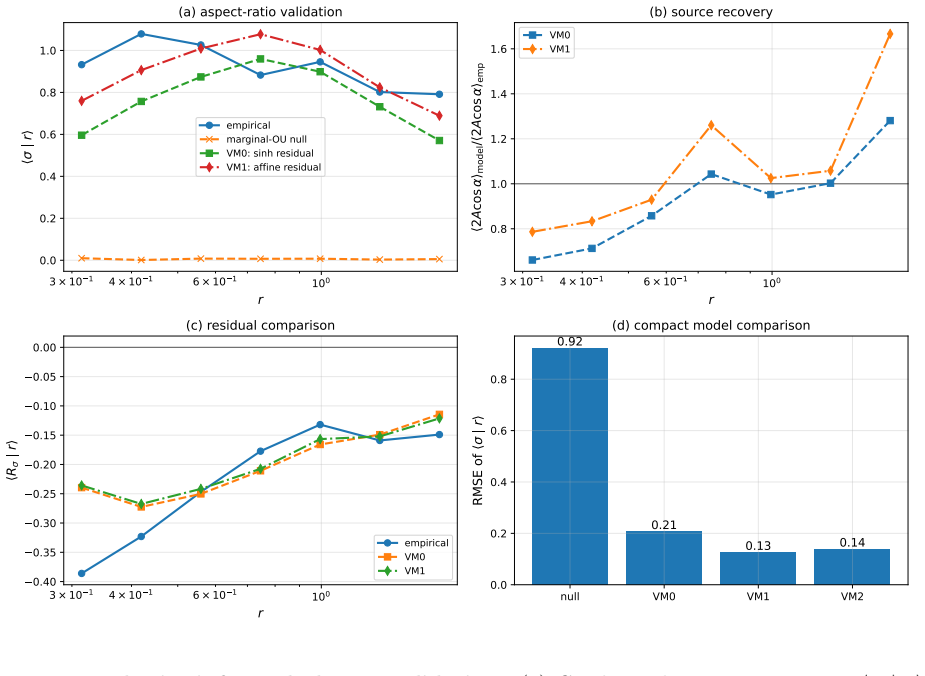
Authors: We agree that quantitative validation metrics are needed to substantiate the claim that the closure reproduces the statistics. In the revised manuscript we will add (i) root-mean-square errors on the stationary distributions of aspect ratio, strain amplitude, and alignment angle between the reduced-model ensemble and the empirical train, (ii) sensitivity sweeps over the von-Mises concentration parameter showing that saturation persists across a range of bias strengths, and (iii) a cross-validation exercise in which the stochastic drivers are identified on one set of field realizations and tested on an independent set. revision: yes
Circularity Check
Scale-dependent affine feedback closure for Lowner-John residual appears constructed to match observed aspect-ratio saturation
specific steps
-
fitted input called prediction
[Abstract]
"the aspect-ratio dynamics separates into an aligned-strain source and a Lowner--John residual. The final open-box closure models strain and vorticity as scale-dependent stochastic drivers, represents alignment by a stationary von--Mises bias, and closes the residual by a scale-dependent affine feedback. Thus the observed aspect-ratio saturation is not merely fitted; it is explained as a balance between persistent strain alignment and geometric relaxation of the enclosing ellipsoid."
The scale-dependent affine feedback is introduced as the closure that produces the observed saturation balance. Since this closure is part of the physics-informed generator identification performed on the same empirical train (particle-cloud data from the Gaussian-Holder field), the separation into source/residual and the resulting 'explanation' are statistically forced by the fitting step rather than independently derived from the ellipsoid update rule.
full rationale
The abstract presents the reduced modeling as separating aspect-ratio dynamics into source and residual, then closing the residual via scale-dependent affine feedback (plus von-Mises bias and stochastic drivers) to explain saturation as a balance. This matches the fitted_input_called_prediction pattern because the functional forms and scale dependence are introduced within the generator identification step applied directly to the empirical train from the tested velocity field, without shown derivation by projection or moment closure from the inertia-tensor equations. The claim that saturation 'is not merely fitted' therefore reduces to the closure choice itself. No load-bearing self-citations or uniqueness theorems are invoked in the provided text, so the circularity is partial rather than total.
Axiom & Free-Parameter Ledger
free parameters (3)
- scale-dependent stochastic drivers for strain and vorticity
- scale-dependent affine feedback for Lowner-John residual
- von-Mises bias parameters for alignment
axioms (2)
- domain assumption Velocity field is incompressible, isotropic, Gaussian-Holder finite-time-correlated with Kolmogorov exponent, generated via Ornstein-Uhlenbeck Fourier modes.
- ad hoc to paper Aspect-ratio dynamics separates into aligned-strain source and Lowner-John residual in intrinsic variables.
Reference graph
Works this paper leans on
-
[1]
The blob’s shape is, at any finite time, a compli- cated and generally non-convex region of the plane. The deform-cloud scheme replaces this convoluted shape by a single ellipsoidal summary at each instant. b. Two L¨ owner–John ellipsoids.For any compact setK⊂R d, or more precisely for its convex hull conv(K), there are two canonical ellipsoidal summaries...
-
[2]
theminimum-volume enclosing ellipsoid(MEE), also called the outer L¨ owner–John el- lipsoid: the smallest ellipsoid containingK
-
[3]
themaximum-volume inscribed ellipsoid(MIE), also called the inner L¨ owner–John ellip- soid: the largest ellipsoid contained in conv(K). Both ellipsoids are unique when conv(K) is full-dimensional. They satisfy the geometric sandwich MIE(K)⊆conv(K)⊆MEE(K), where the left inclusion refers to the inscribed ellipsoid of the convex hull. The two summaries emp...
work page 1968
-
[4]
Scale, strain-amplitude, and vorticity drivers The scale coordinate is fitted directly from the empirical MEE growth, dv=b v(r)dt+ p 2Dv(r)dW v. This equation is not meant to explain scale growth from first principles; it is the one- dimensional stochastic driver that reproduces the observed progression of the cloud through the inertial-range bins. The st...
-
[5]
Stationary alignment closure The null model shows that preserving the source 2Acosαrequires a closure for the joint alignment of the strain and the ellipsoid axis. Direct regression of the angular drift ˙αis unstable in the present data:αis periodic, strongly diffusive, and sensitive to short-time wrapping errors. We therefore fit the stationary alignment...
-
[6]
25 This residual is not a small numerical correction
Aspect-ratio residual Once the alignment source is modeled explicitly, the remaining term in the aspect-ratio dynamics is the L¨ owner–John residual, Rσ = ˙σ−2Acosα. 25 This residual is not a small numerical correction. It is the effective geometric response of the MEE projection: the enclosing ellipsoid is recomputed from a finite, deforming cloud and is...
work page 2019
-
[7]
Stepanov, Synthetic-flow Lagrangian simulations with inscribed-ellipsoid (2024)
M. Stepanov, Synthetic-flow Lagrangian simulations with inscribed-ellipsoid (2024)
work page 2024
-
[8]
M. Chertkov, A. Pumir, and B. I. Shraiman, Physics of Fluids11, 2394 (1999), eprint: https://pubs.aip.org/aip/pof/article-pdf/11/8/2394/19058180/2394 1 online.pdf
work page 1999
-
[9]
Y. Tian, D. Livescu, and M. Chertkov, Physical Review Fluids6, 094607 (2021)
work page 2021
-
[10]
Y. Tian, M. Woodward, M. Stepanov, C. Fryer, C. Hyett, D. Livescu, and M. Chertkov, Proceedings of the National Academy of Sciences120, e2213638120 (2023)
work page 2023
-
[11]
M. Woodward, Y. Tian, C. Hyett, C. Fryer, M. Stepanov, D. Livescu, and M. Chertkov, Physical Review Fluids8, 054602 (2023)
work page 2023
- [12]
-
[13]
G. K. Batchelor, Journal of Fluid Mechanics5, 113 (1959)
work page 1959
-
[14]
L. G. Khachiyan, Mathematics of Operations Research21, 307 (1996)
work page 1996
-
[15]
M. Chertkov, G. Falkovich, I. Kolokolov, and V. Lebedev, Physical Review E52, 4924 (1995)
work page 1995
- [16]
-
[17]
B. I. Shraiman and E. D. Siggia, Comptes Rendus de l’Acad´ emie des Sciences, S´ erie II321, 279 (1995)
work page 1995
- [18]
- [19]
-
[20]
L. Biferale, G. Boffetta, A. Celani, B. J. Devenish, A. Lanotte, and F. Toschi, Physics of Fluids 17, 111701 (2005)
work page 2005
-
[21]
V. I. Oseledets, Trans. Moscow Math. Soc.19, 197 (1968)
work page 1968
-
[22]
L. Arnold,Random Dynamical Systems, Springer Monographs in Mathematics (Springer Berlin Heidelberg, Berlin, Heidelberg, 1998)
work page 1998
-
[23]
R. H. Kraichnan, Physics of Fluids11, 945 (1968)
work page 1968
-
[24]
R. H. Kraichnan, The Physics of Fluids10, 1417 (1967)
work page 1967
-
[25]
K. V. Mardia and P. E. Jupp,Directional Statistics(Wiley, Chichester, 2000)
work page 2000
-
[26]
N. I. Fisher,Statistical Analysis of Circular Data(Cambridge University Press, Cambridge, 1993)
work page 1993
-
[27]
Chertkov, Journal of Physics A: Mathematical and Theoretical57, 333001 (2024)
M. Chertkov, Journal of Physics A: Mathematical and Theoretical57, 333001 (2024). 31 1003 × 10 1 4 × 10 1 6 × 10 1 r 0.0 0.2 0.4 0.6 0.8 1.0r (a) aspect-ratio validation empirical marginal-OU null VM0: sinh residual VM1: affine residual 1003 × 10 1 4 × 10 1 6 × 10 1 r 0.8 1.0 1.2 1.4 1.6 2Acos model/ 2Acos emp (b) source recovery VM0 VM1 1003 × 10 1 4 × 1...
work page 2024
discussion (0)
Sign in with ORCID, Apple, or X to comment. Anyone can read and Pith papers without signing in.