Carbon-Aware Mapping and Scheduling for Deadline-Constrained Workflows
Pith reviewed 2026-06-29 15:18 UTC · model grok-4.3
The pith
The carbon-aware workflow scheduling problem is NP-hard with no constant-factor approximation even on one processor, and the CWM algorithm reduces median carbon cost by 42% over the prior best method when the deadline is twice a carbon-agno
A machine-rendered reading of the paper's core claim, the machinery that carries it, and where it could break.
Core claim
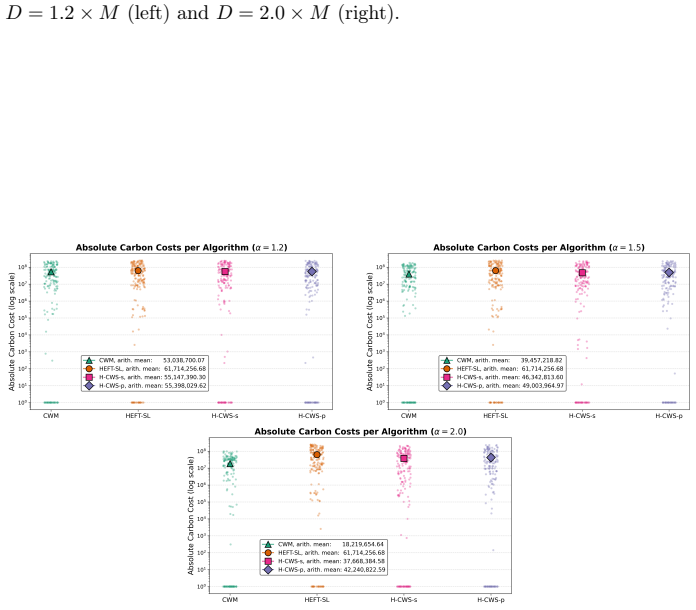
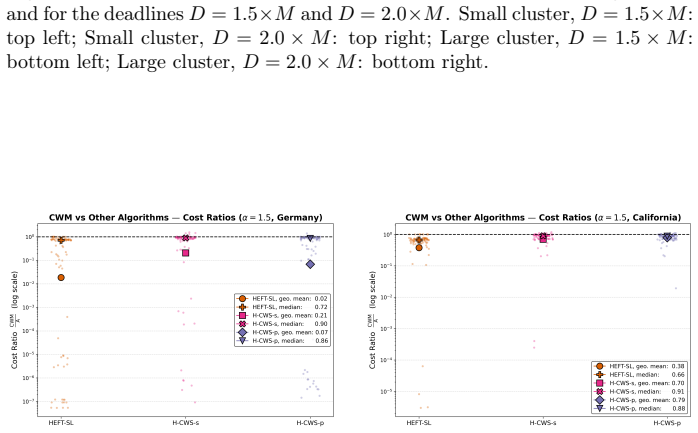
The scheduling problem is NP-hard and admits no constant-factor approximation even for the uni-processor case. CWM combines carbon-aware mapping and scheduling by integrating dynamic programming with efficient heuristics to exploit renewable energy availability and infrastructure heterogeneity, producing feasible solutions that achieve a median carbon cost reduction of 42% over the best version of CaWoSched when the deadline equals two times the makespan of a carbon-agnostic baseline.
What carries the argument
CWM, the algorithm that interleaves dynamic programming for precedence-respecting task ordering with heuristics that assign tasks to machines according to instantaneous carbon intensity and per-machine power consumption.
If this is right
- Workflows with precedence constraints can be executed under tight deadlines while still shifting work into high-renewable periods.
- Heterogeneity in machine power consumption becomes an additional degree of freedom for carbon reduction beyond time-shifting alone.
- Dynamic programming can be combined with fast heuristics to produce practical solutions for an otherwise inapproximable problem.
- A 42% further cut on top of an already 36%-improved baseline indicates that carbon-aware mapping and scheduling remain complementary.
- The approach scales to the tested workflow sizes while still respecting strict deadlines.
Where Pith is reading between the lines
- If the hardness result holds, any practical scheduler for larger workflows will need to rely on similar hybrid exact-heuristic designs rather than pure approximation algorithms.
- Extending CWM to handle uncertainty in future renewable supply forecasts would be a direct next step that preserves the same mapping and ordering machinery.
- The same hardness carries over to related problems such as carbon-aware placement of virtual machines or serverless functions that also carry precedence or data-flow constraints.
Load-bearing premise
The specific workflow instances, energy supply traces, and machine power models used in the experiments are representative of real heterogeneous datacenter conditions and the CaWoSched baseline was implemented without hidden advantages.
What would settle it
Running CWM and CaWoSched on a new collection of workflow traces drawn from production datacenters with measured renewable availability and power draw, then observing whether the median carbon reduction falls below 20%.
Figures





read the original abstract
As datacenters continue to grow in scale, their energy consumption and resulting carbon footprint have become pressing concerns. With the increasing share of renewable energy in a datacenter's mixed energy supply, shifting task execution to periods of high green-power availability is a promising strategy to reduce carbon emissions. However, in heterogeneous computing environments, the power consumption of compute nodes in a datacenter can also vary. In practice, workloads submitted to datacenters are often not isolated tasks, but entire workflows consisting of interdependent tasks with precedence constraints. A further challenge arises from the fact that carbon emission reductions must typically be achieved under strict workflow deadlines. In this work, we show that the problem posed by these challenges for the scheduler is NP-hard and admits no constant-factor approximation even for the uni-processor case. Motivated by this hardness, we present a novel algorithm CWM that combines carbon-aware mapping and scheduling to construct feasible solutions. Our approach integrates dynamic programming with efficient heuristics to exploit renewable energy availability and infrastructure heterogeneity. To assess the quality of the new algorithm, we evaluate it against the state-of-the-art approach CaWoSched and show that CWM achieves significant reductions in terms of carbon emissions in experiments. In particular, we are able to achieve a median carbon cost reduction of 42% over the best version of CaWoSched when the deadline is two times the makespan of a carbon-agnostic baseline. Note that CaWoSched itself already reduces the carbon-agnostic baseline by 36%.
Editorial analysis
A structured set of objections, weighed in public.
Referee Report
Summary. The paper claims that carbon-aware mapping and scheduling of deadline-constrained workflows on heterogeneous datacenters is NP-hard and admits no constant-factor approximation even in the uni-processor case. It proposes the CWM algorithm, which integrates dynamic programming with heuristics to exploit renewable energy availability and node heterogeneity while respecting deadlines. Experiments on workflow DAGs show CWM yields a median 42% carbon-cost reduction versus the best CaWoSched variant (itself 36% better than carbon-agnostic) when the deadline is set to twice the carbon-agnostic makespan.
Significance. If the hardness result and the 42% reduction hold under representative conditions, the work supplies both a theoretical justification for heuristic methods and a practical scheduler that meaningfully lowers carbon emissions for workflow workloads without deadline violations. The combination of DP and heuristics, together with direct comparison against an existing baseline, is a concrete contribution to green scheduling.
major comments (2)
- [§3] §3 (Complexity): The central claim that the problem is NP-hard and has no constant-factor approximation even for the uni-processor case is asserted without visible proof details or reduction; this is load-bearing for the motivation of CWM and must be supplied for the theoretical contribution to be assessable.
- [§5] §5 (Experimental Evaluation): The headline 42% median carbon-cost reduction (and the 36% figure for CaWoSched) is reported without error bars, statistical tests, or a precise description of the workflow DAGs, renewable-energy traces, and heterogeneous power models; because the quantitative claim depends entirely on these choices, the evaluation section does not yet support the performance conclusion.
minor comments (2)
- [§5] The abstract and evaluation text refer to 'the best version of CaWoSched' without explicitly identifying which variant or parameter settings were used; this should be stated clearly in the main text and tables.
- [§2] Notation for carbon cost, energy supply, and power models should be introduced with a single consistent table or figure early in the paper to aid readability.
Simulated Author's Rebuttal
We thank the referee for the constructive feedback on both the theoretical hardness result and the experimental evaluation. We address each major comment below and will make the requested revisions to strengthen the manuscript.
read point-by-point responses
-
Referee: [§3] §3 (Complexity): The central claim that the problem is NP-hard and has no constant-factor approximation even for the uni-processor case is asserted without visible proof details or reduction; this is load-bearing for the motivation of CWM and must be supplied for the theoretical contribution to be assessable.
Authors: We agree that the proof details require greater visibility and elaboration to allow full assessment. Although §3 states the NP-hardness result and the absence of a constant-factor approximation (even in the uni-processor case), the reduction itself is only sketched. In the revised manuscript we will expand §3 to include the complete reduction (from a suitable NP-complete problem such as Partition or Knapsack) together with the formal argument ruling out constant-factor approximations, ensuring the theoretical motivation for CWM is self-contained and verifiable. revision: yes
-
Referee: [§5] §5 (Experimental Evaluation): The headline 42% median carbon-cost reduction (and the 36% figure for CaWoSched) is reported without error bars, statistical tests, or a precise description of the workflow DAGs, renewable-energy traces, and heterogeneous power models; because the quantitative claim depends entirely on these choices, the evaluation section does not yet support the performance conclusion.
Authors: We concur that the quantitative claims need supporting statistical and methodological detail. The revised §5 will report inter-quartile ranges or standard deviations alongside the median reductions, include appropriate non-parametric statistical tests (e.g., Wilcoxon signed-rank with p-values), and provide explicit descriptions of the workflow DAGs (task counts, structures, and sources), the renewable-energy traces (origin, temporal resolution, and carbon-intensity values), and the heterogeneous power models (node types and their measured or modeled power draws). These additions will make the 42 % and 36 % figures reproducible and statistically grounded. revision: yes
Circularity Check
No circularity; hardness proof and algorithm are independent of evaluation metrics
full rationale
The paper's core theoretical claim (NP-hardness and inapproximability even on one processor) is established by a reduction argument that does not reference the experimental traces or CWM outputs. CWM is constructed from dynamic programming plus heuristics motivated by that hardness result, with no equations that define its carbon-cost metric in terms of the same data it later reports. The 42% median reduction versus CaWoSched is an empirical comparison on fixed workflow instances and energy traces; it is not obtained by fitting parameters to a subset and renaming the fit as a prediction, nor by any self-citation chain that bears the central claim. The derivation chain therefore remains self-contained against external benchmarks.
Axiom & Free-Parameter Ledger
axioms (1)
- standard math Standard assumptions from complexity theory that NP-hardness implies no constant-factor approximation unless P=NP
Reference graph
Works this paper leans on
-
[1]
SIGARCH Comput
Abts, D., Marty, M.R., Wells, P.M., Klausler, P., Liu, H.: Energy pro- portional datacenter networks. SIGARCH Comput. Archit. News38(3), 338–347 (Jun 2010)
2010
-
[2]
IEEE Access9(2021) 13
Ahmed, K.M.U., Bollen, M.H.J., Alvarez, M.: A review of data centers energy consumption and reliability modeling. IEEE Access9(2021) 13
2021
-
[3]
Algorithms12(7), 127 (2019)
Angriman, E., van der Grinten, A., von Looz, M., Meyerhenke, H., Nöl- lenburg, M., Predari, M., Tzovas, C.: Guidelines for experimental algorith- mics: A case study in network analysis. Algorithms12(7), 127 (2019)
2019
-
[4]
Future Generation Computer Systems150, 171–185 (2024)
Bader, J., Lehmann, F., Thamsen, L., Leser, U., Kao, O.: Lotaru: Locally predicting workflow task runtimes for resource management on heteroge- neous infrastructures. Future Generation Computer Systems150, 171–185 (2024)
2024
-
[5]
Barbosa, J.G., Moreira, B.: Dynamic scheduling of a batch of parallel task jobs on heterogeneous clusters. Par. computing37(8) (2011)
2011
-
[6]
In: Europ
Breukelman, E., Hall, S., Belgioioso, G., Dörfler, F.: Carbon-aware com- puting in a network of data centers: A hierarchical game-theoretic ap- proach. In: Europ. Control Conf. (ECC). pp. 798–803. IEEE (2024)
2024
-
[7]
IEEE Comm
Cao, Z., Zhou, X., Hu, H., Wang, Z., Wen, Y.: Toward a systematic survey for carbon neutral data centers. IEEE Comm. Surveys & Tutorials24, 1–1 (01 2022)
2022
-
[8]
Future Generation Computer Systems128, 16– 27 (2022)
Coleman, T., Casanova, H., Pottier, L., Kaushik, M., Deelman, E., Ferreira da Silva, R.: WfCommons: A framework for enabling scientific workflow research and development. Future Generation Computer Systems128, 16– 27 (2022)
2022
-
[9]
Dolan, E.D., Moré, J.J.: Benchmarking optimization software with perfor- mance profiles. Math. Program.91(2), 201–213 (2002)
2002
-
[10]
Future Generation Computer Systems36, 221–236 (Jul 2014)
Durillo, J.J., Nae, V., Prodan, R.: Multi-objective energy-efficient work- flow scheduling using list-based heuristics. Future Generation Computer Systems36, 221–236 (Jul 2014)
2014
-
[11]
Simulation Modelling Practice and Theory58, 95–111 (Nov 2015)
Durillo, J.J., Prodan, R., Barbosa, J.G.: Pareto tradeoff scheduling of workflows on federated commercial Clouds. Simulation Modelling Practice and Theory58, 95–111 (Nov 2015)
2015
-
[12]
https://app.electricitymaps.com/datasets(2025), accessed: Decem- ber 2025
Electricity Maps: Electricity Maps: Hourly carbon intensity datasets. https://app.electricitymaps.com/datasets(2025), accessed: Decem- ber 2025
2025
-
[13]
Garey, M.R., Johnson, D.S.: Computers and Intractability, a Guide to the Theory of NP-Completeness. W.H. Freeman and Company (1979)
1979
-
[14]
Hanafy, W.A., Liang, Q., Bashir, N., Irwin, D., Shenoy, P.: CarbonScaler: Leveraging Cloud Workload Elasticity for Optimizing Carbon-Efficiency. Proc. ACM Meas. Anal. Comput. Syst.7(3) (Dec 2023)
2023
-
[15]
IEEE Trans
Haque, M.A., Aydin, H., Zhu, D.: On reliability management of energy- aware real-time systems through task replication. IEEE Trans. on Par. and Dist. Systems28(3), 813–825 (2017) 14
2017
-
[16]
In: 53rd Int
Kulagina, S., Meyerhenke, H., Benoit, A.: Mapping large memory- constrained workflows onto heterogeneous platforms. In: 53rd Int. Conf. on Par. Processing (ICPP) (2024)
2024
-
[17]
In: Proc
Lechowicz, A., Shenoy, R., Bashir, N., Hajiesmaili, M., Wierman, A., De- limitrou, C.: Carbon- and precedence-aware scheduling for data processing clusters. In: Proc. SIGCOMM 2025 Conference. p. 1241–1244. ACM (2025)
2025
-
[18]
In: 2020 IEEE Int
Liu, J., Lu, S., Che, D.: A survey of modern scientific workflow scheduling algorithms and systems in the era of big data. In: 2020 IEEE Int. Conf. on Services Computing (SCC). pp. 132–141. IEEE (2020)
2020
-
[19]
In: 2016 IEEE Int
Mahmud, A.H., Iyengar, S.S.: A distributed framework for carbon and cost aware geographical job scheduling in a hybrid data center infrastructure. In: 2016 IEEE Int. Conf. on Autonomic Comp. (ICAC). pp. 75–84 (2016)
2016
-
[20]
Journal of Cleaner Production529, 146787 (2025)
Mencaroni, A., Leyman, P., Raa, B., De Vuyst, S., Claeys, D.: Towards net-zero manufacturing: Carbon-aware scheduling for GHG emissions re- duction. Journal of Cleaner Production529, 146787 (2025)
2025
-
[21]
In: IEEE Intl
Özkaya, M.Y., Benoit, A., Uçar, B., Herrmann, J., Çatalyürek, Ü.V.: A scalable clustering-based task scheduler for homogeneous processors using DAG partitioning. In: IEEE Intl. Par. and Distrib. Proc. Symp. (IPDPS). pp. 155–165. IEEE (2019)
2019
-
[22]
IEEE Trans
Radovanović, A., Koningstein, R., Schneider, I., Chen, B., Duarte, A., Roy, B., Xiao, D., Haridasan, M., Hung, P., et al.: Carbon-aware computing for datacenters. IEEE Trans. on Power Sys.38(2) (2022)
2022
-
[23]
Energy-Efficient Dist
Rizvandi, N.B., Zomaya, A.Y., Lee, Y.C., Boloori, A.J., Taheri, J.: Mul- tiple frequency selection in DVFS-enabled processors to minimize energy consumption. Energy-Efficient Dist. Comp. Systems pp. 443–463 (2012)
2012
-
[24]
In: 2018 Int
Samadi, Y., Zbakh, M., Tadonki, C.: E-HEFT: Enhancement Heteroge- neous Earliest Finish Time algorithm for Task Scheduling based on Load Balancing in Cloud Computing. In: 2018 Int. Conf. on High Perf. Comp. & Simulation (HPCS). pp. 601–609 (2018)
2018
-
[25]
In: Proc
Schweisgut, D., Benoit, A., Robert, Y., Meyerhenke, H.: Carbon-aware workflow scheduling with fixed mapping and deadline constraint. In: Proc. of the 54th Int. Conf. on Par. Proc., ICPP 2025. pp. 627–637. ACM (2025)
2025
-
[26]
Future Gen
Shi, Z., Dongarra, J.J.: Scheduling workflow applications on processors with different capabilities. Future Gen. Comp. Sys.22(6) (2006)
2006
-
[27]
IEEE Trans
Topcuoglu, H., Hariri, S., Wu, M.Y.: Performance-effective and low- complexity task scheduling for heterogeneous computing. IEEE Trans. Par. Dist. Systems13(3), 260–274 (2002) 15
2002
-
[28]
Viil, J., Srirama, S.N.: Framework for automated partitioning and exe- cution of scientific workflows in the cloud. The J. of Supercomputing74, 2656–2683 (2018)
2018
-
[29]
IEEE Trans
Wang, Y., Sun, W., Ren, P., Harrison, G.: Multi-objective low-carbon scheduling method for data centers based on ensemble reinforcement learn- ing. IEEE Trans. on Smart Grid pp. 1–1 (2025)
2025
-
[30]
In: Proc
Wiesner, P., Behnke, I., Scheinert, D., Gontarska, K., Thamsen, L.: Let’s wait awhile: how temporal workload shifting can reduce carbon emissions in the cloud. In: Proc. 22nd Int. Middleware Conf. p. 260–272. ACM (2021)
2021
-
[31]
Wu, C.J., Raghavendra, R., Gupta, U., Acun, B., Ardalani, N., Maeng, K., Chang, G., et al.: Sustainable AI: Environmental Implications, Challenges and Opportunities (2022),https://arxiv.org/abs/2111.00364 A Proof of Theorem 3.1 Proof.The (decision version of the) problem obviously is in NP: given a schedule (all tasks are mapped onto the same processor) a...
-
[32]
For eachv∈Vand each predecessoruofvsuch thatµ(u) =µ(v)we have σ(u) +t(u)≤σ(v)
-
[33]
For eachv∈Vand each predecessoruofvsuch thatµ(u)̸=µ(v)we have σ(u) +t(u)≤σ(c u,v)≤σ(c u,v) +t(c u,v)≤σ(v)
-
[34]
There are no overlaps on any processor, i.e., there is no pair of tasksu, v such thatµ(u) =µ(v)and σ(u)≤σ(v) +t(v)andσ(v)≤σ(u)(B.1) or σ(u)≤σ(v)≤σ(v) +t(v)≤σ(u) +t(u).(B.2)
-
[35]
Now assumeσ,σ ′ as stated in Lemma B.1
Analogously to Property 3, there are no overlaps on any communication link. Now assumeσ,σ ′ as stated in Lemma B.1. We assume that the interval which the local search picked isI= [b, e[. First, we show Property 1). Letv∈V. If degin(v) = 0, the task is independent and hence, 1) holds. Now assume degin(v)≥1and letu∈N in(v)andµ(u) =µ(v), i.e., the tasks are ...
2024
discussion (0)
Sign in with ORCID, Apple, or X to comment. Anyone can read and Pith papers without signing in.