A Structure-Preserving PML-Domain-Embedding Method for Acoustic Wave Scattering by Moving Objects
Pith reviewed 2026-06-29 15:12 UTC · model grok-4.3
The pith
The PML-domain-embedding method solves acoustic scattering by moving objects on a fixed computational domain without remeshing.
A machine-rendered reading of the paper's core claim, the machinery that carries it, and where it could break.
Core claim
The PML-domain-embedding system enables moving-boundary scattering problems to be solved without remeshing. Matched asymptotic expansions show that the diffuse-interface formulation converges to the sharp-interface system as the interface thickness tends to zero. An energy-dissipation-rate-preserving finite-difference scheme is constructed for the system, and hierarchical local refinement is used to improve efficiency on the fixed domain.
What carries the argument
The PML-domain-embedding (PML-DE) system that combines a perfectly matched layer for wave truncation with a domain-embedding formulation for moving objects on a fixed grid.
If this is right
- The method allows computation of scattering solutions for moving objects without remeshing the domain.
- The diffuse-interface model converges to the sharp-interface acoustic scattering problem as interface thickness goes to zero.
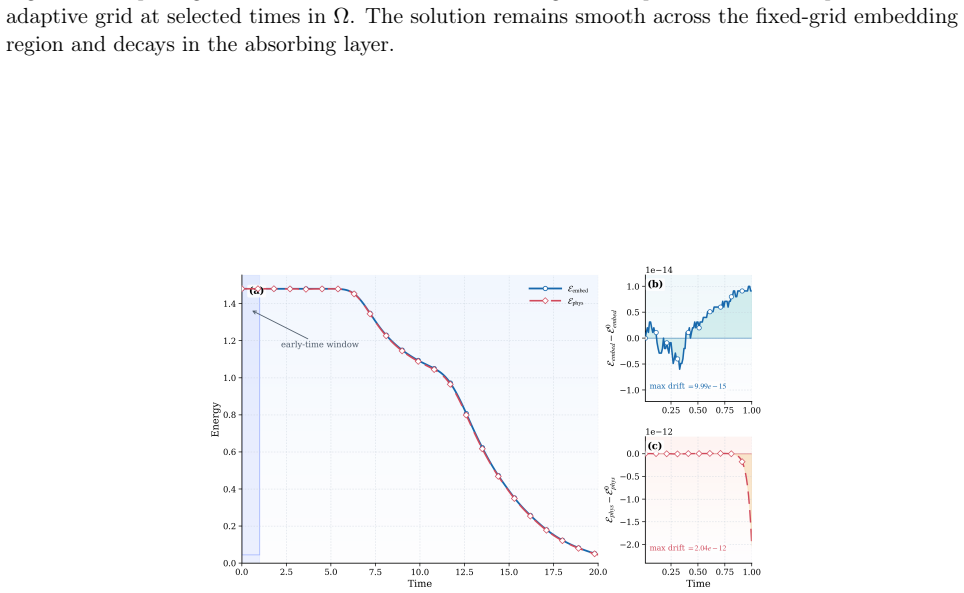
- The finite-difference scheme maintains the correct energy-dissipation rate of the continuous system.
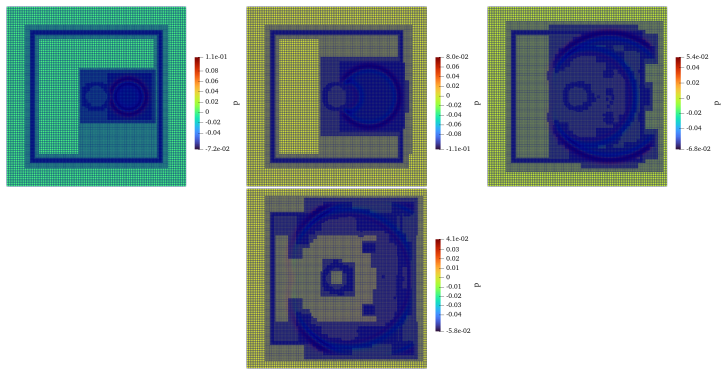
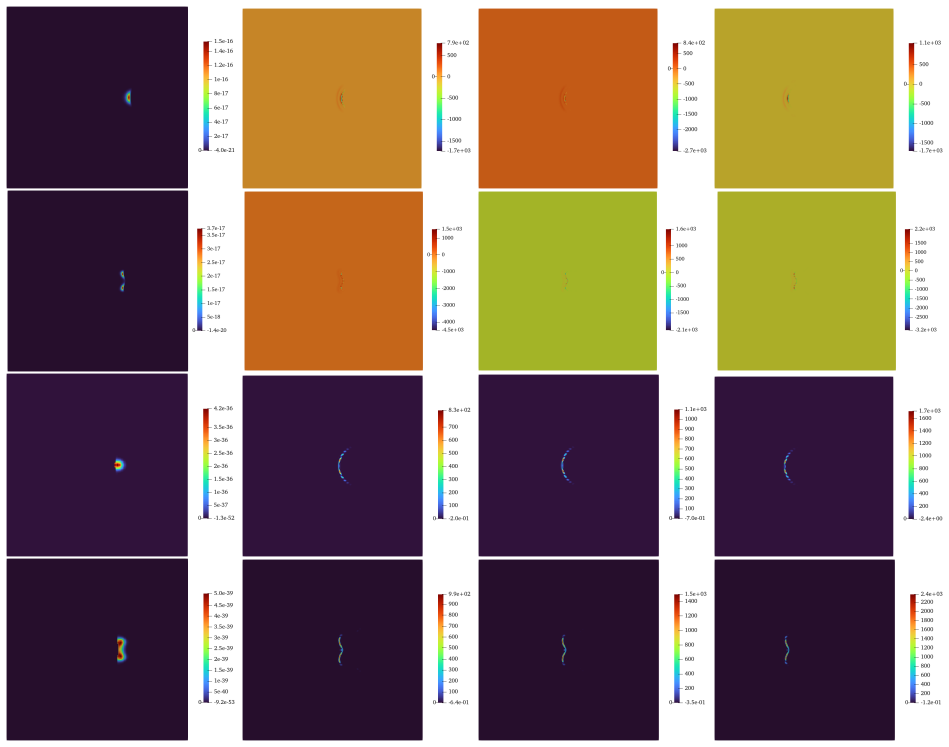
- Adaptive refinement based on object location, PML region, and wave dynamics increases efficiency while staying on the fixed grid.
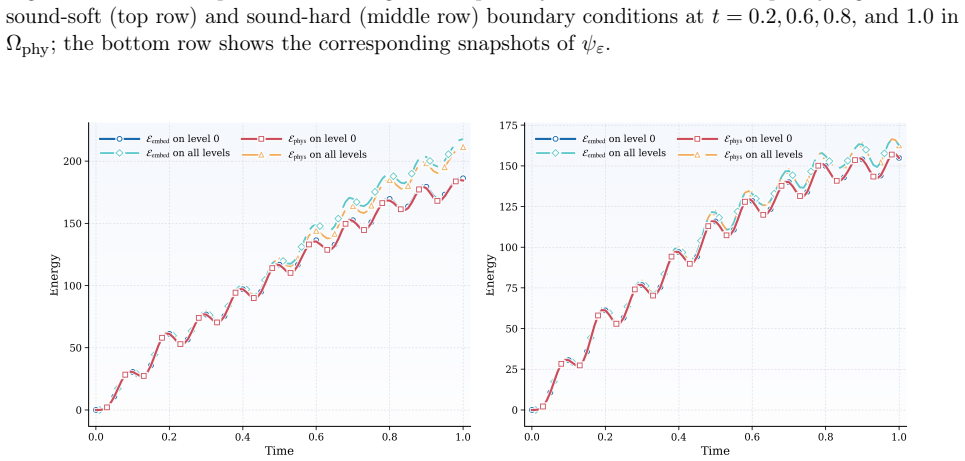
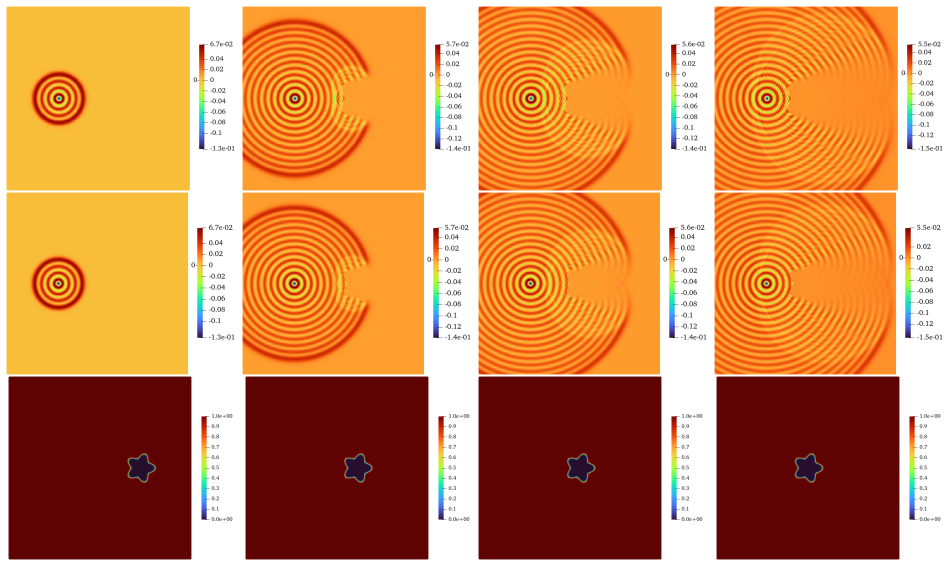
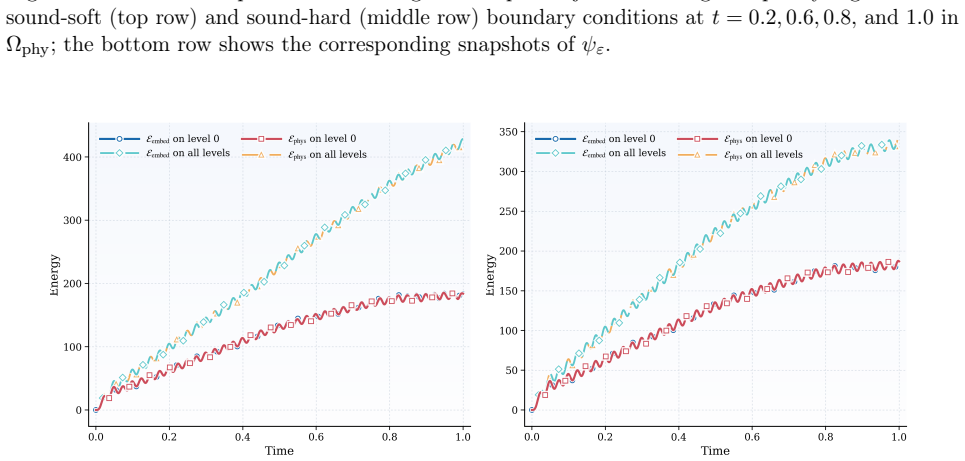
- Numerical tests confirm accuracy and the absorbing properties of the layer.
Where Pith is reading between the lines
- The framework may apply to other types of wave propagation or fluid-structure problems with moving boundaries.
- By avoiding remeshing, the method could lower the computational expense for long-time simulations of complex scattering scenarios.
- Extensions might include incorporating nonlinear effects or higher-order accuracy in the scheme.
- The convergence proof via asymptotics suggests similar techniques could validate other diffuse-interface models in wave problems.
Load-bearing premise
The matched asymptotic expansions correctly connect the diffuse-interface formulation to the sharp-interface acoustic scattering system.
What would settle it
Numerical computation of solutions for decreasing values of the interface thickness parameter and verification that the difference to a known sharp-interface solution decreases to zero.
Figures


read the original abstract
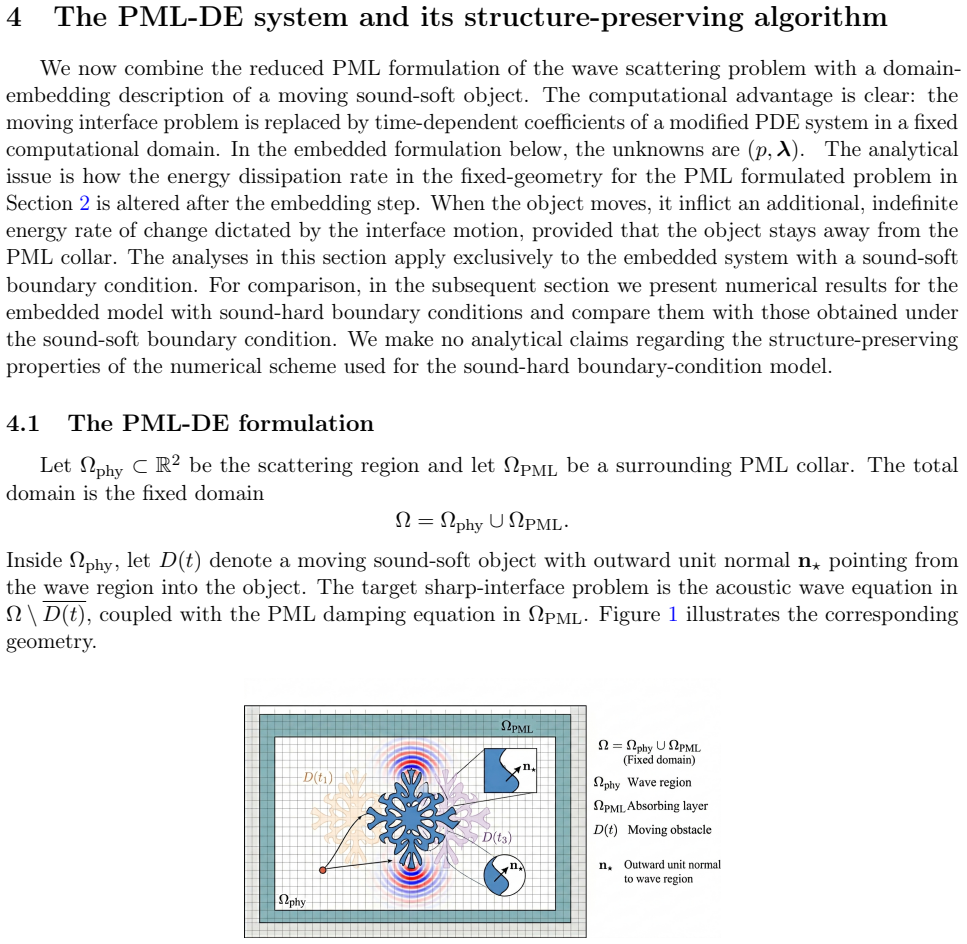
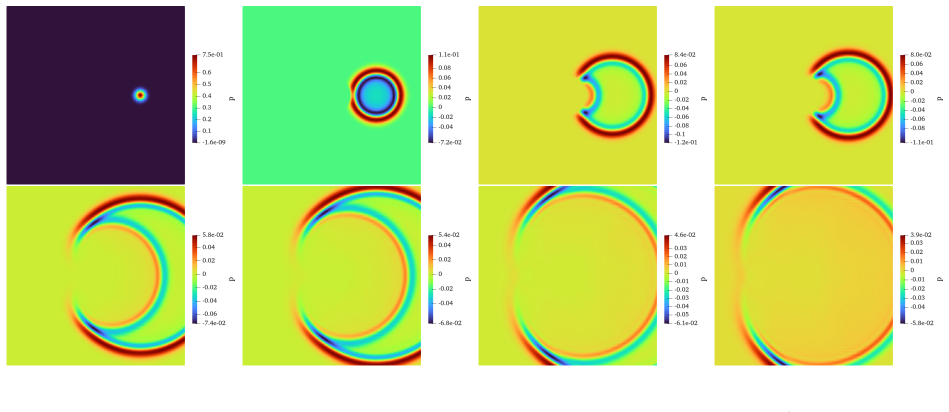
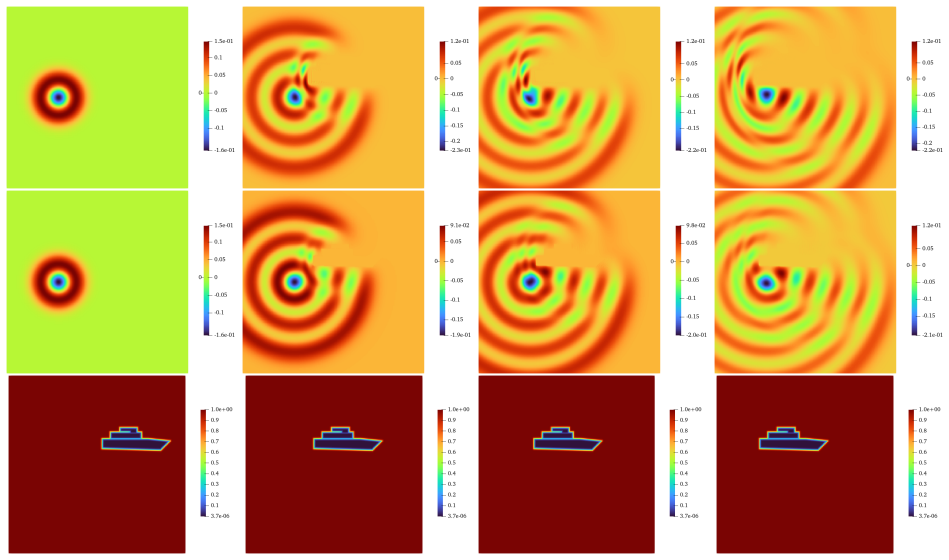
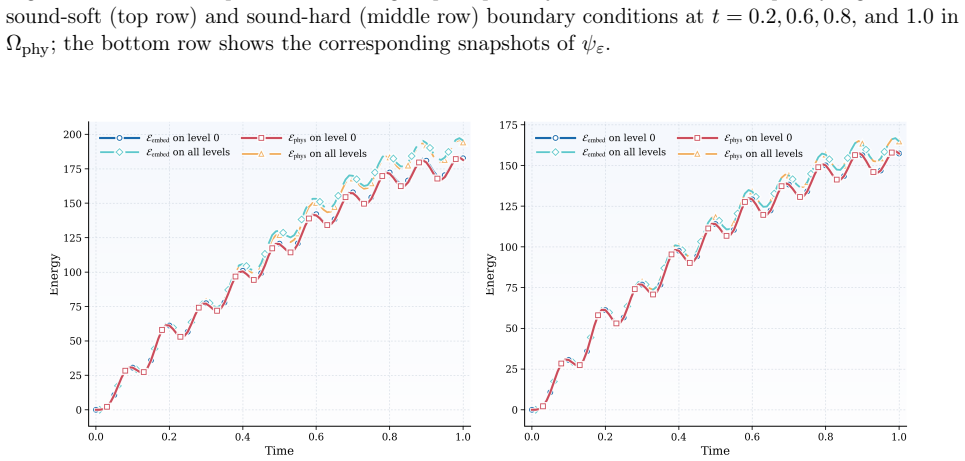
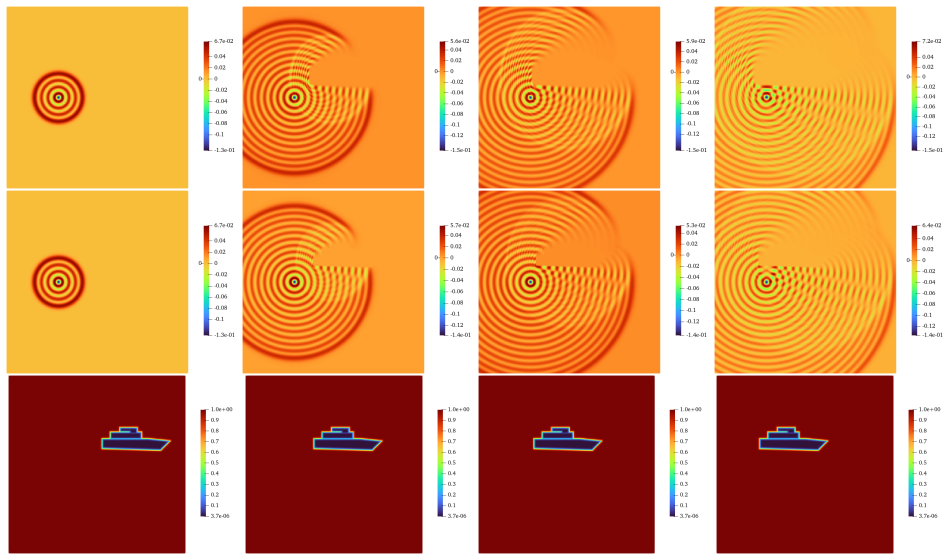
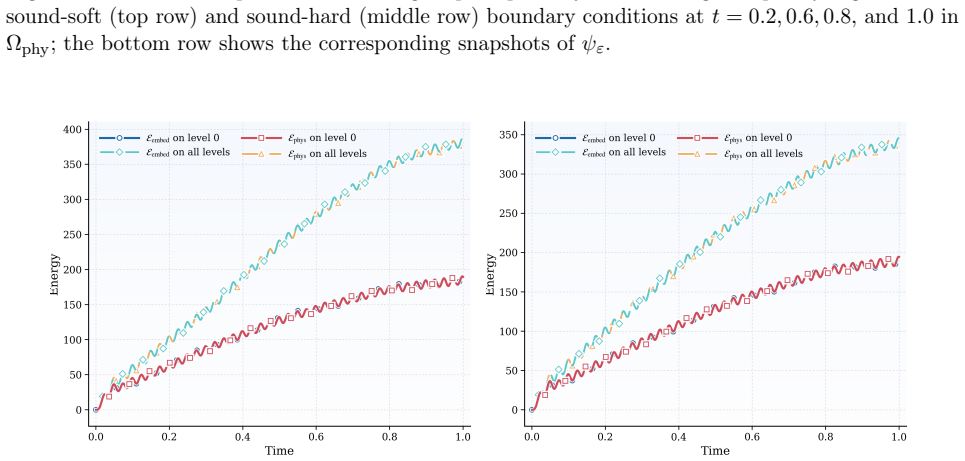
We develop a structure-preserving computational framework for acoustic wave scattering by moving objects, comprising a new PML-domain-embedding model and a compatible numerical approximation. The model couples a perfectly matched layer (PML), used to truncate the acoustic wave equation, with a domain-embedding formulation that represents moving objects on a fixed computational domain. The resulting PML-domain-embedding (PML-DE) system enables moving-boundary scattering problems to be solved without remeshing. Using matched asymptotic expansions, we show that the diffuse-interface formulation converges to the corresponding sharpinterface system as the interface thickness tends to zero. We then construct an energy-dissipationrate-preserving finite-difference scheme for the PML-DE system. To improve computational efficiency, the scheme is combined with hierarchical local refinement informed by the moving-object location, the fixed PML region, and the evolving wave dynamics, all within the fixed computational domain. Numerical experiments demonstrate the accuracy of the computed scattering solutions, the effectiveness of the absorbing layer and object-embedding strategy, and the efficiency of the adaptive algorithm. The proposed framework provides a practical and robust computational approach for engineering applications involving complex acoustic wave-scattering problems.
Editorial analysis
A structured set of objections, weighed in public.
Referee Report
Summary. The manuscript develops a PML-domain-embedding (PML-DE) model that couples a perfectly matched layer with a diffuse-interface domain-embedding formulation to solve acoustic scattering by moving objects on a fixed computational domain without remeshing. Matched asymptotic expansions are invoked to establish convergence of the diffuse-interface system to the classical sharp-interface problem as interface thickness ε tends to zero. An energy-dissipation-rate-preserving finite-difference scheme is constructed for the PML-DE system and combined with hierarchical local refinement driven by object location, PML region, and wave dynamics. Numerical experiments are presented to illustrate accuracy of scattering solutions, effectiveness of the absorbing layer and embedding strategy, and efficiency of the adaptive algorithm.
Significance. If the asymptotic convergence holds with appropriate error control and the energy preservation is rigorously verified, the framework supplies a structure-preserving, remeshing-free approach to moving-boundary acoustic problems that could be useful for engineering simulations of wave scattering. The combination of PML truncation, diffuse-interface embedding, and adaptive refinement on a fixed grid is a concrete technical contribution.
major comments (2)
- [§3] §3: The matched asymptotic expansions are presented formally with inner/outer ansätze and leading-order matching, but supply neither uniform-in-time a-priori estimates nor a proof that the remainder is o(1) in the energy norm once the PML coefficients and nonzero object velocity are active; because these terms enter at the same order as curvature corrections, it is possible that an O(ε) residual persists and the formal matching does not establish the claimed convergence.
- [Abstract, §4] Abstract and §4: The energy-dissipation-rate-preserving property of the finite-difference scheme is asserted, yet the manuscript does not exhibit the discrete energy identity or the precise cancellation that survives the PML and advection terms; without this explicit verification the structure-preservation claim remains formal.
minor comments (1)
- [Numerical experiments] The abstract states that numerical experiments demonstrate convergence as ε→0, but the main text should include a dedicated table or figure quantifying the observed rate in the energy norm for at least two distinct object velocities.
Simulated Author's Rebuttal
We thank the referee for the thorough review and valuable comments. We address each major comment below and will revise the manuscript to strengthen the presentation.
read point-by-point responses
-
Referee: [§3] §3: The matched asymptotic expansions are presented formally with inner/outer ansätze and leading-order matching, but supply neither uniform-in-time a-priori estimates nor a proof that the remainder is o(1) in the energy norm once the PML coefficients and nonzero object velocity are active; because these terms enter at the same order as curvature corrections, it is possible that an O(ε) residual persists and the formal matching does not establish the claimed convergence.
Authors: We acknowledge that the matched asymptotic analysis in §3 is formal. The expansions and leading-order matching are provided, but we do not derive uniform-in-time a priori estimates or prove that the remainder is o(1) in the energy norm when PML coefficients and nonzero object velocity are present. These terms appear at the same order as curvature corrections, so an O(ε) residual cannot be ruled out by the formal calculation alone. In the revision we will change the language to state that convergence is shown formally via matched asymptotics and add a remark that a rigorous error analysis including the PML and advection effects lies beyond the present scope. revision: yes
-
Referee: [Abstract, §4] Abstract and §4: The energy-dissipation-rate-preserving property of the finite-difference scheme is asserted, yet the manuscript does not exhibit the discrete energy identity or the precise cancellation that survives the PML and advection terms; without this explicit verification the structure-preservation claim remains formal.
Authors: We agree that the discrete energy identity must be shown explicitly. Although the manuscript asserts the energy-dissipation-rate-preserving property of the finite-difference scheme, it does not display the full discrete energy balance or verify the cancellations that remain after the PML damping and advection terms are included. In the revised version we will add a dedicated derivation (in §4 or an appendix) that computes the discrete energy identity step by step and confirms that the required cancellations hold for the PML and moving-object advection terms. revision: yes
Circularity Check
No significant circularity; derivation is self-contained
full rationale
The paper introduces a PML-DE model, invokes matched asymptotic expansions to link the diffuse-interface formulation to the sharp-interface limit as ε→0, and separately constructs an energy-dissipation-preserving finite-difference scheme. These steps are presented as independent analytical and numerical constructions rather than reductions of outputs to fitted inputs or self-citations. No equations are shown that equate a claimed prediction or convergence result to its own definition by construction, and the provided text contains no load-bearing self-citations or ansatz smuggling. The central claims therefore remain externally falsifiable and do not collapse to the inputs.
Axiom & Free-Parameter Ledger
axioms (1)
- domain assumption Matched asymptotic expansions correctly capture the limit of the diffuse-interface formulation as interface thickness tends to zero.
Reference graph
Works this paper leans on
-
[1]
Adjerid and K
S. Adjerid and K. Moon. An immersed discontinuous Galerkin method for acoustic wave propagation in inhomogeneous media.SIAM J. Sci. Comput., 41:A139–A162, 2019
2019
-
[2]
Aland, J
S. Aland, J. Lowengrub, A. R"atz, and A. Voigt. Two-phase flow in complex geometries: A diffuse domain approach.Comput. Model. Eng. Sci., 57(1):77–108, 2010
2010
-
[3]
Alpert, L
B. Alpert, L. Greengard, and T. Hagstrom. Nonreflecting boundary conditions for the time- dependent wave equation.J. Comput. Phys., 180:270–296, 2002
2002
-
[4]
D. H. Baffet, M. J. Grote, S. Imperiale, and L. Scapolla. Energy Decay and Stability of a Perfectly Matched Layer for the Wave Equation.J. Sci. Comput., 81(3):2237–2270, 2019
2019
-
[5]
Berenger
J.-P. Berenger. A perfectly matched layer for the absorption of electromagnetic waves .J. Comput. Phys., 114:185–200, 1994
1994
-
[6]
M. J. Berger and P. Colella. Local adaptive mesh refinement for shock hydrodynamics.J. Comput. Phys., 82(1):64–84, 1989
1989
-
[7]
W. Cai, H. Zhang, and Y. Wang. Dissipation-preserving spectral element method for damped seismic wave equations.J. Comput. Phys., 350:260–279, 2017
2017
-
[8]
W. Cai, H. Zhang, and Y. Wang. Modelling damped acoustic waves by a dissipation-preserving conformal symplectic method.Proc. R. Soc. A, 473(2199):20160798, 2017
2017
-
[9]
S. N. Chandler-Wilde, D. P.Hewett, A. Moiola, and J. Besson. Boundary element methods for acoustic scattering by fractal screens.Numer. Math., 147:785–837, 2021
2021
-
[10]
Chen and J
Y. Chen and J. Lowengrub. Tumor growth in complex, evolving microenvironmental geometries: A diffuse domain approach.J. Theor. Biol., 361:14–30, 2014
2014
-
[11]
Chen and J
Y. Chen and J. Lowengrub. Tumor growth and calcification in evolving microenvironmental geometries.J. Theor. Biol., 463:138–154, 2019
2019
-
[12]
Z. Chen. Convergence of the time-domain perfectly matched layer method for acoustic scattering problems.Int. J. Numer. Anal. Model., 6(1):124–146, 2009. 30
2009
-
[13]
Chen and X
Z. Chen and X. Wu. Long-time stability and convergence of the uniaxial perfectly matched layer method for time-domain acoustic scattering problems.SIAM J. Numer. Anal., 50(5):2632–2655, 2012
2012
-
[14]
Cheney and B
M. Cheney and B. Borden. Imaging moving targets from scattered waves.Inverse Probl., 24:035005, 2008
2008
-
[15]
J. Cooper. Scattering of plane waves by a moving obstacle.Arch. Ration. Mech. Anal., 71:113–141, 1979
1979
-
[16]
Diaz and P
J. Diaz and P. Joly. A time domain analysis of PML models in acoustics.Comput. Methods Appl. Mech. Engrg., 195(29–32):3820–3853, 2006
2006
-
[17]
Engquist and A
B. Engquist and A. Majda. Absorbing boundary conditions for the numerical simulation of waves. Math. Comp., 31(139):629–651, 1977
1977
-
[18]
Ervedoza and E
S. Ervedoza and E. Zuazua. Perfectly matched layers in 1-d: Energy decay for continuous and semi-discrete waves.Numer. Math., 109(4):597–634, 2008
2008
-
[19]
Falletta
S. Falletta. BEM coupling with the FEM fictitious domain approach for the solution of the exterior Poisson problem and of wave scattering by rotating rigid bodies.IMA J. Numer. Anal., 38(2):779–809, 2018
2018
-
[20]
Falletta and G
S. Falletta and G. Monegato. An exact non-reflecting boundary condition for 2D time-dependent wave equation problems.Wave Motion, 51:168–192, 2014
2014
-
[21]
Falletta and G
S. Falletta and G. Monegato. A fictitious domain approach for wave propagation problems in unbounded domains. InProceedings of the 5th International Conference on Computational Methods in Structural Dynamics and Earthquake Engineering, pages 959–971. ECCOMAS, 2015
2015
-
[22]
Falletta, G
S. Falletta, G. Monegato, and L. Scuderi. A space-time BIE method for nonhomogeneous exterior wave equation problems. The Dirichlet case.IMA J. Numer. Anal., 32:202–226, 2012
2012
-
[23]
Girault and R
V. Girault and R. Glowinski. Error analysis of a fictitious domain method applied to a Dirichlet problem.Japan J. Indust. Appl. Math., 12:487–524, 1995
1995
-
[24]
G. H. Goedecke, R. C. Wood, and H. J. Auvermann. Doppler broadening of acoustic waves scattered by turbulence flowing with a horizontal wind. Technical report, U.S. Army Research Laboratory, Adelphi, MD, 2000
2000
-
[25]
Y. Gong, J. Cai, and Y. Wang. Some new structure-preserving algorithms for general multi- symplectic formulations of Hamiltonian PDEs.J. Comput. Phys., 279:80–102, 2014
2014
-
[26]
Grote and J
M. Grote and J. Keller. Nonreflecting boundary conditions for time-dependent scattering.J. Comput. Phys., 127:52–65, 1996
1996
-
[27]
M. J. Grote and I. Sim. Efficient PML for the wave equation.arXiv:1001.0319, 2010
work page internal anchor Pith review Pith/arXiv arXiv 2010
-
[28]
X. Gu, H. Guo, W. Yu, G. Hu, and Q. Wang. A domain embedding strategy for acoustic wave scattering by moving obstacles.Computer Physics Communications, 326:110210, 2026
2026
- [29]
-
[30]
Guo and R
Y. Guo and R. H. Thomas. Geometric Acoustics for Aircraft Noise Scattering. InSession: Community Noise, Sonic Boom and Metrics III: Misc, 2022. 31
2022
-
[31]
Z. Guo, F. Yu, P. Lin, S. Wise, and J. Lowengrub. A diffuse domain method for two-phase flows with large density ratio in complex geometries.J. Fluid Mech., 907:A38, 2021
2021
-
[32]
Hiptmair, A
R. Hiptmair, A. Moiola, and I. Perugia. Trefftz discontinuous Galerkin methods for acoustic scattering on locally refined meshes.Appl. Numer. Math., 79:79–91, 2014
2014
-
[33]
Ihlenburg.Finite Element Analysis of Acoustic Scattering
F. Ihlenburg.Finite Element Analysis of Acoustic Scattering. Springer-Verlag, New York, NY
-
[34]
Ihlenburg and I
F. Ihlenburg and I. Babuška. Finite element solution of the Helmholtz equation with high wave number Part I: Theh-version of the FEM.Comput. Math. Appl., 30:9–37, 1995
1995
-
[35]
Ihlenburg and I
F. Ihlenburg and I. Babuška. Finite element solution of the Helmholtz equation with high wave number Part II: Theh-p-version of the FEM.SIAM J. Numer. Anal., 34:315–358, 1997
1997
-
[36]
P. Joly. An elementary introduction to the construction and the analysis of perfectly matched layers for time domain wave propagation.SeMA J., 57:5–48, 2012
2012
-
[37]
Lazzaroni and L
G. Lazzaroni and L. Nardini. On the 1D wave equation in time-dependent domains and the problem of debond initiation.ESAIM Control Optim. Calc. Var., 25:Art. 80, 2019
2019
-
[38]
X. Li, J. Lowengrub, A. Rätz, and A. Voigt. Solving PDEs in complex geometries: A diffuse domain approach.Commun. Math. Sci., 7:81–107, 2009
2009
-
[39]
Liu and H
L. Liu and H. Gao. The well-posedness and energy estimate for wave equations in domains with a space-like boundary.Electron. J. Qual. Theory Differ. Equ., (92):1–19, 2019
2019
-
[40]
Lowengrub, J
J. Lowengrub, J. Allard, and S. Aland. Numerical simulation of endocytosis: Viscous flow driven by membranes with non-uniform distributed curvature-including molecules.J. Comput. Phys., 309:112–128, 2016
2016
-
[41]
Z. Mu, Y. Gong, W. Cai, and Y. Wang. Efficient local energy dissipation preserving algorithms for the Cahn–Hilliard equation.J. Comput. Phys., 374:654–667, 2018
2018
-
[42]
C. S. Peskin. The immersed boundary method.Acta Numer., 11:479–517, 2002
2002
-
[43]
Petkov.Scattering Theory for Hyperbolic Operators
V. Petkov.Scattering Theory for Hyperbolic Operators. North-Holland, Amsterdam, 1989
1989
-
[44]
J. H. Seo and R. Mittal. A high-order immersed boundary method for acoustic wave scattering and low-Mach number flow-induced sound in complex geometries.J. Comput. Phys., 230:1000–1019, 2011
2011
-
[45]
P. D. Stefanov. Inverse scattering problem for moving obstacles.Math. Z., 207:461–480, 1991
1991
-
[46]
K. E. Teigen, X. Li, J. Lowengrub, F. Wang, and A. Voigt. A diffuse-interface approach for modeling transport, diffusion and adsorption/desorption of material quantities on a deformable interface.Commun. Math. Sci., 7(4):1009–1037, 2009
2009
-
[47]
K. E. Teigen, P. Song, J. Lowengrub, and A. Voigt. A diffuse-interface method for two-phase flows with soluble surfactants.J. Comput. Phys., 230:375–393, 2011
2011
-
[48]
J. V. Venas and T. Kvamsdal. Isogeometric boundary element method for acoustic scattering by a submarine.Comput. Methods Appl. Mech. Eng., 359:112670, 2020
2020
-
[49]
Y. Wang, F. Ma, and E. Zheng. A discontinuous Galerkin method for acoustic scattering problem with DtN boundary condition.Appl. Anal., 97:938–961, 2018
2018
-
[50]
T. Xu, H. Jia, and J. Qin. Cluster-driven non-uniform characteristic analysis of underwater target acoustic scattering field.Front. Phys., 13:1541799, 2025. 32
2025
-
[51]
F. Yu, Z. Guo, and J. Lowengrub. Higher-order accurate diffuse-domain methods for partial differential equations with Dirichlet boundary conditions in complex, evolving geometries.J. Comput. Phys., 406:109174, 2020
2020
-
[52]
W. Yu, T. Qian, and Q. Wang. Onsager Principle-Based Domain Embedding and Numerical Approximations for Allen-Cahn-Type Models.J. Comput. Phys., 2025
2025
-
[53]
W. Yu, T. Qian, Z. Zhang, and Q. Wang. Onsager Principle-Based Domain Embedding for thermodynamic consistent Cahn-Hilliard model in arbitrary domains.J. Comput. Phys., 2025
2025
-
[54]
Zhang, A
W. Zhang, A. Almgren, V. Beckner, J. Bell, J. Blaschke, C. Chan, M. Day, B. Friesen, K. Gott, D. Graves, M. P. Katz, A. Myers, T. Nguyen, A. Nonaka, M. Rosso, S. Williams, and M. Zingale. AMReX: a framework for block-structured adaptive mesh refinement.J. Open Source Softw., 4(37):1370, 2019. 33
2019
discussion (0)
Sign in with ORCID, Apple, or X to comment. Anyone can read and Pith papers without signing in.