Robust Moment-Based Estimation via Spectral Gradient Reweighting
Pith reviewed 2026-06-29 14:42 UTC · model grok-4.3
The pith
SGR-GMM reweights gradients via a spectral game to deliver robust GMM estimation with explicit local finite-sample error bounds under contamination.
A machine-rendered reading of the paper's core claim, the machinery that carries it, and where it could break.
Core claim
The SGR-GMM algorithm formulates per-observation gradient reweighting as an entropy-regularized spectral game between a sample-weight player and a density-matrix player, proves explicit convergence radius and finite termination for the fixed-center updates, and establishes a local finite-sample parameter estimation error bound that depends explicitly on the contamination fraction, inlier gradient stability, local GMM identification strength, and optimization accuracy. The same construction specializes to a robust diagonally-weighted GMM estimator for heteroscedastic low-rank Gaussian mixtures observed under additive Gaussian noise and strong contamination.
What carries the argument
The SGR primitive: an entropy-regularized spectral game between a sample-weight player and a density-matrix player that produces soft-reweighted gradients for the moment equations.
If this is right
- Fixed-center SGR updates converge inside an explicit radius and terminate after a finite number of steps.
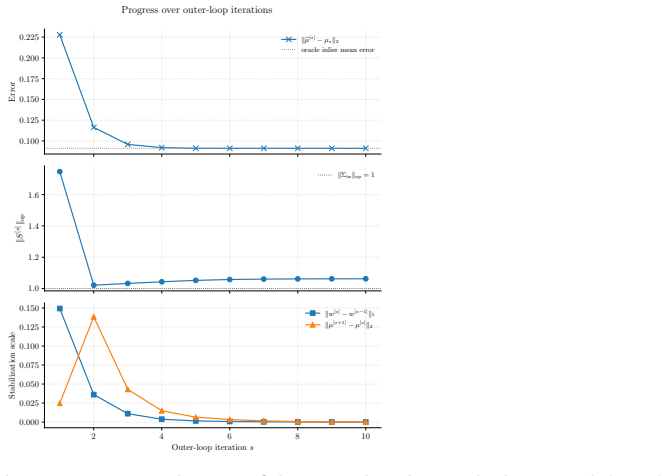
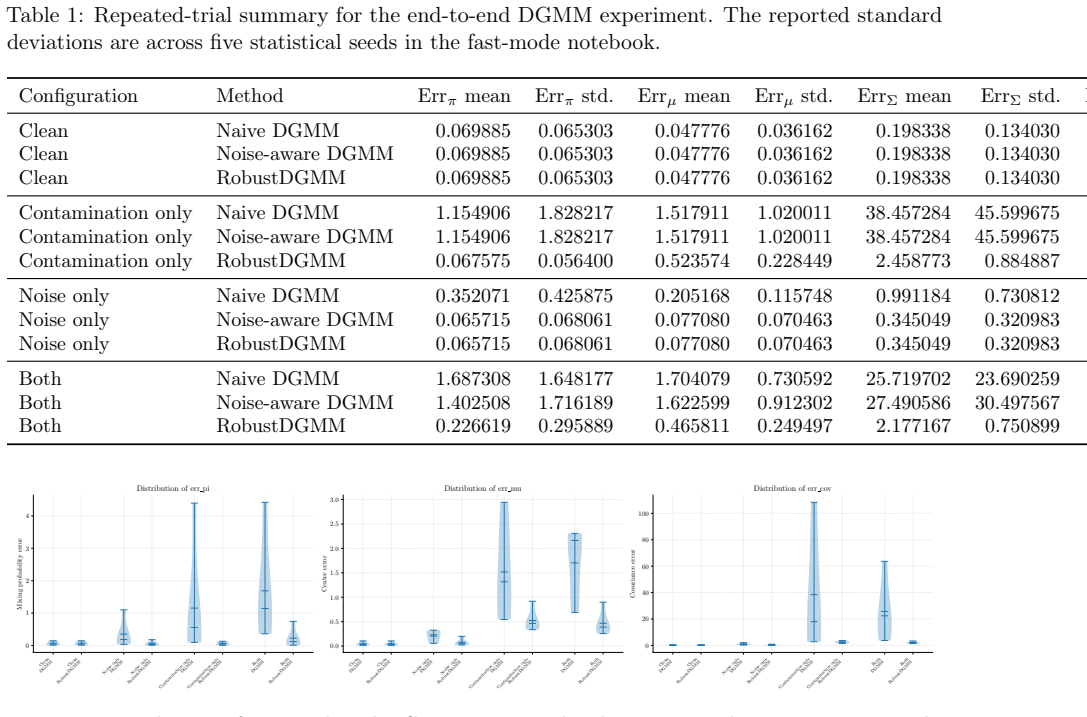
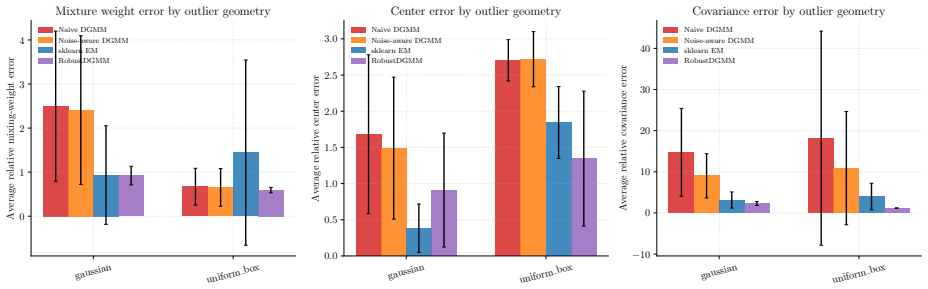
- The robust DGMM specialization produces nearly-oracle gradient estimates and substantially lower error than non-robust moment baselines on contaminated heteroscedastic mixtures.
- The finite-sample bound isolates the separate contributions of contamination level, inlier stability, identification strength, and solver tolerance.
- The procedure remains a valid GMM estimator when the contamination fraction is zero.
Where Pith is reading between the lines
- The same spectral-game reweighting could be inserted into other moment-matching procedures whose gradients admit a low-rank or diagonal structure.
- Empirical checks of inlier gradient stability on hold-out clean data might serve as a practical diagnostic before trusting the estimator on a new contaminated collection.
- Because the bound is local, one could test whether initializing from a coarse robust location estimator enlarges the basin in which the guarantee applies.
Load-bearing premise
Inlier gradient stability and local GMM identification strength must hold at a level sufficient for the chosen contamination fraction.
What would settle it
A data set generated from a locally identified GMM whose clean inliers satisfy the stated gradient-stability condition, yet the recovered parameter error after running SGR-GMM to the claimed accuracy exceeds the explicit bound by a constant factor.
Figures


read the original abstract
Moment-based estimation is a theoretically attractive approach to parametric inference, especially when likelihood-based estimation is unavailable, misspecified, or computationally inconvenient. However, the moment equations involve sample averages, which makes moment-based estimation sensitive to outliers. We propose the SGR-GMM algorithm, a robust generalized method of moments (GMM) procedure that uses a spectral gradient reweighting (SGR) primitive to soft-reweight the per-observation gradients during the moment-matching optimization. Our analysis has three layers. First, for a fixed center, the SGR primitive is formulated as an entropy-regularized spectral game between a sample-weight player and a density-matrix player, which is analyzed using classical multiplicative-weights and matrix-multiplicative-weights regret bounds. Second, we establish explicit convergence radius and finite termination bound for the fixed-center updates in the SGR primitive. Third, we prove a local finite-sample parameter estimation error bound with explicit dependence on the contamination fraction, inlier gradient stability, local GMM identification strength, and optimization accuracy. We further specialize the SGR-GMM algorithm to obtain a robust diagonally-weighted GMM (DGMM) estimator for estimating heteroscedastic low-rank Gaussian mixtures observed under additive Gaussian noise and strong contamination. In the numerical experiments, the SGR primitive produces nearly-oracle gradient estimation and the robust DGMM specialization substantially improves over non-robust moment baselines. The code and data are available at https://github.com/liu-lzhang/sgr-gmm.
Editorial analysis
A structured set of objections, weighed in public.
Referee Report
Summary. The manuscript proposes the SGR-GMM algorithm for robust generalized method of moments estimation. It formulates the spectral gradient reweighting (SGR) primitive as an entropy-regularized spectral game between sample-weight and density-matrix players, analyzed via classical multiplicative-weights and matrix-multiplicative-weights regret bounds. It establishes explicit convergence radius and finite termination for fixed-center updates, and proves a local finite-sample parameter estimation error bound depending explicitly on contamination fraction, inlier gradient stability, local GMM identification strength, and optimization accuracy. The approach is specialized to a robust diagonally-weighted GMM (DGMM) estimator for heteroscedastic low-rank Gaussian mixtures under additive noise and contamination. Numerical experiments indicate that SGR yields nearly-oracle gradients and the robust DGMM outperforms non-robust baselines; code and data are provided.
Significance. If the conditional assumptions hold, the explicit dependence of the error bound on contamination, stability, identification, and accuracy supplies a theoretically grounded robust moment estimator with verifiable conditions, which is valuable when likelihood methods are unavailable or misspecified. The reproducibility via public code is a clear strength.
major comments (2)
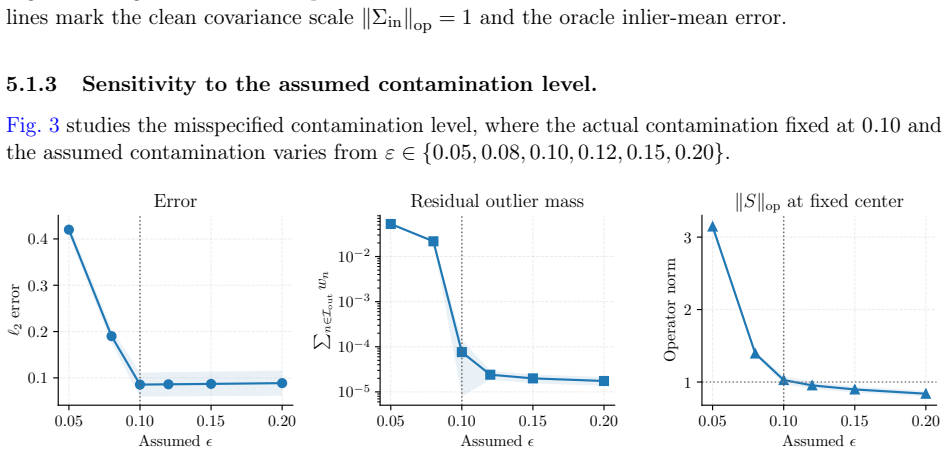
- [Abstract (third layer of analysis) and numerical experiments] Abstract (third layer): The local finite-sample parameter estimation error bound is derived under the assumption that inlier gradient stability and local GMM identification strength are sufficiently large relative to the contamination fraction. For the specialized robust DGMM estimator on heteroscedastic low-rank Gaussian mixtures, neither the general theory nor the numerical section supplies an a-priori guarantee or post-hoc verification that these quantities meet the required thresholds at the tested contamination fractions and noise levels. Without this, the explicit bound does not apply to the reported estimator error or convergence claims.
- [Analysis of fixed-center updates and DGMM specialization] The convergence-radius and finite-termination claims for the fixed-center SGR updates rest on the game formulation and external regret bounds, but the manuscript does not demonstrate that the inlier gradient stability assumption (required for the downstream error bound) is preserved under the specific reweighting produced by the SGR primitive in the DGMM specialization.
minor comments (1)
- [Abstract] The abstract states that the SGR primitive produces nearly-oracle gradient estimation, but the precise metric (e.g., which norm or expectation) and comparison baseline are not defined in the summary.
Simulated Author's Rebuttal
We thank the referee for the careful and constructive review. The comments correctly identify gaps in connecting the conditional theoretical bounds to the numerical experiments and in explicitly linking the SGR reweighting to preservation of the stability assumption. We address each point below and will incorporate revisions.
read point-by-point responses
-
Referee: The local finite-sample parameter estimation error bound is derived under the assumption that inlier gradient stability and local GMM identification strength are sufficiently large relative to the contamination fraction. For the specialized robust DGMM estimator on heteroscedastic low-rank Gaussian mixtures, neither the general theory nor the numerical section supplies an a-priori guarantee or post-hoc verification that these quantities meet the required thresholds at the tested contamination fractions and noise levels. Without this, the explicit bound does not apply to the reported estimator error or convergence claims.
Authors: We agree that the error bound is conditional on inlier gradient stability and local identification strength being sufficiently large relative to contamination, and that the manuscript provides neither a priori guarantees nor post-hoc verification of these conditions for the DGMM experiments. The bound is presented as holding under those assumptions, while the numerics serve as separate empirical evidence. In revision we will add post-hoc numerical verification (e.g., subsample-based estimates of gradient stability and identification strength) for the reported contamination and noise levels, together with a short discussion of practical checks. revision: yes
-
Referee: The convergence-radius and finite-termination claims for the fixed-center SGR updates rest on the game formulation and external regret bounds, but the manuscript does not demonstrate that the inlier gradient stability assumption (required for the downstream error bound) is preserved under the specific reweighting produced by the SGR primitive in the DGMM specialization.
Authors: The stability assumption concerns the uncontaminated inlier population. The SGR primitive is constructed to recover inlier moments via the entropy-regularized game, so that sufficiently accurate optimization yields reweighted gradients whose stability is inherited from the inliers. We acknowledge, however, that an explicit argument showing preservation under the DGMM reweighting map is absent. In revision we will insert a short supporting remark (or lemma) establishing that, when the optimization accuracy condition of the convergence theorem holds, the reweighted gradients remain stable whenever the original inlier gradients are. revision: yes
Circularity Check
No significant circularity: external regret bounds and conditional assumptions keep derivation independent
full rationale
The paper derives its SGR primitive analysis and local finite-sample error bound by invoking classical multiplicative-weights and matrix-multiplicative-weights regret bounds from external online-learning literature, then states explicit dependence on contamination fraction, inlier gradient stability, local GMM identification strength, and optimization accuracy as assumptions. These quantities are not fitted from the target data, self-defined, or obtained via self-citation chains; the central claims therefore remain non-tautological and externally grounded. No load-bearing step reduces by construction to the paper's own inputs or renames a fitted quantity as a prediction.
Axiom & Free-Parameter Ledger
axioms (1)
- standard math Classical multiplicative-weights and matrix-multiplicative-weights regret bounds apply to the entropy-regularized spectral game
invented entities (1)
-
SGR primitive
no independent evidence
Reference graph
Works this paper leans on
-
[1]
The multiplicative weights update method: a meta-algorithm and applications.Theory Comput., 8:121–164, 2012
Sanjeev Arora, Elad Hazan, and Satyen Kale. The multiplicative weights update method: a meta-algorithm and applications.Theory Comput., 8:121–164, 2012. 3, 9, 12, 34
2012
-
[2]
Convex Optimization: Algorithms and Complexity
Sébastien Bubeck. Convex Optimization: Algorithms and Complexity, November 2015. arXiv:1405.4980 [math]. 3, 9, 12, 13
work page internal anchor Pith review Pith/arXiv arXiv 2015
-
[3]
High-dimensional robust mean estimation via gradient descent
Yu Cheng, Ilias Diakonikolas, Rong Ge, and Mahdi Soltanolkotabi. High-dimensional robust mean estimation via gradient descent. InInternational conference on machine learning, pages 1768–1778. PMLR, 2020. 3, 5, 19
2020
-
[4]
Dalalyan and Arshak Minasyan
Arnak S. Dalalyan and Arshak Minasyan. All-in-one robust estimator of the Gaussian mean. The Annals of Statistics, 50(2), April 2022. 3, 5, 16
2022
-
[5]
J. E. Dennis, Jr. and Robert B. Schnabel.Numerical methods for unconstrained optimization and nonlinear equations, volume 16 ofClassics in Applied Mathematics. Society for Industrial and Applied Mathematics (SIAM), Philadelphia, PA, 1996. Corrected reprint of the 1983 original. 4, 10
1996
-
[6]
Robust estimators in high-dimensions without the computational intractability.SIAM Journal on Computing, 48(2):742–864, 2019
Ilias Diakonikolas, Gautam Kamath, Daniel Kane, Jerry Li, Ankur Moitra, and Alistair Stewart. Robust estimators in high-dimensions without the computational intractability.SIAM Journal on Computing, 48(2):742–864, 2019. 3
2019
-
[7]
Sever: A robust meta-algorithm for stochastic optimization
Ilias Diakonikolas, Gautam Kamath, Daniel Kane, Jerry Li, Jacob Steinhardt, and Alistair Stewart. Sever: A robust meta-algorithm for stochastic optimization. InInternational Conference on Machine Learning, pages 1596–1606. PMLR, 2019. 3, 5
2019
-
[8]
Cambridge university press, 2023
Ilias Diakonikolas and Daniel M Kane.Algorithmic high-dimensional robust statistics. Cambridge university press, 2023. 3
2023
-
[9]
Quantum entropy scoring for fast robust mean estimation and improved outlier detection.Advances in Neural Information Processing Systems, 32, 2019
Yihe Dong, Samuel Hopkins, and Jerry Li. Quantum entropy scoring for fast robust mean estimation and improved outlier detection.Advances in Neural Information Processing Systems, 32, 2019. 5
2019
-
[10]
David Donoho and Peter J. Huber. The notion of breakdown point. InA Festschrift for Erich L. Lehmann, Wadsworth Statist./Probab. Ser., pages 157–184. Wadsworth, Belmont, CA, 1983. 3
1983
-
[11]
Wiley Online Library, 2004
Alastair Hall.Generalized Method of Moments. Wiley Online Library, 2004. 4, 17, 18, 31
2004
-
[12]
PhD thesis, University of California, Berkeley, 1968
Frank Rudolf Hampel.Contributions to the theory of robust estimation. PhD thesis, University of California, Berkeley, 1968. 3
1968
-
[13]
Large sample properties of generalized method of moments estimators
Lars Peter Hansen. Large sample properties of generalized method of moments estimators. Econometrica, 50(4):1029–1054, 1982. 2, 4, 17
1982
-
[14]
Introduction to Online Convex Optimization, August 2023
Elad Hazan. Introduction to Online Convex Optimization, August 2023. arXiv:1909.05207 [cs]. 3, 9
-
[15]
Robust and heavy-tailed mean estimation made simple, via regret minimization.Advances in Neural Information Processing Systems, 33:11902–11912,
Sam Hopkins, Jerry Li, and Fred Zhang. Robust and heavy-tailed mean estimation made simple, via regret minimization.Advances in Neural Information Processing Systems, 33:11902–11912,
-
[16]
Robust estimation of a location parameter.The Annals of Mathematical Statistics, 35(1):73–101, 1964
Peter J Huber. Robust estimation of a location parameter.The Annals of Mathematical Statistics, 35(1):73–101, 1964. 3
1964
-
[17]
Peter J. Huber. A robust version of the probability ratio test.Ann. Math. Statist., 36:1753–1758,
-
[18]
Agnostic estimation of mean and covariance
Kevin A Lai, Anup B Rao, and Santosh Vempala. Agnostic estimation of mean and covariance. In2016 IEEE 57th Annual Symposium on Foundations of Computer Science (FOCS), pages 665–674. IEEE, 2016. 3
2016
-
[19]
Gilad Lerman, Kang Li, Tyler Maunu, and Teng Zhang. Global convergence of iteratively reweighted least squares for robust subspace recovery.arXiv preprint arXiv:2506.20533, 2025. 4
-
[20]
Fast, robust and non-convex subspace recovery.Inf
Gilad Lerman and Tyler Maunu. Fast, robust and non-convex subspace recovery.Inf. Inference, 7(2):277–336, 2018. 4, 19
2018
-
[21]
A theoretical review of modern robust statistics.Annu
Po-Ling Loh. A theoretical review of modern robust statistics.Annu. Rev. Stat. Appl., 12:477– 496, 2025. 3
2025
-
[22]
Luenberger and Yinyu Ye.Linear and Nonlinear Programming
David G. Luenberger and Yinyu Ye.Linear and Nonlinear Programming. Number 116 in International Series in Operations Research & Management Science. Springer US, Boston, MA, third edition edition, 2008. 4
2008
-
[23]
Large sample estimation and hypothesis testing
Whitney K Newey and Daniel McFadden. Large sample estimation and hypothesis testing. In Handbook of Econometrics, volume 4, pages 2111–2245. Elsevier, 1994. 4, 17, 18, 19
1994
-
[24]
Cambridge university press, 2010
Michael A Nielsen and Isaac L Chuang.Quantum computation and quantum information. Cambridge university press, 2010. 7
2010
-
[25]
Contributions to the mathematical theory of evolution.Philosophical Transactions of the Royal Society of London
Karl Pearson. Contributions to the mathematical theory of evolution.Philosophical Transactions of the Royal Society of London. A, 185:71–110, 1894. 2
-
[26]
Robust estimation via robust gradient estimation.J
Adarsh Prasad, Arun Sai Suggala, Sivaraman Balakrishnan, and Pradeep Ravikumar. Robust estimation via robust gradient estimation.J. R. Stat. Soc. Ser. B. Stat. Methodol., 82(3):601–627,
-
[27]
Robust generalized method of moments: a finite sample viewpoint.Advances in Neural Information Processing Systems, 35:15970–15981, 2022
Dhruv Rohatgi and Vasilis Syrgkanis. Robust generalized method of moments: a finite sample viewpoint.Advances in Neural Information Processing Systems, 35:15970–15981, 2022. 3, 5
2022
-
[28]
PhD thesis, ETH Zürich, 1979
Elvezio Ronchetti.Robusthatseigenschaften von Tests. PhD thesis, ETH Zürich, 1979. 3
1979
-
[29]
Inequalities for quantum entropy: a review with conditions for equality
Mary Beth Ruskai. Inequalities for quantum entropy: a review with conditions for equality. volume 43, pages 4358–4375. 2002. Quantum information theory. 7
2002
-
[30]
CS395T: Continuous algorithms, part viii: Matrix multiplicative weights, 2025
Kevin Tian. CS395T: Continuous algorithms, part viii: Matrix multiplicative weights, 2025. Lecture notes. 7
2025
-
[31]
Liu Zhang, Oscar Mickelin, Sheng Xu, and Amit Singer. Diagonally-weighted generalized method of moments estimation for Gaussian mixture modeling.arXiv preprint arXiv:2507.20459, 2025. 4, 21, 24, 28
-
[32]
Robust estimation via generalized quasi- gradients.Inf
Banghua Zhu, Jiantao Jiao, and Jacob Steinhardt. Robust estimation via generalized quasi- gradients.Inf. Inference, 11(2):581–636, 2022. 3, 5, 8 33 A Supplementary proofs A.1 Supplementary proofs for fixed-center regret bound In what follows, we will prove that given a fixed centerbµ[s], the averaged weight vector returned from the MW-MMW rounds,bw[s] = w...
2022
discussion (0)
Sign in with ORCID, Apple, or X to comment. Anyone can read and Pith papers without signing in.