Gradient Step Plug-and-Play Model for Dental Cone-Beam CT Reconstruction
Pith reviewed 2026-06-29 12:06 UTC · model grok-4.3
The pith
A gradient-step denoiser trained on simulated fan-beam data enables plug-and-play reconstruction that reduces photon noise in dental cone-beam CT.
A machine-rendered reading of the paper's core claim, the machinery that carries it, and where it could break.
Core claim
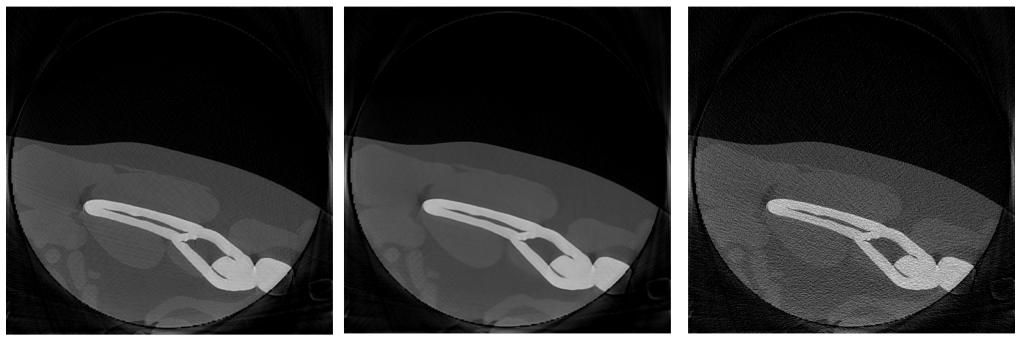
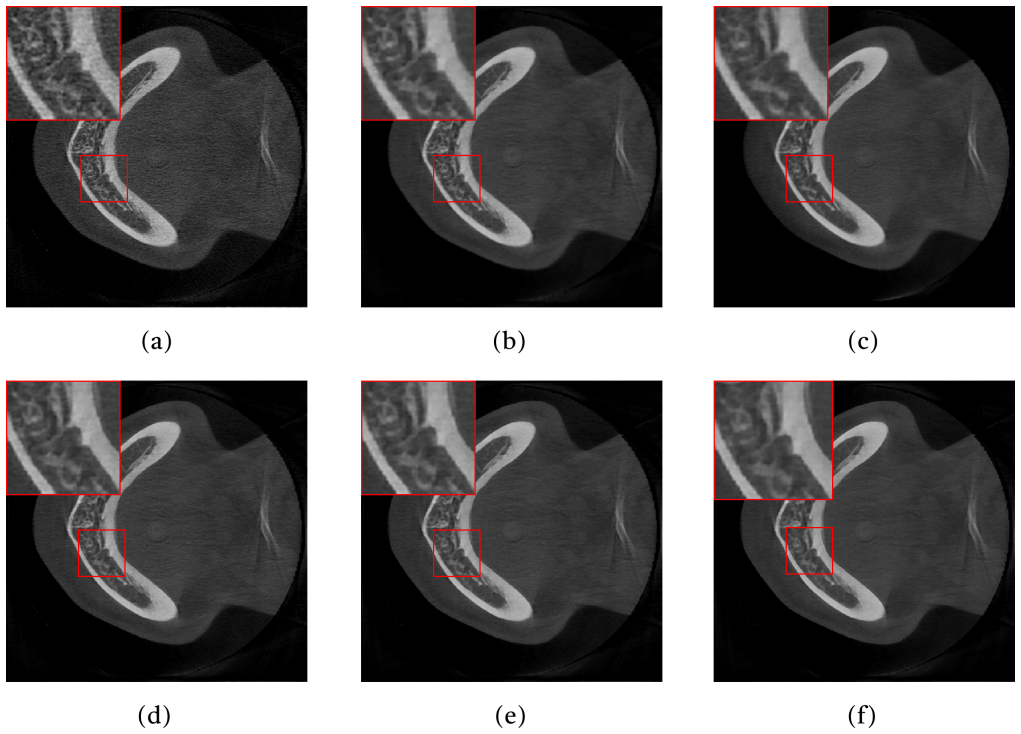
The central claim is that a gradient-step denoiser trained exclusively on reconstructed images from simulated fan-beam acquisitions with added photon noise can be integrated into a plug-and-play gradient-step algorithm to reconstruct images from simulated and real dental cone-beam CT projections, with the model exhibiting denoising on synthetic data and generalization on real data.
What carries the argument
The gradient-step denoiser, a neural network that supplies the gradient of a learned prior for iterative reconstruction steps.
If this is right
- The trained model reduces photon noise in reconstructions from simulated projections.
- Qualitative evaluations confirm the algorithm performs on real dental images.
- The approach demonstrates generalization from fan-beam simulations to cone-beam data without retraining.
Where Pith is reading between the lines
- Simulation-only training may lower the data requirements for learned priors in other medical CT tasks.
- The same plug-and-play structure could be tested on different noise models or scanner geometries to check robustness.
- Adding even a small amount of real data to the training set might further improve performance on clinical scans.
Load-bearing premise
A denoiser trained only on simulated fan-beam data with photon noise will generalize to real dental cone-beam CT projections without domain adaptation or retraining.
What would settle it
Quantitative metrics on a held-out set of real dental CBCT scans showing no noise reduction or degraded image quality when the plug-and-play model is used versus standard filtered back-projection or iterative methods without the learned prior.
Figures

read the original abstract
The goal of this work is to reduce the effect of photon noise in dental cone-beam CT reconstruction. We consider an inverse problem formulation and develop a databased prior. To this end, we simulate fan-beam acquisitions and add photon noise to the projection data. The prior is obtained by training a gradient-step denoiser using reconstructed simulated acquisitions. The trained model is integrated into a plug-and-play gradient-step algorithm to reconstruct images from simulated projections. Experiments on synthetic data demonstrate the denoising capabilities of the trained model, while qualitative evaluations on real images showcase the algorithm's performance and generalization ability.
Editorial analysis
A structured set of objections, weighed in public.
Referee Report
Summary. The manuscript develops a data-driven prior for reducing photon noise in dental cone-beam CT (CBCT) reconstruction by training a gradient-step denoiser on simulated fan-beam projections with added photon noise. The trained denoiser is then plugged into a gradient-step PnP algorithm. Experiments on synthetic data are said to demonstrate denoising, while qualitative results on real images are presented as evidence of performance and generalization ability.
Significance. If the claimed generalization holds, the work would demonstrate that a prior learned exclusively from fan-beam simulations can be effective for real cone-beam dental CBCT without retraining or domain adaptation, which would be useful given the difficulty of obtaining paired real data. The gradient-step formulation is a known technique, so the contribution rests on the specific training regime and the transfer result.
major comments (2)
- [Abstract] Abstract: the central generalization claim (that the fan-beam-trained gradient-step denoiser remains effective on real cone-beam data) is load-bearing for the paper's contribution, yet the manuscript provides only qualitative evaluations on real images with no quantitative metrics, no comparison to baselines, and no ablation on geometry or noise mismatch.
- [Abstract] Abstract: the training distribution is restricted to simulated fan-beam acquisitions with photon noise, while the target is real dental cone-beam geometry; the manuscript contains no analysis or mitigation of the differences in ray divergence, scatter, beam hardening, or detector characteristics that could invalidate the prior.
Simulated Author's Rebuttal
We thank the referee for their constructive feedback on the manuscript. We address each major comment below and indicate where revisions will be made to improve clarity and completeness.
read point-by-point responses
-
Referee: [Abstract] Abstract: the central generalization claim (that the fan-beam-trained gradient-step denoiser remains effective on real cone-beam data) is load-bearing for the paper's contribution, yet the manuscript provides only qualitative evaluations on real images with no quantitative metrics, no comparison to baselines, and no ablation on geometry or noise mismatch.
Authors: We agree that quantitative support for generalization would be desirable. However, paired ground-truth images free of photon noise are unavailable for real dental CBCT acquisitions, precluding standard quantitative metrics or ablations on real data. Synthetic experiments supply the quantitative evidence, while real-data results remain qualitative to illustrate practical utility. We will revise the abstract and add an explicit limitations paragraph discussing the absence of real-data ground truth and the resulting evaluation constraints. revision: partial
-
Referee: [Abstract] Abstract: the training distribution is restricted to simulated fan-beam acquisitions with photon noise, while the target is real dental cone-beam geometry; the manuscript contains no analysis or mitigation of the differences in ray divergence, scatter, beam hardening, or detector characteristics that could invalidate the prior.
Authors: The work centers on a prior learned specifically for photon-noise reduction. We concur that an explicit examination of the domain gap between fan-beam simulation and real cone-beam geometry (including ray divergence, scatter, beam hardening, and detector effects) would strengthen the manuscript. In the revision we will insert a dedicated analysis subsection that discusses these mismatches, their potential influence on prior transfer, and any implicit mitigation arising from the gradient-step formulation. revision: yes
Circularity Check
No circularity; training on simulated data and separate evaluation on real data form independent steps
full rationale
The abstract describes a standard supervised training pipeline: simulate fan-beam projections, add photon noise, reconstruct, train a gradient-step denoiser on those reconstructions, then plug the resulting prior into a PnP algorithm. Synthetic experiments test denoising on held-out simulated data; real-image evaluation is presented as a separate qualitative check. No equations, fitted parameters renamed as predictions, or self-citations appear in the provided text that would make any claimed result equivalent to its inputs by construction. The generalization assumption from fan-beam simulation to cone-beam reality is an empirical claim, not a definitional reduction, so the derivation chain remains self-contained.
Axiom & Free-Parameter Ledger
Forward citations
Cited by 1 Pith paper
-
Multilevel Stochastic Plug-and-Play for Sparse-View CT Reconstruction
ML-SPnP accelerates stochastic PnP for SVCT by using MRA approximation spaces where prior-coherence corrections vanish in expectation, yielding comparable quality at reduced runtime.
Reference graph
Works this paper leans on
-
[1]
Plug-and-play priors for model based reconstruction,
S. V . Venkatakrishnan, C. A. Bouman, and B. Wohlberg, “Plug-and-play priors for model based reconstruction,” in 2013 IEEE global conference on signal and information processing . IEEE, 2013, pp. 945–948
2013
-
[2]
Plug-and-play methods for integrating physical and learned models in computational imaging: Theory, algorithms, and applications,
U. S. Kamilov, C. A. Bouman, G. T. Buzzard, and B. Wohlberg, “Plug-and-play methods for integrating physical and learned models in computational imaging: Theory, algorithms, and applications,” IEEE Signal Processing Magazine , vol. 40, no. 1, pp. 85–97, 2023
2023
-
[3]
Image denoising by sparse 3-D transform-domain collaborative filtering,
K. Dabov, A. Foi, V . Katkovnik, and K. Egiazarian, “Image denoising by sparse 3-D transform-domain collaborative filtering,” IEEE Transactions on Image Processing , vol. 16, no. 8, pp. 2080–2095, 2007
2080
-
[4]
Beyond a Gaussian denoiser: Residual learning of deep CNN for image denoising,
K. Zhang, W. Zuo, Y . Chen, D. Meng, and L. Zhang, “Beyond a Gaussian denoiser: Residual learning of deep CNN for image denoising,” IEEE Trans. on Image Processing , vol. 26, no. 7, pp. 3142–3155, 2017
2017
-
[5]
Plug- and-play image restoration with deep denoiser prior,
K. Zhang, Y . Li, W. Zuo, L. Zhang, L. Van Gool, and R. Timofte, “Plug- and-play image restoration with deep denoiser prior,” IEEE Trans. on Pattern Analysis and Mach. Intel. , vol. 44, no. 10, pp. 6360–6376, 2021
2021
-
[6]
Plug-and- play methods provably converge with properly trained denoisers,
E. Ryu, J. Liu, S. Wang, X. Chen, Z. Wang, and W. Yin, “Plug-and- play methods provably converge with properly trained denoisers,” in International Conference on Machine Learning , 2019, pp. 5546–5557
2019
-
[7]
Learning maximally monotone operators for image recovery,
J.-C. Pesquet, A. Repetti, M. Terris, and Y . Wiaux, “Learning maximally monotone operators for image recovery,” SIAM Journal on Imaging Sciences, vol. 14, no. 3, pp. 1206–1237, 2021
2021
-
[8]
Gradient step denoiser for convergent plug-and-play,
S. Hurault, A. Leclaire, and N. Papadakis, “Gradient step denoiser for convergent plug-and-play,” CoRR, vol. abs/2110.03220, 2021
arXiv 2021
-
[9]
4D XCAT phantom for multimodality imaging research,
W. P. Segars, G. Sturgeon, S. Mendonca, J. Grimes, and B. M. W. Tsui, “4D XCAT phantom for multimodality imaging research,”Medical Physics, vol. 37, no. 9, pp. 4902–4915, 2010
2010
-
[10]
Re- construction Toolkit (RTK) v2, an Insight Toolkit (ITK) module for tomographic reconstruction,
S. Rit, S. Brousmiche, J. Finet, G. C. Sharp, and P. Steininger, “Re- construction Toolkit (RTK) v2, an Insight Toolkit (ITK) module for tomographic reconstruction,” in International Conference on the use of Computers in Radiation therapy (ICCR) , Lyon, France, 2024
2024
-
[11]
Mathemati- cal aspects of divergent beam radiography,
K. T. Smith, D. C. Solmon, S. L. Wagner, and C. Hamaker, “Mathemati- cal aspects of divergent beam radiography,” Proceedings of the National Academy of Sciences , vol. 75, no. 5, pp. 2055–2058, 1978. [Online]. Available: https://www.pnas.org/doi/abs/10.1073/pnas.75.5.2055
-
[12]
Multi- resolution statistical image reconstruction for mitigation of truncation effects: application to cone-beam CT of the head,
H. Dang, J. W. Stayman, A. Sisniega, and W. Zbijewski et al., “Multi- resolution statistical image reconstruction for mitigation of truncation effects: application to cone-beam CT of the head,” Phys Med Biol , vol. 62, no. 2, pp. 539–559, 2016
2016
-
[13]
H. S. Park and K. Jeon, “An iterative reconstruction method for dental cone-beam computed tomography with a truncated field of view,” arXiv preprint arXiv:2508.07618, 2025
arXiv 2025
-
[14]
Proximal denoiser for convergent plug-and-play optimization with nonconvex regularization,
S. Hurault, A. Leclaire, and N. Papadakis, “Proximal denoiser for convergent plug-and-play optimization with nonconvex regularization,” in Int. Conference on Machine Learning , vol. 162, 2022, pp. 9483–9505
2022
-
[15]
Deepinverse: A python package for solving imaging inverse problems with deep learning,
J. Tachella, M. Terris, S. Hurault, and A. Wang et al., “Deepinverse: A python package for solving imaging inverse problems with deep learning,” J. of Open Source Software , vol. 10, no. 115, p. 8923, 2025
2025
-
[16]
A relaxed proximal gradient descent algorithm for convergent plug-and-play with proximal denoiser,
S. Hurault, A. Chambolle, A. Leclaire, and N. Papadakis, “A relaxed proximal gradient descent algorithm for convergent plug-and-play with proximal denoiser,” in International Conference on Scale Space and V ariational Methods in Computer Vision. Springer, 2023, pp. 379–392
2023
discussion (0)
Sign in with ORCID, Apple, or X to comment. Anyone can read and Pith papers without signing in.