Skillful high-resolution weather forecasting independent of physical models
Pith reviewed 2026-06-29 09:37 UTC · model grok-4.3
The pith
A machine learning system produces skillful high-resolution regional weather forecasts and analyses using only observational data, without any numerical weather prediction models or reanalyses.
A machine-rendered reading of the paper's core claim, the machinery that carries it, and where it could break.
Core claim
ObsCast is an end-to-end machine learning model that learns to produce both weather analyses and forecasts solely from observational datasets and achieves state-of-the-art performance in short-term high-resolution regional modeling without using any NWP-generated reanalyses for supervision.
What carries the argument
ObsCast, the regional machine learning system that performs both analysis and forecasting directly from observations.
If this is right
- Forecasts are generated faster than traditional NWP while maintaining higher skill for near-surface variables.
- Precipitation forecasts remain skillful without inheriting resolution limits from reanalysis data.
- Regional services can be built and refined directly from local observations without developing full NWP pipelines.
- The system adapts more easily to locations where suitable reanalysis products are unavailable or expensive.
Where Pith is reading between the lines
- The same observation-only training approach could be tested on global scales if dense enough observational coverage becomes available.
- Performance on rare extreme events would indicate whether the model has captured dynamics that physical constraints normally enforce.
- Combining ObsCast outputs with sparse physical constraints might improve longer-range skill while retaining the independence benefit.
Load-bearing premise
Machine learning models can learn the complex atmospheric dynamics sufficiently well from observational data alone to produce accurate forecasts without guidance from physical models or reanalysis products.
What would settle it
Running ObsCast on a new geographic region with no training observations and comparing its 18-hour forecasts against independent high-resolution measurements would show whether skill falls below that of operational NWP.
Figures
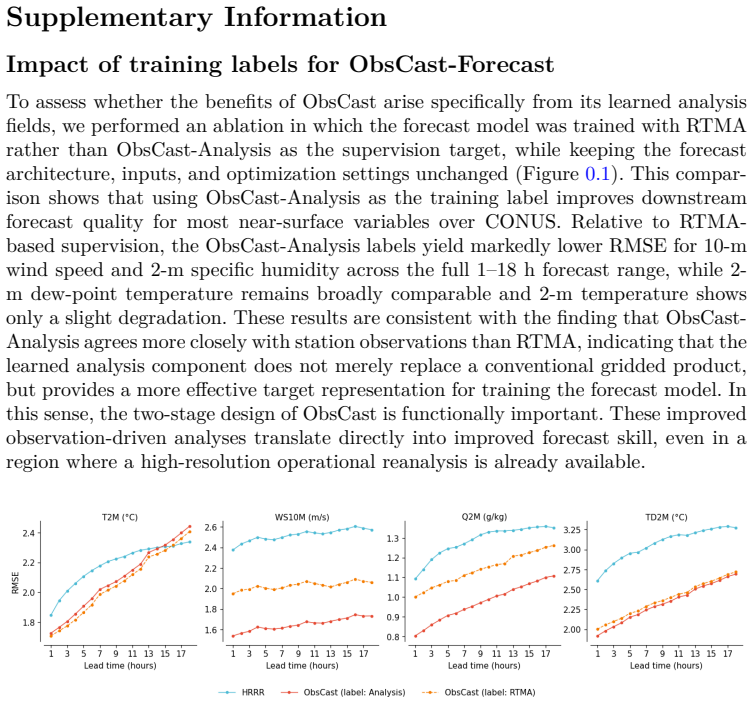
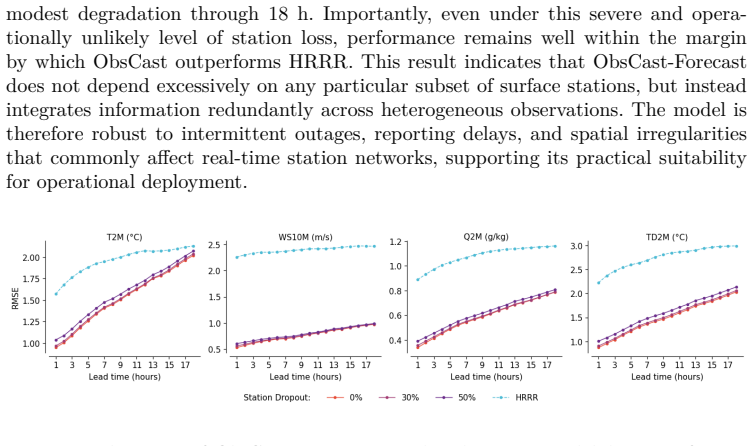
read the original abstract
Accurate and timely weather forecasts are critical for high-impact decisions in modern society. Machine-learning-based weather prediction is emerging as an alternative for producing initial conditions, forecasts, and even both in end-to-end systems. These methods deliver predictions faster and often with higher skill than traditional numerical weather prediction (NWP). However, even end-to-end models typically rely on NWP-generated reanalyses for supervision, thereby inheriting the biases and resolution limitations of those NWPs, and limiting adaptation to settings where suitable reanalysis products are unavailable, infrequently updated, or expensive to produce. Here we introduce ObsCast, a regional system that generates both analysis and predictions, without using any NWP-derived data in either training or inference, while still achieving state-of-the-art performance in short-term high-resolution regional modeling. Over the contiguous United States and Europe, ObsCast outperforms operational NWP for near-surface variables through 18 h and produces skillful precipitation forecasts. It provides a simpler and more adaptable route to build and refine regional forecasting services directly from local observations, without the need to develop complex and costly traditional forecasting pipelines.
Editorial analysis
A structured set of objections, weighed in public.
Referee Report
Summary. The manuscript introduces ObsCast, a regional machine-learning system that produces both analyses and short-term forecasts at high resolution. It claims to operate entirely from raw observational inputs with no NWP-derived data used in training or inference, while achieving state-of-the-art performance over the contiguous United States and Europe: outperforming operational NWP for near-surface variables through 18 h and delivering skillful precipitation forecasts.
Significance. If the independence claim and quantitative performance results are substantiated with full methodological detail, the work would offer a materially simpler pathway for building regional forecasting systems that do not require access to or inheritance from NWP reanalyses. This could be especially relevant for domains lacking mature NWP infrastructure.
major comments (2)
- [Abstract] Abstract: the central performance claims (state-of-the-art skill, outperformance through 18 h, skillful precipitation) are stated without any accompanying metrics, datasets, validation periods, or error bars, rendering the empirical assertions unevaluable from the supplied text.
- [Data and Methods] Data and Methods sections: the load-bearing assertion that 'no NWP-derived data' enters training or inference requires an exhaustive accounting of every input field and its provenance. Standard high-resolution observational products (satellite radiances, radar composites, surface QC) frequently embed NWP backgrounds or physical constraints via retrieval or assimilation steps; without explicit verification that ObsCast inputs avoid all such steps, the independence claim cannot be assessed.
minor comments (1)
- [Abstract] The abstract and title would benefit from a concise operational definition of 'NWP-derived data' to bound the independence claim.
Simulated Author's Rebuttal
We thank the referee for their constructive feedback and recommendation for major revision. We address each major comment below and will revise the manuscript accordingly to improve clarity and substantiation of our claims.
read point-by-point responses
-
Referee: [Abstract] Abstract: the central performance claims (state-of-the-art skill, outperformance through 18 h, skillful precipitation) are stated without any accompanying metrics, datasets, validation periods, or error bars, rendering the empirical assertions unevaluable from the supplied text.
Authors: We agree that the abstract would benefit from greater specificity. In the revised manuscript we will incorporate key quantitative metrics (e.g., RMSE and anomaly correlation for 2 m temperature and 10 m wind), the exact validation periods and domains (e.g., 2022–2023 over CONUS and Europe), and reference to error bars or significance testing so that the performance claims can be directly evaluated from the abstract. revision: yes
-
Referee: [Data and Methods] Data and Methods sections: the load-bearing assertion that 'no NWP-derived data' enters training or inference requires an exhaustive accounting of every input field and its provenance. Standard high-resolution observational products (satellite radiances, radar composites, surface QC) frequently embed NWP backgrounds or physical constraints via retrieval or assimilation steps; without explicit verification that ObsCast inputs avoid all such steps, the independence claim cannot be assessed.
Authors: We acknowledge that an exhaustive provenance table is necessary to fully substantiate the independence claim. The revised Data and Methods section will include a comprehensive table enumerating every input field, its exact observational source, and explicit confirmation that no NWP background, retrieval, or assimilation step is involved (e.g., direct ASOS surface observations, raw radar reflectivity, and unprocessed satellite brightness temperatures). This will allow readers to verify that no NWP-derived information enters training or inference. revision: yes
Circularity Check
No circularity; empirical performance claims from observational data
full rationale
The paper presents ObsCast as an ML system trained and run exclusively on observational inputs to produce analysis and forecasts, with performance evaluated empirically against operational NWP. No equations, derivations, or claims reduce by construction to fitted parameters, self-definitions, or self-citation chains. The independence assertion and skill results are framed as outcomes of data-driven training rather than tautological or load-bearing self-references, making the derivation self-contained.
Axiom & Free-Parameter Ledger
Reference graph
Works this paper leans on
-
[1]
& Brunet, G
Bauer, P., Thorpe, A. & Brunet, G. The quiet revolution of numerical weather prediction.Nature525, 47–55 (2015)
2015
-
[2]
Kalnay, E.Atmospheric modeling, data assimilation and predictability(Cam- bridge university press, 2003)
2003
-
[3]
J.et al.All-sky satellite data assimilation at operational weather forecasting centres.Quarterly Journal of the Royal Meteorological Society144, 1191–1217 (2018)
Geer, A. J.et al.All-sky satellite data assimilation at operational weather forecasting centres.Quarterly Journal of the Royal Meteorological Society144, 1191–1217 (2018)
2018
-
[4]
Reichstein, M.et al.Deep learning and process understanding for data-driven earth system science.Nature566, 195–204 (2019)
2019
-
[5]
Ben Bouallegue, Z.et al.The rise of data-driven weather forecasting: A first statistical assessment of machine learning–based weather forecasts in an operational-like context.Bulletin of the American Meteorological Society105, E864–E883 (2024)
2024
-
[6]
Bi, K.et al.Accurate medium-range global weather forecasting with 3d neural networks.Nature619, 533–538 (2023)
2023
-
[7]
Chen, L.et al.Fuxi: a cascade machine learning forecasting system for 15-day global weather forecast.npj climate and atmospheric science6, 190 (2023)
2023
-
[8]
Lam, R.et al.Learning skillful medium-range global weather forecasting.Science 382, 1416–1421 (2023)
2023
-
[9]
Nature632, 1060–1066 (2024)
Kochkov, D.et al.Neural general circulation models for weather and climate. Nature632, 1060–1066 (2024)
2024
- [10]
-
[11]
Price, I.et al.Probabilistic weather forecasting with machine learning.Nature 637, 84–90 (2025). 19
2025
-
[12]
Bodnar, C.et al.A foundation model for the earth system.Nature1–8 (2025)
2025
-
[13]
Parker, W. S. Reanalyses and observations: What’s the difference?Bulletin of the American Meteorological Society97, 1565–1572 (2016)
2016
-
[14]
Hersbach, H.et al.The era5 global reanalysis.Quarterly journal of the royal meteorological society146, 1999–2049 (2020)
1999
- [15]
- [16]
-
[17]
Allen, A.et al.End-to-end data-driven weather prediction.Nature641, 1172– 1179 (2025)
2025
-
[18]
Nature Communications16, 6658 (2025)
Sun, X.et al.A data-to-forecast machine learning system for global weather. Nature Communications16, 6658 (2025)
2025
-
[19]
Litjens, G.et al.A survey on deep learning in medical image analysis.Medical image analysis42, 60–88 (2017)
2017
-
[20]
Choudhary, K.et al.Recent advances and applications of deep learning methods in materials science.npj Computational Materials8, 59 (2022)
2022
-
[21]
G.et al.Can deep learning beat numerical weather prediction? Philosophical Transactions of the Royal Society A: Mathematical, Physical and Engineering Sciences379(2021)
Schultz, M. G.et al.Can deep learning beat numerical weather prediction? Philosophical Transactions of the Royal Society A: Mathematical, Physical and Engineering Sciences379(2021)
2021
- [22]
-
[23]
Manshausen, P.et al.Generative data assimilation of sparse weather station observations at kilometer scales.Journal of Advances in Modeling Earth Systems 17, e2024MS004505 (2025)
2025
-
[24]
Xiang, Y.et al.Adaf: An artificial intelligence data assimilation framework for weather forecasting.Journal of Advances in Modeling Earth Systems17, e2024MS004839 (2025)
2025
-
[25]
Fan, H.et al.Physically consistent global atmospheric data assimilation with machine learning in latent space.Science Advances12, eaea4248 (2026)
2026
-
[26]
T., Peterson, R
Warner, T. T., Peterson, R. A. & Treadon, R. E. A tutorial on lateral boundary conditions as a basic and potentially serious limitation to regional numerical 20 weather prediction.Bulletin of the American Meteorological Society78, 2599– 2618 (1997)
1997
-
[27]
S.et al.The real-time mesoscale analysis at noaa’s national centers for environmental prediction: current status and development.Weather and Forecasting26, 593–612 (2011)
De Pondeca, M. S.et al.The real-time mesoscale analysis at noaa’s national centers for environmental prediction: current status and development.Weather and Forecasting26, 593–612 (2011)
2011
-
[28]
Zhang, J.et al.Multi-radar multi-sensor (mrms) quantitative precipitation esti- mation: Initial operating capabilities.Bulletin of the American Meteorological Society97, 621–638 (2016)
2016
-
[29]
C.et al.The high-resolution rapid refresh (hrrr): An hourly updating convection-allowing forecast model
Dowell, D. C.et al.The high-resolution rapid refresh (hrrr): An hourly updating convection-allowing forecast model. part i: Motivation and system description. Weather and Forecasting37, 1371–1395 (2022)
2022
-
[30]
URL https://www
ECMWF.IFS Documentation CY49R1(ECMWF, 2024). URL https://www. ecmwf.int/en/elibrary/81623-ifs-documentation-cy49r1-part-i-observations
2024
-
[31]
Noaa global fore- cast system (gfs)
National Oceanic and Atmospheric Administration (NOAA). Noaa global fore- cast system (gfs). Registry of Open Data on AWS (2024). URL https://registry. opendata.aws/noaa-gfs-bdp-pds/. Accessed: 2026-02-05
2024
-
[32]
Fovell, R. G. & Gallagher, A. An evaluation of surface wind and gust forecasts from the high-resolution rapid refresh model.Weather and Forecasting37, 1049– 1068 (2022)
2022
-
[33]
P.et al.The high-resolution rapid refresh (hrrr): an hourly updating convection-allowing forecast model
James, E. P.et al.The high-resolution rapid refresh (hrrr): an hourly updating convection-allowing forecast model. part ii: Forecast performance.Weather and Forecasting37, 1397–1417 (2022)
2022
-
[34]
Ravuri, S.et al.Skilful precipitation nowcasting using deep generative models of radar.Nature597, 672–677 (2021)
2021
-
[35]
Nature619, 526–532 (2023)
Zhang, Y.et al.Skilful nowcasting of extreme precipitation with nowcastnet. Nature619, 526–532 (2023)
2023
-
[36]
Janji´ c, T.et al.On the representation error in data assimilation.Quarterly Journal of the Royal Meteorological Society144, 1257–1278 (2018)
2018
-
[37]
Xu, P.et al.An artificial intelligence-based limited area model for forecasting of surface meteorological variables.Communications Earth & Environment6, 372 (2025)
2025
-
[38]
Dueben, P. D. & Bauer, P. Challenges and design choices for global weather and climate models based on machine learning.Geoscientific Model Development11, 3999–4009 (2018). 21
2018
- [39]
-
[40]
NOAA GOES-16 Advanced Baseline Imager (ABI) Data (2019)
GOES-R Series Program. NOAA GOES-16 Advanced Baseline Imager (ABI) Data (2019). Available at https://www.ncei.noaa.gov/
2019
-
[41]
Meteosat Satellite Observations
European Organisation for the Exploitation of Meteorological Satellites (EUMETSAT). Meteosat Satellite Observations. EUMETSAT data and prod- ucts accessed via EUMETSAT Data Centre (2025). URL https://www.eumetsat. int/our-satellites/meteosat-series
2025
-
[42]
Saltikoff, E.et al.Opera the radar project.Atmosphere10, 320 (2019)
2019
-
[43]
Weng, F.et al.Advanced microwave sounding unit cloud and precipitation algorithms.Radio Science38, 33–1 (2003)
2003
-
[44]
Habib, S., Meynart, R., Neeck, S
Bonsignori, R. Habib, S., Meynart, R., Neeck, S. P. & Shimoda, H. (eds)The Microwave Humidity Sounder (MHS): in-orbit performance assessment. (eds Habib, S., Meynart, R., Neeck, S. P. & Shimoda, H.)Sensors, Systems, and Next- Generation Satellites XI, Vol. 6744, 67440A. International Society for Optics and Photonics (SPIE, 2007). URL https://doi.org/10.11...
-
[45]
Durre, I.et al.Integrated global radiosonde archive (igra), version 2 (2016)
2016
-
[46]
Danielson, J. J. & Gesch, D. B. Global multi-resolution terrain elevation data 2010 (gmted2010). Tech. Rep., US Geological Survey (2011)
2010
-
[47]
An Image is Worth 16x16 Words: Transformers for Image Recognition at Scale
Dosovitskiy, A. An image is worth 16x16 words: Transformers for image recognition at scale.arXiv preprint arXiv:2010.11929(2020)
work page internal anchor Pith review Pith/arXiv arXiv 2010
-
[48]
URL https://arxiv.org/abs/2111.09883
Liu, Z.et al.Swin transformer v2: Scaling up capacity and resolution (2022). URL https://arxiv.org/abs/2111.09883. 2111.09883
-
[49]
Guibas, J.et al.Adaptive fourier neural operators: Efficient token mixers for transformers.arXiv preprint arXiv:2111.13587(2021). Acknowledgments The authors express their gratitude to all providers for providing the publicly acces- sible data. The authors would like to thank Synoptic Data PBC (accessible at https://synopticdata.com/) for aggregating stat...
discussion (0)
Sign in with ORCID, Apple, or X to comment. Anyone can read and Pith papers without signing in.