Learning Logical Operations for Arbitrary Quantum Error Correction Codes
Pith reviewed 2026-06-29 12:17 UTC · model grok-4.3
The pith
A learning framework finds physical circuits realizing logical operations on arbitrary quantum error-correcting codes from the encoding alone.
A machine-rendered reading of the paper's core claim, the machinery that carries it, and where it could break.
Core claim
Given solely an encoding circuit, the framework constructs physical realizations of logical operations while enforcing structural properties such as transversality or shallow depth; the same pipeline extends to a co-design loop that tailors non-additive encodings to a noise model and enforces chosen logical gate sets, including transversal IQP-type families or low-depth universal sets.
What carries the argument
The variational optimization procedure that tunes circuit parameters to match a target logical action subject to structural constraints, extended to joint optimization of the encoding itself.
If this is right
- Logical operations become discoverable for non-additive codes that have no stabilizer description.
- Encodings can be co-optimized with a noise model to support chosen logical gate sets.
- The approach directly supplies hardware-adapted gadgets for early fault-tolerant computation.
- A software pipeline automates the full loop of loss design, ansatz selection, and optimization.
Where Pith is reading between the lines
- Custom non-additive codes could be generated on demand for specific device noise profiles rather than selected from a pre-existing catalog.
- The same optimization loop might be reused to discover fault-tolerant gadgets that go beyond the transversal or low-depth families considered here.
- If the method scales, it could shorten the design cycle between hardware characterization and code selection.
Load-bearing premise
The chosen loss functions and circuit families are sufficient for the optimizer to converge on implementations that actually perform the desired logical operations without requiring separate verification.
What would settle it
Apply the framework to the Steane code with a transversality constraint and test whether the learned circuit matches the known transversal Hadamard or CNOT up to local corrections.
Figures


read the original abstract
Logical operations are essential for quantum computation within quantum error-correcting codes. However, discovering their physical realizations is challenging, especially for non-additive codes that lack a stabilizer description. We present a general learning-based framework that, given only an encoding circuit, constructs physical implementations of logical operations while enforcing structural properties such as transversality or shallow depth. Our approach is validated by rediscovering known logical operations of standard stabilizer codes. We then extend it to a co-design procedure, dubbed variational early fault-tolerant quantum computing (VarEFTQC), which tailors non-additive encodings to a given noise model and enforces desired logical gate sets, such as transversal IQP-type families or low-depth universal sets. A software library implements the complete learning pipeline, including loss-function variants, ansatz families, and optimization routines. Together, these results position VarEFTQC as a practical tool for discovering hardware-adapted logical gadgets for early fault-tolerant quantum computing.
Editorial analysis
A structured set of objections, weighed in public.
Referee Report
Summary. The manuscript presents a learning-based framework that, given only an encoding circuit for a quantum error-correcting code, discovers physical implementations of logical operations while enforcing constraints such as transversality or shallow depth. It validates the approach by rediscovering known operations on stabilizer codes and extends it to a variational co-design method (VarEFTQC) that tailors non-additive encodings to noise models and desired logical gate sets (e.g., transversal IQP or low-depth universal families). A software library implementing the pipeline (loss variants, ansatze, optimizers) is provided.
Significance. If the central claim holds, the work would offer a practical, general tool for logical-gate discovery on non-stabilizer codes and for hardware-adapted early fault-tolerant gadgets, with the open-source library as a concrete contribution that enables reproducibility.
major comments (2)
- [Abstract / validation paragraph] The validation claim (rediscovering known operations) only demonstrates reachability of correct solutions; it does not establish that every low-loss minimum realizes the intended logical action on the code subspace. No explicit post-optimization verification (e.g., computation of the logical channel or commutation with the code projector) is described, leaving open the possibility of spurious minima that satisfy the numerical loss but fail to act correctly as logical unitaries.
- [Framework description] The loss-function construction that is asserted to enforce both logical action and structural constraints (transversality, depth) is not specified in sufficient detail to assess whether it is free of the circularity risk noted in the stress-test: minima could satisfy the loss by construction without guaranteeing the logical map. Concrete forms of the loss, the ansatz families, and any regularization terms are required to evaluate this.
minor comments (2)
- Notation for the encoding circuit and the logical operators should be introduced with explicit definitions before the optimization procedure is described.
- The manuscript should include at least one concrete example (e.g., a small non-additive code) showing the explicit circuit found, the loss value, and an independent check that the logical action is correct.
Simulated Author's Rebuttal
We thank the referee for the careful and constructive review. The two major comments identify areas where additional verification and explicit detail are needed to strengthen the claims. We address each point below and will revise the manuscript accordingly.
read point-by-point responses
-
Referee: [Abstract / validation paragraph] The validation claim (rediscovering known operations) only demonstrates reachability of correct solutions; it does not establish that every low-loss minimum realizes the intended logical action on the code subspace. No explicit post-optimization verification (e.g., computation of the logical channel or commutation with the code projector) is described, leaving open the possibility of spurious minima that satisfy the numerical loss but fail to act correctly as logical unitaries.
Authors: We agree that reachability alone does not rule out spurious minima. Although the loss is constructed to penalize deviations from the target logical action on the code subspace, the manuscript does not report explicit post-optimization checks. In the revision we will add a verification procedure that extracts the effective logical channel via projection onto the code subspace and verifies commutation with the code projector for all rediscovered operations. These checks will be included in the validation section and the supplementary material. revision: yes
-
Referee: [Framework description] The loss-function construction that is asserted to enforce both logical action and structural constraints (transversality, depth) is not specified in sufficient detail to assess whether it is free of the circularity risk noted in the stress-test: minima could satisfy the loss by construction without guaranteeing the logical map. Concrete forms of the loss, the ansatz families, and any regularization terms are required to evaluate this.
Authors: The referee is correct that the current manuscript provides only a high-level description of the loss components. We will expand the framework section with the explicit mathematical expressions for each loss term (logical-action fidelity, transversality penalty, depth penalty), the precise parameterization of the variational ansatze, and the regularization coefficients. These additions will make it possible to evaluate whether the loss enforces the logical map independently of the structural constraints and will reference the corresponding implementations in the released software library. revision: yes
Circularity Check
No circularity: optimization framework with external validation
full rationale
The paper describes a variational learning pipeline that takes an encoding circuit as input and optimizes ansatzes under explicitly constructed loss functions to enforce logical action plus structural constraints. Rediscovery of known stabilizer-code gates serves as external validation rather than definitional closure. No equations reduce the output to the input by construction, no load-bearing self-citations are invoked for uniqueness or ansatz choice, and the central claim (that the framework produces correct gadgets) rests on the design of the loss rather than on renaming fitted quantities. This is a standard non-circular variational search setup.
Axiom & Free-Parameter Ledger
free parameters (1)
- ansatz parameters
axioms (2)
- domain assumption The given encoding circuit is correct and sufficient as input.
- ad hoc to paper Loss functions can be constructed to enforce both logical action and constraints like transversality.
Reference graph
Works this paper leans on
-
[1]
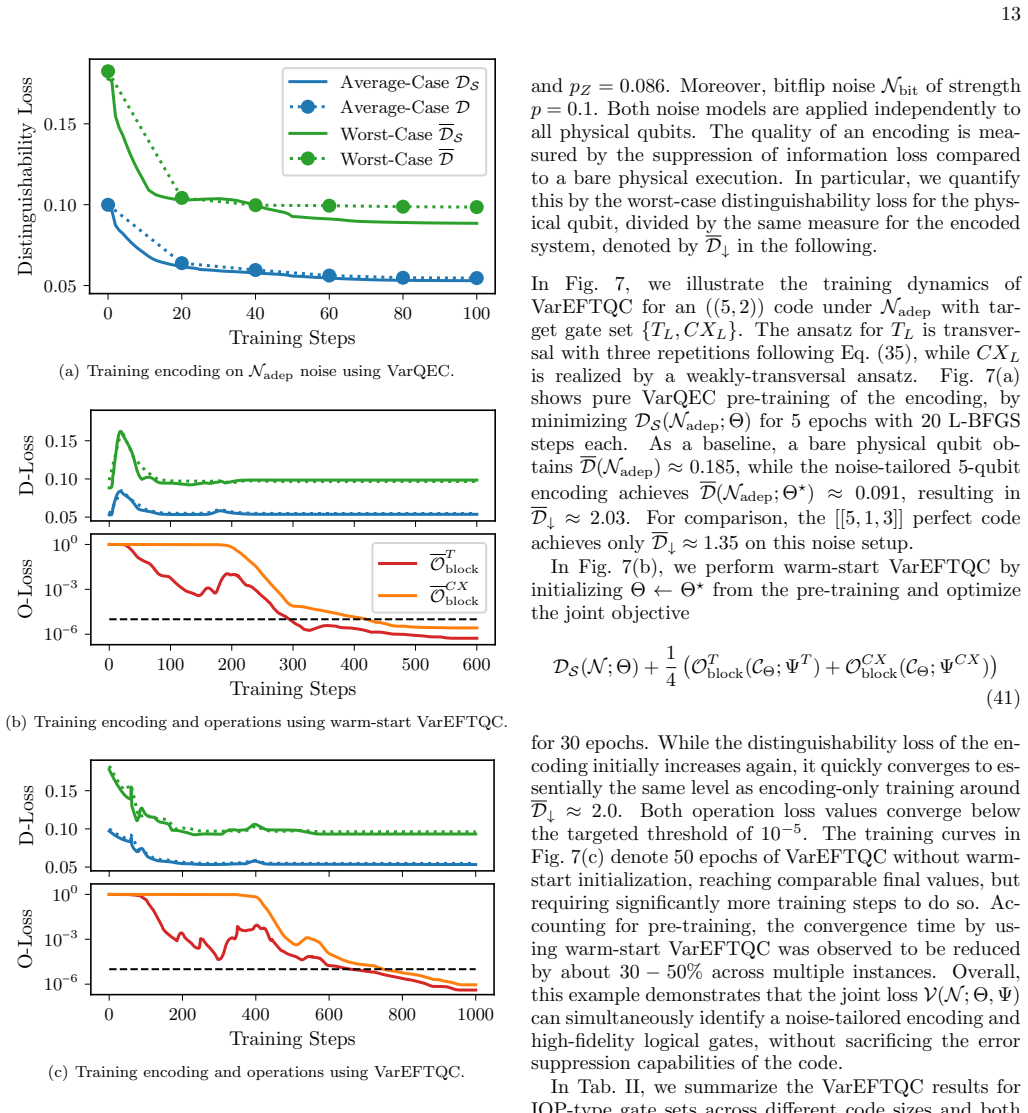
(c) Same VarEFTQC setup as in (b), but without warm-start initialization of the encoding. andp Z = 0.086. Moreover, bitflip noiseN bit of strength p= 0.1. Both noise models are applied independently to all physical qubits. The quality of an encoding is mea- sured by the suppression of information loss compared to a bare physical execution. In particular, ...
-
[2]
P. W. Shor, Scheme for reducing decoherence in quantum computer memory, Phys. Rev. A52, R2493 (1995)
1995
-
[3]
A. M. Steane, Error Correcting Codes in Quantum The- ory, Phys. Rev. Lett.77, 793 (1996)
1996
-
[4]
Gottesman,Stabilizer codes and quantum error cor- rection, Ph.D
D. Gottesman,Stabilizer codes and quantum error cor- rection, Ph.D. thesis, California Institute of Technology (1997)
1997
-
[5]
Learning Encodings by Maximizing State Distinguishability: Variational Quantum Error Correction
N. Meyer, C. Mutschler, A. Maier, and D. D. Scherer, Learning Encodings by Maximizing State Dis- tinguishability: Variational Quantum Error Correction, arXiv:2506.11552 (2025)
work page internal anchor Pith review Pith/arXiv arXiv 2025
-
[6]
Meyer, C
N. Meyer, C. Mutschler, A. Maier, and D. D. Scherer, Variational Quantum Error Correction, inIEEE Inter- national Conference on Quantum Computing and Engi- neering (QCE), Vol. 2 (2025) pp. 456–457
2025
-
[7]
P. W. Shor, Fault-tolerant quantum computation, inSymposium on Foundations of Computer Science (FOCS)(1996) pp. 56–65
1996
-
[8]
Gottesman, An Introduction to Quantum Error Cor- rection and Fault-Tolerant Quantum Computation, in Proc
D. Gottesman, An Introduction to Quantum Error Cor- rection and Fault-Tolerant Quantum Computation, in Proc. Sympos. Appl. Math., Vol. 68 (2010) pp. 13–58
2010
-
[9]
Aliferis, D
P. Aliferis, D. Gottesman, and J. Preskill, Quantum accu- racy threshold for concatenated distance-3 codes, Quan- tum Inf. Comput.6, 97 (2005)
2005
-
[10]
D. A. Lidar and T. A. Brun,Quantum Error Correction (Cambridge University Press, 2013)
2013
-
[11]
Eastin and E
B. Eastin and E. Knill, Restrictions on Transversal En- coded Quantum Gate Sets, Phys. Rev. Lett.102, 110502 (2009)
2009
-
[12]
Horsman, A
D. Horsman, A. G. Fowler, S. Devitt, and R. Van Meter, Surface code quantum computing by lattice surgery, New J. Phys.14, 123011 (2012)
2012
-
[13]
Bravyi and A
S. Bravyi and A. Kitaev, Universal quantum computa- tion with ideal Clifford gates and noisy ancillas, Phys. Rev. A71, 022316 (2005)
2005
-
[14]
Paetznick and B
A. Paetznick and B. W. Reichardt, Universal Fault- Tolerant Quantum Computation with Only Transver- sal Gates and Error Correction, Phys. Rev. Lett.111, 090505 (2013)
2013
-
[15]
Katabarwa, K
A. Katabarwa, K. Gratsea, A. Caesura, and P. D. John- son, Early Fault-Tolerant Quantum Computing, PRX Quantum5, 020101 (2024)
2024
-
[16]
M. A. Webster, A. O. Quintavalle, and S. D. Bartlett, Transversal diagonal logical operators for stabiliser codes, New J. Phys.25, 103018 (2023)
2023
-
[17]
H. Chen, M. Vasmer, N. P. Breuckmann, and E. Grant, Automated discovery of logical gates for quantum error correction, Quantum Inf. Comput.22, 947 (2022)
2022
-
[18]
Kraus, General state changes in quantum theory, Ann
K. Kraus, General state changes in quantum theory, Ann. Phys.64, 311 (1971)
1971
-
[19]
J. Olle, R. Zen, M. Puviani, and F. Marquardt, Si- multaneous discovery of quantum error correction codes and encoders with a noise-aware reinforcement learning agent, npj Quantum Inf.10, 1 (2024)
2024
-
[20]
D. W. Leung, M. A. Nielsen, I. L. Chuang, and Y. Ya- mamoto, Approximate quantum error correction can lead to better codes, Phys. Rev. A56, 2567 (1997)
1997
-
[21]
Laflamme, C
R. Laflamme, C. Miquel, J. P. Paz, and W. H. Zurek, Per- fect Quantum Error Correcting Code, Phys. Rev. Lett. 77, 198 (1996)
1996
-
[22]
A. M. Steane, Quantum Reed-Muller Codes, IEEE Trans. Inf. Theory45, 1701 (2002)
2002
-
[23]
A. G. Fowler, M. Mariantoni, J. M. Martinis, and A. N. Cleland, Surface codes: Towards practical large-scale quantum computation, Phys. Rev. A86, 032324 (2012)
2012
-
[24]
C. Cao, C. Zhang, Z. Wu, M. Grassl, and B. Zeng, Quan- tum variational learning for quantum error-correcting codes, Quantum6, 828 (2022)
2022
-
[25]
Watrous,The Theory of Quantum Information(Cam- bridge University Press, 2018)
J. Watrous,The Theory of Quantum Information(Cam- bridge University Press, 2018)
2018
-
[26]
P. D. Johnson, J. Romero, J. Olson, Y. Cao, and A. Aspuru-Guzik, QVECTOR: an algorithm for device- tailored quantum error correction, arXiv:1711.02249 (2017)
work page internal anchor Pith review Pith/arXiv arXiv 2017
-
[27]
M. A. Nielsen and I. L. Chuang,Quantum Computation and Quantum Information(Cambridge University Press, 2010)
2010
-
[28]
E. Camps-Moreno, H. H. L´ opez, G. L. Matthews, N. Ren- gaswamy, and R. San-Jos´ e, Transversal gates for quan- tum CSS codes, arXiv:2601.21514 (2026)
-
[29]
Chen and N
Z. Chen and N. Rengaswamy, Tailoring Fault-Tolerance to Quantum Algorithms, IEEE J. Sel. Areas Inf. Theory 6, 311 (2025)
2025
-
[30]
Optimized Compilation of Logical Clifford Circuits
A. Popov, N. Meyer, D. D. Scherer, and G. Di- etl, Optimized Compilation of Logical Clifford Circuits, arXiv:2602.12831 (2026)
work page internal anchor Pith review Pith/arXiv arXiv 2026
-
[31]
Z. Chen, J. O. Weinberg, and N. Rengaswamy, Fault Tol- erant Quantum Simulation via Symplectic Transvections, inIEEE International Conference on Quantum Comput- ing and Engineering (QCE), Vol. 1 (2025) p. 158
2025
-
[32]
Hastie,The Elements of Statistical Learning: Data Mining, Inference, and Prediction(Springer, 2009)
T. Hastie,The Elements of Statistical Learning: Data Mining, Inference, and Prediction(Springer, 2009)
2009
-
[33]
Bassily, V
R. Bassily, V. Feldman, C. Guzm´ an, and K. Talwar, Sta- bility of Stochastic Gradient Descent on Nonsmooth Con- vex Losses, inAdvances in Neural Information Processing Systems (NeurIPS), Vol. 33 (2020) pp. 4381–4391
2020
-
[34]
Sommers and K
H.-J. Sommers and K. ˙Zyczkowski, Statistical properties of random density matrices, J. Phys. A37, 8457 (2004)
2004
-
[35]
Ambainis and J
A. Ambainis and J. Emerson, Quantum t-designs: t-wise independence in the quantum world, inIEEE Conference on Computational Complexity (CCC)(2007) pp. 129– 140
2007
-
[36]
Dankert, R
C. Dankert, R. Cleve, J. Emerson, and E. Livine, Exact and approximate unitary 2-designs and their application to fidelity estimation, Phys. Rev. A80, 012304 (2009)
2009
-
[37]
Knill, Quantum computing with realistically noisy de- vices, Nature434, 39 (2005)
E. Knill, Quantum computing with realistically noisy de- vices, Nature434, 39 (2005)
2005
-
[38]
D. C. Liu and J. Nocedal, On the limited memory BFGS 23 method for large scale optimization, Math. Program.45, 503 (1989)
1989
-
[39]
Paszke, S
A. Paszke, S. Gross, F. Massa, A. Lerer, J. Bradbury, G. Chanan, T. Killeen, Z. Lin, N. Gimelshein, L. Antiga, A. Desmaison, A. Kopf, E. Yang, Z. DeVito, M. Raison, A. Tejani, S. Chilamkurthy, B. Steiner, L. Fang, J. Bai, and S. Chintala, PyTorch: An Imperative Style, High- Performance Deep Learning Library, inAdvances in Neu- ral Information Processing S...
2019
-
[40]
PennyLane: Automatic differentiation of hybrid quantum-classical computations
V. Bergholm, J. Izaac, M. Schuld, C. Gogolin, S. Ahmed, V. Ajith, M. S. Alam, G. Alonso-Linaje, B. Akash- Narayanan, A. Asadi,et al., PennyLane: Automatic dif- ferentiation of hybrid quantum-classical computations, arXiv:1811.04968 (2018)
work page internal anchor Pith review Pith/arXiv arXiv 2018
-
[41]
Meyer, C
N. Meyer, C. Ufrecht, M. Periyasamy, A. Plinge, C. Mutschler, D. D. Scherer, and A. Maier, Qiskit-Torch- Module: Fast Prototyping of Quantum Neural Networks, inIEEE International Conference on Quantum Comput- ing and Engineering (QCE), Vol. 1 (2024) pp. 817–823
2024
-
[42]
S. Du, J. Lee, H. Li, L. Wang, and X. Zhai, Gradient De- scent Finds Global Minima of Deep Neural Networks, in International Conference on Machine Learning (ICML), Vol. 95 (2019) pp. 1675–1685
2019
-
[43]
Allen-Zhu, Y
Z. Allen-Zhu, Y. Li, and Z. Song, A Convergence Theory for Deep Learning via Over-Parameterization, inInterna- tional Conference on Machine Learning (ICML), Vol. 97 (2019) pp. 242–252
2019
-
[44]
Hastie, A
T. Hastie, A. Montanari, S. Rosset, and R. J. Tibshirani, Surprises in High-Dimensional Ridgeless Least Squares Interpolation, Ann. Stat.50, 949 (2022)
2022
-
[45]
Meyer, J
N. Meyer, J. Murauer, A. Popov, C. Ufrecht, A. Plinge, C. Mutschler, and D. D. Scherer, Warm-Start Variational Quantum Policy Iteration, inIEEE International Confer- ence on Quantum Computing and Engineering (QCE), Vol. 1 (2024) pp. 1458–1466
2024
-
[46]
Nest, Simulating quantum computers with probabilis- tic methods, Quantum Inf
M. Nest, Simulating quantum computers with probabilis- tic methods, Quantum Inf. Comput.11, 0784 (2009)
2009
-
[47]
M. J. Bremner, R. Jozsa, and D. J. Shepherd, Classi- cal simulation of commuting quantum computations im- plies collapse of the polynomial hierarchy, Proc. Roy. Soc. Lond.467, 459 (2011)
2011
-
[48]
M. J. Bremner, A. Montanaro, and D. J. Shep- herd, Achieving quantum supremacy with sparse and noisy commuting quantum computations, Quantum1, 8 (2017)
2017
-
[49]
Coyle, D
B. Coyle, D. Mills, V. Danos, and E. Kashefi, The Born supremacy: quantum advantage and training of an Ising Born machine, npj Quantum Inf.6, 60 (2020)
2020
-
[50]
E. Recio-Armengol, S. Ahmed, and J. Bowles, Train on classical, deploy on quantum: scaling genera- tive quantum machine learning to a thousand qubits, arXiv:2503.02934 (2025)
-
[51]
Paletta, A
L. Paletta, A. Leverrier, A. Sarlette, M. Mirrahimi, and C. Vuillot, Robust sparse IQP sampling in constant depth, Quantum8, 1337 (2024)
2024
-
[52]
Hangleiter, M
D. Hangleiter, M. Kalinowski, D. Bluvstein, M. Cain, N. Maskara, X. Gao, A. Kubica, M. D. Lukin, and M. J. Gullans, Fault-Tolerant Compiling of Classically Hard Instantaneous Quantum Polynomial Circuits on Hyper- cubes, PRX Quantum6, 020338 (2025)
2025
-
[53]
S. Koutsioumpas, D. Banfield, and A. Kay, The Smallest Code with Transversal T, arXiv:2210.14066 (2022)
-
[54]
Faist, S
P. Faist, S. Nezami, V. V. Albert, G. Salton, F. Pastawski, P. Hayden, and J. Preskill, Continuous Symmetries and Approximate Quantum Error Correc- tion, Phys. Rev. X10, 041018 (2020)
2020
-
[55]
Aliferis and J
P. Aliferis and J. Preskill, Fault-tolerant quantum com- putation against biased noise, Phys. Rev. A78, 052331 (2008)
2008
-
[56]
D. K. Tuckett, S. D. Bartlett, and S. T. Flammia, Ul- trahigh Error Threshold for Surface Codes with Biased Noise, Phys. Rev. Lett.120, 050505 (2018)
2018
-
[57]
Learning to Concatenate Quantum Codes
N. Meyer, C. Mutschler, D. Seuß, A. Maier, and D. D. Scherer, Learning to Concatenate Quantum Codes, arXiv:2604.14931 (2026)
work page internal anchor Pith review Pith/arXiv arXiv 2026
-
[58]
Knill, R
E. Knill, R. Laflamme, and W. H. Zurek, Resilient Quan- tum Computation, Science279, 342 (1998)
1998
-
[59]
M. R. Geller and Z. Zhou, Efficient error models for fault- tolerant architectures and the pauli twirling approxima- tion, Phys. Rev. A88, 012314 (2013)
2013
-
[60]
A. S. Darmawan and D. Poulin, Tensor-network simula- tions of the surface code under realistic noise, Phys. Rev. Lett.119, 040502 (2017)
2017
-
[61]
E. Huang, P.-G. Rozon, A. Dua, S. Gopalakrishnan, and M. J. Gullans, A robust phase of continuous transver- sal gates in quantum stabilizer codes, arXiv:2510.01319 (2025)
discussion (0)
Sign in with ORCID, Apple, or X to comment. Anyone can read and Pith papers without signing in.