Symmetry breaking by quantum light in solid-state high-harmonic generation
Pith reviewed 2026-06-29 10:58 UTC · model grok-4.3
The pith
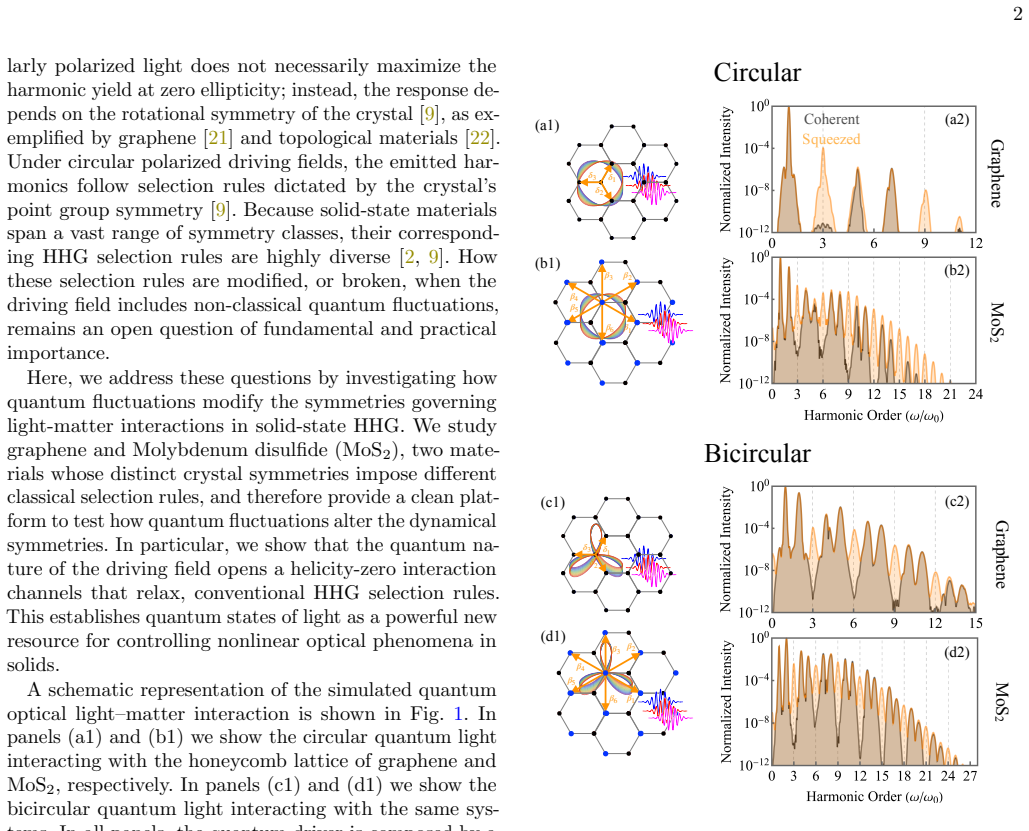
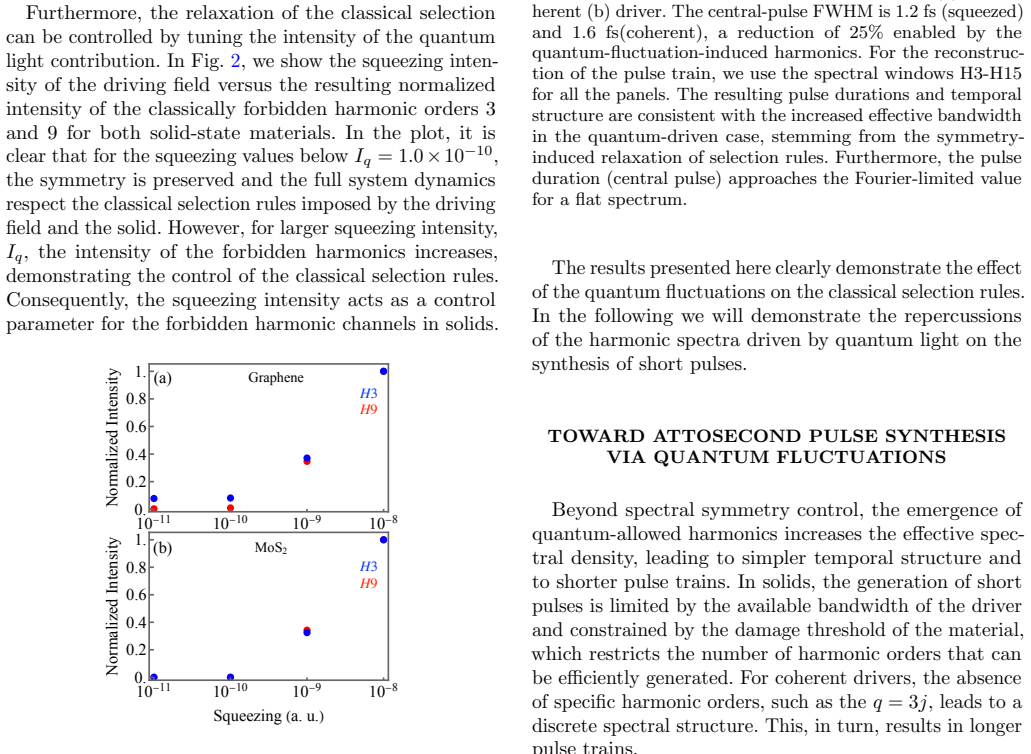
Quantum fluctuations of light break the dynamical symmetry of the driving field while preserving crystal symmetry, enabling classically forbidden harmonics in solids.
A machine-rendered reading of the paper's core claim, the machinery that carries it, and where it could break.
Core claim
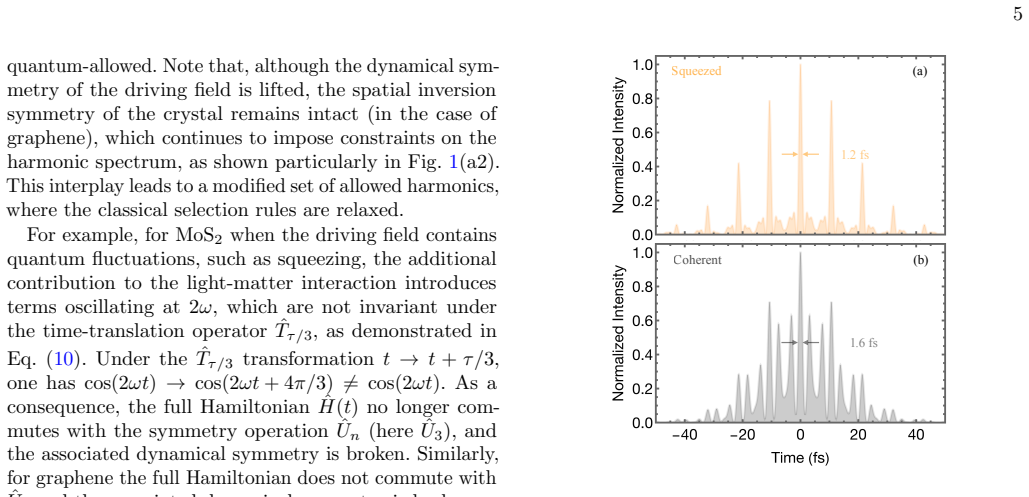
We show that the quantum fluctuations break the dynamical symmetry of the driving field while preserving the crystal symmetry, which enables the generation of classically forbidden harmonics by breaking the corresponding selection rules. These results establish quantum states of light as a new degree of control over harmonic generation in solids, opening routes toward all-optical symmetry engineering of the quantum optical harmonic properties towards attosecond pulse generation.
What carries the argument
Quantum fluctuations of circularly polarized driving light, which break the field's dynamical symmetry while leaving the crystal lattice symmetry intact.
If this is right
- Classically forbidden harmonics become observable in graphene and MoS2 when driven by quantum light.
- Quantum states of light provide an all-optical route to engineer the symmetry properties of emitted harmonics.
- Selection-rule breaking occurs without modifying the crystal structure itself.
- This control opens pathways to attosecond pulse generation with tailored quantum optical properties.
Where Pith is reading between the lines
- The same mechanism could be tested in other 2D materials whose rotational symmetries differ from graphene or MoS2.
- Decoherence or material-specific relaxation might still suppress the effect in real devices, requiring separate quantification.
- If confirmed, the approach could extend to other nonlinear processes such as four-wave mixing where field symmetry dictates allowed orders.
Load-bearing premise
Quantum fluctuations of the driving field are sufficient to break its dynamical symmetry independently of material response details or decoherence effects.
What would settle it
An experiment that drives graphene or MoS2 with circularly polarized quantum light at intensities where classical light produces no forbidden harmonics, then measures whether the forbidden harmonics appear only in the quantum case.
Figures
read the original abstract
Symmetry governs nonlinear interactions in condensed matter systems, particularly in high-harmonic generation (HHG), the interplay between the driving field and crystal symmetries dictate the properties of the emitted harmonics. A central open question is how quantum fluctuations of light modify these symmetry-imposed selection rules in solid state systems. Here, we address this by studying the nonlinear response of graphene and Molybdenum disulfide (MoS$_2$) to circular polarized quantum light, where both materials with distinct rotational symmetries and corresponding classical selection rules. We show that the quantum fluctuations break the dynamical symmetry of the driving field while preserving the crystal symmetry, which enables the generation of classically forbidden harmonics by breaking the corresponding selection rules. These results establish quantum states of light as a new degree of control over harmonic generation in solids, opening routes toward all-optical symmetry engineering of the quantum optical harmonic properties towards attosecond pulse generation.
Editorial analysis
A structured set of objections, weighed in public.
Referee Report
Summary. The manuscript examines the nonlinear response of graphene and MoS2 to circularly polarized quantum light. It claims that quantum fluctuations break the dynamical symmetry of the driving field while preserving the crystal symmetry, enabling the generation of classically forbidden harmonics by breaking the corresponding selection rules. This is presented as establishing quantum states of light as a new degree of control over harmonic generation in solids, with implications for attosecond pulse generation.
Significance. If the calculations hold, the result would be significant for introducing quantum light states as a control parameter in solid-state HHG symmetry selection rules. The use of two materials with distinct rotational symmetries (graphene and MoS2) provides a useful test of generality. The work addresses an open question on quantum fluctuations modifying symmetry-imposed rules.
major comments (1)
- [Theoretical modeling and results] The central claim requires that quantum fluctuations of the driving field break its dynamical symmetry independently of material response details or decoherence effects. The manuscript must demonstrate explicitly (via the nonlinear response model, such as semiconductor Bloch equations or density-matrix evolution) that the fluctuation-induced terms produce observable forbidden harmonics without being averaged out or suppressed by band structure or decoherence.
minor comments (1)
- The abstract would benefit from a brief statement of the theoretical framework (e.g., how the quantum light state is modeled) to aid readers.
Simulated Author's Rebuttal
We thank the referee for their careful reading of the manuscript and for recognizing the potential significance of using quantum light states to control symmetry selection rules in solid-state HHG. We address the major comment below.
read point-by-point responses
-
Referee: [Theoretical modeling and results] The central claim requires that quantum fluctuations of the driving field break its dynamical symmetry independently of material response details or decoherence effects. The manuscript must demonstrate explicitly (via the nonlinear response model, such as semiconductor Bloch equations or density-matrix evolution) that the fluctuation-induced terms produce observable forbidden harmonics without being averaged out or suppressed by band structure or decoherence.
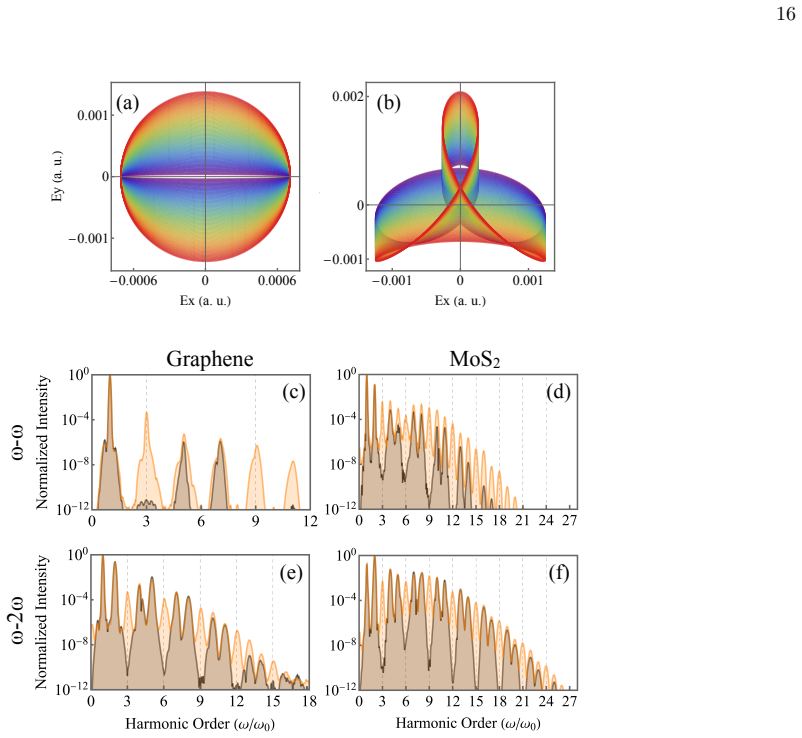
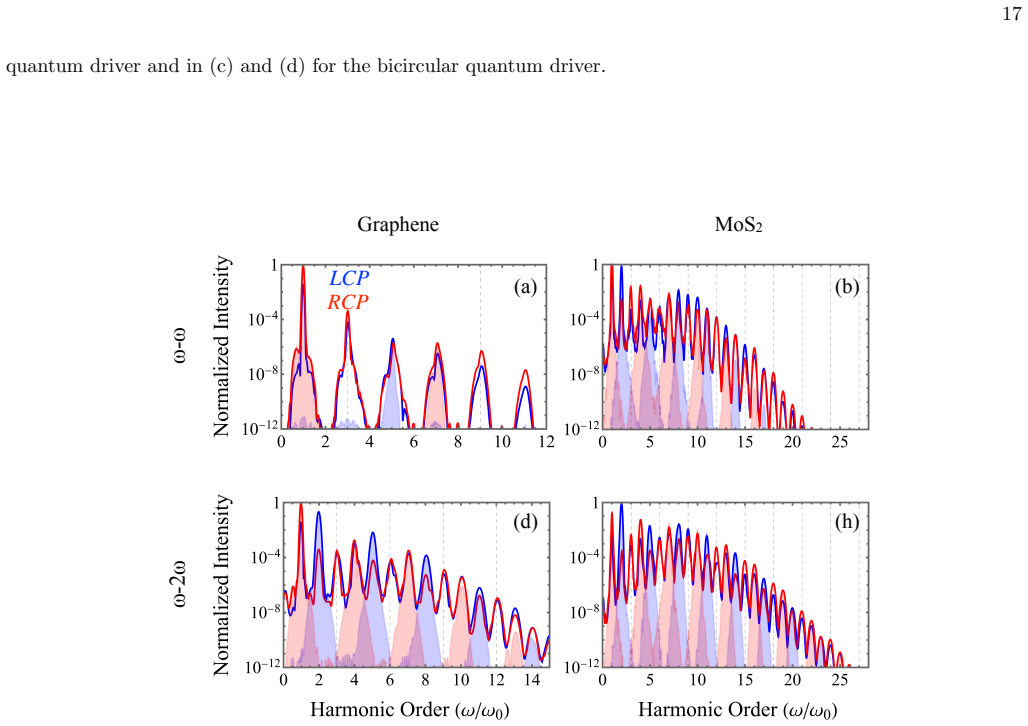
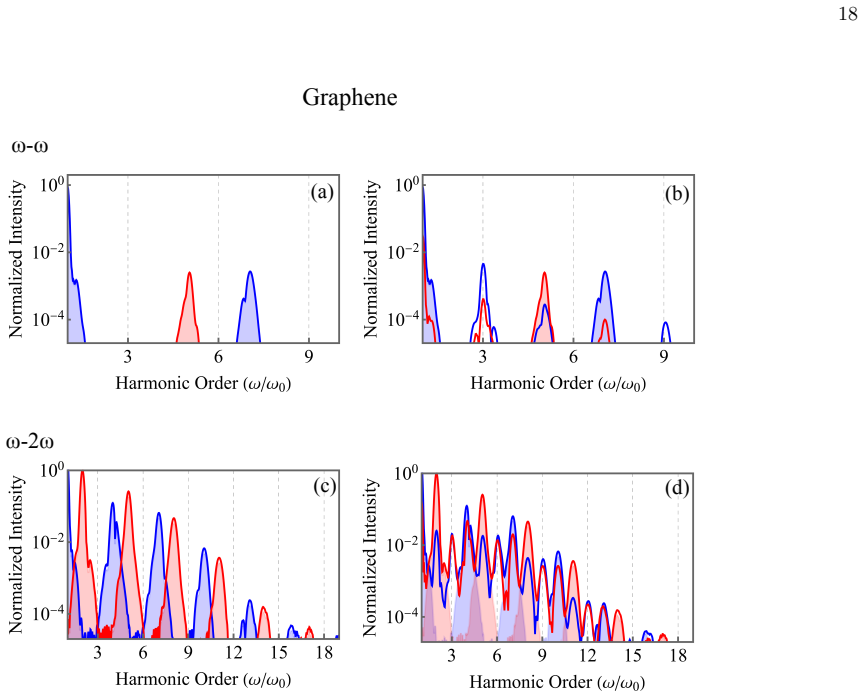
Authors: We appreciate the referee's emphasis on explicit demonstration. Our calculations employ a density-matrix formalism derived from the semiconductor Bloch equations, with the quantum fluctuations of the circularly polarized driving field incorporated through the field's second-order correlation functions. These enter the equations of motion as additional driving terms that break the dynamical symmetry of the field while leaving the crystal symmetry intact. The resulting spectra for both graphene (Figs. 2-3) and MoS2 (Figs. 4-5) show the classically forbidden harmonics with non-negligible intensity, demonstrating that the effect is not averaged out by the band-structure details of either material. We will expand the methods section to include the explicit form of the fluctuation-induced terms in the density-matrix equations and add a dedicated paragraph in the discussion addressing the coherent-regime assumption. We argue that for the sub-cycle pulse durations considered, decoherence times in these materials are long enough that the symmetry-breaking signatures remain observable; a quantitative estimate of the relevant timescales will be included in the revision. revision: partial
Circularity Check
No circularity detected from provided text
full rationale
The abstract and description present the central claim as the outcome of modeling the nonlinear response of specific materials (graphene, MoS2) to quantum light, without any equations, parameter fits, or self-citations shown. No load-bearing step reduces by construction to its inputs, and the derivation chain cannot be inspected for the enumerated circularity patterns because no derivations or citations appear in the given material. This is the expected honest non-finding when the manuscript text supplies no evidence of self-definition, fitted predictions, or imported uniqueness.
Axiom & Free-Parameter Ledger
Reference graph
Works this paper leans on
-
[1]
Neufeld, D
O. Neufeld, D. Ayuso, P. Decleva, M. Y. Ivanov, O. Smirnova, and O. Cohen, Ultrasensitive chiral spec- 8 troscopy by dynamical symmetry breaking in high har- monic generation, Phys. Rev. X9, 031002 (2019)
2019
-
[2]
A. J. Uzan-Narovlansky, G. Orenstein, S. Shames, M. Even Tzur, O. Kneller, B. D. Bruner, T. Arusi-Parpar, O. Cohen, and N. Dudovich, Revealing the interplay be- tween strong field selection rules and crystal symmetries, Phys. Rev. Lett.131, 223802 (2023)
2023
-
[3]
Neufeld, D
O. Neufeld, D. Podolsky, and O. Cohen, Floquet group theory and its application to selection rules in harmonic generation, Nature Communications10, 405 (2019)
2019
-
[4]
Amini, J
K. Amini, J. Biegert, F. Calegari, A. Chac´ on, M. F. Ciap- pina, A. Dauphin, D. K. Efimov, C. Figueira de Moris- son Faria, K. Giergiel, P. Gniewek, A. S. Landsman, M. Le- siuk, M. Mandrysz, A. S. Maxwell, R. Moszy´ nski, L. Ort- mann, J. Antonio P´ erez-Hern´ andez, A. Pic´ on, E. Pisanty, J. Prauzner-Bechcicki, K. Sacha, N. Su´ arez, A. Za¨ ır, J. Za- ...
2019
-
[5]
Lerner, O
G. Lerner, O. Neufeld, L. Hareli, G. Shoulga, E. Bordo, A. Fleischer, D. Podolsky, A. Bahabad, and O. Cohen, Multiscale dynamical symmetries and selection rules in nonlinear optics, Science Advances9, eade0953 (2023)
2023
-
[6]
Mondal, O
A. Mondal, O. Neufeld, T. Balˇ ci¯ unas, B. Waser, S. M¨ uller, M. Rossi, Z. Yin, A. Rubio, N. Tancogne-Dejean, and H. J. W¨ orner, Multi-plateau high-harmonic generation in liquids driven by off-site recombination, Nature Photonics 20, 216 (2026)
2026
-
[7]
Neufeld, M
O. Neufeld, M. E. Tzur, G. Lerner, O. Kfir, A. Fleischer, and O. Cohen, Light symmetry, chirality, and their role in nonlinear optics and ultrafast phenomena, Advances in Optics and Photonics18, 160
-
[8]
Ghimire and D
S. Ghimire and D. A. Reis, A tutorial on high-order harmonic generation in atoms, molecules, and condensed matter, APL Photonics11, 021102 (2026)
2026
-
[9]
Saito, P
N. Saito, P. Xia, F. Lu, T. Kanai, J. Itatani, and N. Ishii, Observation of selection rules for circularly polarized fields in high-harmonic generation from a crystalline solid, Op- tica4, 1333 (2017)
2017
-
[10]
Lewenstein, P
M. Lewenstein, P. Balcou, M. Y. Ivanov, A. L’Huillier, and P. B. Corkum, Theory of high-harmonic generation by low-frequency laser fields, Phys. Rev. A49, 2117 (1994)
1994
-
[11]
Krausz and M
F. Krausz and M. Ivanov, Attosecond physics, Rev. Mod. Phys.81, 163 (2009)
2009
-
[12]
P. B. Corkum, Plasma perspective on strong field multi- photon ionization, Phys. Rev. Lett.71, 1994 (1993)
1994
-
[13]
P. Stammer, Energy conservation in quantum optical high harmonic generation, arXiv preprint arXiv:2410.15503 (2024)
-
[14]
Zhavoronkov, M
´Alvaro Jim´ enez-Gal´ an, N. Zhavoronkov, M. Schloz, F. Morales, and M. Ivanov, Time-resolved high har- monic spectroscopy of dynamical symmetry breaking in bi-circular laser fields: the role of rydberg states, Opt. Express25, 22880 (2017)
2017
-
[15]
Rivera-Dean, P
J. Rivera-Dean, P. Stammer, M. F. Ciappina, and M. Lewenstein, Structured squeezed light allows for high- harmonic generation in classical forbidden geometries, Phys. Rev. Lett.135, 013801 (2025)
2025
-
[16]
Cruz-Rodriguez, D
L. Cruz-Rodriguez, D. Dey, A. Freibert, and P. Stam- mer, Quantum phenomena in attosecond science, Nature Reviews Physics6, 691 (2024)
2024
-
[17]
K. S. Budil, P. Sali` eres, A. L’Huillier, T. Ditmire, and M. D. Perry, Influence of ellipticity on harmonic genera- tion, Phys. Rev. A48, R3437(R) (1993)
1993
-
[18]
Liang, S
Y. Liang, S. Augst, M. V. Ammosov, S. Lazarescu, and S. L. Chin, Experimental investigation of the ellipticity dependence of high-harmonic generation and ionization in argon in the multiphoton regime, Journal of Physics B: Atomic, Molecular and Optical Physics28, 2757 (1995)
1995
-
[19]
D. F. Walls, Squeezed states of light, nature306, 141 (1983)
1983
-
[20]
P. Stammer, C. Granados, and J. Rivera-Dean, Fluctuation-induced symmetry breaking in high harmonic generation for bicircular quantum light, arXiv preprint arXiv:2603.24377 (2026)
-
[21]
Yoshikawa, T
N. Yoshikawa, T. Tamaya, and K. Tanaka, High-harmonic generation in graphene enhanced by elliptically polarized light excitation, Science356, 736 (2017)
2017
-
[22]
Baykusheva, A
D. Baykusheva, A. Chac´ on, J. Lu, T. P. Bailey, J. A. Sobota, H. Soifer, P. S. Kirchmann, C. Rotundu, C. Uher, T. F. Heinz, D. A. Reis, and S. Ghimire, All-Optical Probe of Three-Dimensional Topological Insulators Based on High-Harmonic Generation by Circularly Polarized Laser Fields, Nano Letters21, 8970 (2021)
2021
-
[23]
O. E. Alon, V. Averbukh, and N. Moiseyev, Selection rules for the high harmonic generation spectra, Phys. Rev. Lett.80, 3743 (1998)
1998
-
[24]
C. L. Tang and H. Rabin, Selection rules for circularly polarized waves in nonlinear optics, Phys. Rev. B3, 4025 (1971)
1971
-
[25]
Y. Li, X. Zhu, Q. Zhang, M. Qin, and P. Lu, Quantum- orbit analysis for yield and ellipticity of high order har- monic generation with elliptically polarized laser field, Opt. Express21, 4896 (2013)
2013
-
[26]
P. Stammer, J. Rivera-Dean, P. Tzallas, M. F. Ciappina, and M. Lewenstein, Colloquium: Quantum optics of in- tense light–matter interaction, arXiv:2510.19045 (2025)
-
[27]
Lewenstein, M
M. Lewenstein, M. F. Ciappina, E. Pisanty, J. Rivera- Dean, P. Stammer, T. Lamprou, and P. Tzallas, Gener- ation of optical schr¨ odinger cat states in intense laser– matter interactions, Nature Physics17, 1104 (2021)
2021
-
[29]
S. Yi, N. D. Klimkin, G. G. Brown, O. Smirnova, S. Patchkovskii, I. Babushkin, and M. Ivanov, Gener- ation of massively entangled bright states of light during harmonic generation in resonant media, Physical Review X15, 011023 (2025)
2025
-
[30]
C. S. Lange, T. Hansen, and L. B. Madsen, Excitonic enhancement of squeezed light in quantum-optical high- harmonic generation from a mott insulator, Physical Re- view Letters135, 043603 (2025)
2025
-
[31]
Stammer, J
P. Stammer, J. Rivera-Dean, T. Lamprou, E. Pisanty, M. F. Ciappina, P. Tzallas, and M. Lewenstein, High photon number entangled states and coherent state super- position from the extreme ultraviolet to the far infrared, Physical Review Letters128, 123603 (2022)
2022
-
[32]
R. V. Gothelf, C. S. Lange, and L. B. Madsen, High-order harmonic generation in a crystal driven by quantum light, Physical Review A111, 063105 (2025)
2025
-
[33]
de-la Pe˜ na, O
S. de-la Pe˜ na, O. Neufeld, M. Even Tzur, O. Cohen, H. Appel, and A. Rubio, Quantum electrodynamics in high-harmonic generation: Multitrajectory ehrenfest and exact quantum analysis, Journal of chemical theory and computation21, 283 (2024). 9
2024
-
[34]
Theidel, V
D. Theidel, V. Cotte, P. Heinzel, H. Griguer, M. Weis, R. Sondenheimer, and H. Merdji, Observation of a dis- placed squeezed state in high-harmonic generation, Phys- ical Review Research7, 033223 (2025)
2025
-
[35]
Gorlach, M
A. Gorlach, M. E. Tzur, M. Birk, M. Kr¨ uger, N. Rivera, O. Cohen, and I. Kaminer, High-harmonic generation driven by quantum light, Nature Physics19, 1689 (2023)
2023
-
[36]
Stammer, J
P. Stammer, J. Rivera-Dean, A. Maxwell, T. Lamprou, A. Ord´ o˜ nez, M. F. Ciappina, P. Tzallas, and M. Lewen- stein, Quantum electrodynamics of intense laser-matter interactions: A tool for quantum state engineering, PRX quantum4, 010201 (2023)
2023
-
[37]
Stammer, J
P. Stammer, J. Rivera-Dean, A. S. Maxwell, T. Lam- prou, J. Arg¨ uello-Luengo, P. Tzallas, M. F. Ciappina, and M. Lewenstein, Entanglement and squeezing of the optical field modes in high harmonic generation, Physical review letters132, 143603 (2024)
2024
-
[38]
Rivera-Dean, T
J. Rivera-Dean, T. Lamprou, E. Pisanty, P. Stammer, A. F. Ord´ o˜ nez, A. S. Maxwell, M. F. Ciappina, M. Lewenstein, and P. Tzallas, Strong laser fields and their power to generate controllable high-photon-number coherent-state superpositions, Physical Review A105, 033714 (2022)
2022
-
[39]
Gorlach, O
A. Gorlach, O. Neufeld, N. Rivera, O. Cohen, and I. Kaminer, The quantum-optical nature of high harmonic generation, Nature communications11, 4598 (2020)
2020
-
[40]
Rivera-Dean, L
J. Rivera-Dean, L. Petrovic, M. Lewenstein, and P. Stam- mer, Attosecond quantum optical interferometry, Reports on Progress in Physics89, 047901 (2026)
2026
-
[41]
P. Stammer, J. Rivera-Dean, M. F. Ciappina, and M. Lewenstein, Weak measurement in strong laser field physics, arXiv preprint arXiv:2508.09048 (2025)
-
[42]
Chac´ on, D
A. Chac´ on, D. Kim, W. Zhu, S. P. Kelly, A. Dauphin, E. Pisanty, A. S. Maxwell, A. Pic´ on, M. F. Ciappina, D. E. Kim, C. Ticknor, A. Saxena, and M. Lewenstein, Circular dichroism in higher-order harmonic generation: Heralding topological phases and transitions in chern insulators, Phys. Rev. B102, 134115 (2020)
2020
-
[43]
K. S. Virk and J. E. Sipe, Semiconductor optics in length gauge: A general numerical approach, Phys. Rev. B76, 035213 (2007)
2007
-
[44]
Yue and M
L. Yue and M. B. Gaarde, Structure gauges and laser gauges for the semiconductor bloch equations in high- order harmonic generation in solids, Phys. Rev. A101, 053411 (2020)
2020
-
[45]
Liu, W.-Y
G.-B. Liu, W.-Y. Shan, Y. Yao, W. Yao, and D. Xiao, Three-band tight-binding model for monolayers of group- vib transition metal dichalcogenides, Phys. Rev. B88, 085433 (2013)
2013
-
[46]
Vampa, C
G. Vampa, C. McDonald, A. Fraser, and T. Brabec, High- harmonic generation in solids: Bridging the gap between attosecond science and condensed matter physics, IEEE Journal of Selected Topics in Quantum Electronics21, 1 (2015)
2015
-
[47]
Nayak, D
A. Nayak, D. Rajak, B. Farkas, C. Granados, P. Stammer, J. Rivera-Dean, T. Lamprou, K. Varju, Y. Mairesse, M. F. Ciappina, M. Lewenstein, and P. Tzallas, Attosecond metrology of vacuum-ultraviolet high-order harmonics generated in semiconductors via laser-dressed photoion- ization of alkali metals, Nature Communications16, 1428 (2025)
2025
-
[48]
Rasputnyi, Z
A. Rasputnyi, Z. Chen, M. Birk, O. Cohen, I. Kaminer, M. Kr¨ uger, D. Seletskiy, M. Chekhova, and F. Tani, High- harmonic generation by a bright squeezed vacuum, Nature Physics20, 1960 (2024)
1960
-
[49]
D. Kim, Y. Lee, A. Chac´ on, and D.-E. Kim, Effect of interlayer coupling and symmetry on high-order harmonic generation from monolayer and bilayer hexagonal boron nitride, Symmetry14, 10.3390/sym14010084 (2022)
-
[50]
R. E. F. Silva, F. Mart´ ın, and M. Ivanov, High harmonic generation in crystals using maximally localized wannier functions, Phys. Rev. B100, 195201 (2019)
2019
-
[51]
D. Kim, D. Shin, A. S. Landsman, D. E. Kim, and A. Chac´ on, Theory for all-optical responses in topological materials: The velocity gauge picture, Phys. Rev. B106, 214314 (2022). 10 APPENDIX Classical symmetries of the Hamiltonian and selection rules The symmetries of the Hamiltonian ultimately dictate the selection rules. For the laser-solid interaction...
2022
discussion (0)
Sign in with ORCID, Apple, or X to comment. Anyone can read and Pith papers without signing in.