EchoAvatar: Real-time Generative Avatar Animation from Audio Streams
Pith reviewed 2026-06-29 13:38 UTC · model grok-4.3
The pith
A single streaming model generates continuous full-body avatar motion from live audio streams of speech or music.
A machine-rendered reading of the paper's core claim, the machinery that carries it, and where it could break.
Core claim
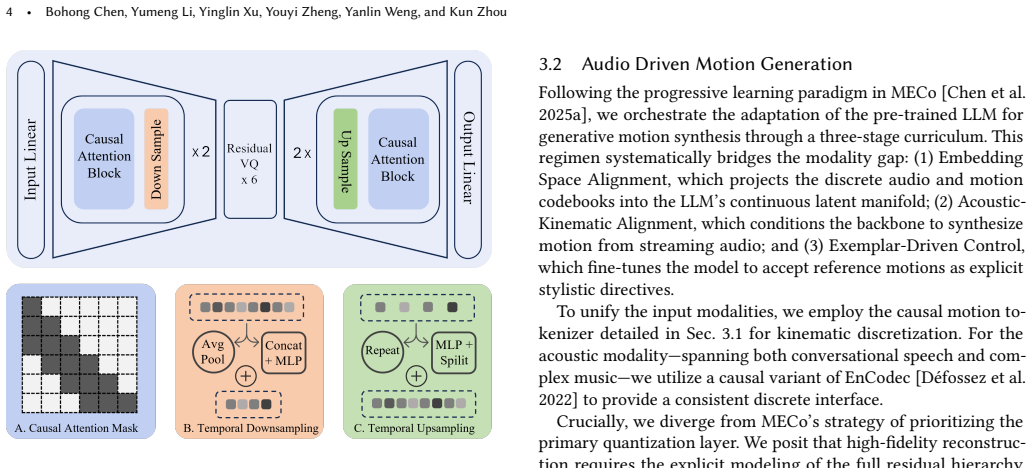
The central claim is that a unified streaming architecture, supported by a robust training strategy enforcing strong audio dependency, produces continuous and coherent full-body motion from incremental audio inputs and generalizes across conversational speech and rhythmic music without explicit domain labels or mode switching, while reinforcement learning improves online quality and a tool-call interface adds controllability from upstream language models.
What carries the argument
The unified streaming architecture that converts incremental audio inputs into continuous coherent full-body motion.
If this is right
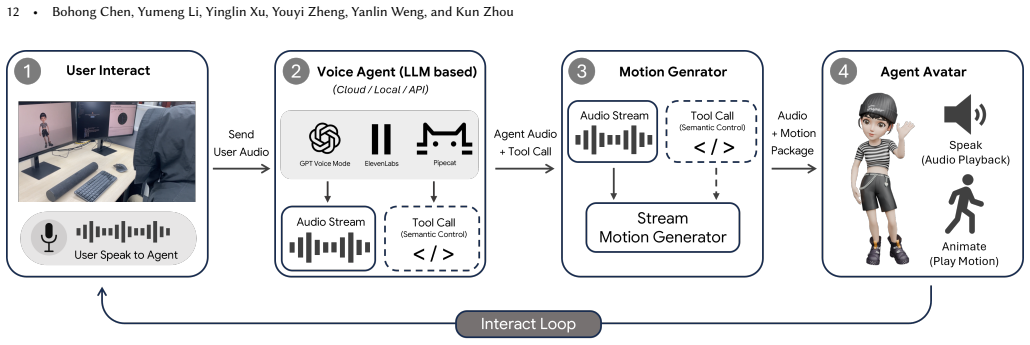
- The system can act as a plug-and-play component that turns voice agents into interactive humanoid avatars.
- It produces higher motion quality and better audio synchronization than existing real-time methods.
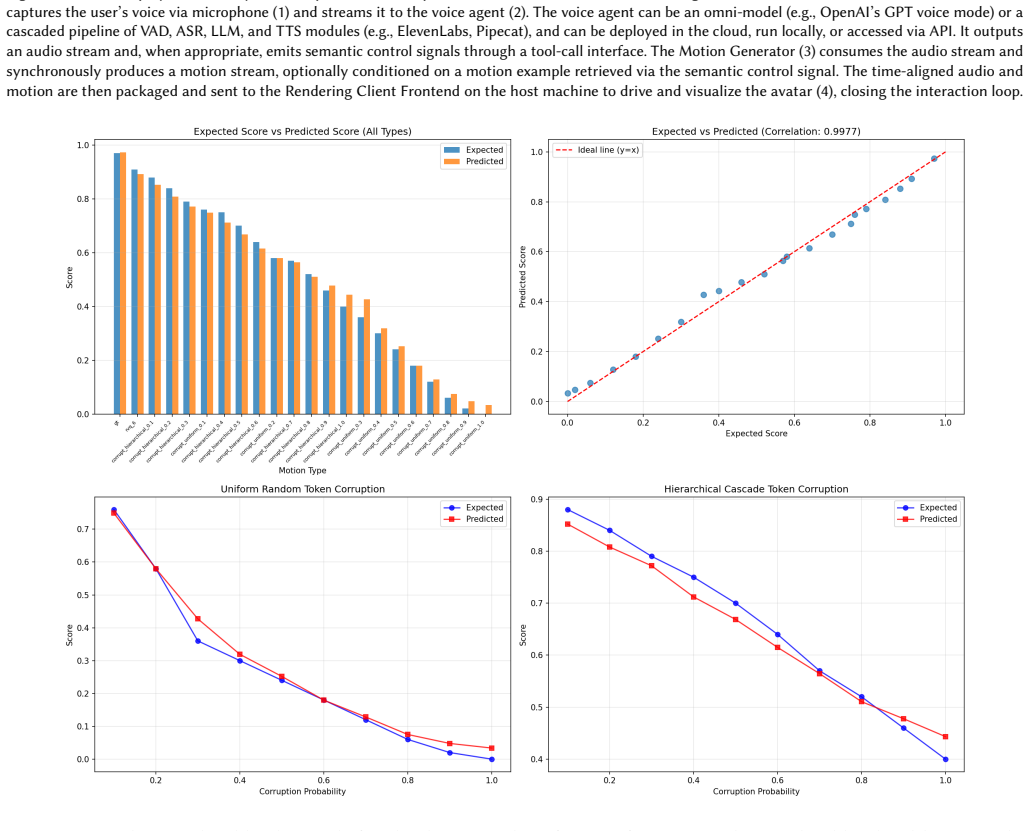
- Reinforcement learning can be applied to improve the quality of the online motion generation process.
- The tool-call interface lets large language models supply explicit semantic control on top of the audio-driven output.
Where Pith is reading between the lines
- The same architecture might accept mixed audio such as speech layered over background music without retraining.
- It could combine with other sensor streams like video or motion capture to create multi-modal avatar control.
- Deployment on edge devices might allow low-latency avatar animation in consumer virtual-reality applications.
Load-bearing premise
The training strategy that enforces strong audio dependency is enough for the model to handle both speech and music seamlessly without any domain labels or switches.
What would settle it
Feeding the model a single audio stream that switches midway from speech to music and checking whether the generated body motion remains coherent and synchronized or breaks into mismatches and artifacts.
Figures






read the original abstract
Real-time synthesis of high-fidelity 3D character motion from audio is a pivotal component for next-generation interactive avatars and virtual assistants. However, most existing approaches are limited to offline processing of complete audio sequences or are constrained to specific domains, rarely handling both speech and music effectively. In this paper, we introduce a novel framework designed to generate continuous, coherent full-body motion from streaming speech and music with low latency. Central to our approach is a unified streaming architecture capable of synthesizing continuous motion from incremental audio inputs. We employ a robust training strategy that enforces strong audio dependency, allowing the model to seamlessly generalize across conversational speech and rhythmic music without requiring explicit domain labels or mode switching. Additionally, we explored Reinforcement Learning to refine the quality of online generation. Furthermore, we bridge reactive animation with intent-driven behavior via a tool-call interface that allows upstream Large Language Models to inject explicit semantic control. By combining this controllability with stream audio-driven synthesis, our framework serves as a plug-and-play solution for transforming voice agents into interactive humanoid avatars. Extensive experiments demonstrate that our method outperforms state-of-the-art realtime baselines in motion quality and synchronization while maintaining the flexibility required for live deployment. Our code, pre-trained models, and videos are available at https://robinwitch.github.io/EchoAvatar-Page.
Editorial analysis
A structured set of objections, weighed in public.
Referee Report
Summary. The paper introduces EchoAvatar, a framework for real-time generative avatar animation from streaming audio. It proposes a unified streaming architecture that synthesizes continuous full-body motion from incremental audio inputs, a robust training strategy claimed to enforce strong audio dependency for seamless generalization across conversational speech and rhythmic music without domain labels or mode switching, reinforcement learning to refine online generation quality, and a tool-call interface enabling upstream LLMs to inject semantic control. The work claims to outperform state-of-the-art real-time baselines in motion quality and synchronization while supporting live deployment, with code and models released.
Significance. If the generalization mechanism and real-time performance claims hold under rigorous validation, the work would advance interactive avatar systems by offering a single model for cross-domain audio-driven animation with LLM controllability, addressing a practical gap in voice-agent-to-avatar pipelines.
major comments (2)
- [Abstract] Abstract: the central generalization claim (seamless cross-domain performance without explicit labels or mode switching) rests entirely on the assertion of a 'robust training strategy that enforces strong audio dependency.' No loss formulation, data-mixing protocol, feature-ablation term, or curriculum is supplied, so the property is an untested assumption rather than a derived result; this is load-bearing for the unified-architecture contribution.
- [Abstract] Abstract: the claim of outperformance over SOTA real-time baselines in motion quality and synchronization is stated without any quantitative metrics, dataset details, ablation results, or baseline descriptions, preventing verification of the experimental support for the core claims.
minor comments (1)
- The provision of code, pre-trained models, and videos at the project page is a positive step toward reproducibility.
Simulated Author's Rebuttal
We thank the referee for the constructive comments on the abstract. We address each point below and will revise the manuscript to improve clarity and support for the claims.
read point-by-point responses
-
Referee: [Abstract] Abstract: the central generalization claim (seamless cross-domain performance without explicit labels or mode switching) rests entirely on the assertion of a 'robust training strategy that enforces strong audio dependency.' No loss formulation, data-mixing protocol, feature-ablation term, or curriculum is supplied, so the property is an untested assumption rather than a derived result; this is load-bearing for the unified-architecture contribution.
Authors: We agree that the abstract would benefit from greater self-containment on this point. The loss formulation, data-mixing protocol, and related training details are presented in Section 3.2, with supporting ablations in Section 4.3. We will revise the abstract to include a concise description of the key training components that enforce audio dependency. revision: yes
-
Referee: [Abstract] Abstract: the claim of outperformance over SOTA real-time baselines in motion quality and synchronization is stated without any quantitative metrics, dataset details, ablation results, or baseline descriptions, preventing verification of the experimental support for the core claims.
Authors: We acknowledge the observation. The quantitative metrics, dataset details, baseline descriptions, and ablation results are reported in Section 4 and Tables 1–3. We will revise the abstract to incorporate key numerical results and evaluation details to make the performance claims more verifiable from the abstract alone. revision: yes
Circularity Check
No circularity; claims rest on architectural description and empirical results rather than self-referential derivations
full rationale
The paper describes a streaming architecture and a 'robust training strategy that enforces strong audio dependency' for cross-domain generalization, but supplies no equations, fitted parameters, or derivation chain that reduces to its own inputs by construction. No self-definitional loops, fitted-input predictions, or load-bearing self-citations appear in the abstract or described claims. The central assertions are presented as design choices validated by experiments, not as mathematical results forced by prior steps within the paper itself. This is the expected non-finding for an applied CV systems paper without visible analytic derivations.
Axiom & Free-Parameter Ledger
Reference graph
Works this paper leans on
-
[1]
Qwen2.5 Technical Report.arXiv preprint arXiv:2412.15115(2024). Quanwei Yang, Luying Huang, Kaisiyuan Wang, Jiazhi Guan, Shengyi He, Fengguo Li, Hang Zhou, Lingyun Yu, Yingying Li, Haocheng Feng, et al. 2025. GestureHYDRA: Semantic Co-speech Gesture Synthesis via Hybrid Modality Diffusion Transformer and Cascaded-Synchronized Retrieval-Augmented Generatio...
work page internal anchor Pith review Pith/arXiv arXiv doi:10.1145/3581783.3612503 2024
-
[2]
Insights into deep non-linear filters for improved multi-channel speech enhancement,
SoundStream: An End-to-End Neural Audio Codec.IEEE/ACM Transactions on Audio, Speech, and Language Processing30 (2022), 495–507. doi:10.1109/TASLP. 2021.3129994 Juze Zhang, Changan Chen, Xin Chen, Heng Yu, Tiange Xiang, Ali Sartaz Khan, Shrinidhi Kowshika Lakshmikanth, and Ehsan Adeli. 2026b. ViBES: A Conver- sational Agent with Behaviorally-Intelligent 3...
-
[3]
Gamify Instructions: Describe *why* you are doing an action
-
[4]
Music Bridge
The "Music Bridge": If the user mentions music, treat it as the climax. # Tools When the user asks to play music: - Use the play_music tool - If they mention a song name or keyword, pass that as the title When the user asks to stop music: - Use the stop_music tool When the user asks for an action or gesture: - Use the send_action tool - Available actions:...
2026
discussion (0)
Sign in with ORCID, Apple, or X to comment. Anyone can read and Pith papers without signing in.