LEIA: Learned Environment for Interactive Architected Materials
Pith reviewed 2026-06-29 13:35 UTC · model grok-4.3
The pith
A learned world model generates step-by-step stress and deformation fields on three-dimensional architected material meshes.
A machine-rendered reading of the paper's core claim, the machinery that carries it, and where it could break.
Core claim
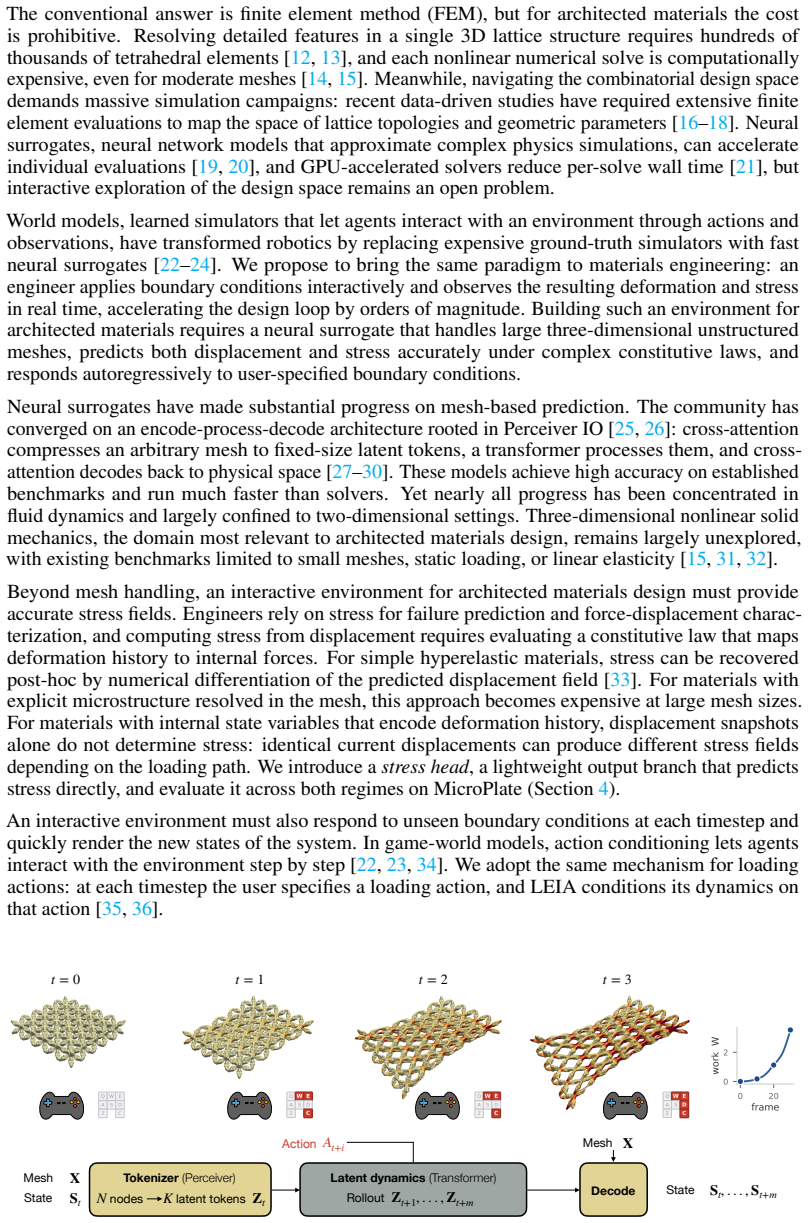
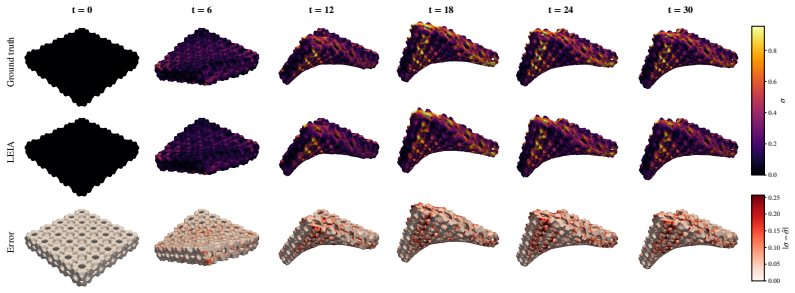
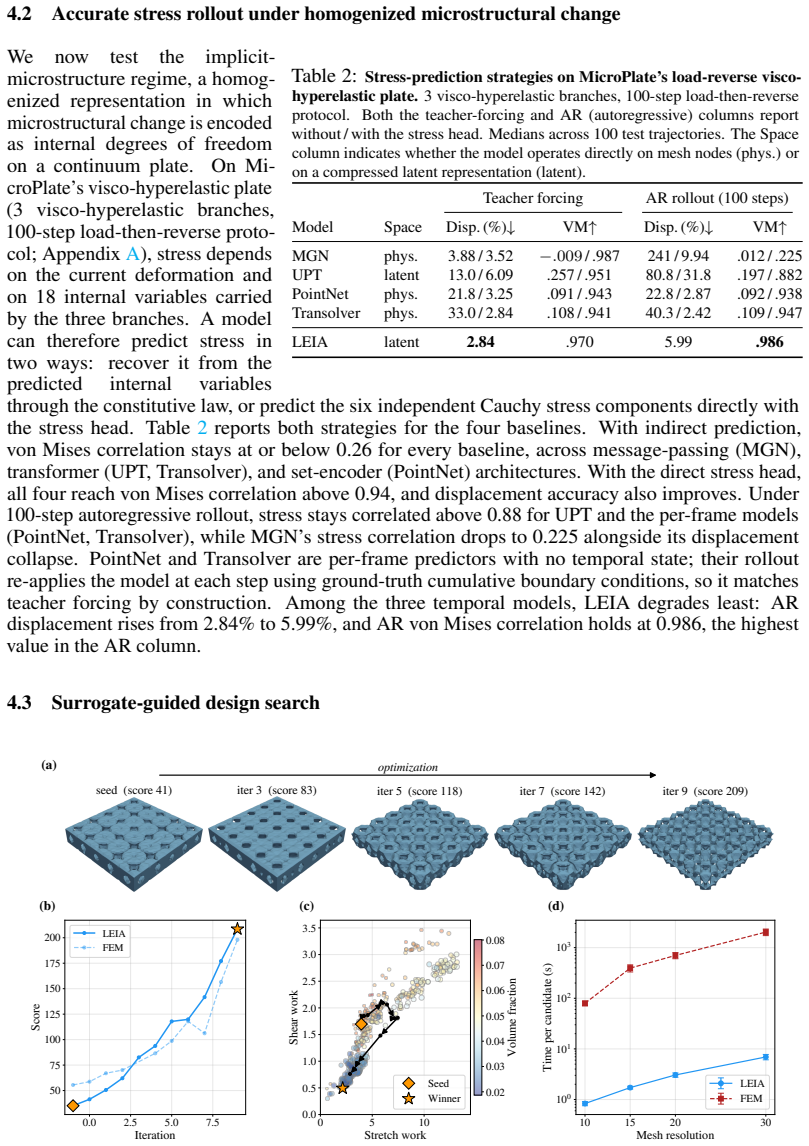
LEIA is a learned environment that applies boundary conditions step by step to large three-dimensional unstructured meshes of architected plates and generates autoregressive responses for deformation and stress fields. It covers two regimes of microstructure modeling in the MicroPlate benchmark and enables efficient candidate generation and ranking for de novo designs, where the stress-accurate rankings are validated by finite element ground truth.
What carries the argument
The autoregressive learned model that produces deformation and stress field responses to sequential user-specified loading on unstructured 3D meshes while capturing nonlinear and history-dependent behavior.
If this is right
- Candidate generation and ranking for de novo architected material designs becomes efficient through surrogate guidance.
- Stress-accurate candidate ranking is achievable and matches finite element ground truth.
- Real-time observation of deformation and stress fields is possible under step-by-step boundary condition application.
- The model operates across both explicit three-dimensional lattice microstructures and implicit homogeneous plate representations.
- The MicroPlate benchmark provides a consistent testbed for comparing world models on architected material tasks.
Where Pith is reading between the lines
- Interactive loading sequences could support testing of materials under complex or time-varying conditions not covered in initial training data.
- The approach might integrate into larger design loops that combine multiple physical objectives beyond stress.
- Extension to hierarchical structures spanning more length scales could follow if the autoregressive structure scales without added error.
- The benchmark could standardize evaluation of learned simulators for other nonlinear engineering domains with history dependence.
Load-bearing premise
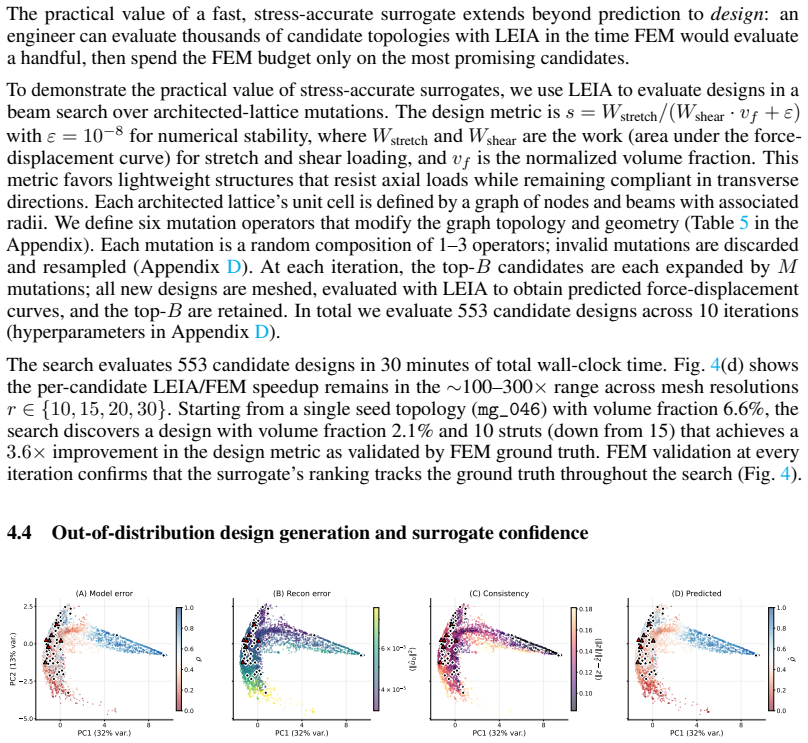
The autoregressive model generalizes to unseen loading sequences and microstructures without accumulating errors that would invalidate the stress predictions used for ranking.
What would settle it
Apply the surrogate-guided search to produce a ranked list of new microstructures, then run full finite element analysis on the top candidates and check whether their actual stress values preserve the same ranking order as LEIA predicted.
Figures



read the original abstract
World models have enabled interactive exploration of game environments and robotic manipulation, but physical engineering remains beyond their reach: real materials exhibit nonlinear constitutive laws, carry history-dependent internal state, undergo inertial dynamics, and may possess hierarchical structures spanning multiple length scales. We present LEIA (Learned Environment for Interactive Architected materials), a world model that lets engineers apply boundary conditions step by step and observe the resulting deformation and stress fields in real time. LEIA handles large three-dimensional unstructured meshes and generates autoregressive responses to user-specified loading. We introduce MicroPlate, a benchmark of architected plates spanning two regimes of microstructure modeling: architected lattices that resolve microstructure explicitly through three-dimensional geometry, and a homogeneous plate where microstructural change is modeled implicitly through internal degrees of freedom. MicroPlate is used to assess LEIA alongside four baseline methods across both regimes. Finally, we demonstrate that LEIA enables efficient candidate generation and ranking for fast surrogate-guided search for de novo designs of architected materials, with stress-accurate candidate ranking validated by finite element ground truth.
Editorial analysis
A structured set of objections, weighed in public.
Referee Report
Summary. The paper introduces LEIA, a learned autoregressive world model for real-time interactive simulation of 3D architected materials under user-specified boundary conditions. It handles nonlinear constitutive behavior, history-dependent states, and large unstructured meshes in both explicit-lattice and implicit-microstructure regimes. The work presents the MicroPlate benchmark to evaluate LEIA against four baselines and demonstrates its application to surrogate-guided de novo design search, claiming stress-accurate candidate ranking validated by finite-element ground truth.
Significance. If the validation claims hold with quantified error bounds, LEIA would represent a meaningful advance in applying world models to physical engineering domains that require history-dependent mechanics and multi-scale structures. The introduction of the MicroPlate benchmark itself provides a reusable testbed for future surrogate models in architected materials.
major comments (2)
- [Abstract] Abstract: the central claim that LEIA supplies 'stress-accurate candidate ranking validated by finite element ground truth' for de novo search is load-bearing, yet the provided text reports neither per-step nor cumulative L2 stress errors, nor any bound on autoregressive drift under distribution shift to unseen loading sequences or microstructures. Without these quantities the ranking accuracy premise cannot be assessed.
- [MicroPlate benchmark and evaluation] MicroPlate evaluation section (implied by the benchmark description): the comparison to four baseline methods is asserted but no tables or figures quantify stress-field accuracy, ranking correlation with FE, or error growth versus sequence length, which directly determines whether the surrogate-guided search claim is supported.
minor comments (1)
- [Abstract] The abstract would benefit from a single sentence stating the key quantitative result (e.g., mean stress error or ranking correlation) that supports the 'stress-accurate' claim.
Simulated Author's Rebuttal
We thank the referee for the detailed and constructive review. The comments correctly identify that the current manuscript does not supply the specific quantitative error metrics needed to fully substantiate the abstract claim and the surrogate-guided design results. We will revise the manuscript to include these quantities.
read point-by-point responses
-
Referee: [Abstract] Abstract: the central claim that LEIA supplies 'stress-accurate candidate ranking validated by finite element ground truth' for de novo search is load-bearing, yet the provided text reports neither per-step nor cumulative L2 stress errors, nor any bound on autoregressive drift under distribution shift to unseen loading sequences or microstructures. Without these quantities the ranking accuracy premise cannot be assessed.
Authors: We agree that the abstract claim is load-bearing and that the manuscript currently lacks the requested per-step and cumulative L2 stress errors as well as explicit bounds on autoregressive drift. In the revised version we will add these metrics (computed on held-out loading sequences and microstructures) to the results section, include them in the abstract, and provide the corresponding tables and figures. revision: yes
-
Referee: [MicroPlate benchmark and evaluation] MicroPlate evaluation section (implied by the benchmark description): the comparison to four baseline methods is asserted but no tables or figures quantify stress-field accuracy, ranking correlation with FE, or error growth versus sequence length, which directly determines whether the surrogate-guided search claim is supported.
Authors: The referee is correct that the present manuscript does not contain the requested tables or figures for stress-field L2 accuracy, ranking correlation with FE ground truth, or error growth versus sequence length. We will expand the MicroPlate evaluation section with these quantitative results (including direct comparison to the four baselines) to support the design-search claims. revision: yes
Circularity Check
No circularity: empirical ML model with external validation
full rationale
The paper presents an autoregressive neural world model trained on simulation data for architected materials, with all claims about stress-accurate ranking supported by direct comparison to independent finite-element ground truth on held-out cases. No closed-form derivations, self-definitional equations, fitted parameters renamed as predictions, or load-bearing self-citations appear in the provided text; performance assertions reduce to standard supervised learning plus external benchmarking rather than any reduction to the model's own inputs by construction.
Axiom & Free-Parameter Ledger
Reference graph
Works this paper leans on
-
[1]
M. A. Meyers, Po-Yu Chen, A. Lin, and Yasuaki Seki. Biological materials: Struc- ture and mechanical properties.Progress in Materials Science, 53:1–206, 2008. doi: 10.1016/j.pmatsci.2007.05.002
-
[2]
U. Wegst, Hao Bai, E. Saiz, A. Tomsia, and Robert O. Ritchie. Bioinspired structural materials. Nature Materials, 14:23–36, 2015. doi: 10.1038/nmat4089
-
[3]
J. U. Surjadi and C. M. Portela. Enabling three-dimensional architected materials across length scales and timescales.Nature Materials, 24:493–505, 2025. doi: 10.1038/s41563-025-02119-8
-
[4]
X. Xia, C. Spadaccini, and J. Greer. Responsive materials architected in space and time.Nature Reviews Materials, 7:683–701, 2022. doi: 10.1038/s41578-022-00450-z
-
[5]
Xiaojian Wang, Shanqing Xu, Shiwei Zhou, W. Xu, M. Leary, Peter Choong, M. Qian, M. Brandt, and Y . Xie. Topological design and additive manufacturing of porous metals for bone scaffolds and orthopaedic implants: A review.Biomaterials, 83:127–141, 2016. doi: 10.1016/j.biomaterials.2016.01.012
-
[6]
T. Tancogne-Dejean, A. Spierings, and D. Mohr. Additively-manufactured metallic micro-lattice materials for high specific energy absorption under static and dynamic loading.Acta Materialia, 116:14–28, 2016. doi: 10.1016/j.actamat.2016.05.054
-
[7]
Pengcheng Jiao, Jochen Mueller, J. Raney, X. Zheng, and Amir H. Alavi. Mechanical metamate- rials and beyond.Nature Communications, 14:6004, 2023. doi: 10.1038/s41467-023-41679-8
-
[8]
A. Shaikeea, Huachen Cui, M. O’Masta, X. Zheng, and V . Deshpande. The toughness of mechanical metamaterials.Nature Materials, 21:297–304, 2022. doi: 10.1038/s41563-021- 01182-1
-
[9]
Xiaoyang Zheng, Xubo Zhang, Ta-Te Chen, and I. Watanabe. Deep learning in mechanical metamaterials: From prediction and generation to inverse design.Advanced Materials, 35: e2302530, 2023. doi: 10.1002/adma.202302530
- [10]
-
[11]
Li Zheng, Siddhant Kumar, and Dennis M. Kochmann. Algebraic language models for in- verse design of metamaterials via diffusion transformers.Nature Machine Intelligence, 8 (4):628–640, 2026. doi: 10.1038/s42256-026-01218-8. URL https://doi.org/10.1038/ s42256-026-01218-8
-
[12]
T. Hirschler, R. Bouclier, P. Antolin, and A. Buffa. Reduced order modeling based inexact FETI- DP solver for lattice structures.International Journal for Numerical Methods in Engineering, 125, 2024. doi: 10.1002/nme.7419
-
[13]
Clément Guillet, Thibaut Hirschler, Pierre Jolivet, Pablo Antolin, and Robin Bouclier. Ef- ficient fine-scale simulation of nonlinear hyperelastic lattice structures.arXiv preprint arXiv:2603.10741, 2026. URLhttps://arxiv.org/abs/2603.10741
-
[14]
Aldair E. Gongora, Caleb Friedman, D. Newton, T. Yee, Zachary Doorenbos, Brian Giera, E. Duoss, T. Yong-Jin Han, Kyle T. Sullivan, and Jennifer N. Rodriguez. Accelerating the design of lattice structures using machine learning.Scientific Reports, 14, 2024. doi: 10.1038/s41598- 024-63204-7
-
[15]
Ayush Jain, Ehsan Haghighat, and Sai Nelaturi. LatticeGraphNet: a two-scale graph neural operator for simulating lattice structures.Engineering with Computers, 41(2):829–844, 2024. doi: 10.1007/s00366-024-02034-7
-
[16]
Jan-Hendrik Bastek, Siddhant Kumar, Bastian Telgen, R. Glaesener, and D. Kochmann. Invert- ing the structure–property map of truss metamaterials by deep learning.Proceedings of the National Academy of Sciences, 119, 2022. doi: 10.1073/pnas.2111505119. 10
-
[17]
Jan-Hendrik Bastek and D. Kochmann. Inverse design of nonlinear mechanical metamaterials via video denoising diffusion models.Nature Machine Intelligence, 5:1466–1475, 2023. doi: 10.1038/s42256-023-00762-x
-
[18]
Karapiperis, Siddhant Kumar, and D
Li Zheng, K. Karapiperis, Siddhant Kumar, and D. Kochmann. Unifying the design space and optimizing linear and nonlinear truss metamaterials by generative modeling.Nature Communications, 14, 2023. doi: 10.1038/s41467-023-42068-x
-
[19]
Daniel A. White, William J. Arrighi, Jun Kudo, and Seth E. Watts. Multiscale topology optimization using neural network surrogate models.Computer Methods in Applied Mechanics and Engineering, 346:1118–1135, 2019. doi: 10.1016/j.cma.2018.09.007. URL https://doi. org/10.1016/j.cma.2018.09.007
-
[20]
Bolei Deng, Ahmad Zareei, Xiaoxiao Ding, James C. Weaver, Chris H. Rycroft, and Katia Bertoldi. Inverse design of mechanical metamaterials with target nonlinear re- sponse via a neural accelerated evolution strategy.Advanced Materials, 34(41), 2022. doi: 10.1002/adma.202206238. URLhttps://doi.org/10.1002/adma.202206238
-
[21]
Xue, Shuheng Liao, Zhengtao Gan, Chanwook Park, Xiaoyu Xie, Wing Kam Liu, and Jian Cao
T. Xue, Shuheng Liao, Zhengtao Gan, Chanwook Park, Xiaoyu Xie, Wing Kam Liu, and Jian Cao. JAX-FEM: A differentiable GPU-accelerated 3D finite element solver for automatic inverse design and mechanistic data science.Computer Physics Communications, 291:108802,
-
[22]
doi: 10.1016/j.cpc.2023.108802
-
[23]
Recurrent World Models Facilitate Policy Evolution
David Ha and Jürgen Schmidhuber. Recurrent world models facilitate policy evolution. In Advances in Neural Information Processing Systems 31, pages 2451–2463, 2018. URL https: //arxiv.org/abs/1809.01999
work page internal anchor Pith review Pith/arXiv arXiv 2018
-
[24]
Mastering Diverse Domains through World Models
Danijar Hafner, Jurgis Pasukonis, Jimmy Ba, and Timothy P. Lillicrap. Mastering diverse domains through world models.CoRR, abs/2301.04104, 2023. URL https://arxiv.org/ abs/2301.04104
work page internal anchor Pith review Pith/arXiv arXiv 2023
-
[25]
Learning Interactive Real-World Simulators
Sherry Yang, Yilun Du, Seyed Kamyar Seyed Ghasemipour, Jonathan Tompson, Leslie Pack Kaelbling, Dale Schuurmans, and Pieter Abbeel. Learning interactive real-world simulators. In The Twelfth International Conference on Learning Representations, ICLR 2024, 2024. URL https://arxiv.org/abs/2310.06114
work page internal anchor Pith review Pith/arXiv arXiv 2024
-
[26]
Perceiver IO: A General Architecture for Structured Inputs & Outputs
Andrew Jaegle, Sebastian Borgeaud, Jean-Baptiste Alayrac, Carl Doersch, Catalin Ionescu, David Ding, Skanda Koppula, Daniel Zoran, Andrew Brock, Evan Shelhamer, Olivier J. Hénaff, Matthew M. Botvinick, Andrew Zisserman, Oriol Vinyals, and João Carreira. Perceiver IO: A general architecture for structured inputs & outputs. InThe Tenth International Confere...
work page internal anchor Pith review Pith/arXiv arXiv 2022
-
[27]
Markus J Buehler. Fieldperceiver: Domain agnostic transformer model to predict multiscale physical fields and nonlinear material properties through neural ologs.Materials Today, 57: 9–25, 2022. doi: 10.1016/j.mattod.2022.05.020
-
[28]
Solving high- dimensional pdes with latent spectral models
Haixu Wu, Tengge Hu, Huakun Luo, Jianmin Wang, and Mingsheng Long. Solving high- dimensional pdes with latent spectral models. InInternational Conference on Machine Learning, ICML 2023, Proceedings of Machine Learning Research, pages 37417–37438. PMLR, 2023. URLhttps://arxiv.org/abs/2301.12664
-
[29]
Universal Physics Transformers: A Framework For Efficiently Scaling Neural Operators
Benedikt Alkin, Andreas Fürst, Simon Schmid, Lukas Gruber, Markus Holzleitner, and Johannes Brandstetter. Universal Physics Transformers: A Framework For Efficiently Scaling Neural Operators. InAdvances in Neural Information Processing Systems 37, 2024. URL https: //arxiv.org/abs/2402.12365
-
[30]
Wang, Etienne Le Naour, Jean-Noël Vittaut, and Patrick Gallinari
Louis Serrano, Thomas X. Wang, Etienne Le Naour, Jean-Noël Vittaut, and Patrick Gallinari. AROMA: Preserving spatial structure for latent PDE modeling with local neural fields. In Advances in Neural Information Processing Systems 37, NeurIPS 2024, 2024. URL https: //arxiv.org/abs/2406.02176
-
[31]
Latent neural operator for solving forward and inverse PDE problems
Tian Wang and Chuang Wang. Latent neural operator for solving forward and inverse PDE problems. InAdvances in Neural Information Processing Systems 37, NeurIPS 2024, 2024. URLhttps://arxiv.org/abs/2406.03923. 11
-
[32]
Fourier neural operator with learned deformations for pdes on general geometries.Journal of Machine Learning Research, 24:388:1–388:26, 2023
Zongyi Li, Daniel Zhengyu Huang, Burigede Liu, and Anima Anandkumar. Fourier neural operator with learned deformations for pdes on general geometries.Journal of Machine Learning Research, 24:388:1–388:26, 2023. URLhttps://jmlr.org/papers/v24/23-0064.html
2023
- [33]
-
[34]
Rishit Dagli, Donglai Xiang, Vismay Modi, Charles Loop, Clement Fuji Tsang, Anka He Chen, Anita Hu, Gavriel State, David I.W. Levin, and Maria Shugrina. V oMP: Predicting volumetric mechanical property fields.arXiv preprint arXiv:2510.22975, 2025. URL https: //arxiv.org/abs/2510.22975
-
[35]
Genie: Generative interactive environments
Jake Bruce, Michael Dennis, Ashley Edwards, Jack Parker-Holder, Yuge Shi, Edward Hughes, Matthew Lai, Aditi Mavalankar, Richie Steigerwald, Chris Apps, Yusuf Aytar, Sarah Bechtle, Feryal Behbahani, Stephanie Chan, Nicolas Heess, Lucy Gonzalez, Simon Osindero, Sherjil Ozair, Scott Reed, Jingwei Zhang, Konrad Zolna, Jeff Clune, Nando de Freitas, Satinder Si...
2024
-
[36]
Scalable diffusion models with transformers
William Peebles and Saining Xie. Scalable diffusion models with transformers. In IEEE/CVF International Conference on Computer Vision, ICCV 2023, pages 4195–4205,
2023
-
[37]
doi: 10.1109/ICCV51070.2023.00387
-
[38]
FiLM: Visual Reasoning with a General Conditioning Layer
Ethan Perez, Florian Strub, Harm de Vries, Vincent Dumoulin, and Aaron C. Courville. FiLM: Visual reasoning with a general conditioning layer. InProceedings of the Thirty-Second AAAI Conference on Artificial Intelligence, pages 3942–3951, 2018. URL https://arxiv.org/ abs/1709.07871
work page internal anchor Pith review Pith/arXiv arXiv 2018
-
[39]
Transolver++: An accurate neural solver for PDEs on million-scale geome- tries
Huakun Luo, Haixu Wu, Hang Zhou, Lanxiang Xing, Yichen Di, Jianmin Wang, and Ming- sheng Long. Transolver++: An accurate neural solver for PDEs on million-scale geome- tries. InProceedings of the 42nd International Conference on Machine Learning, volume 267 ofProceedings of Machine Learning Research, pages 41432–41449. PMLR, 2025. URL https://arxiv.org/ab...
-
[40]
Bjoern List, Li-Wei Chen, Kartik Bali, and Nils Thuerey. Differentiability in Unrolled Training of Neural Physics Simulators on Transient Dynamics.Computer Methods in Applied Mechanics and Engineering, 433:117441, 2025. doi: 10.1016/j.cma.2024.117441
-
[41]
Improving long-range interactions in graph neural simulators via Hamiltonian dynamics
Tai Hoang, Alessandro Trenta, Alessio Gravina, Niklas Freymuth, Philipp Becker, Davide Bacciu, and Gerhard Neumann. Improving long-range interactions in graph neural simulators via Hamiltonian dynamics. InInternational Conference on Learning Representations, 2026. URLhttps://arxiv.org/abs/2511.08185
-
[42]
SineNet: Learning temporal dynamics in time-dependent partial differential equations
Xuan Zhang, Jacob Helwig, Yuchao Lin, Yaochen Xie, Cong Fu, Stephan Wojtowytsch, and Shuiwang Ji. SineNet: Learning temporal dynamics in time-dependent partial differential equations. InInternational Conference on Learning Representations, 2024. URL https: //arxiv.org/abs/2403.19507
-
[43]
Sobolev Training for Neural Networks
Wojciech M. Czarnecki, Simon Osindero, Max Jaderberg, Grzegorz Swirszcz, and Razvan Pascanu. Sobolev training for neural networks. InAdvances in Neural Information Processing Systems 30, pages 4278–4287, 2017. URLhttps://arxiv.org/abs/1706.04859
work page internal anchor Pith review Pith/arXiv arXiv 2017
-
[44]
Sobolev Training for Operator Learning
Namkyeong Cho, Junseung Ryu, and Hyung Ju Hwang. Sobolev Training for Operator Learning. Journal of Computational Physics, 542:114319, 2025. doi: 10.1016/j.jcp.2025.114408
-
[45]
Sobolev acceleration for neural networks
Jong Kwon Oh, Hanbaek Lyu, and Hwijae Son. Sobolev acceleration for neural networks. 2025. URLhttps://arxiv.org/abs/2509.19773. 12
-
[46]
Boyuan Yao, Dingcheng Luo, Lianghao Cao, Nikola Kovachki, Thomas O’Leary-Roseberry, and Omar Ghattas. Derivative-Informed Fourier Neural Operator: Universal Approximation and Applications to PDE-Constrained Optimization. 2025. URLhttps://arxiv.org/abs/ 2512.14086
-
[47]
Learning Memory and Material Dependent Constitutive Laws
Kaushik Bhattacharya, Lianghao Cao, George Stepaniants, Andrew Stuart, and Margaret Trautner. Learning Memory and Material Dependent Constitutive Laws. 2025. URL https: //arxiv.org/abs/2502.05463
-
[48]
Derivative-enhanced deep operator network
Yuan Qiu, Nolan Bridges, and Peng Chen. Derivative-enhanced deep operator network. In Advances in Neural Information Processing Systems 37, NeurIPS 2024, 2024. URL https: //arxiv.org/abs/2402.19242
-
[49]
Jeremy Yu, Lu Lu, Xuhui Meng, and George Em Karniadakis. Gradient-enhanced physics- informed neural networks for forward and inverse PDE problems.Computer Methods in Applied Mechanics and Engineering, 393:114823, 2022. doi: 10.1016/j.cma.2022.114823
-
[50]
Gemnet: Universal directional graph neural networks for molecules
Johannes Gasteiger, Florian Becker, and Stephan Günnemann. Gemnet: Universal directional graph neural networks for molecules. InAdvances in Neural Information Processing Systems 34: Annual Conference on Neural Information Processing Systems 2021, NeurIPS 2021, December 6-14, 2021, virtual, pages 6790–6802, 2021. URL https://proceedings.neurips.cc/ paper/2...
2021
-
[51]
Dor Verbin, Peter Hedman, Ben Mildenhall, Todd E. Zickler, Jonathan T. Barron, and Pratul P. Srinivasan. Ref-nerf: Structured view-dependent appearance for neural radi- ance fields. InIEEE/CVF Conference on Computer Vision and Pattern Recognition, CVPR 2022, New Orleans, LA, USA, June 18-24, 2022, pages 5481–5490. IEEE, 2022. doi: 10.1109/CVPR52688.2022.00541
-
[52]
Zhenguo Nie, Haoliang Jiang, and Levent Burak Kara. Stress field prediction in cantilevered structures using convolutional neural networks.Journal of Computing and Information Science in Engineering, 20, 2020. doi: 10.1115/1.4044097
-
[53]
Jaber Rezaei Mianroodi, Nima H. Siboni, and Dierk Raabe. Teaching solid mechanics to artificial intelligence—a fast solver for heterogeneous materials.npj Computational Materials, 7, 2021. doi: 10.1038/s41524-021-00571-z
-
[54]
Anoop Krishnan
Meer Mehran Rashid, Tanu Pittie, Souvik Chakraborty, and N.M. Anoop Krishnan. Learning the stress-strain fields in digital composites using Fourier neural operator.iScience, 25:105452,
-
[55]
doi: 10.1016/j.isci.2022.105452
-
[56]
Mohammad S. Khorrami, Jaber R. Mianroodi, Nima H. Siboni, Pawan Goyal, Bob Svend- sen, Peter Benner, and Dierk Raabe. An artificial neural network for surrogate modeling of stress fields in viscoplastic polycrystalline materials.npj Computational Materials, 9, 2023. doi: 10.1038/s41524-023-00991-z
-
[57]
Diab W. Abueidda, Seid Koric, Nahil A. Sobh, and Huseyin Sehitoglu. Deep learning for plasticity and thermo-viscoplasticity.International Journal of Plasticity, 136:102852, 2021. doi: 10.1016/j.ijplas.2020.102852
-
[58]
Junyan He, Seid Koric, Shashank Kushwaha, Jaewan Park, Diab Abueidda, and Iwona Jasiuk. Novel DeepONet architecture to predict stresses in elastoplastic structures with variable complex geometries and loads.Computer Methods in Applied Mechanics and Engineering, 415:116277,
-
[59]
doi: 10.1016/j.cma.2023.116277
-
[60]
Junyan He, Seid Koric, Diab Abueidda, Ali Najafi, and Iwona Jasiuk. Geom-DeepONet: A point-cloud-based deep operator network for field predictions on 3D parameterized ge- ometries.Computer Methods in Applied Mechanics and Engineering, 429:117130, 2024. doi: 10.1016/j.cma.2024.117130
-
[61]
Geometry-Informed Neural Operator Transformer
Qibang Liu, Weiheng Zhong, Hadi Meidani, Diab Abueidda, Seid Koric, and Philippe Geubelle. Geometry-Informed Neural Operator Transformer. 2025. URL https://arxiv.org/abs/ 2504.19452. 13
-
[62]
A comprehensive comparison of neural operators for 3D industry-scale engineering designs, 2025
Weiheng Zhong, Qibang Liu, Diab Abueidda, Seid Koric, and Hadi Meidani. A comprehensive comparison of neural operators for 3D industry-scale engineering designs, 2025. URL https: //arxiv.org/abs/2510.05995
-
[63]
Khorrami, Pawan Goyal, Jaber R
Mohammad S. Khorrami, Pawan Goyal, Jaber R. Mianroodi, Bob Svendsen, Peter Benner, and Dierk Raabe. A physics-encoded Fourier neural operator approach for surrogate modeling of divergence-free stress fields in solids. 2024. URLhttps://arxiv.org/abs/2408.15408
-
[64]
Iparraguirre, Iciar Alfaro, David Gonzalez, and Elias Cueto
Mikel M. Iparraguirre, Iciar Alfaro, David Gonzalez, and Elias Cueto. MeshGraphNet- Transformer: Scalable mesh-based learned simulation for solid mechanics. 2026. URL https://arxiv.org/abs/2601.23177
-
[65]
Kevin Linka and Ellen Kuhl. A new family of Constitutive Artificial Neural Networks towards automated model discovery.Computer Methods in Applied Mechanics and Engineering, 403: 115731, 2023. doi: 10.1016/j.cma.2022.115731
-
[66]
Marius Tacke, Matthias Busch, Kian Abdolazizi, Jonas Eichinger, Kevin Linka, Christian Cyron, and Roland Aydin. Automating modeling in mechanics: LLMs as designers of physics- constrained neural networks for constitutive modeling of materials. 2025. URL https: //arxiv.org/abs/2512.01735
-
[67]
GeoPT: Scaling Physics Simulation via Lifted Geometric Pre-Training
Haixu Wu, Minghao Guo, Zongyi Li, Zhiyang Dou, Mingsheng Long, Kaiming He, and Wojciech Matusik. GeoPT: Scaling physics simulation via lifted geometric pre-training. 2026. URLhttps://arxiv.org/abs/2602.20399
work page internal anchor Pith review Pith/arXiv arXiv 2026
-
[68]
Automotive Crash Dynamics Modeling Accelerated with Machine Learning
Mohammad Amin Nabian, Sudeep Chavare, Deepak Akhare, Rishikesh Ranade, Ram Cherukuri, and Srinivas Tadepalli. Automotive Crash Dynamics Modeling Accelerated with Machine Learning. 2025. URLhttps://arxiv.org/abs/2510.15201
-
[69]
P3D: Highly scalable 3D neural surrogates for physics simulations with global context
Benjamin Holzschuh, Georg Kohl, Florian Redinger, and Nils Thuerey. P3D: Highly scalable 3D neural surrogates for physics simulations with global context. InInternational Conference on Learning Representations, 2026. URLhttps://arxiv.org/abs/2509.10186
-
[70]
Winfried van den Dool, Maksim Zhdanov, Yuki M. Asano, and Max Welling. Adaptive mesh- quantization for neural PDE solvers, 2025. URLhttps://arxiv.org/abs/2511.18474
-
[71]
Attention is all you need
Ashish Vaswani, Noam Shazeer, Niki Parmar, Jakob Uszkoreit, Llion Jones, Aidan N Gomez, Łukasz Kaiser, and Illia Polosukhin. Attention is all you need. InAdvances in Neural Informa- tion Processing Systems, volume 30. Curran Associates, Inc., 2017. URL https://papers. nips.cc/paper/2017/hash/3f5ee243547dee91fbd053c1c4a845aa-Abstract.html
2017
-
[72]
Eric M. Stewart and Lallit Anand. A large deformation viscoelasticity theory for elas- tomeric materials and its numerical implementation in the open-source finite element program FEniCSx.International Journal of Solids and Structures, 303:113023, 2024. doi: 10.1016/j.ijsolstr.2024.113023
-
[73]
nodes": [[0.24, 0.61, 0.46], [0.15, 0.18, 0.19], [0.44, 0.57, 0.85], [0.64, 0.12, 0.51]],
Johannes Brandstetter, Daniel E. Worrall, and Max Welling. Message passing neural PDE solvers. InThe Tenth International Conference on Learning Representations, ICLR 2022, 2022. URLhttps://arxiv.org/abs/2202.03376. 14 A Constitutive Models and FEM Solver We consider finite deformation solid mechanics on a body in reference configurationΩ0. The dis- placem...
discussion (0)
Sign in with ORCID, Apple, or X to comment. Anyone can read and Pith papers without signing in.