REVEAL: Reference-Grounded Reasoning for Multimodal Manipulation Detection
Pith reviewed 2026-06-29 12:46 UTC · model grok-4.3
The pith
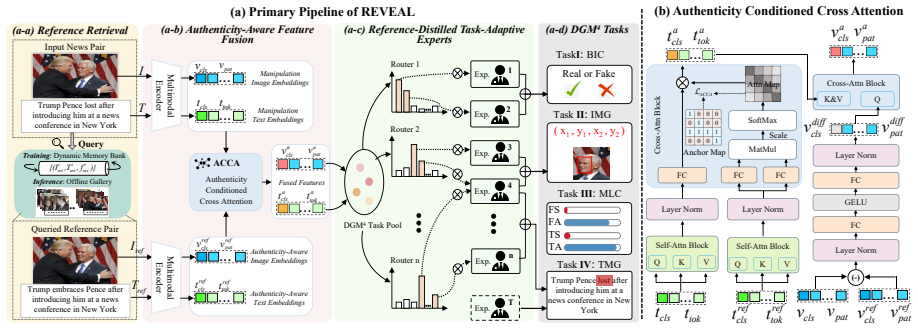
REVEAL detects forged image-text pairs by comparing each query to retrieved authentic references from a 170K-pair library.
A machine-rendered reading of the paper's core claim, the machinery that carries it, and where it could break.
Core claim
Reformulating the task as reference-grounded verification, where authenticity is judged by comparing a query image-text pair against retrieved authentic evidence using difference-aware fusion and a task-decoupled Mixture-of-Experts architecture, enables superior instance-level detection and fine-grained localization while supporting training-free domain adaptation through reference library updates.
What carries the argument
Reference library of 170K authentic image-text pairs together with difference-aware fusion to capture discrepancies and a task-decoupled Mixture-of-Experts architecture that separates detection from localization.
If this is right
- Detection and localization accuracy exceed that of prior state-of-the-art methods on standard benchmarks.
- Domain shifts can be handled without any model retraining by replacing or expanding the reference library.
- Imperceptible manipulations become detectable because the system relies on explicit comparison rather than learned artifact patterns.
- The same framework can address evolving misinformation by maintaining an up-to-date reference collection.
Where Pith is reading between the lines
- The approach may reduce reliance on large labeled sets of fake examples if reference libraries can be assembled from public authentic sources.
- Similar reference-grounded designs could be tested on other paired media such as video-audio or text-audio forgeries.
- Library construction quality and retrieval precision become central engineering requirements for real-world deployment.
Load-bearing premise
A large, high-quality library of authentic image-text pairs can be built and the retrieved references will supply enough comparative detail to expose manipulations.
What would settle it
Run the detector on a new domain after deliberately removing all matching authentic references from the library and measure whether detection and localization performance falls to the level of non-reference baselines.
Figures

read the original abstract
Multimodal manipulation detection aims to simultaneously identify forged image--text pairs and localize tampered regions, yet existing methods typically rely on memorizing isolated artifacts and struggle with imperceptible manipulation traces or domain shifts. Inspired by human comparative reasoning, we reformulate this task as a reference-grounded verification problem, where authenticity is assessed by comparing a query against retrieved authentic evidence. We propose REVEAL Reference-Enabled Verification for Evidence Analysis and Localization), a framework explicitly designed for this comparative paradigm. To support this paradigm, we construct a large-scale reference library comprising 170K authentic news image--text pairs featuring over 40K public figures. Technically, REVEAL employs a difference-aware fusion mechanism to capture fine-grained discrepancies between the query and retrieved evidence. Furthermore, we introduce a task-decoupled Mixture-of-Experts (MoE) architecture to jointly execute instance-level detection and fine-grained grounding, effectively mitigating optimization conflicts between these heterogeneous objectives. Extensive experiments demonstrate that REVEAL significantly outperforms state-of-the-art methods, and notably enables \emph{training-free domain adaptation} by simply updating the reference library, offering a robust and practical solution for detecting evolving misinformation. Code is available at https://anonymous.4open.science/r/REVEAL-Reference-A006.
Editorial analysis
A structured set of objections, weighed in public.
Referee Report
Summary. The paper proposes REVEAL, a reference-grounded framework for multimodal manipulation detection that reformulates the task as comparative verification of a query against retrieved authentic evidence from a constructed 170K library of news image-text pairs (over 40K public figures). It introduces a difference-aware fusion mechanism to capture discrepancies and a task-decoupled Mixture-of-Experts architecture to jointly handle instance-level detection and fine-grained localization, claiming significant outperformance over state-of-the-art methods along with training-free domain adaptation achieved simply by updating the reference library.
Significance. If the results hold, this comparative paradigm could enable practical, evolving detection of multimodal misinformation without retraining, leveraging external authentic references rather than isolated artifact memorization. The public code release at the anonymous link is a positive factor supporting potential reproducibility.
major comments (2)
- [Abstract] Abstract: The training-free domain adaptation claim is load-bearing and rests on the assumption that the 170K reference library can be constructed such that retrieved authentic pairs reliably supply comparative evidence for imperceptible manipulations or domain shifts, yet no mechanism is described for verifying authenticity at scale or for ensuring retrieval success on hard cases.
- [Abstract] Abstract: The assertion that 'extensive experiments demonstrate that REVEAL significantly outperforms state-of-the-art methods' is central to the contribution, but the manuscript provides no quantitative results, baselines, ablation studies, or implementation details to support this or the adaptation capability.
minor comments (1)
- [Abstract] The acronym definition appears to omit parentheses: 'REVEAL Reference-Enabled Verification for Evidence Analysis and Localization' should read 'REVEAL (Reference-Enabled Verification for Evidence Analysis and Localization)'.
Simulated Author's Rebuttal
We thank the referee for the detailed and constructive feedback. We address the two major comments point by point below, clarifying aspects of the REVEAL framework and committing to revisions where the manuscript can be strengthened.
read point-by-point responses
-
Referee: [Abstract] Abstract: The training-free domain adaptation claim is load-bearing and rests on the assumption that the 170K reference library can be constructed such that retrieved authentic pairs reliably supply comparative evidence for imperceptible manipulations or domain shifts, yet no mechanism is described for verifying authenticity at scale or for ensuring retrieval success on hard cases.
Authors: We agree that the training-free adaptation claim requires stronger support regarding library construction and retrieval reliability. The 170K library is assembled exclusively from verified news outlets with established editorial standards, and retrieval employs semantic similarity over image-text embeddings. However, the current manuscript does not detail large-scale authenticity verification protocols or quantitative retrieval success on hard (imperceptible) cases. We will add a new subsection in the method section describing curation sources, verification steps, and retrieval metrics on challenging examples to substantiate the claim. revision: yes
-
Referee: [Abstract] Abstract: The assertion that 'extensive experiments demonstrate that REVEAL significantly outperforms state-of-the-art methods' is central to the contribution, but the manuscript provides no quantitative results, baselines, ablation studies, or implementation details to support this or the adaptation capability.
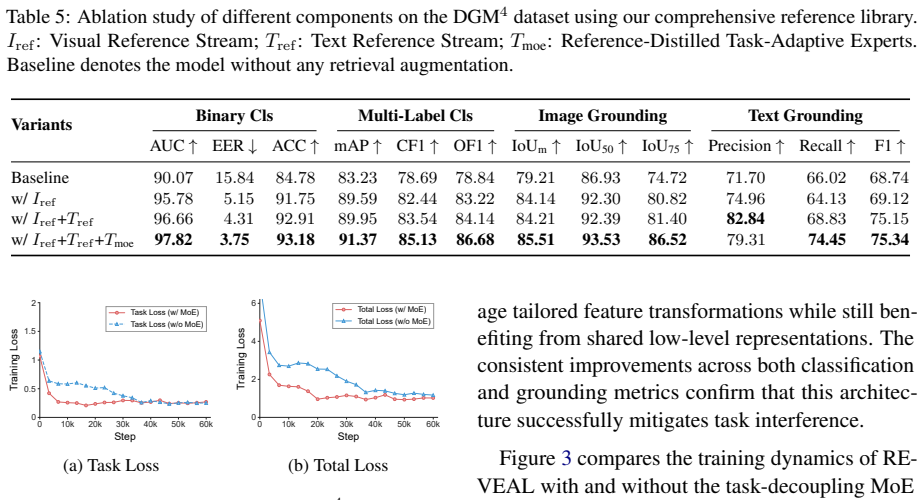
Authors: The full manuscript contains Section 4 (Experiments) with quantitative comparisons against SOTA baselines in Table 1, ablation studies on difference-aware fusion and task-decoupled MoE in Table 2, and training-free adaptation results across domains in Table 3 and Figure 4. Implementation details and hyperparameters appear in Section 3.4 and the released code. To make these results more immediately visible, we will expand the abstract with a concise summary of key metrics and add explicit cross-references to the experimental tables. revision: partial
Circularity Check
No significant circularity; derivation relies on external reference library and empirical validation
full rationale
The paper reformulates the task as reference-grounded verification and introduces difference-aware fusion plus a task-decoupled MoE architecture to support it. These components are defined independently of the target performance metrics; the training-free adaptation claim is realized by updating an externally constructed 170K library rather than by any fitted parameter or self-referential equation. No equations, self-citations, or ansatzes appear that reduce claimed predictions or uniqueness results back to the paper's own inputs by construction. The central results therefore remain falsifiable against external benchmarks and do not exhibit the enumerated circularity patterns.
Axiom & Free-Parameter Ledger
axioms (1)
- domain assumption Neural networks trained on multimodal data can capture fine-grained discrepancies between query and reference pairs
invented entities (1)
-
Task-decoupled Mixture-of-Experts architecture
no independent evidence
Reference graph
Works this paper leans on
-
[1]
Representation Learning with Contrastive Predictive Coding
On the detection of synthetic images generated by diffusion models. InICASSP 2023-2023 IEEE International Conference on Acoustics, Speech and Signal Processing (ICASSP), pages 1–5. IEEE. Davide Cozzolino, Giovanni Poggi, Riccardo Corvi, Matthias Nießner, and Luisa Verdoliva. 2024a. Rais- ing the bar of ai-generated image detection with clip. InProceedings...
work page internal anchor Pith review Pith/arXiv arXiv 2023
-
[2]
Corrective Retrieval Augmented Generation
Faceforensics++: Learning to detect manipu- lated facial images. InProceedings of the IEEE/CVF international conference on computer vision, pages 1–11. Rui Shao, Tianxing Wu, and Ziwei Liu. 2023. Detecting and grounding multi-modal media manipulation. In Proceedings of the IEEE/CVF Conference on Com- puter Vision and Pattern Recognition, pages 6904– 6913....
work page internal anchor Pith review Pith/arXiv arXiv 2023
-
[3]
VisRAG: Vision-based Retrieval-augmented Generation on Multi-modality Documents
TRUST-VL: An explainable news assistant for general multimodal misinformation detection. In Proceedings of the 2025 Conference on Empirical Methods in Natural Language Processing, pages 5588–5604, Suzhou, China. Association for Com- putational Linguistics. Zhiyuan Yan, Yuhao Luo, Siwei Lyu, Qingshan Liu, and Baoyuan Wu. 2024b. Transcending forgery speci- ...
work page internal anchor Pith review Pith/arXiv arXiv 2025
-
[4]
Multimodal misinformation detection by learn- ing from synthetic data with multimodal LLMs. In Findings of the Association for Computational Lin- guistics: EMNLP 2024, pages 10467–10484, Miami, Florida, USA. Association for Computational Lin- guistics. Yuchen Zhang, Yaxiong Wang, Yujiao Wu, Lianwei Wu, Li Zhu, and Zhedong Zheng. 2025a. The coherence trap:...
discussion (0)
Sign in with ORCID, Apple, or X to comment. Anyone can read and Pith papers without signing in.