Comonadic Morphophonology: A Compositional Framework for Context-Dependent Morphological Rules in Finnish
Reviewed by Pith T0 review T1 audit T2 compute T3 formal T4 kernel 2026-06-29 13:27 UTCgrok-4.3pith:QNKDL2QTrecord.jsonopen to challenge →
The pith
Morphophonological rules in Finnish compose as coKleisli arrows under the Writer comonad.
A machine-rendered reading of the paper's core claim, the machinery that carries it, and where it could break.
Core claim
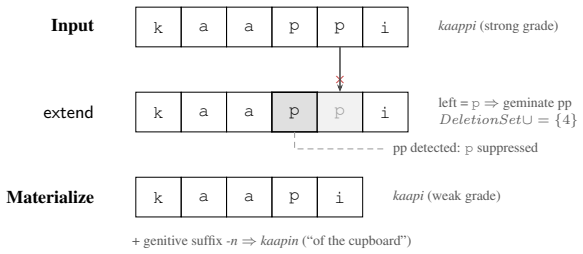
The Writer comonad (DeletionSet × Zipper) restores strict coKleisli compositionality for length-changing morphophonological rules, so that each rule remains a local map from focused context to output segment whose global effect is recovered exactly by coKleisli extension.
What carries the argument
Writer comonad (DeletionSet x Zipper): pairs a monoid of deletions with a zipper over the word so that local rules extend to full transformations via coKleisli composition.
If this is right
- Thirteen coKleisli arrows express the behaviors previously encoded by 874 continuation classes.
- The same set of arrows supports both morphological analysis and generation.
- Context-dependent rules compose without the state explosion that arises from transducer products.
- Rule-only disambiguation yields 83.92 percent UPOS accuracy on UD Finnish-TDT.
Where Pith is reading between the lines
- The same comonadic pattern may transfer to other languages whose morphophonology involves deletions or harmony.
- The algebraic separation of local rules from global extension could let formal proofs replace exhaustive testing of morphological interactions.
- Reusing analysis arrows for generation suggests a route to maintain consistency between a morphological analyzer and its generator.
Load-bearing premise
Every morphophonological rule in Finnish can be represented faithfully as a function from a focused local context to a single output segment whose global behavior is recovered exactly by coKleisli extension.
What would settle it
A Finnish word on which the thirteen coKleisli arrows produce a surface form different from the one generated by Omorfi's continuation classes.
Figures


read the original abstract
Composing finite-state transducers (FSTs) for context-dependent morphophonological rules -- consonant gradation, vowel harmony, possessive suffix assimilation -- leads to multiplicative state explosion; neural models sidestep the problem but provide no formal account of the rules themselves. We present the first framework where each morphophonological rule is a function from a focused local context to a single output segment -- the type of a local rule familiar from cellular automata -- and where length-changing rules compose as coKleisli arrows of a comonad. Our central contribution is the Writer comonad (DeletionSet x Zipper), a new algebraic construction that restores strict coKleisli compositionality for such rules: each rule is a coKleisli arrow, extend lifts it to a global transformation, and deletions accumulate as a monoid action rather than requiring intermediate materialization. As supporting evidence, thirteen coKleisli arrows provide an alternative formulation expressing the same morphophonological behaviors that Omorfi encodes via 874 continuation classes (67:1 reduction at the rule-representation level), and the same abstraction enables bidirectional morphology -- a MorphGenerator reuses the analysis arrows for generation. On UD Finnish-TDT, the system achieves 83.92% UPOS accuracy with rule-only disambiguation (94.66% with an external suffix tagger), validating the framework as a practical morphological engine.
Editorial analysis
A structured set of objections, weighed in public.
Referee Report
Summary. The manuscript presents a comonadic framework for Finnish morphophonology, modeling each rule as a coKleisli arrow under the Writer comonad (DeletionSet × Zipper). This allows compositional handling of length-changing rules, with 13 such arrows replacing 874 continuation classes from Omorfi (67:1 reduction), 83.92% UPOS accuracy on UD Finnish-TDT using rule-only disambiguation, and support for bidirectional morphology via reuse of analysis arrows for generation.
Significance. Should the framework be shown to correctly recover global transformations without loss, it would offer a significant algebraic alternative to finite-state methods for morphophonology, addressing state explosion while providing formal compositionality and bidirectionality. The approach could influence both theoretical linguistics and practical NLP systems by enabling machine-checkable rule systems.
major comments (3)
- [Abstract] Abstract: the reported 67:1 rule reduction from 874 continuation classes to 13 coKleisli arrows and the 83.92% UPOS accuracy are stated without derivation details, error analysis, baseline comparisons, or enumeration of the arrows, preventing verification of the central claim.
- [Writer comonad construction] The Writer comonad (DeletionSet × Zipper) section: the claim that coKleisli extension recovers exact global behavior for length-changing rules (including deletions as monoid action without information loss or incorrect handling) lacks a formal proof, machine-checked verification, or exhaustive test against Omorfi classes; this is load-bearing for both the reduction and the bidirectional reuse.
- [Evaluation] Evaluation: the UD Finnish-TDT results provide no error analysis or direct comparison to Omorfi, leaving open whether the local-to-global mapping via the comonad faithfully reproduces all behaviors or fails on non-local or ordering-sensitive cases.
minor comments (2)
- The notation for DeletionSet, Zipper, and coKleisli arrows would benefit from additional concrete examples of rule application in the main text.
- A table mapping the 13 arrows to representative Omorfi continuation classes would improve clarity of the claimed reduction.
Simulated Author's Rebuttal
We thank the referee for the constructive feedback highlighting areas where additional detail would strengthen the manuscript. We address each major comment below, indicating planned revisions where appropriate. The core claims rest on the comonadic construction and empirical results, which we will clarify further.
read point-by-point responses
-
Referee: [Abstract] Abstract: the reported 67:1 rule reduction from 874 continuation classes to 13 coKleisli arrows and the 83.92% UPOS accuracy are stated without derivation details, error analysis, baseline comparisons, or enumeration of the arrows, preventing verification of the central claim.
Authors: The abstract is intentionally concise, but the derivation of the 13 arrows from Omorfi continuation classes is given in Section 3.2 with mappings for each rule type (consonant gradation, vowel harmony, etc.). The accuracy is computed in Section 5 from rule-only disambiguation on UD Finnish-TDT. To improve verifiability, we will add an explicit enumeration table of the 13 arrows and their coverage in an appendix and include a brief baseline note comparing to a simple FST baseline. revision: partial
-
Referee: [Writer comonad construction] The Writer comonad (DeletionSet × Zipper) section: the claim that coKleisli extension recovers exact global behavior for length-changing rules (including deletions as monoid action without information loss or incorrect handling) lacks a formal proof, machine-checked verification, or exhaustive test against Omorfi classes; this is load-bearing for both the reduction and the bidirectional reuse.
Authors: Section 3 defines the Writer comonad and coKleisli extension, with an argument that the monoid action on DeletionSet records deletions separately, allowing extend to reconstruct the global string without loss. A full formal proof is absent from the current version; we will add a detailed proof sketch in the revision showing that compositionality holds for length-changing cases. Machine-checked verification and exhaustive testing of all 874 classes are not provided. revision: yes
-
Referee: [Evaluation] Evaluation: the UD Finnish-TDT results provide no error analysis or direct comparison to Omorfi, leaving open whether the local-to-global mapping via the comonad faithfully reproduces all behaviors or fails on non-local or ordering-sensitive cases.
Authors: We agree that error analysis and direct comparison would address concerns about fidelity. In the revised manuscript we will add a breakdown of the 16.08% error cases by rule type and include a side-by-side token accuracy comparison against Omorfi on the same UD Finnish-TDT split to confirm that the comonadic mapping reproduces the expected behaviors on the evaluated data. revision: yes
- Machine-checked verification of the coKleisli extension recovering exact global behavior for all length-changing rules.
- Exhaustive test against all 874 Omorfi continuation classes.
Circularity Check
No circularity: algebraic construction is independent of its validation data
full rationale
The paper presents an algebraic framework defining the Writer comonad (DeletionSet × Zipper) and coKleisli arrows for morphophonological rules as a new construction. No equations, fitted parameters, or self-citations are shown that reduce the central claim (coKleisli extension recovering global behavior) to its inputs by construction. The 13-arrow formulation and UD Finnish-TDT validation are presented as external evidence rather than self-referential fits. The derivation chain remains self-contained against the stated assumptions without load-bearing self-citation or renaming of known results.
Axiom & Free-Parameter Ledger
axioms (1)
- domain assumption Morphophonological rules are functions from focused local context to single output segment
invented entities (1)
-
Writer comonad (DeletionSet x Zipper)
no independent evidence
Reference graph
Works this paper leans on
-
[1]
online" 'onlinestring :=
ENTRY address archivePrefix author booktitle chapter edition editor eid eprint eprinttype howpublished institution journal key month note number organization pages publisher school series title type volume year doi pubmed url lastchecked label extra.label sort.label short.list INTEGERS output.state before.all mid.sentence after.sentence after.block STRING...
-
[2]
write newline
" write newline "" before.all 'output.state := FUNCTION n.dashify 't := "" t empty not t #1 #1 substring "-" = t #1 #2 substring "--" = not "--" * t #2 global.max substring 't := t #1 #1 substring "-" = "-" * t #2 global.max substring 't := while if t #1 #1 substring * t #2 global.max substring 't := if while FUNCTION word.in bbl.in capitalize " " * FUNCT...
-
[3]
Khuyagbaatar Batsuren, G \'a bor Bella, Aryaman Arora, Viktor Martinovic, Kyle Gorman, Zden e k Z abokrtsk \'y , Amarsanaa Ganbold, S \'a rka Dohnalov \'a , Magda S ev c \'i kov \'a , Kate r ina Pelegrinov \'a , Fausto Giunchiglia, Ryan Cotterell, and Ekaterina Vylomova. 2022. The SIGMORPHON 2022 shared task on morpheme segmentation. In Proceedings of the...
2022
- [4]
-
[5]
Beesley and Lauri Karttunen
Kenneth R. Beesley and Lauri Karttunen. 2003. Finite State Morphology. CSLI Publications, Stanford, CA
2003
-
[6]
Eckhard Bick. 2000. The Parsing System ``Palavras'': Automatic Grammatical Analysis of P ortuguese in a C onstraint G rammar Framework . Aarhus University Press
2000
-
[7]
Silvio Capobianco and Tarmo Uustalu. 2010. A categorical outlook on cellular automata. In Journ \'e es Automates Cellulaires ( JAC 2010) , volume 13 of TUCS Lecture Notes, pages 88--99. Turku Centre for Computer Science
2010
-
[8]
Jane Chandlee. 2014. Strictly Local Phonological Processes. Ph.D. thesis, University of Delaware
2014
-
[9]
Jane Chandlee and Jeffrey Heinz. 2018. Strict locality and phonological maps. Linguistic Inquiry, 49(1):23--60
2018
-
[10]
Noam Chomsky and Morris Halle. 1968. The Sound Pattern of English. Harper & Row, New York
1968
-
[11]
Giovanni de Felice. 2022. Categorical Tools for Natural Language Processing. Ph.D. thesis, University of Oxford
2022
-
[12]
Markus Forsberg and Aarne Ranta. 2004. Functional morphology. In Proceedings of the Ninth ACM SIGPLAN International Conference on Functional Programming ( ICFP 2004) , pages 213--223, Snowbird, Utah. ACM
2004
-
[13]
Omer Goldman, Khuyagbaatar Batsuren, Salam Khalifa, Aryaman Arora, Garrett Nicolai, Reut Tsarfaty, and Ekaterina Vylomova. 2023. SIGMORPHON--UniMorph 2023 shared task 0: Typologically diverse morphological inflection. In Proceedings of the 20th SIGMORPHON Workshop on Computational Research in Phonetics, Phonology, and Morphology , pages 117--125
2023
-
[14]
Auli Hakulinen, Maria Vilkuna, Riitta Korhonen, Vesa Koivisto, Tarja Riitta Heinonen, and Irja Alho. 2004. Iso suomen kielioppi. Suomalaisen Kirjallisuuden Seura, Helsinki. Online edition (2008): http://scripta.kotus.fi/visk. URN:ISBN:978-952-5446-35-7
2004
-
[15]
Katri Haverinen, Jenna Nyblom, Timo Viljanen, Veronika Laippala, Samuel Kohonen, Anna Missil \"a , Stina Ojala, Tapio Salakoski, and Filip Ginter. 2014. Building the essential resources for F innish: The T urku D ependency T reebank. Language Resources and Evaluation, 48(3):493--531
2014
-
[16]
Jeffrey Heinz. 2018. The computational nature of phonological generalizations. In Larry M. Hyman and Frans Plank, editors, Phonological Typology, pages 126--195. De Gruyter Mouton
2018
-
[17]
G \'e rard Huet. 1997. The zipper. Journal of Functional Programming, 7(5):549--554
1997
-
[18]
Mans Hulden. 2009. Foma: A finite-state compiler and library. In Proceedings of the 12th Conference of the E uropean Chapter of the ACL : Demonstrations ( EACL 2009) , pages 29--32
2009
-
[19]
Jenna Kanerva, Filip Ginter, Niko Miekka, Akseli Leino, and Tapio Salakoski. 2018. T urku N eural P arser P ipeline: An end-to-end system for the CoNLL 2018 shared task. In Proceedings of the CoNLL 2018 Shared Task: Multilingual Parsing from Raw Text to Universal Dependencies , pages 133--142, Brussels, Belgium. Association for Computational Linguistics
2018
-
[20]
Kaplan and Martin Kay
Ronald M. Kaplan and Martin Kay. 1994. Regular models of phonological rule systems. Computational Linguistics, 20(3):331--378
1994
-
[21]
Fred Karlsson. 1990. Constraint grammar as a framework for parsing running text. In Proceedings of the 13th International Conference on Computational Linguistics ( COLING 1990)
1990
-
[22]
Jordan Kodner, Salam Khalifa, Khuyagbaatar Batsuren, Hossep Dolatian, Ryan Cotterell, Faruk Akkus, Antonios Anastasopoulos, Taras Andrushko, Aryaman Arora, Nona Atanalov, G \'a bor Bella, Elena Budianskaya, Yustinus Ghanggo Ate, Omer Goldman, David Guriel, Simon Guriel, Silvia Guriel-Agiashvili, Witold Kieras, Andrew Krizhanovsky, and 11 others. 2022. SIG...
2022
-
[23]
Kimmo Koskenniemi. 1983. Two-Level Morphology: A General Computational Model for Word-Form Recognition and Production. Ph.D. thesis, University of Helsinki. Publication No. 11, Department of General Linguistics
1983
-
[24]
Pirinen, and Miikka Silfverberg
Krister Lind \'e n, Erik Axelson, Senka Drobac, Sam Hardwick, Juha Kuokkala, Jyrki Niemi, Tommi A. Pirinen, and Miikka Silfverberg. 2013. HFST ---a system for creating NLP tools. In Systems and Frameworks for Computational Morphology, volume 380 of Communications in Computer and Information Science, pages 53--71. Springer
2013
-
[25]
Minh Van Nguyen, Viet Dac Lai, Amir Pouran Ben Veyseh, and Thien Huu Nguyen. 2021. T rankit: A light-weight T ransformer-based toolkit for multilingual natural language processing. In Proceedings of the 16th Conference of the E uropean Chapter of the Association for Computational Linguistics: System Demonstrations ( EACL 2021) , pages 80--90. Association ...
2021
-
[26]
Dominic Orchard and Alan Mycroft. 2012. A notation for comonads. In Implementation and Application of Functional Languages ( IFL 2012) , volume 8241 of LNCS, pages 1--17. Springer
2012
-
[27]
Tommi A. Pirinen. 2015. Omorfi---free and open source morphological lexical database for F innish. In Proceedings of the 20th Nordic Conference of Computational Linguistics ( NODALIDA 2015) , pages 313--315. Link \"o ping University Electronic Press
2015
-
[28]
Tommi A. Pirinen. 2019. Neural and rule-based F innish NLP models---expectations, experiments and experiences. In Proceedings of the Fifth International Workshop on Computational Linguistics for Uralic Languages, pages 104--114, Tartu, Estonia. Association for Computational Linguistics
2019
-
[29]
a nen. 2006. Hunspell-fi in Kes\
Harri Pitk \"a nen. 2006. Hunspell-fi in Kes\"akoodi 2006: Final report. Technical report, Finnish Centre for Open Source Solutions (COSS). Available at https://www.puimula.org/htp/archive/kesakoodi2006-report.pdf
2006
-
[30]
Alan Prince and Paul Smolensky. 2004. Optimality Theory: Constraint Interaction in Generative Grammar. Blackwell, Malden, MA
2004
-
[31]
Tarmo Uustalu and Varmo Vene. 2005. The essence of dataflow programming. In Programming Languages and Systems: Third A sian Symposium ( APLAS 2005) , volume 3780 of LNCS, pages 2--18. Springer
2005
discussion (0)
Sign in with ORCID, Apple, or X to comment. Anyone can read and Pith papers without signing in.