Impact of hyperon mixing on neutron star structure based on Skyrme-type equations of state: Systematic analysis of Λ NN and ΛΛ N three-body forces with Bayesisan inference
Pith reviewed 2026-06-29 09:20 UTC · model grok-4.3
The pith
Bayesian inference on Skyrme hyperon models favors sizable three-body repulsion to support observed neutron-star maximum masses.
A machine-rendered reading of the paper's core claim, the machinery that carries it, and where it could break.
Core claim
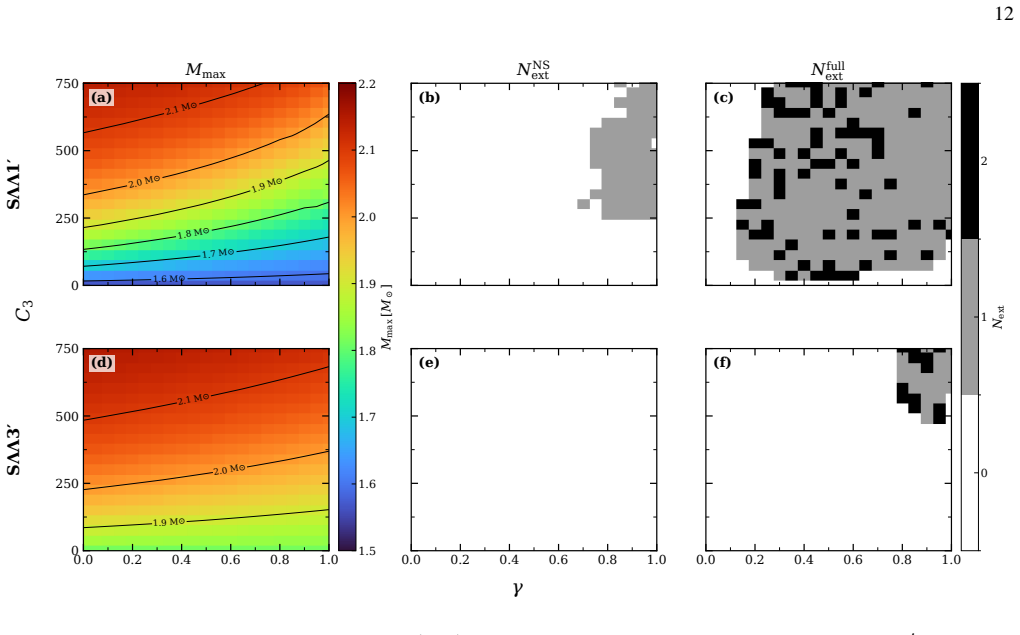
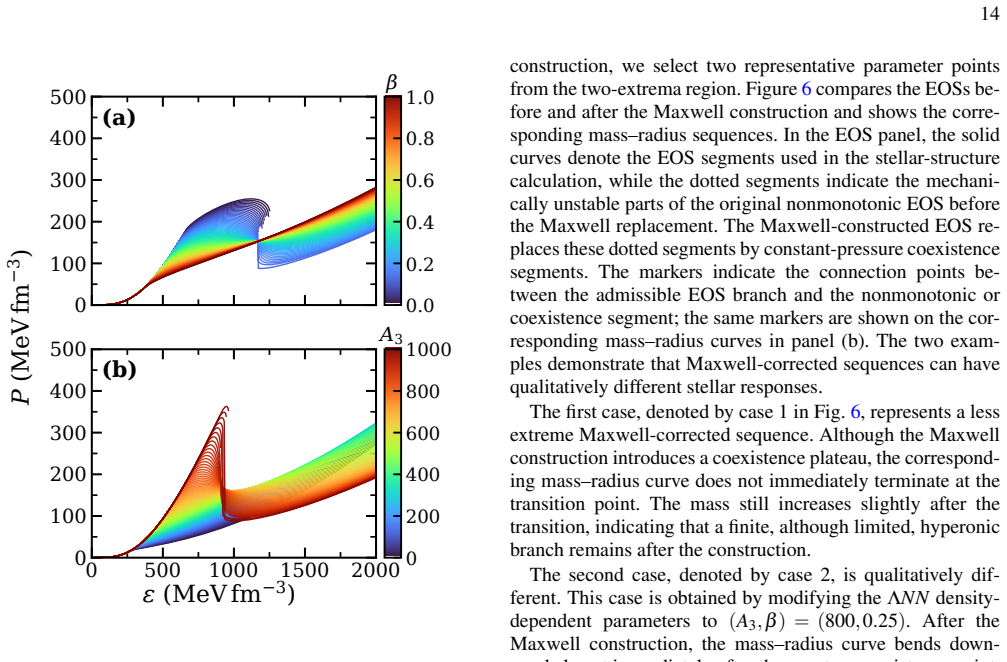
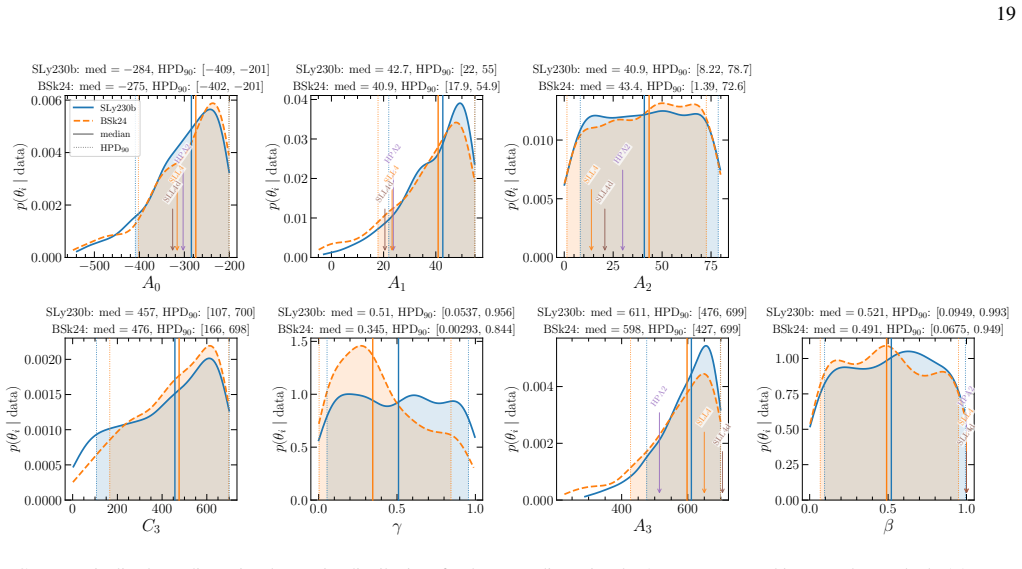
Within the adopted likelihood constructed from neutron-star mass-radius observations and the chosen prior ranges, the posterior distributions favor sizable hyperonic three-body repulsion. The LambdaNN term simultaneously shifts the Lambda onset density and modifies the post-onset branch, while the LambdaLambdaN term leaves the onset unchanged but stiffens the finite-Lambda equation of state; increasing C3 raises M_max in admissible regions whereas increasing gamma reduces the stiffening at fixed C3. Representative two-extrema branches are connected by Maxwell constructions, and SHAP analysis identifies A3 and C3 as the leading controls of M_max and R_2.0.
What carries the argument
Density-dependent effective LambdaNN (beta, A3) and LambdaLambdaN (gamma, C3) three-body terms inside a Skyrme energy-density functional, inserted into beta-equilibrated npe mu Lambda matter and integrated via the Tolman-Oppenheimer-Volkoff equation, with posterior sampling and SHAP surrogate diagnostics.
If this is right
- Increasing C3 at fixed gamma stiffens the post-onset branch and raises the maximum mass in mechanically stable regions.
- The LambdaNN term shifts the Lambda onset density to lower values while simultaneously altering the post-onset stiffness.
- For some reference interactions the parameter plane organizes into branch-limited regions and Maxwell-construction candidates.
- SHAP values rank A3 and C3 as the dominant controls on both M_max and R_2.0 within the sampled posterior.
Where Pith is reading between the lines
- If the favored repulsive three-body terms prove incompatible with hypernuclear binding energies, additional density-dependent or many-body terms will be required.
- The same parameter plane could be re-weighted with tidal-deformability or cooling data to test whether the posterior remains concentrated at large A3 and C3.
- The classification of branches by extremum count supplies a diagnostic that could be applied to other hyperon models to separate onset-driven from stiffness-driven mass recovery.
Load-bearing premise
The Skyrme energy-density functional with only npe mu Lambda composition and a likelihood built solely from neutron-star mass-radius data is assumed to capture the essential physics without additional nuclear or astrophysical constraints.
What would settle it
A precise measurement showing that the radius at 2 solar masses lies outside the narrow band produced by the high-posterior A3-C3 region, or the discovery of a neutron star whose mass exceeds the maximum allowed by any admissible branch once the favored repulsive parameters are fixed.
Figures






read the original abstract
We study hyperonic density-dependent three-body effects in cold neutron-star matter using a Skyrme energy-density-functional framework. In beta-equilibrated $npe\mu\Lambda$ matter, the effective $\Lambda NN$ and $\Lambda\Lambda N$ terms are varied separately in the $(\beta,A_3)$ and $(\gamma,C_3)$ planes, and each tabulated equation of state is used in Tolman--Oppenheimer--Volkoff calculations. The calculated $P$--$\varepsilon$ branches are classified by monotonicity and extremum structure. The $\Lambda\Lambda N$ term does not affect the $\Lambda$-onset condition, but modifies the finite-$\Lambda$ post-onset EOS: increasing $C_3$ generally stiffens the post-onset branch and raises $M_{\max}$ in mechanically admissible regions, whereas increasing $\gamma$ reduces this enhancement at fixed $C_3$. In contrast, the $\Lambda NN$ term shifts the $\Lambda$-onset density and modifies the post-onset EOS simultaneously, producing organized branch-limited and Maxwell-candidate regions for some reference interactions. Representative two-extrema cases are examined with Maxwell constructions. We also perform an exploratory Bayesian analysis using neutron-star mass--radius information alone and apply XGBoost--SHAP surrogate diagnostics to summarize parameter sensitivities. Within the adopted likelihood and prior ranges, the posterior weight tends to favor sizable hyperonic three-body repulsion, and the SHAP analysis identifies $A_3$ and $C_3$ as important controls of $M_\text{max}$ and $R_{2.0}$. These results show that maximum-mass recovery in hyperonic neutron stars is not a single mechanism: $M_\text{max}$ maps must be interpreted together with onset behavior, branch admissibility, and extremum-count diagnostics. *shortened due to the arXiv's word limit.
Editorial analysis
A structured set of objections, weighed in public.
Referee Report
Summary. The paper studies hyperonic three-body forces (ΛNN and ΛΛN) in Skyrme EDFs for cold beta-equilibrated npeμΛ neutron-star matter. It systematically varies the (β, A3) and (γ, C3) parameters, tabulates the resulting EOS, solves the TOV equation, classifies P–ε branches by monotonicity and extremum structure, performs representative Maxwell constructions, and conducts an exploratory Bayesian analysis using only neutron-star mass–radius data together with XGBoost–SHAP diagnostics. The central claim is that, within the adopted priors and M–R likelihood, the posterior favors sizable hyperonic three-body repulsion and that A3 and C3 are the dominant controls of M_max and R_2.0.
Significance. If the results hold, the work demonstrates that maximum-mass recovery in hyperonic stars is not a single-parameter mechanism but requires joint consideration of onset density, post-onset stiffness, and branch admissibility. The systematic mapping of the two parameter planes and the use of SHAP to rank sensitivities constitute useful diagnostics for EDF-based hyperonic models. The explicit branch-classification procedure is a concrete methodological contribution.
major comments (2)
- [Bayesian analysis section] Bayesian analysis section (likelihood construction): The likelihood is assembled exclusively from neutron-star mass–radius constraints. No term enforces the empirical Λ single-particle potential depth (≈ −30 MeV at saturation) or ΛN scattering lengths. Because A3 and C3 directly set both the Λ onset density and the post-onset repulsion, the reported posterior preference for sizable repulsion and the SHAP ranking of A3, C3 may be driven by the chosen prior volume and the limited M–R information rather than by nuclear data.
- [Parameter variation and SHAP diagnostics] Parameter variation and SHAP diagnostics: The same parameters (β, A3, γ, C3) that define the EOS are also the objects of Bayesian inference; the SHAP surrogate is trained on quantities derived from those same EOS. This creates a moderate circularity that must be quantified (e.g., by reporting the effective prior volume after the branch-admissibility filter) before the claim that the posterior “tends to favor sizable hyperonic three-body repulsion” can be regarded as robust.
minor comments (2)
- [Abstract] Abstract: “Bayesisan” is a typographical error.
- [EOS construction] The manuscript states that the ΛΛN term does not affect the Λ-onset condition; an explicit equation or numerical check confirming this independence would strengthen the presentation.
Simulated Author's Rebuttal
We thank the referee for the constructive and detailed report. The two major comments concern the scope of the Bayesian analysis and the interpretation of the SHAP diagnostics. We address each point below and indicate where revisions will be made to improve clarity.
read point-by-point responses
-
Referee: [Bayesian analysis section] Bayesian analysis section (likelihood construction): The likelihood is assembled exclusively from neutron-star mass–radius constraints. No term enforces the empirical Λ single-particle potential depth (≈ −30 MeV at saturation) or ΛN scattering lengths. Because A3 and C3 directly set both the Λ onset density and the post-onset repulsion, the reported posterior preference for sizable repulsion and the SHAP ranking of A3, C3 may be driven by the chosen prior volume and the limited M–R information rather than by nuclear data.
Authors: We agree that the Bayesian section uses only neutron-star mass–radius constraints and does not include nuclear-physics anchors such as the empirical Λ single-particle potential or scattering lengths. The manuscript already describes the analysis as exploratory and qualifies the posterior preference as holding “within the adopted likelihood and prior ranges.” To make this limitation explicit, we will add a short paragraph in the Bayesian section stating that the reported trends are conditioned solely on the M–R data and chosen priors, and that inclusion of nuclear constraints is left for future work. This is a clarification rather than a change in methodology or conclusions. revision: partial
-
Referee: [Parameter variation and SHAP diagnostics] Parameter variation and SHAP diagnostics: The same parameters (β, A3, γ, C3) that define the EOS are also the objects of Bayesian inference; the SHAP surrogate is trained on quantities derived from those same EOS. This creates a moderate circularity that must be quantified (e.g., by reporting the effective prior volume after the branch-admissibility filter) before the claim that the posterior “tends to favor sizable hyperonic three-body repulsion” can be regarded as robust.
Authors: The SHAP analysis is applied after the posterior has been obtained; it ranks the influence of the input parameters on the derived observables (M_max, R_2.0) and is a standard interpretability tool rather than a source of circularity. Nevertheless, we accept the request to quantify the effective prior volume after the branch-admissibility filter. In the revised manuscript we will report the retained fraction of the prior volume (approximately 35–40 % of the sampled points survive the monotonicity and extremum criteria) so that readers can assess how strongly the admissibility cuts shape the posterior. This addition addresses the robustness concern directly. revision: partial
Circularity Check
No significant circularity; Bayesian update uses external M-R likelihood
full rationale
The paper varies Skyrme parameters (β, A3, γ, C3) to build EOS tables, solves TOV equations, classifies branches, then constructs a likelihood solely from independent neutron-star mass-radius observations to obtain the posterior. SHAP is applied post-inference as a sensitivity diagnostic on the sampled parameters versus derived outputs (M_max, R_2.0). No equation reduces a claimed result to its own inputs by construction, no fitted quantity is relabeled as a prediction, and no self-citation chain is invoked as load-bearing justification. The derivation chain is therefore self-contained against the stated external data.
Axiom & Free-Parameter Ledger
free parameters (2)
- β, A3
- γ, C3
axioms (2)
- domain assumption Skyrme energy-density-functional framework is adequate for cold beta-equilibrated npeμΛ matter
- domain assumption Neutron-star mass-radius data alone provide a sufficient likelihood for constraining the three-body parameters
Reference graph
Works this paper leans on
-
[1]
A. Gal, E. V . Hungerford, and D. J. Millener,Strangeness in nu- clear physics, Reviews of Modern Physics88, 035004 (2016), arXiv:1605.00557 [nucl-th]
work page internal anchor Pith review Pith/arXiv arXiv 2016
-
[2]
L. Tolos and L. Fabbietti,Strangeness in nuclei and neutron stars, Progress in Particle and Nuclear Physics112, 103770 (2020), arXiv:2002.09223 [nucl-ex]
-
[3]
P. B. Demorest, T. Pennucci, S. M. Ransom, M. S. E. Roberts, and J. W. T. Hessels,A two-solar-mass neutron star measured using shapiro delay, Nature467, 1081–1083 (2010)
2010
-
[4]
Antoniadis, P
J. Antoniadis, P. C. C. Freire, N. Wex, T. M. Tauris, R. S. Lynch, M. H. van Kerkwijk, M. Kramer, C. Bassa, V . S. Dhillon, T. Driebe, J. W. T. Hessels, V . M. Kaspi, V . I. Kondratiev, N. Langer, T. R. Marsh, M. A. McLaughlin, T. T. Pennucci, S. M. Ransom, I. H. Stairs, J. van Leeuwen, J. P. W. Verbiest, and D. G. Whelan,A massive pulsar in a compact rel...
2013
-
[5]
E. Fonseca, H. T. Cromartie, T. T. Pennucci, P. S. Ray, A. Y . Kirichenko, S. M. Ransom, P. B. Demorest, I. H. Stairs, Z. Ar- zoumanian, L. Guillemot,et al.,Refined mass and geometric measurements of the high-mass PSR J0740+6620, The Astro- physical Journal Letters915, L12 (2021), arXiv:2104.00880 [astro-ph.HE]
-
[6]
T. E. Riley, A. L. Watts, S. Bogdanov, P. S. Ray, R. M. Lud- lam, S. Guillot, Z. Arzoumanian, C. L. Baker, A. V . Bilous, D. Chakrabarty, K. C. Gendreau, A. K. Harding, W. C. G. Ho, J. M. Lattimer, S. M. Morsink, and T. E. Strohmayer,A NICER view of PSR J0030+0451: Millisecond pulsar parameter esti- mation, The Astrophysical Journal Letters887, L21 (2019)
2019
-
[7]
T. E. Riley, A. L. Watts, P. S. Ray, S. Bogdanov, S. Guillot, S. M. Morsink, A. V . Bilous, Z. Arzoumanian, D. Choudhury, J. S. Deneva, K. C. Gendreau, A. K. Harding, W. C. G. Ho, J. M. Lattimer, M. Loewenstein, R. M. Ludlam, C. B. Markwardt, T. Okajima, C. Prescod-Weinstein, R. A. Remillard, M. T. Wolff, E. Fonseca, H. T. Cromartie, M. Kerr, T. T. Pennuc...
2021
-
[8]
D. Choudhury, T. H. J. Salmi, S. Vinciguerra, T. E. Riley, Y . Kini, A. L. Watts, B. Dorsman, S. Bogdanov, S. Guil- lot, P. S. Ray, D. J. Reardon, R. A. Remillard, A. V . Bilous, D. Huppenkothen, J. M. Lattimer, N. Rutherford, Z. Arzou- manian, K. C. Gendreau, S. M. Morsink, and W. C. G. Ho,A NICER view of the nearest and brightest millisecond pulsar: PSR...
-
[9]
B. P. Abbottet al.,Gw170817: Measurements of neutron star radii and equation of state, Physical Review Letters121, 161101 (2018)
2018
-
[10]
An Effective Equation of State for Dense Matter with Strangeness
S. Balberg and A. Gal,An effective equation of state for dense matter with strangeness, Nuclear Physics A625, 435–472 (1997), arXiv:nucl-th/9704013
work page internal anchor Pith review Pith/arXiv arXiv 1997
-
[11]
Do hyperons exist in the interior of neutron stars ?
D. Chatterjee and I. Vidaña,Do hyperons exist in the interior of neutron stars?, The European Physical Journal A52, 29 (2016), arXiv:1510.06306 [nucl-th]
work page internal anchor Pith review Pith/arXiv arXiv 2016
-
[12]
Schulze and E
H.-J. Schulze and E. Hiyama,Skyrme force for light and heavy hypernuclei, Physical Review C90, 047301 (2014)
2014
-
[13]
Guleria, S
N. Guleria, S. K. Dhiman, and R. Shyam,A study ofΛhyper- nuclei within the skyrme–hartree–fock model, Nuclear Physics A886, 71–91 (2012)
2012
-
[14]
D. E. Lanskoy,Double-Λhypernuclei in the skyrme-hartree- fock approach and nuclear core polarization, Phys. Rev. C58, 3351–3358 (1998)
1998
-
[15]
Minato and S
F. Minato and S. Chiba,Fission barrier of actinide nuclei with double-Λparticles within the skyrme–hartree–fock method, Nuclear Physics A856, 55–67 (2011)
2011
- [16]
-
[17]
Malik and C
T. Malik and C. Providência,Bayesian inference of signa- tures of hyperons inside neutron stars, Physical Review D106, 063024 (2022)
2022
-
[18]
Huang, L
C. Huang, L. Tolos, C. Providência, and A. L. Watts,Constrain- ing a relativistic mean field model using neutron star mass- radius measurements ii: Hyperonic models, Monthly Notices of the Royal Astronomical Society536, 3262–3275 (2025)
2025
-
[19]
X. D. Sun, S. C. Han, J. N. Hu, and A. Li,Exploring hyperon Skyrme forces in multi-Λhypernuclei and neutron star mat- ter, Monthly Notices of the Royal Astronomical Society546, stag233 (2026), arXiv:2602.03388 [nucl-th]
work page internal anchor Pith review Pith/arXiv arXiv 2026
-
[20]
Y . Tanimura, C. Hyun, and M. Cheoun, Constraining the ΛΛinteraction with terrestrial and astronomical data (2026), arXiv:2602.18356 [nucl-th]
-
[21]
T. H. R. Skyrme,The effective nuclear potential, Nuclear Physics9, 615–634 (1958)
1958
-
[22]
Vautherin and D
D. Vautherin and D. M. Brink,Hartree-fock calculations with skyrme’s interaction. i. spherical nuclei, Physical Review C5, 626–647 (1972)
1972
-
[23]
Rayet,Self-consistent calculations of hypernuclear proper- ties with the Skyrme interaction, Annals of Physics102, 226– 251 (1976)
M. Rayet,Self-consistent calculations of hypernuclear proper- ties with the Skyrme interaction, Annals of Physics102, 226– 251 (1976)
1976
-
[24]
Rayet,Skyrme parametrization of an effectiveΛ-nucleon in- teraction, Nuclear Physics A367, 381–397 (1981)
M. Rayet,Skyrme parametrization of an effectiveΛ-nucleon in- teraction, Nuclear Physics A367, 381–397 (1981)
1981
-
[25]
Bender, P.-H
M. Bender, P.-H. Heenen, and P.-G. Reinhard,Self-consistent mean-field models for nuclear structure, Reviews of Modern Physics75, 121–180 (2003)
2003
-
[26]
Schulze, inThe 13th International Conference on Hyper- Nuclear and Strange Particle Physics: HYP2018, AIP Confer- ence Proceedings, V ol
H.-J. Schulze, inThe 13th International Conference on Hyper- Nuclear and Strange Particle Physics: HYP2018, AIP Confer- ence Proceedings, V ol. 2130 (AIP Publishing, 2019) p. 020009
2019
-
[27]
Yamamoto, H
Y . Yamamoto, H. Band¯o, and J. Žofka,On theΛ-hypernuclear single particle energies, Progress of Theoretical Physics80, 757–761 (1988)
1988
-
[28]
N. K. Glendenning,Compact Stars: Nuclear Physics, Particle Physics, and General Relativity, 2nd ed., Astronomy and As- trophysics Library (Springer, New York, 2000)
2000
-
[29]
Equations of state for supernovae and compact stars
M. Oertel, M. Hempel, T. Klähn, and S. Typel,Equations of state for supernovae and compact stars, Reviews of Modern Physics89, 015007 (2017), arXiv:1610.03361 [astro-ph.HE]
work page internal anchor Pith review Pith/arXiv arXiv 2017
-
[30]
R. C. Tolman,Static solutions of Einstein’s field equations for spheres of fluid, Physical Review55, 364–373 (1939)
1939
-
[31]
J. R. Oppenheimer and G. M. V olkoff,On massive neutron cores, Physical Review55, 374–381 (1939)
1939
-
[32]
N. K. Glendenning,First-order phase transitions with more than one conserved charge: Consequences for neutron stars, Physical Review D46, 1274–1287 (1992)
1992
-
[33]
T. E. Riley, G. Raaijmakers, and A. L. Watts,On parametrized cold dense matter equation-of-state inference, Monthly Notices of the Royal Astronomical Society478, 1093–1131 (2018)
2018
-
[34]
Raaijmakers, N
G. Raaijmakers, N. Rutherford, P. Timmerman, T. H. J. Salmi, A. L. Watts, C. Prescod-Weinstein, I. Svensson, and M. Mendes,NEoST: A python package for nested sampling of the neutron star equation of state, Journal of Open Source Soft- ware10, 6003 (2025)
2025
-
[35]
J. S. Speagle,dynesty: a dynamic nested sampling package for estimating bayesian posteriors and evidences, Monthly Notices of the Royal Astronomical Society493, 3132–3158 (2020)
2020
-
[36]
Chen and C
T. Chen and C. Guestrin, inProceedings of the 22nd ACM SIGKDD International Conference on Knowledge Discovery and Data Mining(2016) pp. 785–794
2016
-
[37]
S. M. Lundberg and S.-I. Lee, inAdvances in Neural Informa- tion Processing Systems, V ol. 30 (2017) arXiv:1705.07874
work page internal anchor Pith review Pith/arXiv arXiv 2017
discussion (0)
Sign in with ORCID, Apple, or X to comment. Anyone can read and Pith papers without signing in.