Controlled Loop Expansion for Strained Twisted Bilayer Graphene
Pith reviewed 2026-06-29 09:34 UTC · model grok-4.3
The pith
In strained magic-angle twisted bilayer graphene an emergent U(1) symmetry keeps the Mott bands sharp at order s² by forbidding the leading scattering channel.
A machine-rendered reading of the paper's core claim, the machinery that carries it, and where it could break.
Core claim
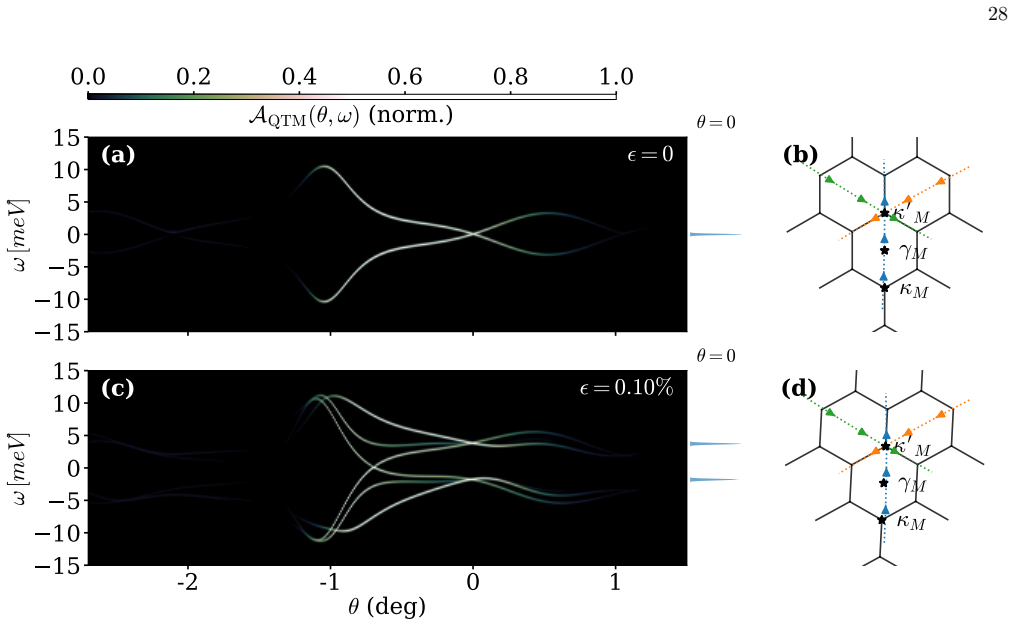
In the flat-chiral limit of strained MATBG an emergent approximate U(1) symmetry forbids the leading scattering channel and leaves the Mott bands sharp at order s². This is in stark contrast to the unstrained case where the linewidth is of order N_f s² U with U the on-site f-f Hubbard interaction and N_f the number of f states per site. Away from the chiral limit the linewidth is nonzero at order s² but more than an order of magnitude smaller than in the unstrained case. The strain-induced energy scale imprints itself directly on the spectrum as an electron-phonon-like kink in the dispersion and as an additional flat trion band.
What carries the argument
Dyson resummation of self-energy insertions organized to any order in the small parameter s² within the topological heavy-fermion formulation of the periodic Anderson model.
If this is right
- The expansion remains controlled down to arbitrarily low temperatures provided the strain energy scale is not too small.
- Away from the chiral limit the linewidth stays nonzero at order s² but is suppressed by more than an order of magnitude relative to the unstrained case.
- Strain imprints an electron-phonon-like kink in the dispersion and an additional flat trion band in the spectrum.
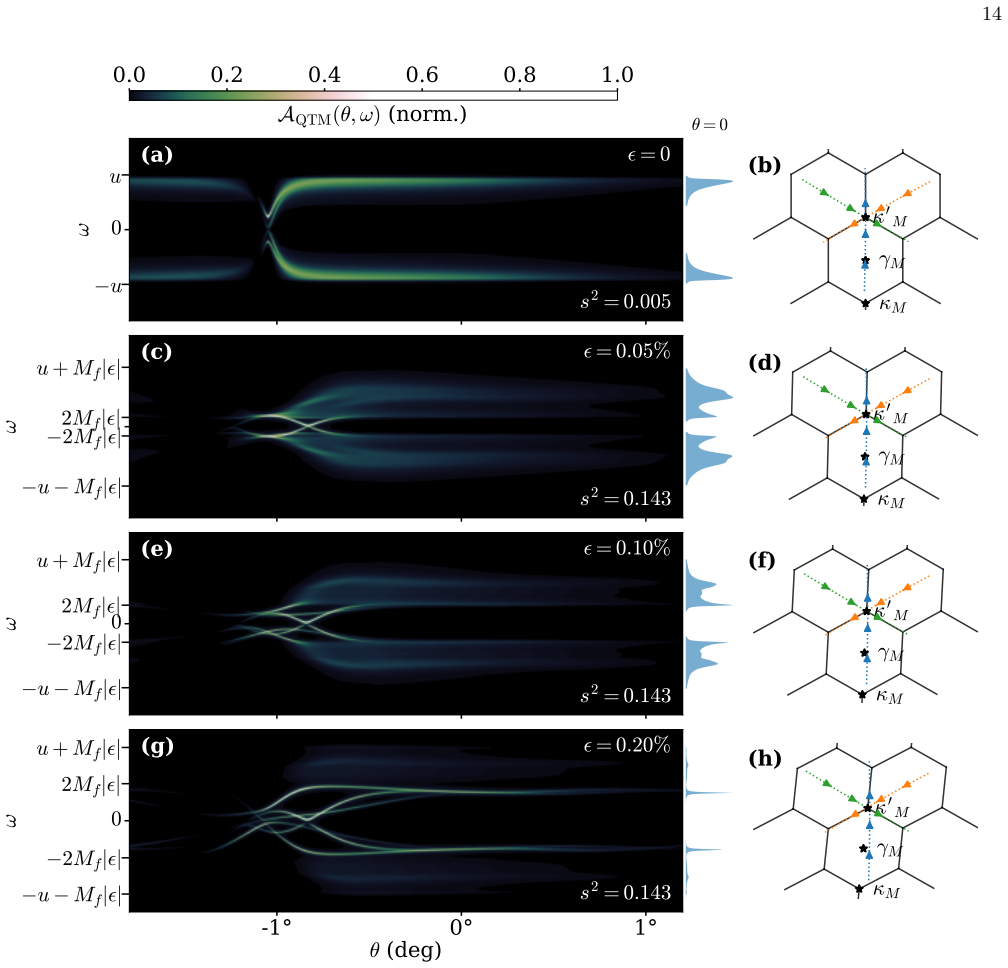
- The framework yields one-loop predictions for the Quantum Twisting Microscope spectrum in both strained and unstrained MATBG.
Where Pith is reading between the lines
- The same resummation technique could be applied to other strained moiré flat-band systems to identify protected spectral features.
- Spectroscopic searches for the predicted flat trion band would provide a direct test of the strain-induced scale.
- Higher-order terms in the expansion might reveal additional approximate symmetries or selection rules not visible at order s².
Load-bearing premise
The strain-induced energy scale must remain large enough for the expansion to stay controlled down to arbitrarily low temperatures.
What would settle it
Measuring a linewidth in strained samples that reaches order N_f s² U instead of being strongly suppressed would falsify the claim that the emergent U(1) symmetry forbids the leading scattering channel.
Figures

read the original abstract
We develop a controlled diagrammatic framework for periodic Anderson models,and apply it to heterostrained magic-angle twisted bilayer graphene (MATBG) at charge neutrality using the topological heavy-fermion formulation. Building on arXiv:2604.14278, we organize self-energy insertions and perform a Dyson resummation to any order in the small parameter $s^2$ -- the fraction of the moir\'e Brillouin zone with nontrivial quantum geometry. For strained MATBG, the expansion remains controlled down to arbitrarily low temperatures as long as the strain induced energy scale is not too small. In the flat-chiral limit, an emergent approximate $\rm{U}(1)$ symmetry forbids the leading scattering channel and leaves the Mott bands sharp at order $s^2$. This is in stark contrast to the unstrained case, where the linewidth is of order $N_f s^2 U$ with $U$ the on-site $f$-$f$ Hubbard interaction and $N_f$ the number of $f$ states per site. Away from the chiral limit, the linewidth is non-zero at order $s^2$ but more than an order of magnitude smaller than in the unstrained case. The strain-induced energy scale also imprints itself directly on the spectrum: as an electron-phonon-like kink in the dispersion, and as an additional flat ``trion'' band -- a single-particle excitation bound to a local $f$ particle-hole pair. We use the framework to predict the Quantum Twisting Microscope spectrum at one-loop order for both strained and unstrained MATBG, and compare with recent experiments.
Editorial analysis
A structured set of objections, weighed in public.
Referee Report
Summary. The manuscript develops a controlled diagrammatic framework for periodic Anderson models and applies it to heterostrained magic-angle twisted bilayer graphene at charge neutrality in the topological heavy-fermion formulation. Building on prior work, it organizes self-energy insertions and performs a Dyson resummation to arbitrary order in the small parameter s² (the fraction of the moiré Brillouin zone with nontrivial quantum geometry). In the flat-chiral limit an emergent approximate U(1) symmetry forbids the leading scattering channel, leaving Mott bands sharp at order s² (in contrast to the unstrained linewidth of order N_f s² U). Away from the chiral limit the linewidth remains nonzero but is suppressed by more than an order of magnitude relative to the unstrained case. Strain imprints appear as an electron-phonon-like kink and an additional flat trion band; one-loop predictions for the Quantum Twisting Microscope spectrum are given for both strained and unstrained cases and compared with experiment.
Significance. If the control of the expansion holds, the work supplies a systematic, order-by-order method for computing spectral functions in strained MATBG and isolates the protective effect of the strain-induced approximate U(1) symmetry. The explicit contrast with the unstrained linewidth, the identification of the trion band, and the one-loop QTM predictions constitute falsifiable, experimentally relevant outputs. The diagrammatic organization and Dyson resummation are reproducible strengths that extend the prior baseline calculation.
major comments (2)
- [§4] §4 (flat-chiral limit): the statement that the emergent U(1) symmetry forbids the leading scattering channel at order s² requires an explicit demonstration that the relevant matrix element vanishes identically (rather than approximately) once the chiral and flat-band conditions are imposed; without this step the suppression of the linewidth relative to the unstrained N_f s² U result remains a claim rather than a derived result.
- [§5] §5 (temperature control): the assertion that the expansion remains controlled to arbitrarily low T provided the strain-induced energy scale is not too small is stated as a caveat but lacks a quantitative bound (e.g., an inequality relating T, the strain scale, and the interaction U) that would allow a reader to assess the practical temperature window; this bound is load-bearing for the claim of controlled low-T behavior.
minor comments (3)
- [Introduction] The definition of s² as the fraction of the moiré Brillouin zone with nontrivial quantum geometry should be restated with an explicit integral formula in the introduction for immediate clarity.
- Figure captions for the QTM spectra should include the precise one-loop truncation order and the value of the strain parameter used in each panel.
- [Abstract] A brief one-sentence recap of the unstrained baseline result from arXiv:2604.14278 would help readers who have not consulted the prior work.
Simulated Author's Rebuttal
We thank the referee for their careful reading and constructive comments on the manuscript. We address each major comment below.
read point-by-point responses
-
Referee: §4 (flat-chiral limit): the statement that the emergent U(1) symmetry forbids the leading scattering channel at order s² requires an explicit demonstration that the relevant matrix element vanishes identically (rather than approximately) once the chiral and flat-band conditions are imposed; without this step the suppression of the linewidth relative to the unstrained N_f s² U result remains a claim rather than a derived result.
Authors: We agree that an explicit demonstration is needed to establish that the matrix element vanishes identically. In the revised manuscript we will add a dedicated calculation (as a new subsection or appendix to §4) that evaluates the relevant scattering vertex under the simultaneous flat-band and chiral conditions and shows its exact cancellation due to the emergent U(1) symmetry. This will convert the statement into a derived result. revision: yes
-
Referee: §5 (temperature control): the assertion that the expansion remains controlled to arbitrarily low T provided the strain-induced energy scale is not too small is stated as a caveat but lacks a quantitative bound (e.g., an inequality relating T, the strain scale, and the interaction U) that would allow a reader to assess the practical temperature window; this bound is load-bearing for the claim of controlled low-T behavior.
Authors: We acknowledge that a quantitative bound would make the temperature window explicit. In the revision we will derive and insert an inequality (e.g., T ≪ strain scale × (strain scale / U)) obtained by requiring that the strain-induced splitting suppresses higher-order diagrams relative to the one-loop terms, and place it in §5. revision: yes
Circularity Check
No significant circularity; derivation applies established framework independently to strained case
full rationale
The paper explicitly builds on arXiv:2604.14278 to organize the diagrammatic expansion and Dyson resummation in the small parameter s², but the central results—the emergent approximate U(1) symmetry in the flat-chiral limit that forbids the leading scattering channel, the resulting sharpness of Mott bands at order s², the contrast to the unstrained N_f s² U linewidth, and the strain-induced kink and trion band—are obtained by applying that framework to the new strained MATBG Hamiltonian. No step reduces a claimed prediction to a fitted input or prior result by construction, and the symmetry argument is presented as a direct consequence of the strained model's quantum geometry and chiral limit rather than a re-derivation of the baseline. The expansion's control down to low T (conditional on strain scale) is stated as a conventional qualification, not a self-referential fit. The overall chain remains self-contained against external benchmarks.
Axiom & Free-Parameter Ledger
axioms (1)
- domain assumption The topological heavy-fermion formulation accurately captures the low-energy physics of MATBG at charge neutrality.
Reference graph
Works this paper leans on
-
[1]
Them-th order in the hybridization has contributions up to orders 2m. For a given diagram in thec-only theory, the order in s2 is given by the number of independent loops in the diagram, and the number ofc-propagators gives the order in the perturbative expansion in the hybridization where the corresponding contributions appear. To calculate the self-ener...
-
[2]
[41], andc ′′ = 0 is forced in the strained case by the chiral symmetry
In the unstrained limit, this reduces to the flat-chiral limit of the THF basis as defined in Ref. [41], andc ′′ = 0 is forced in the strained case by the chiral symmetry. The full THF basis contains additional interaction terms, for exampleV n cnc, W nf nc, withn f , nc thef, c electron densities, respectively, as well as a flavor- exchange interactionJ[...
-
[3]
orbital-flip
¯fλ1,b1(τ ′ 1) c,0,(32) in the regimeu≫M f |ϵ| ≫T, where we can define a long-time scale τlong ∼ 1 Mf |ϵ| ≫ 1 u .(33) Following Ref. [44] we focus on long-range in time pro- cesses. At charge neutrality, there is no possibility for the zero-energy flavor-flips found in the unstrained case. However, we can focus on “orbital-flip” processes where we create ...
-
[4]
Θ(τ′ 2 −τ 2) Θ(τ1 −τ ′ 2)×exp h −(u+M f |ϵ|)(τ2 −τ ′ 1 +τ 1 −τ ′ 2)−2M f |ϵ|(τ ′ 2 −τ 2) i (34) The contribution fromb 1 =−, b 2 = + is exactly the same after renaming the time variables. The total result for the long-range in time part of (32) in Matsubara frequencies is then: fb1,iω1 fb2,iω2 ¯fb2,iω′ 2 ¯fb1,iω′ 1 c,0 =β δ ω1+ω2, ω ′ 1+ω′ 2 (1−δ b1,b2)× ...
-
[5]
(21) is given by ˆγ†Gf,0S(1) λ (iω)Gf,0ˆγ= X λ′ ˆ k′ ˆ ω′ G0 c,λ′(k′, iω′) Γ(2) λ,λ′(ω, ω′, ω′, ω),(36) where ´ k′ ≡ ´ BZ d2k′ ABZ , ´ ω′ ≡ ´ ∞ −∞ dω′ 2π
One-loop diagram To first order, Eq. (21) is given by ˆγ†Gf,0S(1) λ (iω)Gf,0ˆγ= X λ′ ˆ k′ ˆ ω′ G0 c,λ′(k′, iω′) Γ(2) λ,λ′(ω, ω′, ω′, ω),(36) where ´ k′ ≡ ´ BZ d2k′ ABZ , ´ ω′ ≡ ´ ∞ −∞ dω′ 2π . As shown in Ap- pendix E,S (1) is diagonal in the basis that diagonalizes the strain termϵ·σ. WritingS (1) in that basis, we get: S(1)(iω) = S(1) + (iω) 0 0S (1) − ...
-
[6]
2 we plot the spectrum of strained MATBG for a range of strain magnitudes, with additional plots for different model parameters found in Fig
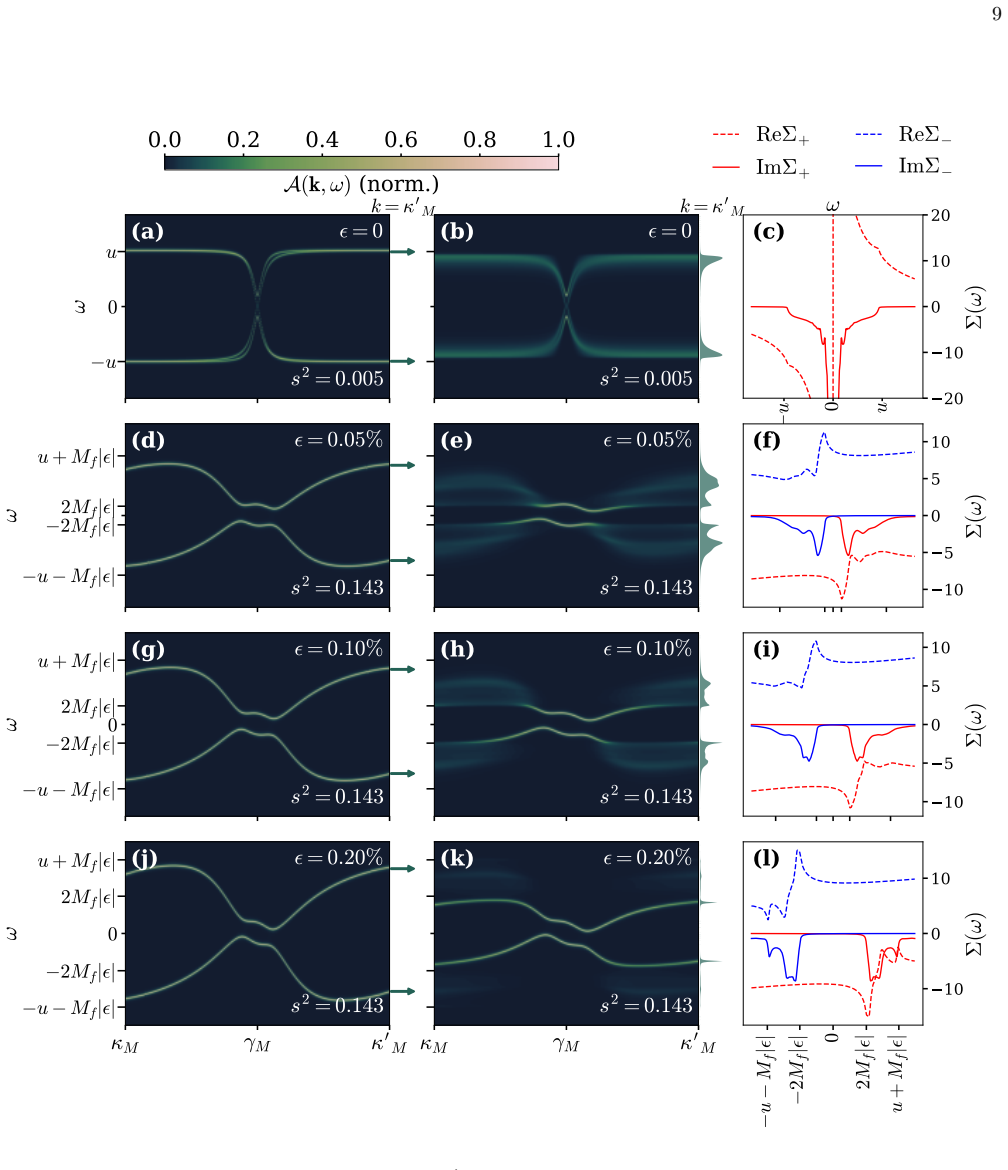
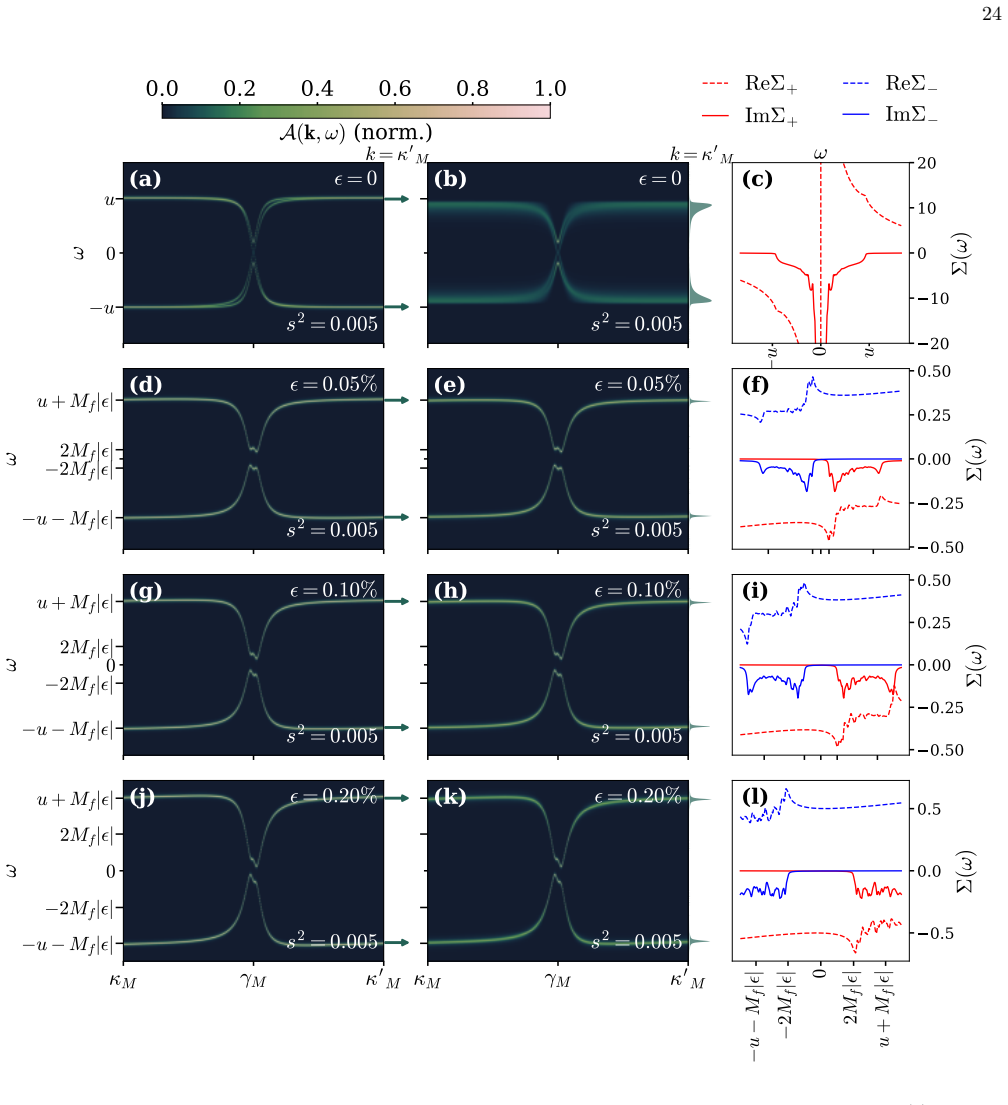
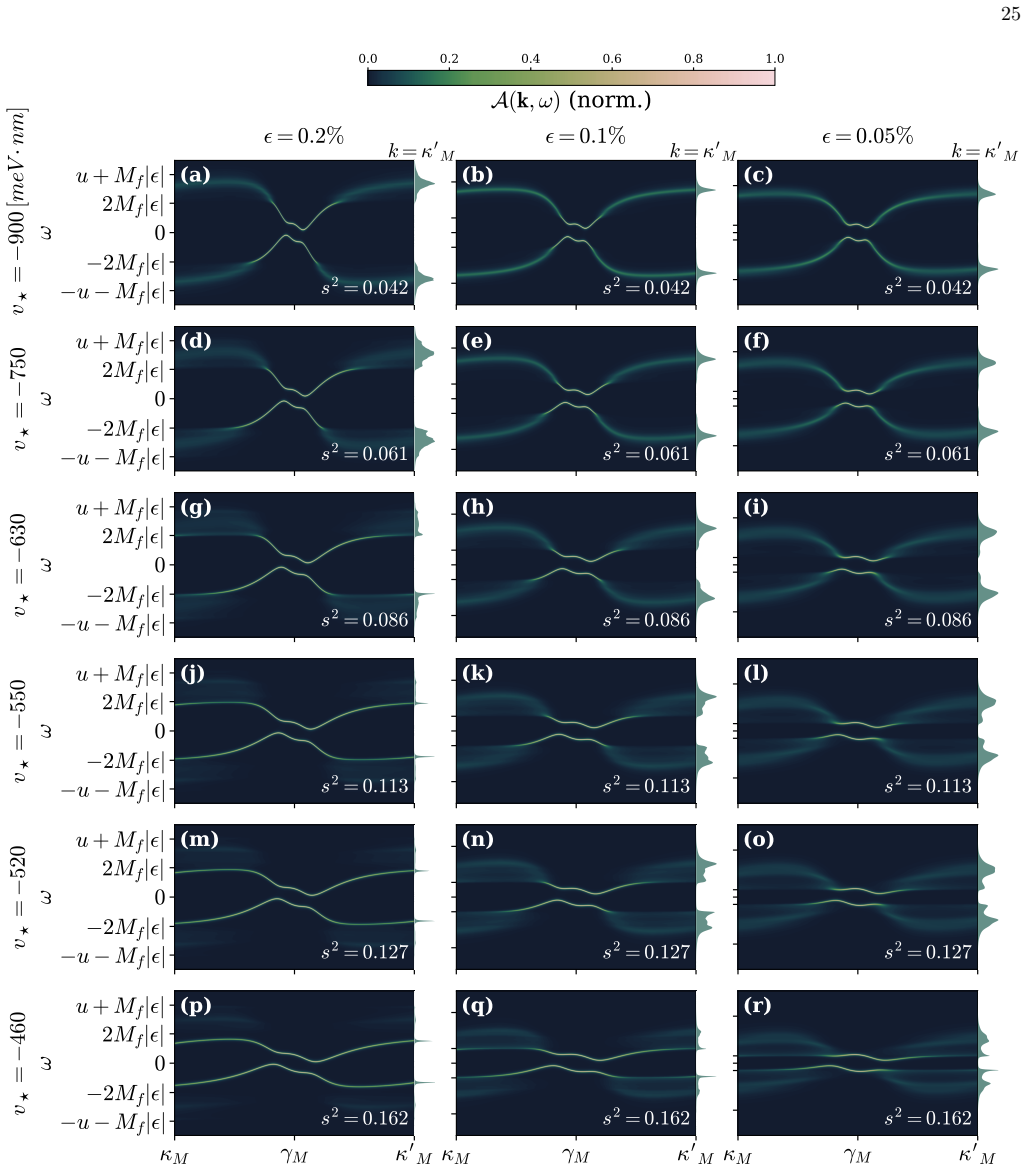
Spectral features at one-loop order In Fig. 2 we plot the spectrum of strained MATBG for a range of strain magnitudes, with additional plots for different model parameters found in Fig. 5. We now analyze the main differences compared to the tree-level spectrum. The new spectral features can be understood from Eq. (39) First, the factor ofρ ± results in a ...
-
[7]
Lastly, we expectρ(ω) to increase with|ω|, since the tree-level density of states (DOS) increases linearly away from the Mott band
this gives an important connection between the distance from the chiral limit and the width of the Mott bands in the strained case. Lastly, we expectρ(ω) to increase with|ω|, since the tree-level density of states (DOS) increases linearly away from the Mott band. This meansρ ±(∓u±M f |ϵ|) and therefore (39) decrease with increasing strain. All these quali...
-
[8]
Y. Cao, V. Fatemi, A. Demir, S. Fang, S. L. Tomarken, J. Y. Luo, J. D. Sanchez-Yamagishi, K. Watanabe, T. Taniguchi, E. Kaxiras, et al., Correlated insulator be- haviour at half-filling in magic-angle graphene superlat- tices, Nature556, 80 (2018)
2018
-
[9]
Y. Cao, V. Fatemi, S. Fang, K. Watanabe, T. Taniguchi, E. Kaxiras, and P. Jarillo-Herrero, Unconventional super- conductivity in magic-angle graphene superlattices, Na- ture556, 43 (2018)
2018
-
[10]
Yankowitz, S
M. Yankowitz, S. Chen, H. Polshyn, Y. Zhang, K. Watan- abe, T. Taniguchi, D. Graf, A. F. Young, and C. R. Dean, Tuning superconductivity in twisted bilayer graphene, Science363, 1059 (2019)
2019
-
[11]
X. Lu, P. Stepanov, W. Yang, M. Xie, M. A. Aamir, I. Das, C. Urgell, K. Watanabe, T. Taniguchi, G. Zhang, et al., Superconductors, orbital magnets and correlated states in magic-angle bilayer graphene, Nature574, 653 (2019)
2019
-
[12]
Codecido, Q
E. Codecido, Q. Wang, R. Koester, S. Che, H. Tian, R. Lv, S. Tran, K. Watanabe, T. Taniguchi, F. Zhang, et al., Correlated insulating and superconducting states in twisted bilayer graphene below the magic angle, Sci- ence Advances5, eaaw9770 (2019)
2019
-
[13]
Saito, J
Y. Saito, J. Ge, K. Watanabe, T. Taniguchi, and A. F. Young, Independent superconductors and correlated in- sulators in twisted bilayer graphene, Nature Physics16, 926 (2020)
2020
-
[14]
Y. Cao, D. Rodan-Legrain, J. M. Park, N. F. Yuan, K. Watanabe, T. Taniguchi, R. M. Fernandes, L. Fu, and P. Jarillo-Herrero, Nematicity and competing orders in superconducting magic-angle graphene, science372, 264 (2021)
2021
-
[15]
H. Tian, X. Gao, Y. Zhang, S. Che, T. Xu, P. Che- ung, K. Watanabe, T. Taniguchi, M. Randeria, F. Zhang, et al., Evidence for dirac flat band superconductivity en- abled by quantum geometry, Nature614, 440 (2023)
2023
-
[16]
Stepanov, I
P. Stepanov, I. Das, X. Lu, A. Fahimniya, K. Watanabe, T. Taniguchi, F. H. Koppens, J. Lischner, L. Levitov, and D. K. Efetov, Untying the insulating and supercon- ducting orders in magic-angle graphene, Nature583, 375 (2020)
2020
-
[17]
H. S. Arora, R. Polski, Y. Zhang, A. Thomson, Y. Choi, H. Kim, Z. Lin, I. Z. Wilson, X. Xu, J.-H. Chu, et al., Superconductivity in metallic twisted bilayer graphene stabilized by wse2, Nature583, 379 (2020)
2020
-
[18]
X. Liu, Z. Hao, E. Khalaf, J. Y. Lee, Y. Ronen, H. Yoo, D. Haei Najafabadi, K. Watanabe, T. Taniguchi, A. Vish- wanath, et al., Tunable spin-polarized correlated states in twisted double bilayer graphene, Nature583, 221 (2020)
2020
-
[19]
J. M. Park, Y. Cao, L.-Q. Xia, S. Sun, K. Watanabe, T. Taniguchi, and P. Jarillo-Herrero, Robust supercon- ductivity in magic-angle multilayer graphene family, Na- ture Materials21, 877 (2022)
2022
-
[20]
Y. Cao, J. M. Park, K. Watanabe, T. Taniguchi, and P. Jarillo-Herrero, Pauli-limit violation and re-entrant superconductivity in moir´ e graphene, Nature595, 526 (2021)
2021
-
[21]
Grover, M
S. Grover, M. Bocarsly, A. Uri, P. Stepanov, G. Di Bat- tista, I. Roy, J. Xiao, A. Y. Meltzer, Y. Myasoedov, K. Pareek, et al., Chern mosaic and berry-curvature mag- netism in magic-angle graphene, Nature physics18, 885 (2022)
2022
-
[22]
S. Wu, Z. Zhang, K. Watanabe, T. Taniguchi, and E. Y. Andrei, Chern insulators, van hove singularities and topological flat bands in magic-angle twisted bilayer graphene, Nature materials20, 488 (2021)
2021
-
[23]
Y. Xie, A. T. Pierce, J. M. Park, D. E. Parker, E. Khalaf, P. Ledwith, Y. Cao, S. H. Lee, S. Chen, P. R. Forrester, et al., Fractional chern insulators in magic-angle twisted bilayer graphene, Nature600, 439 (2021)
2021
-
[24]
A. T. Pierce, Y. Xie, J. M. Park, E. Khalaf, S. H. Lee, Y. Cao, D. E. Parker, P. R. Forrester, S. Chen, K. Watan- abe, et al., Unconventional sequence of correlated chern insulators in magic-angle twisted bilayer graphene, Na- ture Physics17, 1210 (2021)
2021
-
[25]
A. L. Sharpe, E. J. Fox, A. W. Barnard, J. Finney, K. Watanabe, T. Taniguchi, M. Kastner, and D. Goldhaber-Gordon, Emergent ferromagnetism near three-quarters filling in twisted bilayer graphene, Science365, 605 (2019)
2019
-
[26]
Serlin, C
M. Serlin, C. Tschirhart, H. Polshyn, Y. Zhang, J. Zhu, K. Watanabe, T. Taniguchi, L. Balents, and A. Young, Intrinsic quantized anomalous hall effect in a moir´ e het- erostructure, Science367, 900 (2020)
2020
-
[27]
Stepanov, M
P. Stepanov, M. Xie, T. Taniguchi, K. Watanabe, X. Lu, A. H. MacDonald, B. A. Bernevig, and D. K. Efetov, Competing zero-field chern insulators in superconduct- ing twisted bilayer graphene, Physical review letters127, 197701 (2021)
2021
-
[28]
J. Shi, J. Zhu, and A. MacDonald, Moir´ e commensura- bility and the quantum anomalous hall effect in twisted bilayer graphene on hexagonal boron nitride, Physical Review B103, 075122 (2021)
2021
-
[29]
D. Wong, K. P. Nuckolls, M. Oh, R. L. Lee, K. Watanabe, T. Taniguchi, and A. Yazdani, Insulators at fractional fillings in twisted bilayer graphene partially aligned to hexagonal boron nitride, Low Temperature Physics49, 655 (2023)
2023
-
[30]
K. P. Nuckolls, R. L. Lee, M. Oh, D. Wong, T. Soejima, J. P. Hong, D. C˘ alug˘ aru, J. Herzog-Arbeitman, B. A. Bernevig, K. Watanabe, et al., Quantum textures of the many-body wavefunctions in magic-angle graphene, Na- ture620, 525 (2023)
2023
-
[31]
Y. H. Kwan, G. Wagner, T. Soejima, M. P. Zaletel, S. H. 17 Simon, S. A. Parameswaran, and N. Bultinck, Kekul´ e spi- ral order at all nonzero integer fillings in twisted bilayer graphene, Physical Review X11, 041063 (2021)
2021
-
[32]
Wagner, Y
G. Wagner, Y. H. Kwan, N. Bultinck, S. H. Simon, and S. Parameswaran, Global phase diagram of the normal state of twisted bilayer graphene, Physical review letters 128, 156401 (2022)
2022
-
[33]
Y. H. Kwan, G. Wagner, N. Bultinck, S. H. Simon, E. Berg, and S. Parameswaran, Electron-phonon coupling and competing kekul´ e orders in twisted bilayer graphene, Physical Review B110, 085160 (2024)
2024
-
[34]
Herzog-Arbeitman, D
J. Herzog-Arbeitman, D. C˘ alug˘ aru, H. Hu, J. Yu, N. Reg- nault, J. Kang, B. A. Bernevig, and O. Vafek, Kekul´ e spi- ral order from strained topological heavy fermions, Phys- ical Review B112, 125129 (2025)
2025
- [35]
-
[36]
T. Wang, D. E. Parker, T. Soejima, J. Hauschild, S. Anand, N. Bultinck, and M. P. Zaletel, Ground-state order in magic-angle graphene at fillingν=- 3: A full- scale density matrix renormalization group study, Phys- ical Review B108, 235128 (2023)
2023
-
[37]
Kerelsky, L
A. Kerelsky, L. J. McGilly, D. M. Kennes, L. Xian, M. Yankowitz, S. Chen, K. Watanabe, T. Taniguchi, J. Hone, C. Dean, et al., Maximized electron interactions at the magic angle in twisted bilayer graphene, Nature 572, 95 (2019)
2019
-
[38]
Y. Choi, J. Kemmer, Y. Peng, A. Thomson, H. Arora, R. Polski, Y. Zhang, H. Ren, J. Alicea, G. Refael, et al., Electronic correlations in twisted bilayer graphene near the magic angle, Nature physics15, 1174 (2019)
2019
-
[39]
Y. Xie, B. Lian, B. J¨ ack, X. Liu, C.-L. Chiu, K. Watan- abe, T. Taniguchi, B. A. Bernevig, and A. Yazdani, Spec- troscopic signatures of many-body correlations in magic- angle twisted bilayer graphene, Nature572, 101 (2019)
2019
-
[40]
M. Oh, K. P. Nuckolls, D. Wong, R. L. Lee, X. Liu, K. Watanabe, T. Taniguchi, and A. Yazdani, Evidence for unconventional superconductivity in twisted bilayer graphene, Nature600, 240 (2021)
2021
-
[41]
D. Wong, K. P. Nuckolls, M. Oh, B. Lian, Y. Xie, S. Jeon, K. Watanabe, T. Taniguchi, B. A. Bernevig, and A. Yaz- dani, Cascade of electronic transitions in magic-angle twisted bilayer graphene, Nature582, 198 (2020)
2020
-
[42]
J. Xiao, A. Inbar, J. Birkbeck, N. Gershon, Y. Zamir, T. Taniguchi, K. Watanabe, E. Berg, and S. Ilani, The interacting energy bands of magic angle twisted bilayer graphene revealed by the quantum twisting microscope, arXiv preprint arXiv:2506.20738 (2025)
work page internal anchor Pith review arXiv 2025
-
[43]
D. E. Parker, T. Soejima, J. Hauschild, M. P. Zaletel, and N. Bultinck, Strain-induced quantum phase tran- sitions in magic-angle graphene, Physical review letters 127, 027601 (2021)
2021
-
[44]
Bultinck, E
N. Bultinck, E. Khalaf, S. Liu, S. Chatterjee, A. Vish- wanath, and M. P. Zaletel, Ground state and hidden symmetry of magic-angle graphene at even integer fill- ing, Physical Review X10, 031034 (2020)
2020
-
[45]
Shavit, E
G. Shavit, E. Berg, A. Stern, and Y. Oreg, Theory of correlated insulators and superconductivity in twisted bilayer graphene, Physical review letters127, 247703 (2021)
2021
-
[46]
Xie and A
M. Xie and A. H. MacDonald, Nature of the correlated insulator states in twisted bilayer graphene, Physical re- view letters124, 097601 (2020)
2020
-
[47]
Lian, Z.-D
B. Lian, Z.-D. Song, N. Regnault, D. K. Efetov, A. Yaz- dani, and B. A. Bernevig, Twisted bilayer graphene. iv. exact insulator ground states and phase diagram, Physi- cal Review B103, 205414 (2021)
2021
-
[48]
Song and B
Z.-D. Song and B. A. Bernevig, Magic-angle twisted bi- layer graphene as a topological heavy fermion problem, Physical review letters129, 047601 (2022)
2022
-
[49]
C˘ alug˘ aru, M
D. C˘ alug˘ aru, M. Borovkov, L. L. Lau, P. Coleman, Z.-D. Song, and B. A. Bernevig, Twisted bilayer graphene as topological heavy fermion: Ii. analytical approximations of the model parameters, Low Temperature Physics49, 640 (2023)
2023
-
[50]
P. J. Ledwith, J. Dong, A. Vishwanath, and E. Kha- laf, Nonlocal moments and mott semimetal in the chern bands of twisted bilayer graphene, Phys. Rev. X15, 021087 (2025)
2025
-
[51]
Controlled Loop Expansion for the Topological Heavy Fermion Model
Y. Vituri and E. Berg, Controlled loop expansion for the topological heavy fermion model, arXiv preprint arXiv:2604.14278 (2026)
work page internal anchor Pith review Pith/arXiv arXiv 2026
-
[52]
Pairault, D
S. Pairault, D. S´ en´ echal, and A.-M. Tremblay, Strong- coupling expansion for the hubbard model, Physical re- view letters80, 5389 (1998)
1998
-
[53]
Pairault, D
S. Pairault, D. Senechal, and A.-M. Tremblay, Strong- coupling perturbation theory of the hubbard model, The European Physical Journal B-Condensed Matter and Complex Systems16, 85 (2000)
2000
-
[54]
N. Wei, F. von Oppen, and L. I. Glazman, Lifetime and spectral function of topological heavy fermions, arXiv preprint arXiv:2604.14369 (2026)
work page internal anchor Pith review Pith/arXiv arXiv 2026
-
[55]
H. Hu, Y. Shao, L. Crippa, D. C˘ alug˘ aru, G. Sangiovanni, T. Wehling, L. I. Glazman, and B. A. Bernevig, Twisted bilayer graphene lifetimes at integer fillings: An analytic result, arXiv preprint arXiv:2604.14303 (2026)
work page internal anchor Pith review Pith/arXiv arXiv 2026
-
[56]
P. A. Nosov, E. Khalaf, and P. Ledwith, Controlled ex- pansion for correlated electrons with concentrated kine- matics (2026), arXiv:2605.20171 [cond-mat.str-el]
work page internal anchor Pith review Pith/arXiv arXiv 2026
-
[57]
Inbar, J
A. Inbar, J. Birkbeck, J. Xiao, T. Taniguchi, K. Watan- abe, B. Yan, Y. Oreg, A. Stern, E. Berg, and S. Ilani, The quantum twisting microscope, Nature614, 682 (2023)
2023
-
[58]
Hubbard, Electron correlations in narrow energy bands, Proceedings of the Royal Society of London
J. Hubbard, Electron correlations in narrow energy bands, Proceedings of the Royal Society of London. Series A. Mathematical and Physical Sciences276, 238 (1963)
1963
- [59]
-
[60]
Kang and O
J. Kang and O. Vafek, Non-abelian dirac node braiding and near-degeneracy of correlated phases at odd inte- ger filling in magic-angle twisted bilayer graphene, Phys. Rev. B102, 035161 (2020)
2020
-
[61]
S. Liu, E. Khalaf, J. Y. Lee, and A. Vishwanath, Ne- matic topological semimetal and insulator in magic-angle bilayer graphene at charge neutrality, Physical Review Research3, 013033 (2021)
2021
-
[62]
Marsiglio and J
F. Marsiglio and J. Carbotte, Electron-phonon supercon- ductivity, in Superconductivity: conventional and uncon- ventional superconductors (Springer, 2008) pp. 73–162
2008
-
[63]
N. Wei, F. von Oppen, and L. I. Glazman, Dirac-point spectroscopy of flat-band systems with the quantum twisting microscope, Physical Review B111, 085128 (2025). 18
2025
-
[64]
S´ en´ echal, D
D. S´ en´ echal, D. Perez, and D. Plouffe, Cluster perturba- tion theory for hubbard models, Physical Review B66, 075129 (2002)
2002
-
[65]
Gros and R
C. Gros and R. Valent´ ı, Cluster expansion for the self- energy: A simple many-body method for interpreting the photoemission spectra of correlated fermi systems, Phys. Rev. B48, 418 (1993)
1993
- [66]
-
[67]
Rubtsov, M
A. Rubtsov, M. Katsnelson, A. Lichtenstein, and A. Georges, Dual fermion approach to the two- dimensional hubbard model: Antiferromagnetic fluctu- ations and fermi arcs, Physical Review B—Condensed Matter and Materials Physics79, 045133 (2009)
2009
-
[68]
Rohringer, H
G. Rohringer, H. Hafermann, A. Toschi, A. Katanin, A. Antipov, M. Katsnelson, A. Lichtenstein, A. Rubtsov, and K. Held, Diagrammatic routes to nonlocal correla- tions beyond dynamical mean field theory, Reviews of Modern Physics90, 025003 (2018)
2018
-
[69]
Herzog-Arbeitman, J
J. Herzog-Arbeitman, J. Yu, D. C˘ alug˘ aru, H. Hu, N. Reg- nault, O. Vafek, J. Kang, and B. A. Bernevig, Topo- logical heavy fermion model as an efficient representa- tion of atomistic strain and relaxation in twisted bilayer graphene, Physical Review B112, 125128 (2025)
2025
-
[70]
Bistritzer and A
R. Bistritzer and A. H. MacDonald, Moir´ e bands in twisted double-layer graphene, Proceedings of the Na- tional Academy of Sciences108, 12233 (2011)
2011
-
[71]
Kallin and B
C. Kallin and B. Halperin, Excitations from a filled lan- dau level in the two-dimensional electron gas, Physical Review B30, 5655 (1984)
1984
-
[72]
Interplay between many-body correlations, strain and lattice relaxation in twisted bilayer graphene
L. Crippa, G. Rai, D. C˘ alug˘ aru, H. Hu, J. Herzog- Arbeitman, B. A. Bernevig, R. Valent´ ı, G. Sangiovanni, and T. Wehling, Dynamical correlation effects in twisted bilayer graphene under strain and lattice relaxation, arXiv preprint arXiv:2509.19436 (2025)
work page internal anchor Pith review Pith/arXiv arXiv 2025
-
[73]
Z. Bi, N. F. Yuan, and L. Fu, Designing flat bands by strain, Physical Review B100, 035448 (2019). Appendix A: Diagrammatic subtraction rules As explained in Sec. III C, when calculating the corrections to the self-energy we subtract the 1PR part of the n–point correlation function with respect to thefpropagator. Since these subtractions are written using...
2019
-
[74]
BM Hamiltonian The BM Hamiltonian for theKvalley of TBG is given by [63]: ˆH0 ij(k) = hk+gi θTBG 2 δij 3X n=1 ˆTn δgi+gn,gj 3X n=1 ˆT † n δgi,gj+gn hk+gi − θTBG 2 δij ,(H1) with moir´ e reciprocal lattice vectorsg 1 = 0 andg 2,3 =k M(± √ 3/2,3/2) T , wherek M = 2|K|sin(θ TBG/2) and θT BG = 1.05◦ the twist angle. The single-layer Dirac Hami...
-
[75]
We takeE t =−E b =E/2
Effect of strain Uniform uniaxial heterostrain is parametrized by a magnitudeϵand directionϕ, with the strain tensor El =O(ϕ) T ϵ0 0−ν P ϵ O(ϕ) = ϵxx ϵxy ϵyx ϵyy ,(H4) whereν P ≈0.16 is the Poisson ratio of graphene. We takeE t =−E b =E/2. With the addition of strain, the single-layer Hamiltonian in theKvalley becomes [56, 66] h′ p,l =ℏv D M T l p−K−A l ·...
-
[76]
(47) for the non-interacting BM model is shown in Fig
QTM spectrum The QTM spectrum as obtained from Eq. (47) for the non-interacting BM model is shown in Fig. 6. The unstrained spectrum matches the experimental results seen in Fig. 1 of Ref. [35] slightly away from the magic angle, as well as the theoretical results in [56] obtained using the exact equation for d2I dV 2 b , see Fig. 5 of that paper. The res...
-
[77]
(47) is ψα tA ψα tB = 2X b=1 vfb ψ(f,b)(p) + 4X a=1 vca ψ(c,a)(p).(I9) The QTM signal for that quasiparticle then contributesw i eiη 2π(n−1) 3 ψα tA +ψ α tB 2 to Eq
Matrix element calculation Given the (f 1, f2, c1, c2, c3, c4) eigenvectorv= (v f1 , vf2 , vc1 , vc2 , vc3 , vc4)T corresponding to some excitation, the top-layer sublattice spinor used in Eq. (47) is ψα tA ψα tB = 2X b=1 vfb ψ(f,b)(p) + 4X a=1 vca ψ(c,a)(p).(I9) The QTM signal for that quasiparticle then contributesw i eiη 2π(n−1) 3 ψα tA +ψ α tB 2 to Eq...
discussion (0)
Sign in with ORCID, Apple, or X to comment. Anyone can read and Pith papers without signing in.