Comparing Post-Hoc Explainable AI Methods for Interpreting Black-Box EEG Models in Depression Detection
Pith reviewed 2026-06-29 13:40 UTC · model grok-4.3
The pith
Different post-hoc explainability methods applied to an EEG-based deep learning model for depression detection produce partially overlapping relevance structures.
A machine-rendered reading of the paper's core claim, the machinery that carries it, and where it could break.
Core claim
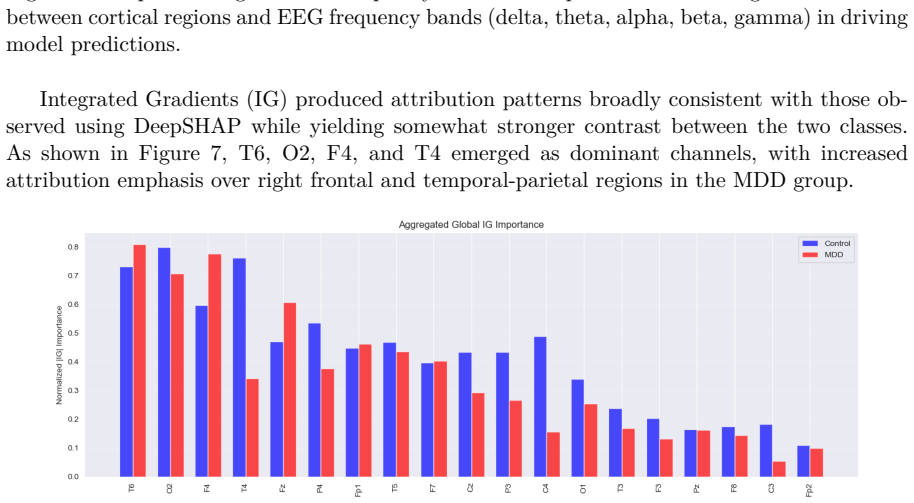
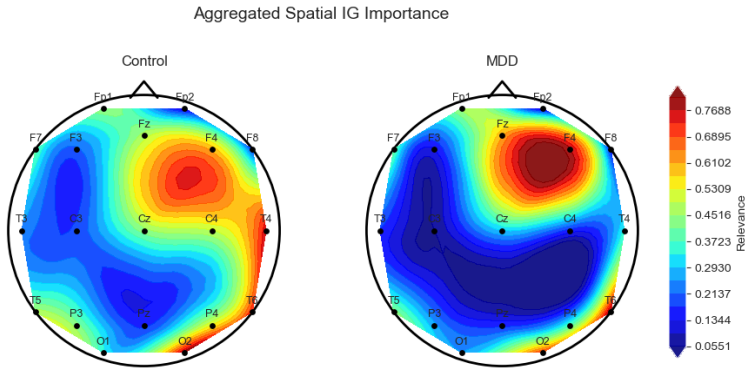
The evaluated methods revealed partially convergent attribution patterns, with recurring emphasis on frontal, temporal, and posterior EEG regions, particularly in the right hemisphere. Quantitative comparison demonstrated substantial agreement between gradient- and perturbation-based approaches, while DeepSHAP produced comparatively distinct attribution distributions. At the same time, variability between explainability methods highlighted the influence of methodological assumptions on the resulting explanations. Overall, the results suggest that different post-hoc explainability approaches capture partially overlapping relevance structures in EEG-based deep learning models for depression de
What carries the argument
Global attribution aggregation of five post-hoc methods (DeepSHAP, Integrated Gradients, GradCAM, Occlusion, Permutation Feature Importance) applied inside subject-level stratified 5-fold cross-validation to an InceptionTime classifier on EEG segments for MDD detection.
If this is right
- Attribution patterns remain broadly consistent with prior EEG studies of MDD.
- Methodological assumptions of each explainer visibly shape the resulting maps.
- Post-hoc explainability is useful for inspecting black-box EEG classifiers yet remains limited for clinical biomarker claims.
- The analysis is positioned as exploratory rather than evidence of definitive neurophysiological markers.
Where Pith is reading between the lines
- If the observed overlaps prove stable across datasets, ensembles of multiple explainers could yield more reliable spatial summaries than any single method.
- The right-hemisphere emphasis could motivate targeted channel-selection experiments in future model training.
- Standardized protocols for comparing explainers on the same EEG partitions would reduce variability introduced by methodological choices.
Load-bearing premise
The subject-level stratified 5-fold cross-validation and global attribution aggregation produce stable, method-independent relevance maps that reflect model behavior rather than artifacts of the chosen explainers or data partitioning.
What would settle it
Re-running the identical pipeline with a different random seed for the 5-fold splits or with an additional explainer that yields completely non-overlapping region rankings would falsify the claim of partially overlapping relevance structures.
Figures





read the original abstract
Recent advances in deep learning have enabled increasingly accurate electroencephalography (EEG)-based classification of Major Depressive Disorder (MDD), but the decision-making processes of high-capacity models remain difficult to interpret. This study investigates multiple post-hoc explainability methods applied to an InceptionTime architecture trained for EEG-based MDD detection. The analysis includes Shapley-based, gradient-based, and perturbation-based attribution approaches: DeepSHAP, Integrated Gradients, GradCAM, Occlusion, and Permutation Feature Importance. Explainability analysis was performed within a subject-level stratified 5-fold cross-validation framework using global attribution aggregation across EEG segments and subjects. The evaluated methods revealed partially convergent attribution patterns, with recurring emphasis on frontal, temporal, and posterior EEG regions, particularly in the right hemisphere. Quantitative comparison demonstrated substantial agreement between gradient- and perturbation-based approaches, while DeepSHAP produced comparatively distinct attribution distributions. At the same time, variability between explainability methods highlighted the influence of methodological assumptions on the resulting explanations. Overall, the results suggest that different post-hoc explainability approaches capture partially overlapping relevance structures in EEG-based deep learning models for depression detection. Although the observed attribution patterns are broadly consistent with several previous EEG studies of MDD, the analysis should be interpreted as exploratory rather than evidence of definitive neurophysiological biomarkers or clinical applicability. The study highlights both the usefulness and limitations of post-hoc explainability for interpreting black-box EEG classifiers in psychiatric applications.
Editorial analysis
A structured set of objections, weighed in public.
Referee Report
Summary. The manuscript compares post-hoc explainability methods (DeepSHAP, Integrated Gradients, GradCAM, Occlusion, Permutation Feature Importance) on an InceptionTime model for EEG-based MDD detection. Within a subject-level stratified 5-fold CV framework and global attribution aggregation, it reports partially convergent patterns across methods, with substantial agreement between gradient- and perturbation-based approaches, distinct distributions for DeepSHAP, and recurring emphasis on frontal/temporal/posterior regions (especially right hemisphere). The analysis is framed as exploratory.
Significance. If the partial overlaps are shown to be stable and not artifacts of partitioning or explainer assumptions, the work would usefully illustrate that different post-hoc methods capture overlapping but non-identical relevance structures in EEG deep-learning models, supporting the recommendation to employ multiple explainers rather than relying on any single technique for interpretability in psychiatric applications.
major comments (2)
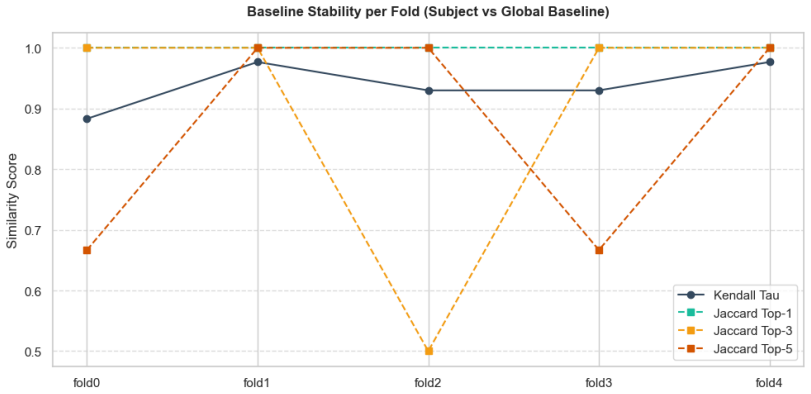
- [Methods and Results] Methods/Results: The central claim that different explainers capture partially overlapping relevance structures depends on the subject-level stratified 5-fold CV plus global aggregation producing stable, method-independent maps. No per-fold attribution variance, inter-fold overlap statistics, or sensitivity analysis to the aggregation procedure is reported. If fold-to-fold maps differ substantially, the reported convergence between gradient/perturbation methods could be an artifact of the particular partition rather than a property of the InceptionTime model.
- [Abstract and Results] Abstract/Results: The abstract states that quantitative comparison showed 'substantial agreement' between gradient- and perturbation-based methods, yet the provided text supplies no numerical metrics (e.g., correlation coefficients, Dice overlap, or statistical tests), error bars, or details on how agreement was quantified. This absence makes it impossible to evaluate the strength or robustness of the convergence claim.
minor comments (1)
- [Discussion] The manuscript appropriately qualifies its conclusions as exploratory and not evidence of definitive biomarkers; this framing should be retained.
Simulated Author's Rebuttal
We thank the referee for the constructive comments, which highlight important aspects of robustness and quantification. We address each point below.
read point-by-point responses
-
Referee: [Methods and Results] Methods/Results: The central claim that different explainers capture partially overlapping relevance structures depends on the subject-level stratified 5-fold CV plus global aggregation producing stable, method-independent maps. No per-fold attribution variance, inter-fold overlap statistics, or sensitivity analysis to the aggregation procedure is reported. If fold-to-fold maps differ substantially, the reported convergence between gradient/perturbation methods could be an artifact of the particular partition rather than a property of the InceptionTime model.
Authors: We agree that the absence of per-fold variance and overlap statistics leaves the stability of the reported patterns unverified. In the revised manuscript we will add (i) per-fold attribution variance maps, (ii) inter-fold Dice overlap coefficients for each explainer, and (iii) a sensitivity comparison of global maps obtained by mean versus median aggregation. These additions will allow readers to judge whether the observed gradient/perturbation convergence is robust across partitions. revision: yes
-
Referee: [Abstract and Results] Abstract/Results: The abstract states that quantitative comparison showed 'substantial agreement' between gradient- and perturbation-based methods, yet the provided text supplies no numerical metrics (e.g., correlation coefficients, Dice overlap, or statistical tests), error bars, or details on how agreement was quantified. This absence makes it impossible to evaluate the strength or robustness of the convergence claim.
Authors: The referee correctly notes that the manuscript does not supply explicit numerical metrics for the claimed agreement. We will revise both the abstract and results section to report average Pearson (and Spearman) correlations between attribution maps of gradient- versus perturbation-based methods, together with standard deviations across folds and appropriate statistical tests. These quantitative details will replace the qualitative phrase 'substantial agreement'. revision: yes
Circularity Check
No circularity: empirical comparison with no derivations or self-referential predictions
full rationale
The paper conducts a direct empirical comparison of standard post-hoc explainability methods (DeepSHAP, Integrated Gradients, etc.) applied to a trained InceptionTime model on EEG data within subject-level stratified 5-fold CV. No equations, fitted parameters renamed as predictions, or load-bearing self-citations appear in the provided text. The central claim of partially overlapping attribution patterns is an observation from applying off-the-shelf tools, not a reduction to prior choices or definitions. The skeptic concern about unquantified fold stability is a potential evidentiary gap but does not constitute circularity under the defined criteria.
Axiom & Free-Parameter Ledger
Reference graph
Works this paper leans on
-
[1]
GBD 2017 Disease and Injury Incidence and Prevalence Collaborators. Global, regional, and national incidence, prevalence, and years lived with disability for 354 diseases and injuries for 195 countries and territories, 1990–2017: a systematic analysis for the global burden of disease study 2017.The Lancet, 392(10159):1789–1858, 2018. doi: 10.1016/ S0140-6...
2017
- [2]
-
[3]
Mark Zimmerman, William Ellison, Diane Young, Iwona Chelminski, and Kristy Dal- rymple. How many different ways do patients meet the diagnostic criteria for major de- pressive disorder?Comprehensive Psychiatry, 56:29–34, 2015. ISSN 0010-440X. doi: https://doi.org/10.1016/j.comppsych.2014.09.007. URLhttps://www.sciencedirect. com/science/article/pii/S00104...
- [4]
-
[5]
Kessler and Evelyn J
Ronald C. Kessler and Evelyn J. Bromet. The epidemiology of depression across cultures.Annual Review of Public Health, 34:119–138, 2013. doi: 10.1146/ annurev-publhealth-031912-114409
2013
-
[6]
Ronald C. Kessler. The potential of predictive analytics to provide clinical decision support in depression treatment planning.Current Opinion in Psychiatry, 31(1):32–39, 2018. ISSN 0951-7367. URLhttps://journals.lww.com/co-psychiatry/fulltext/2018/01000/ the_potential_of_predictive_analytics_to_provide.7.aspx
2018
-
[7]
Andreas Kurt Kaiser, Maria-Theresa Gnjezda, Stephanie Knasmüller, and Wolfgang Aich- horn. Electroencephalogram alpha asymmetry in patients with depressive disorders: cur- rent perspectives.Neuropsychiatric Disease and Treatment, 14:1493–1504, 2018. doi: 18 10.2147/NDT.S137776. URLhttps://www.tandfonline.com/doi/abs/10.2147/NDT. S137776. PMID: 29928121
-
[8]
Milena Čukić, Miodrag Stokić, Slavoljub Radenković, Miloš Ljubisavljević, Slobodan Simić, and Danka Savić. Nonlinear analysis of EEG complexity in episode and remission phase of recurrent depression.International Journal of Methods in Psychiatric Research, 29(2): e1816, 2020. doi: 10.1002/mpr.1816
-
[9]
Leif Simmatis, Emma E. Russo, Joseph Geraci, Irene E. Harmsen, Nardin Samuel, et al. Technical and clinical considerations for electroencephalography-based biomark- ers for major depressive disorder.npj Mental Health Research, 2(18), 2023. doi: 10.1038/s44184-023-00038-7
-
[10]
Alsham- rani, and Abdullah Alshehri
Shumaila Aleem, Noor ul Huda, Rashid Amin, Samina Khalid, Sultan S. Alsham- rani, and Abdullah Alshehri. Machine learning algorithms for depression: Diagno- sis, insights, and research directions.Electronics, 11(7), 2022. ISSN 2079-9292. doi: 10.3390/electronics11071111. URLhttps://www.mdpi.com/2079-9292/11/7/1111
-
[11]
Fernando Soares de Aguiar Neto and João Luís Garcia Rosa. Depression biomark- ers using non-invasive eeg: A review.Neuroscience & Biobehavioral Reviews, 105:83– 93, 2019. ISSN 0149-7634. doi: https://doi.org/10.1016/j.neubiorev.2019.07.021. URL https://www.sciencedirect.com/science/article/pii/S0149763419303823
-
[12]
Behshad Hosseinifard, Mohammad Hassan Moradi, and Reza Rostami. Classifying de- pression patients and normal subjects using machine learning techniques and nonlinear features from eeg signal.Computer Methods and Programs in Biomedicine, 109(3):339– 345, 2013. ISSN 0169-2607. doi: https://doi.org/10.1016/j.cmpb.2012.10.008. URL https://www.sciencedirect.co...
-
[13]
Wajid Mumtaz, Likun Xia, Syed Saad Azhar Ali, Mohd Azhar Mohd Yasin, Muhammad Hussain, and Aamir Saeed Malik. Electroencephalogram (eeg)-based computer-aided tech- nique to diagnose major depressive disorder (mdd).Biomedical Signal Processing and Con- trol, 31:108–115, 2017. ISSN 1746-8094. doi: https://doi.org/10.1016/j.bspc.2016.07.006. URLhttps://www.s...
-
[14]
A pervasive approach to eeg- based depression detection.Complexity, 2018(1):5238028, 2018
Hanshu Cai, Jiashuo Han, Yunfei Chen, Xiaocong Sha, Ziyang Wang, Bin Hu, Jing Yang, Lei Feng, Zhijie Ding, Yiqiang Chen, and Jürg Gutknecht. A pervasive approach to eeg- based depression detection.Complexity, 2018(1):5238028, 2018. doi: https://doi.org/10. 1155/2018/5238028
2018
-
[15]
Ensemble approach for detection of depression using EEG features
Egils Avots, Kl¯ avs Jermakovs, Maie Bachmann, Laura Päeske, Cagri Ozcinar, and Gho- lamreza Anbarjafari. Ensemble approach for detection of depression using EEG features. Entropy, 24(2):211, 2022. doi: 10.3390/e24020211
-
[16]
GCTNet: a graph convolutional transformer network for major depressive disorder detection based on EEG signals.Journal of Neural Engineering, 21(3):036042,
YuwenWang, YudanPeng, MingxiuHan, XinyiLiu, HaijunNiu, JianCheng, SuhuaChang, and Tao Liu. GCTNet: a graph convolutional transformer network for major depressive disorder detection based on EEG signals.Journal of Neural Engineering, 21(3):036042,
-
[17]
doi: 10.1088/1741-2552/ad5048
-
[18]
Stefana Dutua and Alina Elena Sultana. Optimizing depression classification using com- bined datasets and hyperparameter tuning with Optuna.Sensors, 25(7):2083, 2025. doi: 10.3390/s25072083
-
[19]
Alan Jovic, Nikolina Frid, Karla Brkic, and Mario Cifrek. Interpretability and accuracy of machine learning algorithms for biomedical time series analysis – a scoping review. 19 Biomedical Signal Processing and Control, 110:108153, 2025. ISSN 1746-8094. doi: https: //doi.org/10.1016/j.bspc.2025.108153. URLhttps://www.sciencedirect.com/science/ article/pii...
-
[20]
CynthiaRudin. Stopexplainingblackboxmachinelearningmodelsforhighstakesdecisions and use interpretable models instead.Nature Machine Intelligence, 1(5):206–215, 2019. ISSN 2522-5839. doi: 10.1038/s42256-019-0048-x
-
[21]
Ričards Marcinkevičs and Julia E. Vogt. Interpretable and explainable machine learning: A methods-centric overview with concrete examples.WIREs Data Mining and Knowledge Discovery, 13(3):e1493, 2023. doi: https://doi.org/10.1002/widm.1493. URLhttps:// wires.onlinelibrary.wiley.com/doi/abs/10.1002/widm.1493
-
[22]
Explainable ai: A review of machine learning interpretability methods.Entropy, 23(1), 2021
Pantelis Linardatos, Vasilis Papastefanopoulos, and Sotiris Kotsiantis. Explainable ai: A review of machine learning interpretability methods.Entropy, 23(1), 2021. ISSN 1099-4300. doi: 10.3390/e23010018. URLhttps://www.mdpi.com/1099-4300/23/1/18
-
[23]
Steven A. Hicks, Jonas L. Isaksen, Vajira Thambawita, Jonas Ghouse, Gustav Ahlberg, Allan Linneberg, Niels Grarup, Inga Strümke, Christina Ellervik, Morten Salling Ole- sen, Torben Hansen, Claus Graff, Niels-Henrik Holstein-Rathlou, Pål Halvorsen, Mary M. Maleckar, and Jørgen K. Kanters. Explaining deep neural networks for knowledge discovery in electroca...
-
[24]
Damir Mulc, Jaksa Vukojevic, Eda Kalafatic, Mario Cifrek, Domagoj Vidovic, and Alan Jovic. Opportunities and challenges for clinical practice in detecting depression using EEG and machine learning.Sensors, 25(2), 2025. ISSN 1424-8220. doi: 10.3390/s25020409
-
[25]
Inceptiontime: Finding alexnet for time series classification.Data mining and knowledge discovery, 34(6):1936–1962, 2020
Hassan Ismail Fawaz, Benjamin Lucas, Germain Forestier, Charlotte Pelletier, Daniel F Schmidt, Jonathan Weber, Geoffrey I Webb, Lhassane Idoumghar, Pierre-Alain Muller, and François Petitjean. Inceptiontime: Finding alexnet for time series classification.Data mining and knowledge discovery, 34(6):1936–1962, 2020. URLhttps://doi.org/10.1007/ s10618-020-00710-y
1936
-
[26]
Complexity and irregularity in the brain oscillations of depressive patients: A systematic review.Neuropsychiatry, 7(5):279–290,
Alejandro de la Torre-Luque and Xavier Bornas. Complexity and irregularity in the brain oscillations of depressive patients: A systematic review.Neuropsychiatry, 7(5):279–290,
-
[27]
doi: 10.4172/Neuropsychiatry.1000232
-
[28]
Faranak Farzan, Sravya Atluri, Ye Mei, Sylvain Moreno, Andrea J. Levinson, Daniel M. Blumberger, and Zafiris J. Daskalakis. Brain temporal complexity in explaining the ther- apeutic and cognitive effects of seizure therapy.Brain, 140(4):1011–1025, 03 2017. ISSN 0006-8950. doi: 10.1093/brain/awx030
-
[29]
Zenas C. Chao, Daniel G. Dillon, Yi-Hung Liu, Elyssa M. Barrick, and Chien-Te Wu. Altered coordination between frontal delta and parietal alpha networks underlies anhedo- nia and depressive rumination in major depressive disorder.Journal of Psychiatry and Neuroscience, 47(6):E367–E378, 2022. doi: 10.1503/jpn.220046
-
[30]
Study on fea- ture selection methods for depression detection using three-electrode EEG data.Inter- disciplinary Sciences: Computational Life Sciences, 10(3):558–565, 2018
Hanshu Cai, Yunfei Chen, Jiashuo Han, Xiangzi Zhang, and Bin Hu. Study on fea- ture selection methods for depression detection using three-electrode EEG data.Inter- disciplinary Sciences: Computational Life Sciences, 10(3):558–565, 2018. doi: 10.1007/ s12539-018-0292-5
2018
-
[31]
Single- channel EEG-based machine learning method for prescreening major depressive disorder
Zhijiang Wan, Hao Zhang, Jiajin Huang, Haiyan Zhou, Jie Yang, and Ning Zhong. Single- channel EEG-based machine learning method for prescreening major depressive disorder. 20 International Journal of Information Technology & Decision Making, 18(05):1579–1603,
-
[32]
doi: 10.1142/S0219622019500342
-
[33]
A study of resting-state EEG biomarkers for depression recognition.arXiv preprint arXiv:2002.11039,
Shuting Sun, Jianxiu Li, Huayu Chen, Tao Gong, Xiaowei Li, and Bin Hu. A study of resting-state EEG biomarkers for depression recognition.arXiv preprint arXiv:2002.11039,
-
[34]
doi: 10.48550/arXiv.2002.11039
-
[35]
Johannes Burchert, Thorben Werner, Vijaya Krishna Yalavarthi, Diego Coello de Por- tugal, Maximilian Stubbemann, and Lars Schmidt-Thieme. Are eeg sequences time se- ries? eeg classification with time series models and joint subject training.arXiv preprint arXiv:2404.06966, 2024. URLhttps://arxiv.org/abs/2404.06966
-
[36]
Alireza Rafiei, Rasoul Zahedifar, Chiranjibi Sitaula, and Faezeh Marzbanrad. Automated detection of major depressive disorder with eeg signals: A time series classification using deep learning.IEEE Access, 10:73804–73817, 2022. URLhttps://ieeexplore.ieee. org/document/9828387
-
[37]
Reza Akbari Movahed, Gila Pirzad Jahromi, Shima Shahyad, and Gholam Hossein Meftahi. A major depressive disorder classification framework based on EEG signals using statistical, spectral, wavelet, functional connectivity, and nonlinear analysis.Journal of Neuroscience Methods, 358:109209, 2021. doi: 10.1016/j.jneumeth.2021.109209
-
[38]
Wei Liu, Kebin Jia, and Zhuozheng Wang. Graph-based eeg approach for depres- sion prediction: integrating time-frequency complexity and spatial topology.Frontiers in Neuroscience, Volume 18 - 2024, 2024. ISSN 1662-453X. doi: 10.3389/fnins.2024. 1367212. URLhttps://www.frontiersin.org/journals/neuroscience/articles/10. 3389/fnins.2024.1367212
-
[39]
Daniel C. Elton. Self-explaining AI as an Alternative to Interpretable AI. In Ben Goertzel, Aleksandr I. Panov, Alexey Potapov, and Roman Yampolskiy, editors,Artificial General Intelligence, pages 95–106, Cham, 2020. Springer International Publishing. doi: 10.1007/ 978-3-030-52152-3\_10
2020
-
[40]
Nadia Burkart and Marco F. Huber. A survey on the explainability of supervised machine learning.Journal of Artificial Intelligence Research, 70:245–317, 2021. doi: 10.1613/jair.1. 12228
-
[41]
Pranav Rajpurkar, Emma Chen, Oishi Banerjee, and Eric J. Topol. Ai in health and medicine.Nature Medicine, 28(1):31–38, 2022. ISSN 1546-170X. doi: 10.1038/ s41591-021-01614-0. URLhttps://doi.org/10.1038/s41591-021-01614-0
-
[42]
Juan Manuel Durán and Karin Rolanda Jongsma. Who is afraid of black box algorithms? On the epistemological and ethical basis of trust in medical AI.Journal of Medical Ethics, 47(5):329–335, 2021. ISSN 0306-6800. doi: 10.1136/medethics-2020-106820
-
[43]
Scott M. Lundberg and Su-In Lee. A unified approach to interpreting model predictions. InProceedings of the 31st International Conference on Neural Information Processing Sys- tems, NIPS’17, page 4768–4777, Red Hook, NY, USA, 2017. Curran Associates Inc. ISBN 9781510860964. URLhttps://dl.acm.org/doi/10.5555/3295222.3295230
-
[44]
Marco Ancona, Enea Ceolini, Cengiz Öztireli, and Markus H. Gross. Towards better under- standing of gradient-based attribution methods for deep neural networks. InInternational Conference on Learning Representations, 2017. URLhttps://api.semanticscholar. org/CorpusID:3728967. 21
2017
-
[45]
Axiomatic attribution for deep net- works
Mukund Sundararajan, Ankur Taly, and Qiqi Yan. Axiomatic attribution for deep net- works. InInternational conference on machine learning, pages 3319–3328. PMLR, 2017. URLhttps://dl.acm.org/doi/10.5555/3305890.3306024
-
[46]
Visualizing and understanding convolutional networks
Matthew D Zeiler and Rob Fergus. Visualizing and understanding convolutional networks. InEuropean conference on computer vision, pages 818–833. Springer, 2014. URLhttps: //link.springer.com/chapter/10.1007/978-3-319-10590-1_53
-
[47]
Perturbation-based methods for explaining deep neural networks: A survey.Pattern Recognition Letters, 150:228–234, 2021
Maksims Ivanovs, Roberts Kadikis, and Kaspars Ozols. Perturbation-based methods for explaining deep neural networks: A survey.Pattern Recognition Letters, 150:228–234, 2021. URLhttps://www.sciencedirect.com/science/article/pii/S0167865521002440
2021
-
[48]
Interpretable machine learning.Lulu
C Molnar. Interpretable machine learning.Lulu. com, 2020
2020
-
[49]
The disagreement problem in explainable machine learning: A practitioner’s perspective.Trans
Satyapriya Krishna, Tessa Han, Alex Gu, Javin Pombra, Shahin Jabbari, Steven Wu, and Himabindu Lakkaraju. The disagreement problem in explainable machine learning: A practitioner’s perspective.Trans. Mach. Learn. Res., 2024, 2022. URLhttps://api. semanticscholar.org/CorpusID:246485817
2024
-
[50]
S. Mahato and S. Paul. Classification of depression patients and normal subjects based on electroencephalogram (eeg) signal using alpha power and theta asymmetry.Journal of Medical Systems, 44(1):28, 2019. doi: 10.1007/s10916-019-1486-z
-
[51]
Y. Liu, C. Pu, S. Xia, D. Deng, X. Wang, and M. Li. Machine learning approaches for diagnosing depression using eeg: A review.Translational Neuroscience, 13(1):224–235,
-
[52]
doi: 10.1515/tnsci-2022-0234
-
[53]
J. Zhu, Z. Wang, T. Gong, S. Zeng, X. Li, B. Hu, J. Li, S. Sun, and L. Zhang. An im- proved classification model for depression detection using eeg and eye tracking data.IEEE Transactions on Nanobioscience, 19(3):527–537, 2020. doi: 10.1109/TNB.2020.2990690
-
[54]
Mdd patients and healthy controls eeg data (new), November 2016
Wajid Mumtaz. Mdd patients and healthy controls eeg data (new), November 2016. URL https://figshare.com/articles/dataset/EEG_Data_New/4244171. Figshare dataset
-
[55]
Learning important features through propagating activation differences
Avanti Shrikumar, Peyton Greenside, and Anshul Kundaje. Learning important features through propagating activation differences. InInternational conference on machine learn- ing, pages 3145–3153. PMlR, 2017. URLhttps://dl.acm.org/doi/10.5555/3305890. 3306006
-
[56]
Grad-cam: Visual explanations from deep networks via gradient-based localization,
Ramprasaath R Selvaraju, Michael Cogswell, Abhishek Das, Ramakrishna Vedantam, Devi Parikh, and Dhruv Batra. Grad-cam: Visual explanations from deep networks via gradient- based localization. InProceedings of the IEEE international conference on computer vision, pages 618–626, 2017. URLhttps://dl.acm.org/doi/10.1007/s11263-019-01228-7
-
[57]
Random forests.Machine learning, 45(1):5–32, 2001
Leo Breiman. Random forests.Machine learning, 45(1):5–32, 2001
2001
-
[58]
Aaron Fisher, Cynthia Rudin, and Francesca Dominici. All models are wrong, but many are useful: Learning a variable’s importance by studying an entire class of prediction models simultaneously.Journal of Machine Learning Research, 20(177):1–81, 2019. URL http://jmlr.org/papers/v20/18-760.html
2019
-
[59]
C. T. Ekstrøm, T. A. Gerds, and A. K. Jensen. Sequential rank agreement methods for comparison of ranked lists.Biostatistics, 20(4):582–598, 2019. doi: 10.1093/biostatistics/ kxy017. 22
-
[60]
Sepehr Mortaheb, Jitka Annen, Camille Chatelle, Helena Cassol, Geraldine Martens, Au- rore Thibaut, Olivia Gosseries, and Steven Laureys. A graph signal processing approach to study high density eeg signals in patients with disorders of consciousness. In2019 41st Annual International Conference of the IEEE Engineering in Medicine and Biology Society (EMBC...
-
[61]
Richard J. Davidson. Affective style and affective disorders: Perspectives from affective neuroscience.Cognition and Emotion, 12(3):307–330, 1998. doi: 10.1080/026999398379628
-
[62]
John J. B. Allen, Philipp M. Keune, Michael Schönenberg, and Robin Nusslock. Frontal EEG alpha asymmetry and emotion: From neural underpinnings and methodological con- siderations to psychopathology and social cognition.Psychophysiology, 55(1):e13028, 2018. doi: https://doi.org/10.1111/psyp.13028
-
[63]
Altered beta band spatial-temporal interactions during negative emotional processing in major depressive disorder: An MEG study.Journal of Affective Disorders, 338:254–261,
Yishan Du, Lingling Hua, Shui Tian, ZhongPeng Dai, Yi Xia, Shuai Zhao, HaoWen Zou, Xiaoqin Wang, Hao Sun, Hongliang Zhou, YingHong Huang, ZhiJian Yao, and Qing Lu. Altered beta band spatial-temporal interactions during negative emotional processing in major depressive disorder: An MEG study.Journal of Affective Disorders, 338:254–261,
-
[64]
doi: 10.1016/j.jad.2023.06.001
ISSN 0165-0327. doi: 10.1016/j.jad.2023.06.001
-
[65]
Chaolin Teng, Mengwei Wang, Wei Wang, Jin Ma, Min Jia, Min Wu, Yuanyuan Luo, Yu Wang, Yiyang Zhang, and Jin Xu. Abnormal properties of cortical functional brain net- work in major depressive disorder: Graph theory analysis based on electroencephalography- source estimates.Neuroscience, 506:80–90, 2022. ISSN 0306-4522. doi: https://doi.org/ 10.1016/j.neuro...
-
[66]
Alexander A. Fingelkurts, Andrew A. Fingelkurts, Heikki Rytsälä, Kirsi Suominen, Erkki Isometsä, and Seppo Kähkönen. Composition of brain oscillations in ongoing EEG during major depression disorder.Neuroscience Research, 56(2):133–144, 2006. ISSN 0168-0102. doi: https://doi.org/10.1016/j.neures.2006.06.006
-
[67]
Sara Hooker, Dumitru Erhan, Pieter-Jan Kindermans, and Been Kim. A benchmark for in- terpretability methods in deep neural networks.Advances in neural information processing systems, 32, 2019. URLhttps://arxiv.org/abs/1806.10758. 23
discussion (0)
Sign in with ORCID, Apple, or X to comment. Anyone can read and Pith papers without signing in.