The incremental voter model: mean-field analysis and convergence to equilibrium
Pith reviewed 2026-06-29 09:06 UTC · model grok-4.3
The pith
The incremental voter model is governed by a mean-field system of nonlinear ODEs whose solutions converge to an equilibrium opinion distribution.
A machine-rendered reading of the paper's core claim, the machinery that carries it, and where it could break.
Core claim
By deriving the mean-field system of nonlinear ordinary differential equations that governs the large-population limit of the agent-based model, the paper develops a rigorous mathematical framework to study the asymptotic behavior of the opinion distribution in the mean-field limit of the incremental voter model.
What carries the argument
The mean-field system of nonlinear ordinary differential equations that governs the evolution of the opinion distribution in the large-population limit.
If this is right
- The opinion distribution in the model approaches an equilibrium as time progresses.
- This mean-field limit enables analytical study of opinion polarization without agent-based simulations.
- The framework supports investigation of how the range of opinions k influences long-term outcomes.
- Results apply to understanding social influence in complex multi-agent systems.
Where Pith is reading between the lines
- The derivation suggests that similar mean-field techniques could apply to variants with different update rules or continuous opinions.
- Testing the model against real-world opinion survey data over time could validate or refute its predictive power.
- Equilibrium states might indicate conditions under which interventions could shift group opinions toward consensus.
Load-bearing premise
Real social influence processes can be accurately modeled by always picking two agents uniformly at random and allowing the listener to change opinion by at most one unit.
What would settle it
A large-scale numerical simulation of the agent-based incremental voter model for increasing population sizes should show the distribution of opinions converging to the trajectory predicted by the mean-field ODE system.
Figures
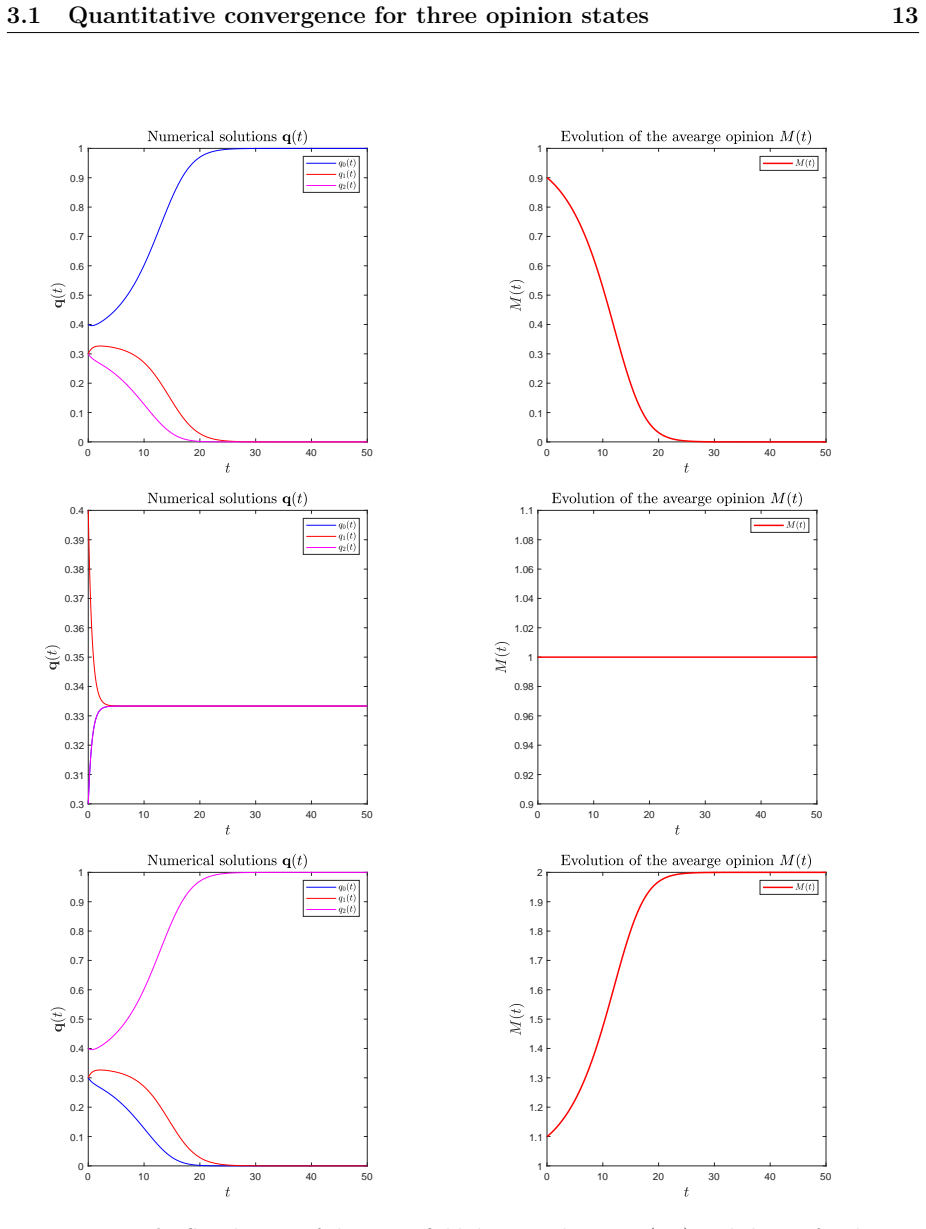
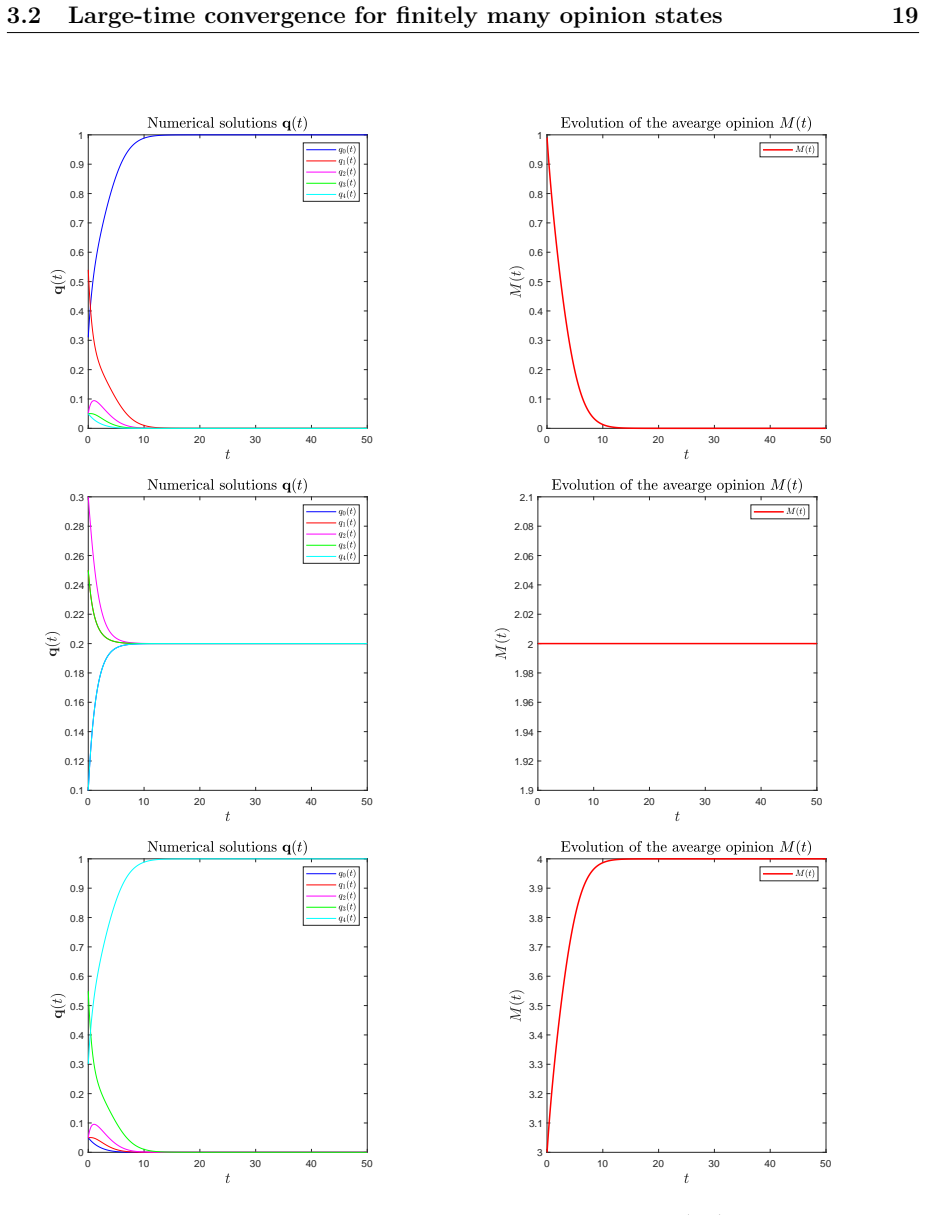
read the original abstract
We introduce the incremental voter model (IVM), a discrete-opinion multi-agent system where agents undergo step-wise transitions biased by the opinion of a randomly selected persuader. Our incremental voter model comprises a large population of interacting agents, each holding an opinion represented by an element of the discrete set $\{-k,\ldots,0,\ldots,k\}, k \in \mathbb{N}_{+}$. At each update step as time progresses, a pair of distinct agents are selected independently and uniformly at random from the population, and the first agent (viewed as the ``listener'') updates its opinion based on that of the second (viewed as the ``persuader''), adopting a new opinion that differs from its current one by at most one unit. By deriving the mean-field system of nonlinear ordinary differential equations (ODEs) that governs the large-population limit of the agent-based model, we develop a rigorous mathematical framework to study the asymptotic behavior of the opinion distribution in the mean-field limit. These results contribute to a deeper understanding of social influence processes in complex systems, particularly in modeling opinion polarization, and may guide the formulation of more advanced models in future research.
Editorial analysis
A structured set of objections, weighed in public.
Referee Report
Summary. The paper introduces the incremental voter model (IVM) on the discrete opinion set {-k, ..., k}. Pairs of distinct agents are selected uniformly at random; the listener updates its opinion by at most one unit under the influence of the persuader. The central claim is that the large-N limit is governed by a closed system of nonlinear ODEs on the simplex of opinion proportions, which is then used to analyze asymptotic behavior and convergence to equilibrium.
Significance. If the mean-field derivation and convergence analysis are rigorous, the work supplies a deterministic ODE framework for studying incremental opinion updates in large populations. This is a standard technique for interacting particle systems and could be useful for modeling bounded opinion shifts and polarization, provided the limit is shown to close and the equilibria are characterized explicitly.
major comments (2)
- [Abstract] Abstract and main derivation section: the central claim asserts that 'the mean-field system of nonlinear ordinary differential equations (ODEs) that governs the large-population limit' is derived and that this yields a rigorous framework for asymptotic behavior. However, the manuscript provides neither the explicit form of the ODE system (e.g., the drift terms for each opinion proportion) nor the generator calculation or martingale argument establishing the limit, so the support for the claim cannot be verified.
- [Abstract] Convergence analysis: the abstract states that the ODEs are used to study 'convergence to equilibrium,' but no equilibria are identified, no Lyapunov function or linearization is exhibited, and no error bounds between the finite-N process and the ODE are given; these steps are load-bearing for the asymptotic claim.
minor comments (2)
- The update rule is described only at the level of 'adopting a new opinion that differs from its current one by at most one unit'; clarify whether the change is always toward the persuader's opinion or can be in either direction.
- Notation for the opinion proportions (e.g., p_j(t) for opinion j) and the precise form of the interaction rates should be introduced before any mean-field statements.
Simulated Author's Rebuttal
We thank the referee for their careful reading and constructive comments on the manuscript. We address the major comments point by point below.
read point-by-point responses
-
Referee: [Abstract] Abstract and main derivation section: the central claim asserts that 'the mean-field system of nonlinear ordinary differential equations (ODEs) that governs the large-population limit' is derived and that this yields a rigorous framework for asymptotic behavior. However, the manuscript provides neither the explicit form of the ODE system (e.g., the drift terms for each opinion proportion) nor the generator calculation or martingale argument establishing the limit, so the support for the claim cannot be verified.
Authors: We agree that the explicit form of the ODE system and the supporting derivation details should be presented more prominently to allow verification of the central claim. In the revised manuscript we will state the explicit nonlinear ODE system (including the drift terms for each opinion proportion) already in the abstract and expand the main derivation section to include the generator calculation together with the martingale argument establishing the mean-field limit. revision: yes
-
Referee: [Abstract] Convergence analysis: the abstract states that the ODEs are used to study 'convergence to equilibrium,' but no equilibria are identified, no Lyapunov function or linearization is exhibited, and no error bounds between the finite-N process and the ODE are given; these steps are load-bearing for the asymptotic claim.
Authors: We acknowledge that the convergence analysis requires additional explicit steps to fully support the asymptotic claims. In the revision we will identify the equilibria of the ODE system, exhibit a suitable Lyapunov function (or linearization where appropriate) to establish convergence, and add a discussion of the relationship between the finite-N process and the ODE limit, including any available error bounds or a clear statement of their absence. revision: yes
Circularity Check
No significant circularity in mean-field derivation
full rationale
The paper defines the incremental voter model via a standard pairwise random selection and bounded opinion update rule on a finite opinion set, then invokes the classical mean-field limit for the empirical measure of a Markovian interacting particle system to obtain a closed ODE system on opinion proportions. This limit is an external, well-established technique (generator-to-drift convergence as N→∞) whose validity does not depend on any quantity fitted or defined inside the paper. No self-citations appear as load-bearing steps, no parameters are fitted to data and then relabeled as predictions, and the derivation chain does not reduce any claimed result to a tautological renaming or self-definition of its own inputs. The framework is therefore self-contained against external benchmarks.
Axiom & Free-Parameter Ledger
axioms (1)
- domain assumption The large-population limit of the stochastic agent-based process is described by a closed system of nonlinear ODEs.
invented entities (1)
-
Incremental voter model
no independent evidence
Reference graph
Works this paper leans on
-
[1]
Opinion dynamics: rise and fall of political parties.Europhysics Letters,69(5):671–677, 2005
Eli Ben-Naim. Opinion dynamics: rise and fall of political parties.Europhysics Letters,69(5):671–677, 2005
2005
-
[2]
Fei Cao, and Nadia Loy. The Bennati-Dragulescu-Yakovenko model in the continuous setting: PDE derivation and long-time behavior.arXiv preprint arXiv:2512.06101, 2025
-
[3]
Derivation of wealth distributions from biased ex- change of money.Kinetic & Related Models,16(5):764–794, 2023
Fei Cao, and Sebastien Motsch. Derivation of wealth distributions from biased ex- change of money.Kinetic & Related Models,16(5):764–794, 2023
2023
-
[4]
Entropy dissipation and propagation of chaos for the uniform reshuffling model.Mathematical Models and Methods in Applied Sciences,33(4):829–875, 2023
Fei Cao, Pierre-Emannuel Jabin, and Sebastien Motsch. Entropy dissipation and propagation of chaos for the uniform reshuffling model.Mathematical Models and Methods in Applied Sciences,33(4):829–875, 2023
2023
-
[5]
Fractal opinions among interacting agents.SIAM Journal on Applied Dynamical Systems,24(2):1529–1552, 2025
Fei Cao, and Roberto Cortez. Fractal opinions among interacting agents.SIAM Journal on Applied Dynamical Systems,24(2):1529–1552, 2025
2025
-
[6]
The fractal geometry of opinion formation.arXiv preprint arXiv:2601.21023, 2026
Fei Cao, and Roberto Cortez. The fractal geometry of opinion formation.arXiv preprint arXiv:2601.21023, 2026
-
[7]
From interacting agents to Boltzmann-Gibbs distribution of money.Nonlinearity,37(12):125020, 2024
Fei Cao, and Pierre-Emannuel Jabin. From interacting agents to Boltzmann-Gibbs distribution of money.Nonlinearity,37(12):125020, 2024
2024
-
[8]
The iterative persuasion-polarization opinion dynamics and its mean-field analysis.SIAM Journal on Applied Mathematics,85(4):1596–1620, 2025
Fei Cao, and Stephanie Reed. The iterative persuasion-polarization opinion dynamics and its mean-field analysis.SIAM Journal on Applied Mathematics,85(4):1596–1620, 2025
2025
-
[9]
Uncovering a two-phase dynamics from a dol- lar exchange model with bank and debt.SIAM Journal on Applied Mathematics, 83(5):1872–1891, 2023
Fei Cao, and Sebastien Motsch. Uncovering a two-phase dynamics from a dol- lar exchange model with bank and debt.SIAM Journal on Applied Mathematics, 83(5):1872–1891, 2023
2023
-
[10]
Uniform propagation of chaos for a dollar exchange econophysics model.European Journal of Applied Mathematics,36(1):27–39, 2025
Fei Cao, and Roberto Cortez. Uniform propagation of chaos for a dollar exchange econophysics model.European Journal of Applied Mathematics,36(1):27–39, 2025
2025
-
[11]
Fei Cao, Sebastien Motsch, and Wendy Garcia Umbarita. Wealth exchange under ceiling and flooring constraints: a modified Bennati-Dragulescu-Yakovenko model. arXiv preprint arXiv:2602.00988, 2026
-
[12]
Kinetic limits for pair-interaction driven master equations and biological swarm models.Mathematical Models and Methods in Applied Sciences,23(07):1339–1376, 2013
Eric Carlen, Pierre Degond, and Bernt Wennberg. Kinetic limits for pair-interaction driven master equations and biological swarm models.Mathematical Models and Methods in Applied Sciences,23(07):1339–1376, 2013
2013
-
[13]
Statistical physics of social dynamics.Reviews of modern physics,81(2):591, 2009
Claudio Castellano, Santo Fortunato, and Vittorio Loreto. Statistical physics of social dynamics.Reviews of modern physics,81(2):591, 2009
2009
-
[14]
A model for spatial conflict.Biometrika, 60(3):581–588, 1973
Peter Clifford, and Aidan Sudbury. A model for spatial conflict.Biometrika, 60(3):581–588, 1973. REFERENCES 22
1973
-
[15]
Quantitative propagation of chaos for gener- alized Kac particle systems.The Annals of Applied Probability,26(2):892–916, 2016
Roberto Cortez, and Joaquin Fontbona. Quantitative propagation of chaos for gener- alized Kac particle systems.The Annals of Applied Probability,26(2):892–916, 2016
2016
-
[16]
Mixing beliefs among interacting agents.Advances in Complex Systems,3(01n04):87–98, 2000
Guillaume Deffuant, David Neau, Frederic Amblard, and Gérard Weisbuch. Mixing beliefs among interacting agents.Advances in Complex Systems,3(01n04):87–98, 2000
2000
-
[17]
How can extremism prevail? A study based on the relative agreement interaction model.Journal of Artificial Societies and Social Simulation,5(4):27, 2002
Guillaume Deffuant, Frédéric Amblard, and Gérard Weisbuch, and Thierry Faure. How can extremism prevail? A study based on the relative agreement interaction model.Journal of Artificial Societies and Social Simulation,5(4):27, 2002
2002
-
[18]
Macroscopic limits of the Boltzmann equation: a review.Modeling and computational methods for kinetic equations, pp
Pierre Degond. Macroscopic limits of the Boltzmann equation: a review.Modeling and computational methods for kinetic equations, pp. 3–57, 2004
2004
-
[19]
A Boltzmann-type approach to the formation of wealth distribution curves.Available at SSRN 1281404, 2008
Bertram Düring, Daniel Matthes, and Giuseppe Toscani. A Boltzmann-type approach to the formation of wealth distribution curves.Available at SSRN 1281404, 2008
2008
-
[20]
Probability: theory and examples
Rick Durrett. Probability: theory and examples. Cambridge university press, 2019
2019
-
[21]
Sociophysics: A new approach of sociological collective behavior.The Journal of Mathematical Sociology,9(1):1–13, 1982
Serge Galam, Yuval Gefen, and Yonathan Shapir. Sociophysics: A new approach of sociological collective behavior.The Journal of Mathematical Sociology,9(1):1–13, 1982
1982
-
[22]
Opinion dynamics and bounded confidence models, analysis, and simulation.Journal of artificial societies and social simulation, 5(3), 2002
Rainer Hegselmann, and Ulrich Krause. Opinion dynamics and bounded confidence models, analysis, and simulation.Journal of artificial societies and social simulation, 5(3), 2002
2002
-
[23]
Denton, Michael E
Elisa Heinrich Mora, Kaleda K. Denton, Michael E. Palmer, and Marcus W. Feld- man. Ergodic theorems for weakly interacting infinite systems and the voter model. Proceedings of the National Academy of Sciences,122(03):e2417078122, 2025
2025
-
[24]
Holley, and Thomas M
Richard A. Holley, and Thomas M. Liggett. Ergodic theorems for weakly interacting infinite systems and the voter model.The Annals of Probability,3(4):643–663, 1975
1975
-
[25]
Clustering and asymptotic behavior in opinion formation.Journal of Differential Equations,257(11):4165–4187, 2014
Pierre-Emmanuel Jabin, and Sebastien Motsch. Clustering and asymptotic behavior in opinion formation.Journal of Differential Equations,257(11):4165–4187, 2014
2014
-
[26]
Stochastic modeling
Nicolas Lanchier. Stochastic modeling. Springer, 2017
2017
-
[27]
Bounded confidence dynamics and graph control: Enforcing consensus.Networks and Heterogeneous Media,15(3):489– 517, 2020
GuanLin Li, Sebastien Motsch, and Dylan Weber. Bounded confidence dynamics and graph control: Enforcing consensus.Networks and Heterogeneous Media,15(3):489– 517, 2020
2020
-
[28]
Thomas Milton Liggett, and Thomas M. Liggett. Interacting particle systems. New York: Springer, 1985
1985
-
[29]
On steady distributions of kinetic models of conservative economies.Journal of Statistical Physics,130(6):1087–1117, 2008
Daniel Matthes, and Giuseppe Toscani. On steady distributions of kinetic models of conservative economies.Journal of Statistical Physics,130(6):1087–1117, 2008. REFERENCES 23
2008
-
[30]
Mathematical modeling of collective behavior in socio-economic and life sciences.Springer Science & Business Media, 2010
Giovanni Naldi, Lorenzo Pareschi, and Giuseppe Toscani. Mathematical modeling of collective behavior in socio-economic and life sciences.Springer Science & Business Media, 2010
2010
-
[31]
Chakrabarti
Parongama Sen, and Bikas K. Chakrabarti. Sociophysics: an introduction. OUP Oxford, 2014
2014
-
[32]
Opinion evolution in closed community
Katarzyna Sznajd-Weron, and Jozef Sznajd. Opinion evolution in closed community. International Journal of Modern Physics C,11(06):1157–1165, 2000
2000
-
[33]
A review on the Sznajd model - 20 years after.Physica A: Statistical Mechanics and its Applications,565:1– 12, 2021
Katarzyna Sznajd-Weron, Józef Sznajd, and Tomasz Weron. A review on the Sznajd model - 20 years after.Physica A: Statistical Mechanics and its Applications,565:1– 12, 2021
2021
-
[34]
Topics in propagation of chaos
Alain-Sol Sznitman. Topics in propagation of chaos. InEcole d’été de probabilités de Saint-Flour XIX—1989, pages 165–251. Springer, 1991
1989
-
[35]
Kinetic models of opinion formation.Communications in Mathe- matical Sciences,4(3):481–496, 2006
Giuseppe Toscani. Kinetic models of opinion formation.Communications in Mathe- matical Sciences,4(3):481–496, 2006
2006
discussion (0)
Sign in with ORCID, Apple, or X to comment. Anyone can read and Pith papers without signing in.