Topological superconductivity from Abelian fractional Chern insulators
Pith reviewed 2026-06-29 09:30 UTC · model grok-4.3
The pith
A ν=1/3 fractional Chern insulator can be turned into three topological superconductors with a U(3) parton theory.
A machine-rendered reading of the paper's core claim, the machinery that carries it, and where it could break.
Core claim
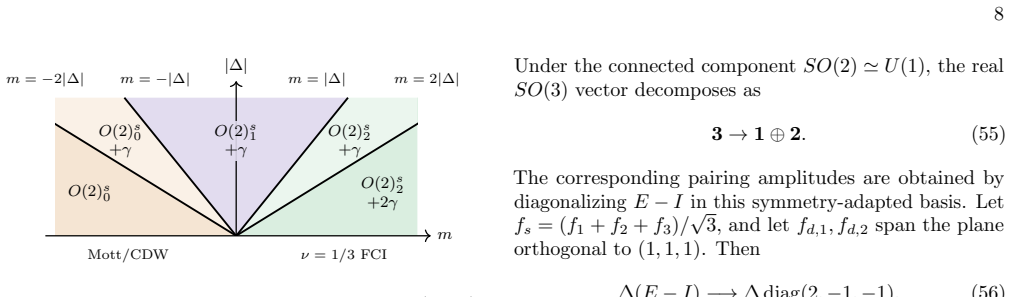
Using a U(3) infrared parton theory for the ν=1/3 FCI, where the electron is composed of three charge-e/3 constituents and the Cooper pair of three constituent pairs, the resulting superconductors share an ordinary charge-2e sector but differ in their neutral color response, giving an SC* with the parent Laughlin U(1)_3 order, a chiral topological superconductor with c_-=3/2, and a strong-pairing anyon superconductor with c_-=3. The same framework organizes a nearby σ_xy=0 charge density wave state, with natural ties to period-three density order at commensurate filling while the SC* branch can preserve microscopic translations.
What carries the argument
The U(3) infrared parton theory in which three colored charge-e/3 anyons constitute the electron and three such pairs constitute the charge-2e Cooper pair.
If this is right
- The three superconductors differ only in neutral color response while sharing the same charge-2e sector.
- At commensurate filling the normal state and the c=3 and c=3/2 superconducting states are tied to period-three density order.
- The SC* branch can preserve microscopic translations.
- Away from commensuration a chargon metal can pair into the same c=3/2 topological superconductor.
- The FCI, reentrant CDW, and chiral superconductivity are unified inside the single U(3) parton theory.
Where Pith is reading between the lines
- The parton construction could be extended to other Abelian fractional Chern insulators at different fillings.
- Thermal Hall measurements that resolve the predicted central charges would provide direct signatures.
- The framework suggests a route to realize anyon superconductors in moiré systems that host fractional Chern insulators.
- The same neutral-sector distinctions might appear in other paired states derived from Abelian anyon fluids.
Load-bearing premise
The U(3) infrared parton theory is assumed to correctly capture the low-energy physics of the ν=1/3 FCI.
What would settle it
Detection of a superconducting state emerging from a ν=1/3 FCI that exhibits a neutral sector with central charge exactly 3/2 or exactly 3, or the absence of any such state with the predicted anyon content, would test the claim.
Figures

read the original abstract
Can a Laughlin anyon fluid become a topological superconductor? We answer this question for a $\nu=1/3$ fractional Chern insulator (FCI) using a $U(3)$ infrared parton theory. Three charge-$e/3$ constituents form the electron, while three constituent pairs form a gauge-invariant charge-$2e$ Cooper pair. The resulting superconductors share an ordinary charge-$2e$ sector but differ in their neutral color response, giving an SC$^\ast$ with the parent Laughlin $U(1)_3$ order, a chiral topological superconductor with $c_-=3/2$, and a strong-pairing anyon superconductor with $c_-=3$. The same framework organizes a nearby $\sigma_{xy}=0$ charge density wave (CDW) state. At commensurate filling, the normal state and the $c_-=3$ and $c_-=3/2$ superconducting descendants are naturally tied to a period-three density order background, while the SC$^\ast$ branch can preserve microscopic translations. Away from commensuration, a chargon metal can pair into the same $c_-=3/2$ topological superconductor. The FCI, reentrant CDW, and chiral superconductivity are unified in the $U(3)$ parton theory.
Editorial analysis
A structured set of objections, weighed in public.
Referee Report
Summary. The manuscript develops a U(3) infrared parton construction for the ν=1/3 fractional Chern insulator in which each electron comprises three charge-e/3 partons and each charge-2e Cooper pair comprises three parton pairs. Pairing in different channels is shown to produce three superconductors that share an ordinary charge-2e sector but realize distinct neutral responses: an SC* inheriting the parent Laughlin U(1)_3 order, a chiral topological superconductor with c_-=3/2, and a strong-pairing anyon superconductor with c_-=3. The same framework also organizes a nearby σ_xy=0 charge-density-wave state and discusses translation symmetry at and away from commensurate filling.
Significance. If the parton construction is valid, the work supplies a single gauge-theoretic framework that unifies a fractional Chern insulator, a charge-density wave, and three distinct topological superconductors differing only in their neutral color sectors. The explicit organization of multiple neutral responses from one parent state constitutes a useful organizational result for the theory of anyon-based superconductivity.
major comments (3)
- [Abstract] Abstract, first paragraph: the central claim that the U(3) parton theory reproduces the Laughlin U(1)_3 order of the ν=1/3 FCI and then yields the stated central charges upon pairing is asserted without an explicit computation of the parton Chern numbers, the resulting K-matrix, or the anyon content that would confirm the parent topological order.
- [Abstract] The derivation of c_-=3/2 and c_-=3 for the paired states is presented as an outcome of the three pairing channels, yet no gap equations, edge-mode spectra, or explicit neutral-sector response functions are supplied to show that these central charges follow independently rather than by construction from the assumed U(3) gauge structure and pairing ansatz.
- [Abstract] The manuscript states that the same U(3) framework organizes the σ_xy=0 CDW and the reentrant period-three density order, but does not provide the explicit mean-field decoupling or the resulting charge-density modulation that would establish this unification beyond the level of symmetry assignment.
minor comments (1)
- Notation for the neutral color response and the distinction between SC* and the other branches should be defined more explicitly when first introduced.
Simulated Author's Rebuttal
We thank the referee for their positive evaluation of the work's significance and for the constructive comments on the abstract and presentation. We address each major comment below with clarifications from the manuscript and indicate planned revisions.
read point-by-point responses
-
Referee: [Abstract] Abstract, first paragraph: the central claim that the U(3) parton theory reproduces the Laughlin U(1)_3 order of the ν=1/3 FCI and then yields the stated central charges upon pairing is asserted without an explicit computation of the parton Chern numbers, the resulting K-matrix, or the anyon content that would confirm the parent topological order.
Authors: The parent U(1)_3 order is obtained directly from the U(3) parton construction in which each of the three partons fills a Chern band of C=1; the resulting K-matrix and anyon content (including the e/3 anyons with mutual statistics 2π/3) are derived explicitly in Section II of the manuscript. The abstract summarizes this established result rather than repeating the full derivation. To improve clarity we will add a parenthetical reference to Section II in the revised abstract. revision: partial
-
Referee: [Abstract] The derivation of c_-=3/2 and c_-=3 for the paired states is presented as an outcome of the three pairing channels, yet no gap equations, edge-mode spectra, or explicit neutral-sector response functions are supplied to show that these central charges follow independently rather than by construction from the assumed U(3) gauge structure and pairing ansatz.
Authors: The central charges follow from the neutral-sector edge-mode counting after the three distinct pairing channels are imposed on the partons (Section IV). The c_-=3/2 state retains one neutral chiral Majorana mode per color after pairing, while the strong-pairing channel gaps all neutral modes except for the anyonic contribution yielding c_-=3; these spectra are obtained by diagonalizing the paired parton Hamiltonian and are independent of the specific gap magnitude. Gap equations are not solved because the construction is mean-field by design. We will add a short sentence in the abstract noting that the central charges are obtained from the neutral edge spectrum. revision: partial
-
Referee: [Abstract] The manuscript states that the same U(3) framework organizes the σ_xy=0 CDW and the reentrant period-three density order, but does not provide the explicit mean-field decoupling or the resulting charge-density modulation that would establish this unification beyond the level of symmetry assignment.
Authors: The σ_xy=0 CDW arises by condensing the U(3) parton density operators at wave-vector 2π/3, which is worked out via mean-field decoupling in Section V; the resulting charge modulation is period-three and carries zero Hall conductivity by construction. The reentrant order at commensurate filling is likewise obtained from the same parton bilinears. We agree that a concise description of the decoupling and the explicit density profile would strengthen the abstract and will add one sentence summarizing the mean-field result. revision: yes
Circularity Check
No circularity detected in provided text
full rationale
The paper introduces a U(3) parton construction as the framework for analyzing the FCI and its superconducting descendants. The abstract describes the setup and states the resulting states, but supplies no equations, no fitted parameters renamed as predictions, and no self-citations that bear the central load. The topological orders are outputs of the chosen ansatz, which is presented transparently as the method rather than derived from an independent first-principles calculation that secretly reduces to the input. No load-bearing step reduces by construction to its own definition or to a prior self-citation. The derivation is therefore self-contained within the stated theoretical model.
Axiom & Free-Parameter Ledger
axioms (2)
- domain assumption U(3) infrared parton theory accurately describes the low-energy physics of the ν=1/3 FCI
- domain assumption Three charge-e/3 constituents form the electron and three constituent pairs form a gauge-invariant charge-2e Cooper pair
Forward citations
Cited by 1 Pith paper
-
Superconductivity and non-Fermi liquid metals in a charge-1/3 anyon fluid
Doping a fractional Chern insulator yields an anyon fluid that can form an SC* superconductor with residual Z2 order or a non-Fermi liquid Z3 orthogonal metal.
Reference graph
Works this paper leans on
-
[1]
J. M. Leinaas and J. Myrheim, Il Nuovo Cimento B37, 1 (1977)
1977
-
[2]
Wilczek, Physical Review Letters49, 957 (1982)
F. Wilczek, Physical Review Letters49, 957 (1982)
1982
-
[3]
Arovas, J
D. Arovas, J. R. Schrieffer, and F. Wilczek, Physical Review Letters53, 722 (1984)
1984
-
[4]
R. B. Laughlin, Physical Review Letters60, 2677 (1988)
1988
-
[5]
R. B. Laughlin, Science242, 525 (1988)
1988
-
[6]
A. L. Fetter, C. B. Hanna, and R. B. Laughlin, Physical Review B39, 9679 (1989)
1989
-
[7]
Y.-H. Chen, F. Wilczek, E. Witten, and B. I. Halperin, International Journal of Modern Physics B3, 1001 (1989)
1989
-
[8]
Lee and M
D.-H. Lee and M. P. A. Fisher, Physical Review Letters 63, 903 (1989)
1989
-
[9]
B. I. Halperin, Helvetica Physica Acta65, 215 (1992)
1992
-
[10]
Tang, J.-W
E. Tang, J.-W. Mei, and X.-G. Wen, Physical Review Letters106, 236802 (2011)
2011
-
[11]
K. Sun, Z. Gu, H. Katsura, and S. Das Sarma, Physical Review Letters106, 236803 (2011)
2011
-
[12]
Neupert, L
T. Neupert, L. Santos, C. Chamon, and C. Mudry, Physi- cal Review Letters106, 236804 (2011)
2011
-
[13]
D. N. Sheng, Z.-C. Gu, K. Sun, and L. Sheng, Nature Communications2, 389 (2011)
2011
-
[14]
Regnault and B
N. Regnault and B. A. Bernevig, Physical Review X1, 021014 (2011)
2011
-
[15]
J. Cai, E. Anderson, C. Wang, X. Zhang, X. Liu, W. Holtz- mann, Y. Zhang, F. Fan, T. Taniguchi, K. Watanabe, Y. Ran, T. Cao, L. Fu, D. Xiao, W. Yao, and X. Xu, Nature622, 63 (2023)
2023
-
[16]
F. Xu, Z. Sun, T. Jia, C. Liu, C. Xu, C. Li, Y. Gu, K. Watanabe, T. Taniguchi, B. Tong, J. Jia, Z. Shi, S. Jiang, Y. Zhang, X. Liu, and T. Li, Physical Review X 13, 031037 (2023)
2023
-
[17]
H. Park, J. Cai, E. Anderson, Y. Zhang, J. Zhu, X. Liu, C. Wang, W. Holtzmann, C. Hu, Z. Liu, T. Taniguchi, K. Watanabe, J.-H. Chu, T. Cao, L. Fu, W. Yao, C.-Z. Chang, D. Cobden, D. Xiao, and X. Xu, Nature622, 74 (2023)
2023
- [18]
- [19]
-
[20]
F. Xu, Z. Sun, J. Li, C. Zheng, C. Xu, J. Gao, T. Jia, Y. Su, K. Watanabe, T. Taniguchi, B. Tong, L. Lu, J. Jia, Z. Shi, S. Jiang, J. Lin, Y. Zhang, Y. Zhang, S. Lei, X. Liu, and T. Li, Signatures of Unconventional Superconductivity near Reentrant and Fractional Quantum Anomalous Hall Insulators (2025), arXiv:2504.06972 [cond-mat.mes-hall]. 6
work page internal anchor Pith review Pith/arXiv arXiv 2025
-
[21]
T. Han, Z. Lu, Z. Hadjri, L. Shi, Z. Wu, W. Xu, Y. Yao, A. A. Cotten, O. S. Sedeh, H. Weldeyesus, J. Yang, J. Seo, S. Ye, M. Zhou, H. Liu, G. Shi, Z. Hua, K. Watanabe, T. Taniguchi, P. Xiong, D. M. Zumb¨ uhl, L. Fu, and L. Ju, Nature643, 654 (2025), arXiv:2408.15233 [cond-mat.mes- hall]
- [22]
-
[23]
T. Wang and M. P. Zaletel, Chiral Superconductivity near a Fractional Chern Insulator (2025), arXiv:2507.07921 [cond-mat.str-el]
- [24]
- [25]
- [26]
-
[27]
P. A. Nosov, Z. Han, and E. Khalaf, Physical Review Let- ters136, 106501 (2026), arXiv:2506.02108 [cond-mat.str- el]
work page internal anchor Pith review Pith/arXiv arXiv 2026
- [28]
-
[29]
F. Pichler, C. Kuhlenkamp, M. Knap, and A. Vishwanath, Newton2, 100340 (2026), arXiv:2506.08000 [cond-mat.str- el]
-
[30]
Topological Charge-2ne Superconductors
Z.-Q. Gao, Y.-Q. Wang, H. Yang, and C. Wu, Topological Charge-2ne Superconductors (2025), arXiv:2512.21325 [cond-mat.str-el]
work page internal anchor Pith review Pith/arXiv arXiv 2025
- [31]
-
[32]
Ma and Y.-C
R. Ma and Y.-C. He, Physical Review Research2, 033348 (2020)
2020
-
[33]
P. W. Anderson, Science235, 1196 (1987)
1987
-
[34]
Baskaran, Z
G. Baskaran, Z. Zou, and P. W. Anderson, Solid State Communications63, 973 (1987)
1987
-
[35]
Kotliar and J
G. Kotliar and J. Liu, Physical Review B38, 5142 (1988)
1988
-
[36]
Z_2 Gauge Theory of Electron Fractionalization in Strongly Correlated Systems
T. Senthil and M. P. A. Fisher, Physical Review B62, 7850 (2000), arXiv:cond-mat/9910224
work page internal anchor Pith review Pith/arXiv arXiv 2000
-
[37]
P. A. Lee, N. Nagaosa, and X.-G. Wen, Reviews of Modern Physics78, 17 (2006), arXiv:cond-mat/0410445
work page internal anchor Pith review Pith/arXiv arXiv 2006
-
[38]
Quantum Orders and Symmetric Spin Liquids
X.-G. Wen, Physical Review B65, 165113 (2002), arXiv:cond-mat/0107071
work page internal anchor Pith review Pith/arXiv arXiv 2002
-
[39]
Zhang, Physical Review B113, 155110 (2026), arXiv:2506.00110 [cond-mat.str-el]
Y.-H. Zhang, Physical Review B113, 155110 (2026), arXiv:2506.00110 [cond-mat.str-el]
-
[40]
Projective Construction of Non-Abelian Quantum Hall Liquids
X.-G. Wen, Physical Review B60, 8827 (1999), arXiv:cond-mat/9811111
work page internal anchor Pith review Pith/arXiv arXiv 1999
-
[41]
In the quotient group of Eq
In a lifted SU (3) ×U (1) notation, a charge- −3 Higgs might appear to leave a separate Z3 gauge group. In the quotient group of Eq. (3), that subgroup is identified with the SU (3) center. Determinant locking therefore leaves the local neutral algebra su(3) while preserving the correct U(3) flux lattice and line selection rule
-
[42]
Level/rank Duality and Chern-Simons-Matter Theories
P.-S. Hsin and N. Seiberg, Journal of High Energy Physics 2016, 095 (2016), arXiv:1607.07457 [hep-th]
work page internal anchor Pith review Pith/arXiv arXiv 2016
-
[43]
Commensurability, excitation gap and topology in quantum many-particle systems on a periodic lattice
M. Oshikawa, Physical Review Letters84, 1535 (2000), arXiv:cond-mat/9911137
work page internal anchor Pith review Pith/arXiv arXiv 2000
-
[44]
M. B. Hastings, Physical Review B69, 104431 (2004), arXiv:cond-mat/0305505
work page internal anchor Pith review Pith/arXiv arXiv 2004
-
[45]
Filling constraints for spin-orbit coupled insulators in symmorphic and non-symmorphic crystals
H. Watanabe, H. C. Po, A. Vishwanath, and M. P. Zale- tel, Proceedings of the National Academy of Sciences of the United States of America112, 14551 (2015), arXiv:1505.04193
work page internal anchor Pith review Pith/arXiv arXiv 2015
-
[46]
N. Read and D. Green, Physical Review B61, 10267 (2000), arXiv:cond-mat/9906453
work page internal anchor Pith review Pith/arXiv arXiv 2000
-
[47]
Witten, Communications in Mathematical Physics121, 351 (1989)
E. Witten, Communications in Mathematical Physics121, 351 (1989)
1989
-
[48]
Kitaev, Annals of Physics321, 2 (2006)
A. Kitaev, Annals of Physics321, 2 (2006)
2006
-
[49]
F. A. Bais, P. Bouwknegt, M. Surridge, and K. Schoutens, Nuclear Physics B304, 371 (1988)
1988
-
[50]
Lacki and P
J. Lacki and P. Zaugg, Physics Letters B228, 223 (1989)
1989
-
[51]
Chern-Simons-matter dualities with $SO$ and $USp$ gauge groups
O. Aharony, F. Benini, P.-S. Hsin, and N. Seiberg, Journal of High Energy Physics2017, 072 (2017), arXiv:1611.07874 [cond-mat.str-el]
work page internal anchor Pith review Pith/arXiv arXiv 2017
-
[52]
Z. D. Shi and T. Senthil, Non-Abelian Topological Su- perconductivity from Melting Abelian Fractional Chern Insulators (2025), arXiv:2512.17996 [cond-mat.str-el]
work page internal anchor Pith review Pith/arXiv arXiv 2025
-
[53]
Z.-D. Fan, A. Vishwanath, and Z. Wang, Hidden Weak- Pairing Superconductivity of Non-Interacting Anyons Obeying 1 3 Statistics (2026), arXiv:2605.19036 [cond- mat.str-el]
work page internal anchor Pith review Pith/arXiv arXiv 2026
- [54]
-
[55]
Li and F
H. Li and F. D. M. Haldane, Physical Review Letters 101, 010504 (2008)
2008
-
[56]
M. P. Zaletel, R. S. K. Mong, and F. Pollmann, Physical Review Letters110, 236801 (2013)
2013
-
[57]
Q. Niu, D. J. Thouless, and Y.-S. Wu, Physical Review B31, 3372 (1985)
1985
-
[58]
D. J. Van Harlingen, Reviews of Modern Physics67, 515 (1995)
1995
-
[59]
C. C. Tsuei and J. R. Kirtley, Reviews of Modern Physics 72, 969 (2000)
2000
-
[60]
Banerjee, M
M. Banerjee, M. Heiblum, V. Umansky, D. E. Feldman, Y. Oreg, and A. Stern, Nature559, 205 (2018). End Matter Magnetic translations and PSG—Here we justify the translation convention used in the main text. If the U(3) partons are taken as microscopic Hofstadter degrees of freedom, the magnetic-translation algebra must be kept explicitly. After determinant ...
2018
discussion (0)
Sign in with ORCID, Apple, or X to comment. Anyone can read and Pith papers without signing in.