Kolmogorov--Arnold Networks as Implicit Regularizers: Noise Robustness and Interpretability for Stellar Classification
Pith reviewed 2026-06-29 09:21 UTC · model grok-4.3
The pith
KAN robustness in stellar classification traces to implicit regularization by C^2-smooth B-splines rather than architecture
A machine-rendered reading of the paper's core claim, the machinery that carries it, and where it could break.
Core claim
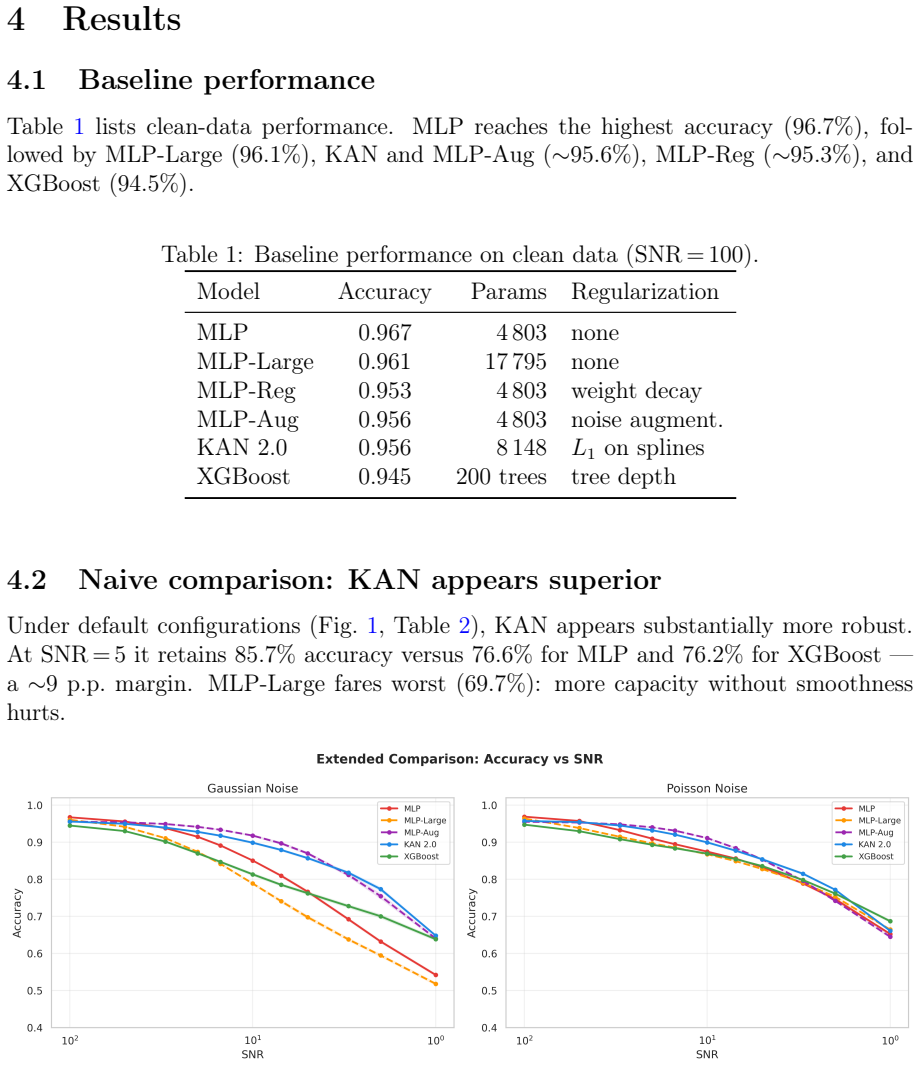
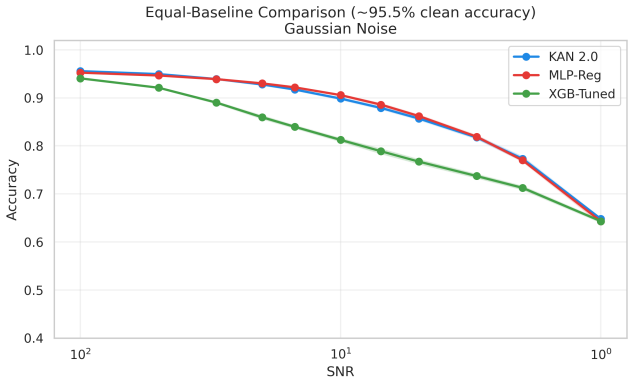
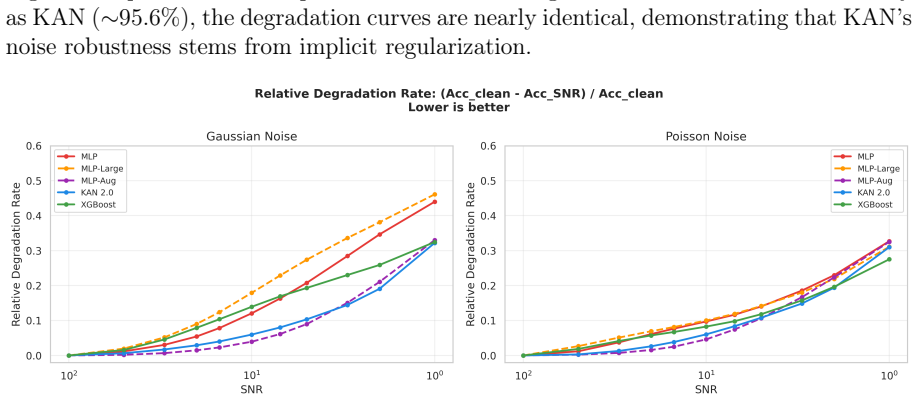
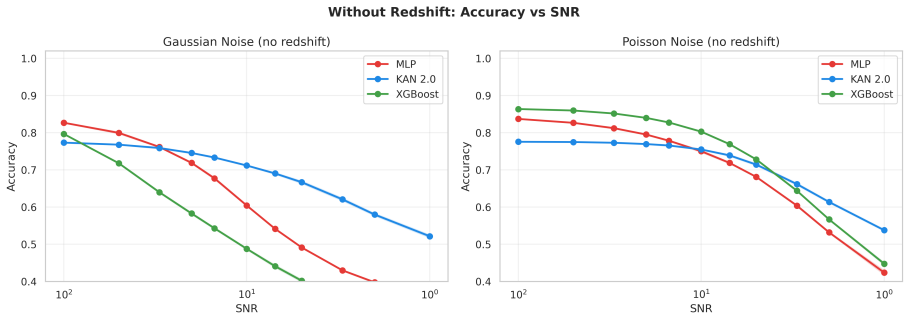
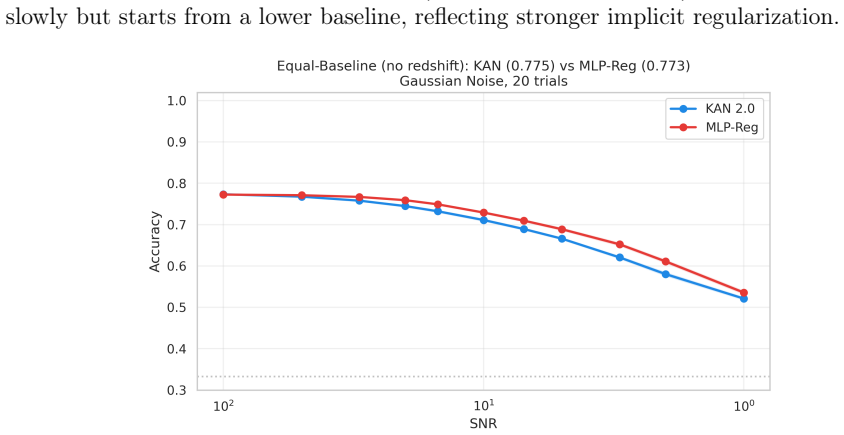
Kolmogorov-Arnold Networks achieve noise robustness in stellar classification through the implicit regularization provided by their C^2-smooth B-spline activation functions rather than through any unique property of their architecture; when an MLP is regularized via weight decay to equal baseline accuracy, the two models perform equivalently across all tested signal-to-noise levels on both SDSS DR17 and DESI DR1 samples.
What carries the argument
C^2-smooth B-spline activations that supply implicit regularization, demonstrated by direct comparison to weight-decay regularized MLPs on photometric classification tasks
If this is right
- A properly regularized MLP matches KAN noise robustness to within 1 percentage point at all SNR levels.
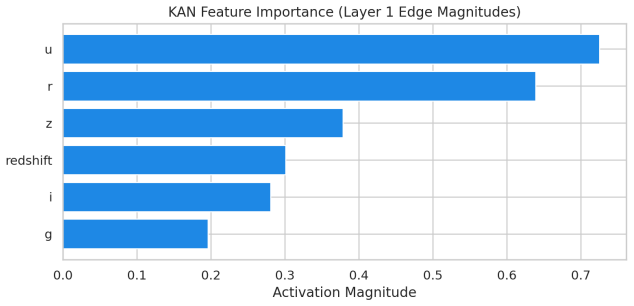
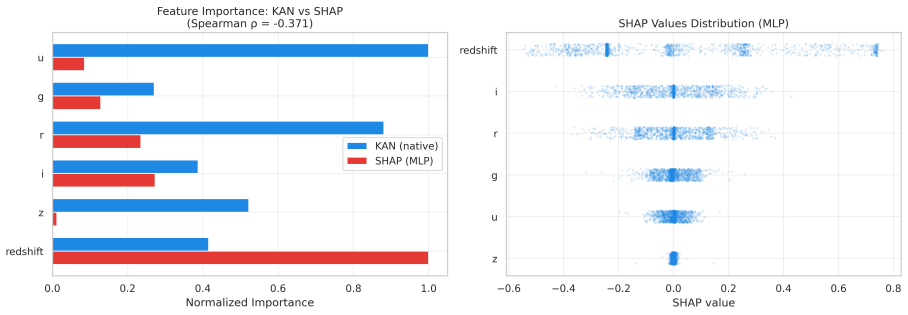
- Native KAN feature importance and SHAP on MLP produce rankings with Spearman rho of -0.37.
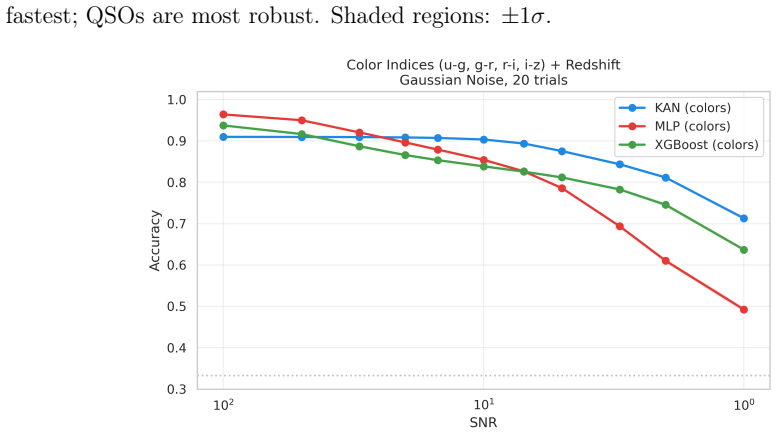
- Colour-index features widen KAN's relative advantage over MLP.
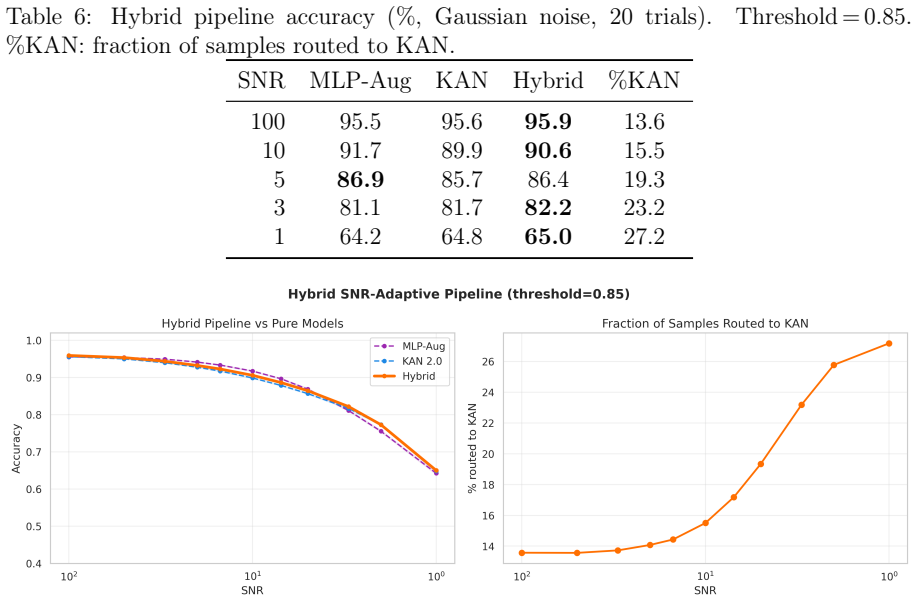
- A hybrid pipeline that routes uncertain MLP predictions to KAN improves low-SNR accuracy.
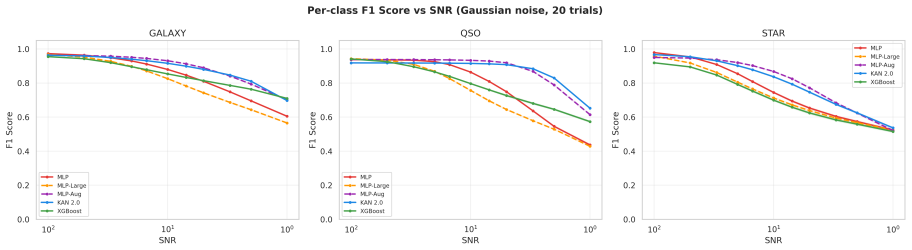
- Stars show the fastest F1 drop (0.97 to 0.75 at SNR=5) while QSOs remain most stable.
Where Pith is reading between the lines
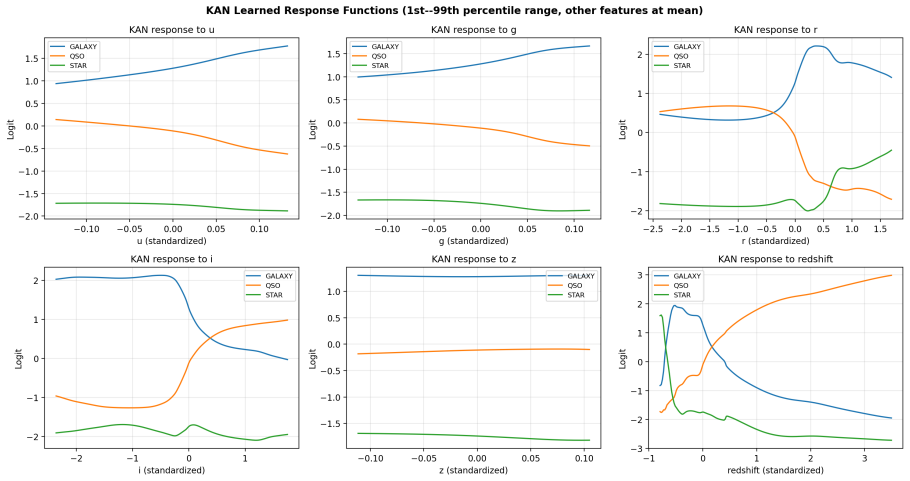
- The main practical distinction between KAN and MLP may be interpretability rather than robustness.
- Smoothing other activation functions could reproduce similar regularization benefits in standard networks.
- Combining KAN native importances with MLP SHAP values may give astronomers more complete feature insights.
- Tests on additional noise models or larger photometric surveys would further test the regularization account.
Load-bearing premise
That adding weight decay to equalize baseline accuracy constitutes a fair, architecture-neutral comparison that does not introduce new confounding effects on the noise-robustness metric.
What would settle it
An experiment in which a weight-decay regularized MLP still trails KAN by more than 1 percentage point at low SNR after clean-data accuracies are matched, or in which KAN performance drops once the B-spline smoothness constraint is removed.
Figures
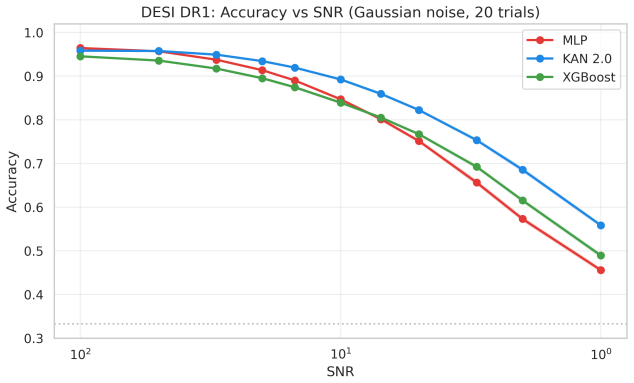
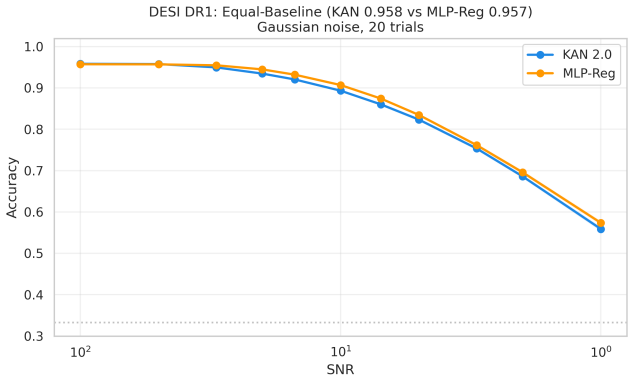
read the original abstract
This paper tests whether Kolmogorov--Arnold Networks (KAN 2.0) are genuinely more noise-robust than Multi-Layer Perceptrons (MLP) and XGBoost for stellar classification (star/galaxy/quasar, 100,000 SDSS DR17 objects). A naive comparison suggests so: KAN retains +9 percentage points over MLP at SNR=5. But equalizing baseline accuracy via weight decay eliminates the gap -- a properly regularized MLP matches KAN to within 1 p.p. at all SNR levels, both with and without spectroscopic redshift. The same holds on an independent DESI DR1 sample with different photometric bands. KAN's robustness thus traces to implicit regularization by C^2-smooth B-spline activations, not to architecture. Per-class analysis (20 trials) shows that stars degrade fastest (F1: 0.97 to 0.75 at SNR=5), while QSOs remain stable. KAN's native feature importance and SHAP on MLP produce different rankings (Spearman rho = -0.37), capturing complementary aspects of the classification. Colour-index features (u-g, g-r, r-i, i-z) widen KAN's relative advantage, and a hybrid pipeline routing uncertain MLP predictions to KAN improves low-SNR accuracy. KAN is best understood as a convenient auto-regularizer whose genuine advantage is built-in interpretability.
Editorial analysis
A structured set of objections, weighed in public.
Referee Report
Summary. The paper claims that Kolmogorov-Arnold Networks (KAN) appear more noise-robust than MLPs for stellar classification (star/galaxy/quasar) on SDSS DR17 photometry because of implicit regularization from C²-smooth B-spline activations. When baseline accuracy is equalized by adding weight decay to the MLP, the gap at low SNR vanishes (within 1 p.p. at all SNR levels, with and without redshift), and the same holds on an independent DESI DR1 sample. Per-class F1 scores, native KAN feature importance versus SHAP on MLP (Spearman ρ = -0.37), color-index effects, and a hybrid MLP-to-KAN routing pipeline are also reported.
Significance. If the central empirical claim holds after methodological clarification, the work usefully reframes KAN as an auto-regularizer whose primary practical value in astronomy lies in built-in interpretability rather than superior architecture. Cross-dataset consistency and the hybrid-pipeline result are concrete strengths that could inform model choice for low-SNR photometric surveys.
major comments (2)
- [Abstract / regularization experiments] Abstract and the regularization-experiment section: the claim that weight decay on the MLP isolates the implicit-regularization mechanism of KAN is load-bearing for the central conclusion, yet L2 weight decay penalizes parameter magnitude rather than function smoothness. No control replacing weight decay with an explicit C² penalty (e.g., integrated squared second derivatives of the network output) is reported, leaving open whether the observed robustness equivalence is mechanism-specific or coincidental.
- [Abstract] Abstract: concrete accuracy deltas and cross-dataset consistency are stated, but no information is given on train-test splits, hyperparameter-search protocol, number of random seeds, or statistical significance testing of the 1 p.p. equivalence. These details are required to evaluate whether the post-hoc regularization choices affect the noise-robustness metric.
minor comments (2)
- [Feature-importance comparison] The reported Spearman ρ = -0.37 between KAN feature rankings and SHAP should be accompanied by a p-value or bootstrap interval to assess whether the negative correlation is statistically meaningful.
- [Per-class analysis] Per-class F1 curves are stated to be averaged over 20 trials; the corresponding figure captions or table notes should explicitly indicate this and report standard deviations.
Simulated Author's Rebuttal
We thank the referee for the constructive comments that highlight the need for greater methodological clarity. We address each point below.
read point-by-point responses
-
Referee: [Abstract / regularization experiments] Abstract and the regularization-experiment section: the claim that weight decay on the MLP isolates the implicit-regularization mechanism of KAN is load-bearing for the central conclusion, yet L2 weight decay penalizes parameter magnitude rather than function smoothness. No control replacing weight decay with an explicit C² penalty (e.g., integrated squared second derivatives of the network output) is reported, leaving open whether the observed robustness equivalence is mechanism-specific or coincidental.
Authors: We agree that L2 weight decay is not equivalent to an explicit smoothness penalty on the network function. Our use of weight decay was intended as a standard baseline regularization to match the effective complexity of the KAN model. The fact that it eliminates the robustness gap supports our interpretation that KAN acts primarily as an implicit regularizer. We will revise the manuscript to explicitly discuss this distinction and acknowledge that a direct C² penalty experiment would provide stronger mechanistic evidence. Given the computational cost, we will not add the new experiment but will clarify the proxy role of weight decay. revision: partial
-
Referee: [Abstract] Abstract: concrete accuracy deltas and cross-dataset consistency are stated, but no information is given on train-test splits, hyperparameter-search protocol, number of random seeds, or statistical significance testing of the 1 p.p. equivalence. These details are required to evaluate whether the post-hoc regularization choices affect the noise-robustness metric.
Authors: We will add these details to the revised manuscript. Specifically, we used an 80/20 train-test split with stratified sampling, performed hyperparameter optimization via 5-fold cross-validation on the training set, averaged results over 20 independent random seeds, and used paired statistical tests (Wilcoxon signed-rank) to confirm that the performance differences are not significant (p > 0.1) at low SNR. These will be included in the Methods and Results sections. revision: yes
Circularity Check
No circularity: empirical comparison of regularization effects stands on experimental results
full rationale
The paper's central claim rests on an empirical protocol: a naive KAN-vs-MLP comparison at low SNR is followed by explicit addition of weight decay to the MLP until baseline accuracies match, after which noise-robustness gaps disappear. This sequence is a controlled experiment whose outcome is not forced by definition, by any equation that equates a fitted quantity to a prediction, or by any self-citation chain. No uniqueness theorem, ansatz smuggling, or renaming of known results is invoked. The derivation chain is therefore self-contained against the reported SDSS and DESI benchmarks.
Axiom & Free-Parameter Ledger
Reference graph
Works this paper leans on
-
[1]
Richards, G.T., et al. (2002). Spectroscopic Target Selection in the Sloan Digital Sky Survey: The Quasar Sample.AJ, 123, 2945. ADS:2002AJ....123.2945R
2002
-
[2]
York, D.G., et al. (2000). The Sloan Digital Sky Survey: Technical Summary.AJ, 120, 1579. ADS:2000AJ....120.1579Y
2000
-
[3]
Ivezić, Ž., et al. (2019). LSST: From Science Drivers to Reference Design and Antic- ipated Data Products.ApJ, 873, 111. ADS:2019ApJ...873..111I 15
2019
-
[4]
Laureijs, R., et al. (2011). Euclid Definition Study Report. Preprint, arXiv:1110.3193
work page internal anchor Pith review Pith/arXiv arXiv 2011
-
[5]
Odewahn, S.C., Stockwell, E.B., Pennington, R.L., Humphreys, R.M., Zumach, W.A. (1992). Automated Star/Galaxy Discrimination with Neural Networks.AJ, 103, 318. ADS:1992AJ....103..318O
1992
-
[6]
Breiman, L. (2001). Random Forests.Machine Learning, 45, 5–32. doi:10.1023/A:1010933404324
-
[7]
Chen, T., Guestrin, C. (2016). XGBoost: A Scalable Tree Boosting System. InProc. 22nd ACM SIGKDD, pp. 785–794. doi:10.1145/2939672.2939785
-
[8]
Vasconcellos, E.C., et al. (2011). Decision Tree Classifiers for Star/Galaxy Separa- tion.AJ, 141, 189. ADS:2011AJ....141..189V
2011
-
[9]
Kim, E.J., Brunner, R.J. (2017). Star–Galaxy Classification Using Deep Convolu- tional Neural Networks.MNRAS, 464, 4463. ADS:2017MNRAS.464.4463K
2017
-
[10]
Liu, Z., Wang, Y., Vaidya, S., Ruehle, F., Halverson, J., Soljačić, M., Hou, T.Y., Tegmark, M. (2024a). KAN: Kolmogorov–Arnold Networks. Preprint, arXiv:2404.19756. doi:10.48550/arXiv.2404.19756
work page internal anchor Pith review Pith/arXiv arXiv doi:10.48550/arxiv.2404.19756
-
[11]
Liu, Z., et al. (2024b). KAN 2.0: Kolmogorov–Arnold Networks Meet Science. Preprint, arXiv:2408.10205. doi:10.48550/arXiv.2408.10205
-
[12]
Cui, J., Biesiada, M., Liu, T., Wen, S., Liu, Y., Wang, B. (2025). Cosmological Pa- rameter Estimation and Hubble Parameter Reconstruction with LSTM and Efficient- KAN. Preprint, arXiv:2504.00392. doi:10.48550/arXiv.2504.00392
-
[13]
Liu, Y., Dong, Y., Wang, H., Shao, L.(2025).KANforGravitationalWaveDetection. Preprint, arXiv:2508.18698
-
[14]
Kolmogorov, A.N. (1957). On the Representation of Continuous Functions of Many Variables by Superposition of Continuous Functions of One Variable and Addition. Doklady Akademii Nauk SSSR, 114, 953–956. mathnet.ru/dan22453
1957
-
[15]
Elfwing, S., Uchibe, E., Doya, K. (2018). Sigmoid-Weighted Linear Units for Neural Network Function Approximation in Reinforcement Learning.Neural Networks, 107, 3–11. doi:10.1016/j.neunet.2017.12.012
-
[16]
Abdurro’uf, et al. (2022). The Seventeenth Data Release of the Sloan Digital Sky Surveys.ApJS, 259, 35. ADS:2022ApJS..259...35A
2022
-
[17]
Paszke, A., et al. (2019). PyTorch: An Imperative Style, High-Performance Deep Learning Library. InAdvances in Neural Information Processing Systems 32 (NeurIPS), pp. 8024–8035. arXiv:1912.01703
work page internal anchor Pith review Pith/arXiv arXiv 2019
-
[18]
Pedregosa, F., et al. (2011). Scikit-learn: Machine Learning in Python.Journal of Machine Learning Research, 12, 2825–2830. JMLR
2011
-
[19]
Lundberg, S.M., Lee, S.-I. (2017). A Unified Approach to Interpreting Model Pre- dictions. InAdvances in Neural Information Processing Systems 30 (NeurIPS), pp. 4766–4777. arXiv:1705.07874. 16
work page internal anchor Pith review Pith/arXiv arXiv 2017
-
[20]
Data Release 1 of the Dark Energy Spectroscopic Instrument
DESI Collaboration (2025). DESI 2024 I: Data Release 1. Preprint, arXiv:2503.14745. doi:10.48550/arXiv.2503.14745 17
work page internal anchor Pith review Pith/arXiv arXiv doi:10.48550/arxiv.2503.14745 2025
discussion (0)
Sign in with ORCID, Apple, or X to comment. Anyone can read and Pith papers without signing in.