Designing for the Moment: How One-Minute Interventions Fit or Falter Across Domains
Pith reviewed 2026-06-29 10:04 UTC · model grok-4.3
The pith
Co-authorship lets users rewrite one-minute prompts to balance relevance and low friction across lifestyle domains.
A machine-rendered reading of the paper's core claim, the machinery that carries it, and where it could break.
Core claim
By examining how participants rewrote the supplied one-minute prompts, the study shows that intentional personalization through co-authorship can serve as a lightweight mechanism that balances relevance with low friction, allowing the same basic intervention format to fit physical activity, healthy eating, and mental well-being goals.
What carries the argument
One-minute digital prompts that require only an immediate, low-effort action, combined with user co-authorship of prompt wording as the personalization step.
If this is right
- The interventions require no sensing hardware or user onboarding yet still aim to work for people with low motivation.
- Co-authorship can be applied in at least three distinct lifestyle domains using the same core prompt format.
- Participants' rewrites reveal concrete wording changes that increase perceived relevance without adding friction.
- The approach avoids heavy personalization algorithms by shifting some design work to the user at the moment of use.
Where Pith is reading between the lines
- Designers of mobile health apps could insert a single rewrite step at first use instead of building separate prompt libraries for each domain.
- The method might extend to other short-burst behaviors such as productivity micro-tasks or financial micro-savings if similar rewrite data were collected.
- Future studies could test whether the benefit of co-authorship persists when prompts are delivered by third-party apps rather than a research interface.
Load-bearing premise
Prompt rewrites collected from 22 participants over 14 days supply reliable evidence that co-authorship improves outcomes across domains.
What would settle it
If a larger trial measures action completion rates and finds no reliable difference between standard prompts and co-authored prompts, the claim that co-authorship supplies effective lightweight personalization would not hold.
Figures

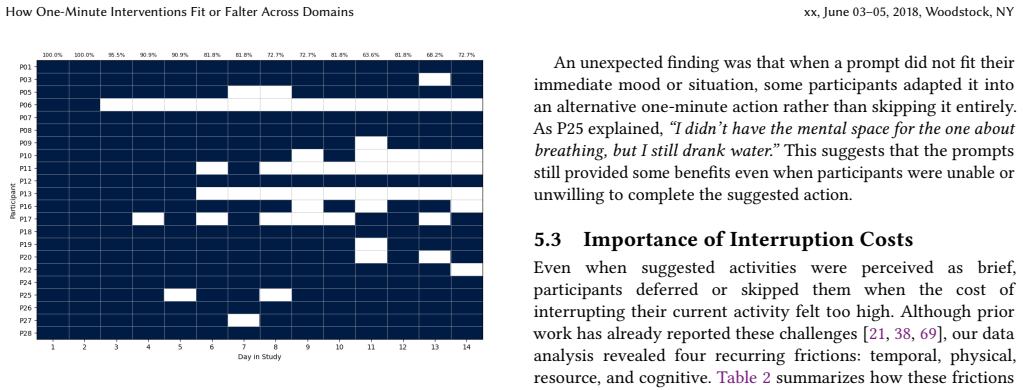

read the original abstract
This paper explores the design space for one-minute digital interventions that prompt immediate action without onboarding or sensing. By embracing Fogg's Behavior Model and four design principles informed by literature, the goal of these interventions was to provide triggers that encourage actions so simple that even people with low motivation would be willing to complete them. We examined the utility of these prompts by conducting a 14-day study with 22 participants interested in making small lifestyle improvements in at least one of three domains: physical activity, healthy eating, and mental well-being. When combined with insights drawn from participants' rewrites of our prompts, our findings suggest that intentional personalization through co-authorship could be a lightweight personalization mechanism that balances relevance with low friction.
Editorial analysis
A structured set of objections, weighed in public.
Referee Report
Summary. The manuscript explores the design space for one-minute digital interventions that prompt immediate action without onboarding or sensing, drawing on Fogg's Behavior Model and four design principles from the literature. It reports findings from a 14-day study with 22 participants interested in small lifestyle improvements across physical activity, healthy eating, and mental well-being. The central claim is that insights from participants' rewrites of the prompts indicate intentional personalization through co-authorship is a lightweight mechanism that balances relevance with low friction.
Significance. If the empirical link between the observed rewrites and the proposed co-authorship mechanism holds under stronger scrutiny, the work could usefully extend HCI research on low-friction, trigger-based behavior-change tools by offering a practical personalization approach grounded in Fogg's model. The explicit use of an established theoretical framework is a constructive element.
major comments (2)
- [Abstract] Abstract: The claim that participant rewrites demonstrate co-authorship balances relevance and low friction across domains rests on N=22 over 14 days with only qualitative rewrite data; no quantitative adherence metrics, behavior-change outcomes, or breakdown of participants per domain are referenced, rendering the generalization from observed rewrites to a reliable cross-domain mechanism under-supported and load-bearing for the central suggestion.
- [Study description] Study description (abstract and methods): Details on how the 22 participants' rewrites were collected, coded, or mapped onto the four design principles, along with any inter-rater reliability or thematic analysis procedure, are absent; this gap directly affects evaluation of whether the rewrites provide evidence for the utility of the interventions or the co-authorship proposal.
minor comments (2)
- [Abstract] Abstract: Consider adding one sentence naming the four design principles to allow readers to assess alignment with Fogg's model without needing the full text.
- References: Verify that the full citation for Fogg's Behavior Model appears in the bibliography and that any domain-specific prior work on one-minute interventions is referenced.
Simulated Author's Rebuttal
We thank the referee for the constructive feedback highlighting opportunities to strengthen the presentation of our exploratory qualitative study. We address each major comment below and will revise the manuscript to improve clarity and transparency while preserving the scope of our claims.
read point-by-point responses
-
Referee: [Abstract] Abstract: The claim that participant rewrites demonstrate co-authorship balances relevance and low friction across domains rests on N=22 over 14 days with only qualitative rewrite data; no quantitative adherence metrics, behavior-change outcomes, or breakdown of participants per domain are referenced, rendering the generalization from observed rewrites to a reliable cross-domain mechanism under-supported and load-bearing for the central suggestion.
Authors: We agree the study is exploratory and qualitative; the central suggestion is framed as a hypothesis emerging from observed rewrite patterns rather than a validated cross-domain mechanism. No quantitative adherence or outcome metrics were collected, as the design focused on prompt co-authorship and participant reflections. We will revise the abstract to explicitly note the exploratory nature, the sample size, and the qualitative basis, and will include a participant breakdown by domain in the methods/results if not already detailed. revision: partial
-
Referee: [Study description] Study description (abstract and methods): Details on how the 22 participants' rewrites were collected, coded, or mapped onto the four design principles, along with any inter-rater reliability or thematic analysis procedure, are absent; this gap directly affects evaluation of whether the rewrites provide evidence for the utility of the interventions or the co-authorship proposal.
Authors: The full methods section describes the 14-day procedure and prompt delivery, but we acknowledge that the rewrite collection, coding, mapping to design principles, and analysis procedures require more explicit detail. We will expand this section to describe data collection (daily rewrite submissions), the thematic analysis approach, how rewrites were mapped to the four principles, and any inter-rater reliability steps. revision: yes
Circularity Check
No circularity: empirical study with no derivations or self-referential reductions
full rationale
The paper reports results from a 14-day user study with 22 participants and qualitative analysis of prompt rewrites. Its central suggestion (co-authorship as lightweight personalization) is presented as an inference from observed participant feedback and Fogg's model, not from any equation, fitted parameter, or prediction that reduces to the input data by construction. No self-citation load-bearing steps, uniqueness theorems, or ansatzes appear in the provided abstract or described structure. The work is self-contained empirical reporting; the derivation chain does not collapse into its own inputs.
Axiom & Free-Parameter Ledger
axioms (1)
- domain assumption Fogg's Behavior Model provides a useful framework for designing effective behavior prompts
Reference graph
Works this paper leans on
-
[1]
Andreas Balaskas, Stephen M. Schueller, Anna L. Cox, and Gavin Doherty. 2021. Ecological Momentary Interventions for Mental Health: A Scoping Review.PLOS ONE16, 3 (March 2021), e0248152. doi:10.1371/journal.pone.0248152 PMID: 33705457; PMCID: PMC7951936
-
[2]
Andreas Balaskas, Stephen M Schueller, Kevin Doherty, Anna L Cox, and Gavin Doherty. 2024. Designing personalized mental health interventions for anxiety: CBT therapists’ perspective.International Journal of Human-Computer Studies 190 (2024), 103319. doi:10.1016/j.ijhcs.2024.103319
-
[3]
1997.Self-efficacy: The Exercise of Control
Albert Bandura. 1997.Self-efficacy: The Exercise of Control. W.H. Freeman, New York
1997
-
[4]
Bateman, Sarah Emily Wilson, Ariane Gauvreau, Katherine Matthews, Maggie Gucwa, William Therrien, Rose Nevill, and Micah O
Katherine J. Bateman, Sarah Emily Wilson, Ariane Gauvreau, Katherine Matthews, Maggie Gucwa, William Therrien, Rose Nevill, and Micah O. Mazurek
-
[5]
Journal of Early Intervention45, 2 (jul 2022), 105381512211117
Visual Supports to Increase Conversation Engagement for Preschoolers With Autism Spectrum Disorder During Mealtimes: An Initial Investigation. Journal of Early Intervention45, 2 (jul 2022), 105381512211117. doi:10.1177/ 10538151221111762
2022
-
[6]
Amit Baumel, Theresa Fleming, and Stephen M Schueller. 2020. Digital Micro Interventions for Behavioral and Mental Health Gains: Core Components and Conceptualization of Digital Micro Intervention Care.J Med Internet Res22, 10 (29 Oct 2020), e20631. doi:10.2196/20631
-
[7]
Amit Baumel, Frederick Muench, Stav Edan, and John M Kane. 2019. Objective User Engagement With Mental Health Apps: Systematic Search and Panel-Based Usage Analysis.J Med Internet Res21, 9 (25 Sep 2019), e14567. doi:10.2196/14567
-
[8]
Ananya Bhattacharjee, Jiyau Pang, Angelina Liu, Alex Mariakakis, and Joseph Jay Williams. 2023. Design Implications for One-Way Text Messaging Services that Support Psychological Wellbeing.ACM Trans. Comput.-Hum. Interact.30, 3, Article 34 (June 2023), 29 pages. doi:10.1145/3569888
-
[9]
Mohr, Michael Liut, Alex Mariakakis, Rachel Kornfield, and Joseph Jay Williams
Ananya Bhattacharjee, Sarah Yi Xu, Pranav Rao, Yuchen Zeng, Jonah Meyerhoff, Syed Ishtiaque Ahmed, David C. Mohr, Michael Liut, Alex Mariakakis, Rachel Kornfield, and Joseph Jay Williams. 2025. Perfectly to a Tee: Understanding User Perceptions of Personalized LLM-Enhanced Narrative Interventions. In Proceedings of the 2025 ACM Designing Interactive Syste...
-
[10]
Joan-Isaac Biel, Nathalie Martin, David Labbe, and Daniel Gatica-Perez. 2018. Bites‘n’Bits: Inferring Eating Behavior from Contextual Mobile Data.Proc. ACM Interact. Mob. Wearable Ubiquitous Technol.1, 4, Article 125 (Jan. 2018), 33 pages. doi:10.1145/3161161
-
[11]
Gregory B. Bissonette and Matthew R. Roesch. 2016. Development and function of the midbrain dopamine system: what we know and what we need to.Genes, Brain and Behavior15, 1 (2016), 62–73. doi:10.1111/gbb.12257
-
[12]
Virginia Braun and Victoria Clarke. 2019. Reflecting on reflexive thematic analysis. Qualitative Research in Sport, Exercise and Health11, 4 (2019), 589–597. doi:10.1080/ 2159676X.2019.1628806 arXiv:https://doi.org/10.1080/2159676X.2019.1628806
-
[13]
Brumby, Anna L
Duncan P. Brumby, Anna L. Cox, Jon Back, and Sandy J. J. Gould. 2013. Recovering from an interruption: Investigating speed-accuracy trade-offs in task resumption behavior.Journal of Experimental Psychology: Applied19, 2 (2013), 95–107. doi:10. 1037/a0032696
2013
-
[14]
Clara Caldeira, Yu Chen, Lesley Chan, Vivian Pham, Yunan Chen, and Kai Zheng. 2017. Mobile Apps for Mood Tracking: An Analysis of Features and User Reviews. InAMIA Annual Symposium Proceedings. American Medical Informatics Association, 495–504. PMID: 29854114; PMCID: PMC5977660
2017
-
[15]
Cambo, Daniel Avrahami, and Matthew L
Scott A. Cambo, Daniel Avrahami, and Matthew L. Lee. 2017. BreakSense: Combining Physiological and Location Sensing to Promote Mobility during Work- Breaks. InProceedings of the 2017 CHI Conference on Human Factors in Computing Systems(Denver, Colorado, USA)(CHI ’17). Association for Computing Machinery, New York, NY, USA, 3595–3607. doi:10.1145/3025453.3026021
-
[16]
All Day, Every Day, Listening to Trauma
Connie W. Chau, Colleen Norton, Kaylee Payne Kruzan, and Maia Jacobs. 2025. "All Day, Every Day, Listening to Trauma": Investigating Features of Digital Interventions for Empathy-Based Stress and Burnout. InProceedings of the 2025 xx, June 03–05, 2018, Woodstock, NY xx CHI Conference on Human Factors in Computing Systems (CHI ’25). Association for Computi...
-
[17]
Mina Choi and Catalina L. Toma. 2014. Social sharing through interpersonal media: Patterns and effects on emotional well-being.Computers in Human Behavior36 (2014), 530–541. doi:10.1016/j.chb.2014.04.026
-
[18]
Woohyeok Choi, Sangkeun Park, Duyeon Kim, Youn-kyung Lim, and Uichin Lee
-
[19]
Multi-Stage Receptivity Model for Mobile Just-In-Time Health Intervention. Proc. ACM Interact. Mob. Wearable Ubiquitous Technol.3, 2, Article 39 (June 2019), 26 pages. doi:10.1145/3328910
-
[20]
Joana Couto da Silva, Beatriz Félix, Leina Meoli, Xolani Ntinga, Ricardo Melo, Yaseen Joolay, Sarina Till, Melissa Densmore, and Francisco Nunes. 2025. Perspectives of Parents and Healthcare Professionals on Using Chatbots to Support Parents in Child Health: A Qualitative Study. InProceedings of the 5th Biennial African Human Computer Interaction Conferen...
-
[21]
Pooja M. Desai, Elliot G. Mitchell, Maria L. Hwang, Matthew E. Levine, David J. Albers, and Lena Mamykina. 2019. Personal Health Oracle: Explorations of Personalized Predictions in Diabetes Self-Management. InProceedings of the 2019 CHI Conference on Human Factors in Computing Systems. Association for Computing Machinery, New York, NY, USA, Article 370, 1...
-
[22]
Geyze Diniz, Ligia Korkes, Luca Schiliró Tristão, Rosangela Pelegrini, Patrícia Lacerda Bellodi, and Wanderley Marques Bernardo. 2023. The Effects of Gratitude Interventions: A Systematic Review and Meta-Analysis.Einstein (Sao Paulo)21 (2023), eRW0371. doi:10.31744/einstein_journal/2023RW0371
-
[23]
Katharina Feil, Julian Fritsch, and Ryan E. Rhodes. 2023. The intention-behaviour gap in physical activity: a systematic review and meta-analysis of the action control framework.British Journal of Sports Medicine57, 19 (Oct. 2023), 1265–1271. doi:10.1136/bjsports-2022-106640 Epub 2023-07-17. PMID: 37460164
-
[24]
BJ Fogg. 2009. A behavior model for persuasive design. InProceedings of the 4th International Conference on Persuasive Technology(Claremont, California, USA)(Persuasive ’09). Association for Computing Machinery, New York, NY, USA, Article 40, 7 pages. doi:10.1145/1541948.1541999
-
[25]
Asbjørn Følstad, Marita Skjuve, and Petter Brandtzaeg. 2019.Different Chatbots for Different Purposes: Towards a Typology of Chatbots to Understand Interaction Design. Springer, Cham, 145–156. doi:10.1007/978-3-030-17705-8_13
-
[26]
Gollwitzer
Peter M. Gollwitzer. 1990. Action phases and mind-sets. InHandbook of Motivation and Cognition: Foundations of Social Behavior, E. Tory Higgins and Richard M. Sorrentino (Eds.). Vol. 2. Guilford Press, 53–92
1990
-
[27]
Gollwitzer and Paschal Sheeran
Peter M. Gollwitzer and Paschal Sheeran. 2006. Implementation Intentions and Goal Achievement: A Meta-analysis of Effects and Processes. InEncyclopedia of Behavioral Medicine. Advances in Experimental Social Psychology, Vol. 38. Academic Press, 69–119. doi:10.1016/S0065-2601(06)38002-1
-
[28]
David Haag, Devender Kumar, Sebastian Gruber, MSc Hofer, Dominik P., Mahdi Sareban, Gunnar Treff, Josef Niebauer, Christopher N Bull, Albrecht Schmidt, and Jan David Smeddinck. 2025. The Last JITAI? Exploring Large Language Models for Issuing Just-in-Time Adaptive Interventions: Fostering Physical Activity in a Prospective Cardiac Rehabilitation Setting. ...
-
[29]
Hare, Jonathan Malmaud, and Antonio Rangel
Todd A. Hare, Jonathan Malmaud, and Antonio Rangel. 2011. Focusing Attention on the Health Aspects of Foods Changes Value Signals in vmPFC and Improves Dietary Choice.Journal of Neuroscience31, 30 (2011), 11077–11087. doi:10.1523/ JNEUROSCI.6383-10.2011
2011
-
[30]
Katharine J. Head, Seth M. Noar, Nicholas T. Iannarino, and Nancy Grant Harrington. 2013. Efficacy of text messaging-based interventions for health promotion: a meta-analysis.Social Science & Medicine97, 0 (2013), 41–48. doi:10.1016/j.socscimed.2013.08.003
-
[31]
Heinz Heckhausen and Peter M. Gollwitzer. 1987. Thought contents and cognitive functioning in motivational versus volitional states of mind. InMotivation, Intention, and Volition, Fred Halisch and Julius Kuhl (Eds.). Springer, 485–511. doi:10.1007/978-3-642-71763-5
-
[32]
Heron and Joshua M
Kristin E. Heron and Joshua M. Smyth. 2010. Ecological Momentary Interventions: Incorporating Mobile Technology into Psychosocial and Health Behaviour Treatments.British Journal of Health Psychology15, 1 (2010), 1–39. doi:10. 1348/135910709X466063
2010
-
[33]
Shamsi T. Iqbal and Brian P. Bailey. 2008. Effects of intelligent notification management on users and their tasks. InProceedings of the SIGCHI Conference on Human Factors in Computing Systems(Florence, Italy)(CHI ’08). Association for Computing Machinery, New York, NY, USA, 93–102. doi:10.1145/1357054.1357070
-
[34]
Shamsi T. Iqbal and Eric Horvitz. 2010. Notifications and awareness: a field study of alert usage and preferences. InProceedings of the 2010 ACM Conference on Computer Supported Cooperative Work(Savannah, Georgia, USA)(CSCW ’10). Association for Computing Machinery, New York, NY, USA, 27–30. doi:10.1145/ 1718918.1718926
-
[35]
Neil S. Jacobson, Christopher R. Martell, and Sona Dimidjian. 2001. Behavioral activation treatment for depression: Returning to contextual roots.Clinical Psychology: Science and Practice8, 3 (2001), 255–270. doi:10.1093/clipsy.8.3.255
-
[36]
Hamblin, Catherine Steele, and Kylie Ball
Nazanin Karimi, Rachael Opie, David Crawford, Shelley O’Connell, Peter S. Hamblin, Catherine Steele, and Kylie Ball. 2023. Participants’ and Health Care Providers’ Insights Regarding a Web-Based and Mobile-Delivered Healthy Eating Program for Disadvantaged People With Type 2 Diabetes: Descriptive Qualitative Study.JMIR Formative Research7 (2023), e37429. ...
-
[37]
Rachel Kornfield, Jonah Meyerhoff, Hannah Studd, Ananya Bhattacharjee, Joseph Jay Williams, Madhu Reddy, and David C. Mohr. 2022. Meeting Users Where They Are: User-centered Design of an Automated Text Messaging Tool to Support the Mental Health of Young Adults. InProceedings of the 2022 CHI Conference on Human Factors in Computing Systems(New Orleans, LA...
-
[38]
Harsh Kumar, Tong Li, Jiakai Shi, Ilya Musabirov, Rachel Kornfield, Jonah Meyerhoff, Ananya Bhattacharjee, Chris Karr, Theresa Nguyen, David Mohr, et al
-
[39]
InProceedings of the AAAI Conference on Artificial Intelligence, Vol
Using adaptive bandit experiments to increase and investigate engagement in mental health. InProceedings of the AAAI Conference on Artificial Intelligence, Vol. 38. 22906–22912. doi:10.1609/aaai.v38i21.30328
-
[40]
Florian Künzler, Varun Mishra, Jan-Niklas Kramer, David Kotz, Elgar Fleisch, and Tobias Kowatsch. 2020. Exploring the State-of-Receptivity for mHealth Interventions.Proceedings of the ACM on interactive, mobile, wearable and ubiquitous technologies3, 4, Article 140 (Sept. 2020), 27 pages. doi:10.1145/3369805
-
[41]
Dombrowski, Martin White, and Falko Sniehotta
Dominika Kwasnicka, Stephan U. Dombrowski, Martin White, and Falko Sniehotta. 2016. Theoretical explanations for maintenance of behaviour change: a systematic review of behaviour theories.Health Psychology Review10, 3 (Sept. 2016), 277–296. doi:10.1080/17437199.2016.1151372 Epub 2016-03-07. PMID: 26854092; PMCID: PMC4975085
-
[42]
Mengying Li and Eun Kyoung Choe. 2025. Identifying Design Opportunities for Behavior Displacement for Intervening Sedentary Time among Older Adults. Proc. ACM Interact. Mob. Wearable Ubiquitous Technol.9, 3, Article 102 (Sept. 2025), 23 pages. doi:10.1145/3749476
-
[43]
Peng Liao, Kristjan Greenewald, Predrag Klasnja, and Susan Murphy. 2020. Personalized HeartSteps: A Reinforcement Learning Algorithm for Optimizing Physical Activity.Proc. ACM Interact. Mob. Wearable Ubiquitous Technol.4, 1, Article 18 (March 2020), 22 pages. doi:10.1145/3381007
-
[44]
Yanhui Liao, Qiuxia Wu, Brian C. Kelly, Fengyu Zhang, Yi-Yuan Tang, Qianjin Wang, Honghong Ren, Yuzhu Hao, Mei Yang, Joanna Cohen, et al . 2018. Effectiveness of a text-messaging-based smoking cessation intervention (“Happy Quit”) for smoking cessation in China: a randomized controlled trial.PLoS Medicine15, 12 (2018), e1002713. doi:10.1371/journal.pmed.1002713
-
[45]
Yuhan Luo, Bongshin Lee, Donghee Yvette Wohn, Amanda L. Rebar, David E. Conroy, and Eun Kyoung Choe. 2018. Time for Break: Understanding Information Workers’ Sedentary Behavior Through a Break Prompting System. InProceedings of the 2018 CHI Conference on Human Factors in Computing Systems(Montreal QC, Canada)(CHI ’18). Association for Computing Machinery,...
-
[46]
Batoul Manana, Claire El-Jor, Joelle Abi Kharma, and Nadine Zeeni. 2023. Effectiveness of a Text-Messaging Intervention on Intuitive Eating: A Randomised Controlled Trial.Public Health Nutrition26, 9 (2023), 1682–1690. doi:10.1017/ S1368980023000939
2023
-
[47]
Rob McCarney, James Warner, Steve Iliffe, Robbert Van Haselen, Mark Griffin, and Peter Fisher. 2007. The Hawthorne Effect: A Randomised, Controlled Trial. BMC Medical Research Methodology7 (2007), 30. doi:10.1186/1471-2288-7-30
-
[48]
Miller and Stephen Rollnick
William R. Miller and Stephen Rollnick. 2013.Motivational Interviewing: Helping People Change(3 ed.). Guilford Press, New York
2013
-
[49]
Madison Milne-Ives, Ching Lam, Caroline De Cock, Michelle Helena Van Velthoven, and Edward Meinert. 2020. Mobile Apps for Health Behavior Change in Physical Activity, Diet, Drug and Alcohol Use, and Mental Health: Systematic Review.JMIR mHealth and uHealth8, 3 (March 2020), e17046. doi:10.2196/17046
-
[50]
Varun Mishra, Florian Künzler, Jan-Niklas Kramer, Elgar Fleisch, Tobias Kowatsch, and David Kotz. 2021. Detecting Receptivity for mHealth Interventions in the Natural Environment.Proc. ACM Interact. Mob. Wearable Ubiquitous Technol.5, 2, Article 74 (June 2021), 24 pages. doi:10.1145/3463492
-
[51]
Mitchell, Elizabeth M
Elliot G. Mitchell, Elizabeth M. Heitkemper, Marissa Burgermaster, Matthew E. Levine, Yishen Miao, Maria L. Hwang, Pooja M. Desai, Andrea Cassells, Jonathan N. Tobin, Esteban G. Tabak, David J. Albers, Arlene M. Smaldone, and Lena Mamykina. 2021. From Reflection to Action: Combining Machine Learning with Expert Knowledge for Nutrition Goal Recommendations...
2021
-
[52]
doi:10.1145/3411764.3445555
-
[53]
Frederick Muench and Amit Baumel. 2017. More than a text message: dismantling digital triggers to curate behavior change in patient-centered health interventions. Journal of Medical Internet Research19, 5 (2017), e147. doi:10.2196/jmir.7463 How One-Minute Interventions Fit or Falter Across Domains xx, June 03–05, 2018, Woodstock, NY
-
[54]
Inbal Nahum-Shani, Shawna N Smith, Bonnie J Spring, Linda M Collins, Katie Witkiewitz, Ambuj Tewari, and Susan A Murphy. 2017. Just-in-Time Adaptive Interventions (JITAIs) in Mobile Health: Key Components and Design Principles for Ongoing Health Behavior Support.Annals of Behavioral Medicine52, 6 (12 2017), 446–462. doi:10.1007/s12160-016-9830-8
-
[55]
Adiba Orzikulova, Han Xiao, Zhipeng Li, Yukang Yan, Yuntao Wang, Yuanchun Shi, Marzyeh Ghassemi, Sung-Ju Lee, Anind K Dey, and Xuhai Xu. 2024. Time2Stop: Adaptive and Explainable Human-AI Loop for Smartphone Overuse Intervention. InProceedings of the 2024 CHI Conference on Human Factors in Computing Systems(Honolulu, HI, USA)(CHI ’24). Association for Com...
-
[56]
Dan Roland Persson, Mel Ramasawmy, Nushrat Khan, Amitava Banerjee, Ann Blandford, Jakob Eyvind Bardram, and Per Bækgaard. 2025. A Design Framework for Microintervention Software Technology in Digital Health: Critical Interpretive Synthesis.J Med Internet Res27 (12 Sep 2025), e72658. doi:10.2196/72658
-
[57]
Charlie Pinder, Jo Vermeulen, Benjamin R. Cowan, and Russell Beale. 2018. Digital Behaviour Change Interventions to Break and Form Habits.ACM Trans. Comput.- Hum. Interact.25, 3, Article 15 (June 2018), 66 pages. doi:10.1145/3196830
-
[58]
Julianne Power and Andrea Bersamin. 2017. Txt4HappyKids, A text messaging pilot study to promote fruit and vegetable intake among families with young children.JMIR Formative Research2 (07 2017). doi:10.2196/formative.8544
-
[59]
Mashfiqui Rabbi, Predrag Klasnja, Tanzeem Choudhury, Ambuj Tewari, and Susan Murphy. 2019. Optimizing mHealth interventions with a bandit. InDigital Phenotyping and Mobile Sensing: New Developments in Psychoinformatics. Springer, 277–291. doi:10.1007/978-3-030-98546-2_21
-
[60]
Stefan Rennick-Egglestone, Sarah Knowles, Gill Toms, Penny Bee, Karina Lovell, and Peter Bower. 2016. Health Technologies ’In the Wild’: Experiences of Engagement with Computerised CBT. InProceedings of the 2016 CHI Conference on Human Factors in Computing Systems(San Jose, California, USA)(CHI ’16). Association for Computing Machinery, New York, NY, USA,...
-
[61]
Mohi Reza, Angela Zavaleta Bernuy, Emmy Liu, Tong Li, Zhongyuan Liang, Calista K Barber, and Joseph Jay Williams. 2023. Exam Eustress: Designing Brief Online Interventions for Helping Students Identify Positive Aspects of Stress. In Proceedings of the 2023 CHI Conference on Human Factors in Computing Systems (Hamburg, Germany)(CHI ’23). Association for Co...
-
[62]
Rogers, Arvind Singhal, and Margaret M
Everett M. Rogers, Arvind Singhal, and Margaret M. Quinlan. 2014. Diffusion of innovations. InAn Integrated Approach to Communication Theory and Research. Routledge, 432–448
2014
-
[63]
John Rooksby, Mattias Rost, Alistair Morrison, and Matthew Chalmers. 2014. Personal tracking as lived informatics. InProceedings of the SIGCHI Conference on Human Factors in Computing Systems(Toronto, Ontario, Canada)(CHI ’14). Association for Computing Machinery, New York, NY, USA, 1163–1172. doi:10. 1145/2556288.2557039
-
[64]
Jessica L. Schleider and John R. Weisz. 2017. Little Treatments, Promising Effects? Meta-Analysis of Single-Session Interventions for Youth Psychiatric Problems. Journal of the American Academy of Child and Adolescent Psychiatry56, 2 (Feb. 2017), 107–115. doi:10.1016/j.jaac.2016.11.007 Epub 2016-11-25
-
[65]
Jessica L. Schleider, Juan Pablo Zapata, Andy Rapoport, Annie Wescott, Arka Ghosh, Benji Kaveladze, Erica Szkody, and Isaac L. Ahuvia. 2025. Single-Session Interventions for Mental Health Problems and Service Engagement: Umbrella Review of Systematic Reviews and Meta-Analyses.Annual Review of Clinical Psychology21 (2025), 279–303. doi:10.1146/annurev-clin...
-
[66]
Petr Slovak, Alissa Antle, Nikki Theofanopoulou, Claudia Daudén Roquet, James Gross, and Katherine Isbister. 2023. Designing for Emotion Regulation Interventions: An Agenda for HCI Theory and Research.ACM Trans. Comput.- Hum. Interact.30, 1, Article 13 (March 2023), 51 pages. doi:10.1145/3569898
-
[67]
Jay Thakkar, Rahul Kurup, Tracey-Lea Laba, Karla Santo, Aravinda Thiagalingam, Anthony Rodgers, Mark Woodward, Julie Redfern, and Clara K Chow. 2016. Mobile Telephone Text Messaging for Medication Adherence in Chronic Disease: A Meta-analysis.JAMA Internal Medicine176, 3 (March 2016), 340–349. doi:10. 1001/jamainternmed.2015.7667
-
[68]
Thaler and Cass R
Richard H. Thaler and Cass R. Sunstein. 2008.Nudge: Improving Decisions About Health, Wealth, and Happiness. Yale University Press, New Haven, CT. doi:10. 1016/j.soscij.2008.09.003
2008
-
[69]
Emily J. Tomayko, Eliza J. Webber, Kate A. Cronin, Ronald J. Prince, and Alexandra K. Adams. 2021. Use of Text Messaging and Facebook Groups to Support the Healthy Children, Strong Families 2 Healthy Lifestyle Intervention for American Indian Families.Current Developments in Nutrition5, 6 (2021), nzab071. doi:10.1093/cdn/nzab071
-
[70]
Bas Verplanken and Wendy Wood. 2006. Interventions to Break and Create Consumer Habits.Journal of Public Policy & Marketing25, 1 (2006), 90–103. doi:10.1509/jppm.25.1.90
-
[71]
Parkin, Joseph Beyene, Elizabeth M
Gita Wahi, Patricia C. Parkin, Joseph Beyene, Elizabeth M. Uleryk, and Catherine S. Birken. 2011. Effectiveness of Interventions Aimed at Reducing Screen Time in Children: A Systematic Review and Meta-analysis of Randomized Controlled Trials.Archives of Pediatrics & Adolescent Medicine165, 11 (2011), 979–986. doi:10.1001/archpediatrics.2011.122
-
[72]
R. Waller and S. Gilbody. 2009. Barriers to the uptake of computerized cognitive behavioural therapy: a systematic review of the quantitative and qualitative evidence.Psychological Medicine39, 5 (2009), 705–712. doi:DOI: 10.1017/S0033291708004224
-
[73]
Thomas L. Webb and Paschal Sheeran. 2006. Does changing behavioral intentions engender behavior change? A meta-analysis of the experimental evidence. Psychological Bulletin132, 2 (March 2006), 249–268. doi:10.1037/0033-2909.132.2. 249 PMID: 16536643
-
[74]
Wendy Wood and Dennis Rünger. 2016. Psychology of Habit.Annual Review of Psychology67 (2016), 289–314. doi:10.1146/annurev-psych-122414-033417
-
[75]
Zuoyi Zhang, Teng Han, John Swystun, Yumiko Sakamoto, and Pourang Irani
-
[76]
Design to Eat Smart: A Design Framework for Pervasive Interventions of Eating Habits. InProceedings of the 14th EAI International Conference on Pervasive Computing Technologies for Healthcare(Atlanta, GA, USA)(PervasiveHealth ’20). Association for Computing Machinery, New York, NY, USA, 108–121. doi:10. 1145/3421937.3421974 xx, June 03–05, 2018, Woodstock...
discussion (0)
Sign in with ORCID, Apple, or X to comment. Anyone can read and Pith papers without signing in.