Seeing through boxes: Non-Line-of-Sight 3D Reconstruction from Radar Signals
Pith reviewed 2026-06-29 12:51 UTC · model grok-4.3
The pith
GeRaF 2.0 reconstructs both visible and hidden geometry from radar by feeding known outside surfaces as priors into a neural signed-distance field.
A machine-rendered reading of the paper's core claim, the machinery that carries it, and where it could break.
Core claim
The central claim is that a unified LoS-NLoS neural geometry framework called GeRaF 2.0, by integrating visual priors from the outside Line-of-Sight region into the neural field formulation, models RF propagation from the visible area into the enclosed region and thereby achieves stable training together with physically consistent reconstruction of both visible and hidden geometry from radar signals.
What carries the argument
Integration of visual LoS priors into the neural signed-distance-field formulation to guide RF signal propagation from the LoS region into the NLoS region.
If this is right
- Stable optimization becomes possible for neural RF reconstruction inside enclosed spaces.
- Both visible and hidden surfaces can be recovered as accurate zero-level sets of the same signed-distance field.
- Physical consistency of the reconstructed geometry improves because propagation paths are constrained by the known outside surfaces.
- The method sets a new state-of-the-art on RF-based 3D geometry benchmarks.
Where Pith is reading between the lines
- The same prior-integration idea could be tested on other penetrating-wave modalities such as sonar or through-wall ultrasound.
- If approximate rather than exact LoS geometry is supplied, the framework might still reduce ambiguity enough for coarse hidden-object detection.
- Hybrid camera-radar rigs that first map the exterior and then reconstruct the interior become a practical sensing architecture.
Load-bearing premise
The outside Line-of-Sight geometry must be known accurately enough that feeding it as a prior supplies the physical constraints needed to remove surface ambiguity and stabilize optimization.
What would settle it
Running the same neural-field training on identical RF measurements once with the LoS prior and once without it, then measuring whether the version without the prior still produces stable zero-level sets and lower surface error than the version with the prior.
Figures






read the original abstract
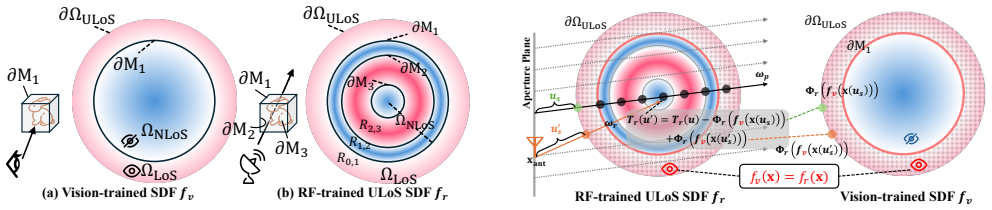
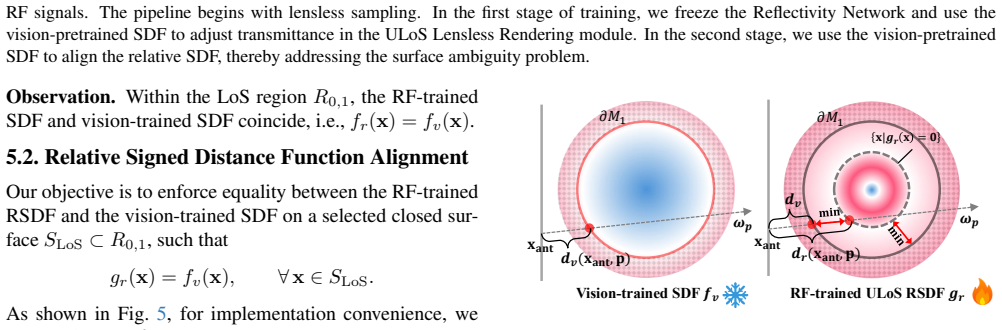
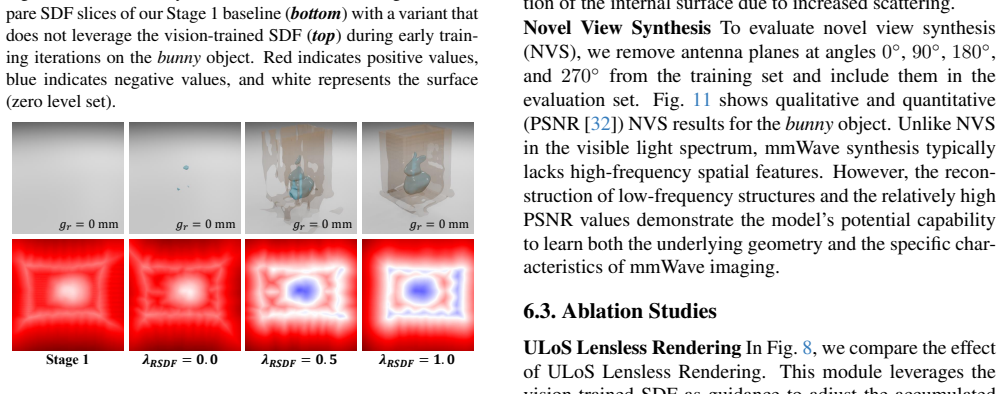
Reconstructing object geometry from radio frequency (RF) signals is fundamentally challenging due to the lensless imaging nature of RF sensing, which leads to low spatial resolution and high noise. Unlike light signals, RF signals can penetrate occlusions and thus capture information about hidden scenes. Existing Non-Line-of-Sight (NLoS) 3D neural reconstruction methods can recover coarse surfaces inside enclosed environments but often suffer from unstable optimization, noisy surface geometry, and surface ambiguity, failing to produce accurate zero-level sets from the signed distance field (SDF). These limitations largely stem from neglecting the role of Line-of-Sight (LoS) geometry outside the enclosed region, which provides valuable physical constraints for modeling signal propagation. In this paper, we introduce a Unified LoS and NLoS neural geometry reconstruction framework GeRaF 2.0 that leverages the outside LoS geometry to model and guide RF propagation from the LoS region into the NLoS region. By integrating visual LoS priors into the neural field formulation, GeRaF 2.0 achieves stable training and physically consistent reconstruction of both visible and hidden geometry, setting a new state-of-the-art in RF-based geometry reconstruction.
Editorial analysis
A structured set of objections, weighed in public.
Referee Report
Summary. The paper introduces GeRaF 2.0, a unified LoS and NLoS neural geometry reconstruction framework for recovering 3D object geometry from RF signals. It claims that integrating visual Line-of-Sight (LoS) priors into the neural field formulation models and guides RF propagation, yielding stable training, physically consistent reconstruction of visible and hidden geometry, and new state-of-the-art performance in RF-based 3D reconstruction by resolving surface ambiguity in the signed distance field (SDF).
Significance. If the integration of LoS priors demonstrably supplies the claimed physical constraints and produces accurate SDF zero-level sets, the work could advance RF-based non-line-of-sight imaging by combining modalities to handle occlusions. This would be relevant for applications requiring penetration through barriers, provided the method generalizes beyond idealized conditions.
major comments (2)
- [Abstract] Abstract: the central claim that integrating visual LoS priors 'models and guides RF propagation' and yields 'physically consistent reconstruction' is unsupported because the abstract (and by extension the manuscript) supplies no equations, loss formulation, or derivation showing how the prior enters the neural SDF or constrains the zero-level set. This is load-bearing for the claim of resolving surface ambiguity.
- [Abstract] Abstract and implied methods: the assumption that outside LoS geometry is accurately known and supplies physical constraints is load-bearing, yet no ablation, sensitivity analysis, or error propagation study addresses realistic measurement error in the visual LoS prior. If even modest geometric error is present, the claimed constraints on RF propagation would be violated, leaving NLoS ambiguity unresolved.
Simulated Author's Rebuttal
We thank the referee for the constructive comments on the abstract and the role of LoS priors. We address each point below. Where the manuscript requires clarification or additional analysis, we will revise accordingly.
read point-by-point responses
-
Referee: [Abstract] Abstract: the central claim that integrating visual LoS priors 'models and guides RF propagation' and yields 'physically consistent reconstruction' is unsupported because the abstract (and by extension the manuscript) supplies no equations, loss formulation, or derivation showing how the prior enters the neural SDF or constrains the zero-level set. This is load-bearing for the claim of resolving surface ambiguity.
Authors: The abstract is intentionally concise and omits equations. Section 3 of the manuscript presents the unified neural SDF formulation, in which the visual LoS geometry is incorporated as a boundary condition that defines the entry points for RF propagation into the NLoS region. This enters the optimization through an additional term in the loss that penalizes SDF values inconsistent with the expected travel times and attenuation derived from the LoS-to-NLoS interface. The zero-level set is thereby constrained to surfaces that satisfy both the RF measurements and the known propagation geometry. We will add a one-sentence pointer to this formulation in the revised abstract. revision: partial
-
Referee: [Abstract] Abstract and implied methods: the assumption that outside LoS geometry is accurately known and supplies physical constraints is load-bearing, yet no ablation, sensitivity analysis, or error propagation study addresses realistic measurement error in the visual LoS prior. If even modest geometric error is present, the claimed constraints on RF propagation would be violated, leaving NLoS ambiguity unresolved.
Authors: The current experiments assume noise-free visual LoS geometry obtained from standard depth sensors. No dedicated sensitivity study on LoS measurement error appears in the manuscript. This is a substantive limitation of the presented evaluation. We will add an ablation that injects controlled geometric noise into the LoS prior and reports the resulting degradation in NLoS zero-level set accuracy. revision: yes
Circularity Check
No circularity; derivation introduces integration of external priors without self-referential reduction
full rationale
The paper's abstract and description present GeRaF 2.0 as a new framework that integrates known visual LoS geometry as a prior into a neural SDF formulation to guide RF propagation modeling for NLoS reconstruction. No equations, fitted parameters renamed as predictions, self-citations as load-bearing uniqueness theorems, or ansatzes smuggled via prior work are quoted or exhibited that would make the output equivalent to the input by construction. The central step is an empirical integration whose physical consistency is claimed to arise from the added prior, not from tautological redefinition of terms. This is the common case of a self-contained proposal whose independence cannot be reduced without further equations.
Axiom & Free-Parameter Ledger
axioms (1)
- domain assumption Outside LoS geometry provides valuable physical constraints for modeling RF signal propagation from LoS into NLoS regions.
Reference graph
Works this paper leans on
-
[1]
See through walls with wifi! In SIGCOMM, 2013
Fadel Adib and Dina Katabi. See through walls with wifi! In SIGCOMM, 2013. 1
2013
-
[2]
Multi- sensor depth fusion framework for real-time 3d reconstruc- tion.Ieee Access, 7:136471–136480, 2019
Muhammad Kashif Ali, Asif Rajput, Muhammad Shahzad, Farhan Khan, Faheem Akhtar, and Anko B ¨orner. Multi- sensor depth fusion framework for real-time 3d reconstruc- tion.Ieee Access, 7:136471–136480, 2019. 3
2019
-
[3]
Fast fourier methods for synthetic aperture radar imaging
Fredrik Andersson, Randolph Moses, and Frank Natterer. Fast fourier methods for synthetic aperture radar imaging. IEEE Transactions on Aerospace and Electronic Systems,
-
[4]
Multi-view 3d surface reconstruction from sar images by inverse rendering, 2025
Emile Barbier-Renard, Florence Tupin, Nicolas Trouv ´e, and Lo¨ıc Denis. Multi-view 3d surface reconstruction from sar images by inverse rendering, 2025. 2
2025
-
[5]
Radar fields: Frequency-space neural scene represen- tations for fmcw radar
David Borts, Erich Liang, Tim Broedermann, Andrea Ra- mazzina, Stefanie Walz, Edoardo Palladin, Jipeng Sun, David Brueggemann, Christos Sakaridis, Luc Van Gool, et al. Radar fields: Frequency-space neural scene represen- tations for fmcw radar. InSIGGRAPH, 2024. 1, 2
2024
-
[6]
Nerd: Neural reflectance decomposition from image collections
Mark Boss, Raphael Braun, Varun Jampani, Jonathan T Bar- ron, Ce Liu, and Hendrik Lensch. Nerd: Neural reflectance decomposition from image collections. InICCV, 2021. 2
2021
-
[7]
Anjun Chen, Xiangyu Wang, Kun Shi, Yuchi Huo, Jiming Chen, and Qi Ye. Towards weather-robust 3d human body reconstruction: Millimeter-wave radar-based dataset, bench- mark, and multi-modal fusion.IEEE Transactions on Cir- cuits and Systems for Video Technology, 2024. 3
2024
-
[8]
Radarsim: Simulating single-chip radar via multimodal neural fields
Chuhan Chen, Tianshu Huang, Akarsh Prabhakara, Chaithanya Kumar Mummadi, Zhongxiao Cong, Anthony Rowe, Matthew O’Toole, and Deva Ramanan. Radarsim: Simulating single-chip radar via multimodal neural fields. InThirteenth International Conference on 3D Vision. 3
-
[9]
Neusg: Neural im- plicit surface reconstruction with 3d gaussian splatting guid- ance.arXiv preprint, 2023
Hanlin Chen, Chen Li, and Gim Hee Lee. Neusg: Neural im- plicit surface reconstruction with 3d gaussian splatting guid- ance.arXiv preprint, 2023. 2
2023
-
[10]
MMDetection3D: Open- MMLab next-generation platform for general 3D object detection.https://github.com/open- mmlab/ mmdetection3d, 2020
MMDetection3D Contributors. MMDetection3D: Open- MMLab next-generation platform for general 3D object detection.https://github.com/open- mmlab/ mmdetection3d, 2020. 7
2020
-
[11]
Liquid: A wireless liquid identifier
Ashutosh Dhekne, Mahanth Gowda, Yixuan Zhao, Haitham Hassanieh, and Romit Roy Choudhury. Liquid: A wireless liquid identifier. InProceedings of the 16th annual interna- tional conference on mobile systems, applications, and ser- vices, pages 442–454, 2018. 2
2018
-
[12]
Non-line-of-sight 3d object reconstruction via mmwave surface normal estimation
Laura Dodds, Tara Boroushaki, Kaichen Zhou, and Fadel Adib. Non-line-of-sight 3d object reconstruction via mmwave surface normal estimation. InMobiCom, 2025. 2, 5
2025
-
[13]
Toward 3d reconstruc- tion of outdoor scenes using an mmw radar and a monocular vision sensor.Sensors, 15(10):25937–25967, 2015
Ghina El Natour, Omar Ait-Aider, Raphael Rouveure, Franc ¸ois Berry, and Patrice Faure. Toward 3d reconstruc- tion of outdoor scenes using an mmw radar and a monocular vision sensor.Sensors, 15(10):25937–25967, 2015. 3
2015
-
[14]
Relightable 3d gaussians: Re- alistic point cloud relighting with brdf decomposition and ray tracing
Jian Gao, Chun Gu, Youtian Lin, Zhihao Li, Hao Zhu, Xun Cao, Li Zhang, and Yao Yao. Relightable 3d gaussians: Re- alistic point cloud relighting with brdf decomposition and ray tracing. InECCV, 2024. 2
2024
-
[15]
Implicit geometric regularization for learning shapes.arXiv preprint arXiv:2002.10099,
Amos Gropp, Lior Yariv, Niv Haim, Matan Atzmon, and Yaron Lipman. Implicit geometric regularization for learning shapes.arXiv preprint arXiv:2002.10099, 2020. 7
-
[16]
Irgs: Inter-reflective gaussian splatting with 2d gaus- sian ray tracing
Chun Gu, Xiaofei Wei, Zixuan Zeng, Yuxuan Yao, and Li Zhang. Irgs: Inter-reflective gaussian splatting with 2d gaus- sian ray tracing. InCVPR, 2025. 2
2025
-
[17]
Through fog high-resolution imag- ing using millimeter wave radar
Junfeng Guan, Sohrab Madani, Suraj Jog, Saurabh Gupta, and Haitham Hassanieh. Through fog high-resolution imag- ing using millimeter wave radar. InCVPR, 2020. 2
2020
-
[18]
2d gaussian splatting for geometrically ac- curate radiance fields
Binbin Huang, Zehao Yu, Anpei Chen, Andreas Geiger, and Shenghua Gao. 2d gaussian splatting for geometrically ac- curate radiance fields. InSIGGRAPH, 2024. 2
2024
-
[19]
Dart: Im- plicit doppler tomography for radar novel view synthesis
Tianshu Huang, John Miller, Akarsh Prabhakara, Tao Jin, Tarana Laroia, Zico Kolter, and Anthony Rowe. Dart: Im- plicit doppler tomography for radar novel view synthesis. In CVPR, 2024. 1, 2
2024
-
[20]
3d object reconstruction with mmwave radars.arXiv preprint arXiv:2504.12348,
Samah Hussein, Junfeng Guan, Swathi Narashiman, Saurabh Gupta, and Haitham Hassanieh. 3d object reconstruction with mmwave radars.arXiv preprint arXiv:2504.12348,
-
[21]
Gaussianshader: 3d gaussian splatting with shading functions for reflective surfaces
Yingwenqi Jiang, Jiadong Tu, Yuan Liu, Xifeng Gao, Xiaox- iao Long, Wenping Wang, and Yuexin Ma. Gaussianshader: 3d gaussian splatting with shading functions for reflective surfaces. InCVPR, 2024. 2
2024
-
[22]
Tensoir: Tensorial inverse rendering
Haian Jin, Isabella Liu, Peijia Xu, Xiaoshuai Zhang, Song- fang Han, Sai Bi, Xiaowei Zhou, Zexiang Xu, and Hao Su. Tensoir: Tensorial inverse rendering. InCVPR, 2023. 2
2023
-
[23]
3d gaussian splatting for real-time radiance field rendering.ACM Transactions on Graphics (TOG), 2023
Bernhard Kerbl, Georgios Kopanas, Thomas Leimk ¨uhler, and George Drettakis. 3d gaussian splatting for real-time radiance field rendering.ACM Transactions on Graphics (TOG), 2023. 2
2023
-
[24]
Radarsplat: Radar gaussian splatting for high-fidelity data synthesis and 3d reconstruc- tion of autonomous driving scenes
Pou-Chun Kung, Skanda Harisha, Ram Vasudevan, Aline Eid, and Katherine A Skinner. Radarsplat: Radar gaussian splatting for high-fidelity data synthesis and 3d reconstruc- tion of autonomous driving scenes. InProceedings of the IEEE/CVF International Conference on Computer Vision, pages 27596–27606, 2025. 1, 2 11
2025
-
[25]
Enabling visual recognition at radio frequency
Haowen Lai, Gaoxiang Luo, Yifei Liu, and Mingmin Zhao. Enabling visual recognition at radio frequency. InMobiCom,
-
[26]
Gs-ir: 3d gaussian splatting for inverse rendering
Zhihao Liang, Qi Zhang, Ying Feng, Ying Shan, and Kui Jia. Gs-ir: 3d gaussian splatting for inverse rendering. InCVPR,
-
[27]
Rcbevdet: Radar-camera fusion in bird’s eye view for 3d object detection
Zhiwei Lin, Zhe Liu, Zhongyu Xia, Xinhao Wang, Yong- tao Wang, Shengxiang Qi, Yang Dong, Nan Dong, Le Zhang, and Ce Zhu. Rcbevdet: Radar-camera fusion in bird’s eye view for 3d object detection. InProceedings of the IEEE/CVF Conference on Computer Vision and Pattern Recognition, pages 14928–14937, 2024. 3
2024
-
[28]
Wave-based non-line-of-sight imaging using fast fk migra- tion.ACM Transactions on Graphics (ToG), 38(4):1–13,
David B Lindell, Gordon Wetzstein, and Matthew O’Toole. Wave-based non-line-of-sight imaging using fast fk migra- tion.ACM Transactions on Graphics (ToG), 38(4):1–13,
-
[29]
Non-line-of-sight imaging using phasor-field virtual wave optics.Nature, 572(7771): 620–623, 2019
Xiaochun Liu, Ib ´on Guill ´en, Marco La Manna, Ji Hyun Nam, Syed Azer Reza, Toan Huu Le, Adrian Jarabo, Diego Gutierrez, and Andreas Velten. Non-line-of-sight imaging using phasor-field virtual wave optics.Nature, 572(7771): 620–623, 2019. 2
2019
-
[30]
Nero: Neural geometry and brdf reconstruction of reflective objects from multiview images.ACM Transactions on Graphics (TOG), 2023
Yuan Liu, Peng Wang, Cheng Lin, Xiaoxiao Long, Jiepeng Wang, Lingjie Liu, Taku Komura, and Wenping Wang. Nero: Neural geometry and brdf reconstruction of reflective objects from multiview images.ACM Transactions on Graphics (TOG), 2023. 2
2023
-
[31]
Geraf: Neural geometry reconstruction from radio frequency signals
Jiachen Lu, Hailan Shanbhag, and Haitham Hassanieh. Geraf: Neural geometry reconstruction from radio frequency signals. InNeurIPS, 2025. 1, 2, 3, 6, 7, 8, 15
2025
-
[32]
Nerf: Representing scenes as neural radiance fields for view syn- thesis.Communications of the ACM, 2021
Ben Mildenhall, Pratul P Srinivasan, Matthew Tancik, Jonathan T Barron, Ravi Ramamoorthi, and Ren Ng. Nerf: Representing scenes as neural radiance fields for view syn- thesis.Communications of the ACM, 2021. 2, 9
2021
-
[33]
Instant neural graphics primitives with a mul- tiresolution hash encoding.ACM Transactions on Graphics (TOG), 2022
Thomas M ¨uller, Alex Evans, Christoph Schied, and Alexan- der Keller. Instant neural graphics primitives with a mul- tiresolution hash encoding.ACM Transactions on Graphics (TOG), 2022. 4
2022
-
[34]
Extracting triangular 3d models, materials, and lighting from images
Jacob Munkberg, Jon Hasselgren, Tianchang Shen, Jun Gao, Wenzheng Chen, Alex Evans, Thomas M¨uller, and Sanja Fi- dler. Extracting triangular 3d models, materials, and lighting from images. InCVPR, 2022. 2
2022
-
[35]
Differentiable volumetric rendering: Learn- ing implicit 3d representations without 3d supervision
Michael Niemeyer, Lars Mescheder, Michael Oechsle, and Andreas Geiger. Differentiable volumetric rendering: Learn- ing implicit 3d representations without 3d supervision. In CVPR, 2020. 2
2020
-
[36]
Confocal non-line-of-sight imaging based on the light-cone transform.Nature, 555(7696):338–341, 2018
Matthew O’Toole, David B Lindell, and Gordon Wetzstein. Confocal non-line-of-sight imaging based on the light-cone transform.Nature, 555(7696):338–341, 2018. 2
2018
-
[37]
Principles of modern radar
Mark A Richards, Jim Scheer, William A Holm, and William L Melvin. Principles of modern radar. 2010. 3, 14
2010
-
[38]
Nerv: Neural reflectance and visibility fields for relighting and view synthesis
Pratul P Srinivasan, Boyang Deng, Xiuming Zhang, Matthew Tancik, Ben Mildenhall, and Jonathan T Barron. Nerv: Neural reflectance and visibility fields for relighting and view synthesis. InCVPR, 2021. 2
2021
-
[39]
Electromagnetic signal attenuation in con- struction materials
William C Stone. Electromagnetic signal attenuation in con- struction materials. 1997. 2
1997
-
[40]
3drimr: 3d reconstruction and imaging via mmwave radar based on deep learning
Yue Sun, Zhuoming Huang, Honggang Zhang, Zhi Cao, and Deqiang Xu. 3drimr: 3d reconstruction and imaging via mmwave radar based on deep learning. InIEEE Interna- tional Performance, Computing, and Communications Con- ference (IPCCC), 2021. 2
2021
-
[41]
3d reconstruction of multiple objects by mmwave radar on uav
Yue Sun, Zhuoming Huang, Honggang Zhang, and Xiaohui Liang. 3d reconstruction of multiple objects by mmwave radar on uav. In2022 IEEE 19th International Conference on Mobile Ad Hoc and Smart Systems (MASS), 2022
2022
-
[42]
R2p: A deep learning model from mmwave radar to point cloud
Yue Sun, Honggang Zhang, Zhuoming Huang, and Benyuan Liu. R2p: A deep learning model from mmwave radar to point cloud. InInternational Conference on Artificial Neural Networks, 2022. 2
2022
-
[43]
Spinr: Neural volumetric reconstruction for fmcw radars.arXiv preprint,
Harshvardhan Takawale and Nirupam Roy. Spinr: Neural volumetric reconstruction for fmcw radars.arXiv preprint,
-
[44]
Fast 3d reconstruction of space targets from isar image sequences based on neural network
Weiyi Tan, Yu Wang, Biao Tian, and Shiyou Xu. Fast 3d reconstruction of space targets from isar image sequences based on neural network. InIEEE 8th International Con- ference on Vision, Image and Signal Processing (ICVISP),
-
[45]
Texas instrument awr1843.https://www.ti
TI Inc. Texas instrument awr1843.https://www.ti. com/product/AWR1843, 2023. 7
2023
-
[46]
and Niantic, Inc
Toolbox AI, Inc. and Niantic, Inc. Scaniverse: 3d scanner app, 2025. Mobile application for iOS. 7
2025
-
[47]
Recovering three-dimensional shape around a corner using ultrafast time-of-flight imaging.Nature communications, 3 (1):745, 2012
Andreas Velten, Thomas Willwacher, Otkrist Gupta, Ashok Veeraraghavan, Moungi G Bawendi, and Ramesh Raskar. Recovering three-dimensional shape around a corner using ultrafast time-of-flight imaging.Nature communications, 3 (1):745, 2012. 2
2012
-
[48]
Neus: Learning neural implicit surfaces by volume rendering for multi-view reconstruction
Peng Wang, Lingjie Liu, Yuan Liu, Christian Theobalt, Taku Komura, and Wenping Wang. Neus: Learning neural implicit surfaces by volume rendering for multi-view reconstruction. InNeurIPS, 2021. 2, 3, 4, 5, 7, 8
2021
-
[49]
Safe for generations to come: Considerations of safety for millimeter waves in wireless communications.IEEE mi- crowave magazine, 2015
Ting Wu, Theodore S Rappaport, and Christopher M Collins. Safe for generations to come: Considerations of safety for millimeter waves in wireless communications.IEEE mi- crowave magazine, 2015. 1
2015
-
[50]
Zizhang Wu, Guilian Chen, Yuanzhu Gan, Lei Wang, and Jian Pu. Mvfusion: Multi-view 3d object detection with semantic-aligned radar and camera fusion.arXiv preprint arXiv:2302.10511, 2023. 3
-
[51]
Zfusion: An effective fuser of camera and 4d radar for 3d object perception in autonomous driving
Sheng Yang, Tong Zhan, Shichen Qiao, Jicheng Gong, Qing Yang, Jian Wang, and Yanfeng Lu. Zfusion: An effective fuser of camera and 4d radar for 3d object perception in autonomous driving. InProceedings of the Computer Vi- sion and Pattern Recognition Conference, pages 3768–3777,
-
[52]
Near-field 2-d sar imaging by millimeter-wave radar for concealed item detec- tion
Muhammet Emin Yanik and Murat Torlak. Near-field 2-d sar imaging by millimeter-wave radar for concealed item detec- tion. In2019 IEEE radio and Wireless Symposium (RWS),
-
[53]
Neilf: Neural incident light field for physically-based ma- terial estimation
Yao Yao, Jingyang Zhang, Jingbo Liu, Yihang Qu, Tian Fang, David McKinnon, Yanghai Tsin, and Long Quan. Neilf: Neural incident light field for physically-based ma- terial estimation. InECCV, 2022. 2
2022
-
[54]
Reflective gaussian splatting
Yuxuan Yao, Zixuan Zeng, Chun Gu, Xiatian Zhu, and Li Zhang. Reflective gaussian splatting. InICLR, 2025. 2 12
2025
-
[55]
Multiview neu- ral surface reconstruction by disentangling geometry and ap- pearance
Lior Yariv, Yoni Kasten, Dror Moran, Meirav Galun, Matan Atzmon, Basri Ronen, and Yaron Lipman. Multiview neu- ral surface reconstruction by disentangling geometry and ap- pearance. InNeurIPS, 2020. 2
2020
-
[56]
V ol- ume rendering of neural implicit surfaces
Lior Yariv, Jiatao Gu, Yoni Kasten, and Yaron Lipman. V ol- ume rendering of neural implicit surfaces. InNeurIPS, 2021. 2
2021
-
[57]
Sparsefusion3d: Sparse sensor fusion for 3d object detection by radar and camera in environmental per- ception.IEEE Transactions on Intelligent Vehicles, 9(1): 1524–1536, 2023
Zedong Yu, Weibing Wan, Maiyu Ren, Xiuyuan Zheng, and Zhijun Fang. Sparsefusion3d: Sparse sensor fusion for 3d object detection by radar and camera in environmental per- ception.IEEE Transactions on Intelligent Vehicles, 9(1): 1524–1536, 2023. 3
2023
-
[58]
Bodycompass: Monitoring sleep posture with wireless signals.Proceedings of the ACM on Interactive, Mobile, Wearable and Ubiquitous Technologies, 4(2):1–25,
Shichao Yue, Yuzhe Yang, Hao Wang, Hariharan Rahul, and Dina Katabi. Bodycompass: Monitoring sleep posture with wireless signals.Proceedings of the ACM on Interactive, Mobile, Wearable and Ubiquitous Technologies, 4(2):1–25,
-
[59]
Jiarui Zhang, Zhihao Li, Chong Wang, and Bihan Wen. Rf4d: Neural radar fields for novel view synthesis in outdoor dynamic scenes.arXiv preprint arXiv:2505.20967, 2025. 1, 2 A. Additional Experiments A.1. Additional RSDF Alignment Ablation In Fig. 12, we present additional ablation studies on RSDF alignment by comparing SDF slices for different objects. Wi...
discussion (0)
Sign in with ORCID, Apple, or X to comment. Anyone can read and Pith papers without signing in.