Visible inelasticity as a probe of tau flavor content of astrophysical neutrinos
Pith reviewed 2026-06-29 10:47 UTC · model grok-4.3
The pith
Visible inelasticity of starting tracks in neutrino telescopes statistically separates tau neutrinos from muon neutrinos.
A machine-rendered reading of the paper's core claim, the machinery that carries it, and where it could break.
Core claim
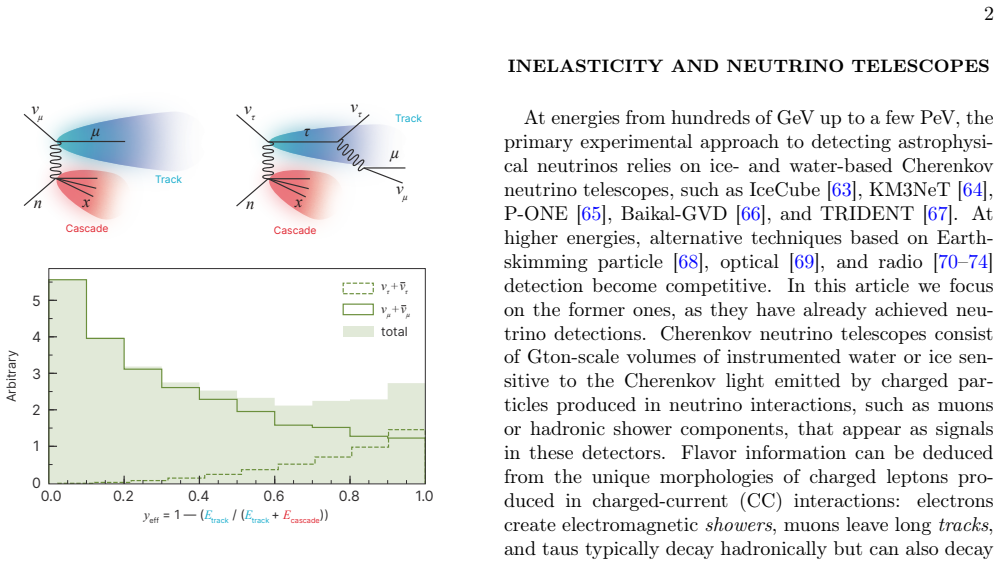
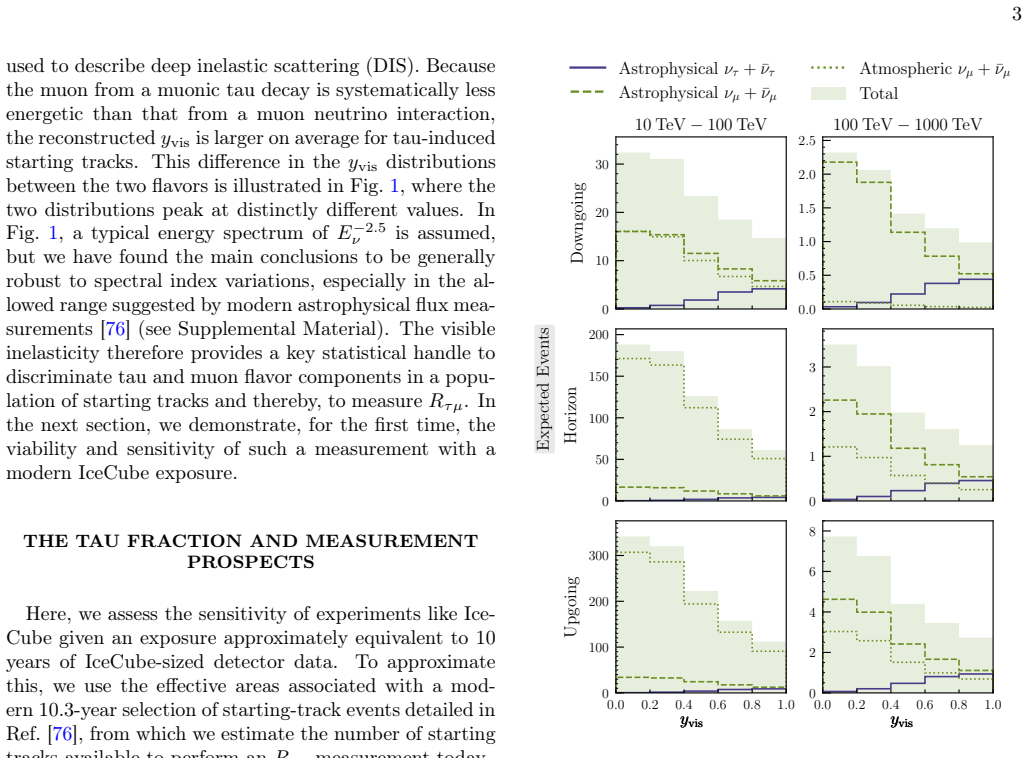
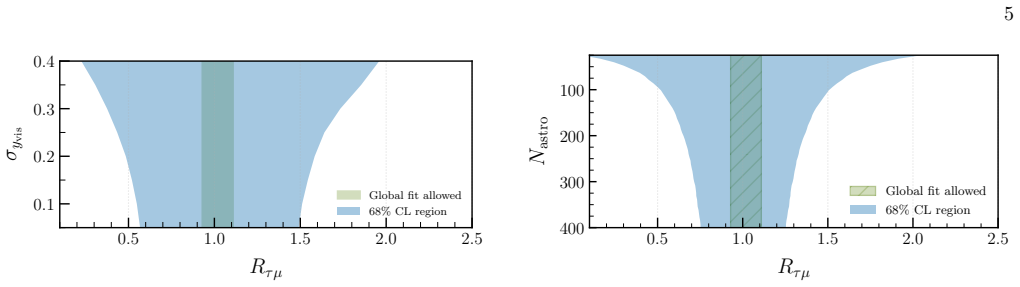
Muonic decays of tau leptons produce tracks with systematically larger visible inelasticity than those from muon neutrino charged-current interactions, potentially enabling statistical separation of the two flavors; using realistic IceCube exposures and detector performance, this observable already yields competitive sensitivity to the tau-to-muon flux ratio R_τμ achievable with existing data.
What carries the argument
The systematic difference in visible inelasticity between muonic tau lepton decays and direct muon neutrino interactions in starting track events.
If this is right
- Competitive sensitivity to R_τμ already reachable with current IceCube exposures and performance.
- Flavor composition measurements become possible for individual astrophysical neutrino sources.
- Tau-enhanced source catalogs can be selected using the inelasticity observable.
- The method provides a probe of potential physics beyond standard neutrino mixing via flavor ratios.
- It serves as an immediately accessible complement to rare double-cascade signatures.
Where Pith is reading between the lines
- Reanalysis of archival IceCube starting-track samples could yield an early tau-flavor constraint without new data taking.
- The inelasticity separation might be combined with other observables to tighten overall flavor ratio bounds.
- If the separation persists, similar techniques could be tested at next-generation neutrino telescopes with improved track reconstruction.
- Source-by-source application could reveal whether any known neutrino emitters show anomalous tau content.
Load-bearing premise
Detector response simulations accurately capture the difference in visible inelasticity between tau muonic decays and muon neutrino interactions without significant bias.
What would settle it
IceCube data or updated simulations showing no measurable difference in the visible inelasticity distributions for the two event classes after accounting for backgrounds and systematics.
Figures

read the original abstract
Astrophysical neutrinos provide a unique probe of neutrino flavor changes over cosmological baselines. While the tau component of the neutrino flux is expected to arise almost entirely from mixing, current measurements rely primarily on rare double-cascade signatures. We investigate a complementary method to measure the tau fraction using the visible inelasticity of starting track events in neutrino telescopes. Muonic decays of tau leptons produce tracks with systematically larger visible inelasticity than those from muon neutrino interactions, potentially enabling statistical separation of the two flavors. Using realistic IceCube exposures and detector performance, we show that this observable already yields competitive sensitivity to the tau-to-muon flux ratio, $R_{\tau\mu}$, achievable with existing data. This approach may further enable flavor measurements of individual sources and the selection of tau-enhanced source catalogs. Starting-track inelasticity thus provides a powerful and immediately accessible probe of astrophysical neutrino flavor and of potential physics beyond standard neutrino mixing.
Editorial analysis
A structured set of objections, weighed in public.
Referee Report
Summary. The paper proposes using the visible inelasticity distribution of starting-track events in IceCube to statistically separate the tau-neutrino component from the muon-neutrino component of the astrophysical flux. It argues that muonic tau decays produce tracks with systematically higher visible inelasticity than direct u_ u CC interactions, and claims that realistic IceCube exposures already yield competitive sensitivity to the flux ratio R_ au u.
Significance. If the simulated inelasticity separation is shown to be robust against detector-response systematics, the method would provide a complementary, high-statistics handle on astrophysical neutrino flavor that does not rely on the rare double-cascade topology. This could enable source-by-source flavor measurements and tests of standard mixing over cosmological baselines.
major comments (2)
- [§3] §3: The central claim that muonic tau-decay tracks exhibit systematically larger visible inelasticity than u_ u CC tracks rests entirely on Monte Carlo distributions; the manuscript provides no data-driven validation or quantitative estimate of bias from hadronic-shower modeling, muon energy-loss parametrization, or starting-track selection cuts.
- [§4] §4: The assertion of “competitive sensitivity … achievable with existing data” is presented without tabulated statistical power, systematic-error budget, or the precise exposure and effective-area values used in the calculation, so the reader cannot assess whether modest degradation of the separation power would render the result marginal rather than competitive.
minor comments (2)
- [Abstract] Abstract: the quantitative claim of competitive sensitivity is stated without any numerical result or uncertainty; a single sentence summarizing the expected precision on R_ au u would improve clarity.
- Notation: the symbol R_ au u is introduced without an explicit definition in terms of the individual flavor fluxes; adding the definition near first use would aid readability.
Simulated Author's Rebuttal
We thank the referee for their thoughtful review and positive evaluation of the significance of our proposed method. We respond to the major comments point by point below.
read point-by-point responses
-
Referee: [§3] §3: The central claim that muonic tau-decay tracks exhibit systematically larger visible inelasticity than ν_μ CC tracks rests entirely on Monte Carlo distributions; the manuscript provides no data-driven validation or quantitative estimate of bias from hadronic-shower modeling, muon energy-loss parametrization, or starting-track selection cuts.
Authors: We agree that the analysis is simulation-based, as is common for such proposed methods given the current statistics. The separation arises from well-understood kinematics: in ν_τ CC interactions followed by muonic τ decay, the visible track energy includes the hadronic shower plus a muon from the decay, leading to higher inelasticity y_vis compared to ν_μ CC where the muon carries most of the energy. To address the concern, we will revise the manuscript to include quantitative estimates of systematic biases. Specifically, we will vary hadronic shower models (e.g., using different generators) and muon energy loss parameters within their uncertainties and report the impact on the separation significance. While a full data-driven validation is limited by the small number of astrophysical starting-track events, we will compare the MC to atmospheric neutrino data in the relevant energy range to validate the modeling. This will be added in a new subsection in §3. revision: partial
-
Referee: [§4] §4: The assertion of “competitive sensitivity … achievable with existing data” is presented without tabulated statistical power, systematic-error budget, or the precise exposure and effective-area values used in the calculation, so the reader cannot assess whether modest degradation of the separation power would render the result marginal rather than competitive.
Authors: We acknowledge that additional details would improve clarity. In the revised version, we will add a dedicated table summarizing the statistical power (e.g., expected significance for R_τμ =1), the systematic error budget (including contributions from flux normalization, detector systematics, and modeling uncertainties), and the precise exposure assumptions (e.g., livetime, effective area as function of energy). This will allow readers to evaluate the competitiveness under various scenarios. The calculations are based on 10 years of IceCube data with standard effective areas for starting tracks. revision: yes
Circularity Check
No significant circularity; sensitivity estimate uses independent Monte Carlo modeling of interaction physics
full rationale
The paper derives its sensitivity claim from Monte Carlo simulations of visible inelasticity distributions for tau muonic decays versus nu_mu CC interactions, using standard IceCube detector response modeling. This is an external input based on known particle physics and detector simulation, not a fit to the target R_tau_mu or a self-referential definition. No equations reduce the claimed separation power to a fitted parameter by construction, and no load-bearing self-citations or ansatze are present in the abstract or described sections. The derivation chain remains self-contained against external benchmarks.
Axiom & Free-Parameter Ledger
axioms (2)
- standard math Standard three-flavor neutrino mixing and tau lepton decay properties hold over astrophysical baselines
- domain assumption IceCube detector response simulations accurately reproduce visible inelasticity distributions for track events
Reference graph
Works this paper leans on
-
[1]
M. G. Aartsenet al.(IceCube Collaboration), Evidence for high-energy extraterrestrial neutrinos at the IceCube detector, Science342, 1242856 (2013), arXiv:1311.5238 [astro-ph.HE]
work page internal anchor Pith review Pith/arXiv arXiv 2013
-
[2]
J. G. Learned and S. Pakvasa, Detecting tau-neutrino os- cillations at PeV energies, Astropart. Phys.3, 267 (1995), arXiv:hep-ph/9405296
work page internal anchor Pith review Pith/arXiv arXiv 1995
-
[3]
Probing Particle Physics with IceCube
M. Ahlers, K. Helbing, and C. Pérez de los Heros, Prob- ing particle physics with IceCube, Eur. Phys. J. C78, 924 (2018), arXiv:1806.05696 [astro-ph.HE]
work page internal anchor Pith review Pith/arXiv arXiv 2018
-
[4]
Fundamental Physics with High-Energy Cosmic Neutrinos
M. Ackermannet al., Fundamental physics with high- energy cosmic neutrinos, Bull. Am. Astron. Soc.51, 215 (2019), arXiv:1903.04333 [astro-ph.HE]
work page internal anchor Pith review Pith/arXiv arXiv 2019
-
[5]
C. A. Argüelles, M. Bustamante, A. Kheirandish, S. Palomares-Ruiz, J. Salvado, and A. C. Vincent, Fun- damental physics with high-energy cosmic neutrinos to- day and in the future, PoSICRC2019, 849 (2020), arXiv:1907.08690 [astro-ph.HE]
work page internal anchor Pith review Pith/arXiv arXiv 2020
-
[6]
O. Mena, S. Palomares-Ruiz, and A. C. Vincent, Fla- vor composition of the high-energy neutrino events in IceCube, Phys. Rev. Lett.113, 091103 (2014), arXiv:1404.0017 [astro-ph.HE]
work page internal anchor Pith review Pith/arXiv arXiv 2014
-
[7]
The spectrum and flavor composition of the astrophysical neutrinos in IceCube
A. Watanabe, The spectrum and flavor composition of the astrophysical neutrinos in IceCube, JCAP08, 030, arXiv:1412.8264 [astro-ph.HE]
work page internal anchor Pith review Pith/arXiv arXiv
-
[8]
Spectral analysis of the high-energy IceCube neutrinos
S. Palomares-Ruiz, A. C. Vincent, and O. Mena, Spectral analysisofthehigh-energyIceCubeneutrinos,Phys.Rev. D91, 103008 (2015), arXiv:1502.02649 [astro-ph.HE]
work page internal anchor Pith review Pith/arXiv arXiv 2015
-
[9]
Which is the flavor of cosmic neutrinos seen by IceCube?
A. Palladino, G. Pagliaroli, F. L. Villante, and F. Vis- sani, What is the flavor of the cosmic neutrinos seen by IceCube?, Phys. Rev. Lett.114, 171101 (2015), arXiv:1502.02923 [astro-ph.HE]
work page internal anchor Pith review Pith/arXiv arXiv 2015
-
[10]
M. G. Aartsenet al.(IceCube Collaboration), Flavor ra- tio of astrophysical neutrinos above 35 TeV in IceCube, Phys. Rev. Lett.114, 171102 (2015), arXiv:1502.03376 [astro-ph.HE]
work page internal anchor Pith review Pith/arXiv arXiv 2015
-
[11]
M. G. Aartsenet al.(IceCube Collaboration), A com- binedmaximum-likelihoodanalysisofthehigh-energyas- trophysical neutrino flux measured with IceCube, Astro- phys. J.809, 98 (2015), arXiv:1507.03991 [astro-ph.HE]
work page internal anchor Pith review Pith/arXiv arXiv 2015
-
[12]
Mammen Abrahamet al., Tau neutrinos in the next decade: from GeV to EeV, J
R. Mammen Abrahamet al., Tau neutrinos in the next decade: from GeV to EeV, J. Phys. G49, 110501 (2022), arXiv:2203.05591 [hep-ph]
-
[13]
Prospects for observations of high-energy cosmic tau neutrinos
H. Athar, G. Parente, and E. Zas, Prospects for observa- tions of high-energy cosmic tau neutrinos, Phys. Rev. D 62, 093010 (2000), arXiv:hep-ph/0006123
work page internal anchor Pith review Pith/arXiv arXiv 2000
-
[14]
P. F. de Salas, D. V. Forero, S. Gariazzo, P. Martínez- Miravé, O. Mena, C. A. Ternes, M. Tórtola, and J. W. F. Valle, 2020 global reassessment of the neutrino oscillation picture, JHEP02, 071, arXiv:2006.11237 [hep-ph]
work page internal anchor Pith review Pith/arXiv arXiv 2020
-
[15]
NuFit-6.0: Updated global analysis of three-flavor neutrino oscillations
I. Esteban, M. C. Gonzalez-Garcia, M. Maltoni, I. Martinez-Soler, J. P. Pinheiro, and T. Schwetz, NuFit- 6.0: updated global analysis of three-flavor neutrino os- cillations, JHEP12, 216, arXiv:2410.05380 [hep-ph]
work page internal anchor Pith review Pith/arXiv arXiv
-
[16]
F. Capozzi, W. Giarè, E. Lisi, A. Marrone, A. Melchiorri, and A. Palazzo, Neutrino masses and mixing: Entering theeraofsubpercentprecision,Phys.Rev.D111,093006 (2025), arXiv:2503.07752 [hep-ph]
-
[17]
Flavor Composition and Energy Spectrum of Astrophysical Neutrinos
P. Lipari, M. Lusignoli, and D. Meloni, Flavor compo- sition and energy spectrum of astrophysical neutrinos, Phys. Rev. D75, 123005 (2007), arXiv:0704.0718 [astro- ph]
work page internal anchor Pith review Pith/arXiv arXiv 2007
-
[18]
Theoretically palatable flavor combinations of astrophysical neutrinos
M. Bustamante, J. F. Beacom, and W. Winter, The- oretically palatable flavor combinations of astrophys- ical neutrinos, Phys. Rev. Lett.115, 161302 (2015), arXiv:1506.02645 [astro-ph.HE]
work page internal anchor Pith review Pith/arXiv arXiv 2015
-
[19]
Ultra-high neutrino fluxes as a probe for non-standard physics
A. Bhattacharya, S. Choubey, R. Gandhi, and A. Watan- abe, Ultra-high neutrino fluxes as a probe for non- standard physics, JCAP09, 009, arXiv:1006.3082 [hep- ph]
work page internal anchor Pith review Pith/arXiv arXiv
-
[20]
C. A. Argüelles, T. Katori, and J. Salvado, New physics in astrophysical neutrino flavor, Phys. Rev. Lett.115, 161303 (2015), arXiv:1506.02043 [hep-ph]
work page internal anchor Pith review Pith/arXiv arXiv 2015
-
[21]
I. M. Shoemaker and K. Murase, Probing BSM neutrino physics with flavor and spectral distortions: prospects for future high-energy neutrino telescopes, Phys. Rev. D93, 085004 (2016), arXiv:1512.07228 [astro-ph.HE]
work page internal anchor Pith review Pith/arXiv arXiv 2016
- [22]
- [23]
- [24]
- [25]
-
[26]
Testing neutrino flavor mixing plus decay with neutrino telescopes
M. Maltoni and W. Winter, Testing neutrino oscilla- tions plus decay with neutrino telescopes, JHEP07, 064, arXiv:0803.2050 [hep-ph]
work page internal anchor Pith review Pith/arXiv arXiv 2050
-
[27]
Neutrino Decays over Cosmological Distances and the Implications for Neutrino Telescopes
P. Baerwald, M. Bustamante, and W. Winter, Neutrino decays over cosmological distances and the implications for neutrino telescopes, JCAP10, 020, arXiv:1208.4600 [astro-ph.CO]
work page internal anchor Pith review Pith/arXiv arXiv
-
[28]
Testing decay of astrophysical neutrinos with incomplete information
M. Bustamante, J. F. Beacom, and K. Murase, Testing decay of astrophysical neutrinos with incom- plete information, Phys. Rev. D95, 063013 (2017), arXiv:1610.02096 [astro-ph.HE]
work page internal anchor Pith review Pith/arXiv arXiv 2017
-
[29]
A. Abdullahi and P. B. Denton, Visible decay of astro- physical neutrinos at IceCube, Phys. Rev. D102, 023018 (2020), arXiv:2005.07200 [hep-ph]
- [30]
-
[31]
J. F. Beacom, N. F. Bell, D. Hooper, J. G. Learned, S. Pakvasa, and T. J. Weiler, PseudoDirac neutrinos: a challenge for neutrino telescopes, Phys. Rev. Lett.92, 011101 (2004), arXiv:hep-ph/0307151
work page internal anchor Pith review Pith/arXiv arXiv 2004
-
[32]
Pseudo-Dirac Neutrino Scenario: Cosmic Neutrinos at Neutrino Telescopes
A. Esmaili, Pseudo-Dirac neutrino scenario: cosmic neu- trinos at neutrino telescopes, Phys. Rev. D81, 013006 (2010), arXiv:0909.5410 [hep-ph]
work page internal anchor Pith review Pith/arXiv arXiv 2010
-
[33]
K. Carloni, I. Martínez-Soler, C. A. Arguelles, K. S. Babu, and P. S. B. Dev, Probing pseudo-Dirac neutri- nos with astrophysical sources at IceCube, Phys. Rev. D 109, L051702 (2024), arXiv:2212.00737 [astro-ph.HE]
-
[34]
Non-standard interaction effects on astrophysical neutrino fluxes
M. Blennow and D. Meloni, Non-standard interaction ef- fects on astrophysical neutrino fluxes, Phys. Rev. D80, 065009 (2009), arXiv:0901.2110 [hep-ph]
work page internal anchor Pith review Pith/arXiv arXiv 2009
-
[35]
M. C. Gonzalez-Garcia, M. Maltoni, I. Martinez-Soler, and N. Song, Non-standard neutrino interactions in the Earth and the flavor of astrophysical neutrinos, As- tropart. Phys.84, 15 (2016), arXiv:1605.08055 [hep-ph]
work page internal anchor Pith review Pith/arXiv arXiv 2016
-
[36]
P. F. de Salas, R. A. Lineros, and M. Tórtola, Neutrino propagation in the galactic dark matter halo, Phys. Rev. D94, 123001 (2016), arXiv:1601.05798 [astro-ph.HE]
work page internal anchor Pith review Pith/arXiv arXiv 2016
-
[37]
Flavor of cosmic neutrinos preserved by ultralight dark matter
Y. Farzan and S. Palomares-Ruiz, Flavor of cosmic neu- trinos preserved by ultralight dark matter, Phys. Rev. D 99, 051702 (2019), arXiv:1810.00892 [hep-ph]
work page internal anchor Pith review Pith/arXiv arXiv 2019
- [38]
-
[39]
C. A. Argüelles, K. Farrag, and T. Katori, Ultra-light dark matter limits from astrophysical neutrino flavour, PoSICRC2023, 1415 (2023)
2023
-
[40]
P. Q. Hung and H. Pas, Cosmo MSW effect for mass varying neutrinos, Mod. Phys. Lett. A20, 1209 (2005), arXiv:astro-ph/0311131
work page internal anchor Pith review Pith/arXiv arXiv 2005
-
[41]
S. Ando, M. Kamionkowski, and I. Mocioiu, Neutrino oscillations, Lorentz/CPT violation, and dark energy, Phys. Rev. D80, 123522 (2009), arXiv:0910.4391 [hep- ph]
work page internal anchor Pith review Pith/arXiv arXiv 2009
-
[42]
Effects of a neutrino-dark energy coupling on oscillations of high-energy neutrinos
N. Klop and S. Ando, Effects of a neutrino-dark energy coupling on oscillations of high-energy neutrinos, Phys. Rev. D97, 063006 (2018), arXiv:1712.05413 [hep-ph]
work page internal anchor Pith review Pith/arXiv arXiv 2018
-
[43]
Effects of neutrino mixing on high-energy cosmic neutrino flux
H. Athar, M. Jezabek, and O. Yasuda, Effects of neutrino mixing on high-energy cosmic neutrino flux, Phys. Rev. D62, 103007 (2000), arXiv:hep-ph/0005104
work page internal anchor Pith review Pith/arXiv arXiv 2000
-
[44]
Effects of sterile neutrinos on the ultrahigh-energy cosmic neutrino flux
P. Keranen, J. Maalampi, M. Myyrylainen, and J. Riit- tinen, Effects of sterile neutrinos on the ultrahigh-energy cosmic neutrino flux, Phys. Lett. B574, 162 (2003), arXiv:hep-ph/0307041
work page internal anchor Pith review Pith/arXiv arXiv 2003
- [45]
-
[46]
Neutrino Observatories Can Characterize Cosmic Sources and Neutrino Properties
G. Barenboim and C. Quigg, Neutrino observatories can characterize cosmic sources and neutrino properties, Phys. Rev. D67, 073024 (2003), arXiv:hep-ph/0301220
work page internal anchor Pith review Pith/arXiv arXiv 2003
-
[47]
Lorentz and CPT Invariance Violation In High-Energy Neutrinos
D. Hooper, D. Morgan, and E. Winstanley, Lorentz and CPT invariance violation in high-energy neutrinos, Phys. Rev. D72, 065009 (2005), arXiv:hep-ph/0506091
work page internal anchor Pith review Pith/arXiv arXiv 2005
-
[48]
Diffuse Ultra-High Energy Neutrino Fluxes and Physics Beyond the Standard Model
A. Bhattacharya, S. Choubey, R. Gandhi, and A. Watan- abe, Diffuse ultra-high energy neutrino fluxes and physics beyond the Standard Model, Phys. Lett. B690, 42 (2010), arXiv:0910.4396 [hep-ph]
work page internal anchor Pith review Pith/arXiv arXiv 2010
-
[49]
Energy-independent new physics in the flavour ratios of high-energy astrophysical neutrinos
M. Bustamante, A. M. Gago, and C. Pena-Garay, Energy-independent new physics in the flavour ratios of high-energy astrophysical neutrinos, JHEP04, 066, arXiv:1001.4878 [hep-ph]
work page internal anchor Pith review Pith/arXiv arXiv
-
[50]
Test of Lorentz Violation with Astrophysical Neutrino Flavor
T. Katori, C. A. Argüelles, and J. Salvado, Test of Lorentz violation with astrophysical neutrino flavor, in 7th Meeting on CPT and Lorentz Symmetry(2017) pp. 209–212, arXiv:1607.08448 [hep-ph]
work page internal anchor Pith review Pith/arXiv arXiv 2017
-
[51]
H.MinakataandA.Y.Smirnov,High-energycosmicneu- trinos and the equivalence principle, Phys. Rev. D54, 3698 (1996), arXiv:hep-ph/9601311
work page internal anchor Pith review Pith/arXiv arXiv 1996
-
[52]
Probing Quantum Decoherence with High-Energy Neutrinos
D. Hooper, D. Morgan, and E. Winstanley, Probing quantum decoherence with high-energy neutrinos, Phys. Lett. B609, 206 (2005), arXiv:hep-ph/0410094
work page internal anchor Pith review Pith/arXiv arXiv 2005
-
[53]
L. A. Anchordoqui, H. Goldberg, M. C. Gonzalez-Garcia, F. Halzen, D. Hooper, S. Sarkar, and T. J. Weiler, Prob- ing Planck scale physics with IceCube, Phys. Rev. D72, 065019 (2005), arXiv:hep-ph/0506168
work page internal anchor Pith review Pith/arXiv arXiv 2005
-
[54]
J. G. Learned, Dumand as a tau detector, inProceedings of the 1980 International DUMAND Symposium, Vol. 2, edited by V. J. Stenger (University of Hawaii / Hawaii DUMAND Center, Honolulu, Hawaii, 1981) p. 272
1980
-
[55]
D. F. Cowen (IceCube), Tau neutrinos in IceCube, J. Phys. Conf. Ser.60, 227 (2007)
2007
- [56]
- [57]
-
[58]
Astrophysical tau neutrino detection in kilometer-scale Cherenkov detectors via muonic tau decay
T. DeYoung, S. Razzaque, and D. F. Cowen, Astrophys- ical tau neutrino detection in kilometer-scale Cherenkov detectors via muonic tau decay, Astropart. Phys.27, 238 (2007), arXiv:astro-ph/0608486
work page internal anchor Pith review Pith/arXiv arXiv 2007
-
[59]
S. W. Li, M. Bustamante, and J. F. Beacom, Echo tech- nique to distinguish flavors of astrophysical neutrinos, Phys. Rev. Lett.122, 151101 (2019), arXiv:1606.06290 [astro-ph.HE]
work page internal anchor Pith review Pith/arXiv arXiv 2019
-
[60]
M. D. Kistler and R. Laha, Multi-PeV signals from a new astrophysical neutrino flux beyond the Glashow resonance, Phys. Rev. Lett.120, 241105 (2018), arXiv:1605.08781 [astro-ph.HE]
work page internal anchor Pith review Pith/arXiv arXiv 2018
-
[61]
R. Abbasiet al.(IceCube Collaboration), Detection of astrophysical tau neutrino candidates in IceCube, Eur. Phys. J. C82, 1031 (2022), arXiv:2011.03561 [hep-ex]
-
[62]
R. Abbasiet al.(IceCube Collaboration), Observa- tion of seven astrophysical tau neutrino candidates with IceCube, Phys. Rev. Lett.132, 151001 (2024), arXiv:2403.02516 [astro-ph.HE]
- [63]
-
[64]
Letter of Intent for KM3NeT 2.0
S. Adrian-Martinezet al.(KM3NeT Collaboration), Let- ter of intent for KM3NeT 2.0, J. Phys. G43, 084001 (2016), arXiv:1601.07459 [astro-ph.IM]
work page internal anchor Pith review Pith/arXiv arXiv 2016
-
[65]
M. Agostiniet al.(P-ONE Collaboration), The Pa- cific Ocean Neutrino Experiment, Nature Astron.4, 913 (2020), arXiv:2005.09493 [astro-ph.HE]. 8
-
[66]
A. D. Avrorinet al., Status and recent results of the BAIKAL-GVD project, Phys. Part. Nucl.46, 211 (2015)
2015
- [67]
- [68]
- [69]
-
[70]
The Giant Radio Array for Neutrino Detection (GRAND): Science and Design
J. Álvarez-Muñizet al.(GRAND Collaboration), The Giant Radio Array for Neutrino Detection (GRAND): science and design, Sci. China Phys. Mech. Astron.63, 219501 (2020), arXiv:1810.09994 [astro-ph.HE]
work page internal anchor Pith review Pith/arXiv arXiv 2020
-
[71]
K. Koteraet al.(BEACON and GRAND Collabora- tions), The Hybrid Elevated Radio Observatory for Neu- trinos (HERON) project, PoSICRC2025, 1078 (2025), arXiv:2507.04382 [astro-ph.IM]
- [72]
-
[73]
Q. Abarret al.(PUEO Collaboration), The Payload for Ultrahigh Energy Observations (PUEO): a white paper, JINST16(08), P08035, arXiv:2010.02892 [astro-ph.IM]
-
[74]
Southallet al.(BEACON Collaboration), Searching for RF-only triggered cosmic ray events with the high- elevation BEACON prototype, PoSICRC2021, 1084 (2021)
D. Southallet al.(BEACON Collaboration), Searching for RF-only triggered cosmic ray events with the high- elevation BEACON prototype, PoSICRC2021, 1084 (2021)
2021
-
[75]
Jin, Charm meson induced double cascades in neu- trino telescopes (2024)
M. Jin, Charm meson induced double cascades in neu- trino telescopes (2024)
2024
-
[76]
R. Abbasiet al.(IceCube Collaboration), Characteriza- tion of the astrophysical diffuse neutrino flux using start- ing track events in IceCube, Phys. Rev. D110, 022001 (2024), arXiv:2402.18026 [astro-ph.HE]
-
[77]
Calculation of conventional and prompt lepton fluxes at very high energy
A. Fedynitch, R. Engel, T. K. Gaisser, F. Riehn, and T. Stanev, Calculation of conventional and prompt lep- ton fluxes at very high energy, EPJ Web Conf.99, 08001 (2015), arXiv:1503.00544 [hep-ph]
work page internal anchor Pith review Pith/arXiv arXiv 2015
-
[78]
The hadronic interaction model SIBYLL 2.3c and Feynman scaling
F. Riehn, H. P. Dembinski, R. Engel, A. Fedynitch, T. K. Gaisser, and T. Stanev, The hadronic interaction model SIBYLL 2.3c and Feynman scaling, PoSICRC2017, 301 (2018), arXiv:1709.07227 [hep-ph]
work page internal anchor Pith review Pith/arXiv arXiv 2018
-
[79]
T. K. Gaisser, T. Stanev, and S. Tilav, Cosmic ray rnergy spectrum from measurements of air showers, Front. Phys. (Beijing)8, 748 (2013), arXiv:1303.3565 [astro-ph.HE]
work page internal anchor Pith review Pith/arXiv arXiv 2013
-
[80]
M. G. Aartsenet al.(IceCube Collaboration), Mea- surements using the inelasticity distribution of multi- TeV neutrino interactions in IceCube, Phys. Rev. D99, 032004 (2019), arXiv:1808.07629 [hep-ex]
work page internal anchor Pith review Pith/arXiv arXiv 2019
discussion (0)
Sign in with ORCID, Apple, or X to comment. Anyone can read and Pith papers without signing in.