Eulerian Gaussian Splatting using Hashed Probability Pyramids
Pith reviewed 2026-06-29 12:36 UTC · model grok-4.3
The pith
Gaussian primitive locations can be optimized end-to-end by sampling them from a learnable volumetric density stored in hashed probability pyramids.
A machine-rendered reading of the paper's core claim, the machinery that carries it, and where it could break.
Core claim
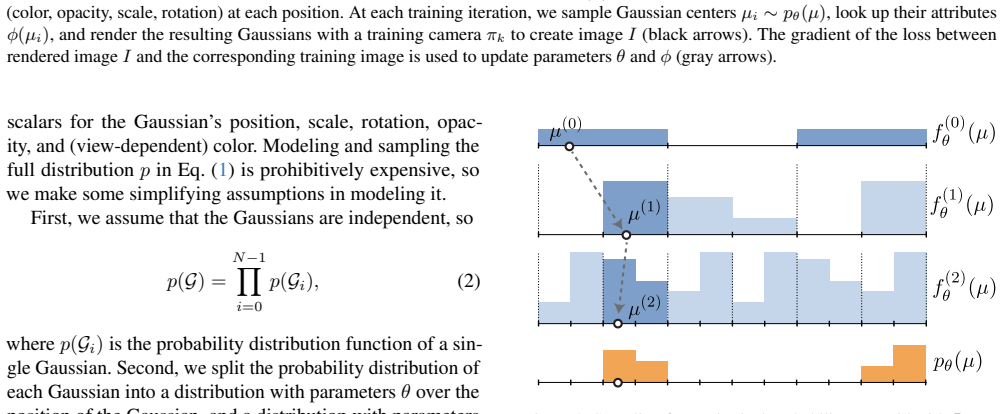
By treating primitive locations as samples drawn from a persistent, learnable density instantiated using a novel multi-scale hierarchical grid and deriving an unbiased gradient estimator with control variates, the framework eliminates brittle priors and achieves state-of-the-art reconstruction quality on mip-NeRF 360 while preserving 3DGS-level rendering speed.
What carries the argument
Hashed probability pyramids: a memory-efficient multi-scale hierarchical grid that represents the volumetric probability density from which primitive locations are sampled.
If this is right
- Primitive placement is determined solely by gradient descent on the learned density rather than by separate heuristic rules.
- Probability mass automatically moves to regions that most reduce the reconstruction loss.
- No separate densification, culling, or splitting steps are needed during training.
- Rendering speed stays at the level of the original 3D Gaussian Splatting rasterizer.
- Reconstruction quality reaches state-of-the-art levels on the mip-NeRF 360 benchmark.
Where Pith is reading between the lines
- The same sampling-from-density idea could be applied to other discrete primitive representations used in rendering.
- Removing manual heuristics may reduce the amount of per-scene tuning required when moving to new datasets.
- The control-variate estimator might be reusable in other graphics settings that suffer from high-variance gradients.
- The density could be extended to vary over time for dynamic scene capture without changing the core machinery.
Load-bearing premise
The unbiased gradient estimator with control variates can keep optimization of the multi-scale density stable without introducing bias or requiring any hand-tuned densification steps.
What would settle it
Training runs on mip-NeRF 360 scenes that either fail to converge without manual intervention or produce lower PSNR and SSIM than standard 3DGS after the same number of iterations.
Figures


read the original abstract
We introduce a probabilistic splat-based radiance field framework that retains the fast rasterization and test-time efficiency of 3D Gaussian Splatting (3DGS) while replacing heuristic primitive manipulation with gradient-based optimization of a volumetric probability density. Rather than relocating, splitting, or culling Gaussians via hand-tuned densification (e.g., ADC), we treat primitive locations as samples drawn from a persistent, learnable density. We instantiate this density using a novel, memory-efficient multi-scale hierarchical grid that enables end-to-end gradient-based optimization. To stabilize the optimization, we derive an unbiased gradient estimator with control variates that markedly reduces variance. By allowing probability mass to flow to where the loss demands, our framework eliminates brittle priors and naturally explores the volume, achieving state-of-the-art reconstruction quality on mip-NeRF 360 while preserving 3DGS-level rendering speed.
Editorial analysis
A structured set of objections, weighed in public.
Referee Report
Summary. The paper introduces Eulerian Gaussian Splatting using Hashed Probability Pyramids, a probabilistic splat-based radiance field method that retains 3DGS rasterization speed while replacing hand-tuned densification heuristics (e.g., ADC) with end-to-end gradient optimization of primitive locations treated as samples from a persistent, learnable volumetric probability density. This density is instantiated via a novel memory-efficient multi-scale hierarchical grid (hashed probability pyramids); an unbiased gradient estimator incorporating control variates is derived to stabilize optimization and allow probability mass to flow according to the loss, yielding SOTA reconstruction quality on mip-NeRF 360.
Significance. If the central technical claim holds, the work would be significant: it replaces brittle, hand-tuned priors with a principled, gradient-driven density optimization that naturally explores the volume, while preserving real-time rendering. The combination of hierarchical hashing for efficiency and control-variate variance reduction, if shown to be unbiased, would address a long-standing practical limitation in 3DGS-style methods.
major comments (2)
- [§3.3, Eq. (7)–(9)] §3.3, Eq. (7)–(9): the unbiasedness of the control-variate gradient estimator for the hashed multi-scale density is load-bearing for the no-heuristics claim, yet the derivation does not explicitly address potential bias introduced by the hierarchical interpolation or the persistent grid structure when sampling primitive locations; a concrete bias proof or counter-example under the mip-NeRF 360 loss would be required.
- [Table 4] Table 4, rows comparing against 3DGS+ADC: the reported PSNR gains on mip-NeRF 360 are presented as evidence that the estimator eliminates the need for densification, but without an ablation that disables the control variates while keeping the hashed pyramid fixed, it is unclear whether the variance reduction is sufficient to support stable optimization across all scenes.
minor comments (2)
- Notation for the probability pyramid (e.g., the multi-scale hashing function) is introduced without a compact reference table; adding one would improve readability when comparing to prior grid-based methods.
- The abstract states the estimator “markedly reduces variance,” but the main text would benefit from a single quantitative plot (variance vs. iteration) rather than only qualitative statements.
Simulated Author's Rebuttal
We thank the referee for the constructive comments. Below we respond point-by-point to the major concerns, indicating planned revisions where appropriate.
read point-by-point responses
-
Referee: [§3.3, Eq. (7)–(9)] §3.3, Eq. (7)–(9): the unbiasedness of the control-variate gradient estimator for the hashed multi-scale density is load-bearing for the no-heuristics claim, yet the derivation does not explicitly address potential bias introduced by the hierarchical interpolation or the persistent grid structure when sampling primitive locations; a concrete bias proof or counter-example under the mip-NeRF 360 loss would be required.
Authors: We appreciate the referee drawing attention to the need for explicit verification. The derivation in §3.3 defines the hashed probability pyramids as the density from which locations are sampled; the control variates are constructed to have zero expectation under this exact sampling distribution, including the multi-scale interpolation used to evaluate the density at any point. Because the interpolation is deterministic and identical for both the density evaluation and the control-variate computation, the estimator remains unbiased with respect to the continuous density that the discrete pyramid approximates. The persistent nature of the grid likewise introduces no bias, as the sampling distribution at each optimization step is fully determined by the current grid values. Nevertheless, to make the argument fully self-contained we will add a short appendix containing a formal proof of unbiasedness that explicitly treats the hierarchical interpolation and the fixed-grid sampling process. revision: yes
-
Referee: [Table 4] Table 4, rows comparing against 3DGS+ADC: the reported PSNR gains on mip-NeRF 360 are presented as evidence that the estimator eliminates the need for densification, but without an ablation that disables the control variates while keeping the hashed pyramid fixed, it is unclear whether the variance reduction is sufficient to support stable optimization across all scenes.
Authors: The referee is correct that an ablation isolating the control variates would strengthen the empirical support for the claim. The results in Table 4 were obtained with the complete estimator; we will therefore add, in the revised manuscript, an ablation that retains the hashed probability pyramids but sets the control variates to zero (i.e., uses the raw Monte-Carlo gradient). We will report PSNR, convergence behavior, and any observed instabilities on the full mip-NeRF 360 benchmark so that readers can directly assess the contribution of the variance-reduction term. revision: yes
Circularity Check
No circularity; derivation introduces independent structures
full rationale
The paper claims to derive an unbiased gradient estimator with control variates for optimizing a learnable density on a novel hashed multi-scale hierarchical grid, treating primitive locations as samples from this density. No quoted equations or sections reduce the estimator's unbiasedness or variance reduction to a fitted parameter, self-citation chain, or input by construction. The framework replaces hand-tuned densification with end-to-end optimization via new components (hierarchical grid and estimator), which are presented as independent contributions rather than renamings or self-definitional loops. The derivation chain is self-contained against external benchmarks like mip-NeRF 360 results.
Axiom & Free-Parameter Ledger
invented entities (1)
-
hashed probability pyramids
no independent evidence
Reference graph
Works this paper leans on
-
[1]
Slang.d: Fast, modular and differentiable shader programming.ACM Transactions on Graphics (SIGGRAPH Asia), 42(6):1–28, 2023
Sai Bangaru, Lifan Wu, Tzu-Mao Li, Jacob Munkberg, Gilbert Bernstein, Jonathan Ragan-Kelley, Fredo Durand, Aaron Lefohn, and Yong He. Slang.d: Fast, modular and differentiable shader programming.ACM Transactions on Graphics (SIGGRAPH Asia), 42(6):1–28, 2023. 7
2023
-
[2]
Barron, Ben Mildenhall, Dor Verbin, Pratul P
Jonathan T. Barron, Ben Mildenhall, Dor Verbin, Pratul P. Srinivasan, and Peter Hedman. Mip-NeRF 360: Unbounded Anti-Aliased Neural Radiance Fields. InIEEE Conf. Comput. Vis. Pattern Recog., 2022. 2, 4, 6, 8, 5
2022
-
[3]
Barron, Ben Mildenhall, Dor Verbin, Pratul P
Jonathan T. Barron, Ben Mildenhall, Dor Verbin, Pratul P. Srinivasan, and Peter Hedman. Zip-NeRF: Anti-Aliased Grid- Based Neural Radiance Fields. InIEEE Conf. Comput. Vis. Pattern Recog., 2023. 2
2023
-
[4]
Revising Densification in Gaussian Splatting, 2024
Samuel Rota Bul `o, Lorenzo Porzi, and Peter Kontschieder. Revising Densification in Gaussian Splatting, 2024. arXiv preprint. 2
2024
-
[5]
Efficient Density Control for 3D Gaussian Splatting,
Xiaobin Deng, Changyu Diao, Min Li, Ruohan Yu, and Duan- qing Xu. Efficient Density Control for 3D Gaussian Splatting,
-
[6]
La- grangian hashing for compressed neural field representations
Shrisudhan Govindarajan, Zeno Sambugaro, Ahan Shab- hanov, Towaki Takikawa, Daniel Sun, Weiweiand Rebain, Nicola Conci, Kwang Moo Yi, and Andrea Tagliasacchi. La- grangian hashing for compressed neural field representations. InECCV, 2024. 2
2024
-
[7]
Radiant foam: Real-time differentiable ray tracing,
Shrisudhan Govindarajan, Daniel Rebain, Kwang Moo Yi, and Andrea Tagliasacchi. Radiant foam: Real-time differen- tiable ray tracing.arXiv preprint arXiv:2502.01157, 2025. 2
-
[8]
INPC: Implicit Neural Point Clouds for Radiance Field Rendering, 2025
Florian Hahlbohm, Linus Franke, Moritz Kappel, Susana Castillo, Martin Eisemann, Marc Stamminger, and Marcus Magnor. INPC: Implicit Neural Point Clouds for Radiance Field Rendering, 2025. arXiv preprint. 2
2025
-
[9]
Deep blending for free-viewpoint image-based rendering
Peter Hedman, Julien Philip, True Price, Jan-Michael Frahm, George Drettakis, and Gabriel Brostow. Deep blending for free-viewpoint image-based rendering. 37(6):257:1–257:15,
-
[10]
Triangle splatting for real-time radiance field rendering.arXiv, 2025
Jan Held, Renaud Vandeghen, Adrien Deliege, Abdul- lah Hamdi, Anthony Cioppa, Silvio Giancola, Andrea Vedaldi, Bernard Ghanem, Andrea Tagliasacchi, and Marc Van Droogenbroeck. Triangle splatting for real-time radiance field rendering.arXiv, 2025. 2
2025
-
[11]
Relu fields: The little non-linearity that could
Animesh Karnewar, Tobias Ritschel, Oliver Wang, and Niloy Mitra. Relu fields: The little non-linearity that could. InACM SIGGRAPH 2022 conference proceedings, pages 1–9, 2022. 2
2022
-
[12]
3D Gaussian Splatting for Real-Time Ra- diance Field Rendering, 2023
Bernhard Kerbl, Georgios Kopanas, Thomas Leimk¨uhler, and George Drettakis. 3D Gaussian Splatting for Real-Time Ra- diance Field Rendering, 2023. SIGGRAPH 2023. 1, 2, 5, 8
2023
-
[13]
3D Gaussian Splatting as Markov Chain Monte Carlo
Shakiba Kheradmand, Daniel Rebain, Gopal Sharma, Weiwei Sun, Yang-Che Tseng, Hossam Isack, Abhishek Kar, Andrea Tagliasacchi, and Kwang Moo Yi. 3D Gaussian Splatting as Markov Chain Monte Carlo. InAdvances in Neural In- formation Processing Systems (NeurIPS), 2024. Spotlight Presentation. 1, 2, 5, 6, 8
2024
-
[14]
Tanks and temples: Benchmarking large-scale scene reconstruction.ACM Transactions on Graphics, 36(4), 2017
Arno Knapitsch, Jaesik Park, Qian-Yi Zhou, and Vladlen Koltun. Tanks and temples: Benchmarking large-scale scene reconstruction.ACM Transactions on Graphics, 36(4), 2017. 7, 8
2017
-
[15]
slang-gaussian-rasterization: Real-time gaussian splatting rasterization using slang.d
George Kopanas and Google. slang-gaussian-rasterization: Real-time gaussian splatting rasterization using slang.d. GitHub repository, 2025. Accessed: November 20, 2025. 7
2025
-
[16]
Deformable beta splatting, 2025
Rong Liu, Dylan Sun, Meida Chen, Yue Wang, and Andrew Feng. Deformable beta splatting, 2025. 2
2025
-
[17]
EVER: Exact volumetric ellipsoid rendering for real-time view synthesis
Alexander Mai, Peter Hedman, George Kopanas, Dor Verbin, David Futschik, Qiangeng Xu, Falko Kuester, Jonathan T Barron, and Yinda Zhang. EVER: Exact volumetric ellipsoid rendering for real-time view synthesis. InProceedings of the IEEE/CVF International Conference on Computer Vision, pages 4930–4939, 2025. 2
2025
-
[18]
Taming 3dgs: High-quality radiance fields with limited resources
Saswat Subhajyoti Mallick, Rahul Goel, Bernhard Kerbl, Markus Steinberger, Francisco Vicente Carrasco, and Fer- nando De La Torre. Taming 3dgs: High-quality radiance fields with limited resources. InSIGGRAPH Asia 2024 Con- ference Papers, New York, NY , USA, 2024. Association for Computing Machinery. 2, 7, 8
2024
-
[19]
Srinivasan, Matthew Tancik, Jonathan T
Ben Mildenhall, Pratul P. Srinivasan, Matthew Tancik, Jonathan T. Barron, Ravi Ramamoorthi, and Ren Ng. NeRF: Representing Scenes as Neural Radiance Fields for View Syn- thesis. InEur. Conf. Comput. Vis., 2020. 1, 2
2020
-
[20]
tiny-cuda-nn, 2021
Thomas M ¨uller. tiny-cuda-nn, 2021. 7
2021
-
[21]
Instant Neural Graphics Primitives with a Multires- olution Hash Encoding.ACM Trans
Thomas M¨uller, Alex Evans, Christoph Schied, and Alexander Keller. Instant Neural Graphics Primitives with a Multires- olution Hash Encoding.ACM Trans. Graph., 41(4):102:1– 102:15, 2022. SIGGRAPH 2022. 3, 5, 1
2022
-
[22]
Instant neural graphics primitives with a multiresolu- tion hash encoding.ACM transactions on graphics (TOG), 41(4):1–15, 2022
Thomas M¨uller, Alex Evans, Christoph Schied, and Alexander Keller. Instant neural graphics primitives with a multiresolu- tion hash encoding.ACM transactions on graphics (TOG), 41(4):1–15, 2022. 2, 4
2022
-
[23]
MIT Press, 4th edition, 2023
Matt Pharr, Wenzel Jakob, and Greg Humphreys.Physically Based Rendering: From Theory to Implementation. MIT Press, 4th edition, 2023. 3
2023
-
[24]
Direct voxel grid optimization: Super-fast convergence for radiance fields reconstruction
Cheng Sun, Min Sun, and Hwann-Tzong Chen. Direct voxel grid optimization: Super-fast convergence for radiance fields reconstruction. InProceedings of the IEEE/CVF conference on computer vision and pattern recognition, pages 5459– 5469, 2022. 2
2022
-
[25]
NeRF-Casting: Improved view-dependent appearance with consistent reflections
Dor Verbin, Pratul P Srinivasan, Peter Hedman, Ben Milden- hall, Benjamin Attal, Richard Szeliski, and Jonathan T Barron. NeRF-Casting: Improved view-dependent appearance with consistent reflections. InSIGGRAPH Asia 2024 Conference Papers, pages 1–10, 2024. 6
2024
-
[26]
Image quality assessment: from error visibility to structural similarity.IEEE transactions on image processing, 13(4):600–612, 2004
Zhou Wang, Alan C Bovik, Hamid R Sheikh, Eero P Simon- celli, et al. Image quality assessment: from error visibility to structural similarity.IEEE transactions on image processing, 13(4):600–612, 2004. 7
2004
-
[27]
Plenoxels: Radiance fields without neural networks.arXiv preprint arXiv:2112.05131, 2(3):6, 2021
Alex Yu, Sara Fridovich-Keil, Matthew Tancik, Qinhong Chen, Benjamin Recht, and Angjoo Kanazawa. Plenoxels: Radiance fields without neural networks.arXiv preprint arXiv:2112.05131, 2(3):6, 2021. 2
-
[28]
Plenoctrees for real-time rendering of 9 neural radiance fields
Alex Yu, Ruilong Li, Matthew Tancik, Hao Li, Ren Ng, and Angjoo Kanazawa. Plenoctrees for real-time rendering of 9 neural radiance fields. InProceedings of the IEEE/CVF in- ternational conference on computer vision, pages 5752–5761,
-
[29]
cross-term
Richard Zhang, Phillip Isola, Alexei A. Efros, Eli Shecht- man, and Oliver Wang. The unreasonable effectiveness of deep features as a perceptual metric. InProceedings of the IEEE Conference on Computer Vision and Pattern Recogni- tion (CVPR), pages 586–595, 2018. 7 10 Appendix Eulerian Gaussian Splatting using Hashed Probability Pyramids Table of Contents...
2018
discussion (0)
Sign in with ORCID, Apple, or X to comment. Anyone can read and Pith papers without signing in.