Evolutionary Refinement of Generative Graph Topologies: A Hybrid WGAN-GA Approach
Pith reviewed 2026-06-29 13:11 UTC · model grok-4.3
The pith
A genetic algorithm refines the edges of graphs from a WGAN generator to lower combined MMD and match real structural patterns more closely.
A machine-rendered reading of the paper's core claim, the machinery that carries it, and where it could break.
Core claim
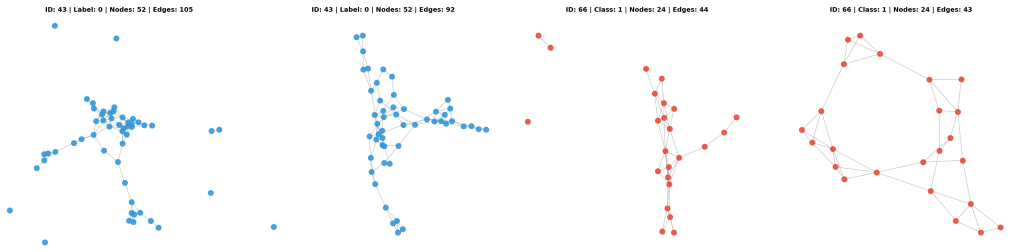
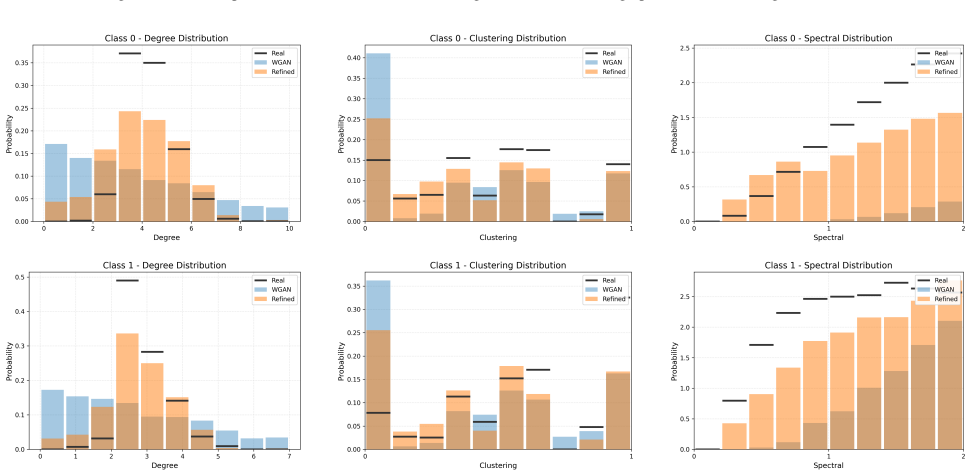
Applying a genetic algorithm to mutate edges of graphs produced by an existing WGAN-GNN generator consistently lowers the combined Maximum Mean Discrepancy to real graphs, yielding outputs whose degree and spectral distributions align more closely with the target data while preserving class consistency and diversity.
What carries the argument
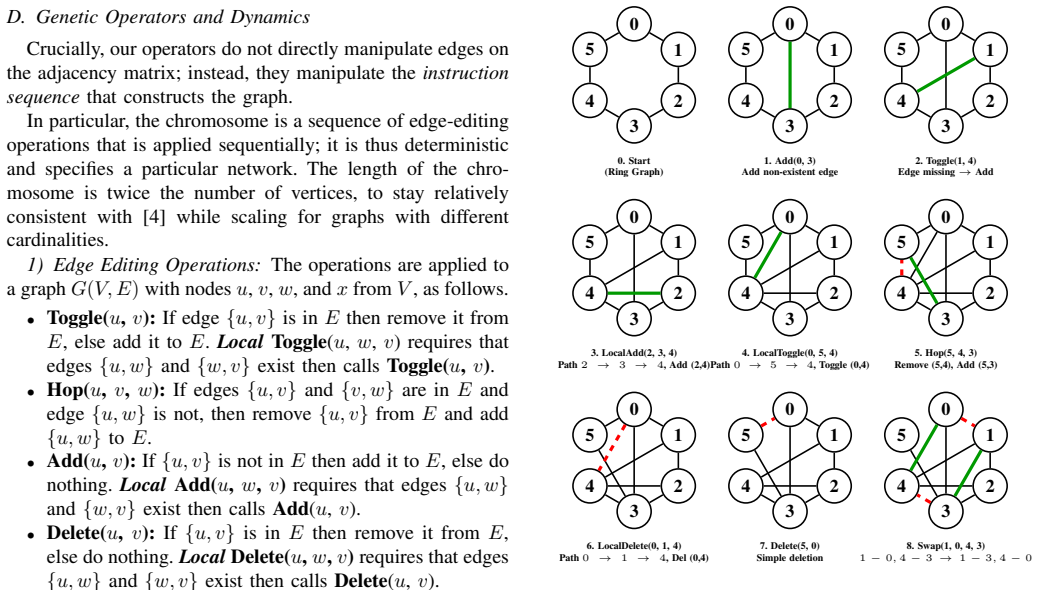
The genetic algorithm that performs targeted edge mutations on GAN outputs, with fitness evaluated by structural discrepancy metrics, while the pre-trained GNN critic continues to guard global and class-level properties.
If this is right
- Refined graphs exhibit lower deviation in both degree distribution and spectral properties than the raw GAN outputs.
- The same refinement step can be attached to other GAN-based graph generators without retraining the critic.
- Generated graphs become more suitable for downstream tasks that require faithful reproduction of real structural statistics.
- Diversity and novelty metrics remain comparable to the base generator, so the method does not simply copy training examples.
Where Pith is reading between the lines
- Post-generation evolutionary correction can serve as a general remedy for residual distribution gaps that adversarial training alone leaves open.
- The separation of the critic (global constraints) from the GA (local structural tuning) suggests a modular design that could be tested on other discrete generative models.
- If the GA fitness were made differentiable, the refinement step might be folded back into end-to-end training to reduce the need for a separate post-processing phase.
Load-bearing premise
Edge mutations guided only by local structural fitness can reduce measured deviations without breaking the class consistency already enforced by the GNN critic.
What would settle it
Apply the same GA refinement procedure to a fresh batch of graphs from the base WGAN and measure whether the combined MMD score fails to decrease or rises above the base-model value.
Figures

read the original abstract
Generating realistic graph-structured data is challenging due to discrete connectivity, varying graph sizes, and class-specific structural patterns. Recent Generative Adversarial Networks (GAN)-based graph generation methods improve edge modelling by learning connectivity and matching class-specific density distributions. However these models still exhibit noticeable deviations such as in degree and spectral distribution when compared to real graphs, indicating that important structural properties are not fully preserved. This work aims to reduce these deviations by refining the graphs produced by an existing GAN-based graph generator framework with a Genetic Algorithm (GA). In the GAN framework, the generator produces both node features and connectivity patterns, while a GNN-based critic evaluates graph realism and class consistency to ensure global structural and class alignment. Building on this foundation, we apply a GA to refine the edges of generated graphs. The refinement process guides synthetic graphs toward closer agreement with real data, while preserving diversity and novelty. Experimental results show that the GA refinement consistently lowers combined Maximum Mean Discrepancy (MMD) compared to the base model, leading to graphs that more closely match real structural patterns. This demonstrates that evolutionary refinement is an effective and flexible way to correct residual structural deviations in GAN-based graph generators, improving their suitability for realistic graph synthesis and data augmentation.
Editorial analysis
A structured set of objections, weighed in public.
Referee Report
Summary. The manuscript proposes a hybrid WGAN-GA framework for generating realistic graphs: a WGAN with GNN critic first produces node features and connectivity while enforcing class consistency and global structure, after which a genetic algorithm refines the edges of the generated graphs to reduce residual deviations in degree and spectral distributions. The central empirical claim is that this GA refinement consistently lowers combined MMD relative to the base WGAN model while preserving diversity and novelty.
Significance. If the reported MMD reductions are reproducible and the refinement mechanism demonstrably preserves the critic-enforced properties, the work would supply a practical post-processing technique that could improve the structural fidelity of existing GAN-based graph generators for data-augmentation tasks. No machine-checked proofs, reproducible code, or parameter-free derivations are described.
major comments (2)
- [Abstract] Abstract: the assertion that 'the GA refinement consistently lowers combined Maximum Mean Discrepancy (MMD)' supplies neither quantitative MMD values, baseline comparisons, statistical tests, nor any description of the number of graphs or datasets evaluated, rendering the central empirical claim unverifiable from the provided text.
- [Abstract] Abstract, paragraph on refinement process: the description of the GA states that it 'refines the edges' and 'guides synthetic graphs toward closer agreement with real data' but provides no fitness function, mutation or crossover operators, stopping criteria, or explicit mechanism ensuring that post-mutation graphs remain consistent with the GNN critic's class-specific evaluations; this directly bears on whether observed MMD reductions could be artifacts of unconstrained search.
Simulated Author's Rebuttal
We thank the referee for the constructive feedback. We address the two major comments on the abstract point by point below, agreeing that additional specificity is warranted in the abstract itself.
read point-by-point responses
-
Referee: [Abstract] Abstract: the assertion that 'the GA refinement consistently lowers combined Maximum Mean Discrepancy (MMD)' supplies neither quantitative MMD values, baseline comparisons, statistical tests, nor any description of the number of graphs or datasets evaluated, rendering the central empirical claim unverifiable from the provided text.
Authors: We agree that the abstract should be more self-contained on the central empirical claim. The full manuscript reports MMD reductions, baseline comparisons, and evaluation details (including dataset counts and graph numbers) in the experimental results section, along with statistical tests. We will revise the abstract to incorporate representative quantitative MMD values, the number of datasets evaluated, and a brief note on statistical significance to make the claim verifiable from the abstract alone. revision: yes
-
Referee: [Abstract] Abstract, paragraph on refinement process: the description of the GA states that it 'refines the edges' and 'guides synthetic graphs toward closer agreement with real data' but provides no fitness function, mutation or crossover operators, stopping criteria, or explicit mechanism ensuring that post-mutation graphs remain consistent with the GNN critic's class-specific evaluations; this directly bears on whether observed MMD reductions could be artifacts of unconstrained search.
Authors: The abstract supplies only a high-level summary. The manuscript details the fitness function (MMD on degree and spectral distributions), mutation/crossover operators (controlled edge edits), stopping criteria (MMD convergence or generation limit), and the consistency mechanism (mutations are constrained and re-validated against the GNN critic's class-specific scores to prevent violation of enforced properties). We will revise the abstract to explicitly note that the GA operates under critic-derived constraints that preserve class consistency, thereby addressing the concern that reductions could arise from unconstrained search. revision: yes
Circularity Check
No circularity: experimental comparison to external base model
full rationale
The paper describes an experimental hybrid WGAN-GA pipeline for graph generation and reports that GA edge refinement lowers combined MMD relative to the base WGAN. No equations, fitted parameters renamed as predictions, self-definitional loops, or load-bearing self-citations appear in the abstract or described claims. The improvement is measured against an independent base model using an external metric (MMD), satisfying the criteria for a self-contained empirical result with no reduction to its own inputs by construction.
Axiom & Free-Parameter Ledger
Reference graph
Works this paper leans on
-
[1]
Arjovsky, S
M. Arjovsky, S. Chintala, and L. Bottou. Wasserstein generative adversarial networks. InProc. Intl. Conf. on Machine Learning, pages 214–223, 2017
2017
-
[2]
Barry, J
A. Barry, J. Griffith, and C. O’Riordan. An evolutionary and graph- rewriting based approach to graph generation. InIntl. Joint Conf. on Computational Intelligence (IJCCI), volume 1, pages 237–243, 2015
2015
-
[3]
De Cao and T
N. De Cao and T. Kipf. MolGAN: An implicit generative model for small molecular graphs.ICML 2018 workshop on Theoretical Foundations and Applications of Deep Generative Models, 2018
2018
-
[4]
Dub ´e, S
M. Dub ´e, S. Houghten, and D. Ashlock. Representation for evolution of epidemic models. In2019 IEEE Congress on Evolutionary Computation (CEC), pages 2370–2377, Piscataway NJ, 06 2019. IEEE Press
2019
- [5]
-
[6]
Gulrajani et al
I. Gulrajani et al. Improved training of Wasserstein GANs. InAdvances in Neural Information Processing Systems, 2017
2017
-
[7]
Learning Deep Generative Models of Graphs
Y . Li et al. Learning deep generative models of graphs.arXiv preprint arXiv:1803.03324, 2018
work page internal anchor Pith review Pith/arXiv arXiv 2018
-
[8]
Morris et al
C. Morris et al. Tudataset: A collection of benchmark datasets for learning with graphs. InICML 2020 Workshop on Graph Representation Learning and Beyond (GRL+ 2020), 2020
2020
-
[9]
Razi Razavi et al
S.A. Razi Razavi et al. Generating labeled graphs using conditional Wasserstein GANs. In35th International Conference on Collaborative Advances in Software and Computing (CASCON). IEEE Computer Society, 2025
2025
-
[10]
S.A. Razi Razavi et al. Adaptive edge learning for density-aware graph generation.arXiv preprint arXiv:2601.23052, 2026
-
[11]
Simonovsky and N
M. Simonovsky and N. Komodakis. GraphV AE: Towards generation of small graphs using variational autoencoders. InIntl. Conf. on Artificial Neural Networks, 2018
2018
-
[12]
Wang et al
H. Wang et al. GraphGAN: Graph representation learning with gen- erative adversarial nets. InProceedings of the AAAI Conference on Artificial Intelligence, volume 32, 2018
2018
-
[13]
Wang et al
P. Wang et al. Graph generative adversarial networks with evolutionary algorithm.Applied Soft Computing, 164:111981, 2024
2024
-
[14]
You et al
J. You et al. Graph convolutional policy network for goal-directed molec- ular graph generation. InAdvances in Neural Information Processing Systems, 2018
2018
discussion (0)
Sign in with ORCID, Apple, or X to comment. Anyone can read and Pith papers without signing in.