Assessing the Relative Importance of Neutrino Matter Interaction Channels in Post-Merger Remnant of Binary Neutron Stars
Pith reviewed 2026-06-29 10:01 UTC · model grok-4.3
The pith
Inelastic scattering on electrons makes important contributions to the thermalization of heavy-lepton neutrinos in neutron star merger remnants.
A machine-rendered reading of the paper's core claim, the machinery that carries it, and where it could break.
Core claim
Using Monte Carlo neutrino transport in a post-merger remnant simulation, the authors find that pair annihilation rates increase greatly in cold low-density regions when using actual neutrino distributions, and that inelastic scattering on electrons makes important contributions to the thermalization of heavy-lepton neutrinos.
What carries the argument
Energy-dependent Monte Carlo neutrino transport that samples the actual neutrino distribution functions to compute opacities without equilibrium assumptions.
If this is right
- Nucleon-nucleon bremsstrahlung is active in high-density regions while electron-positron annihilation dominates in low-density regions.
- Pair annihilation rates for heavy-lepton neutrinos increase substantially in cold low-density regions when opacities use actual distributions instead of equilibrium assumptions.
- Inelastic scattering on electrons contributes to thermalization of heavy-lepton neutrinos and should be accounted for in future simulations.
- Opacity evaluations must incorporate non-equilibrium neutrino distributions for accuracy across the remnant's thermodynamic conditions.
Where Pith is reading between the lines
- Future merger simulations that include inelastic neutrino-electron scattering could produce different neutrino energy spectra and altered outflow compositions.
- The revised thermalization may change predictions for r-process nucleosynthesis yields in the ejected material.
- Electromagnetic signals from kilonovae could provide indirect tests of whether these interaction channels are modeled correctly.
Load-bearing premise
The Monte Carlo simulation accurately samples the neutrino distribution function in all thermodynamic regions of the remnant, allowing reliable opacity calculations from the actual distributions.
What would settle it
A direct comparison of heavy-lepton neutrino spectra or thermalization timescales in two otherwise identical merger simulations, one including inelastic electron scattering and one excluding it.
Figures

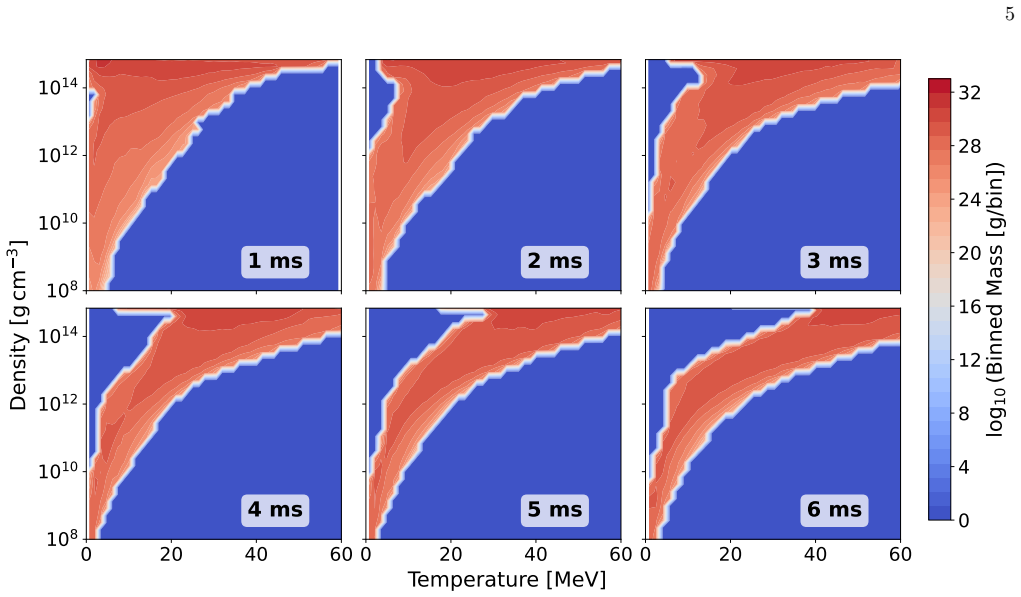
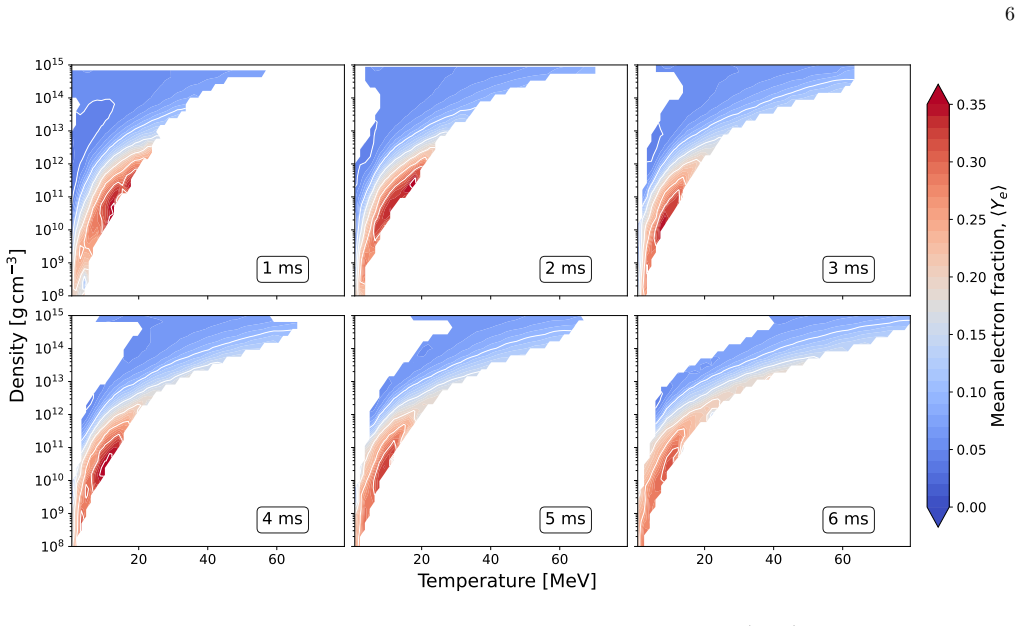
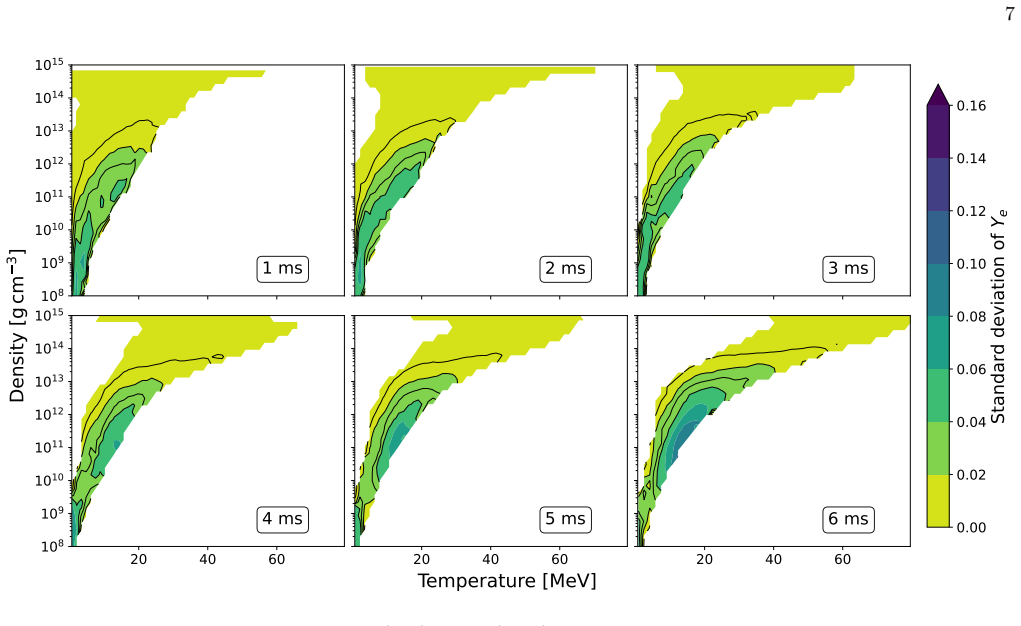


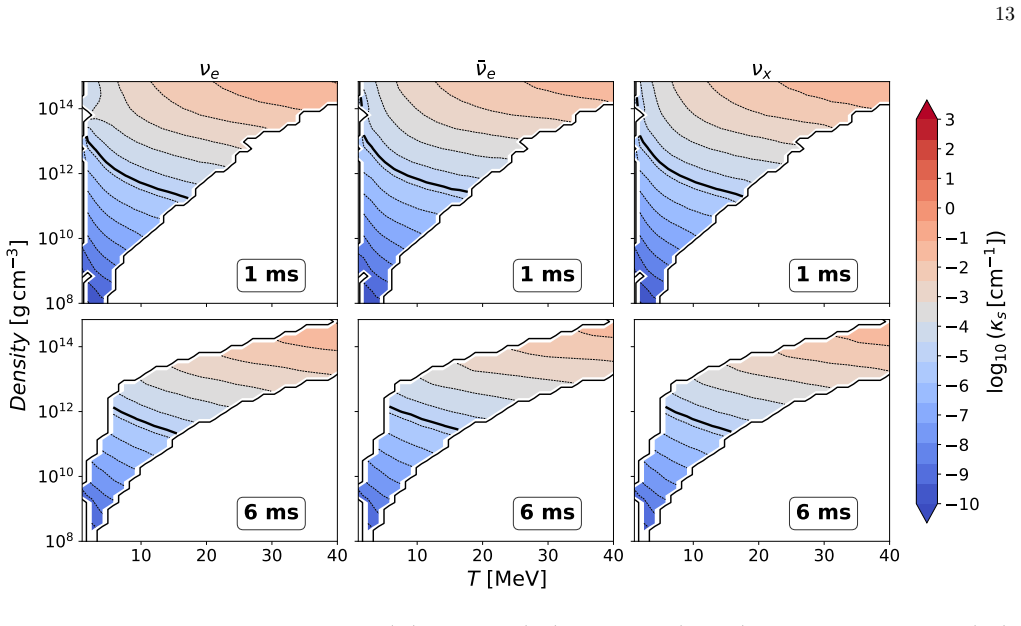


read the original abstract
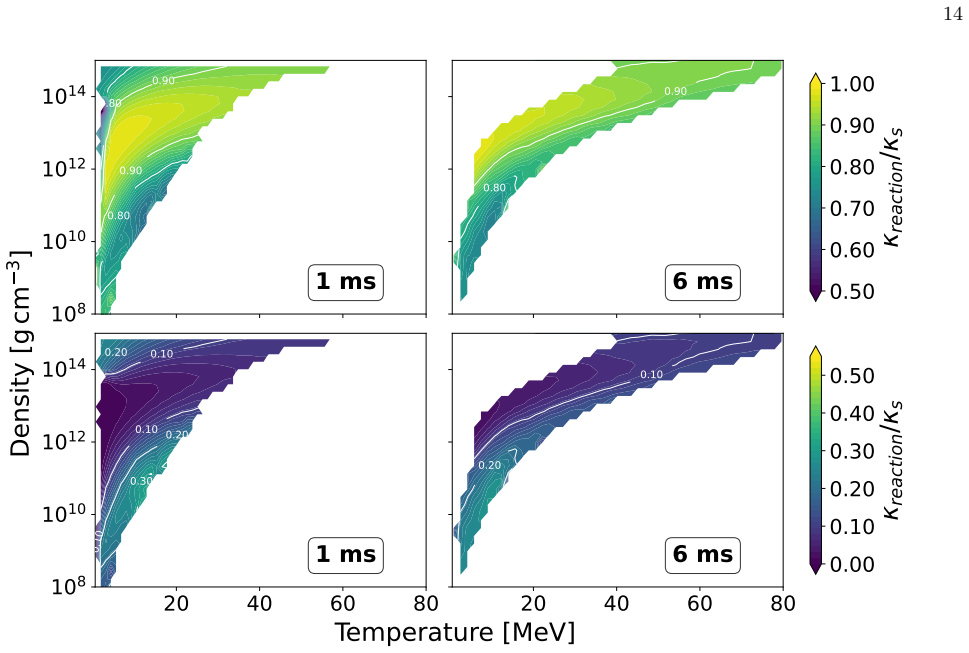
Neutron star mergers are amongst the most promising sources for the joint detection of gravitational waves and electromagnetic signals. They are also potential sites for the production of r-process elements and probes of the equation of state of matter above nuclear saturation density. Neutrino-matter interactions during and after merger strongly influence the thermodynamic evolution and composition of the remnant and its outflows, thereby affecting kilonova emission and nucleosynthesis yields. However, existing merger simulations remain limited by significant approximations in the treatment of neutrino transport and interaction rates. In this work, we assess the thermodynamic conditions under which neutrinos decouple from matter and show the effect of charged-current absorption, quasi-elastic scattering on nucleons and nuclei, pair-production processes, and inelastic neutrino-electron scattering for electron neutrinos, electron antineutrinos, and heavy-lepton neutrinos in the different thermodynamical conditions sampled by a simulation using an energy-dependent Monte Carlo neutrino transport. We first estimate opacities in the post-merger remnant assuming neutrinos in equilibria with the fluid, and find results consistent with previous studies performed on simulations using a gray two-moment scheme. We note the very distinct regions in which nucleon-nucleon Bremmstrahlung and electron-positron annihilation are active (high and low density regions, respectively). We then evaluate opacities using the actual distribution function of neutrinos within a Monte Carlo simulation. We show greatly increased pair annihilation rates in cold, low-density regions, especially for heavy-lepton neutrinos. We also show that inelastic scattering on electrons, which has not been included in merger simulations so far, makes important contributions to the thermalization of heavy-lepton neutrinos.
Editorial analysis
A structured set of objections, weighed in public.
Referee Report
Summary. The paper evaluates neutrino opacities in binary neutron star post-merger remnants under both equilibrium assumptions and actual non-equilibrium distributions extracted from an energy-dependent Monte Carlo transport simulation. It reports consistency with prior gray two-moment studies for equilibrium cases, identifies distinct density regimes for nucleon-nucleon bremsstrahlung versus electron-positron annihilation, and claims substantially higher pair-annihilation rates in cold low-density regions plus important thermalization contributions from inelastic neutrino-electron scattering (previously omitted) for heavy-lepton neutrinos.
Significance. If the Monte Carlo sampling proves reliable, the work strengthens the case that non-equilibrium neutrino distributions and inelastic electron scattering must be incorporated in future merger simulations, with potential consequences for remnant thermodynamics, outflow composition, r-process yields, and kilonova signals. The explicit separation of process activity by thermodynamic region and the direct use of simulation-derived distributions are positive features.
major comments (1)
- [Abstract (results from actual distributions)] The central claims of greatly increased pair-annihilation rates in cold low-density regions and important inelastic electron-scattering contributions to heavy-lepton neutrino thermalization rest on opacities computed from the actual Monte Carlo neutrino distribution functions. However, the manuscript provides no explicit convergence tests, particle-number scaling studies, or comparisons of sampled moments against equilibrium expectations in the low-density regimes where mean free paths become long; without these, statistical under-sampling cannot be ruled out as the source of the reported differences.
minor comments (1)
- [Abstract] The abstract is lengthy and could be tightened by moving some methodological detail to the introduction while preserving the key quantitative findings.
Simulated Author's Rebuttal
We thank the referee for their thorough review and constructive feedback on our manuscript. The major comment identifies a valid concern regarding validation of the Monte Carlo results. We address it point-by-point below and will incorporate revisions as indicated.
read point-by-point responses
-
Referee: [Abstract (results from actual distributions)] The central claims of greatly increased pair-annihilation rates in cold low-density regions and important inelastic electron-scattering contributions to heavy-lepton neutrino thermalization rest on opacities computed from the actual Monte Carlo neutrino distribution functions. However, the manuscript provides no explicit convergence tests, particle-number scaling studies, or comparisons of sampled moments against equilibrium expectations in the low-density regimes where mean free paths become long; without these, statistical under-sampling cannot be ruled out as the source of the reported differences.
Authors: We agree that the absence of explicit convergence tests and particle-number scaling studies in the low-density regimes represents a limitation of the current manuscript. Although the Monte Carlo scheme is energy-dependent and the reported differences align with physical expectations (longer mean free paths allowing non-equilibrium effects to persist), we cannot rule out statistical under-sampling without additional checks. In the revised manuscript we will add a dedicated subsection presenting particle-number scaling studies, comparisons of sampled moments to equilibrium expectations, and tests of opacity sensitivity in the cold, low-density regions to substantiate the central claims. revision: yes
Circularity Check
No circularity; opacities derived directly from Monte Carlo distributions
full rationale
The paper's central results follow from running an energy-dependent Monte Carlo neutrino transport simulation on post-merger remnant data, extracting the actual (non-equilibrium) distribution functions, and computing opacities for multiple interaction channels under both equilibrium and sampled-distribution assumptions. No step reduces a claimed prediction to a fitted parameter by construction, invokes a self-citation as the sole justification for a uniqueness theorem, or renames a known result. The abstract and provided text contain only direct comparisons to prior literature without load-bearing self-references. This matches the default expectation of a self-contained simulation study.
Axiom & Free-Parameter Ledger
Forward citations
Cited by 1 Pith paper
-
Impact of neutrino-electron scattering and an improved treatment of pair processes on binary neutron star mergers
Improved Monte Carlo neutrino transport in BNS merger simulations that includes inelastic electron scattering and refined pair processes produces lower heavy-lepton neutrino energies/luminosities and 50% higher ejecta mass.
Reference graph
Works this paper leans on
-
[1]
Multi-messenger picture of compact binary mergers
S. Rosswog, The multi-messenger picture of compact bi- nary mergers, Int. J. Mod. Phys. D24, 1530012 (2015), arXiv:1501.02081 [astro-ph.HE]
work page internal anchor Pith review Pith/arXiv arXiv 2015
-
[2]
Binary neutron-star mergers: a review of Einstein's richest laboratory
L. Baiotti and L. Rezzolla, Binary neutron star merg- ers: a review of Einstein’s richest laboratory, Rept. Prog. Phys.80, 096901 (2017), arXiv:1607.03540 [gr-qc]
work page internal anchor Pith review Pith/arXiv arXiv 2017
-
[3]
Black holes, gravitational waves and fundamental physics: a roadmap
L. Baracket al., Black holes, gravitational waves and fundamental physics: a roadmap, Class. Quant. Grav. 36, 143001 (2019), arXiv:1806.05195 [gr-qc]
work page internal anchor Pith review Pith/arXiv arXiv 2019
-
[4]
Bernuzzi, Correction: Neutron star merger remnants [doi: 10.1007/s10714-020-02752-5], Gen
S. Bernuzzi, Correction: Neutron star merger remnants [doi: 10.1007/s10714-020-02752-5], Gen. Rel. Grav.52, 108 (2020), arXiv:2004.06419 [astro-ph.HE]
- [5]
-
[6]
Binary Neutron Star Mergers: Dependence on the Nuclear Equation of State
K. Hotokezaka, K. Kyutoku, H. Okawa, M. Shibata, and K. Kiuchi, Binary Neutron Star Mergers: Dependence on the Nuclear Equation of State, Phys. Rev. D83, 124008 (2011), arXiv:1105.4370 [astro-ph.HE]
work page internal anchor Pith review Pith/arXiv arXiv 2011
-
[7]
Prompt merger collapse and the maximum mass of neutron stars
A. Bauswein, T. W. Baumgarte, and H. T. Janka, Prompt merger collapse and the maximum mass of neutron stars, Phys. Rev. Lett.111, 131101 (2013), arXiv:1307.5191 [astro-ph.SR]
work page internal anchor Pith review Pith/arXiv arXiv 2013
-
[8]
Hotokezaka, K
K. Hotokezaka, K. Kiuchi, K. Kyutoku, H. Okawa, Y.-i. Sekiguchi, M. Shibata, and K. Taniguchi, Mass ejection from the merger of binary neutron stars, Physical Re- view D—Particles, Fields, Gravitation, and Cosmology 87, 024001 (2013)
2013
-
[9]
Symbalisty and D
E. Symbalisty and D. N. Schramm, Neutron star colli- sions and the r-process, Astrophys. Lett.; (United States) 22:4(1982)
1982
-
[10]
F. K. Thielemann, M. Eichler, I. V. Panov, and B. Wehmeyer, Neutron Star Mergers and Nucleosynthe- sis of Heavy Elements, Ann. Rev. Nucl. Part. Sci.67, 253 (2017), arXiv:1710.02142 [astro-ph.HE]
work page internal anchor Pith review Pith/arXiv arXiv 2017
-
[11]
Transient Events from Neutron Star Mergers
L.-X. Li and B. Paczynski, Transient events from neu- tron star mergers, Astrophys. J. Lett.507, L59 (1998), arXiv:astro-ph/9807272
work page internal anchor Pith review Pith/arXiv arXiv 1998
-
[12]
B. D. Metzger, G. Mart´ ınez-Pinedo, S. Darbha, E. Quataert, A. Arcones, D. Kasen, R. Thomas, P. Nu- gent, I. V. Panov, and N. T. Zinner, Electromagnetic counterparts of compact object mergers powered by the radioactive decay of r-process nuclei, Mon. Not. Roy. As- tron. Soc.406, 2650 (2010)
2010
-
[13]
Kilonova/Macronova Emission from Compact Binary Mergers
M. Tanaka, Kilonova/Macronova Emission from Com- pact Binary Mergers, Adv. Astron.2016, 6341974 (2016), arXiv:1605.07235 [astro-ph.HE]
work page internal anchor Pith review Pith/arXiv arXiv 2016
-
[14]
B. D. Metzger, Kilonovae, Living Rev. Rel.20, 3 (2017), arXiv:1610.09381 [astro-ph.HE]
work page internal anchor Pith review Pith/arXiv arXiv 2017
-
[15]
J. Barnes and D. Kasen, Effect of a High Opacity on the Light Curves of Radioactively Powered Transients from Compact Object Mergers, Astrophys. J.775, 18 (2013), arXiv:1303.5787 [astro-ph.HE]
work page internal anchor Pith review Pith/arXiv arXiv 2013
-
[16]
I. Kullmann, S. Goriely, O. Just, R. Ardevol-Pulpillo, A. Bauswein, and H. T. Janka, Dynamical ejecta of neu- tron star mergers with nucleonic weak processes I: nu- cleosynthesis, Mon. Not. Roy. Astron. Soc.510, 2804 (2022), arXiv:2109.02509 [astro-ph.HE]
- [17]
-
[18]
S. Rosswog and O. Korobkin, Heavy Elements and Electromagnetic Transients from Neutron Star Mergers, Annalen Phys.536, 2200306 (2024), arXiv:2208.14026 [astro-ph.HE]
-
[19]
Eichler, M
D. Eichler, M. Livio, T. Piran, and D. N. Schramm, Nu- cleosynthesis, Neutrino Bursts and Gamma-Rays from Coalescing Neutron Stars, Nature340, 126 (1989)
1989
-
[20]
H. T. Janka and M. Ruffert, Can neutrinos from neutron star mergers power gamma-ray bursts?, Astron. Astro- phys.307, L33 (1996), arXiv:astro-ph/9512144
work page internal anchor Pith review Pith/arXiv arXiv 1996
-
[21]
E. Nakar, Short-Hard Gamma-Ray Bursts, Phys. Rept. 442, 166 (2007), arXiv:astro-ph/0701748
work page internal anchor Pith review Pith/arXiv arXiv 2007
-
[22]
W. H. Lee and E. Ramirez-Ruiz, The Progenitors of Short Gamma-Ray Bursts, New J. Phys.9, 17 (2007), arXiv:astro-ph/0701874
work page internal anchor Pith review Pith/arXiv arXiv 2007
-
[23]
P. Meszaros and M. J. Rees, Gamma-Ray Bursts, arXiv (2014), arXiv:1401.3012 [astro-ph.HE]
work page internal anchor Pith review Pith/arXiv arXiv 2014
-
[24]
B. P. Abbottet al.(LIGO Scientific, Virgo), GW170817: Observation of Gravitational Waves from a Binary Neu- tron Star Inspiral, Phys. Rev. Lett.119, 161101 (2017), arXiv:1710.05832 [gr-qc]
work page internal anchor Pith review Pith/arXiv arXiv 2017
-
[25]
Grado, Einstein Telescope, the future generation of ground based gravitational wave detectors, J
A. Grado, Einstein Telescope, the future generation of ground based gravitational wave detectors, J. Phys. Conf. Ser.2429, 012041 (2023)
2023
-
[26]
B. P. Abbottet al.(LIGO Scientific, Virgo, Fermi- GBM, INTEGRAL), Gravitational Waves and Gamma- rays from a Binary Neutron Star Merger: GW170817 and GRB 170817A, Astrophys. J. Lett.848, L13 (2017), arXiv:1710.05834 [astro-ph.HE]
work page internal anchor Pith review Pith/arXiv arXiv 2017
-
[27]
B. P. Abbottet al.(LIGO Scientific, Virgo, Fermi GBM, INTEGRAL, IceCube, AstroSat Cadmium Zinc Telluride Imager Team, IPN, Insight-Hxmt, ANTARES, Swift, AGILE Team, 1M2H Team, Dark Energy Camera GW-EM, DES, DLT40, GRAWITA, Fermi-LAT, ATCA, ASKAP, Las Cumbres Observatory Group, OzGrav, DWF (Deeper Wider Faster Program), AST3, CAAS- TRO, VINROUGE, MASTER, J...
work page internal anchor Pith review Pith/arXiv arXiv 2017
-
[28]
Origin of the heavy elements in binary neutron-star mergers from a gravitational wave event
D. Kasen, B. Metzger, J. Barnes, E. Quataert, and E. Ramirez-Ruiz, Origin of the heavy elements in binary neutron-star mergers from a gravitational wave event, Nature551, 80 (2017), arXiv:1710.05463 [astro-ph.HE]
work page internal anchor Pith review Pith/arXiv arXiv 2017
-
[29]
V. A. Villaret al., The Combined Ultraviolet, Op- tical, and Near-Infrared Light Curves of the Kilo- nova Associated with the Binary Neutron Star Merger GW170817: Unified Data Set, Analytic Models, and Physical Implications, Astrophys. J. Lett.851, L21 (2017), arXiv:1710.11576 [astro-ph.HE]
work page internal anchor Pith review Pith/arXiv arXiv 2017
-
[30]
AT2017gfo: an anisotropic and three-component kilonova counterpart of GW170817
A. Perego, D. Radice, and S. Bernuzzi, AT 2017gfo: An Anisotropic and Three-component Kilonova Counter- part of GW170817, Astrophys. J. Lett.850, L37 (2017), arXiv:1711.03982 [astro-ph.HE]
work page internal anchor Pith review Pith/arXiv arXiv 2017
-
[31]
R. T. Wollaeger, O. Korobkin, C. J. Fontes, S. K. Ross- wog, W. P. Even, C. L. Fryer, J. Sollerman, A. L. Hunger- ford, D. R. van Rossum, and A. B. Wollaber, Impact of ejecta morphology and composition on the electromag- netic signatures of neutron star mergers, Mon. Not. Roy. Astron. Soc.478, 3298 (2018), arXiv:1705.07084 [astro- ph.HE]
work page internal anchor Pith review Pith/arXiv arXiv 2018
-
[32]
K. Kawaguchi, M. Shibata, and M. Tanaka, Radiative transfer simulation for the optical and near-infrared elec- tromagnetic counterparts to GW170817, Astrophys. J. Lett.865, L21 (2018), arXiv:1806.04088 [astro-ph.HE]
work page internal anchor Pith review Pith/arXiv arXiv 2018
-
[33]
J. M. Miller, B. R. Ryan, J. C. Dolence, A. Burrows, C. J. Fontes, C. L. Fryer, O. Korobkin, J. Lippuner, M. R. Mumpower, and R. T. Wollaeger, Full Transport Model of GW170817-Like Disk Produces a Blue Kilo- nova, Phys. Rev. D100, 023008 (2019), arXiv:1905.07477 [astro-ph.HE]
work page internal anchor Pith review Pith/arXiv arXiv 2019
-
[34]
M. Ruffert, H. T. Janka, K. Takahashi, and G. Schaefer, Coalescing neutron stars: A Step towards physical mod- els. 2. Neutrino emission, neutron tori, and gamma-ray bursts, Astron. Astrophys.319, 122 (1997), arXiv:astro- ph/9606181
-
[35]
High Resolution Calculations of Merging Neutron Stars II: Neutrino Emission
S. Rosswog and M. Liebendoerfer, High resolution cal- culations of merging neutron stars. 2: Neutrino emis- sion, Mon. Not. Roy. Astron. Soc.342, 673 (2003), arXiv:astro-ph/0302301
work page internal anchor Pith review Pith/arXiv arXiv 2003
-
[36]
M. B. Deaton, M. D. Duez, F. Foucart, E. O’Connor, C. D. Ott, L. E. Kidder, C. D. Muhlberger, M. A. Scheel, and B. Szilagyi, Black Hole-Neutron Star Mergers with a Hot Nuclear Equation of State: Outflow and Neutrino- Cooled Disk for a Low-Mass, High-Spin Case, Astrophys. J.776, 47 (2013), arXiv:1304.3384 [astro-ph.HE]
work page internal anchor Pith review Pith/arXiv arXiv 2013
-
[37]
Magnetized Neutron Stars With Realistic Equations of State and Neutrino Cooling
D. Neilsen, S. L. Liebling, M. Anderson, L. Lehner, E. O’Connor, and C. Palenzuela, Magnetized Neu- tron Stars With Realistic Equations of State and Neutrino Cooling, Phys. Rev. D89, 104029 (2014), arXiv:1403.3680 [gr-qc]
work page internal anchor Pith review Pith/arXiv arXiv 2014
-
[38]
Production of all the r-process nuclides in the dynamical ejecta of neutron star mergers
S. Wanajo, Y. Sekiguchi, N. Nishimura, K. Kiuchi, K. Kyutoku, and M. Shibata, Production of all the r-process nuclides in the dynamical ejecta of neutron star mergers, Astrophys. J. Lett.789, L39 (2014), arXiv:1402.7317 [astro-ph.SR]
work page internal anchor Pith review Pith/arXiv arXiv 2014
-
[39]
Y. Sekiguchi, K. Kiuchi, K. Kyutoku, and M. Shibata, Dynamical mass ejection from binary neutron star merg- ers: Radiation-hydrodynamics study in general relativ- ity, Phys. Rev. D91, 064059 (2015), arXiv:1502.06660 [astro-ph.HE]
work page internal anchor Pith review Pith/arXiv arXiv 2015
-
[40]
Post-merger evolution of a neutron star-black hole binary with neutrino transport
F. Foucart, E. O’Connor, L. Roberts, M. D. Duez, R. Haas, L. E. Kidder, C. D. Ott, H. P. Pfeiffer, M. A. Scheel, and B. Szilagyi, Post-merger evolution of a neu- tron star-black hole binary with neutrino transport, Phys. Rev. D91, 124021 (2015), arXiv:1502.04146 [astro- ph.HE]
work page internal anchor Pith review Pith/arXiv arXiv 2015
- [41]
-
[42]
Impact of an improved neutrino energy estimate on outflows in neutron star merger simulations
F. Foucart, E. O’Connor, L. Roberts, L. E. Kidder, H. P. Pfeiffer, and M. A. Scheel, Impact of an improved neutrino energy estimate on outflows in neutron star merger simulations, Phys. Rev. D94, 123016 (2016), 22 arXiv:1607.07450 [astro-ph.HE]
work page internal anchor Pith review Pith/arXiv arXiv 2016
-
[43]
F. Foucart, M. D. Duez, F. Hebert, L. E. Kidder, P. Ko- varik, H. P. Pfeiffer, and M. A. Scheel, Implementation of Monte Carlo Transport in the General Relativistic SpEC Code, Astrophys. J.920, 82 (2021), arXiv:2103.16588 [astro-ph.HE]
-
[44]
F. Foucart, M. D. Duez, R. Haas, L. E. Kidder, H. P. Pfeiffer, M. A. Scheel, and E. Spira-Savett, General rel- ativistic simulations of collapsing binary neutron star mergers with Monte Carlo neutrino transport, Phys. Rev. D107, 103055 (2023), arXiv:2210.05670 [astro-ph.HE]
- [45]
-
[46]
S. L. Shapiro and S. A. Teukolsky,Black Holes, White Dwarfs, and Neutron Stars: The Physics of Compact Ob- jects(Wiley-Interscience, New York, 1983)
1983
-
[47]
Explosion Mechanisms of Core-Collapse Supernovae
H.-T. Janka, Explosion Mechanisms of Core-Collapse Su- pernovae, Ann. Rev. Nucl. Part. Sci.62, 407 (2012), arXiv:1206.2503 [astro-ph.SR]
work page internal anchor Pith review Pith/arXiv arXiv 2012
-
[48]
T. A. Thompson and A. Burrows, Neutrino processes in supernovae and the physics of protoneutron star winds, Nucl. Phys. A688, 377 (2001), arXiv:astro-ph/0009449
work page internal anchor Pith review Pith/arXiv arXiv 2001
-
[49]
R. Buras, H.-T. Janka, M. Rampp, and K. Kifonidis, Two-dimensional hydrodynamic core-collapse supernova simulations with spectral neutrino transport. 2. models for different progenitor stars, Astron. Astrophys.457, 281 (2006), arXiv:astro-ph/0512189
work page internal anchor Pith review Pith/arXiv arXiv 2006
-
[50]
Effects of Inelastic Neutrino-Nucleus Scattering on Supernova Dynamics and Radiated Neutrino Spectra
K. Langanke, G. Martinez-Pinedo, B. Muller, H. T. Janka, A. Marek, W. R. Hix, A. Juodagalvis, and J. M. Sampaio, Effects of Inelastic Neutrino-Nucleus Scattering on Supernova Dynamics and Radiated Neutrino Spectra, Phys. Rev. Lett.100, 011101 (2008), arXiv:0706.1687 [astro-ph]
work page internal anchor Pith review Pith/arXiv arXiv 2008
-
[51]
Charged-current reactions in the supernova neutrino-sphere
E. Rrapaj, J. W. Holt, A. Bartl, S. Reddy, and A. Schwenk, Charged-current reactions in the super- nova neutrino-sphere, Phys. Rev. C91, 035806 (2015), arXiv:1408.3368 [nucl-th]
work page internal anchor Pith review Pith/arXiv arXiv 2015
-
[52]
A. Endrizzi, A. Perego, F. M. Fabbri, L. Branca, D. Radice, S. Bernuzzi, B. Giacomazzo, F. Pederiva, and A. Lovato, Thermodynamics conditions of matter in the neutrino decoupling region during neutron star mergers, Eur. Phys. J. A56, 15 (2020), arXiv:1908.04952 [astro- ph.HE]
-
[53]
P. C.-K. Cheong, F. Foucart, H. H.-Y. Ng, A. Offermans, M. D. Duez, N. Muhammed, and P. Chawhan, Influence of neutrino-electron scattering and neutrino-pair annihi- lation on hypermassive neutron star, Phys. Rev. D111, 043036 (2025), arXiv:2410.20681 [astro-ph.HE]
work page internal anchor Pith review Pith/arXiv arXiv 2025
-
[54]
M. D. Duez, F. Foucart, L. E. Kidder, H. P. Pfeiffer, M. A. Scheel, and S. A. Teukolsky, Evolving black hole- neutron star binaries in general relativity using pseu- dospectral and finite difference methods, Phys. Rev. D 78, 104015 (2008), arXiv:0809.0002 [gr-qc]
work page internal anchor Pith review Pith/arXiv arXiv 2008
-
[55]
F. Foucart, M. B. Deaton, M. D. Duez, L. E. Kidder, I. MacDonald, C. D. Ott, H. P. Pfeiffer, M. A. Scheel, B. Szilagyi, and S. A. Teukolsky, Black hole-neutron star mergers at realistic mass ratios: Equation of state and spin orientation effects, Phys. Rev. D87, 084006 (2013), arXiv:1212.4810 [gr-qc]
work page internal anchor Pith review Pith/arXiv arXiv 2013
-
[56]
An Open-Source Neutrino Radiation Hydrodynamics Code for Core-Collapse Supernovae
E. O’Connor, An Open-Source Neutrino Radiation Hy- drodynamics Code for Core-Collapse Supernovae, Astro- phys. J. Suppl.219, 24 (2015), arXiv:1411.7058 [astro- ph.HE]
work page internal anchor Pith review Pith/arXiv arXiv 2015
-
[57]
F. Foucart, Assessing the difficulty of capturing the distribution function of neutrinos in neutron star merger simulations, Phys. Rev. D112, 023046 (2025), arXiv:2504.21822 [astro-ph.HE]
- [58]
- [59]
- [60]
- [61]
-
[62]
H. Gieg, R. Jaeger, M. Ujevic, and T. Dietrich, Consis- tent Treatment of Muons in Binary Neutron Star Merg- ers, arXiv (2026), arXiv:2604.14225 [astro-ph.HE]
work page internal anchor Pith review Pith/arXiv arXiv 2026
-
[63]
S. W. Bruenn, Stellar core collapse: Numerical model and infall epoch, Astrophys. J. Suppl. Ser.58, 771 (1985)
1985
-
[64]
Neutrino Opacities in Nuclear Matter
A. Burrows, S. Reddy, and T. A. Thompson, Neutrino opacities in nuclear matter, Nucl. Phys. A777, 356 (2006), arXiv:astro-ph/0404432
work page internal anchor Pith review Pith/arXiv arXiv 2006
-
[65]
F. Foucart, Neutrinos in colliding neutron stars and black holes, Encyclopedia of Particle Physics 10.1016/B978- 0-443-26598-3.00004-3 (2025), arXiv:2410.03646 [astro- ph.HE]
-
[66]
D. A. Dicus, Stellar energy-loss rates in a convergent the- ory of weak and electromagnetic interactions, Phys. Rev. D6, 941 (1972)
1972
-
[67]
Foucart, Neutrino transport in general relativistic neu- tron star merger simulations, Liv
F. Foucart, Neutrino transport in general relativistic neu- tron star merger simulations, Liv. Rev. Comput. Astro- phys.9, 1 (2023), arXiv:2209.02538 [astro-ph.HE]
-
[68]
R. P. Brinkmann and M. S. Turner, Numerical rates for nucleon-nucleon, axion bremsstrahlung, Phys. Rev. D38, 2338 (1988)
1988
-
[69]
S. Hannestad and G. Raffelt, Supernova neutrino opac- ity from nucleon-nucleon Bremsstrahlung and related processes, Astrophys. J.507, 339 (1998), arXiv:astro- ph/9711132
- [70]
-
[71]
A. Arcones, G. Martinez-Pinedo, L. F. Roberts, and S. E. Woosley, Electron fraction constraints based on nuclear statistical equilibrium with beta equilibrium, Astron. As- trophys.522, A25 (2010), arXiv:1008.3890 [astro-ph.SR]
work page internal anchor Pith review Pith/arXiv arXiv 2010
- [72]
- [73]
-
[74]
Mezzacappa and S
A. Mezzacappa and S. W. Bruenn, Stellar core collapse: A boltzmann treatment of neutrino-electron scattering, 23 Astrophys. J.410, 740 (1993)
1993
-
[75]
Impact of Neutrino Opacities on Core-Collapse Supernova Simulations
K. Kotake, T. Takiwaki, T. Fischer, K. Nakamura, and G. Mart´ ınez-Pinedo, Impact of Neutrino Opacities on Core-Collapse Supernova Simulations, Astrophys. J.853, 170 (2018), arXiv:1801.02703 [astro-ph.HE]
work page internal anchor Pith review Pith/arXiv arXiv 2018
discussion (0)
Sign in with ORCID, Apple, or X to comment. Anyone can read and Pith papers without signing in.