Epidemic spreading on multigraphs
Pith reviewed 2026-06-29 00:19 UTC · model grok-4.3
The pith
Differences in epidemic spreading between simple graphs and multigraphs with identical degree sequences arise solely when activity persists for exponentially long times on isolated hubs.
A machine-rendered reading of the paper's core claim, the machinery that carries it, and where it could break.
Core claim
When epidemic models reach an active steady state on both graph classes, the dynamics coincide except in the special case where activity can linger exponentially long in the degree on isolated hubs; in all other regimes the thresholds, scaling, and localization are indistinguishable between the two graph types.
What carries the argument
The persistence time of epidemic activity on isolated star subgraphs formed by high-degree hubs, which determines whether differences between simple graphs and multigraphs appear.
If this is right
- Thresholds and scaling laws match on both graph types for standard epidemic models.
- Localization of the epidemic process is equivalent unless the exponential persistence condition holds.
- Multigraphs eliminate the need for artificial degree cutoffs and correlations in large heterogeneous networks.
- Configuration-model multigraphs become a valid benchmark for dynamical processes on scale-free networks with γ < 3.
Where Pith is reading between the lines
- Other dynamical processes on networks may exhibit similar equivalence between multigraphs and simple graphs.
- Studies of very large scale-free networks can now proceed without the previous methodological restrictions.
- Models where activity does not persist long on hubs can safely use multigraph representations.
Load-bearing premise
The models must maintain an active steady state on the shared degree sequence for both simple graphs and multigraphs.
What would settle it
Finding different epidemic thresholds or scaling exponents between the two graph types in a model where activity decays faster than exponentially on hubs would disprove the equivalence claim.
Figures

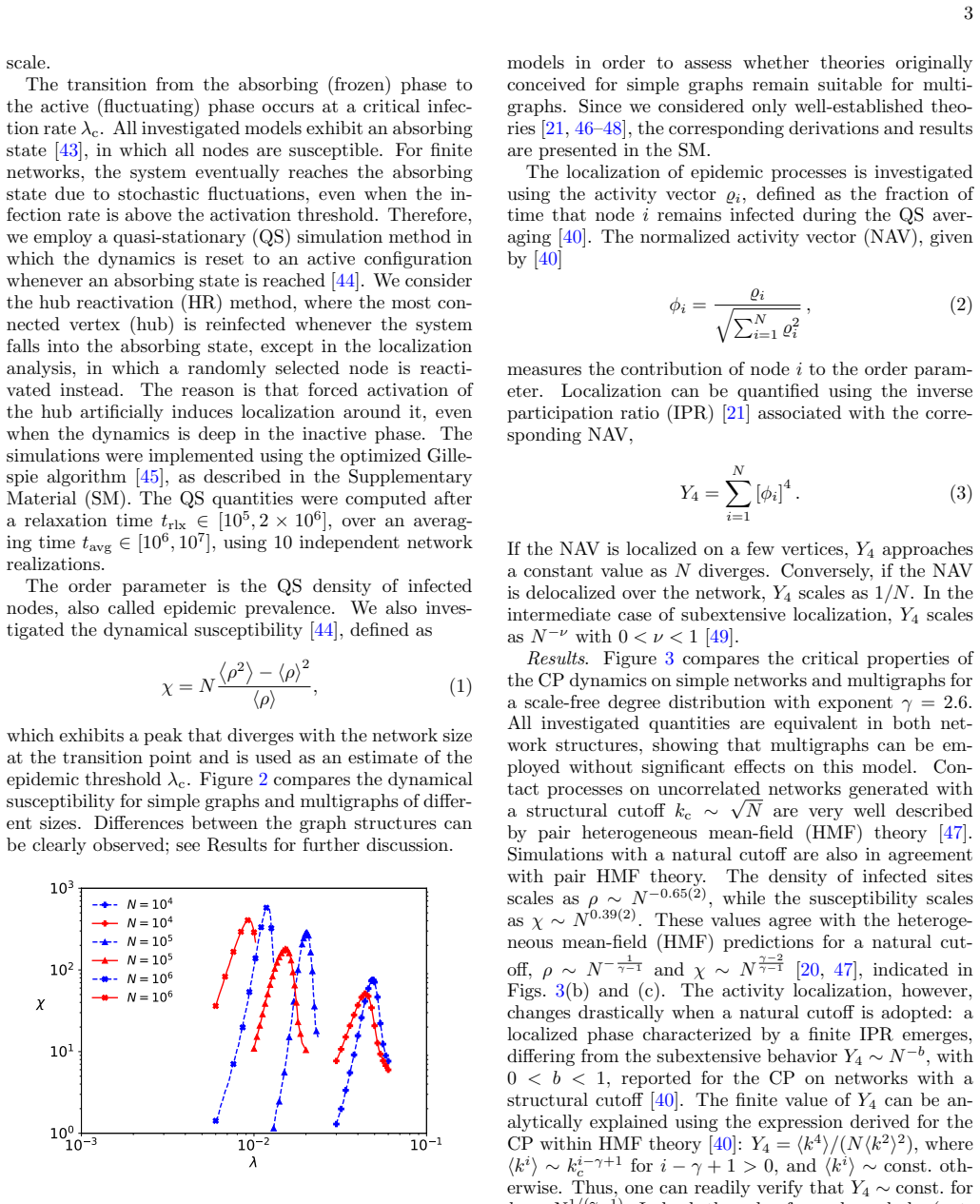
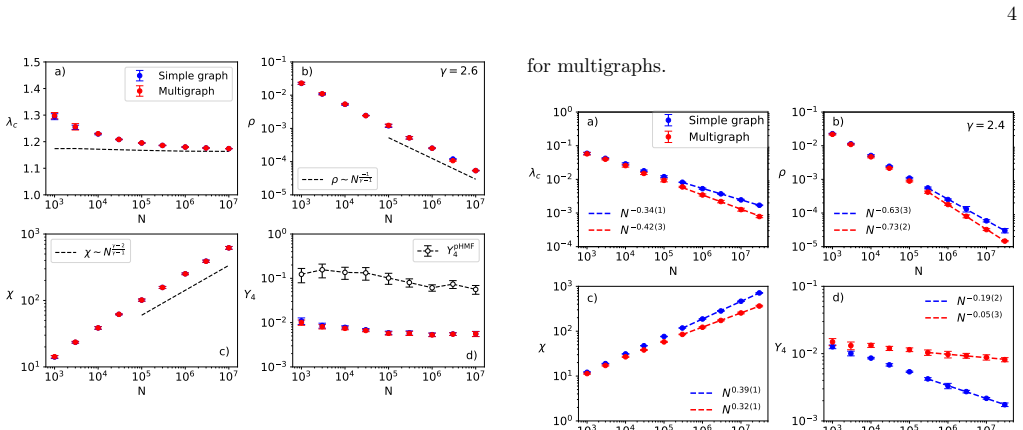
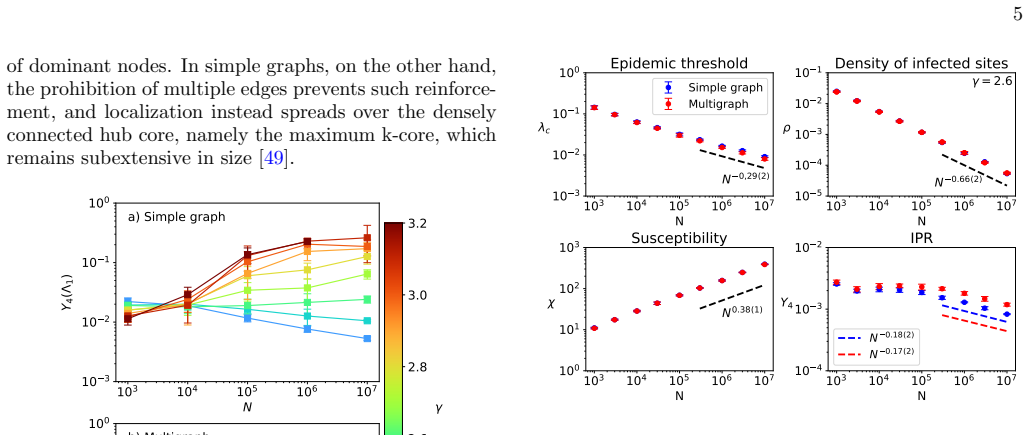
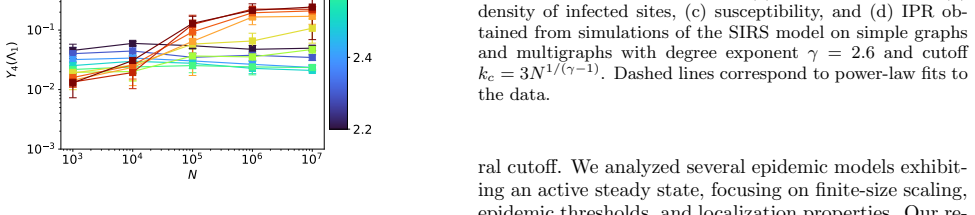
read the original abstract
Multigraphs are graphs in which multiple links between pairs of nodes are allowed, whereas they are forbidden in simple graphs, the latter being widely used in network science. Simple graphs generated by the configuration model have served as a benchmark for validating theoretical approaches to dynamical processes on networks. However, generating large scale-free networks with degree exponent $\gamma<3$ introduces uncontrolled disassortative correlations and severe computational limitations due to the prohibition of reconnecting hubs. These constraints do not exist in multigraphs. We investigate how multiple connections affect epidemic spreading by comparing several epidemic models exhibiting an active steady state on simple graphs and multigraphs sharing the same degree sequence and natural upper cutoff. By analyzing epidemic thresholds, finite-size scaling, and localization, we show that differences between simple graphs and multigraphs emerge only when epidemic activity can persist on isolated hubs (star subgraphs) for times exponentially long in the hub degree. Our results remove a methodological barrier to the study of dynamical processes on large scale-free networks.
Editorial analysis
A structured set of objections, weighed in public.
Referee Report
Summary. The manuscript compares epidemic spreading on multigraphs versus simple graphs that share the same degree sequence and natural upper cutoff. It examines several epidemic models that possess an active steady state on both graph classes. The central claim is that differences in epidemic thresholds, finite-size scaling, and localization between the two classes appear exclusively in the regime where epidemic activity persists for times exponentially long in the degree of isolated hubs (star subgraphs). The work concludes that this condition removes a methodological barrier to studying dynamical processes on large scale-free networks with γ < 3.
Significance. If the central claim is substantiated by the finite-size scaling and localization analysis, the result is significant for network epidemiology and statistical physics of complex networks. It supplies an explicit, testable criterion (exponential persistence on hubs) that delineates when the prohibition of multiple edges matters, thereby justifying the use of multigraphs as a computationally tractable benchmark for large scale-free networks. The paper gives credit to the configuration-model literature while clarifying its scope.
major comments (2)
- [epidemic models section] § on epidemic models and steady-state assumption: the claim that the selected models exhibit an active steady state on both simple graphs and multigraphs with identical degree sequence and cutoff is load-bearing for the entire comparison; the manuscript should provide an explicit verification (analytic or numerical) that the steady-state existence is independent of the simple/multigraph distinction rather than asserted from the abstract.
- [finite-size scaling] Finite-size scaling analysis: the reported scaling collapse and the identification of the regime where differences emerge rely on the natural upper cutoff being identical; any post-hoc adjustment of the cutoff between the two graph ensembles would undermine the cross-graph comparison and must be shown to be absent.
minor comments (2)
- [localization arguments] Notation for the hub-persistence time scale should be introduced once and used consistently when contrasting the exponential versus sub-exponential regimes.
- [abstract and methods] The abstract states that 'several epidemic models' are compared; a brief table or enumerated list of the specific models (SIS, SIR variants, etc.) and their parameters would improve readability.
Simulated Author's Rebuttal
We thank the referee for the positive evaluation and the recommendation of minor revision. We address the two major comments below and will incorporate the requested clarifications.
read point-by-point responses
-
Referee: [epidemic models section] § on epidemic models and steady-state assumption: the claim that the selected models exhibit an active steady state on both simple graphs and multigraphs with identical degree sequence and cutoff is load-bearing for the entire comparison; the manuscript should provide an explicit verification (analytic or numerical) that the steady-state existence is independent of the simple/multigraph distinction rather than asserted from the abstract.
Authors: We agree that an explicit verification is warranted. In the revised manuscript we will add a short subsection (or appendix) containing both a brief analytic argument based on the heterogeneous mean-field rate equations (which depend only on the degree sequence) and numerical confirmation that the chosen models reach a non-zero steady-state density on both ensembles for the same parameters and cutoff. revision: yes
-
Referee: [finite-size scaling] Finite-size scaling analysis: the reported scaling collapse and the identification of the regime where differences emerge rely on the natural upper cutoff being identical; any post-hoc adjustment of the cutoff between the two graph ensembles would undermine the cross-graph comparison and must be shown to be absent.
Authors: The natural upper cutoff is fixed by the prescribed degree sequence and is therefore identical by construction for both the simple-graph and multigraph ensembles. We will add an explicit statement to this effect together with a supplementary panel confirming that the realized degree distributions (including the largest degree) coincide exactly, thereby ruling out any post-hoc adjustment. revision: yes
Circularity Check
No significant circularity; derivation is self-contained
full rationale
The paper compares epidemic thresholds, finite-size scaling, and localization between simple graphs and multigraphs that share the same degree sequence and cutoff, under the explicit scope that both support an active steady state. No equations reduce any claimed distinction to a fitted parameter or self-definition by construction. No self-citation chains are invoked as load-bearing uniqueness theorems. The central result—that differences appear only when activity persists exponentially long on isolated hubs—is presented as an outcome of the direct comparison rather than an input assumption. This is the normal case of an independent analysis.
Axiom & Free-Parameter Ledger
axioms (1)
- standard math Configuration model generates graphs (simple or multi) with a prescribed degree sequence and natural upper cutoff.
Reference graph
Works this paper leans on
-
[1]
Barab´ asi and M
A.-L. Barab´ asi and M. P´ osfai,Network science (Cam- bridge University Press, 2016)
2016
-
[2]
Boccaletti, P
S. Boccaletti, P. D. Lellis, C. I. del Genio, K. Alfaro- Bittner, R. Criado, S. Jalan, and M. Romance, The struc- ture and dynamics of networks with higher order inter- actions (2023)
2023
-
[3]
Masuda and R
N. Masuda and R. Lambiotte, A Guide to Temporal Networks, Vol. 4 (WORLD SCIENTIFIC (EUROPE), 2016)
2016
-
[4]
Multilayer network science: theory, methods, and applications
A. Aleta, A. S. Teixeira, G. F. de Arruda, A. Baronchelli, A. Barrat, J. Kert´ esz, A. D´ ıaz-Guilera, O. Artime, M. Starnini, G. Petri, M. Karsai, S. Patwardhan, A. Vespignani, Y. Moreno, and S. Fortunato, Multi- layer network science: theory, methods, and applications, arXiv preprint arXiv:2511.23371 (2026)
work page internal anchor Pith review Pith/arXiv arXiv 2026
-
[5]
Pastor-Satorras, C
R. Pastor-Satorras, C. Castellano, P. V. Mieghem, and A. Vespignani, Epidemic processes in complex networks, Reviews of Modern Physics87, 925 (2015)
2015
-
[6]
Moreno, M
Y. Moreno, M. Nekovee, and A. F. Pacheco, Dynamics of rumor spreading in complex networks, Physical Review E69, 066130 (2004)
2004
-
[7]
G. F. de Arruda, L. G. S. Jeub, A. S. Mata, F. A. Ro- drigues, and Y. Moreno, From subcritical behavior to a correlation-induced transition in rumor models, Nature Communications13, 3049 (2022)
2022
-
[8]
Opinion dynamics: Statistical physics and beyond
M. Starnini, F. Baumann, T. Galla, D. Garcia, G. I˜ niguez, M. Karsai, J. Lorenz, and K. Sznajd-Weron, Opinion dynamics: Statistical physics and beyond, arXiv preprint arXiv:2507.11521 (2025)
work page internal anchor Pith review Pith/arXiv arXiv 2025
-
[9]
F. A. Rodrigues, T. K. D. Peron, P. Ji, and J. Kurths, The kuramoto model in complex networks, Physics Re- ports610, 1 (2016)
2016
-
[10]
S. N. Dorogovtsev and J. F. F. Mendes, The nature of complex networks (Oxford University Press, 2022) p. 481
2022
-
[11]
Barrat, M
A. Barrat, M. Barth´ elemy, and A. Vespignani, Dynamical Processes on Complex Networks (Cambridge University Press, 2008)
2008
-
[12]
W. Wang, M. Tang, H. E. Stanley, and L. A. Braun- stein, Unification of theoretical approaches for epidemic spreading on complex networks, Reports on Progress in Physics80, 036603 (2017)
2017
-
[13]
D. H. Silva, S. C. Ferreira, W. Cota, R. Pastor-Satorras, and C. Castellano, Spectral properties and the accu- racy of mean-field approaches for epidemics on correlated power-law networks, Physical Review Research1, 033024 (2019)
2019
-
[14]
T. E. Harris, Contact interactions on a lattice, The An- nals of Probability2, 969 (1974)
1974
-
[15]
H. Hong, M. Ha, and H. Park, Finite-size scaling in complex networks, Physical Review Letters98, 258701 (2007)
2007
-
[16]
Castellano and R
C. Castellano and R. Pastor-Satorras, Non-mean-field behavior of the contact process on scale-free networks, Physical Review Letters96, 038701 (2006)
2006
-
[17]
non-mean- field behavior of the contact process on scale-free net- works
M. Ha, H. Hong, and H. Park, Comment on “non-mean- field behavior of the contact process on scale-free net- works”, Physical Review Letters98, 029801 (2007)
2007
-
[18]
Castellano and R
C. Castellano and R. Pastor-Satorras, Castellano and pastor-satorras reply:, Physical Review Letters98, 029802 (2007)
2007
-
[19]
Castellano and R
C. Castellano and R. Pastor-Satorras, Routes to thermo- dynamic limit on scale-free networks, Physical Review Letters100, 148701 (2008)
2008
-
[20]
S. C. Ferreira, R. S. Ferreira, C. Castellano, and R. Pastor-Satorras, Quasistationary simulations of the contact process on quenched networks, Physical Review E84, 066102 (2011)
2011
-
[21]
A. V. Goltsev, S. N. Dorogovtsev, J. G. Oliveira, and J. F. F. Mendes, Localization and spreading of diseases in complex networks, Physical Review Letters109, 128702 (2012)
2012
-
[22]
Bogu˜ n´ a, C
M. Bogu˜ n´ a, C. Castellano, and R. Pastor-Satorras, Nature of the epidemic threshold for the susceptible- infected-susceptible dynamics in networks, Physical Re- view Letters111, 068701 (2013)
2013
-
[23]
H. K. Lee, P.-S. Shim, and J. D. Noh, Epidemic threshold of the susceptible-infected-susceptible model on complex networks, Physical Review E87, 062812 (2013)
2013
-
[24]
Castellano and R
C. Castellano and R. Pastor-Satorras, Cumulative merg- ing percolation and the epidemic transition of the susceptible-infected-susceptible model in networks, Phys- ical Review X10, 011070 (2020)
2020
-
[25]
A. S. Mata and S. C. Ferreira, Multiple transitions of the susceptible-infected-susceptible epidemic model on com- plex networks, Physical Review E91, 012816 (2015). 7
2015
-
[26]
Pastor-Satorras and A
R. Pastor-Satorras and A. Vespignani, Epidemic dynam- ics and endemic states in complex networks, Physical Re- view E63, 066117 (2001)
2001
-
[27]
Holme, B
P. Holme, B. J. Kim, C. N. Yoon, and S. K. Han, Attack vulnerability of complex networks, Physical Review E65, 056109 (2002)
2002
-
[28]
Bollob´ as,Modern Graph Theory, Vol
B. Bollob´ as,Modern Graph Theory, Vol. 184 (Springer New York, 1998)
1998
-
[29]
Molloy and B
M. Molloy and B. Reed, A critical point for random graphs with a given degree sequence, Random Structures & Algorithms6, 161 (1995)
1995
-
[30]
Bogu˜ n´ a, R
M. Bogu˜ n´ a, R. Pastor-Satorras, and A. Vespignani, Cut- offs and finite size effects in scale-free networks, The Eu- ropean Physical Journal B - Condensed Matter38, 205 (2004)
2004
-
[31]
Newman, Networks (Oxford University PressOxford, 2018)
M. Newman, Networks (Oxford University PressOxford, 2018)
2018
-
[32]
M. E. J. Newman, Assortative mixing in networks, Phys- ical Review Letters89, 208701 (2002)
2002
-
[33]
Catanzaro, M
M. Catanzaro, M. Bogu˜ n´ a, and R. Pastor-Satorras, Gen- eration of uncorrelated random scale-free networks, Phys- ical Review E71, 027103 (2005)
2005
-
[34]
W. Cota, A. S. Mata, and S. C. Ferreira, Robustness and fragility of the susceptible-infected-susceptible epi- demic models on complex networks, Physical Review E 98, 012310 (2018)
2018
-
[35]
S. C. Ferreira, C. Castellano, and R. Pastor- Satorras, Epidemic thresholds of the susceptible-infected- susceptible model on networks: A comparison of numeri- cal and theoretical results, Physical Review E86, 041125 (2012)
2012
-
[36]
Moreno, J
Y. Moreno, J. B. G´ omez, and A. F. Pacheco, Epidemic incidence in correlated complex networks, Physical Re- view E68, 035103 (2003)
2003
-
[37]
Chen, S.-M
X.-H. Chen, S.-M. Cai, W. Wang, M. Tang, and H. E. Stanley, Predicting epidemic threshold of correlated net- works: A comparison of methods, Physica A: Statistical Mechanics and its Applications505, 500 (2018)
2018
-
[38]
Bogu˜ n´ a, C
M. Bogu˜ n´ a, C. Castellano, and R. Pastor-Satorras, Langevin approach for the dynamics of the contact pro- cess on annealed scale-free networks, Physical Review E 79, 036110 (2009)
2009
-
[39]
Guerra and J
B. Guerra and J. G´ omez-Garde˜ nes, Annealed and mean- field formulations of disease dynamics on static and adap- tive networks, Physical Review E82, 035101 (2010)
2010
-
[40]
D. H. Silva and S. C. Ferreira, Dissecting localization phenomena of dynamical processes on networks, Journal of Physics: Complexity2, 025011 (2021)
2021
-
[41]
S. C. Ferreira, R. S. Sander, and R. Pastor-Satorras, Col- lective versus hub activation of epidemic phases on net- works, Physical Review E93, 032314 (2016)
2016
-
[42]
M. J. Keeling and P. Rohani, Modeling Infectious Diseases in Humans and Animals (Princeton University Press, 2008)
2008
-
[43]
S. L. M. Henkel, H. Hinrichsen, Non-Equilibrium Phase Transitions, edited by S. Dor- drecht (Springer Netherlands, 2008)
2008
-
[44]
R. S. Sander, G. S. Costa, and S. C. Ferreira, Sampling methods for the quasistationary regime of epidemic pro- cesses on regular and complex networks, Physical Review E94, 042308 (2016)
2016
-
[45]
Cota and S
W. Cota and S. C. Ferreira, Optimized Gillespie algo- rithms for the simulation of markovian epidemic pro- cesses on large and heterogeneous networks, Computer Physics Communications219, 303 (2017)
2017
-
[46]
A. S. Mata and S. C. Ferreira, Pair quenched mean- field theory for the susceptible-infected-susceptible model on complex networks, EPL (Europhysics Letters)103, 48003 (2013)
2013
-
[47]
A. S. Mata, R. S. Ferreira, and S. C. Ferreira, Hetero- geneous pair-approximation for the contact process on complex networks, New Journal of Physics16, 053006 (2014)
2014
-
[48]
J. C. M. Silva, D. H. Silva, F. A. Rodrigues, and S. C. Fer- reira, Comparison of theoretical approaches for epidemic processes with waning immunity in complex networks, Physical Review E106, 034317 (2022)
2022
-
[49]
R. Pastor-Satorras and C. Castellano, Distinct types of eigenvector localization in networks, Scientific Reports6, 10.1038/srep18847 (2016). 8 Supplementary Material: Epidemic spreading on multigraphs DEGREE CORRELA TIONS Correlations are characterized using the average nearest-neighbor degreek nn(k) as a function of degreek[1]. For uncorrelated networks,...
discussion (0)
Sign in with ORCID, Apple, or X to comment. Anyone can read and Pith papers without signing in.