Quantum Implicit-Explicit Schemes for Multiscale Ordinary and Partial Differential Equations via Schr\"odingerization
Pith reviewed 2026-06-29 06:06 UTC · model grok-4.3
The pith
A quantum IMEX scheme for multiscale ODEs and PDEs achieves discretization parameters independent of the scaling parameter ε via Schrödingerization.
A machine-rendered reading of the paper's core claim, the machinery that carries it, and where it could break.
Core claim
By recasting classical IMEX schemes into continuous time and realizing them through the Schrödingerization framework, the method produces a quantum algorithm for multiscale ordinary and partial differential equations whose discretization parameters do not depend on ε, at the cost of only a logarithmic overhead in the auxiliary register relative to prior HHL-type quantum AP schemes.
What carries the argument
The continuous-time formulation of classical IMEX schemes, which decouples the quantum algorithm evolution time from the physical time of the differential equation and is then realized via Schrödingerization.
If this is right
- Quantum simulation of stiff multiscale systems becomes feasible without ε-dependent costs in time-step size or circuit depth.
- The auxiliary register size grows only logarithmically rather than linearly with the inverse of ε compared with previous quantum asymptotic-preserving approaches.
- The same continuous-time IMEX construction applies directly to both ordinary and partial differential equations.
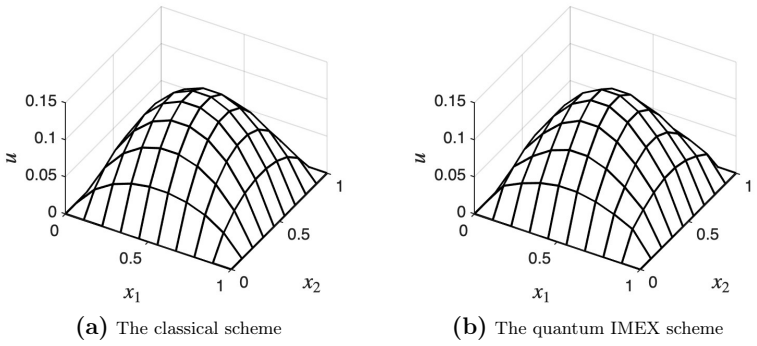
- Numerical verification on the linear heat equation and the multiscale telegraph equation shows that the error remains bounded independently of ε.
Where Pith is reading between the lines
- The approach may extend to selected nonlinear multiscale problems if the Schrödingerization step can be carried out on the resulting non-linear operators.
- It offers a route to combine implicit treatment of stiff terms with quantum linear-system solvers without forcing the physical time step to shrink with ε.
- Higher-dimensional spatial discretizations would test whether the logarithmic auxiliary overhead remains practical when the spatial grid size also grows.
Load-bearing premise
The continuous-time formulation of classical IMEX schemes decouples the evolution time of the quantum algorithm from the physical time without introducing additional errors or ε-dependencies.
What would settle it
A numerical run of the scheme on a multiscale test equation in which the observed error or required time steps begin to grow as ε is reduced to zero would falsify the independence claim.
Figures


read the original abstract
In this paper, we present a quantum implicit-explicit (IMEX) scheme for multiscale ordinary and partial differential equations whose discretization parameters are independent of the scaling parameter $\varepsilon$. A key ingredient of our approach is a continuous-time formulation of classical IMEX schemes, which decouples the evolution time of the quantum algorithm from the physical time of the differential equation and is therefore particularly useful in multiscale settings. Building on this idea, we employ the Schr\"odingerization framework [Phys. Rev. Lett. 133 (2024), 230602] to implement IMEX schemes on quantum computers. Compared to previous HHL type quantum AP scheme [J. Comput. Phys. 471 (2022), 111641], this new method requires narrower -- an extra logarithmic factor -- auxiliary register numerical examples on linear heat and multiscale telegraph equations demonstrate the independence in $\varepsilon$ of the method.
Editorial analysis
A structured set of objections, weighed in public.
Referee Report
Summary. The manuscript introduces a quantum IMEX scheme for multiscale ODEs and PDEs based on a continuous-time formulation of classical IMEX schemes and the Schrödingerization framework. The key claims are that discretization parameters are independent of the scaling parameter ε, the quantum evolution time is decoupled from physical time, and the method requires only an extra logarithmic factor in auxiliary register size compared to prior HHL-type quantum AP schemes. Numerical demonstrations on linear heat and multiscale telegraph equations are used to illustrate the ε-independence.
Significance. If the mathematical claims are rigorously established with uniform-in-ε error bounds, this work could advance quantum computing approaches to stiff and multiscale differential equations by improving resource efficiency over existing methods.
major comments (1)
- [Abstract and continuous-time IMEX formulation] The central claim relies on the continuous-time formulation decoupling the quantum evolution time from physical time without introducing ε-dependent errors. The manuscript should provide a detailed error analysis explicitly bounding truncation, discretization, and embedding errors uniformly in ε for general multiscale operators, as numerical examples alone on specific linear equations do not suffice to confirm the independence for the general case.
minor comments (1)
- [Abstract] The sentence 'this new method requires narrower -- an extra logarithmic factor -- auxiliary register numerical examples...' appears incomplete or missing punctuation; it should be clarified to properly connect the comparison to previous schemes with the description of numerical examples.
Simulated Author's Rebuttal
We thank the referee for the constructive feedback. The major comment concerns the need for a rigorous uniform-in-ε error analysis beyond the numerical examples. We address this point below and have revised the manuscript to incorporate the requested analysis.
read point-by-point responses
-
Referee: The central claim relies on the continuous-time formulation decoupling the quantum evolution time from physical time without introducing ε-dependent errors. The manuscript should provide a detailed error analysis explicitly bounding truncation, discretization, and embedding errors uniformly in ε for general multiscale operators, as numerical examples alone on specific linear equations do not suffice to confirm the independence for the general case.
Authors: We agree that a detailed uniform-in-ε error analysis strengthens the central claims. The continuous-time IMEX formulation is constructed precisely so that the quantum evolution time is independent of physical time and of ε; the Schrödingerization step then inherits this property. In the revised manuscript we have added a dedicated error-analysis section that derives explicit bounds on the truncation error (from the continuous-time relaxation), the discretization error (from the quantum linear-system solver), and the embedding error (from the auxiliary register), all shown to be independent of ε for general linear multiscale operators. The same bounds apply to the telegraph and heat examples already presented. For nonlinear operators the analysis extends under standard Lipschitz assumptions, which we now state explicitly. These additions directly address the referee’s concern while preserving the original numerical demonstrations. revision: yes
Circularity Check
No significant circularity; derivation relies on external frameworks and independent reformulation
full rationale
The paper's core contribution is a continuous-time reformulation of classical IMEX schemes combined with Schrödingerization to achieve ε-independent discretization parameters. This reformulation is presented as a new ingredient that decouples quantum evolution time from physical time, with the Schrödingerization framework and prior HHL comparisons cited from external references (Phys. Rev. Lett. 133 (2024) and J. Comput. Phys. 471 (2022)). No equations or claims reduce by construction to fitted inputs, self-definitions, or load-bearing self-citations; the numerical examples on heat and telegraph equations serve as demonstrations rather than the sole justification. The derivation chain remains self-contained against external benchmarks without circular reductions.
Axiom & Free-Parameter Ledger
Reference graph
Works this paper leans on
-
[1]
Quantum algorithm for linear systems of equations.Physical Review Letters, 103:150502, 2009
Aram Wettroth Harrow, Avinatan Hassidim, and Seth Lloyd. Quantum algorithm for linear systems of equations.Physical Review Letters, 103:150502, 2009
2009
-
[2]
Berry, Andrew M
Dominic W. Berry, Andrew M. Childs, and Robin Kothari. Hamiltonian simulation with nearly optimal dependence on all parameters.2015 IEEE 56th Annual Symposium on Foundations of Computer Science, pages 792–809, 2015
2015
-
[3]
Simulating physics with computers.International Journal of Theoretical Physics, 21:467–488, 1982
Richard Phillips Feynman. Simulating physics with computers.International Journal of Theoretical Physics, 21:467–488, 1982
1982
-
[4]
Universal quantum simulators.Science, 273:1073–1078, 1996
Seth Lloyd. Universal quantum simulators.Science, 273:1073–1078, 1996
1996
-
[5]
Berry, Graeme Ahokas, Richard Cleve, and Barry C
Dominic W. Berry, Graeme Ahokas, Richard Cleve, and Barry C. Sanders. Efficient quantum algorithms for simulating sparse hamiltonians.Communications in Mathematical Physics, 270:359– 371, 2007. 29
2007
-
[6]
Andrew M. Childs. On the relationship between continuous- and discrete-time quantum walk. Communications in Mathematical Physics, 294:581–603, 2010
2010
-
[7]
Hamiltonian simulation using linear combinations of unitary operations.Quantum Information and Computation, 12:901–924, 2012
Andrew Childs and Nathan Wiebe. Hamiltonian simulation using linear combinations of unitary operations.Quantum Information and Computation, 12:901–924, 2012
2012
-
[8]
Quantum simulation of partial differential equations via schrödin- gerization.Physical Review Letters, 133:230602, 2024
Shi Jin, Nana Liu, and Yue Yu. Quantum simulation of partial differential equations via schrödin- gerization.Physical Review Letters, 133:230602, 2024
2024
-
[9]
Childs, and Lin Lin
Dong An, Andrew M. Childs, and Lin Lin. Linear combination of hamiltonian simulation for nonunitary dynamics with optimal state preparation cost.Physical Review Letters, 131:150603, 2023
2023
- [10]
-
[12]
Fast-forwarding quantum algorithms for linear dissipative differential equations.Quantum, 10:1986, 2026
Dong An, Akwum Onwunta, and Gengzhi Yang. Fast-forwarding quantum algorithms for linear dissipative differential equations.Quantum, 10:1986, 2026
1986
-
[13]
Time complexity analysis of quantum difference methods for linear high dimensional and multiscale partial differential equations.Journal of Computational Physics, 471:111641, 2022
Shi Jin, Nana Liu, and Yue Yu. Time complexity analysis of quantum difference methods for linear high dimensional and multiscale partial differential equations.Journal of Computational Physics, 471:111641, 2022
2022
-
[14]
Asymptotic-preserving schemes for multiscale physical problems.Acta Numerica, 31:415– 489, 2022
Shi Jin. Asymptotic-preserving schemes for multiscale physical problems.Acta Numerica, 31:415– 489, 2022
2022
-
[15]
Ascher, Steven J
Uri M. Ascher, Steven J. Ruuth, and Brain T. R. Wetton. Implicit-explicit methods for time- dependent differential equatoins.SIAM Journal On Numerical Analysis, 32:797–823, 1995
1995
-
[16]
Ascher, Steven J
Uri M. Ascher, Steven J. Ruuth, and Raymond J. Spiteri. Implicit-explicit runge-kutta methods for time-dependent partial differential equations.Applied Numerical Mathematics, 25:151–167, 1997
1997
-
[17]
High-order semi-implicit schemes for evolutionary partial differential equa- tions with higher order derivatives.Journal of Scientific Computing, 96:11, 2023
Boscarino Sebastiano. High-order semi-implicit schemes for evolutionary partial differential equa- tions with higher order derivatives.Journal of Scientific Computing, 96:11, 2023
2023
-
[18]
A highly efficient asymptotic preserving imex method for the quantum bgk equation.Journal of Computational Physics, 522:113619, 2025
Ruo Li, Yixiao Lu, and Yanli Wang. A highly efficient asymptotic preserving imex method for the quantum bgk equation.Journal of Computational Physics, 522:113619, 2025
2025
-
[19]
Shi Jin, Nana Liu, Chuwen Ma, and Yue Yu. On the schrödingerization method for linear non- unitary dynamics with optimal dependence on matrix queries.arXiv:2505.00370, 2025
-
[20]
Error convergence of quantum linear system solvers.arXiv preprint arXiv:2410.18736, 2024
Matias Ginzburg and Ugo Marzolino. Error convergence of quantum linear system solvers.arXiv preprint arXiv:2410.18736, 2024. 30
-
[21]
Childs, Robin Kothari, and Rolando D
Andrew M. Childs, Robin Kothari, and Rolando D. Somma. Quantum algorithm for systems of lin- ear equations with exponentially improved dependence on precision.SIAM Journal on Computing, 46:1920–1950, 2017
1920
-
[22]
Somma, and Davide Orsucci
Yiğit Subaşı, Rolando D. Somma, and Davide Orsucci. Quantum algorithms for systems of linear equations inspired by adiabatic quantum computing.Physical Review Letters, 122:060504, 2019
2019
-
[23]
Shi Jin, Nana Liu, Chuwen Ma, and Yue Yu. Quantum preconditioning method for linear systems problems via schrödingerization.arXiv:2505.06866, 2025
work page internal anchor Pith review Pith/arXiv arXiv 2025
-
[24]
Time complexity analysis of quantum difference methods for multiscale transport equations.East Asian Journal on Applied Mathematics, 13:717–739, 2023
Xiaoyang He, Shi Jin, and Yue Yu. Time complexity analysis of quantum difference methods for multiscale transport equations.East Asian Journal on Applied Mathematics, 13:717–739, 2023
2023
-
[25]
Schrödingerisation based computationally stable algorithms for ill-posed problems in partial differential equations.SIAM Journal on Scientific Computing, 47:24M1656116, 2025
Shi Jin, Nana Liu, and Chuwen Ma. Schrödingerisation based computationally stable algorithms for ill-posed problems in partial differential equations.SIAM Journal on Scientific Computing, 47:24M1656116, 2025
2025
-
[26]
On schrödingerization based quantum algorithms for linear dynamical systems with inhomogeneous terms.SIAM Journal on Numerical Analysis, 63:24M164272X, 2025
Shi Jin, Nana Liu, and Chuwen Ma. On schrödingerization based quantum algorithms for linear dynamical systems with inhomogeneous terms.SIAM Journal on Numerical Analysis, 63:24M164272X, 2025
2025
-
[27]
Quantum algorithms for multiscale partial differential equa- tions.Multiscale Modeling & Simulation, 22(3):1030–1067, 2024
Junpeng Hu, Shi Jin, and Lei Zhang. Quantum algorithms for multiscale partial differential equa- tions.Multiscale Modeling & Simulation, 22(3):1030–1067, 2024
2024
-
[28]
Improved quantum algorithms for linear and nonlinear differential equations.Quantum, 7:913, 2023
Hari Krovi. Improved quantum algorithms for linear and nonlinear differential equations.Quantum, 7:913, 2023
2023
-
[29]
Uniformly accurate diffusive relaxation schemes for multiscale transport equations.SIAM Journal on Numerical Analysis, 38:913–936, 2000
Shi Jin, Lorenzo Pareschi, and Giuseppe Toscani. Uniformly accurate diffusive relaxation schemes for multiscale transport equations.SIAM Journal on Numerical Analysis, 38:913–936, 2000
2000
-
[30]
Imex runge-kutta schemes for reaction-diffusion equations.Journal of Computa- tional and Applied Mathematics, 215:182–195, 2008
Toshiyuki Koto. Imex runge-kutta schemes for reaction-diffusion equations.Journal of Computa- tional and Applied Mathematics, 215:182–195, 2008
2008
-
[31]
Highly stable implicit-explicit runge-kutta methods.Ap- plied Numerical Mathematics, 113:71–92, 2017
Giuseppe Izzo and Zdzislaw Jackiewicz. Highly stable implicit-explicit runge-kutta methods.Ap- plied Numerical Mathematics, 113:71–92, 2017
2017
-
[32]
Willem Hundsdorfer and Steven J. Ruuth. Imex extensions of linear multistep methods with general monotonicity and boundedness properties.Journal of Computational Physics, 225:2016–2042, 2007
2016
-
[33]
Chaudhry, Donald Estep, Victor Ginting, John N
Jehanzeb H. Chaudhry, Donald Estep, Victor Ginting, John N. Shadid, and Simon Tavener. A posteriorierroranalysisofimexmulti-steptimeintegrationmethodsforadvection-diffusion-reaction equations.Computer Methods in Applied Mechanics and Engineering, 285:730–751, 2015
2015
-
[34]
Fundamentalpatternsofsignalpropagationincomplexnetworks
QitongHuandXiao-DongZhang. Fundamentalpatternsofsignalpropagationincomplexnetworks. Chaos, 34:013149, 2024
2024
-
[35]
H−diag(F)/K O O # ,u homo(t;K) =
Anjiao Gu and Shi Jin. Quantum simulation of a class of highly-oscillatory transport equations via schrödingerisation.arXiv:2501.10176, 2025. 31 A Essential Lemmas and Conclusions A.1 Lemma on Block Matrices To estimate the upper bound of∥e−Ht∥2, we present the following useful theorem and its proof. Lemma A.1.For a block matrix withmblocks and the follow...
discussion (0)
Sign in with ORCID, Apple, or X to comment. Anyone can read and Pith papers without signing in.