Rowmotion on hook and two-row alt ν-Tamari lattices
Pith reviewed 2026-06-29 06:51 UTC · model grok-4.3
The pith
Orbit structures under rowmotion on alt hook-Tamari and two-row Tamari lattices stay the same regardless of the increment vector δ.
A machine-rendered reading of the paper's core claim, the machinery that carries it, and where it could break.
Core claim
We explicitly determine the orbit structures of H_δ(a,b) and T_δ(a,b) under rowmotion, and prove that their orbit structures are independent of the increment vector δ. As a consequence, we show that rowmotion on H_δ(a,b) exhibits the cyclic sieving phenomenon. We also compute orbit sums for several natural statistics; all of these except the area statistic are homometric under rowmotion.
What carries the argument
The switching property for semidistributive lattices, which equates the orbit structures arising from different increment vectors by local comparison of covering relations.
If this is right
- Rowmotion on every alt hook-Tamari lattice H_δ(a,b) satisfies cyclic sieving for any choice of δ.
- The sums of the down-degree, peak, and valley statistics over orbits are independent of δ in both families.
- Orbit sums can be computed once for a convenient increment vector and then reused for all others.
- The homometric property holds for the listed statistics on the hook and two-row families.
Where Pith is reading between the lines
- The same independence argument may apply to other families of alt ν-Tamari lattices once a suitable switching relation is identified.
- Homometric statistics under rowmotion could be used to produce new q-analogues or generating functions that are invariant under the action.
- The local modification technique used for the hook Hasse diagrams might extend to other graded posets with simple covering relations.
Load-bearing premise
The switching property introduced for semidistributive lattices holds and lets one transfer orbit information directly between different increment vectors in the two-row setting.
What would settle it
An explicit pair of distinct increment vectors δ and δ' together with parameters a,b such that the multiset of orbit lengths under rowmotion on H_δ(a,b) differs from the multiset on H_δ'(a,b).
Figures


read the original abstract
In 2024, Ceballos and Chenevi{\`e}re introduced alt $\nu$-Tamari lattices, parameterized by a lattice path $\nu$ and an increment vector $\delta$, as a common generalization of $\nu$-Tamari and $\nu$-Dyck lattices. We study rowmotion on two families: the alt hook-Tamari lattice $\mathsf{H}_{\delta}(a,b)$ (where $\nu=EN^{a-1}E^{b-1}N$) and the alt $2$-row-Tamari lattice $\mathsf{T}_{\delta}(a,b)$ (where $\nu=E^aNE^bN$). We explicitly determine the orbit structures of $\mathsf{H}_{\delta}(a,b)$ and $\mathsf{T}_{\delta}(a,b)$ under rowmotion, and prove that their orbit structures are independent of the increment vector $\delta$. As a consequence, we show that rowmotion on $\mathsf{H}_{\delta}(a,b)$ exhibits the cyclic sieving phenomenon. We also compute orbit sums for several natural statistics. In the hook case, we evaluate the down-degree, peak, valley, and area statistics; in the $2$-row case, we focus on the down-degree statistic. All of these -- except for the area statistic -- are homometric under rowmotion. Regarding the methodology of this paper, our results in the hook case are obtained by applying a simple local modification to their Hasse diagrams. In the $2$-row case, we introduce a switching property for semidistributive lattices, which allows us to compare the orbit structures arising from different increment vectors.
Editorial analysis
A structured set of objections, weighed in public.
Referee Report
Summary. The manuscript determines the orbit structures of rowmotion on the alt hook-Tamari lattices H_δ(a,b) (ν = EN^{a-1}E^{b-1}N) and alt two-row Tamari lattices T_δ(a,b) (ν = E^a N E^b N). It proves these structures are independent of the increment vector δ, establishes that rowmotion on H_δ(a,b) exhibits the cyclic sieving phenomenon, and computes orbit sums for the down-degree, peak, valley, and area statistics in the hook case and down-degree in the two-row case, showing homometry under rowmotion for all except area. Proofs rely on local Hasse-diagram modifications for the hook family and a newly introduced switching property for semidistributive lattices in the two-row case.
Significance. If the claims hold, the work supplies explicit orbit data for rowmotion on these generalized Tamari lattices and introduces a switching property that enables parameter-independent comparisons. The δ-independence result and the CSP corollary are substantive if the arguments are complete; the homometric statistics provide additional concrete information on statistic behavior. The local-modification approach for hooks is self-contained and the switching property may have wider use in lattice dynamics.
major comments (1)
- [switching property definition and application (two-row case)] The switching property for semidistributive lattices (introduced to equate orbit structures across different δ in the two-row case) is load-bearing for the δ-independence claim on T_δ(a,b) and the subsequent CSP corollary. The manuscript must verify explicitly that the property transfers the full cycle index (cycle lengths and multiplicities), not merely a coarser invariant such as the number of orbits.
minor comments (2)
- Notation for the lattices is introduced as alt ν-Tamari in the abstract but the title uses alt ν-Tamari; ensure consistent spelling and capitalization throughout.
- The abstract states that all statistics except area are homometric; the manuscript should clarify whether this holds uniformly for both families or only where computed.
Simulated Author's Rebuttal
We thank the referee for their careful reading and for highlighting the need for explicit verification of the switching property. We address the single major comment below and will revise the manuscript accordingly.
read point-by-point responses
-
Referee: The switching property for semidistributive lattices (introduced to equate orbit structures across different δ in the two-row case) is load-bearing for the δ-independence claim on T_δ(a,b) and the subsequent CSP corollary. The manuscript must verify explicitly that the property transfers the full cycle index (cycle lengths and multiplicities), not merely a coarser invariant such as the number of orbits.
Authors: The switching property (Definition 4.2) is constructed as a bijection φ between the underlying sets of T_δ(a,b) and T_δ'(a,b) that is a lattice isomorphism for the semidistributive structure and satisfies φ ∘ rowmotion_δ = rowmotion_δ' ∘ φ. Because rowmotion is defined uniformly via the join and meet operations of the lattice, the commuting relation directly implies that φ maps orbits to orbits while preserving their lengths and multiplicities; the cycle index is therefore identical. The explicit orbit structures are first computed for a convenient choice of δ and then transferred via this isomorphism. We agree that a dedicated lemma stating “the switching map induces an equivariant bijection of dynamical systems, hence identical cycle indices” would make the argument fully transparent, and we will insert this lemma (with a short proof) in the revised version. revision: yes
Circularity Check
No circularity; derivation self-contained via new combinatorial arguments
full rationale
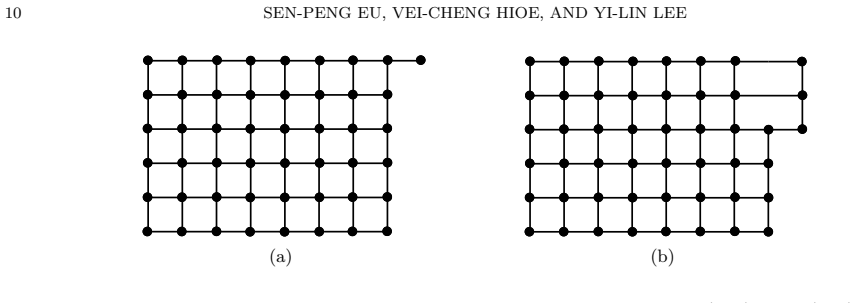
The paper introduces and applies a switching property on semidistributive lattices to equate orbit structures across increment vectors δ in the two-row case T_δ(a,b), while the hook case H_δ(a,b) uses independent local Hasse-diagram modifications. These steps are presented as newly proven combinatorial facts rather than reductions to prior fits, self-definitions, or self-citation chains; the δ-independence and cyclic sieving claims therefore rest on self-contained arguments without the enumerated circularity patterns.
Axiom & Free-Parameter Ledger
axioms (1)
- domain assumption Semidistributive lattices admit a switching property that preserves orbit structures under rowmotion for different increment vectors
Reference graph
Works this paper leans on
-
[1]
Invariance of r owmotion for variants of the tamari lattice, In prepa- ration, 2026
Ben Adenbaum, Emily Barnard, Cesar Ceballos, Cl´ ement C henevi` ere, Colin Defant, Sam Hopkins, Matthias M¨ uller, Martin Rubey, and Jessica Striker. Invariance of r owmotion for variants of the tamari lattice, In prepa- ration, 2026
2026
-
[2]
Rowmotion on 321-avoid ing permutations
Ben Adenbaum and Sergi Elizalde. Rowmotion on 321-avoid ing permutations. Electron. J. Combin. , 30(3):Paper No. 3.5, 26, 2023
2023
-
[3]
The canonical join complex
Emily Barnard. The canonical join complex. Electron. J. Combin. , 26(1):Paper No. 1.24, 25, 2019
2019
-
[4]
Higher trivariate diagonal harmonics via generalize d Tamari posets
Fran¸ cois Bergeron and Louis-Fran¸cois Pr´ eville-Ratelle. Higher trivariate diagonal harmonics via generalize d Tamari posets. J. Comb. , 3(3):317–341, 2012
2012
-
[5]
On linear intervals in the alt ν-Tamari lattices
Cesar Ceballos and Cl´ ement Chenevi` ere. On linear intervals in the alt ν-Tamari lattices. Comb. Theory, 4(2):Paper No. 18, 31, 2024
2024
-
[6]
The ν-Tamari lattice via ν-trees, ν-bracket vectors, and subword complexes
Cesar Ceballos, Arnau Padrol, and Camilo Sarmiento. The ν-Tamari lattice via ν-trees, ν-bracket vectors, and subword complexes. Electron. J. Combin. , 27(1):Paper No. 1.14, 31, 2020
2020
-
[7]
Sagan, and Zach Stewart
Pranjal Dangwal, Jamie Kimble, Jinting Liang, Jianzhi L ou, Bruce E. Sagan, and Zach Stewart. Rowmotion on rooted trees. S´ em. Lothar. Combin., 88:Art. B88a, 21, [2023–2024]
2023
-
[8]
Rowmotion on m-Tamari and biCambrian lattices
Colin Defant and James Lin. Rowmotion on m-Tamari and biCambrian lattices. Comb. Theory , 4(1):Paper No. 15, 46, 2024
2024
-
[9]
Semidistrim lattices
Colin Defant and Nathan Williams. Semidistrim lattices . Forum Math. Sigma , 11:Paper No. e50, 35, 2023
2023
-
[10]
Sergi Elizalde, Matthew Plante, Tom Roby, and Bruce E. S agan. Rowmotion on fences. Algebr. Comb., 6(1):17–36, 2023
2023
-
[11]
The enumeration of generalized Tamari intervals
Louis-Fran¸ cois Pr´ eville-Ratelle and Xavier Viennot. The enumeration of generalized Tamari intervals. Trans. Amer. Math. Soc. , 369(7):5219–5239, 2017
2017
-
[12]
Homomesy in products of two cha ins
James Propp and Tom Roby. Homomesy in products of two cha ins. Electron. J. Combin. , 22(3):Paper 3.4, 29, 2015
2015
-
[13]
Reiner, D
V. Reiner, D. Stanton, and D. White. The cyclic sieving p henomenon. J. Combin. Theory Ser. A , 108(1):17–50, 2004
2004
-
[14]
Richard P. Stanley. Enumerative combinatorics. Volume 1 , volume 49 of Cambridge Studies in Advanced Mathe- matics. Cambridge University Press, Cambridge, second edition, 2 012
-
[15]
The algebra of bracketings and their enumer ation
Dov Tamari. The algebra of bracketings and their enumer ation. Nieuw Arch. Wisk. (3) , 10:131–146, 1962
1962
-
[16]
Thomas and N
H. Thomas and N. Williams. Rowmotion in slow motion. Proc. Lond. Math. Soc. (3) , 119(5):1149–1178, 2019
2019
-
[17]
Framing lattices an d flow polytopes
Matias von Bell and Cesar Ceballos. Framing lattices an d flow polytopes. S´ em. Lothar. Combin., 91B:Art. 98, 12, 2024
2024
-
[18]
Framing Lattices and Flow Polytopes
Matias von Bell and Cesar Ceballos. Framing lattices an d flow polytopes, 2025. https://arxiv.org/abs/2512.20575. (S.-P. Eu) Department of Mathematics, National Taiw an Norm al University, Taipei, Taiw an Email address : speu@math.ntnu.edu.tw (V.-C. Hioe) Department of Mathematics, National Taiw an No rmal University, Taipei, Taiw an Email address : Victor...
work page internal anchor Pith review Pith/arXiv arXiv 2025
discussion (0)
Sign in with ORCID, Apple, or X to comment. Anyone can read and Pith papers without signing in.