Charmonium production at SPS and FAIR energies
Pith reviewed 2026-06-29 06:53 UTC · model grok-4.3
The pith
The Remler formalism with an in-medium heavy quark potential describes charmonium production at SPS energies.
A machine-rendered reading of the paper's core claim, the machinery that carries it, and where it could break.
Core claim
The Remler formalism, implemented within PHSD and supplied with an in-medium heavy-quark potential in which the J/ψ dissociates near Tc, reproduces the measured charmonium yields in heavy-ion collisions at SPS energies once the nuclear absorption cross section extracted from p+A collisions is inserted; the same framework is then applied to predict charmonium production at GSI/FAIR energies.
What carries the argument
Remler formalism for charmonium production and dissociation, combined with an in-medium heavy-quark potential inside the PHSD transport model.
If this is right
- Charmonium suppression at SPS is accounted for by the in-medium potential without extra medium-dependent adjustments.
- The same nuclear absorption cross section and potential can be used to forecast charmonium yields at GSI/FAIR beam energies.
- Baryon-rich matter effects on charmonium are captured through the temperature-dependent dissociation near Tc.
- The approach supplies a consistent baseline for comparing SPS data with future FAIR measurements.
Where Pith is reading between the lines
- If the FAIR predictions hold, the same potential may govern quarkonium behavior in other dense baryonic environments such as neutron-star mergers.
- The framework could be tested by extending it to bottomonium states under identical SPS and FAIR conditions.
- Discrepancies between the model and new FAIR data would point to additional baryon-density-dependent dissociation channels not included here.
Load-bearing premise
The nuclear absorption cross section fitted to p+A data can be used unchanged in heavy-ion collisions once the chosen in-medium potential is active.
What would settle it
A measurement of J/ψ or ψ' yields in central Pb+Pb collisions at SPS energies that lies significantly outside the band predicted by the Remler formalism with the in-medium potential.
Figures




read the original abstract
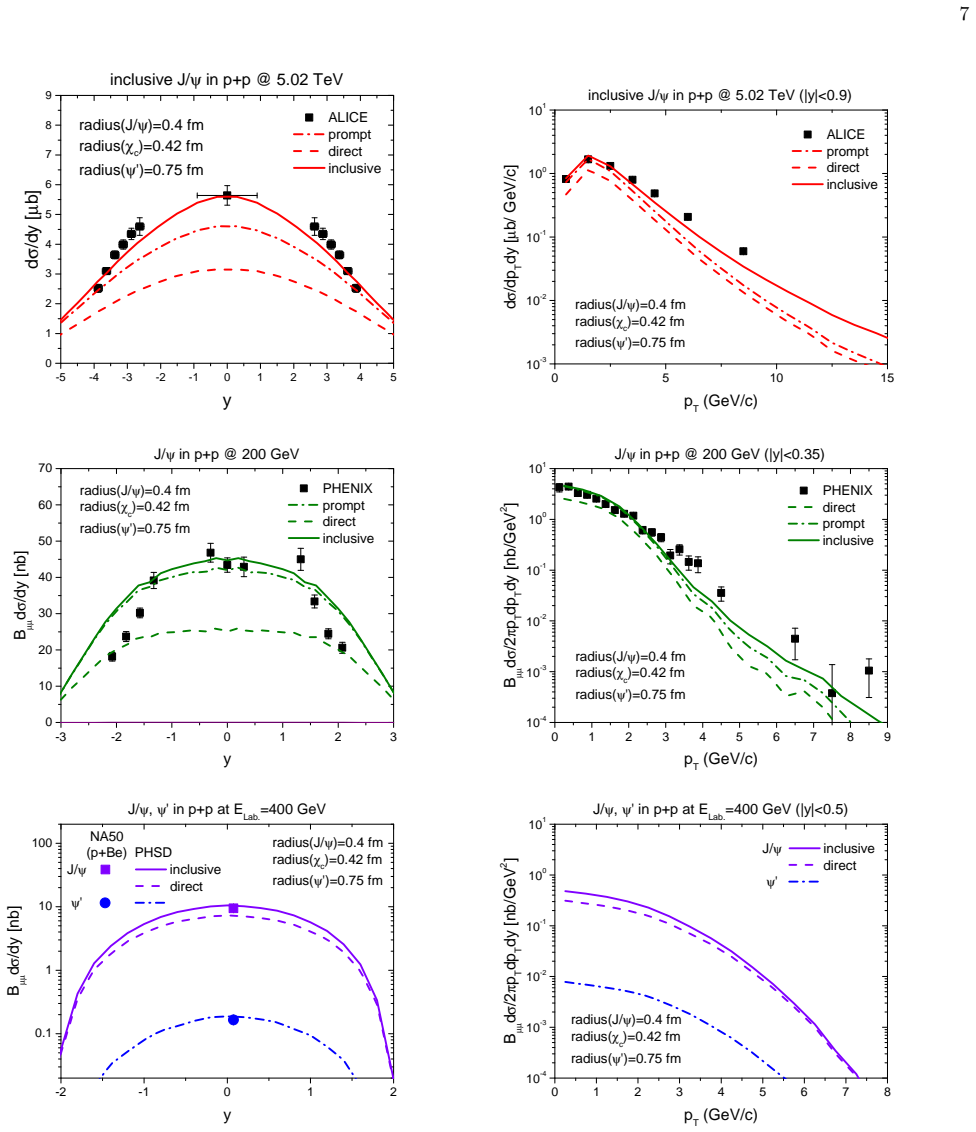
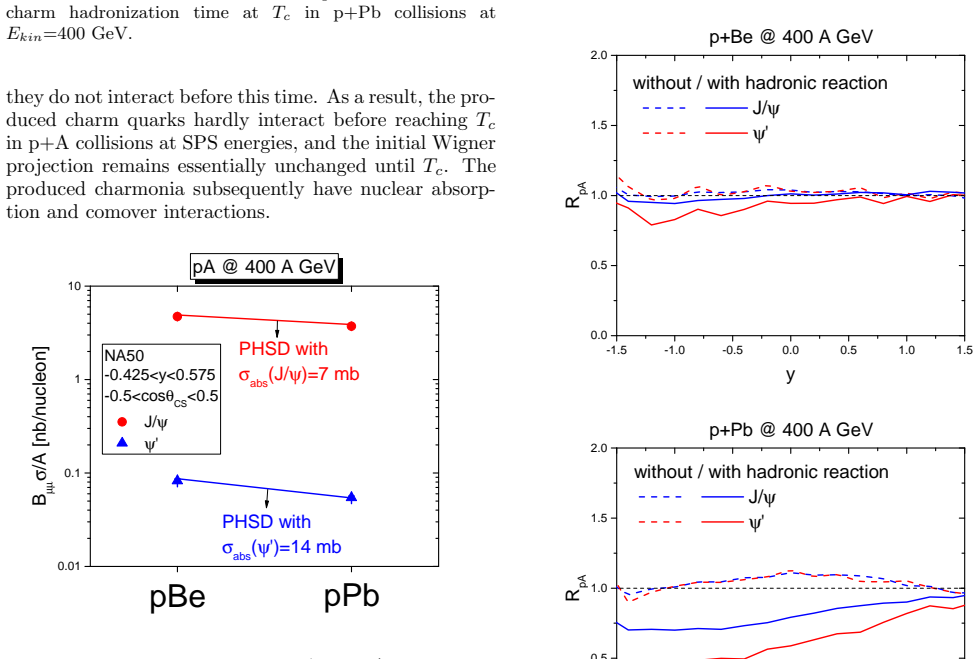
In this study we apply the Remler formalism to charmonium production at SPS and GSI/FAIR energies in order to investigate the effects of baryon-rich matter on charmonium production and dissociation in heavy-ion collisions within the Parton-Hadron-String Dynamics (PHSD). As a first step the Remler formalism is tested in p+p collisions and then applied to p+A collisions in order to extract the nuclear absorption cross section of charmonium, which is then utilized in heavy-ion collisions. We find that the Remler formalism successfully describes charmonium production in heavy-ion collisions at SPS energies when an in-medium heavy quark potential is implemented, in which $J/\psi$ dissociates near $T_c$. Finally the same formalism is applied to the GSI/FAIR energies, where we estimate charmonium production.
Editorial analysis
A structured set of objections, weighed in public.
Referee Report
Summary. The manuscript applies the Remler formalism inside the PHSD transport model to charmonium production and dissociation. It first validates the approach in p+p collisions, extracts a nuclear absorption cross section from p+A data, inserts that cross section into A+A calculations at SPS energies together with an in-medium heavy-quark potential that dissociates J/ψ near Tc, and finally estimates charmonium yields at GSI/FAIR energies.
Significance. If the transfer of the absorption cross section proves valid, the work would supply evidence that the Remler formalism plus a temperature-dependent potential can account for SPS charmonium data in baryon-rich matter and would furnish concrete predictions for the lower beam energies accessible at FAIR.
major comments (2)
- [Abstract; p+A to A+A application] Abstract and the section describing the transition from p+A to A+A collisions: the nuclear absorption cross section is fitted to p+A data and then used unchanged in the heavy-ion calculation; this data-driven parameter directly controls the SPS description, yet the manuscript provides no sensitivity study or additional justification for the assumption that cold-nuclear-matter absorption remains unmodified by the finite-temperature, baryon-rich environment beyond the chosen in-medium potential.
- [Heavy-ion collisions at SPS energies] Heavy-ion results section: the claim of successful description at SPS energies is stated without quantitative metrics (χ², error bands, or comparison to alternative potentials), rendering the central assertion only partially verifiable from the presented material.
minor comments (1)
- [Abstract] The abstract would benefit from a brief statement of the numerical values obtained for the nuclear absorption cross section and the in-medium potential parameters.
Simulated Author's Rebuttal
We thank the referee for the constructive comments on our manuscript. We address each major point below and indicate the planned revisions.
read point-by-point responses
-
Referee: [Abstract; p+A to A+A application] Abstract and the section describing the transition from p+A to A+A collisions: the nuclear absorption cross section is fitted to p+A data and then used unchanged in the heavy-ion calculation; this data-driven parameter directly controls the SPS description, yet the manuscript provides no sensitivity study or additional justification for the assumption that cold-nuclear-matter absorption remains unmodified by the finite-temperature, baryon-rich environment beyond the chosen in-medium potential.
Authors: We agree that the transfer of the absorption cross section merits explicit justification and a sensitivity analysis. In the revised manuscript we will add a dedicated paragraph explaining why cold-nuclear-matter absorption is expected to remain largely unmodified (with the temperature-dependent potential handling hot-medium dissociation) and will include a sensitivity study in which the cross section is varied within its p+A uncertainty range, showing the resulting variation in SPS yields. revision: yes
-
Referee: [Heavy-ion collisions at SPS energies] Heavy-ion results section: the claim of successful description at SPS energies is stated without quantitative metrics (χ², error bands, or comparison to alternative potentials), rendering the central assertion only partially verifiable from the presented material.
Authors: We accept that quantitative metrics are needed for verifiability. The revised version will report χ² values (or χ²/dof) for the comparison to SPS charmonium data, include error bands on the theoretical curves where statistics permit, and add a brief comparison to results obtained with an alternative (constant) heavy-quark potential to illustrate the role of the in-medium dissociation. revision: yes
Circularity Check
No significant circularity in derivation chain
full rationale
The paper extracts a nuclear absorption cross section from p+A data for use in A+A calculations at SPS energies, alongside the Remler formalism, PHSD transport, and an in-medium heavy-quark potential with J/ψ dissociation near Tc. This is a standard parameter transfer between collision systems rather than any reduction of the A+A result to the p+A input by construction; the A+A description incorporates additional independent dynamics and is tested against separate data, remaining falsifiable. No self-definitional steps, fitted inputs renamed as predictions, self-citation load-bearing arguments, uniqueness theorems, or ansatz smuggling are present in the provided text. The central claim retains independent content from the model components.
Axiom & Free-Parameter Ledger
free parameters (1)
- nuclear absorption cross section
Reference graph
Works this paper leans on
-
[1]
Matsui and H
T. Matsui and H. Satz, Phys. Lett. B178, 416 (1986)
1986
-
[2]
The widths of quarkonia in quark gluon plasma
Y. Park, K.-I. Kim, T. Song, S. H. Lee, and C.-Y. Wong, Phys. Rev. C76, 044907 (2007), 0704.3770
work page internal anchor Pith review Pith/arXiv arXiv 2007
-
[3]
T. Song, Y. Park, S. H. Lee, and C.-Y. Wong, Phys. Lett. B659, 621 (2008), 0709.0794
work page internal anchor Pith review Pith/arXiv arXiv 2008
-
[4]
Real-time static potential in hot QCD
M. Laine, O. Philipsen, P. Romatschke, and M. Tassler, JHEP03, 054 (2007), hep-ph/0611300
work page internal anchor Pith review Pith/arXiv arXiv 2007
-
[5]
M. L. Bellac,Thermal Field Theory, Cambridge Mono- graphs on Mathematical Physics (Cambridge University Press, 2011), ISBN 978-0-511-88506-8, 978-0-521-65477- 7
2011
- [6]
-
[7]
J/psi and eta_c in the nuclear medium: QCD sum rule approach
F. Klingl, S.-s. Kim, S. H. Lee, P. Morath, and W. Weise, Phys. Rev. Lett.82, 3396 (1999), [Erratum: Phys.Rev.Lett. 83, 4224 (1999)], nucl-th/9811070
work page internal anchor Pith review Pith/arXiv arXiv 1999
-
[8]
$J/\psi$-Nucleon Scattering Length and In-medium Mass Shift of $J/\psi$ in QCD Sum Rule Analysis
A. Hayashigaki, Prog. Theor. Phys.101, 923 (1999), nucl-th/9811092
work page internal anchor Pith review Pith/arXiv arXiv 1999
-
[9]
S.-s. Kim and S. H. Lee, Nucl. Phys. A679, 517 (2001), nucl-th/0002002
work page internal anchor Pith review Pith/arXiv arXiv 2001
-
[10]
D mesons in matter and the in-medium properties of charmonium
B. Friman, S. H. Lee, and T. Song, Phys. Lett. B548, 153 (2002), nucl-th/0207006
work page internal anchor Pith review Pith/arXiv arXiv 2002
-
[11]
A. Hayashigaki, Phys. Lett. B487, 96 (2000), nucl- th/0001051
-
[12]
String Breaking and Quarkonium Dissociation at Finite Temperatures
S. Digal, P. Petreczky, and H. Satz, Phys. Lett. B514, 57 (2001), hep-ph/0105234
work page internal anchor Pith review Pith/arXiv arXiv 2001
-
[13]
A. Bazavov, D. Hoying, R. N. Larsen, S. Mukherjee, P. Petreczky, A. Rothkopf, and J. H. Weber (HotQCD), Phys. Rev. D109, 074504 (2024), 2308.16587
-
[14]
Heavy quark free energies and the renormalized Polyakov loop in full QCD
O. Kaczmarek, S. Ejiri, F. Karsch, E. Laermann, and F. Zantow, Prog. Theor. Phys. Suppl.153, 287 (2004), hep-lat/0312015
work page internal anchor Pith review Pith/arXiv arXiv 2004
-
[15]
Static quark-antiquark potential in the quark-gluon plasma from lattice QCD
Y. Burnier, O. Kaczmarek, and A. Rothkopf, Phys. Rev. Lett.114, 082001 (2015), 1410.2546
work page internal anchor Pith review Pith/arXiv arXiv 2015
- [16]
-
[17]
E. A. Remler and A. P. Sathe, Annals Phys.91, 295 (1975)
1975
-
[18]
E. A. Remler, Annals Phys.95, 455 (1975)
1975
-
[19]
E. A. Remler, Annals Phys.136, 293 (1981)
1981
-
[20]
T. Song, J. Aichelin, and E. Bratkovskaya, Phys. Rev. C 96, 014907 (2017), 1705.00046
work page internal anchor Pith review Pith/arXiv arXiv 2017
-
[21]
J. Zhao, P. B. Gossiaux, T. Song, E. Bratkovskaya, and J. Aichelin, Nuovo Cim. C48, 5 (2025)
2025
- [22]
- [23]
- [24]
-
[25]
Parton transport and hadronization from the dynamical quasiparticle point of view
W. Cassing and E. L. Bratkovskaya, Phys. Rev. C78, 034919 (2008), 0808.0022
work page internal anchor Pith review Pith/arXiv arXiv 2008
-
[26]
Parton-Hadron-String Dynamics: an off-shell transport approach for relativistic energies
W. Cassing and E. L. Bratkovskaya, Nucl. Phys. A831, 215 (2009), 0907.5331
work page internal anchor Pith review Pith/arXiv arXiv 2009
- [27]
-
[28]
E. L. Bratkovskaya and W. Cassing, Nucl. Phys. A807, 214 (2008), 0712.0635
work page internal anchor Pith review Pith/arXiv arXiv 2008
-
[29]
O. Linnyk, E. L. Bratkovskaya, and W. Cassing, Prog. Part. Nucl. Phys.87, 50 (2016), 1512.08126
work page internal anchor Pith review Pith/arXiv arXiv 2016
- [30]
-
[31]
Open charm production in relativistic nucleus-nucleus collisions
W. Cassing, E. L. Bratkovskaya, and A. Sibirtsev, Nucl. Phys. A691, 753 (2001), nucl-th/0010071
work page internal anchor Pith review Pith/arXiv arXiv 2001
-
[32]
E. L. Bratkovskaya, W. Cassing, and H. Stoecker, Phys. Rev. C67, 054905 (2003), nucl-th/0301083
work page internal anchor Pith review Pith/arXiv arXiv 2003
-
[33]
T. Sjostrand, S. Mrenna, and P. Z. Skands, JHEP05, 026 (2006), hep-ph/0603175
work page internal anchor Pith review Pith/arXiv arXiv 2006
-
[34]
The p_T Spectrum in Heavy-Flavour Hadroproduction
M. Cacciari, M. Greco, and P. Nason, JHEP05, 007 (1998), hep-ph/9803400
work page internal anchor Pith review Pith/arXiv arXiv 1998
-
[35]
The p_T Spectrum in Heavy-Flavour Photoproduction
M. Cacciari, S. Frixione, and P. Nason, JHEP03, 006 (2001), hep-ph/0102134
work page internal anchor Pith review Pith/arXiv arXiv 2001
-
[36]
T. Song, H. Berrehrah, D. Cabrera, J. M. Torres-Rincon, L. Tolos, W. Cassing, and E. Bratkovskaya, Phys. Rev. C92, 014910 (2015), 1503.03039
work page internal anchor Pith review Pith/arXiv arXiv 2015
-
[37]
T. Song, H. Berrehrah, D. Cabrera, W. Cassing, and E. Bratkovskaya, Phys. Rev. C93, 034906 (2016), 1512.00891
work page internal anchor Pith review Pith/arXiv arXiv 2016
-
[38]
K. J. Eskola, H. Paukkunen, and C. A. Salgado, JHEP 04, 065 (2009), 0902.4154
work page internal anchor Pith review Pith/arXiv arXiv 2009
-
[39]
QCD thermodynamics and confinement from a dynamical quasiparticle point of view
W. Cassing, Nucl. Phys. A791, 365 (2007), 0704.1410
work page internal anchor Pith review Pith/arXiv arXiv 2007
-
[40]
Dynamical quasiparticles properties and effective interactions in the sQGP
W. Cassing, Nucl. Phys. A795, 70 (2007), 0707.3033
work page internal anchor Pith review Pith/arXiv arXiv 2007
-
[41]
O. Soloveva, P. Moreau, and E. Bratkovskaya, Phys. Rev. C101, 045203 (2020), 1911.08547
-
[42]
I. Grishmanovskii, O. Soloveva, T. Song, C. Greiner, and E. Bratkovskaya, Phys. Rev. C109, 024911 (2024), 2308.03105
- [43]
-
[44]
H. Berrehrah, P.-B. Gossiaux, J. Aichelin, W. Cassing, and E. Bratkovskaya, Phys. Rev. C90, 064906 (2014), 1405.3243
work page internal anchor Pith review Pith/arXiv arXiv 2014
- [45]
-
[46]
I. Grishmanovskii, T. Song, O. Soloveva, C. Greiner, and E. Bratkovskaya, Phys. Rev. C106, 014903 (2022), 2204.01561
-
[47]
I. Grishmanovskii, O. Soloveva, T. Song, C. Greiner, and E. Bratkovskaya, Phys. Rev. C110, 014908 (2024), 2402.04923
-
[48]
I. Grishmanovskii, T. Song, C. Greiner, and E. Bratkovskaya, Phys. Rev. D112, 014042 (2025), 2503.22311
-
[49]
Collisional processes of on-shell and off-shell heavy quarks in vacuum and in the Quark-Gluon-Plasma
H. Berrehrah, E. Bratkovskaya, W. Cassing, P. B. Gos- siaux, J. Aichelin, and M. Bleicher, Phys. Rev. C89, 054901 (2014), 1308.5148
work page internal anchor Pith review Pith/arXiv arXiv 2014
- [50]
-
[51]
Gonin et al
M. Gonin et al. (NA50), Nucl. Phys. A610, 404C (1996)
1996
-
[52]
M. C. Abreu et al. (NA50), Phys. Lett. B477, 28 (2000)
2000
-
[53]
J/Psi Suppression in Pb-Pb Collisions: A Hint of Quark-Gluon Plasma Production?
J.-P. Blaizot and J.-Y. Ollitrault, Phys. Rev. Lett.77, 1703 (1996), hep-ph/9606289
work page internal anchor Pith review Pith/arXiv arXiv 1996
- [54]
-
[55]
$J/\Psi$ suppression in nuclear collisions at SPS energies
W. Cassing and C. M. Ko, Phys. Lett. B396, 39 (1997), nucl-th/9609025
work page internal anchor Pith review Pith/arXiv arXiv 1997
-
[56]
Production and absorption of $c \bar{c}$ pairs in nuclear collisions at SPS energies
W. Cassing and E. L. Bratkovskaya, Nucl. Phys. A623, 570 (1997), hep-ph/9705257
work page internal anchor Pith review Pith/arXiv arXiv 1997
-
[57]
A quantitative reanalysis of charmonium suppression in nuclear collisions
N. Armesto and A. 1164, Phys. Lett. B430, 23 (1998), hep-ph/9705275
work page internal anchor Pith review Pith/arXiv arXiv 1998
-
[58]
Non-saturation of the J/psi suppression at large transverse energy in the comovers approach
A. Capella, E. G. Ferreiro, and A. B. Kaidalov, Phys. Rev. Lett.85, 2080 (2000), hep-ph/0002300
work page internal anchor Pith review Pith/arXiv arXiv 2080
-
[59]
Novel features of $J/\Psi$ dissociation in matter
A. Sibirtsev, K. Tsushima, K. Saito, and A. W. Thomas, Phys. Lett. B484, 23 (2000), nucl-th/9904015
work page internal anchor Pith review Pith/arXiv arXiv 2000
-
[60]
Quark exchange model for charmonium dissociation in hot hadronic matter
K. Martins, D. Blaschke, and E. Quack, Phys. Rev. C 51, 2723 (1995), hep-ph/9411302
work page internal anchor Pith review Pith/arXiv arXiv 1995
-
[61]
Model for $J/\psi$ absorption in hadronic matter
Z.-w. Lin and C. M. Ko, Phys. Rev. C62, 034903 (2000), nucl-th/9912046
work page internal anchor Pith review Pith/arXiv arXiv 2000
-
[62]
K. L. Haglin and C. Gale, Phys. Rev. C63, 065201 (2001), nucl-th/0010017
work page internal anchor Pith review Pith/arXiv arXiv 2001
-
[63]
C.-Y. Wong, E. S. Swanson, and T. Barnes, Phys. Rev. C65, 014903 (2002), [Erratum: Phys.Rev.C 66, 029901 (2002)], nucl-th/0106067
work page internal anchor Pith review Pith/arXiv arXiv 2002
- [64]
-
[65]
Y.-s. Oh, T. Song, and S. H. Lee, Phys. Rev. C63, 034901 (2001), nucl-th/0010064
work page internal anchor Pith review Pith/arXiv arXiv 2001
-
[66]
Y.-s. Oh, S. Kim, and S. H. Lee, Phys. Rev. C65, 067901 (2002), hep-ph/0111132
work page internal anchor Pith review Pith/arXiv arXiv 2002
-
[67]
Quarkonium-Hadron Interactions in Perturbative QCD
T. Song and S. H. Lee, Phys. Rev. D72, 034002 (2005), hep-ph/0501252
work page internal anchor Pith review Pith/arXiv arXiv 2005
-
[68]
(Non)Thermal Aspects of Charmonium Production and a New Look at J/$\psi$ Suppression
P. Braun-Munzinger and J. Stachel, Phys. Lett. B490, 196 (2000), nucl-th/0007059
work page internal anchor Pith review Pith/arXiv arXiv 2000
-
[69]
On Charm Production near the Phase Boundary
P. Braun-Munzinger and J. Stachel, Nucl. Phys. A690, 119 (2001), nucl-th/0012064
work page internal anchor Pith review Pith/arXiv arXiv 2001
-
[70]
R. L. Thews, M. Schroedter, and J. Rafelski, Phys. Rev. C63, 054905 (2001), hep-ph/0007323
work page internal anchor Pith review Pith/arXiv arXiv 2001
-
[71]
Charmonium Production from the Secondary Collisions at LHC Energy
P. Braun-Munzinger and K. Redlich, Eur. Phys. J. C16, 519 (2000), hep-ph/0001008
work page internal anchor Pith review Pith/arXiv arXiv 2000
-
[72]
Secondary Charmonium Production at LHC Energy
P. Braun-Munzinger and K. Redlich, Nucl. Phys. A661, 546 (1999), nucl-th/9908026
work page internal anchor Pith review Pith/arXiv arXiv 1999
-
[73]
C.-Y. Wong, E. S. Swanson, and T. Barnes, Phys. Rev. C62, 045201 (2000), hep-ph/9912431
work page internal anchor Pith review Pith/arXiv arXiv 2000
-
[74]
C. M. Ko, B. Zhang, X. N. Wang, and X. F. Zhang, Phys. Lett. B444, 237 (1998), nucl-th/9808032
work page internal anchor Pith review Pith/arXiv arXiv 1998
- [75]
- [76]
-
[77]
Open charm enhancement by secondary interactions in relativistic nucleus-nucleus collisions?
W. Cassing, L. A. Kondratyuk, G. I. Lykasov, and M. V. Rzjanin, Phys. Lett. B513, 1 (2001), hep-ph/0103073
work page internal anchor Pith review Pith/arXiv arXiv 2001
-
[78]
R. Arnaldi et al. (NA60), J. Phys. G32, S51 (2006), nucl-ex/0609039
work page internal anchor Pith review Pith/arXiv arXiv 2006
-
[79]
B. Alessandro et al. (NA50), Eur. Phys. J. C48, 329 (2006), nucl-ex/0612012
work page internal anchor Pith review Pith/arXiv arXiv 2006
-
[80]
Charmonium Suppression in Lead-Lead Collisions: Is There a Break in the $J/\psi$ Cross-Section?
N. Armesto, A. Capella, and E. G. Ferreiro, Phys. Rev. C59, 395 (1999), hep-ph/9807258
work page internal anchor Pith review Pith/arXiv arXiv 1999
discussion (0)
Sign in with ORCID, Apple, or X to comment. Anyone can read and Pith papers without signing in.