Polyakov-loop potential of accelerated gluonic matter and subtlety in thermodynamics
Pith reviewed 2026-06-29 06:43 UTC · model grok-4.3
The pith
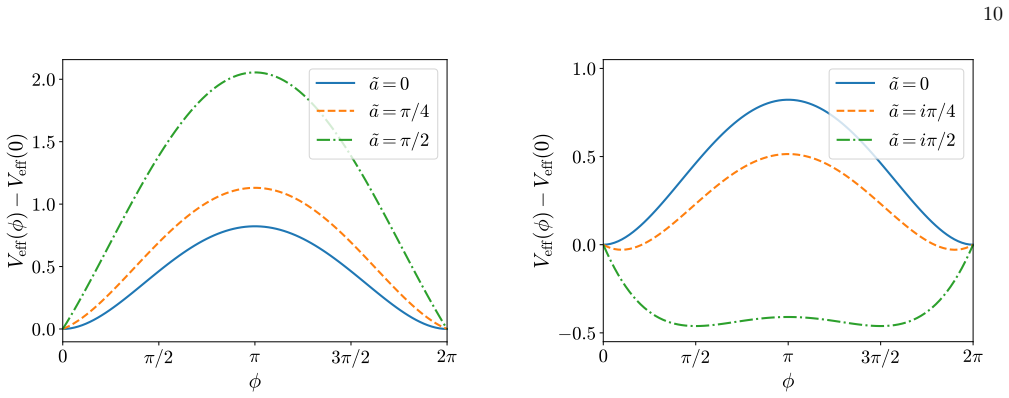
Real acceleration strengthens deconfining properties in gluonic matter when the optical metric effective potential is minimized.
A machine-rendered reading of the paper's core claim, the machinery that carries it, and where it could break.
Core claim
The central claim is that the effective potential for the Polyakov loop in accelerated gluonic matter must be taken from the optical metric formulation rather than the Rindler formulation, because the optical version corresponds to the relevant components of the energy-momentum tensor; minimizing this potential shows that real acceleration strengthens deconfining properties.
What carries the argument
The optical metric formulation of the one-loop Polyakov-loop effective potential, obtained from the Rindler metric by a conformal transformation and tied to particular energy-momentum tensor components.
If this is right
- Real acceleration enhances the deconfining tendency of the gluonic system.
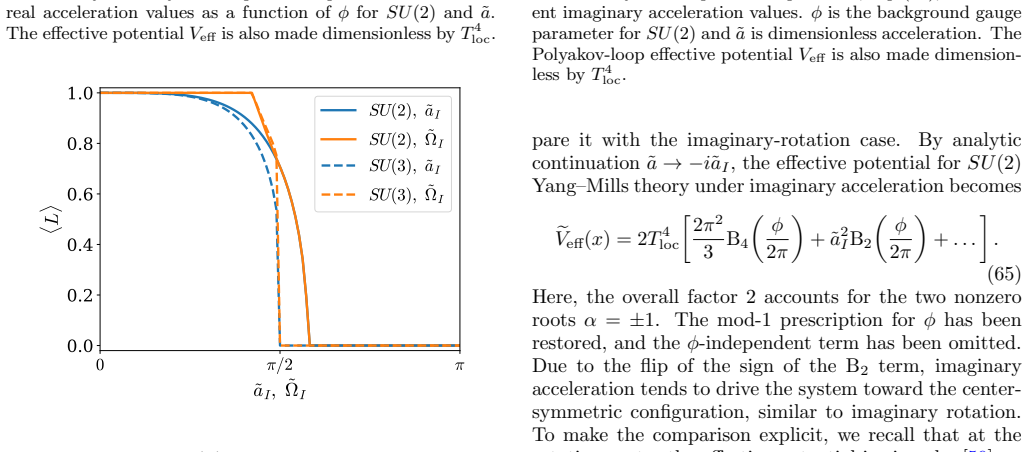
- Analytic continuation to imaginary acceleration produces a perturbatively confined phase.
- Imaginary acceleration shares some but not all features with imaginary rotation.
Where Pith is reading between the lines
- The resolution of the metric discrepancy for conical backgrounds may apply to other gauge-invariant observables.
- The distinction between the two formulations could affect thermodynamic modeling of accelerated systems in related contexts.
- The appearance of a confined phase under imaginary acceleration invites comparison with other imaginary-parameter studies in gauge theories.
Load-bearing premise
The optical-metric formulation rather than the Rindler formulation supplies the physically relevant effective potential for the Polyakov-loop expectation value.
What would settle it
A direct evaluation or lattice computation of the Polyakov-loop expectation value in real accelerated gluonic matter that finds the loop suppressed rather than enhanced with increasing acceleration.
Figures

read the original abstract
We study the one-loop Polyakov-loop effective potential in pure gluonic matter under constant acceleration. We perform the computation in both the Euclidean Rindler spacetime and the optical spacetime, which are related via a conformal transformation. The results from the two formulations correspond to physically different observables, and we clarify their connection to specific components of the energy-momentum tensor. This identification resolves a discrepancy previously noted for fields on conical backgrounds. For the Polyakov-loop expectation value, we should minimize the effective potential computed in the optical metric formulation, which concludes that real acceleration strengthens deconfining properties. We also discuss analytic continuation from real to imaginary acceleration and find a perturbatively confined phase. We point out some suggestive similarities and differences between systems under imaginary acceleration and imaginary rotation.
Editorial analysis
A structured set of objections, weighed in public.
Referee Report
Summary. The manuscript computes the one-loop Polyakov-loop effective potential in pure gluonic matter under constant acceleration in both the Euclidean Rindler spacetime and the conformally related optical spacetime. The two formulations yield results corresponding to distinct observables identified with specific components of the energy-momentum tensor, resolving a prior discrepancy for fields on conical backgrounds. The authors argue that the optical-metric potential is the physically relevant one to minimize for the Polyakov-loop expectation value, concluding that real acceleration strengthens deconfining properties. They further analyze analytic continuation to imaginary acceleration, finding a perturbatively confined phase, and note similarities and differences with imaginary rotation.
Significance. If the EMT-component identification and resulting choice of potential hold, the work clarifies a subtle thermodynamic issue in accelerated gauge theories and provides a consistent framework for the deconfinement order parameter. The explicit dual-formulation calculations, resolution of the conical discrepancy, and analytic-continuation analysis are strengths that could inform studies of QCD matter in non-inertial frames. This adds to the literature on Polyakov-loop potentials by addressing frame-dependent observables directly.
major comments (1)
- [section on EMT identification and formulation comparison] The central claim that the optical-metric effective potential should be minimized for the Polyakov-loop expectation value rests on the derived correspondence to specific EMT components (discussed in the section clarifying the connection to the energy-momentum tensor). While the paper performs the identification and uses it to select the optical result, the explicit mapping from this component to the standard minimization condition for the Polyakov loop (as the temporal Wilson-line expectation value) would benefit from a more detailed step-by-step derivation to confirm it is not affected by the conformal factor.
minor comments (3)
- The abstract and main text refer to 'specific components of the energy-momentum tensor' without a summary table or equation listing the exact correspondences (e.g., which component for Rindler vs. optical); adding this would improve clarity for readers.
- [section on analytic continuation and imaginary acceleration] In the discussion of analytic continuation from real to imaginary acceleration, the range of validity of the one-loop perturbative result for the confined phase could be stated more explicitly, including any caveats about higher-order corrections.
- [one-loop calculation sections] The one-loop computation steps involving the conformal transformation between Rindler and optical metrics would benefit from additional intermediate equations or explanatory text to aid readers unfamiliar with optical metrics in curved-space QFT.
Simulated Author's Rebuttal
We thank the referee for the positive assessment and the constructive suggestion regarding the EMT identification. We address the point below and will incorporate the requested clarification in the revised manuscript.
read point-by-point responses
-
Referee: The central claim that the optical-metric effective potential should be minimized for the Polyakov-loop expectation value rests on the derived correspondence to specific EMT components (discussed in the section clarifying the connection to the energy-momentum tensor). While the paper performs the identification and uses it to select the optical result, the explicit mapping from this component to the standard minimization condition for the Polyakov loop (as the temporal Wilson-line expectation value) would benefit from a more detailed step-by-step derivation to confirm it is not affected by the conformal factor.
Authors: We agree that an expanded derivation would strengthen the presentation. In the revised version we will add a dedicated subsection that walks through the mapping in explicit steps: (i) identification of the relevant EMT component from the optical-metric computation, (ii) its relation to the temporal Wilson-line operator via the definition of the Polyakov loop, and (iii) verification that the conformal factor does not alter the stationarity condition because it factors out of the variation with respect to the background Polyakov loop. This will confirm that the optical-metric potential remains the appropriate quantity to minimize. revision: yes
Circularity Check
No significant circularity; derivation is self-contained
full rationale
The paper performs explicit one-loop computations of the Polyakov-loop effective potential in both Euclidean Rindler and optical metrics, derives their distinct correspondences to specific energy-momentum tensor components, and uses that identification to select the optical result for minimization. This step resolves a noted discrepancy on conical backgrounds without reducing to a fitted parameter, self-citation chain, or definitional equivalence. The analytic continuation to imaginary acceleration is likewise performed directly. No load-bearing premise collapses to the paper's own inputs by construction.
Axiom & Free-Parameter Ledger
axioms (2)
- domain assumption One-loop approximation suffices to capture the leading behavior of the Polyakov-loop effective potential in accelerated gluonic matter.
- domain assumption The optical-metric formulation yields the correct effective potential whose minimum determines the Polyakov-loop expectation value.
Reference graph
Works this paper leans on
-
[1]
Instead of computing lnZ directly, it would be more instructive to compute the variation,δlnZ, in response toδσ(z)
Derivation from the EMT We shall introduce a transient variation of the metric by hand;g zz =e 2σ(z), which would not change the results if we setσ→0 at the end. Instead of computing lnZ directly, it would be more instructive to compute the variation,δlnZ, in response toδσ(z). Becauseδσ(z) depends onz, three contributions arise as −δlnZ= Z d4x √g gzz ⟨T z...
-
[2]
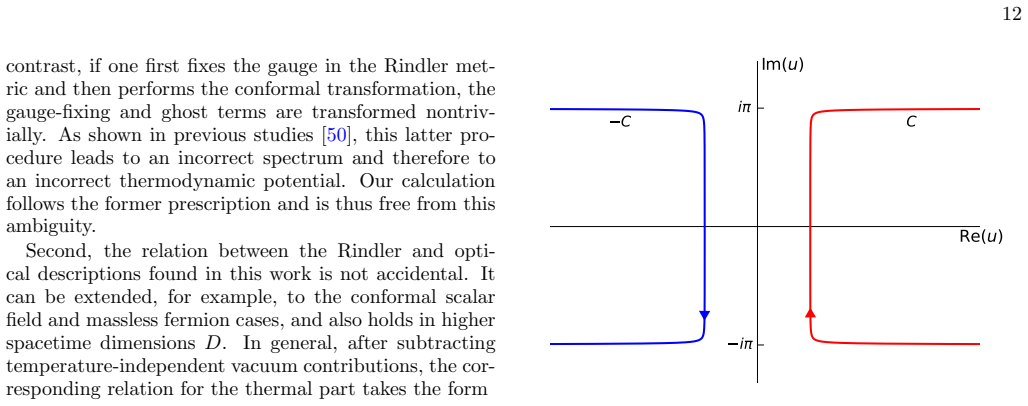
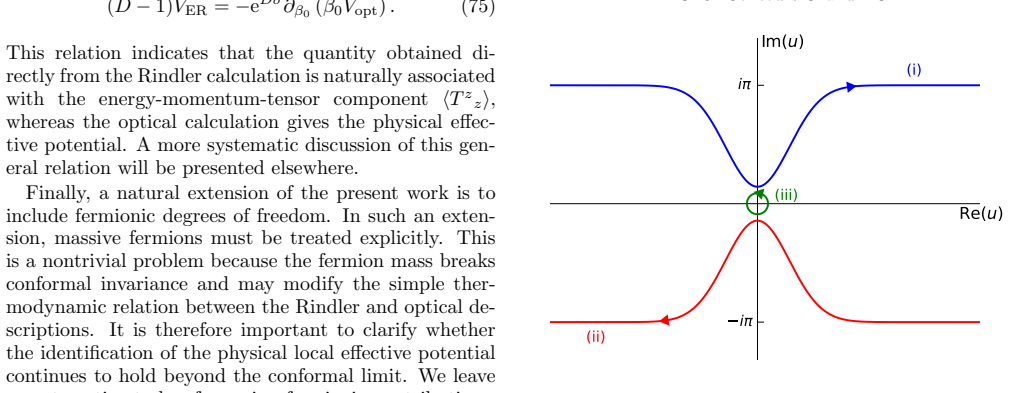
Derivation from the direct calculation With the solution of physical modes in Eq. (26), the local thermodynamic potential can be expressed in terms of the corresponding heat-kernel representation, VER =− X α,n Z d2k Z ∞ 0 dλ Z ∞ 0 ds s e−s(λ2+k2) × ∂zΦ∂zΦ∗ + (az)−2(DτΦ)(DτΦ)∗ λ2 . 7 We can perform an integration by parts and use the equa- tion of motion f...
-
[3]
Formal expressions In the optical spacetime, we will utilize the heat ker- nel method. The spatial slice (Σ 3, hij) is the hyperbolic spaceH 3 1/a of radiusL= 1/ain the Poincar´ e half-space representation, with which the curvature isR=−6a 2, whereais the acceleration of the corresponding Rindler spacetime. As we already emphasized, as a characteristic of...
-
[4]
=− Z ∞ 0 ds s T0 Kτ,th(s;ϕ)K Σ(s), (48) is satisfied for someD ′
-
[5]
Simultaneously, this regularization also keepsϕ-dependence sinceK τ,0 does not depend onϕ
Here, from our definition, the right-hand side exhibits precisely the same dependence onT 0 as the case without the regularization (i.e., in- cluding allK τ). Simultaneously, this regularization also keepsϕ-dependence sinceK τ,0 does not depend onϕ. Therefore, the regularization operatorD ′ 4 is totally ir- relevant in our thermal calculations and we can ...
-
[6]
Heat kernel expansion for ghosts and gluons For the ghosts and gluons, we consider the Laplacians for them in the optical spacetime. As in the previous calculations, the gauge field is decomposed into the back- ground part and the dynamical part asA µ =A Bµ +A µ, and then the Yang–Mills action becomes trF µνF µν =−2 trA µ G2 B Aµ + 2 trAν[∇µ,∇ ν]Aµ +O A3 ...
-
[7]
D. J. Gross, R. D. Pisarski, and L. G. Yaffe, Rev. Mod. Phys.53, 43 (1981)
1981
-
[8]
Weiss, Phys
N. Weiss, Phys. Rev. D24, 475 (1981)
1981
-
[9]
Weiss, Phys
N. Weiss, Phys. Rev. D25, 2667 (1982)
1982
-
[10]
Polyakov loop modeling for hot QCD
K. Fukushima and V. Skokov, Prog. Part. Nucl. Phys. 96, 154 (2017), arXiv:1705.00718 [hep-ph]
work page internal anchor Pith review Pith/arXiv arXiv 2017
-
[11]
From Color Glass Condensate to Quark Gluon Plasma through the event horizon
D. Kharzeev and K. Tuchin, Nucl. Phys. A753, 316 (2005), arXiv:hep-ph/0501234
work page internal anchor Pith review Pith/arXiv arXiv 2005
-
[12]
S.-Z. Zhong, X.-G. Deng, X.-G. Huang, and Y.-G. Ma, (2026), arXiv:2604.00302 [nucl-th]
- [13]
-
[14]
S. A. Fulling, Phys. Rev. D7, 2850 (1973)
1973
-
[15]
P. C. W. Davies, J. Phys. A8, 609 (1975)
1975
-
[16]
W. G. Unruh, Phys. Rev. D14, 870 (1976)
1976
-
[17]
W. G. Unruh and N. Weiss, Phys. Rev. D29, 1656 (1984)
1984
-
[18]
L. C. B. Crispino, A. Higuchi, and G. E. A. Matsas, Rev. Mod. Phys.80, 787 (2008), arXiv:0710.5373 [gr-qc]
work page internal anchor Pith review Pith/arXiv arXiv 2008
- [19]
-
[20]
Restoration of Dynamically Broken Chiral and Color Symmetries for an Accelerated Observer
D. Ebert and V. C. Zhukovsky, Phys. Lett. B645, 267 (2007), arXiv:hep-th/0612009
work page internal anchor Pith review Pith/arXiv arXiv 2007
-
[21]
Spontaneous symmetry breaking and the Unruh effect
A. Dobado, in4th International Conference on the Na- ture and Ontology of Spacetime(2017) pp. 161–173, arXiv:1703.05675 [gr-qc]
work page internal anchor Pith review Pith/arXiv arXiv 2017
-
[22]
Brout-Englert-Higgs mechanism for accelerating observers
A. Dobado, Phys. Rev. D96, 085009 (2017), arXiv:1710.01564 [gr-qc]
work page internal anchor Pith review Pith/arXiv arXiv 2017
-
[23]
Chiral symmetry breaking and the Unruh effect
A. Casado-Turri´ on and A. Dobado, in15th Marcel Gross- mann Meeting on Recent Developments in Theoretical and Experimental General Relativity, Astrophysics, and Relativistic Field Theories(2019) arXiv:1901.06964 [hep- th]
work page internal anchor Pith review Pith/arXiv arXiv 2019
-
[24]
A. Casado-Turri´ on and A. Dobado, Phys. Rev. D99, 125018 (2019), arXiv:1905.11179 [hep-ph]
work page internal anchor Pith review Pith/arXiv arXiv 2019
- [25]
-
[26]
K. Peeters and M. Zamaklar, JHEP01, 038, arXiv:0711.3446 [hep-th]
work page internal anchor Pith review Pith/arXiv arXiv
-
[27]
Temperature versus acceleration: the Unruh effect for holographic models
A. Paredes, K. Peeters, and M. Zamaklar, JHEP04, 015, arXiv:0812.0981 [hep-th]
work page internal anchor Pith review Pith/arXiv arXiv
-
[28]
Accelerated Quark and Holography for Confining Gauge theory
K. Ghoroku, M. Ishihara, K. Kubo, and T. Taminato, Phys. Rev. D83, 024020 (2011), arXiv:1010.4396 [hep- th]
work page internal anchor Pith review Pith/arXiv arXiv 2011
-
[29]
Symmetry Restoration By Acceleration
P. Castorina and M. Finocchiaro, J. Mod. Phys.3, 1703 (2012), arXiv:1207.3677 [hep-th]
work page internal anchor Pith review Pith/arXiv arXiv 2012
-
[30]
S. Takeuchi, Phys. Lett. B750, 209 (2015), arXiv:1501.07471 [hep-th]
-
[31]
Unruh effect and condensate in and out of an accelerated vacuum
S. Benic and K. Fukushima, (2015), arXiv:1503.05790 [hep-th]
work page internal anchor Pith review Pith/arXiv arXiv 2015
- [32]
- [33]
- [34]
- [35]
-
[36]
V. V. Braguta, V. A. Goy, J. Dey, and A. A. Roenko, (2026), arXiv:2602.20970 [hep-lat]
work page internal anchor Pith review Pith/arXiv arXiv 2026
-
[37]
Linet, Phys
B. Linet, Phys. Rev. D35, 536 (1987)
1987
-
[38]
D. V. Fursaev, Class. Quant. Grav.11, 1431 (1994), arXiv:hep-th/9309050
work page internal anchor Pith review Pith/arXiv arXiv 1994
-
[39]
J. S. Dowker, Class. Quant. Grav.11, L55 (1994), arXiv:hep-th/9401159
work page internal anchor Pith review Pith/arXiv arXiv 1994
-
[40]
S. N. Solodukhin, Phys. Rev. D51, 609 (1995), arXiv:hep-th/9407001
work page internal anchor Pith review Pith/arXiv arXiv 1995
-
[41]
D. V. Fursaev and S. N. Solodukhin, Phys. Rev. D52, 2133 (1995), arXiv:hep-th/9501127
work page internal anchor Pith review Pith/arXiv arXiv 1995
-
[42]
D. V. Fursaev and G. Miele, Nucl. Phys. B484, 697 (1997), arXiv:hep-th/9605153
work page internal anchor Pith review Pith/arXiv arXiv 1997
- [43]
-
[44]
Kabat's Surface Terms in the Zeta-Function approach
D. Iellici and V. Moretti, in12th Italian Conference on General Relativity and Gravitational Physics(1996) pp. 317–321, arXiv:hep-th/9703088
work page internal anchor Pith review Pith/arXiv arXiv 1996
-
[45]
V. Moretti, Int. J. Mod. Phys. A12, 3787 (1997), arXiv:hep-th/9607178
work page internal anchor Pith review Pith/arXiv arXiv 1997
-
[46]
G. W. Gibbons and M. J. Perry, Proc. Roy. Soc. Lond. A358, 467 (1978)
1978
-
[47]
J. S. Dowker and G. Kennedy, J. Phys. A11, 895 (1978)
1978
-
[48]
Y. V. Gusev and A. I. Zelnikov, Phys. Rev. D59, 024002 (1999), arXiv:hep-th/9807038
work page internal anchor Pith review Pith/arXiv arXiv 1999
- [49]
-
[50]
A. A. Bytsenko, G. Cognola, and S. Zerbini, Nucl. Phys. B458, 267 (1996), arXiv:hep-th/9508104
work page internal anchor Pith review Pith/arXiv arXiv 1996
- [51]
-
[52]
V. P. Frolov and D. V. Fursaev, Class. Quant. Grav.15, 2041 (1998), arXiv:hep-th/9802010
work page internal anchor Pith review Pith/arXiv arXiv 2041
-
[53]
S. Sonego, J. Math. Phys.51, 092502 (2010), arXiv:1004.1714 [gr-qc]
work page internal anchor Pith review Pith/arXiv arXiv 2010
- [54]
-
[55]
Diakonov, JHEP04, 077, arXiv:2310.08522 [hep-th]
D. Diakonov, JHEP04, 077, arXiv:2310.08522 [hep-th]
-
[56]
Optical Approach for the Thermal Partition Function of Photons
V. Moretti and D. Iellici, Phys. Rev. D55, 3552 (1997), arXiv:hep-th/9610180
work page internal anchor Pith review Pith/arXiv arXiv 1997
-
[57]
D. N. Zubarev, A. V. Prozorkevich, and S. A. Smolyan- skii, Theor. Math. Phys.40, 821 (1979)
1979
-
[58]
G. Y. Prokhorov, O. V. Teryaev, and V. I. Zakharov, Phys. Rev. D99, 071901 (2019), arXiv:1903.09697 [hep- th]
work page internal anchor Pith review Pith/arXiv arXiv 2019
- [59]
-
[60]
F. Becattini, M. Buzzegoli, and A. Palermo, JHEP02, 101, arXiv:2007.08249 [hep-th]
-
[61]
A. Palermo, M. Buzzegoli, and F. Becattini, JHEP10, 077, arXiv:2106.08340 [hep-th]
-
[62]
Palermo,Spin polarization in the strongly interacting QCD matter at global and local equilibrium, Ph.D
A. Palermo,Spin polarization in the strongly interacting QCD matter at global and local equilibrium, Ph.D. thesis, U. Florence (main), Goethe U., Frankfurt (main) (2023)
2023
-
[63]
On the local thermodynamic relations in relativistic spin hydrodynamics
F. Becattini and R. Singh, Eur. Phys. J. C85, 1338 (2025), arXiv:2506.20681 [nucl-th]
work page internal anchor Pith review Pith/arXiv arXiv 2025
- [64]
- [65]
-
[66]
J. S. Dowker and J. P. Schofield, Nucl. Phys. B327, 267 (1989)
1989
-
[67]
Thermodynamic equilibrium in relativity: four-temperature, Killing vectors and Lie derivatives
F. Becattini, Acta Phys. Polon. B47, 1819 (2016), arXiv:1606.06605 [gr-qc]
work page internal anchor Pith review Pith/arXiv arXiv 2016
- [68]
-
[69]
V. P. Frolov and E. M. Serebryanyi, Phys. Rev. D35, 3779 (1987)
1987
-
[70]
D. N. Page, Phys. Rev. D25, 1499 (1982)
1982
-
[71]
D. V. Vassilevich, Phys. Rept.388, 279 (2003), arXiv:hep-th/0306138
work page internal anchor Pith review Pith/arXiv arXiv 2003
discussion (0)
Sign in with ORCID, Apple, or X to comment. Anyone can read and Pith papers without signing in.