Enhanced All-Distance Equi-Zenith Angle Method for Cosmic-Ray Anisotropy Measurement
Pith reviewed 2026-06-29 06:11 UTC · model grok-4.3
The pith
An enhanced equi-zenith angle method measures cosmic-ray anisotropy with unstable detectors by determining efficiency directly from the data.
A machine-rendered reading of the paper's core claim, the machinery that carries it, and where it could break.
Core claim
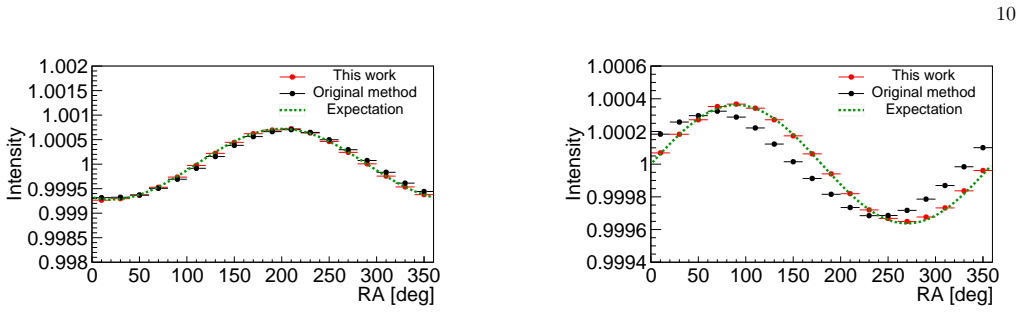
The enhanced all-distance equi-zenith angle method enables the simultaneous measurement of anisotropies over multiple time frames and allows the detection efficiency to be determined directly from the data. This feature makes the method especially suitable for applications where the detector array does not operate with long-term stability, and thus allows for the measurement of anisotropy with high-precision. The approach remains feasible even when the data do not span complete tropical years.
What carries the argument
The enhanced all-distance equi-zenith angle method, which extracts detection efficiency directly from the data to correct for time-varying instrumental effects while preserving the anisotropy signal.
If this is right
- Anisotropy measurements become possible with detector arrays that lack long-term stability.
- High-precision results can be obtained for signals whose relative intensity remains below 0.1 percent.
- Analysis can proceed on data sets that do not cover complete tropical years.
- Anisotropies can be extracted simultaneously over several distinct time frames.
Where Pith is reading between the lines
- The method could be tested on existing cosmic-ray arrays that previously discarded data because of efficiency drifts.
- It might allow shorter observation campaigns to yield usable anisotropy constraints.
- The direct efficiency extraction could be combined with other background-subtraction techniques to further reduce systematic errors.
- Application to multi-year data with seasonal gaps would test whether the multiple-time-frame feature recovers consistent large-scale patterns.
Load-bearing premise
The observed data contains enough information to determine detection efficiency directly without introducing new biases into the anisotropy measurement.
What would settle it
Apply the method to simulated cosmic-ray arrival data that include known artificial efficiency variations over time; if the output anisotropy map deviates from the input map by more than the statistical uncertainty, the claim that efficiency can be recovered without bias would be falsified.
Figures

read the original abstract
Long-term observations indicate that the relative intensity of cosmic-ray anisotropy remains below $0.1\%$ for energies less than $\sim 1$ PeV. Measuring such faint signals poses a significant challenge in data analysis, requiring careful removal of instrumental and atmospheric artifacts. The all-distance equi-zenith angle method is widely employed to extract cosmic-ray anisotropies, as it effectively suppresses the instantaneous variations arising from the instrument and atmosphere. \textcolor{black}{However, instability in the detector efficiency makes precise measurements of anisotropy challenging with this method.} In this work, we present an enhanced all-distance equi-zenith angle method for cosmic-ray anisotropy measurement. Unlike previous implementations, our improved approach enables the simultaneous measurement of anisotropies over multiple time frames and allows the detection efficiency to be determined directly from the data. This feature makes the method especially suitable for applications where the detector array does not operate with long-term stability\textcolor{black}{, and thus allows for the measurement of anisotropy with high-precision}. Moreover, our enhanced method is also feasible when the data do not span complete tropical years.
Editorial analysis
A structured set of objections, weighed in public.
Referee Report
Summary. The manuscript presents an enhanced all-distance equi-zenith angle method for extracting cosmic-ray anisotropies with relative intensity below 0.1% at energies ≲1 PeV. The central innovation is the extension to simultaneous measurements across multiple time frames, with detection efficiency solved directly from the same dataset rather than requiring long-term stability or full tropical-year coverage.
Significance. If the direct efficiency estimation can be shown to remain orthogonal to the anisotropy signal at the 10^{-4} level, the method would address a practical limitation in arrays with variable efficiency and enable analyses on incomplete datasets. The paper does not, however, supply machine-checked derivations, reproducible code, or parameter-free tests that would strengthen this assessment.
major comments (2)
- [Method description (enhanced equi-zenith construction)] The central claim that efficiency parameters can be determined directly from the data without absorbing part of the true anisotropy signal rests on an implicit assumption of separability in the multi-frame system of equations. No explicit orthogonality proof, condition-number analysis, or Monte-Carlo leakage test at the 10^{-4} level is provided to substantiate this for the chosen time-frame partitioning.
- [Abstract and introduction] The abstract states that the approach 'allows the detection efficiency to be determined directly from the data' and is 'suitable for applications where the detector array does not operate with long-term stability.' This claim is load-bearing for the entire result, yet the manuscript supplies neither the explicit system of equations nor a demonstration that the additional time-frame constraints render the efficiency-anisotropy matrix sufficiently over-determined.
minor comments (2)
- [Abstract] The LaTeX markup \textcolor{black}{...} appears in the abstract; this should be removed prior to publication.
- [Abstract] The final sentence of the abstract repeats the phrase 'and thus allows for the measurement of anisotropy with high-precision'; rephrasing would improve clarity.
Simulated Author's Rebuttal
We thank the referee for the constructive comments. We agree that the manuscript requires additional explicit mathematical detail to substantiate the central claims regarding direct efficiency estimation and separability. We will incorporate the requested derivations, analyses, and tests in the revision.
read point-by-point responses
-
Referee: [Method description (enhanced equi-zenith construction)] The central claim that efficiency parameters can be determined directly from the data without absorbing part of the true anisotropy signal rests on an implicit assumption of separability in the multi-frame system of equations. No explicit orthogonality proof, condition-number analysis, or Monte-Carlo leakage test at the 10^{-4} level is provided to substantiate this for the chosen time-frame partitioning.
Authors: We acknowledge the absence of these explicit elements in the current manuscript. The multi-frame formulation treats efficiency as a shared parameter across frames while allowing the anisotropy to vary, producing an over-determined linear system. In the revised version we will add (i) the full system of equations, (ii) a condition-number evaluation for the adopted time-frame partitioning, and (iii) Monte-Carlo results demonstrating that leakage of the anisotropy signal into the efficiency solution remains below 10^{-4}. revision: yes
-
Referee: [Abstract and introduction] The abstract states that the approach 'allows the detection efficiency to be determined directly from the data' and is 'suitable for applications where the detector array does not operate with long-term stability.' This claim is load-bearing for the entire result, yet the manuscript supplies neither the explicit system of equations nor a demonstration that the additional time-frame constraints render the efficiency-anisotropy matrix sufficiently over-determined.
Authors: The abstract and introduction will be updated to point to a new dedicated subsection that presents the explicit linear system and demonstrates over-determination. The subsection will show how the additional independent constraints from multiple time frames render the efficiency parameters solvable without absorbing the anisotropy signal, thereby supporting the suitability claim for arrays lacking long-term stability. revision: yes
Circularity Check
No circularity; abstract presents method description without inspectable derivation chain or equations
full rationale
The abstract describes an enhanced equi-zenith method that determines detection efficiency directly from data across multiple time frames, but supplies no equations, parameter fits, self-citations, or derivation steps. Without any load-bearing mathematical reduction visible, no instance of self-definition, fitted-input-as-prediction, or imported uniqueness can be quoted or exhibited. The central claim therefore remains self-contained against external benchmarks on the basis of the provided text.
Axiom & Free-Parameter Ledger
Reference graph
Works this paper leans on
-
[1]
At a given local sidereal timet, the field of view is divided into spatial bins of equal solid angle, based on local coordinates
To measure the anisotropy in sidereal time, the ob- servation time is divided according to the local side- real time. At a given local sidereal timet, the field of view is divided into spatial bins of equal solid angle, based on local coordinates. The CR events recorded over full years are then assigned to bins N(t, θ, ϕ) according to both the local sider...
-
[2]
For each zenith angle belt, the azimuthal distribution accumulated over the full tropical year is normalized so that its mean value is 1
Given the stable non-uniform azimuthal efficiency of the detector array, an azimuthal correction is applied to all data bins. For each zenith angle belt, the azimuthal distribution accumulated over the full tropical year is normalized so that its mean value is 1. By inverting this normalized distribu- tion and using it as an event weight, the total num- b...
-
[3]
on-source
In the equal-zenith-angle method, when a given bin is taken as an “on-source” bin with an event count ofN on(t, θ, ϕ), the background is estimated using events from the other bins within the same zenith belt at the same local sidereal timet, That is, 1 nθ −1 X ϕ′̸=ϕ Noff(t, θ, ϕ′),(1) whereN off(t, θ, ϕ′) is the event count of a single “off-source” bin,n ...
-
[4]
To solve such complicated equations, an iterative method is in- troduced into theχ 2 statistic, i.e
When theχ 2 statistic reaches its minimum, i.e., ∂χ2 ∂I(δ, α) = 0 for everyI(δ, α), the two- dimensional distribution of the relative intensity of the anisotropy can be determined. To solve such complicated equations, an iterative method is in- troduced into theχ 2 statistic, i.e. χ2 = X t,θ,ϕ " Non(t, θ, ϕ) I k+1(δ, α) − 1 nθ −1 P ϕ′̸=ϕ Noff(t, θ, ϕ′) I ...
-
[5]
Anisotropy and Corotation of Galactic Cosmic Rays
M. Amenomori, S. Ayabe, X. J. Bi, D. Chen, S. W. Cui, Danzengluobu, L. K. Ding, X. H. Ding, C. F. Feng, Z. Feng, Z. Y. Feng, X. Y. Gao, Q. X. Geng, H. W. Guo, H. H. He, M. He, K. Hibino, N. Hotta, H. Hu, H. B. Hu, J. Huang, Q. Huang, H. Y. Jia, F. Kajino, K. Kasahara, Y. Katayose, C. Kato, K. Kawata, Labaciren, G. M. Le, A. F. Li, J. Y. Li, Y.-Q. Lou, H. ...
work page internal anchor Pith review Pith/arXiv arXiv 2006
-
[6]
G. Guillian, J. Hosaka, K. Ishihara, J. Kameda, Y. Koshio, A. Minamino, C. Mitsuda, M. Miura, S. Moriyama, M. Nakahata, T. Namba, Y. Obayashi, H. Ogawa, M. Shiozawa, Y. Suzuki, A. Takeda, Y. Takeuchi, S. Yamada, I. Higuchi, M. Ishitsuka, T. Ka- jita, K. Kaneyuki, G. Mitsuka, S. Nakayama, H. Nishino, A. Okada, K. Okumura, C. Saji, Y. Takenaga, S. De- sai, ...
-
[7]
A. A. Abdo, B. Allen, T. Aune, D. Berley, E. Blaufuss, S. Casanova, C. Chen, B. L. Dingus, R. W. Ellsworth, L. Fleysher, R. Fleysher, M. M. Gonzalez, J. A. Good- man, C. M. Hoffman, P. H. H¨ untemeyer, B. E. Kolter- man, C. P. Lansdell, J. T. Linnemann, J. E. McEnery, A. I. Mincer, P. Nemethy, D. Noyes, J. Pretz, J. M. Ryan, P. M. S. Parkinson, A. Shoup, ...
work page internal anchor Pith review Pith/arXiv arXiv 2008
-
[8]
A. A. Abdo, B. T. Allen, T. Aune, D. Berley, S. Casanova, C. Chen, B. L. Dingus, R. W. Ellsworth, L. Fleysher, R. Fleysher, M. M. Gonzalez, J. A. Good- man, C. M. Hoffman, B. Hopper, P. H. H¨ untemeyer, B. E. Kolterman, C. P. Lansdell, J. T. Linnemann, J. E. McEnery, A. I. Mincer, P. Nemethy, D. Noyes, J. Pretz, J. M. Ryan, P. M. S. Parkinson, A. Shoup, G...
work page internal anchor Pith review Pith/arXiv arXiv 2009
-
[9]
Measurement of the Anisotropy of Cosmic Ray Arrival Directions with IceCube
R. Abbasi, Y. Abdou, T. Abu-Zayyad, J. Adams, J. A. Aguilar, M. Ahlers, K. Andeen, J. Auffenberg, X. Bai, M. Baker, S. W. Barwick, R. Bay, J. L. Bazo Alba, K. Beattie, J. J. Beatty, S. Bechet, J. K. Becker, K.-H. Becker, M. L. Benabderrahmane, S. BenZvi, J. Berdermann, P. Berghaus, D. Berley, E. Bernardini, D. Bertrand, D. Z. Besson, M. Bissok, E. Blaufus...
work page internal anchor Pith review Pith/arXiv arXiv 2010
-
[10]
On Temporal Variations of the Multi-TeV Cosmic Ray Anisotropy using the Tibet III Air Shower Array
M. Amenomori, X. J. Bi, D. Chen, S. W. Cui, Danzenglu- obu, L. K. Ding, X. H. Ding, C. Fan, C. F. Feng, Z. Feng, Z. Y. Feng, X. Y. Gao, Q. X. Geng, Q. B. Gou, H. W. Guo, H. H. He, M. He, K. Hibino, N. Hotta, H. Hu, H. B. Hu, J. Huang, Q. Huang, H. Y. Jia, L. Jiang, F. Ka- jino, K. Kasahara, Y. Katayose, C. Kato, K. Kawata, Labaciren, G. M. Le, A. F. Li, H...
work page internal anchor Pith review Pith/arXiv arXiv 2010
-
[11]
R. Abbasi, Y. Abdou, T. Abu-Zayyad, J. Adams, J. A. Aguilar, M. Ahlers, D. Altmann, K. Andeen, J. Auffen- berg, X. Bai, M. Baker, S. W. Barwick, R. Bay, J. L. Bazo Alba, K. Beattie, J. J. Beatty, S. Bechet, J. K. Becker, K.-H. Becker, M. L. Benabderrahmane, S. Ben- Zvi, J. Berdermann, P. Berghaus, D. Berley, E. Bernar- dini, D. Bertrand, D. Z. Besson, D. ...
work page internal anchor Pith review Pith/arXiv arXiv 2011
-
[12]
Observation of an Anisotropy in the Galactic Cosmic Ray arrival direction at 400 TeV with IceCube
R. Abbasi, Y. Abdou, T. Abu-Zayyad, M. Ackermann, J. Adams, J. A. Aguilar, M. Ahlers, M. M. Allen, D. Alt- mann, K. Andeen, J. Auffenberg, X. Bai, M. Baker, S. W. Barwick, R. Bay, J. L. Bazo Alba, K. Beattie, J. J. Beatty, S. Bechet, J. K. Becker, K.-H. Becker, M. L. Benabderrahmane, S. BenZvi, J. Berdermann, P. Berghaus, D. Berley, E. Bernardini, D. Bert...
work page internal anchor Pith review Pith/arXiv arXiv 2012
-
[13]
M. G. Aartsen, R. Abbasi, Y. Abdou, M. Ackermann, J. Adams, J. A. Aguilar, M. Ahlers, D. Altmann, K. An- deen, J. Auffenberg, X. Bai, M. Baker, S. W. Barwick, V. Baum, R. Bay, K. Beattie, J. J. Beatty, S. Bechet, J. Becker Tjus, K.-H. Becker, M. Bell, M. L. Benab- derrahmane, S. BenZvi, J. Berdermann, P. Berghaus, D. Berley, E. Bernardini, D. Bertrand, D....
work page internal anchor Pith review Pith/arXiv arXiv 2013
-
[14]
Medium scale anisotropy in the TeV cosmic ray flux observed by ARGO-YBJ
B. Bartoli, P. Bernardini, X. J. Bi, I. Bolognino, P. Bran- chini, A. Budano, A. K. Calabrese Melcarne, P. Camarri, Z. Cao, R. Cardarelli, S. Catalanotti, S. Z. Chen, T. L. Chen, P. Creti, S. W. Cui, B. Z. Dai, A. D’Amone, Danzengluobu, I. De Mitri, B. D’Ettorre Piazzoli, T. Di Girolamo, G. Di Sciascio, C. F. Feng, Z. Feng, Z. Feng, Q. B. Gou, Y. Q. Guo, ...
work page internal anchor Pith review Pith/arXiv arXiv 2013
-
[15]
B. Bartoli, P. Bernardini, X. J. Bi, Z. Cao, S. Catalan- otti, S. Z. Chen, T. L. Chen, S. W. Cui, B. Z. Dai, A. D’Amone, Danzengluobu, I. De Mitri, B. D’Ettorre Piazzoli, T. Di Girolamo, G. Di Sciascio, C. F. Feng, Z. Feng, Z. Feng, W. Gao, Q. B. Gou, Y. Q. Guo, H. H. He, H. Hu, H. Hu, M. Iacovacci, R. Iuppa, H. Y. Jia, Labaciren, H. J. Li, C. Liu, J. Liu...
-
[16]
A. U. Abeysekara, R. Alfaro, C. Alvarez, J. D. ´Alvarez, R. Arceo, J. C. Arteaga-Vel´ azquez, H. A. Ayala So- lares, A. S. Barber, B. M. Baughman, N. Bautista-Elivar, E. Belmont, S. Y. BenZvi, D. Berley, M. Bonilla Ros- ales, J. Braun, K. S. Caballero-Mora, A. Carrami˜ nana, M. Castillo, U. Cotti, J. Cotzomi, E. de la Fuente, C. De Le´ on, T. DeYoung, R. ...
work page internal anchor Pith review Pith/arXiv arXiv 2014
-
[17]
M. G. Aartsen, K. Abraham, M. Ackermann, J. Adams, J. A. Aguilar, M. Ahlers, M. Ahrens, D. Altmann, T. An- derson, I. Ansseau, G. Anton, M. Archinger, C. Ar- guelles, T. C. Arlen, J. Auffenberg, X. Bai, S. W. Bar- wick, V. Baum, R. Bay, J. J. Beatty, J. Becker Tjus, K.- H. Becker, E. Beiser, S. BenZvi, P. Berghaus, D. Berley, E. Bernardini, A. Bernhard, D...
work page internal anchor Pith review Pith/arXiv arXiv 2016
-
[18]
Northern sky Galactic Cosmic Ray anisotropy between 10-1000 TeV with the Tibet Air Shower Array
M. Amenomori, X. J. Bi, D. Chen, T. L. Chen, W. Y. Chen, S. W. Cui, Danzengluobu, L. K. Ding, C. F. Feng, Z. Feng, Z. Y. Feng, Q. B. Gou, Y. Q. Guo, H. H. He, Z. T. He, K. Hibino, N. Hotta, H. Hu, H. B. Hu, J. Huang, H. Y. Jia, L. Jiang, F. Kajino, K. Kasahara, Y. Katayose, C. Kato, K. Kawata, M. Kozai, Labaciren, G. M. Le, A. F. Li, H. J. Li, W. J. Li, C...
work page internal anchor Pith review Pith/arXiv arXiv 2017
-
[19]
Pierre Auger Collaboration, A. Aab, P. Abreu, M. Agli- etta, I. A. Samarai, I. F. M. Albuquerque, I. Allekotte, A. Almela, J. Alvarez Castillo, J. Alvarez-Mu˜ niz, G. A. Anastasi, L. Anchordoqui, B. Andrada, S. Andringa, C. Aramo, F. Arqueros, N. Arsene, H. Asorey, P. As- sis, J. Aublin, G. Avila, A. M. Badescu, A. Bal- aceanu, F. Barbato, R. J. Barreira ...
work page internal anchor Pith review Pith/arXiv arXiv 2017
-
[20]
A. U. Abeysekara, R. Alfaro, C. Alvarez, R. Arceo, J. C. Arteaga-Vel´ azquez, D. Avila Rojas, E. Belmont- Moreno, S. Y. BenZvi, C. Brisbois, T. Capistr´ an, A. Carramiana, S. Casanova, U. Cotti, J. Cotzomi, J. C. D´ ıaz-V´ elez, C. De Le´ on, E. De la Fuente, S. Dichiara, M. A. DuVernois, C. Espinoza, D. W. Fiorino, H. Fleischhack, N. Fraija, A. Galv´ an-...
work page internal anchor Pith review Pith/arXiv arXiv 2019
-
[21]
K. Munakata, M. Kozai, C. Kato, Y. Hayashi, R. Kataoka, A. Kadokura, M. Tokumaru, R. R. S. Men- don¸ ca, E. Echer, A. D. Lago, M. Rockenbach, N. J. Schuch, J. V. Bageston, C. R. Braga, H. K. A. Jassar, M. M. Sharma, M. L. Duldig, J. E. Humble, I. Sabbah, P. Evenson, P.-S. Mangeard, T. Kuwabara, D. Ruffolo, A. S´ aiz, W. Mitthumsiri, W. Nuntiyakul, and J. ...
-
[22]
T. LHAASO collabration, Z. Cao, F. Aharonian, Y. X. Bai, Y. W. Bao, D. Bastieri, X. J. Bi, Y. J. Bi, W. Bian, A. V. Bukevich, C. M. Cai, W. Y. Cao, Z. Cao, J. Chang, J. F. Chang, A. M. Chen, E. S. Chen, G. H. Chen, H. X. Chen, L. Chen, L. Chen, M. J. Chen, M. L. Chen, Q. H. Chen, S. Chen, S. H. Chen, S. Z. Chen, T. L. Chen, X. B. Chen, X. J. Chen, Y. Chen...
-
[23]
Z. Cao, F. Aharonian, Y. X. Bai, Y. W. Bao, D. Bastieri, X. J. Bi, Y. J. Bi, W. Bian, A. V. Bukevich, C. M. Cai, W. Y. Cao, Z. Cao, J. Chang, J. F. Chang, A. M. Chen, E. S. Chen, G. H. Chen, H. X. Chen, L. Chen, L. Chen, M. J. Chen, M. L. Chen, Q. H. Chen, S. Chen, S. H. Chen, S. Z. Chen, T. L. Chen, X. B. Chen, X. J. Chen, Y. Chen, N. Cheng, Y. D. Cheng,...
-
[24]
Deciphering the Dipole Anisotropy of Galactic Cosmic Rays
M. Ahlers, Phys. Rev. Lett.117, 151103 (2016), arXiv:1605.06446 [astro-ph.HE]
work page internal anchor Pith review Pith/arXiv arXiv 2016
- [25]
- [26]
-
[27]
O. Fornieri, D. Gaggero, D. Guberman, L. Brahimi, P. D. L. T. Luque, and A. Marcowith, Phys. Rev. D104, 103013 (2021), arXiv:2007.15321 [astro-ph.HE]
- [28]
-
[29]
N. A. Schwadron, F. C. Adams, E. R. Christian, P. De- siati, P. Frisch, H. O. Funsten, J. R. Jokipii, D. J. Mc- Comas, E. Moebius, and G. P. Zank, Science343, 988 (2014)
2014
- [30]
-
[31]
Origin of Small-Scale Anisotropies in Galactic Cosmic Rays
M. Ahlers and P. Mertsch, Progress in Particle and Nu- clear Physics94, 184 (2017), arXiv:1612.01873 [astro- ph.HE]
work page internal anchor Pith review Pith/arXiv arXiv 2017
-
[32]
Linsley, Phys
J. Linsley, Phys. Rev. Lett.34, 1530 (1975)
1975
-
[33]
R. Bonino, V. V. Alekseenko, O. Deligny, P. L. Ghia, M. Grigat, A. Letessier-Selvon, H. Lyberis, S. Mollerach, S. Over, and E. Roulet, Astrophys. J.738, 67 (2011), arXiv:1106.2651 [astro-ph.IM]
work page internal anchor Pith review Pith/arXiv arXiv 2011
-
[34]
A Northern Sky Survey for Steady TeV Gamma-Ray Point Sources Using the Tibet Air Shower Array
M. Amenomori, S. Ayabe, D. Chen, S. W. Cui, Danzengluobu, L. K. Ding, X. H. Ding, C. F. Feng, Z. Y. Feng, X. Y. Gao, Q. X. Geng, H. W. Guo, H. H. He, M. He, K. Hibino, N. Hotta, H. Hu, H. B. Hu, J. Huang, Q. Huang, H. Y. Jia, F. Ka- jino, K. Kasahara, Y. Katayose, C. Kato, K. Kawata, Labaciren, G. M. Le, J. Y. Li, H. Lu, S. L. Lu, X. R. Meng, K. Mizutani,...
work page internal anchor Pith review Pith/arXiv arXiv 2005
-
[35]
R. Atkins, W. Benbow, D. Berley, E. Blaufuss, J. Bus- sons, D. G. Coyne, R. S. Delay, T. De Young, B. L. Dingus, D. E. Dorfan, R. W. Ellsworth, A. Falcone, L. Fleysher, R. Fleysher, G. Gisler, M. M. Gonzalez, J. A. Goodman, T. J. Haines, E. Hays, C. M. Hoffman, L. A. Kelley, R. W. Laird, J. McCullough, J. E. McEnery, R. S. Miller, A. I. Mincer, M. F. Mora...
work page internal anchor Pith review Pith/arXiv arXiv 2003
-
[36]
D. E. Alexandreas, D. Berley, S. Biller, G. M. Dion, J. A. Goodman, T. J. Haines, C. M. Hoffman, E. Horch, X.- Q. Lu, C. Sinnis, G. B. Yodh, and W. Zhang, Nuclear Instruments and Methods in Physics Research A328, 570 (1993)
1993
-
[37]
A New Maximum-Likelihood Technique for Reconstructing Cosmic-Ray Anisotropy at All Angular Scales
M. Ahlers, S. Y. BenZvi, P. Desiati, J. C. D´ ıaz–V´ elez, D. W. Fiorino, and S. Westerhoff, Astrophys. J.823, 10 (2016), arXiv:1601.07877 [astro-ph.HE]
work page internal anchor Pith review Pith/arXiv arXiv 2016
-
[38]
B. Bartoli, P. Bernardini, X. J. Bi, Z. Cao, S. Catalan- otti, S. Z. Chen, T. L. Chen, S. W. Cui, B. Z. Dai, A. D’Amone, Danzengluobu, I. De Mitri, B. D’Ettorre Piazzoli, T. Di Girolamo, G. Di Sciascio, C. F. Feng, Z. Y. Feng, W. Gao, Q. B. Gou, Y. Q. Guo, H. H. He, H. Hu, H. Hu, M. Iacovacci, R. Iuppa, H. Y. Jia, Labaciren, H. J. Li, C. Liu, J. Liu, M. Y...
work page internal anchor Pith review Pith/arXiv arXiv 2018
-
[39]
W. Liu, D. X. Sun, D. Li, H. B. Hu, Q. Yuan, Y. Q. Guo, and Lhaaso Collaboration, in38th International Cosmic Ray Conference(2024) p. 186. 16
2024
-
[40]
W. Gao, H. He, H. Lv, S. Cui, W. Zhang, and Lhaaso Collaboration, in38th International Cosmic Ray Confer- ence(2024) p. 478
2024
-
[41]
W. Liu, D. Li, D. X. Sun, H. B. Hu, Q. Yuan, Y. Q. Guo, and Lhaaso Collaboration, in39th International Cosmic Ray Conference(2025) p. 320
2025
-
[42]
W. Y. Zhang, W. Gao, H. H. He, S. W. Cui, H. K. Lv, and H. Y. Zhang, in39th International Cosmic Ray Con- ference(2025) p. 266
2025
-
[43]
A. H. Compton and I. A. Getting, Physical Review47, 817 (1935)
1935
-
[44]
D. J. Cutler and D. E. Groom, Nature (London)322, 434 (1986)
1986
-
[45]
Measurements and implications of cosmic ray anisotropies from TeV to trans-EeV energies
O. Deligny, Astroparticle Physics104, 13 (2019), arXiv:1808.03940 [astro-ph.HE]
work page internal anchor Pith review Pith/arXiv arXiv 2019
-
[46]
F. J. M. Farley and J. R. Storey, Proceedings of the Phys- ical Society A67, 996 (1954)
1954
-
[47]
F. J. M. Farley and J. R. Storey, Nature (London)173, 445 (1954)
1954
-
[48]
F. J. M. Farley and J. R. Storey, Proceedings of the Phys- ical Society B70, 840 (1957)
1957
-
[49]
T. Li, M. Liu, S. Cui, and Z. Hou, Astroparticle Physics 39, 144 (2012)
2012
-
[50]
Pierre Auger Collaboration, J. Abraham, P. Abreu, M. Aglietta, C. Aguirre, E. J. Ahn, D. Allard, I. Allekotte, J. Allen, P. Allison, J. Alvarez-Mu˜ niz, M. Ambrosio, L. Anchordoqui, S. Andringa, A. Anza- lone, C. Aramo, E. Arganda, S. Argir` o, K. Arisaka, F. Arneodo, F. Arqueros, T. Asch, H. Asorey, P. As- sis, J. Aublin, M. Ave, G. Avila, T. B¨ acker, D...
work page internal anchor Pith review Pith/arXiv arXiv 2009
-
[51]
Bartoli, P
B. Bartoli, P. Bernardini, X. J. Bi, I. Bolognino, P. Bran- chini, A. Budano, A. K. Calabrese Melcarne, P. Ca- marri, Z. Cao, R. Cardarelli, S. Catalanotti, S. Z. Chen, T. L. Chen, Y. Chen, P. Creti, S. W. Cui, B. Z. Dai, A. D’Amone, Danzengluobu, I. De Mitri, B. D’Ettorre Piazzoli, T. Di Girolamo, X. H. Ding, G. Di Scias- cio, C. F. Feng, Z. Feng, Z. Fen...
2014
discussion (0)
Sign in with ORCID, Apple, or X to comment. Anyone can read and Pith papers without signing in.