FLIP: Real-Time and Resilient Formation Planning for Large-Scale DIstributed Swarms via Point Cloud Registration
Pith reviewed 2026-06-29 06:45 UTC · model grok-4.3
The pith
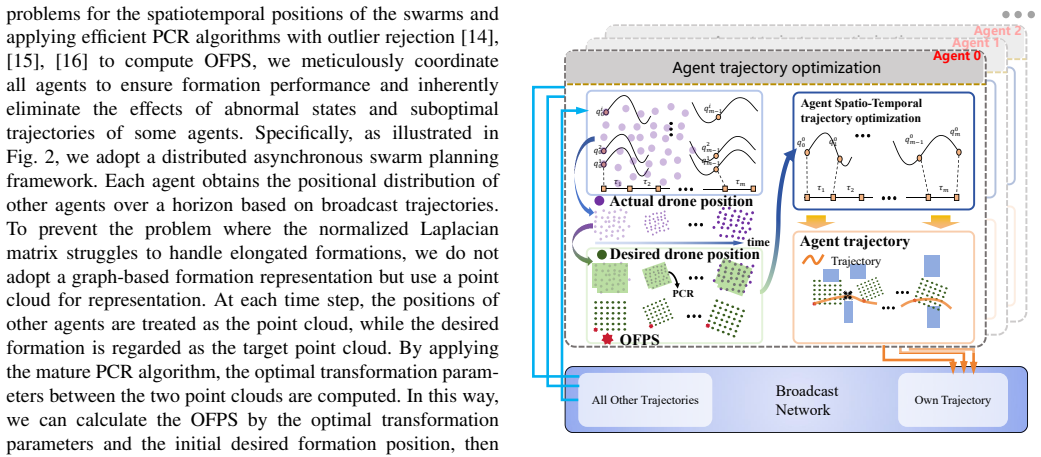
Each swarm agent computes its optimal formation position sequence by treating the assignment as a distributed point cloud registration task.
A machine-rendered reading of the paper's core claim, the machinery that carries it, and where it could break.
Core claim
The authors establish that the Optimal Formation Position Sequence (OFPS) calculation problem reduces to a spatiotemporal point cloud registration problem in which each agent distributively computes the matching result between its current positions and the desired formation positions of all other agents, applies outlier rejection to block propagation of bad data, and then uses its derived OFPS to optimize the cooperative formation trajectory.
What carries the argument
Spatiotemporal point cloud registration with outlier rejection, used to derive each agent's Optimal Formation Position Sequence from local position matching.
If this is right
- Each agent derives its OFPS without needing complete collaborative relationships.
- Outlier rejection prevents suboptimal trajectories or failed agents from affecting the rest of the swarm.
- Real-time distributed trajectory planning becomes feasible for swarms of at least 120 agents.
- The approach achieves uniformly resilient, efficient, and distributed planning in a single framework.
Where Pith is reading between the lines
- The same registration step could be applied to other multi-agent assignment problems that currently rely on centralized solvers.
- In high-failure environments the outlier rejection may preserve formation coherence where consensus methods break down.
- Real-world use would require pairing the method with reliable relative localization to supply the input point clouds.
Load-bearing premise
The distributed PCR matching with outlier rejection produces accurate OFPS values that, when used for trajectory optimization, yield globally coherent and optimal cooperative trajectories without requiring complete inter-agent collaboration or central oversight.
What would settle it
A 120-drone simulation in which position errors are injected into a subset of agents and the distributed method produces measurably higher collision rates or longer total flight times than a centralized optimal solver.
Figures



read the original abstract
Traditional large-scale formation planning either oversimplify the formation representation which leads to poor performance, or they employ complete collaborative relationships, which results in excessive computational load. To achieve high-performance and large-scale formation planning, we transform the Optimal Formation Position Sequence \cite{c1} (OFPS) calculation problem into a spatiotemporal Point Cloud Registration (PCR) problem. Each agent derives its OFPS by distributively computing the matching result between current positions and the desired formation positions of all other agents. Then each agent optimizes the cooperative formation trajectory by using OFPS. We leverage the PCR method with outlier rejection to rapidly perform large-scale formation position registration. This prevents suboptimal trajectories and failed agents from propagating through the cooperative network and affecting more agents. Consequently, we uniformly achieve resilient, efficient, and distributed trajectory planning for large-scale swarms. The effectiveness and the superiority of the proposed method are demonstrated through large-scale simulations of 120-drone formation, and rigorous benchmarking against state-of-the-art (SOTA) methods.
Editorial analysis
A structured set of objections, weighed in public.
Referee Report
Summary. The manuscript presents FLIP, a method that recasts the Optimal Formation Position Sequence (OFPS) calculation as a spatiotemporal point cloud registration (PCR) problem. Each agent is said to derive its OFPS by distributively performing PCR matching between the swarm's current positions and the desired formation positions of all other agents, employing outlier rejection to isolate failures, after which agents optimize cooperative trajectories. The approach is asserted to deliver resilient, efficient, distributed planning for large swarms and is supported by 120-drone simulations plus SOTA benchmarking.
Significance. If a truly distributed implementation with limited communication can be shown to produce globally coherent OFPS values, the work would usefully bridge established PCR techniques to swarm formation planning and provide a scalable route to resilience. The reported 120-agent scale is a positive indicator of practical relevance, yet the absence of explicit equations, complexity bounds, or quantitative metrics in the abstract limits assessment of whether the central transformation yields the claimed optimality and distributivity.
major comments (2)
- [Abstract] Abstract: the description states that each agent 'derives its OFPS by distributively computing the matching result between current positions and the desired formation positions of all other agents.' Standard PCR operates on complete point clouds; obtaining the full current-position cloud at every agent therefore requires either all-to-all broadcasts or a central aggregator. This directly contradicts the premise of operation 'without requiring complete inter-agent collaboration or central oversight' and is load-bearing for the scalability and resilience claims.
- [Abstract] Abstract: the effectiveness claim rests on 'large-scale simulations of 120-drone formation' and 'rigorous benchmarking against SOTA methods,' yet no registration error, trajectory cost, runtime, or success-rate figures are supplied, nor is the specific PCR algorithm or outlier-rejection procedure identified. Without these, the central empirical support for superiority cannot be evaluated.
minor comments (1)
- [Title] Title: 'DIstributed' contains an apparent capitalization error.
Simulated Author's Rebuttal
We thank the referee for the constructive comments on the abstract. We address each point below and will revise the manuscript accordingly to improve clarity and completeness.
read point-by-point responses
-
Referee: [Abstract] Abstract: the description states that each agent 'derives its OFPS by distributively computing the matching result between current positions and the desired formation positions of all other agents.' Standard PCR operates on complete point clouds; obtaining the full current-position cloud at every agent therefore requires either all-to-all broadcasts or a central aggregator. This directly contradicts the premise of operation 'without requiring complete inter-agent collaboration or central oversight' and is load-bearing for the scalability and resilience claims.
Authors: The referee correctly notes an ambiguity in the abstract phrasing. The full manuscript presents a distributed PCR formulation in which each agent computes a local registration using only partial swarm information exchanged via neighbor-to-neighbor communication; the outlier-rejection step explicitly tolerates missing data from non-neighbors. This avoids all-to-all broadcasts while still producing coherent OFPS values. We will revise the abstract to explicitly state the limited-communication mechanism and reference the relevant algorithmic sections. revision: yes
-
Referee: [Abstract] Abstract: the effectiveness claim rests on 'large-scale simulations of 120-drone formation' and 'rigorous benchmarking against SOTA methods,' yet no registration error, trajectory cost, runtime, or success-rate figures are supplied, nor is the specific PCR algorithm or outlier-rejection procedure identified. Without these, the central empirical support for superiority cannot be evaluated.
Authors: The abstract is a concise summary and therefore omits specific numerical results and algorithm identifiers, which appear in Sections 4 and 5 of the manuscript (including the chosen PCR solver, outlier-rejection threshold, and tabulated metrics for the 120-agent case). To facilitate evaluation, we will augment the abstract with a short clause reporting key quantitative outcomes (e.g., registration error, runtime, and success rate) and name the PCR algorithm employed. revision: yes
Circularity Check
No significant circularity; methodological reframing is self-contained
full rationale
The paper reframes the OFPS calculation (cited from prior work) as a spatiotemporal PCR problem and applies standard PCR with outlier rejection for distributed matching. No equations or steps reduce the claimed result to its inputs by construction, no fitted parameters are relabeled as predictions, and no load-bearing self-citation chain is invoked to force uniqueness. The central claim is an application of established PCR techniques to formation planning, which remains externally verifiable and does not collapse into tautology.
Axiom & Free-Parameter Ledger
Reference graph
Works this paper leans on
-
[1]
Robust and efficient trajectory planning for formation flight in dense environments,
L. Quan, L. Yin, T. Zhang, M. Wang, R. Wang, S. Zhong, X. Zhou, Y . Cao, C. Xu, and F. Gao, “Robust and efficient trajectory planning for formation flight in dense environments,”IEEE Transactions on Robotics, 2023
2023
-
[2]
Swarm of micro flying robots in the wild,
X. Zhou, X. Wen, Z. Wang, Y . Gao, H. Li, Q. Wang, T. Yang, H. Lu, Y . Cao, C. Xu,et al., “Swarm of micro flying robots in the wild,” Science Robotics, vol. 7, no. 66, p. eabm5954, 2022
2022
-
[3]
Multi-robot formation control and object transport in dynamic environments via constrained opti- mization,
J. Alonso-Mora, S. Baker, and D. Rus, “Multi-robot formation control and object transport in dynamic environments via constrained opti- mization,”The International Journal of Robotics Research, vol. 36, no. 9, pp. 1000–1021, 2017
2017
-
[4]
Programmable self- assembly in a thousand-robot swarm,
M. Rubenstein, A. Cornejo, and R. Nagpal, “Programmable self- assembly in a thousand-robot swarm,”Science, vol. 345, no. 6198, pp. 795–799, 2014
2014
-
[5]
Probabilistic and distributed control of a large-scale swarm of autonomous agents,
S. Bandyopadhyay, S.-J. Chung, and F. Y . Hadaegh, “Probabilistic and distributed control of a large-scale swarm of autonomous agents,”IEEE Transactions on Robotics, vol. 33, no. 5, pp. 1103–1123, 2017
2017
-
[6]
Agile coordination and assistive collision avoidance for quadrotor swarms using virtual structures,
D. Zhou, Z. Wang, and M. Schwager, “Agile coordination and assistive collision avoidance for quadrotor swarms using virtual structures,” IEEE Transactions on Robotics, vol. 34, no. 4, pp. 916–923, 2018
2018
-
[7]
Mean-shift exploration in shape assembly of robot swarms,
G. Sun, R. Zhou, Z. Ma, Y . Li, R. Groß, Z. Chen, and S. Zhao, “Mean-shift exploration in shape assembly of robot swarms,”Nature Communications, vol. 14, no. 1, p. 3476, 2023
2023
-
[8]
Obstacle avoidance of resilient uav swarm formation with active sensing system in the dense environment,
P. Peng, W. Dong, G. Chen, and X. Zhu, “Obstacle avoidance of resilient uav swarm formation with active sensing system in the dense environment,” in2022 IEEE/RSJ International Conference on Intelligent Robots and Systems (IROS), pp. 10 529–10 535
-
[9]
Towards a swarm of agile micro quadrotors,
A. Kushleyev, D. Mellinger, C. Powers, and V . Kumar, “Towards a swarm of agile micro quadrotors,”Autonomous Robots, vol. 35, no. 4, pp. 287–300, 2013
2013
-
[10]
Re-formation: Re- silient and efficient formation planning in large-scale distributed aerial swarms,
Y . Zhou, L. Quan, C. Xu, G. Xu, and F. Gao, “Re-formation: Re- silient and efficient formation planning in large-scale distributed aerial swarms,”IEEE Transactions on Automation Science and Engineering, 2025
2025
-
[11]
Region-based shape control for a swarm of robots,
C. C. Cheah, S. P. Hou, and J. J. E. Slotine, “Region-based shape control for a swarm of robots,”Automatica, vol. 45, no. 10, pp. 2406– 2411, 2009
2009
-
[12]
Finite-time formation control for multi-agent systems,
F. Xiao, L. Wang, J. Chen, and Y . Gao, “Finite-time formation control for multi-agent systems,”Automatica, vol. 45, no. 11, pp. 2605–2611, 2009
2009
-
[13]
3d registration with maximal cliques,
X. Zhang, J. Yang, S. Zhang, and Y . Zhang, “3d registration with maximal cliques,” inProceedings of the IEEE/CVF Conference on Computer Vision and Pattern Recognition, 2023, pp. 17 745–17 754
2023
-
[14]
Random sample consensus: a paradigm for model fitting with applications to image analysis and automated cartography,
M. A. Fischler and R. C. Bolles, “Random sample consensus: a paradigm for model fitting with applications to image analysis and automated cartography,”Communications of the ACM, vol. 24, no. 6, pp. 381–395, 1981
1981
-
[15]
Pairwise consistent measurement set maximization for robust multi- robot map merging,
J. G. Mangelson, D. Dominic, R. M. Eustice, and R. Vasudevan, “Pairwise consistent measurement set maximization for robust multi- robot map merging,” in2018 IEEE international conference on robotics and automation (ICRA), pp. 2916–2923
-
[16]
Teaser: Fast and certifiable point cloud registration,
H. Yang, J. Shi, and L. Carlone, “Teaser: Fast and certifiable point cloud registration,”IEEE Transactions on Robotics, vol. 37, no. 2, pp. 314–333, 2020
2020
-
[17]
Markov chain approach to proba- bilistic guidance for swarms of autonomous agents,
B. Ac ¸ıkmes ¸e and D. S. Bayard, “Markov chain approach to proba- bilistic guidance for swarms of autonomous agents,”Asian Journal of Control, vol. 17, no. 4, pp. 1105–1124, 2015
2015
-
[18]
Formation control with collision avoidance through deep reinforcement learning using model-guided demonstration,
Z. Sui, Z. Pu, J. Yi, and S. Wu, “Formation control with collision avoidance through deep reinforcement learning using model-guided demonstration,”IEEE Transactions on Neural Networks and Learning Systems, vol. 32, no. 6, pp. 2358–2372, 2020
2020
-
[19]
Y . Xie, C. Yu, H. Zang, F. Gao, W. Tang, J. Huang, J. Chen, B. Xu, Y . Wu, and Y . Wang, “Multi-uav behavior-based formation with static and dynamic obstacles avoidance via reinforcement learning,”arXiv preprint arXiv:2410.18495, 2024
-
[20]
Finite-time resilient formation control with bounded inputs,
J. Usevitch, K. Garg, and D. Panagou, “Finite-time resilient formation control with bounded inputs,” in2018 IEEE conference on decision and control (CDC), pp. 2567–2574
-
[21]
Distributed adaptive resilient formation control of uncertain nonholonomic mobile robots under deception attacks,
W. Wang, Z. Han, K. Liu, and J. L ¨u, “Distributed adaptive resilient formation control of uncertain nonholonomic mobile robots under deception attacks,”IEEE Transactions on Circuits and Systems I: Regular Papers, vol. 68, no. 9, pp. 3822–3835, 2021
2021
-
[22]
Resilient flocking for mobile robot teams,
K. Saulnier, D. Saldana, A. Prorok, G. J. Pappas, and V . Kumar, “Resilient flocking for mobile robot teams,”IEEE Robotics and Au- tomation letters, vol. 2, no. 2, pp. 1039–1046, 2017
2017
-
[23]
Formations for re- silient robot teams,
L. Guerrero-Bonilla, A. Prorok, and V . Kumar, “Formations for re- silient robot teams,”IEEE Robotics and Automation Letters, vol. 2, no. 2, pp. 841–848, 2017
2017
-
[24]
A distributed pipeline for scalable, deconflicted formation flying,
P. C. Lusk, X. Cai, S. Wadhwania, A. Paris, K. Fathian, and J. P. How, “A distributed pipeline for scalable, deconflicted formation flying,” IEEE Robotics and Automation Letters, vol. 5, no. 4, pp. 5213–5220, 2020
2020
-
[25]
Geometrically constrained tra- jectory optimization for multicopters,
Z. Wang, X. Zhou, C. Xu, and F. Gao, “Geometrically constrained tra- jectory optimization for multicopters,”IEEE Transactions on Robotics, vol. 38, no. 5, pp. 3259–3278, 2022
2022
-
[26]
A computational algorithm for functional inequality constrained optimization problems,
L. S. Jennings and K. L. Teo, “A computational algorithm for functional inequality constrained optimization problems,”Automatica, vol. 26, no. 2, pp. 371–375, 1990
1990
-
[27]
On the limited memory bfgs method for large scale optimization,
D. C. Liu and J. Nocedal, “On the limited memory bfgs method for large scale optimization,”Mathematical programming, vol. 45, no. 1, pp. 503–528, 1989
1989
discussion (0)
Sign in with ORCID, Apple, or X to comment. Anyone can read and Pith papers without signing in.