Gyroscopic Precession in Axisymmetric Kerr Spacetime: Horizon Regularity and Coordinate Effects
Pith reviewed 2026-06-29 06:41 UTC · model grok-4.3
The pith
Divergence of gyroscopic precession near the Kerr horizon disappears in horizon-penetrating coordinates.
A machine-rendered reading of the paper's core claim, the machinery that carries it, and where it could break.
Core claim
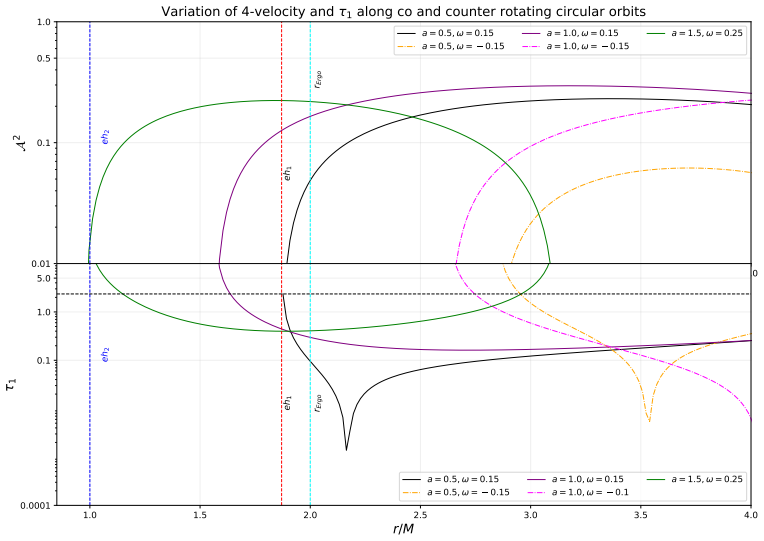
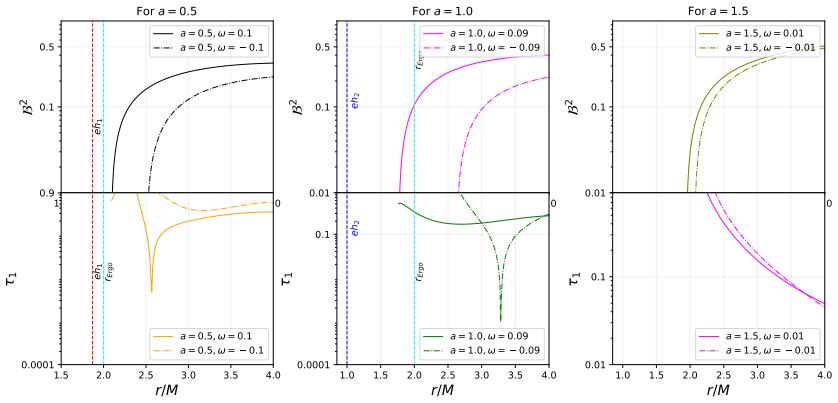
In axisymmetric Kerr spacetime the Frenet-Serret precession frequency along generic spiral trajectories diverges near the event horizon in Boyer-Lindquist coordinates yet remains finite in Kerr-Schild coordinates. The difference arises solely from the regularity properties of the coordinate chart at the horizon; once the trajectory remains timelike, the frequency stays well-defined regardless of whether an event horizon is crossed.
What carries the argument
Covariant Frenet-Serret formalism applied to timelike four-velocities in Boyer-Lindquist versus Kerr-Schild coordinates, isolating the effect of coordinate regularity on the precession frequency.
If this is right
- Precession remains finite for any timelike observer that reaches or crosses the horizon in a regular coordinate system.
- Divergence in the strong-field regime cannot be treated as an invariant diagnostic of horizon structure.
- The same coordinate dependence appears for both prograde and retrograde motions.
- Results hold for both geodesic (Killing) and accelerated (non-Killing) trajectories.
Where Pith is reading between the lines
- Other proposed strong-field signatures that rely on frame or curvature quantities may need re-examination in multiple coordinate systems.
- Observers using horizon-penetrating coordinates could measure finite precession rates even very close to the horizon.
- The finding suggests that coordinate artefacts can mimic physical effects in any calculation that mixes frame-dependent quantities with singular charts.
Load-bearing premise
The Frenet-Serret equations remain valid and free of extra singularities for both Killing and non-Killing timelike paths after the coordinate change.
What would settle it
Explicit numerical evaluation of the precession frequency for one chosen spiral trajectory that crosses the horizon radius; the value must remain finite throughout the crossing when computed in Kerr-Schild coordinates.
Figures



read the original abstract
We investigate gyroscopic precession along Killing and non-Killing timelike trajectories in Kerr spacetime using the covariant Frenet--Serret formalism. The precession frequency is analyzed for both prograde and retrograde motion in Boyer--Lindquist and horizon-penetrating Kerr--Schild coordinate systems. For generic spiral trajectories, we show explicitly that the divergence of the precession frequency appearing near the horizon in Boyer--Lindquist coordinates disappears in Kerr--Schild coordinates. Our analysis demonstrates that the finiteness of the Frenet--Serret precession frequency is determined by the timelike character of the trajectory rather than by the existence of an event horizon itself. These results indicate that the divergence of gyroscopic precession in the strong-field regime is a coordinate artefact and therefore cannot serve as an invariant signature of horizon structure.
Editorial analysis
A structured set of objections, weighed in public.
Referee Report
Summary. The manuscript uses the covariant Frenet-Serret formalism to compute gyroscopic precession frequencies along Killing and non-Killing timelike trajectories in Kerr spacetime. It compares prograde and retrograde motion in Boyer-Lindquist versus horizon-penetrating Kerr-Schild coordinates and claims to show explicitly that the divergence of the precession frequency near the horizon in Boyer-Lindquist coordinates is absent for generic spiral trajectories in Kerr-Schild coordinates. The central conclusion is that this divergence is a coordinate artifact and therefore cannot serve as an invariant signature of horizon structure.
Significance. If the compared trajectories are physically identical worldlines, the result would establish that Frenet-Serret precession divergence is not a coordinate-independent diagnostic of event horizons, with implications for strong-field GR phenomenology. The explicit coordinate comparison and use of an invariant formalism constitute a concrete test of coordinate dependence; however, the significance is conditional on verification that the trajectories match under the coordinate transformation.
major comments (1)
- [Trajectory definitions and comparison sections] The generic spiral trajectories are defined via coordinate-dependent expressions in each chart. Because the Frenet-Serret scalars (including the precession frequency) are coordinate invariants, any genuine discrepancy between charts requires that the worldlines be identical. The coordinate transformation between Boyer-Lindquist and Kerr-Schild coordinates changes the asymptotic behavior of the time and azimuthal coordinates near the horizon, so identical coordinate parametrizations do not guarantee identical physical curves. No invariant characterization of the trajectories (e.g., via conserved Killing quantities, proper-time parametrization, or geodesic deviation independent of chart) is provided to establish equivalence, which is load-bearing for the claim that the divergence is purely a coordinate artifact.
minor comments (2)
- [Abstract and §1] Clarify in the abstract and introduction whether the analysis applies only to non-geodesic trajectories or also includes geodesics, and specify the range of spin parameters and radii considered for the 'generic spiral' paths.
- [Figures] Ensure that all figures plotting precession frequency versus radius explicitly label the coordinate system used and indicate the location of the horizon in each chart.
Simulated Author's Rebuttal
We thank the referee for the careful review and for identifying the key requirement that the compared trajectories must be physically identical worldlines. We address this point directly below.
read point-by-point responses
-
Referee: The generic spiral trajectories are defined via coordinate-dependent expressions in each chart. Because the Frenet-Serret scalars (including the precession frequency) are coordinate invariants, any genuine discrepancy between charts requires that the worldlines be identical. The coordinate transformation between Boyer-Lindquist and Kerr-Schild coordinates changes the asymptotic behavior of the time and azimuthal coordinates near the horizon, so identical coordinate parametrizations do not guarantee identical physical curves. No invariant characterization of the trajectories (e.g., via conserved Killing quantities, proper-time parametrization, or geodesic deviation independent of chart) is provided to establish equivalence, which is load-bearing for the claim that the divergence is purely a coordinate artifact.
Authors: We agree that the physical equivalence of the trajectories is essential to the central claim. The manuscript defines the spiral trajectories through their coordinate velocities in each chart separately, without an explicit demonstration that the resulting worldlines coincide under the coordinate transformation. In the revised version we will add an invariant characterization: we will express both families of trajectories using the same set of conserved Killing quantities (energy and angular momentum per unit mass) together with a common proper-time parametrization, and we will verify that the four-velocity components transform consistently between the two charts. This will establish that the worldlines are identical and that the observed difference in precession-frequency behavior arises solely from the coordinate representation. revision: yes
Circularity Check
No significant circularity; derivation compares independent coordinate calculations without reduction to inputs or self-citations.
full rationale
The paper computes Frenet-Serret precession frequencies explicitly in Boyer-Lindquist and Kerr-Schild coordinates for trajectories labeled as generic spirals in each chart. The central result—that divergence near the horizon vanishes in the horizon-penetrating system—follows directly from these separate calculations and the coordinate transformation properties, without any fitted parameters renamed as predictions, self-definitional loops, or load-bearing self-citations. The Frenet-Serret scalars are treated as invariants within each coordinate system, and the conclusion that the effect is a coordinate artifact rests on the explicit disappearance rather than on any imported uniqueness theorem or ansatz from prior work. No step reduces the claimed result to its own inputs by construction.
Axiom & Free-Parameter Ledger
axioms (1)
- standard math Kerr spacetime is described by the standard metric in general relativity
Reference graph
Works this paper leans on
-
[1]
¨Uber die Wirkung rotierender ferner Massen in der Einsteinschen Gravitationstheorie
Hans Thirring. “ ¨Uber die Wirkung rotierender ferner Massen in der Einsteinschen Gravitationstheorie.” In:Physikalische Zeitschrift19 (Jan. 1918), p. 33
1918
-
[2]
¨Uber den Einfluß der Eigenrotation der Zen- tralk¨ orper auf die Bewegung der Planeten und Monde nach der Einsteinschen Grav- itationstheorie
Josef Lense and Hans Thirring. “ ¨Uber den Einfluß der Eigenrotation der Zen- tralk¨ orper auf die Bewegung der Planeten und Monde nach der Einsteinschen Grav- itationstheorie”. In:Physikalische Zeitschrift19 (Jan. 1918), p. 156
1918
-
[3]
Motion of a gyroscope according to Einstein’s theory of gravitation
L I Schiff. “Motion of a gyroscope according to Einstein’s theory of gravitation”. In:Proc. Natl. Acad. Sci. U. S. A.46.6 (June 1960), pp. 871–882
1960
-
[4]
Gravity Probe B: Final Results of a Space Experiment to Test General Relativity
C. W. F. Everitt et al. “Gravity Probe B: Final Results of a Space Experiment to Test General Relativity”. In:Phys. Rev. Lett.106 (22 2011), p. 221101.doi: 10.1103/PhysRevLett.106.221101.url:https://link.aps.org/doi/10.1103/ PhysRevLett.106.221101
work page doi:10.1103/physrevlett.106.221101.url:https://link.aps.org/doi/10.1103/ 2011
-
[5]
W. Rindler and V. Perlick. “Rotating frames in relativity”. In:General Relativity and Gravitation22.11 (1990), pp. 1067–1081.doi:10.1007/BF00756329
-
[6]
Frenet-Serret description of gyroscopic preces- sion
B. R. Iyer and C. V. Vishveshwara. “Frenet-Serret description of gyroscopic preces- sion”. In:Phys. Rev. D48 (12 1993), pp. 5706–5720.doi:10.1103/PhysRevD.48. 5706.url:https://link.aps.org/doi/10.1103/PhysRevD.48.5706
-
[7]
Gyroscope on polar orbit in the Kerr field
O. Semer´ ak. “Gyroscope on polar orbit in the Kerr field”. In:General Relativity and Gravitation29.2 (1997), pp. 153–168.doi:10.1023/A:1018802203493
-
[8]
The many faces of gravitoelectromagnetism
Donato Bini et al. “The many faces of gravitoelectromagnetism”. In:Classical and Quantum Gravity14 (1997), pp. 2584–2596.doi:10.1088/0264-9381/14/9/017
-
[9]
Circular orbits in stationary axisymmetric spacetimes
O. Semer´ ak. “Circular orbits in stationary axisymmetric spacetimes”. In:Gen- eral Relativity and Gravitation30.8 (1998), pp. 1203–1215.doi:10 . 1023 / A : 1018812325747. 15
1998
-
[10]
Gyroscopic Precession and Inertial Forces in Axially Symmetric Stationary Spacetimes
K. Rajesh Nayak and C. V. Vishveshwara. “Gyroscopic Precession and Inertial Forces in Axially Symmetric Stationary Spacetimes”. In:General Relativity and Gravitation30.4 (1998), pp. 593–615.doi:10 . 1023 / A : 1018870208493. eprint: gr-qc/9808036
work page internal anchor Pith review Pith/arXiv arXiv 1998
-
[11]
1999, MNRAS, 309, 447, doi: 10.1046/j.1365-8711.1999.02853.x
O. Semer´ ak. “Spin Precession Along Circular Orbits in Stationary Axially Symmet- ric Spacetimes”. In:Monthly Notices of the Royal Astronomical Society308 (1999), pp. 863–875.doi:10.1046/j.1365-8711.1999.02791.x
-
[12]
Kyriakos Destounis et al. “Extreme-mass-ratio inspirals into rotating boson stars: Nonintegrability, chaos, and transient resonances”. In:Phys. Rev. D108 (8 Oct. 2023), p. 084062.doi:10.1103/PhysRevD.108.084062.url:https://link.aps. org/doi/10.1103/PhysRevD.108.084062
work page doi:10.1103/physrevd.108.084062.url:https://link.aps 2023
-
[13]
T. A. Apostolatos et al. “Spin-induced orbital precession and its modulation of the gravitational waveforms from merging binaries”. In:Physical Review D49.12 (1994), pp. 6274–6297.doi:10.1103/PhysRevD.49.6274
-
[14]
General-relativistic precession in a black-hole binary
Mark Hannam et al. “General-relativistic precession in a black-hole binary”. In: Nature610.7933 (2022), pp. 652–655.doi:10.1038/s41586-022-05212-z
-
[15]
Antoni Ramos-Buades et al. “SEOBNRv5PHM: Next generation of accurate and efficient multipolar precessing-spin effective-one-body waveforms for binary black holes”. In:Physical Review D108.12 (2023), p. 124037.doi:10.1103/PhysRevD. 108.124037.url:https://arxiv.org/abs/2303.18046
-
[16]
H´ ector Estell´ es et al. “New twists in compact binary waveform modeling: A fast time-domain model for precession (IMRPhenomTPHM)”. In:Physical Review D 105.8 (2022), p. 084040.doi:10 . 1103 / PhysRevD . 105 . 084040.url:https : / / arxiv.org/abs/2105.05872
-
[17]
GW190521: Tracing imprints of spin-precession on the most massive black hole binary
Simona J. Miller et al. “GW190521: Tracing imprints of spin-precession on the most massive black hole binary”. In:Physical Review D109.2 (2024), p. 024024.doi: 10.1103/PhysRevD.109.024024.url:https://arxiv.org/abs/2310.01544
work page doi:10.1103/physrevd.109.024024.url:https://arxiv.org/abs/2310.01544 2024
-
[18]
Effect of double spin-precession and higher harmonics on spin-induced quadrupole moment measurements
N. V. Krishnendu et al. “Effect of double spin-precession and higher harmonics on spin-induced quadrupole moment measurements”. In:Physical Review D109.2 (2024), p. 023016.doi:10.1103/PhysRevD.109.023016.url:https://arxiv. org/abs/2311.05506
work page doi:10.1103/physrevd.109.023016.url:https://arxiv 2024
-
[19]
Harsh Narola et al. “Gravitational-wave parameter estimation with relative binning: Inclusion of higher-order modes and precession, and applications to lensing and third-generation detectors”. In:Physical Review D110.8 (2024), p. 084085.doi: 10.1103/PhysRevD.110.084085.url:https://arxiv.org/abs/2507.10304
work page doi:10.1103/physrevd.110.084085.url:https://arxiv.org/abs/2507.10304 2024
-
[20]
Leor Barack and Curt Cutler. “Using LISA extreme-mass-ratio inspiral sources to test off-Kerr deviations in the geometry of massive black holes”. In:Physical Review D75 (2007), p. 042003.doi:10.1103/PhysRevD.75.042003
-
[21]
Probing Kerr Symmetry Breaking with LISA Extreme-Mass-Ratio Inspirals
Pablo F. Muguruza and Carlos F. Sopuerta. “Probing Kerr Symmetry Breaking with LISA Extreme-Mass-Ratio Inspirals”. In:arXiv preprint(2026). arXiv:2604.06053 [gr-qc]
work page internal anchor Pith review Pith/arXiv arXiv 2026
-
[22]
Paulami Majumder and K Rajesh Nayak. “Gyroscopic Precession in the vicinity of Static Blackhole’s Event Horizon”. In:General Relativity and Gravitation55 (4 2023).doi:10.1007/s10714- 023- 03108- 5.url:https://doi.org/10.1007/ s10714-023-03108-5. 16
-
[23]
Gyroscopic precession in Reissner– Nordstr¨ om spacetime
Paulami Majumder and K. Rajesh Nayak. “Gyroscopic precession in Reissner– Nordstr¨ om spacetime”. In:General Relativity and Gravitation57.4 (Apr. 2025), p. 63.issn: 1572-9532.doi:10.1007/s10714-025-03395-0.url:https://doi. org/10.1007/s10714-025-03395-0
work page doi:10.1007/s10714-025-03395-0.url:https://doi 2025
-
[24]
Gravitational Collapse: the Role of General Relativity
Roger Penrose. “Gravitational Collapse: the Role of General Relativity”. In:Nuovo Cimento Rivista Serie1 (Jan. 1969), p. 252
1969
-
[25]
Roy P. Kerr. “Gravitational Field of a Spinning Mass as an Example of Algebraically Special Metrics”. In:Phys. Rev. Lett.11 (5 Sept. 1963), pp. 237–238.doi:10.1103/ PhysRevLett.11.237.url:https://link.aps.org/doi/10.1103/PhysRevLett. 11.237
-
[26]
Stationary Black Holes: Uniqueness and Beyond
Piotr T. Chru´ sciel et al. “Stationary Black Holes: Uniqueness and Beyond”. In: Living Reviews in Relativity15.1 (May 2012), p. 7.doi:10.12942/lrr- 2012- 7. url:https://doi.org/10.12942/lrr-2012-7
-
[27]
The Flatter Regions of Newman, Unti, and Tamburino’s Gen- eralized Schwarzschild Space
Charles W. Misner. “The Flatter Regions of Newman, Unti, and Tamburino’s Gen- eralized Schwarzschild Space”. In:Journal of Mathematical Physics4.7 (July 1963), pp. 924–937.doi:10.1063/1.1704019. eprint:https://pubs.aip.org/aip/jmp/ article-pdf/4/7/924/19328324/924_1_online.pdf.url:https://doi.org/ 10.1063/1.1704019
-
[28]
Innermost stable circular orbits of spinning test particles in Schwarzschild and Kerr space-times
Paul I. Jefremov et al. “Innermost stable circular orbits of spinning test particles in Schwarzschild and Kerr space-times”. In:Phys. Rev. D91 (12 June 2015), p. 124030. doi:10.1103/PhysRevD.91.124030.url:https://link.aps.org/doi/10.1103/ PhysRevD.91.124030
work page doi:10.1103/physrevd.91.124030.url:https://link.aps.org/doi/10.1103/ 2015
-
[29]
Gabriel Andres Piovano. “Particles with precessing spin in Kerr spacetime: Analytic solutions for eccentric orbits and homoclinic motion near the equatorial plane”. In: Phys. Rev. D113 (6 2026), p. 064024.doi:10 . 1103 / jzbw - m1cp.url:https : //link.aps.org/doi/10.1103/jzbw-m1cp
-
[30]
Spherical inspirals of spinning bodies into Kerr black holes
Viktor Skoup´ y et al. “Spherical inspirals of spinning bodies into Kerr black holes”. In:Phys. Rev. D112 (12 2025), p. 124054.doi:10.1103/x9yy-c2jq.url:https: //link.aps.org/doi/10.1103/x9yy-c2jq
-
[31]
Efficient simulations of high-spin black holes with a new gauge
Y. Chen et al. “Efficient simulations of high-spin black holes with a new gauge”. In: Physical Review D104 (2021), p. 084046.doi:10.1103/PhysRevD.104.084046
-
[32]
Analytical and numerical treatment of perturbed black holes in horizon-penetrating coordinates
Maitraya K. Bhattacharyya et al. “Analytical and numerical treatment of perturbed black holes in horizon-penetrating coordinates”. In:Phys. Rev. D102 (2 2020), p. 024039.doi:10.1103/PhysRevD.102.024039.url:https://link.aps.org/ doi/10.1103/PhysRevD.102.024039
work page doi:10.1103/physrevd.102.024039.url:https://link.aps.org/ 2020
-
[33]
Is there supernova evidence for dark energy metamorphosis ?
Rohta Takahashi. “Horizon-penetrating transonic accretion discs around rotating black holes”. In:Monthly Notices of the Royal Astronomical Society382.2 (2007), pp. 567–593.issn: 0035-8711.doi:10.1111/j.1365- 2966.2007.11877.x.url: https://doi.org/10.1111/j.1365-2966.2007.11877.x. 17
discussion (0)
Sign in with ORCID, Apple, or X to comment. Anyone can read and Pith papers without signing in.