From XXLTraffic to EvoXXLTraffic: Scaling Traffic Forecasting to Sensor-Evolving Networks
Pith reviewed 2026-06-29 07:33 UTC · model grok-4.3
The pith
Traffic sensor networks that grow over decades make many state-of-the-art forecasting models ineffective.
A machine-rendered reading of the paper's core claim, the machinery that carries it, and where it could break.
Core claim
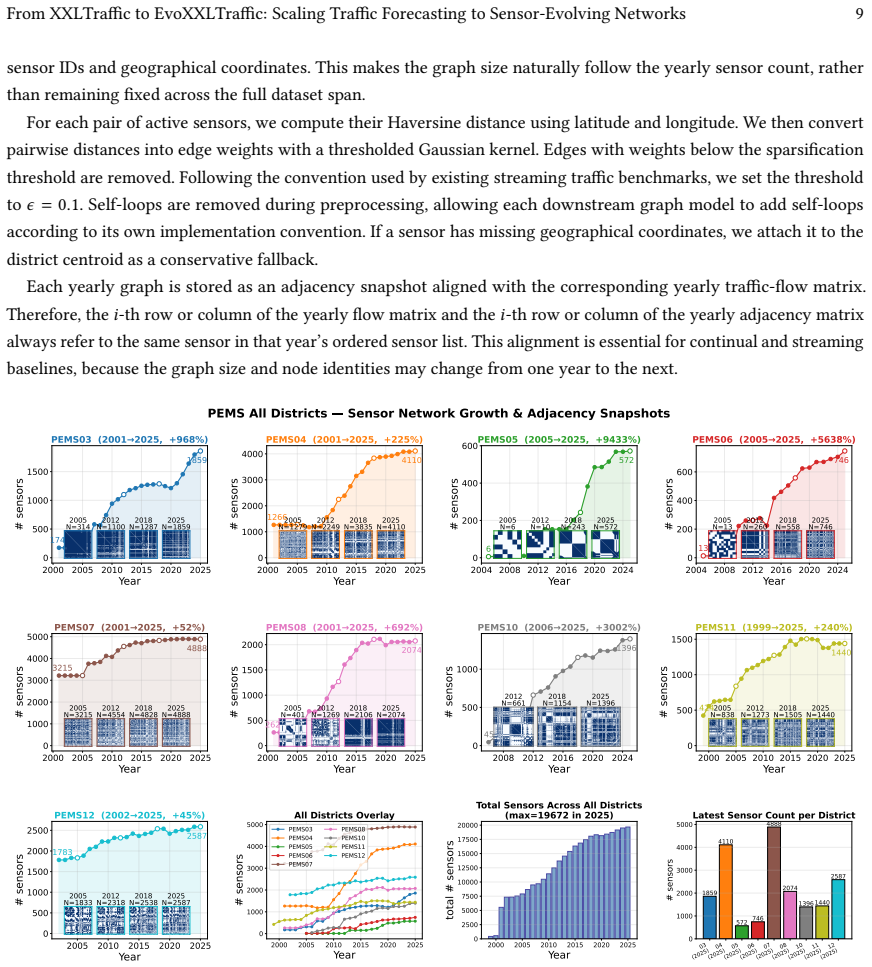
Existing traffic forecasting assumes a fixed sensor set, but real networks grow continuously. The EvoXXLTraffic dataset reorganizes PeMS and Transport for NSW data into per-year active sensors, traffic-flow matrices, and graph snapshots spanning up to 27 years with growth ratios up to over 10,000%. Under a yearly streaming forecasting protocol, many state-of-the-art methods no longer achieve their reported results, better reflecting real-world conditions.
What carries the argument
The sensor-evolving reorganization of traffic data into yearly snapshots and the yearly streaming forecasting protocol on EvoXXLTraffic.
Load-bearing premise
Reorganizing the records into per-year active sensors accurately captures genuine network growth without introducing artifacts from labeling or cleaning choices.
What would settle it
Running the same baselines on a different city's traffic data with independently verified sensor addition dates and checking if the performance drop matches the paper's observations.
Figures



read the original abstract
Existing traffic forecasting benchmarks assume a fixed sensor set, but real road-sensor networks grow continuously as the road network changes year by year. We introduce the XXLTraffic dataset family, which spans up to 27 years of California PeMS and Transport for NSW data. The fixed-sensor subsets of XXLTraffic support extremely long forecasting with multi-year gaps and standard hourly / daily long-horizon forecasting. We extend it to EvoXXLTraffic, a sensor-evolving reorganization that exposes per-year active sensors, yearly traffic-flow matrices, and yearly graph snapshots across nine PeMS districts, with growth ratios ranging from +305% to over +10,000%. We define a yearly streaming forecasting protocol on EvoXXLTraffic in which each calendar year is a continual task, and benchmark a wide range of representative baselines drawn from static spatio-temporal GNNs, na\"ive online schemes, evolving-graph continual methods, and retrieval / test-time methods. We find that our ultra-large evolutionary dataset better reflects the real world, and many state-of-the-art (SOTA) results no longer work. Our dataset complements existing benchmarks by enabling more realistic forecasting under ultra-long evolutionary road networks. Our code and baselines are available at github repo: https://github.com/cruiseresearchgroup/TSAS26-EvoXXLTraffic
Editorial analysis
A structured set of objections, weighed in public.
Referee Report
Summary. The paper introduces the XXLTraffic dataset family from up to 27 years of California PeMS and Transport for NSW traffic records. Fixed-sensor subsets enable long-horizon forecasting with multi-year gaps. EvoXXLTraffic reorganizes the data into sensor-evolving yearly snapshots exposing per-year active sensors, traffic-flow matrices, and graph snapshots with growth ratios from +305% to over +10,000%. A yearly streaming forecasting protocol is defined, and baselines spanning static spatio-temporal GNNs, naïve online schemes, evolving-graph continual methods, and retrieval/test-time approaches are benchmarked. The authors conclude that the evolutionary dataset better reflects the real world and that many SOTA results no longer hold.
Significance. If the reorganization faithfully isolates genuine network growth, the work supplies a large-scale benchmark that directly challenges the fixed-sensor assumption prevalent in traffic forecasting. This could drive development of continual and evolving-graph methods. Public release of code and baselines is a clear strength supporting reproducibility.
major comments (2)
- [Abstract] Abstract: The central claim that EvoXXLTraffic 'better reflects the real world' and that 'many state-of-the-art (SOTA) results no longer work' is load-bearing on the fidelity of the sensor-evolving reorganization. The description of 'per-year active sensors' and 'yearly graph snapshots' supplies no criteria for determining sensor activation dates, overlap statistics, or mitigation of upstream cleaning/relabeling artifacts common in long-term archives; performance drops could therefore arise from labeling inconsistencies rather than evolutionary dynamics.
- [Abstract] Abstract: Growth ratios (+305% to >+10,000%) are reported without accompanying per-year sensor counts, data-completeness metrics, or external validation against deployment records. This omission prevents assessment of whether the yearly snapshots isolate true network expansion or embed retrospective labeling choices.
minor comments (2)
- The escaped quote in 'na"ive' should be rendered as 'naive'.
- The GitHub repository link is given but the manuscript would benefit from a one-sentence summary of its contents (implemented baselines, data loaders, etc.).
Simulated Author's Rebuttal
We thank the referee for the constructive comments on the fidelity of the EvoXXLTraffic reorganization. We address each point below and will revise the manuscript accordingly to improve transparency.
read point-by-point responses
-
Referee: [Abstract] Abstract: The central claim that EvoXXLTraffic 'better reflects the real world' and that 'many state-of-the-art (SOTA) results no longer work' is load-bearing on the fidelity of the sensor-evolving reorganization. The description of 'per-year active sensors' and 'yearly graph snapshots' supplies no criteria for determining sensor activation dates, overlap statistics, or mitigation of upstream cleaning/relabeling artifacts common in long-term archives; performance drops could therefore arise from labeling inconsistencies rather than evolutionary dynamics.
Authors: We agree that the abstract omits key construction details. In the revised manuscript we will add an explicit subsection describing the activation criterion (a sensor is marked active in year Y if it contributes at least one valid hourly reading in the raw PeMS files for that calendar year), a table of year-to-year overlap percentages, and a short discussion of how we avoided additional relabeling by using the original district-level archives. These additions will allow readers to evaluate whether observed performance changes stem from network growth rather than labeling artifacts. revision: yes
-
Referee: [Abstract] Abstract: Growth ratios (+305% to >+10,000%) are reported without accompanying per-year sensor counts, data-completeness metrics, or external validation against deployment records. This omission prevents assessment of whether the yearly snapshots isolate true network expansion or embed retrospective labeling choices.
Authors: We will insert a new table (or expand Table 1) listing, for each district and year, the exact number of active sensors, the fraction of hours with valid readings, and the growth ratio computed directly from those counts. External validation against official deployment logs is not feasible because the public PeMS releases do not include linked deployment-date metadata; we will explicitly note this limitation and its implications for interpreting the growth figures. revision: partial
- External validation of sensor activation dates against official deployment records (not available in the public data sources used)
Circularity Check
No circularity: empirical dataset paper with no derivations or self-referential fitting.
full rationale
The manuscript introduces XXLTraffic and EvoXXLTraffic via reorganization of public PeMS/NSW archives into yearly snapshots, then reports empirical benchmarks of existing methods. No equations, no fitted parameters renamed as predictions, and no load-bearing self-citations or uniqueness theorems appear in the provided text. The central claim (SOTA methods fail on the new evolutionary setting) rests on external comparisons to published baselines rather than any reduction to the authors' own prior definitions or fits. This matches the default expectation of a self-contained empirical contribution.
Axiom & Free-Parameter Ledger
axioms (1)
- domain assumption Public traffic records from PeMS and Transport for NSW can be reorganized into per-year active sensor sets and graph snapshots that reflect genuine network growth.
Reference graph
Works this paper leans on
-
[1]
Lei Bai, Lina Yao, Can Li, Xianzhi Wang, and Can Wang. 2020. Adaptive graph convolutional recurrent network for traffic forecasting.Advances in neural information processing systems33 (2020), 17804–17815
2020
-
[2]
Chao Chen, Karl Petty, Alexander Skabardonis, Pravin Varaiya, and Zhanfeng Jia. 2001. Freeway performance measurement system: mining loop detector data.Transportation research record1748 (2001), 96–102
2001
-
[3]
Wei Chen and Yuxuan Liang. 2025. Expand and compress: Exploring tuning principles for continual spatio-temporal graph forecasting. InInternational Conference on Learning Representations, Vol. 2025. 81631–81656
2025
-
[4]
Wei Chen and Yuxuan Liang. 2025. Learning with calibration: Exploring test-time computing of spatio-temporal forecasting.Advances in Neural Information Processing Systems38 (2025), 155895–155929
2025
-
[5]
Xinyu Chen and Lijun Sun. 2021. Bayesian temporal factorization for multidimensional time series prediction.IEEE Transactions on Pattern Analysis and Machine Intelligence44 (2021), 4659–4673
2021
-
[6]
Xu Chen, Junshan Wang, and Kunqing Xie. 2021. TrafficStream: A Streaming Traffic Flow Forecasting Framework Based on Graph Neural Networks and Continual Learning. InProceedings of the Thirtieth International Joint Conference on Artificial Intelligence, IJCAI-21, Zhi-Hua Zhou (Ed.). International Joint Conferences on Artificial Intelligence Organization, 3...
- [7]
-
[8]
Razvan-Gabriel Cirstea, Chenjuan Guo, Bin Yang, Tung Kieu, Xuanyi Dong, and Shirui Pan. 2022. Triformer: Triangular, Variable-Specific Attentions for Long Sequence Multivariate Time Series Forecasting. InProceedings of the Thirty-First International Joint Conference on Artificial Intelligence, IJCAI-22, Lud De Raedt (Ed.). International Joint Conferences ...
-
[9]
Prathamesh Deshpande and Sunita Sarawagi. 2019. Streaming adaptation of deep forecasting models using adaptive recurrent units. InProceedings of the 25th ACM SIGKDD International Conference on Knowledge Discovery & Data Mining. 1560–1568
2019
-
[10]
Zheng Fang, Qingqing Long, Guojie Song, and Kunqing Xie. 2021. Spatial-temporal graph ode networks for traffic flow forecasting. InProceedings of the 27th ACM SIGKDD conference on knowledge discovery & data mining. 364–373
2021
-
[11]
Albert Gu and Tri Dao. 2023. Mamba: Linear-time sequence modeling with selective state spaces.arXiv preprint arXiv:2312.00752(2023)
work page internal anchor Pith review Pith/arXiv arXiv 2023
-
[12]
Shengnan Guo, Youfang Lin, Ning Feng, Chao Song, and Huaiyu Wan. 2019. Attention based spatial-temporal graph convolutional networks for traffic flow forecasting. InProceedings of the AAAI Conference on Artificial Intelligence, Vol. 33. 922–929
2019
-
[13]
Liangzhe Han, Bowen Du, Leilei Sun, Yanjie Fu, Yisheng Lv, and Hui Xiong. 2021. Dynamic and multi-faceted spatio-temporal deep learning for traffic speed forecasting. InProceedings of the 27th ACM SIGKDD conference on knowledge discovery & data mining. 547–555. Manuscript submitted to ACM From XXLTraffic to EvoXXLTraffic: Scaling Traffic Forecasting to Se...
2021
-
[14]
Yuxin Jia, Youfang Lin, Xinyan Hao, Yan Lin, Shengnan Guo, and Huaiyu Wan. 2024. Witran: Water-wave information transmission and recurrent acceleration network for long-range time series forecasting.Advances in Neural Information Processing Systems36 (2024)
2024
-
[15]
Jiawei Jiang, Chengkai Han, Wayne Xin Zhao, and Jingyuan Wang. 2023. Pdformer: Propagation delay-aware dynamic long-range transformer for traffic flow prediction. InProceedings of the AAAI conference on artificial intelligence, Vol. 37. 4365–4373
2023
-
[16]
Guangyin Jin, Yuxuan Liang, Yuchen Fang, Zezhi Shao, Jincai Huang, Junbo Zhang, and Yu Zheng. 2023. Spatio-temporal graph neural networks for predictive learning in urban computing: A survey.IEEE Transactions on Knowledge and Data Engineering(2023)
2023
-
[17]
Guokun Lai, Wei-Cheng Chang, Yiming Yang, and Hanxiao Liu. 2018. Modeling long-and short-term temporal patterns with deep neural networks. InThe 41st international ACM SIGIR conference on research & development in information retrieval. 95–104
2018
-
[18]
Shiyong Lan, Yitong Ma, Weikang Huang, Wenwu Wang, Hongyu Yang, and Pyang Li. 2022. Dstagnn: Dynamic spatial-temporal aware graph neural network for traffic flow forecasting. InInternational conference on machine learning. PMLR, 11906–11917
2022
-
[19]
Hyunwook Lee, Seungmin Jin, Hyeshin Chu, Hongkyu Lim, and Sungahn Ko. 2021. Learning to Remember Patterns: Pattern Matching Memory Networks for Traffic Forecasting. InInternational Conference on Learning Representations
2021
-
[20]
Hao Li, Jie Shao, Kewen Liao, and Mingjian Tang. 2022. Do Simpler Statistical Methods Perform Better in Multivariate Long Sequence Time-Series Forecasting?. InProceedings of the 31st ACM International Conference on Information & Knowledge Management. 4168–4172
2022
-
[21]
Shiyang Li, Xiaoyong Jin, Yao Xuan, Xiyou Zhou, Wenhu Chen, Yu-Xiang Wang, and Xifeng Yan. 2019. Enhancing the locality and breaking the memory bottleneck of transformer on time series forecasting.Advances in Neural Information Processing Systems32 (2019), 5243–5253
2019
-
[22]
Yanhong Li, Jack Xu, and David Anastasiu. 2024. Learning from Polar Representation: An Extreme-Adaptive Model for Long-Term Time Series Forecasting.Proceedings of the AAAI Conference on Artificial Intelligence38 (Mar. 2024), 171–179. doi:10.1609/aaai.v38i1.27768
-
[23]
Yaguang Li, Rose Yu, Cyrus Shahabi, and Yan Liu. 2018. Diffusion Convolutional Recurrent Neural Network: Data-Driven Traffic Forecasting. In International Conference on Learning Representations
2018
-
[24]
Yang Lin, Irena Koprinska, and Mashud Rana. 2021. SSDNet: State space decomposition neural network for time series forecasting. In2021 IEEE International Conference on Data Mining (ICDM). IEEE, 370–378
2021
-
[25]
Aoyu Liu and Yaying Zhang. [n. d.]. A General Spatio-Temporal Backbone with Scalable Contextual Pattern Bank for Urban Continual Forecasting. InThe Fourteenth International Conference on Learning Representations
-
[26]
Dachuan Liu, Jin Wang, Shuo Shang, and Peng Han. 2022. Msdr: Multi-step dependency relation networks for spatial temporal forecasting. In Proceedings of the 28th ACM SIGKDD conference on knowledge discovery and data mining. 1042–1050
2022
-
[27]
Hangchen Liu, Zheng Dong, Renhe Jiang, Jiewen Deng, Jinliang Deng, Quanjun Chen, and Xuan Song. 2023. Spatio-temporal adaptive embedding makes vanilla transformer sota for traffic forecasting. InProceedings of the 32nd ACM international conference on information and knowledge management. 4125–4129
2023
-
[28]
Shizhan Liu, Hang Yu, Cong Liao, Jianguo Li, Weiyao Lin, Alex X Liu, and Schahram Dustdar. 2021. Pyraformer: Low-complexity pyramidal attention for long-range time series modeling and forecasting. InInternational conference on learning representations
2021
-
[29]
Xu Liu, Yutong Xia, Yuxuan Liang, Junfeng Hu, Yiwei Wang, Lei Bai, Chao Huang, Zhenguang Liu, Bryan Hooi, and Roger Zimmermann. 2024. Largest: A benchmark dataset for large-scale traffic forecasting.Advances in Neural Information Processing Systems36 (2024)
2024
-
[30]
Yong Liu, Tengge Hu, Haoran Zhang, Haixu Wu, Shiyu Wang, Lintao Ma, and Mingsheng Long. 2024. iTransformer: Inverted Transformers Are Effective for Time Series Forecasting. InThe Twelfth International Conference on Learning Representations. https://openreview.net/forum?id= JePfAI8fah
2024
-
[31]
Minbo Ma, Kai Tang, Huan Li, Fei Teng, Dalin Zhang, and Tianrui Li. 2025. Beyond fixed variables: Expanding-variate time series forecasting via flat scheme and spatio-temporal focal learning. InProceedings of the 31st ACM SIGKDD Conference on Knowledge Discovery and Data Mining V. 2. 2054–2065
2025
-
[32]
Yuqi Nie, Nam H Nguyen, Phanwadee Sinthong, and Jayant Kalagnanam. [n. d.]. A Time Series is Worth 64 Words: Long-term Forecasting with Transformers. InThe Eleventh International Conference on Learning Representations
-
[33]
Arian Prabowo, Hao Xue, Wei Shao, Piotr Koniusz, and Flora D Salim. 2024. Traffic forecasting on new roads using spatial contrastive pre-training (SCPT).Data Mining and Knowledge Discovery38 (2024), 913–937
2024
-
[34]
Chao Shang, Jie Chen, and Jinbo Bi. 2021. Discrete Graph Structure Learning for Forecasting Multiple Time Series. InInternational Conference on Learning Representations
2021
- [35]
- [36]
-
[37]
Zezhi Shao, Zhao Zhang, Wei Wei, Fei Wang, Yongjun Xu, Xin Cao, and Christian S Jensen. 2022. Decoupled dynamic spatial-temporal graph neural network for traffic forecasting.Proceedings of the VLDB Endowment15 (2022), 2733–2746
2022
-
[38]
Chao Song, Youfang Lin, Shengnan Guo, and Huaiyu Wan. 2020. Spatial-temporal synchronous graph convolutional networks: A new framework for spatial-temporal network data forecasting. InProceedings of the AAAI conference on artificial intelligence, Vol. 34. 914–921
2020
-
[39]
Binwu Wang, Yudong Zhang, Jiahao Shi, Pengkun Wang, Xu Wang, Lei Bai, and Yang Wang. 2023. Knowledge expansion and consolidation for continual traffic prediction with expanding graphs.IEEE Transactions on Intelligent Transportation Systems24, 7 (2023), 7190–7201. Manuscript submitted to ACM 26 Du Yin et al
2023
-
[40]
Binwu Wang, Yudong Zhang, Xu Wang, Pengkun Wang, Zhengyang Zhou, Lei Bai, and Yang Wang. 2023. Pattern expansion and consolidation on evolving graphs for continual traffic prediction. InProceedings of the 29th ACM SIGKDD Conference on Knowledge Discovery and Data Mining. 2223–2232
2023
-
[41]
Huiqiang Wang, Jian Peng, Feihu Huang, Jince Wang, Junhui Chen, and Yifei Xiao. 2023. Micn: Multi-scale local and global context modeling for long-term series forecasting. InThe eleventh international conference on learning representations
2023
-
[42]
Zhang, and JUN ZHOU
Shiyu Wang, Haixu Wu, Xiaoming Shi, Tengge Hu, Huakun Luo, Lintao Ma, James Y. Zhang, and JUN ZHOU. 2024. TimeMixer: Decomposable Multiscale Mixing for Time Series Forecasting. InThe Twelfth International Conference on Learning Representations. https://openreview.net/forum? id=7oLshfEIC2
2024
-
[43]
Gerald Woo, Chenghao Liu, Doyen Sahoo, Akshat Kumar, and Steven Hoi. 2023. Learning Deep Time-index Models for Time Series Forecasting. In Proceedings of the 40th International Conference on Machine Learning (Proceedings of Machine Learning Research, Vol. 202), Andreas Krause, Emma Brunskill, Kyunghyun Cho, Barbara Engelhardt, Sivan Sabato, and Jonathan S...
2023
-
[44]
Haixu Wu, Tengge Hu, Yong Liu, Hang Zhou, Jianmin Wang, and Mingsheng Long. 2022. Timesnet: Temporal 2d-variation modeling for general time series analysis. InThe eleventh international conference on learning representations
2022
-
[45]
Haixu Wu, Jiehui Xu, Jianmin Wang, and Mingsheng Long. 2021. Autoformer: Decomposition transformers with auto-correlation for long-term series forecasting.Advances in Neural Information Processing Systems34 (2021), 22419–22430
2021
-
[46]
Sifan Wu, Xi Xiao, Qianggang Ding, Peilin Zhao, Ying Wei, and Junzhou Huang. 2020. Adversarial sparse transformer for time series forecasting. Advances in neural information processing systems33 (2020), 17105–17115
2020
-
[47]
Zonghan Wu, Shirui Pan, Guodong Long, Jing Jiang, Xiaojun Chang, and Chengqi Zhang. 2020. Connecting the dots: Multivariate time series forecasting with graph neural networks. InProceedings of the 26th ACM SIGKDD international conference on knowledge discovery & data mining. 753–763
2020
-
[48]
Zonghan Wu, Shirui Pan, Guodong Long, Jing Jiang, and Chengqi Zhang. 2019. Graph wavenet for deep spatial-temporal graph modeling. In Proceedings of the 28th International Joint Conference on Artificial Intelligence. 1907–1913
2019
-
[49]
Du Yin, Hao Xue, Arian Prabowo, Shuang Ao, and Flora Salim. 2025. XXLTraffic: Expanding and Extremely Long Traffic forecasting beyond test adaptation. InProceedings of the 33rd ACM International Conference on Advances in Geographic Information Systems. 511–521
2025
-
[50]
Bing Yu, Haoteng Yin, and Zhanxing Zhu. 2018. Spatio-temporal graph convolutional networks: a deep learning framework for traffic forecasting. InProceedings of the 27th International Joint Conference on Artificial Intelligence. 3634–3640
2018
-
[51]
Chengqing Yu, Fei Wang, Zezhi Shao, Tao Sun, Lin Wu, and Yongjun Xu. 2023. Dsformer: A double sampling transformer for multivariate time series long-term prediction. InProceedings of the 32nd ACM International Conference on Information and Knowledge Management. 3062–3072
2023
-
[52]
Ailing Zeng, Muxi Chen, Lei Zhang, and Qiang Xu. 2023. Are transformers effective for time series forecasting?. InProceedings of the AAAI conference on artificial intelligence, Vol. 37. 11121–11128
2023
-
[53]
Haoyu Zhang, Hao Miao, Xinke Jiang, Yuchen Fang, and Yifan Zhang. 2025. Strap: Spatio-temporal pattern retrieval for out-of-distribution generalization.Advances in Neural Information Processing Systems38 (2025), 118006–118041
2025
-
[54]
Ling Zhao, Yujiao Song, Chao Zhang, Yu Liu, Pu Wang, Tao Lin, Min Deng, and Haifeng Li. 2019. T-GCN: A temporal graph convolutional network for traffic prediction.IEEE transactions on intelligent transportation systems21, 9 (2019), 3848–3858
2019
-
[55]
Yusheng Zhao, Xiao Luo, Wei Ju, Chong Chen, Xian-Sheng Hua, and Ming Zhang. 2023. Dynamic hypergraph structure learning for traffic flow forecasting. In2023 IEEE 39th International Conference on Data Engineering (ICDE). IEEE, 2303–2316
2023
-
[56]
Haoyi Zhou, Shanghang Zhang, Jieqi Peng, Shuai Zhang, Jianxin Li, Hui Xiong, and Wancai Zhang. 2021. Informer: Beyond efficient transformer for long sequence time-series forecasting. InProceedings of the AAAI conference on artificial intelligence, Vol. 35. 11106–11115
2021
-
[57]
Tian Zhou, Ziqing Ma, Qingsong Wen, Xue Wang, Liang Sun, and Rong Jin. 2022. Fedformer: Frequency enhanced decomposed transformer for long-term series forecasting. InInternational Conference on Machine Learning. PMLR, 27268–27286
2022
-
[58]
Dongcheng Zou, Senzhang Wang, Xuefeng Li, Hao Peng, Yuandong Wang, Chunyang Liu, Kehua Sheng, and Bo Zhang. 2024. Multispans: A multi-range spatial-temporal transformer network for traffic forecast via structural entropy optimization. InProceedings of the 17th ACM International Conference on Web Search and Data Mining. 1032–1041. Received 1 June 2026; rev...
2024
discussion (0)
Sign in with ORCID, Apple, or X to comment. Anyone can read and Pith papers without signing in.